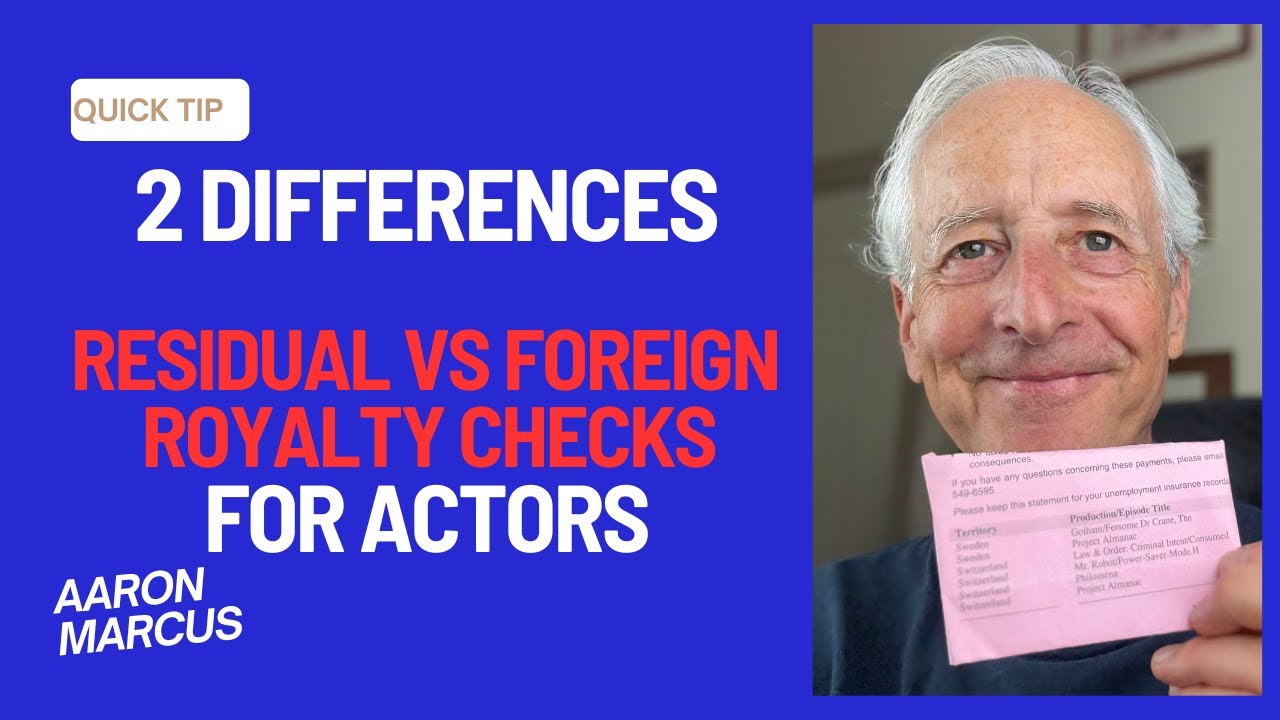
In this tutorial, Aaron Marcus, a SAG‑AFTRA member, breaks down how actors earn money after a job is completed. He first defines residual checks—payments that continue to arrive while a union project (TV commercial, TV series, or film) is still airing, streaming, or in theaters. He explains the mechanics for TV commercials, including the traditional 13‑week run, session fees, market‑based points, holds, and the impact of streaming. He then outlines how residuals for film and television are calculated, noting that the amount depends on factors such as the number of airings or purchases, the actor’s days worked, and the size of the cast, with examples from Homicide: Life on the Street, The Wire, and A Man Called Otto. The video shifts to foreign royalty checks, highlighting two key differences from regular residuals: they are issued as paper checks with no taxes withheld (aside from a small union transfer fee) and agents do not receive a commission on them. Aaron advises actors to set aside money for taxes on foreign royalties, encourages viewers to share their own experiences, and promotes a bonus behind‑the‑scenes video for further actor education.
Chapters
You know, you might have heard about residuals that actors get from film, television, even TV commercials if they're union, but you might not have heard anything about foreign royalty checks. So what I'm going to be doing in this video is sharing information about what residuals are really all about and the 2 main differences between regular residual checks And foreign royalty checks. Hey, at the end, I've got a great bonus video for you. If, if you don't see it at the end, I will place the link in the description on the channel, and it's behind the scenes of, of a film, and this is something all actors need to know. Okay, let's get started. Hi, I'm Aaron Marcus, and welcome to the Acting and Modeling Quick Tips channel and the Actor Career Center. Look, you might have heard about residual checks, and I love getting residual checks. Basically what happens is anytime you do a union job— I'm a member of SAG-AFTRA— you will get a residual check, assuming that the project is still running, it's still airing, either streaming or it's still in the theaters, or maybe it's a TV commercial. Now The crazy thing is, and this is something that was from a project I worked on many years ago, a couple decades ago. I think it was in the '90s, if I'm not mistaken, and it was a TV show called Homicide: Life on the Street. There was also— I can think of this for a couple different projects called The Wire, which I still think might be the best television show of all time, which was on HBO. And because it's so old and I only worked one day on it, now I might get a residual check for 3 cents, 4 cents. I mean, sometimes it's a couple dollars, but it's a pretty, pretty small amount. But I've also gotten thousands of dollars from projects in residuals. So let me just briefly explain to you what the residuals are all about. And before I forget, if you haven't done this yet, don't forget, subscribe, click the notification bell so you always know when I upload a new video. And if you like it, give it a thumbs up. That's actually very helpful. And share, share the link with your fellow actors. So for TV commercials, and I know there have been changes very recently with our contracts, so You might want to just double-check just to make sure it's completely up to date, but it used to be for a TV spot, the TV spot would run for 13 weeks. Once again, this is for union spots. It will run for 13 weeks and you get your session fee, and then it can run for 13 weeks. You will get an additional check depending on the market that it's running in. If it's a bigger market, you know, New York, LA, Chicago, you will Basically, it's population. You get extra money on top of your regular fee. After 13 weeks, then one of a few things can happen. If they stop airing it, you don't get any money. If they continue to air the TV commercial, then you will get your residual check plus your, your points. It's, you know, once again, it's based on the population. If it's a A small local market, you're going to get less than in a big market, or if it's a national running spot, and that's where actors can see a tremendous amount of money. That's, that's a big population, you get a lot more points that way. And so basically it just keeps going on. Sometimes they'll put the commercial on hold, meaning that they decide they're going to take a break right now, they're not going to air it. Maybe it's a seasonal kind of thing. And so if they put put it on hold, that means you will get a residual check for your session fee, but you don't get any points because it's not airing. And then if they air it later, then you get your, your points and your regular session fee. So those are TV commercials. And once again, there are, there are so many new ways that this can play out depending on whether it's a streaming service But anyhow, that's the basic idea. Now, for film and television, let me just tell you, it is so complicated I just don't understand it. I have some basic ideas, but basically what will happen is your residual check is based on a few different factors. Certainly how many times It's airing. How many people purchase, if it's a film or a TV show, how many people purchase it? But probably most importantly, it's how much did you work on the project? If you worked one day, you're not going to get nearly as much as somebody who was starring in it and maybe worked for 90 days or worked for a year on the project. It's also based on how many other people are in the project. So because it gets split evenly with everybody, so the people who work the most, they're going to get the most amount of money. But if there are thousands of people involved in the project, then your cut is much less. So for me, probably the project that I've earned the most from is A Man Called Otto. Because there really were not that many actors in the project compared to other major films. And I also worked a pretty good amount, both as doing stunt, working as an actor, and I had 2 different scenes and we had to shoot over 4 days. So anyhow, that's what residuals are all about. They are great. I mean, you do the job, you get paid well, and then you just keep getting money sent to you afterwards. Now, there is something else, and it is called the foreign royalty check. This is different, and I'll show you. You can see right here, and I didn't want to put the numbers in, and I've got other data in there that I don't want to share with the world, like Social Security numbers and stuff. Or actually, that's not in there, but there is some other identifying information. But you can see it here. And basically there are 2 differences between regular residuals and the foreign, the foreign money. The difference is, number one, and I'm not really sure why, but I don't have this directly deposited into my checking account like I do for other checks, other projects, other residuals. This one comes as an actual check. One of the differences is that— and these are projects that are shown in other countries outside the U.S.— and one of the differences is that no taxes are taken out. Now, the union will take out some money just because it costs money for them to be able to transfer the money, so they do take some money out, but no taxes are taken out. So if you do get these checks, make sure you Save money for to pay the taxes on it. That's one difference. The other thing is we do not, at least according to union rules, we do not have to pay our agents a commission fee for foreign royalty checks. So those are the 2 major differences, but it acts in a very similar way. These are projects you worked on, they're being shown in foreign markets outside the United States. And man, it is great just to get these checks in. And it's also pretty cool to know, hey, the projects you worked on have been seen in Switzerland or Germany and many other countries. So anyhow, I wanted to share those with you. If you have ever gotten a residual check or a foreign royalty check, please share it on the channel. Let us know what the project was. If you have any other additional information about how it gets calculated, please share that here. Love to learn from you about that. I did promise this other video, depending on the format, you might see it right up here. You also might not, and that's why I'm leaving the link right in the description. And it's behind the scenes of a film, and it's information that all actors need to know about. Hey, I'm Aaron Marcus, and I can't wait to talk with you again soon. See ya. See ya.