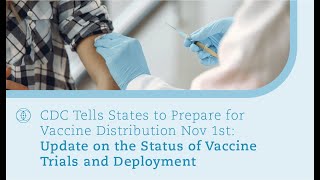
Aaron Hartman reviews three leading COVID-19 vaccines in development: AstraZeneca, Moderna, and Pfizer/BioNTech. The CDC is telling states to prepare for vaccine distribution by late October or November 1. Phase-3 trials started in July, with early data showing strong antibody responses, though full results weren't yet published.
Questions this video answers
By late October or November 1 (as stated in the talk).
Two doses: one on day 1 and a second 28 days later.
Phase‑3 expanded; phase‑3 started June 28 in Brazil and had been in phase‑3 in the US by end of August (speaker cites Aug 31/late June start in Brazil).
Lipid‑nanoparticle mRNA vaccines (mRNA delivered via phospholipid nanoparticles).
Phase‑3 studies started July 27 (speaker) with target enrollment around 30,000 adults each (or similar 30,000 targets).
Chapters
You, It's great to be with everybody once again. So we're going to do an update today on the situation of the COVID 19 vaccine. Now for some of you may have heard that the CDC actually updated a guideline to all the states. And the CDC is actually recommending states get ready to deploy the COVID 19 vaccine by late October or the first of November. And the links for all these sources will be below in the show notes or in one of the social media outlets that we're currently using. And so that's a pretty profound statement for the CDC to make for all the states to get ready to deploy this vaccine by the end of October, November 1st. You know, the question becomes, what's going on with these vaccines? This is the fastest deployment of a vaccine ever, period. My research center, Virginia Research center, is part of the Pfizer biointech study. But there's three major US study, three major studies worldwide going on. And so with this information coming out, this is a game changer. If there's a vaccine available by November 1st, that's going to change. College, school, how we interact with people, it's going to change a lot, a lot of things. So I think we need to be informed about this and know the facts, know what's going on. So what I'd like to do today is talk about the three major vaccines, what's going on, where they are, just so you all can know how to interpret what's going on and be prepared for whatever happens in the next two months or so. So the first study a lot of people have heard of is the University of Oxford. That's the AstraZeneca vaccine study. Some people have asked me about, you know, real live viruses. This is the adenovirus based vaccine. So a lot of vaccines in the past have been adenovirus based. The technology and the know how behind this vaccine is actually using similar platforms from the past. It's nothing novel, nothing new, but it is using an adenovirus, which is the most common cause of a common cold currently in the United States. It's actually been expanded, it was expanded into phase three trials as of 31 August. So this has been phase three studies for maybe a week or so. At this point in time, the US government put $1.2 billion into this and the EU has ordered about 400 million doses of this vaccine so far. So what that means is they're already ordering stuff, getting ready to deploy, they're expecting delivery of this particular vaccine maybe as soon as the 1st of October. And there's already several million doses that have been produced in India. India is a country we don't talk about a whole lot. It's an outlier. It's a third world country that's developing based on the British first world model. So they have a lot of industry, they had a lot of know how, it's just, it's still an emerging country. They have a lot of really great pharmaceutical infrastructure to make vaccines rapidly and quickly. And we'll probably see a lot of our medical resourcing over the next year, switching from a China based to an India based source of note. I already noticed when I was getting some tools from, from Lowe's this past week for gardening that they're actually made in Taiwan. And it was interesting when I picked the tools up, I noticed how much stronger and heavier they were and I was like, wait, what's going on? I looked at them and I just kind of. That's an interesting, interesting thing I noticed. Personally, I feel like we're gonna start seeing some similar trends and medications and other things. We have been sourcing previously from China and drugs is a big one of those. And we might be seeing India, Mexico, other Brazil, other partners we've had in the past becoming those new sources for us. But this is a time when India is potentially going to be a big source for this particular vaccine. I don't want to go into many details. The phase three of it started 28th of June in Brazil and it's in the final stages of already starting in the United States. So I think that the big thing about this vaccine, it's two shots, one on day one, one on 28 days later. There's already been some in vitro test tube stuff showing that it actually do get an antibody response with it. And the big thing is safety with all these vaccines. They all appear to be safe on the front end. But with any vaccine, flu vaccine, etc. You have to deploy the thousands of people. And that is where, that's one of the reasons why these vaccines, they're looking at getting up to 30 to 40,000 people in these studies. So we can say are these vaccines safe? Safe or not? So some other details. You know, there's already been 50,000, 50,000 participants worldwide. South Africa, Brazil, India, the United Kingdom, Russia and Japan. So that's one of the major vaccines. The second one is the Moderna vaccine. The next two, the Moderna and then the Biontech Pfizer study are the two that are probably the most close to being deployed. Now the Moderna is a similar platform to the Pfizer vaccine in that it's a nanoparticle, phospholipid based kind of sunflower oral soy oil based vaccine that uses these nanoparticles to deliver an rna. This is a novel way. The RNA is actually information for your ribosomes. Your ribosomes make protein and that protein, which is the spike protein, your body makes antibodies to. So it's not as complete as the AstraZeneca and it's not a true viral particle being delivered, but it's cleaner, probably less likely to have side effects. In our research place, we are seeing people having some typical side effects and the phase one, phase two study showed maybe 50% of people with this platform will have some kind of side effects. Currently August 11, the US started trials. The United States gave $1.1 billion, $1.5 billion to Moderna for the development of this vaccine. You're going to hear recurring theme. The United States is putting lots and lots of money into development of this vaccine. Something you're not hearing about a lot, but we're putting a ton. We are probably the number one investor in this vaccine in the world right now, which is probably appropriate because we have the resources. But that's what's going on anyway. So the Moderna and the AstraZeneca. I've talked about this before. MRNA vaccine, you know, phase three trials for Moderna, you know, July 27th, they're looking for 30,000 adults. The big thing is safety. How long do we create antibodies to this and how safe it is? And so far it appears to be effective and safe. One of the interesting things is we've had very, very, very robust antibody responses with these RNA viruses. 90 plus percent of people being vaccinated getting antibodies. We've also seen with the Pfizer Biontech, which is the next vaccine I want to talk about actually showing innate immune cytotoxic T cell memory, which is where your long term memory for immunity sits. Anyway, the last one is the Pfizer Biointech vaccine. The United States has pre ordered $1.9 billion of this vaccine. Again, a lot of money. This is a German Biontech is a German company with Pfizer. It's a similar background mRNA similar to the Moderna. It's in phase three studies. Those studies started July 27th, so. So you're seeing a lot of these studies have already started and are finishing rapidly. We're getting 30,000 people in these studies. You know, we'll just use August 1st. So within two months. We're getting 30,000 People worldwide. To put this in perspective, my research company was involved with the Pfizer vaccine study for a C. Diff colitis vaccine about a year, a year and a half ago, and we. And worldwide, they were shooting for about 15,000 patients. It took almost two years to get 15,000. We're doing three separate studies in the same thing, roughly 30 to 50,000, and we're doing it in two months. So it's interesting how, when you have companies and countries focused on a single singular entity, how quickly things can happen. So again, they're open worldwide, there's a hundred million doses already being ordered, and they're hoping to get these deployed by the end of October. So that's soon, people. That's very, very soon. So much we don't know. There's no published data on the phase three as of yet. That's what we do in the United States. That's what we do in the West. We do phase three. We have a phase one and phase two. We get the theory, we get the efficacy. Phase three, does it really work in the population? Is it really safe in the population? The reason I'm mentioning that is because China and Russia skipped phase three trials with their vaccines. So they did phase one, phase two, and literally their phase three is we're giving it to the population now. Let's see what happens. So that's an interesting difference between, you know, Russian, Chinese, Communist authoritarian governors versus Western governments. We don't actually experiment on our. Well, history is interesting. I won't go into detail, and there's examples of us experimenting in the past, but we tend not to experiment on the population. We tend not to do that in the West. We tend to shoot for safety first, hence doing phase three studies and even phase four studies, which is after something's deployed, we continue. Every drug that's out there is in a phase four, which means every doctor, every clinician is watching it to see if there's side effects and reporting it. If you've, if you've ever heard about drug being withdrawn from the market, you know, and that's happened. That's the phase four. When we continue to watch this, physicians, practitioners say, hmm, I'm noticing this weird side effect. People report it and they say, wait a second, that drug causes, that's supposed to prevent heart attacks. Causes heart attacks. You know, that, that Zantac is, has an adulterant in it that's causing certain cancers. Let's pull that from the market. And that happened recently. So we're always doing this with this vaccine. They're not doing that in China and Russia. I think that's just an interesting. It's not a political statement. It's just a statement of fact. Take it as you will. But anyway, so hopefully that's helpful. I will continue to update people on things that I feel are important, like the vaccines lock deployment. The reason I'm mentioning this is because this is historical. Never in the history of the world has a vaccine been created and deployed in such a short fashion. This is exciting, but also we should have caution, caution being, you know, is this purely safe? Is it going to be efficacious? And so I'm waiting on that data to come out. And as I get it, I will be sharing with you all. So please stay tuned, stay safe, and be well. Take care.