ER Physician Shares Insight into ER and Hospital Care During COVID-19
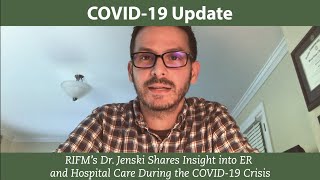
Christian Jensky, an emergency physician, describes managing COVID-19 patients on the frontlines. His hospital shifted toward permissive dehydration and hypoxia to avoid worsening lung damage, and discovered microvascular thrombosis as a key problem. He emphasizes communication with families and disputes claims that patients are being abandoned or forced onto ventilators.
Chapters
Hi friends, my name is Christian Jensky and I am a physician at Richmond Integrative and Functional Medicine. I am board certified in integrative medicine and certified in functional medicine through the Institute for Functional Medicine. In addition, I am board certified in emergency medicine and have practicing in the emergency department for the better part of 17 years. I did spend some time in urgent care as well. I wanted to talk to you today about SARS CoV2, the virus that causes the disease COVID19 and just give you my unique perspective as I see it. There's been a lot of videos, a lot of social media posts, just a lot of content out there these days that for the most part are good and informative and keeping people educated on the information that's coming so fast and furious. But unfortunately there's a few videos that have gone viral recently that I feel are doing more harm than good. And so I just wanted to touch base on that. You know, my perspective is just that it's my perspective. So I just want to speak intelligently on my experiences with this and my thoughts and that's all that they are. I am not an ICU doc, but we do manage intensive care patients in the emergency department just about every day. Every we admit to the intensive care unit. We are their ICU docs while they're in the emergency department and sometimes they're there for a long time getting stabilized or waiting for a bed to free up for them to go to. We have been seeing a decent number of COVID 19 patients coming through the emergency department where I practice here in Richmond, Virginia. So you know, really in the beginning when this first started, ultimately everyone was a little confused as to what was going on. It was overwhelming. Information was coming fast and furious on a daily basis. We were essentially getting new updates on what this disease process was, what it could do, what the potential complications were, comorbidities, treatment, if there was any. And the list goes on and on and on. And I feel to some degree that's still evolving, just not quite at the pace it was in the beginning, when it was also new and novel. We were kept up to speed with clear, concise information. And it was early and it was often and I think I give a lot of credit to the hospital system in which I work and the ER group that employs me because they have been fantastic with regards to their communication and to this day continue to be great at doing that. We were updated almost daily. There was a weekly town hall meeting in which we would have summaries of what had transpired not just on a local but national stage, as well as what was going on in the globe. We were given a white paper early on, and then it was revised, and as revisions were made, we were given those updates. Information with regards to resources, information with regards to ppe, how much we had, where it would be coming from, what our contingency plans were, what the overflow would look like. Just about everything that you could possibly think of in a disaster type situation was being openly discussed with the providers, the nurses, the ancillary staff, and everyone within the emergency department so that we were best equipped to work as a team. I feel like some of the information that's being put out there is information that is misleading and kind of painting a different picture. Now, again, I can only speak to my personal experience. I don't know what's happening in other states, I don't know what's happening in other hospital systems, but I can say what's happening in ours. And I think these patients are being managed appropriately. I think these patients are being managed with care and concern and nothing is really being withheld. They are not isolated or alone. They may feel that way at times because of the precautions that we have to take, but those are precautions that we are taking based on guidelines set forth by the CDC and the Virginia Department of Health and our own administrators. And this is based on science and not whether or not we want them to be in isolation or not. I mean, this is just essentially how these patients have to be managed. And early in the course of this, we weren't sure how the presentation was going to be. Everyone was essentially being screened. If you had a shortness of breath or a cough or a fever, any sort of respiratory symptoms, actually if you had travel, and then that evolved because once it kind of permeated the community, whether or not you traveled was moot. And then we saw the evolving symptomatology, some being change in taste, some being change in sense of smell, some being GI related symptoms, sometimes rash or red eyes at one point in time. And so really everyone became a potential positive at that point in time. And so we had to be really, really careful. And so hospital policies were implemented that involved making sure everyone had a mask, including patients, making sure that we wouldn't have visitors anymore because it became too much of a liability medically and not just for the visitors themselves, but for staff and the patients and other family members. And that was hard. That was the hardest part. And I think that's where a lot of the problem with these videos that claim that patients are being abandoned come from, you know, when you're sick and really sick for that matter, it's natural to be scared. And I think that in that setting, in and of itself, you feel alone to some degree. When you are on respiratory precautions, when you are on contact precautions, when everyone coming into your room is covered in blue plastic from head to toe with goggles and face masks, I feel like it could absolutely magnify that situation. But behind the masks, behind the goggles, underneath that plastic, are human beings that are caring for these individuals and working really hard to make sure that they're okay. I don't believe that patients are abandoned. At least they're not in our hospital system. And I strongly feel like that's the way that it's been across the nation and hopefully the globe. I do know that our policies as these patients come in, one of the first things that they're asked by the nursing staff that's triaging them is who their point of contact is and what that phone number might be. And that phone number is immediately posted on our tracker board for accessibility for the providers and the rest of the staff that need to contact their family members. I personally made a point to contact every family member of every patient that I saw to let them know that they were okay, even if it was as simple as a two minute conversation, just saying that, because that's ultimately what I would want for me or my family member if I was in the same situation, it would be to know that they were okay or to tell and convey to my family that I was okay. And so I've had many of those conversations and I spent way more time on the phone than I would like during some of these very busy shifts. But that's just the way that it had to be. So again, not alone, in my opinion, not isolated, not abandoned, but just necessary precautions being taken and communication being really, really important. Not just communication with the patient, but the families, the hospitalists, the consultants, the critical care specialists, ancillary staff, administration. Just making sure that everything was running smoothly and we were minimizing as much risk as possible during this pandemic. That still continues to be something that we're dealing with with regards to the kind of management of these patients. I think some of the viral videos that are out there have touched on certain medications not being given, patients being forcibly placed on ventilators against their wishes and subsequently having bad outcomes because of that. And again, I can only speak to what it is that I've seen, but I can honestly say that that's not happening, at least not in our hospital system and probably not in many. You know, a lot of these medications, we don't really know if they work, and a lot of the evidence is anecdotal. And some of the medicines I'm referring to would be things like steroids or hydroxychloroquine or azithromycin or some of these meds that early on were touted as these miracle cures only to later find out that they didn't do much. And if they did, it was little. And it has the potential for complications, especially in cardiac patients with regards to prolongation of their QT interval and causation of arrhythmias and other bad outcomes. So pros and cons have to be weighed. But in the setting of someone who is incredibly sick having complications, potentially dying, I mean, clearly the pros of using a medicine that might have a side effect outweigh the cons because it may be a life saving measurement. So these medications were utilized as we saw fit in conjunction with the FDA's approval, in conjunction with what was the standard of care in a very non standard situation. Monitoring of potassium and magnesium, giving IV vitamin C and other vitamins, you know, restricting fluids. This is another hot topic. You know, these patients come in and when they look as sick as they do ultimately, you know, I think it's kind of like a knee jerk reflex to give these patients fluids, especially if their heart rate is up or they have a fever and they have some insensible loss from that, or especially if they're hypotensive and have low blood pressure. And that's typically how we would manage septic patients is, you know, you try to wash the lactic acid out, you give them fluids, you maintain their blood pressure. And there's kind of protocol driven standards of care for septic shock. This was very different. And that was a hard learn in the beginning because a lot of what we do is not so much robotic, but it has to be ingrained because with critical care you don't have the luxury of time. And often you have to just know what to do instinctually. And this was kind of unlearning some of those instincts and managing these patients a little bit differently. And so we had to allow for some permissive dehydration, let some of these patients be a little dry. Reason being that if we saw that if we gave them fluids, a lot of times they would go into ARDS or that ARDS type picture more quickly and they would get too volume overloaded and so that was a hard lesson learned. And with regards to oxygen saturation, hypoxia is defined by oxygen saturation below 93%. And then hypoxemia is a blood measurement done with what's called an arterial blood gas. And when these patients initially were coming in with the respiratory distress and their hypoxia, first thing that you want to do is give them oxygen and then figure out if there's an underlying reason as to the hypoxia or hypoxemia, and if you can correct that. And then the next step is non invasive with things like CPAP and bipap, followed by invasive, which is intubation and ventilation. Giving oxygen is not as simple as that. I mean, there's many ways to do it, anywhere from just a nasal cannula all the way to a non rebreather, keeping in mind all the while that this disease process is not airborne. But as soon as you start to do some of these traditional modalities of respiratory support, you aerosolize it. And that includes nebulizer treatments for patients that might be wheezing. And then you make that whole room an area of contamination. And so you had to really think critically, quickly with these patients and determine, was there a different way that you could manage this patient? Could you manage this hypoxia by close monitoring and allowing a little bit of permissive hypoxia? As long as they looked comfortable, their skin coloration was good, they were mentating appropriately, they had no evidence of end organ damage or any of these other things that would be concerning. And I think that's become kind of the standard because these patients don't do incredibly well when they're placed on the vent. That's just the nature of the beast. And it's because the traditional stiffness of the lungs that you would see in an ARDS presentation is not what we're seeing with these patients. What we're seeing instead is this kind of microvascular damage that's occurring. They become thrombotic and form clots. And, you know, traditional management is no longer applicable. And so you have to really think smartly and think on your feet. But again, these are all things that we were learning on the fly, none of which was being withheld or not done for any particular reason. It was just as these patients were presenting, as new information was being presented, as data was coming out, the consensus was this is how we would manage these patients, and that's what we did. And so, again, going back to the whole isolation, going back to neglect and mismanagement. I personally don't believe that that's what's happening. At least that's not what's happening in my hospital system. You know, I feel like this is easily one of the most surreal and scary times that our nation has faced. And honestly, if I were to say that I wasn't anxious or scared, I would be lying to you. But I think that's the humanism behind a lot of these masks that these patients are seeing that allow us to be empathetic and sympathetic. I mean, we do what we do because we care. We do what we do because it's our calling. This is in our nature to practice medicine, to help people, to try to do our best, to make them feel comfortable and to make them feel like they're not alone. So I think a lot of the information that's out there is really good. I think a lot of it is educational. But I think that there's some out there that agenda driven and, you know, just pick and choose what you listen to. Be smart, ask the right questions, be safe, love one another, you know, and just continue to practice, you know, lifestyle changes, lifestyle medicine, the things that support your own innate immune system, the things that support the inherent wisdom of our own bodies and its incredible ability to heal. Things like proper sleep and stress management and exercise and movement, diet and spirituality and interconnectedness. And I know that's hard with the social isolation, but connect with yourself, connect with those in your house. Connect via videos like this. Pick up a phone, pick up an old school landline if you have to. Just do the things that support your body's ability to heal and to fend off foreign invaders like this virus. You know, at Richmond, integrative and functional medicine, that's what we try to do. We try to empower our patients, we try to educate our patients, but most importantly, we just follow our moral compasses and do what's best based on where that guides us in conjunction with the information that's out there. And so, you know, I hope that some of this was educational for you and maybe shed a little light onto some of the positives or silver linings that are out there, which is to say that there are those of us that are working really hard to take care of these individuals and to keep up on all the information that's appropriate in doing so and that are trying to be as positive as possible. And I hope that you can stay that way, stay safe, stay blessed, and take care of one another. Thank you.
More from Aaron

Too Many Gut Fixes Can Undo Your Healing. What Helps It Last | Dr. Sabine Hazan


Women’s Heart Attack Symptoms Differ From Men’s 95% of the Time — Only 30% Have Chest Pain #shorts

Heart Disease Kills More Women Than All Cancers Combined — 80% of Cardiac Research Is on Men #shorts

Women’s Physiology Was Systematically Ignored in Drug Research — The Consequences Are Still #shorts



It Took the FDA 20 Years to Realize Women Need Half the Dose of Ambien #shorts

Until 1993, Women Were Banned From Clinical Drug Trials — Then Those Drugs Were Prescribed t #shorts