Gut Health 101 Ep.3: Your Gut-Brain-Immune Axis with Dr. Jenski
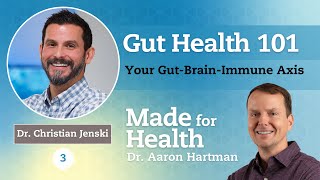
Dr. Jenski and Aaron Hartman explore how your gut, brain, and immune system talk to each other. A leaky gut can trigger autoimmunity and brain inflammation. They cover IBS, SIBO, and treatments like stool testing, dietary changes, and low-dose naltrexone.
Chapters
Welcome back. Once again, we continue on all things GI track. Today I think we're going to talk more about the GI tract in regards to your gut, your immune system and your brain. Typically in the functional medicine world, when we think about gut, we think about things and systems. How things, what are, what are ways in which your body works together. And the big one, these big systems, is how your gut interplays with your immune system and your brain. So I'm going to start there, Dr. Jet Ski, like talk to us about this system too, we call it, or try to. But what is this unique interaction between your gut and your immune system in your brain? So if you have a gut issue, you have to look at your immune and brain. If you have a brain issue, you have to look at your immune, your gut. Literally, if you have anxiety and depression or autoimmune issue, the gut is always looked at. Yeah, in this should be. Should be, yes.
Um, so I, I think the best way to explain it is kind of what most people already know it called, which is the gut brain axis. And so there's a connection between the gut and the brain and it's essentially the vagus nerve and that is this kind of intersection of sympathetic parasympathetics. So therefore the autonomic nervous system and its brain connecting to gut, gut connecting to brain. Actually more inputs going from gut to brain than from brain to gut. And ultimately it's this back and forth interplay of information. And so therefore if your gut is off, your brain tends to be off and vice versa, like you mentioned. And when we say off, we're referring to things like dysbiosis or inflamed or leaky or something to that accord. All the while along the way your immune system is being negatively affected because as you mentioned in our previous video, 70, 80 plus percent of the immune system emanates from the gut. When we talk about the gut, we're talking about the intestinal tract. So all day, every day, this hollow tube that's being fed information from our environment, whether we're doing it on purpose by eating, or we're breathing it in and swallowing it, or it's being created secondary to metabolism or dysbiosis or the bacteria that's there. There's, there's immune cells, there's the gall, there's the malt, there's these pyrus patches, there's the dendrites that are putting their finger like productions up and just sampling the air. What's in here, what's good, what's Bad and trying to process that information and convey it. Do we need to do something or not? So there's the immune involvement in that response. And so therefore, if you have leaky gut, you have the potential for things like autoimmunity, neurodegeneration, a polarized immune system that can lead to mast cell and histamine related issues. You can have actually a little bit of an immune compromised status. Secondary to that, you can have neurotransmitter problems because the gut's off. So things like serotonin and dopamine that are made in the gut that then goes up and crosses into the brain, because leaky gut means leaky blood brain barrier. So now I have neuroinflammation, and I have anxiety or depression or OCD or attention deficit. And I'm getting all these labels, which for us are more symptoms of something else. And so it goes back to look at the gut, see what's going on there. Can we heal it? And does that translate into better brain function? Or look at the brain, can we heal that? Does that translate into better gut function? You often have to do both hand in hand, in my opinion, to kind of get them fully across the finish line. But I think that's a good kind of introduction of how that interplay is. What do you think?
Well, you know, I tend to think, you know, agree with everything you said in regards to gut issues. You know, traditional diseases, you know, Crohn's disease, ulcers with colitis. You know, in the last several years, there's been this. Some relatively new ones, like microscopic colitis, colagenous colitis, even eosinophilic colitis. You know, it used to be just eoe, and now I realize you can get eosinophils, like, all over GE.
EOE. Yeah, yeah.
And just. And this was something that 15 years ago was. Was an oddity, a rarity. And now it's like. I think most people have kind of. Oh, yeah, yeah. Well, my kids, My kids, friends at school has that, you know. Yeah. But, you know, you think about these. These entities, you know, biliary dyskinesia, which is abnormally functioning gallbladder, which can give you pain or discomfort with meals. Not just gallstones, gastroparesis, where your stomach, the musculature is. It's a type of dysautonomia, where your muscles aren't contracting the right way, so food just sits and you're in your GI tract, and all of a sudden these diseases have interplay with your gut, microbiome but also interplay with inflammation and your brain. You know, how many times do you see a person with any of these that has no anxiety, has no depression, have no, has no sleep problems, has no inflammation, no joint aches and pains? And the answer is they always got, you know, and if you do a blood test, you all of a sudden now you're seeing antibodies. But one thing I want to talk about briefly, ibs, which, you know, I think a third of all visits, a couple of years ago I saw this stat third of all visits to the GI doctors for ibs.
Yeah.
Which is, which is a functional bowel disorder. Yeah. Well, what's a functional. Talk about a functional. Yeah, I don't know.
I think IBS is a symptom for me. Someone comes in with an IBS tag, my question is, what is behind this? And it's usually small intestinal bacterial overgrowth or food sensitivity or food allergy or dysbiosis or a yeast overgrowth or a parasite or an issue with limbic dysfunction or something. You know, there's, there's so many things that lead to this diagnosis of IBS that, you know, if you have chronic GI issues and you have intermittent diarrhea or constipation or both, an abdominal pain and then you go to GI and you get scoped, you do upper endoscopy, maybe they even do a small bowel follow through, they do a motility study, maybe they do colonoscopy and everything looks okay or normal to them. They're going to say ibs. But we're taking that a step further and we're looking under a microscope, not personally, a lab is. So we're getting a stool analysis, you're getting a breath test, you're getting food testing if necessary. You're asking that person about their stress, you're measuring their HPA axis, you're, you're evaluating your neurocognitive status, you're looking at inflammatory markers, you're looking at maybe autoimmune markers, you're looking at these predictive autoantibodies like the yeast panels that we can look at now that are predictive of future ibd. And therefore you're gaining insight into what might behind this IBS tag that you can correct. And then all of a sudden the IBS goes away because there was something more definable, that was more upstream and more definitive in a way that you can say this is the cause that gave you this acronym. And it might be a different acronym, but either way. But we're going to treat it, and then you're going to own it. And that's going to be your health for the rest of your life. Because I literally have patients that come in and I've been constipated my whole life, and now all of a sudden they're pooping Normally. Well, it's not magic. It's just figuring out what, what was behind that. Right.
And the thing that mentioned about functional bowel disorder, that's, that's a diagnosis that you get when you see a specialist. And they do the, the scopes, and the scope is normal. And they do their, their, their manometry testing as normal. They do the CAT scan, MRI as normal. And it's like, okay, your abdominal pain is a functional bowel disorder. It's not IBS because you don't need meet room four criteria, which means you don't have all these other kind of symptoms. And so it's a functional, that's I. E. Idiopathic, I. E. A function, a.
Function of the limitation of our testing.
It's like, well, if.
So we're going to say functional.
But do they let the. When you did your training, if they said this, like, every disease will ultimately declare itself if you wait long enough and you can't figure it out, eventually it'll pop its head up and you're like, oh, it's your gallbladder or whatever. And so many ways like this.
But that's so downstream, right? Like, isn't that the epitome of downstream? It's like, wait for it to revere, reveal itself, rear its ugly head. Why not catch it before it does that? Right?
Well, that's, you know, that's what we do. That's what we do. But a lot of people will have these functional bowel disorders, ibs, ib, IB Visual bowel syndrome. D, diarrhea predominant. C, constipation predominant. Mixed. The interesting thing is in the literature shows us that mixed and diarrhea predominant are actually all immune spectrum disorders. And that's where you start doing your anti sarcomyces cervica antibody, anti yeast, anti tubulant antibodies. You can use antibodies that actually predict. Wait a second. This might actually turn into inflammatory bowel disease. Let's change the microbiome. Let's work on it. You know, so I think that, um, you know, the gut, immune brain, we have these diagnoses, but most of what people go to the doctors with are these abstract things or symptoms that are suggestive of deeper things under the hood, like inflammation. So let's talk about Autoimmune diseases. Because if someone comes with autoimmune disease, I'm automatically like looking for triggers and looking for antecedents and what sets you up for this? But if someone has an autoimmune disease, they have to have four things, right? They have to have a triggering event, you have to have a leaky gut, you have to have a chronic infection of some sort. And the infection can be the chronic Lyme or whatever, but also can be their dysbiosis or Sibo. So all of a sudden with autoimmune inflammation, which is kind of everywhere, right, all of a sudden you have to look at the gut. Could you talk a little bit about autoimmune diseases? Like not, not going to Hashimoto's and retort, but like from this, this systems paradigm, you know, not to categorize everybody like this, but when some comes with autoimmune disease, like if it's a rheumatoid, you see a rheumatologist, if it's multiple sclerosis, you see the neurologist. But yet they're underpinnings for those. You have to have those four things. So talk to us about.
That's the final common pathway. It's genetics, leaky gut, and environmental trigger. And the triggering mechanism is different for everybody. But there's triggering and CO stimulation. So essentially the genes are not rare. We all have these genes, by the way, and it's just a matter of whether or not they're epigenetically activated. And that's where the antecedents, the triggers, the mediators, the modifying events, the things that we kind of try to determine. Because a triggering event is finite, it happened. So that's usually not an issue. But that history is important. But if there's something ongoing, you clearly want to know what that is, because that's something that's a modifier that you can remove. And if that's something that's still happening, then you gotta get it gone. Otherwise it's gonna continue to create that problem and potentiate that autoimmunity and make it worse, get more entrenched in the process of things like epitope spreading and others. But ultimately genes load the gun, environment pulls the trigger. A gene is activated by the combination of, as you alluded to some infection, a combination of leaky gut, where you start to get that loss of immune tolerance that we alluded to in our last video. Those T regulatory cells that are supposed to know the difference between self and foreign are getting a little bit gray in that area. Now all of a sudden we have CO stimulation presenting of self antigen and B cells start making antibodies to self. So it's that final common pathway. So if someone's got Hashimoto's or celiac or Ms. Or rheumatoid, I don't look at them all the same, but I know that the underlying underpinning mechanism is the same. Which is to say I got to look at their gut, I got to look at their diet, I got to ask them about their stress, I got to look for infections and I gotta make sure that there's not something else that might be ongoing as a triggering event. Is it biotoxin patient? Is this a heavy metal patient? Is this something else? But you always start with the foundational stuff because stress, you're not gonna get the gut right, the brain component, if you don't get that brain component right. So ultimately you gotta get it pushed across the finish line. Tighten up those tight junctions, work on identification of triggers, heal whatever infection is there, smoldering or was there and maybe reactivated. And then you can start to see autoimmune markers trend towards remission. And oftentimes we use things like ldn, low dose naltrexone, which is anti inflammatory and immunomodulator, an immune modulator. And this is something that's pretty profound in the vast majority of autoimmune patients because it's doing something globally shared by all of them, which is they have immune imbalances and inflammation. So that's why I think it works.
I'm actually going to take that. That was, I love you said LDN because that's going to give me, that's gonna give me something to talk about now. So ldn, like in many ways I just have this little thing off my head. In many ways it's like a connection with the gut, immune, brain access. It's like the most like, I don't say the paradigm, but it's so lotus. Naltrexone, you know, it's naltrexone and low doses it's an opioid blocker. It was traditionally used to treat opioid addiction, alcohol addiction, overdose. In smaller doses actually it can modulate, it's balances th1, th2. It's interesting in your brain it actually lowers microglia activation. So all my autistic kids, my young kids come with pandas and pans. They're all getting started on lowest naltrexone. It's amazing how that actually helps with them sleep. An Alzheimer's Patient traumatic brain injury patients. There's interesting literature on naltrexone.
Right.
After a spinal cord injury, if you get in within six hours, the outcomes improve dramatically Just by getting this neural anti inflammatory. And the gut stuff, LDN is, it's interesting a lot of our SIBO protocols, small intestinal bacterial overgrowth. Part of that gut issue is not just the bacterial liver growth. It's the motility component. There's an inflammatory component and a neurological component.
It does all of it.
And so all of a sudden ldn, like if you, if, you know, it'd be nice if everybody got better with Xifaxim, if everybody SIBO got better as if Axin, you sprinkle a little neomycin if needed. You know, maybe a little Bactrin, maybe a little, little tetracycline, whatever. But the reality is those aren't the people we see. They don't have just the bacteria. They have the inflammation, motility, neural stuff. And also an LDN actually is a pro motility agent, helps with inflammation. It's actually calming down the whole the gut brain axis. It actually has a positive impact on neural inflammation and then inflammation proper.
It balances that th1, th2 and th17. Th17, th17 is that spillover to hollow space infections, which is the gut. Right. So you have dysbiosis, which is potentiating that TH17, which is auto potentiating the TH2, which is imbalancing your, your teeter totter that we talked about. So Th1, Th2 and Th1 are yin and yang. Th1 is fighting intracellular infections. Th2 is allergies, asthma, pollen, addressing that kind of stuff. Th17 is extracellular hollow space infections. So these two play together and are the yin to this yang. So ultimately when one's activated, the other is suppressed. And so if you have a TH2 polarization and TH17 kind of an autocrine loop that's created, it's at the suppression of TH1. I can't fight intracellular infections. That might have been a triggering mechanism for the autoimmunity. I'm creating inflammation and tissue destruction and depleting my glutathione stores. Glutathione does what supports TH1. So this is getting even deeper. I'm making histamine and all these other things. LDN is just starting to kind of do this a little bit as you're playing detective. Gets pretty beautiful in what it does and, and pretty simple.
Well, one of the things about ldn, it's interesting. There is a prescription dose of naltrexone, a drug called Contrave, which is a weight loss drug, FDA approved for weight loss. And its dose in that medication is 8 to 16 milligrams twice a day. So all of a sudden you've got this drug that does like crazy stuff. At a higher dose you can actually treat opioid addiction. I used to, when I was in the military, I used to use it with people who had issues with alcohol addiction. Abuse worked great. People would lose their, lose their cravings at a lower dose. It's, it's affecting weight through whether it's inflammation and then even lower doses. At these lower doses you have this immune modulation. It's, it's really an amazing kind of drug that's relatively inexpensive. Unfortunately you have to compound it.
Yeah, but it changes what it does for the body depending on the dose, which is so unique. I mean we used it in the ER in the form of Narcan all the time for, for opiate overdose. But it's, it was when I first learned about what it was doing. I mean that's why it was initially studied is for the opiate epidemic. It was, how can we control these people that are addicted to pain medication with a non narcotic pain medicine? Well, let's try, let's try naltrexone in low dosing. And they saw this uptick in the, in your own endogenous opiate receptors and your own endogenous endorphins. And so these people were getting pain relief with an opiate antagonist and it was like, this is pretty profound. Let's study it further. Fast forward 20 plus years and this is all the stuff we now know about it. It's pretty amazing. I mean I use it in everybody.
Well, this is an interesting antidote because I don't do this. That's nothing I do on a routine basis. But I did one patient where it was a chronic fatigue fire patient who happened to be on Percocet at one point in time but eventually got them off of that. It was interesting. She inadvertently mixed like a low dose naltrexone and with a Percocet and all of a sudden she's like, I'm taking half as much Percocet, I don't need it anymore. And when I do take it, it works so much better. Now this, I'm not recommending that. It's off label. Never recommend that. It's totally anecdotal.
That is good.
But it's been, I think it is speaking to. She has a chronic Fatigue fibro patient.
Yeah.
She also had some early cognitive decline. She was on part of the Brenson Del Bracol we do here. So that's how she came to see me with some concerns of Alzheimer's. But just I think speaks to the anti inflammatory capabilities of a slower dose. It changes what, it's a, it's, it's a chameleon. It changes what it does at the dose you use it.
Yeah, it's a, that's well said. But that's the, that's what Suboxone is. Suboxone is a combination prescribable FDA approved opiate antagonist agonist in one. Right. So any of my patients that are on opiates, I don't put them on LDN until we're able to wean them off it. Although in a situation like that it sounds like that might be something you consider as long as the patient's willing to do it. But Suboxone is essentially that it's, it's literally trying to do that. And so I think there's just more here. And I use it in SIRS patients. I use it in long Covid, which I think is the same thing. I use it in chronic fatigue, fibro placebo with dysmotility. I mean it's just the list goes.
On and on and on. I think this is just an example of autoimmune patients. Yeah. And this is an example of how the gut immune brain and it can act and how we're, I say, I say patients, we're turning these knobs to, to, to do things. And naltrexone is one of many examples of the ways we look at this. So let's transition quickly to the brain. We've got immune brain, we talk about brain. It's not just Alzheimer's and Parkinson's, but it's depression, it's anxiety, it's adhd, it's post concussive syndrome. It's brain fog. So when you're seeing a, a person who comes in and I've got brain fog, it's like thinking through gel. I can't think very well. They have no other complaints.
Right.
Maybe they don't realize this is post Covid because strangely enough, it appears what's happening now is most people with long Covid actually had mild Covid symptoms, which is kind of concerning and treating all the same time. Or it's a chronic fatigue patient. How do you like when you see those brain patients? How do you walk through going through the brain to immune to the gut when you're kind of working with them.
So all of my patients, and I don't know if I think I've mentioned this, but all my patients get a stool test and I'm looking at their gut. It doesn't matter what their presentation is, whether it's brain autoimmune skin. I want optimization. I actually have GI symptoms. Doesn't matter. You poop it in a box so I can see what's going on. The other aspect that everybody gets, no excuses, is that HPA access to kind of assess their cortisol 24 hour salivary cortisol with a car or cortisol awakening response so I can see what their stress loop is. That allows me to at least have a component of the gut brain axis that's a little bit of a step back and a broad scope of, hey, these are two big players that affect a lot of things and may be major contributors to your current neighborhood neurologic symptoms. So why don't we start here and see what happens. Clearly beyond that is specific to the individual of, you know, do I need to be looking at hormones and see if they're optimized or excessive in someone that was previously seeing a practitioner that was repleting them? Do I need to look at nutritional status? Is this a nutrient deficiency? Do I need to look at toxins? Is this someone who's got a history that supports heavy metal exposure and potential for toxicity? Is this a biotoxin patient that I got to go down that rabbit hole of working them up for SIRS or chronic Lyme or chronic infections, that kind of thing. And then plus or minus, do I need to pivot to some sort of neuroimaging at that point in time, but for me it's supporting the brain. Well, how do you do that? You gotta support the gut, you gotta get stress under control because cortisol, although life saving and necessary, is toxic to the brain in excess. And if this person's cortisol is super duper high and their counterbalance DHEA is depleted, they're just pummeling their brain with excess cortisol until the body figures it out and shuts it down. And then they have just enough to get feet stay alive, but not enough to really be functional in that way. So phospholipids are huge anti inflammatories that are natural in nature, like fish oil, SPMs, curcumin. I love BPC for brain health. You used to be able to get it nasally. I think you might still be able to at certain Places, but you can take it orally. I like Synapsin for brain health. I mean, there's lots of cool things that you can do depending on what you want to do. But the goal being that is this inflammatory, is this autoimmune, is this nutritional, and, and by doing that, you're essentially doing the Bredesen protocol that you alluded to looking at through maybe a broader lens of all the different subtypes of, of cognitive decline. But that's kind of how I approach it. It's, it's the, everyone gets these things and then depending on who you are and what you told me, you get these other things.
It's more interesting when we, when I did my IFM during the Institute of Functional Medicine and they had their msq and you look at the questions from msq, it's, it's a multiple system questionnaire. That's one of the ways they, they recommend people use to figure out like how you really bad or not so bad. But it's interesting, if you look at those questions, they almost all sit in system two, gutamine brain. It's like the majority of that evaluation is looking at inflammation, looking at gut and energy brain, all that kind of stuff. And so this correlation, we talk about gut health, you know, that's, which is the purpose of this. It's so much bigger than just, you know, do you poop, do you have gas, do you have bloating? You know, you have to think about all these, the different things. So I wanted to briefly discuss that, not belabor it, but that's when you think about gut health, it's the extra intestinal manifestation.
It's just everything. Yeah, everything.
And go back, we actually had an interesting conversation with Dr. Pam Smith, she's a hormone expert this past week, and it was interesting. She was talking about in her clinic in Detroit, she's like, it's amazing. People come in, they have no GI symptoms whatsoever. But like you said, and she's been doing this for like decades, she's looked at that and she's like, oh, they, they're horrible. They're awful. And so if you have inflammation, gotta look at the gut. If you have any brain symptoms, gotta look at the gut. So I think next time what I wanna do is take a deep dive into the single biggest driver of gut health, which is food.
Yeah.
Oh, gosh. Yeah. So, and so we've had a great time talking about the mouth to the anus. We've had an amazing time talking about system two, gutamine brain. But ultimately all these Things on top of food, which is the driver or preventer of inflammation, immune system function, gut health, and ultimately how our body heals and repairs itself. So I'm really excited about talking about.
It's all information.
Yeah. Talking about spending some time talking about food, what real food means, what it is. Because I think right now when we're recording this here, October, I feel like now just, it's. We're just starting to get to the public consciousness, awareness that. Wait a second, 80% of what we. Of chronic illness in our country is directly related to eating processed foods. What, you know, 60 to 70% of what kids eat right now is ultra processed.
Like, what is shocking to me is that people are shocked by that. Like, I feel like this is not new knowledge. This is, this is, this has been knowledge that is a. Like, thankfully, it's being brought to the, to the front lines and to Capitol Hill. But like, the reality is, like, isn't this what people have been preaching for decades in this field? And like, you know, we, you know, I just feel like it's how you personally transformed your family's health. It's how I transform mine. It's how we work on our patients. Like, it is the most profound thing you can do. We talked about the broad scope of fiber as an intervention, but like, let's take a step back. Fiber comes from food. It's the food component that either is healing or it's poison.
We'll talk about this a little bit because I feel like it comes to, well, you know, tobacco. I'm from Virginia. I remember in the 1980s, you could still smoke indoors. And those debate, you know, smokers rights. How dare you say we can't smoke indoors? I mean, it literally was 50 years and 7,000 research articles before, you know, cirge United States said smoke causes cancer. Right. And so I feel like part of it's like it just takes us a long time to learn. But there's also a lot of governmental involvement and there's also industry involvement. So it's not as simple as, you know, mom's, you know, you have chimney cricket. You are what you eat from the head down to your feet. I learned that in elementary school from Jiminy Cricket Keister elementary, Harrisonburg, Virginia. Right. And. But then you go to medical school and you're like, what you eat doesn't matter. So I don't want to talk about that today because we're going to talk about that next. But I feel like that if all the cool, fancy things we've talked about so far LDN and B and ta. Like, if you don't do the basics, the really cool things just don't work as well. You gotta do the basics. It's like soccer, right? You're a soccer guy, right? Professional soccer players become amazing at passing and kicking. You know, there's cool things, there's people that can do, you know, all the cool stuff. But professional athletes become expert at doing the basics well. I remember my wrestling coach in high school. He was like, I can roll you. I can do one thing. I can. I can. I can. I can roll you. That's all he could do. He won nationals wrestling for VMI during one thing. But he could do it to you anytime, anywhere. Yeah. Where you're at, I can roll you. He's like, I'm afraid to do it. He just would like, okay, you get hurt me. You ready? I'm getting ready to roll you. I'm like, you're not even touching me on my back, right? And so that's where, like, in my mind, the basics for this, for what we're getting ready to talk about next, is just real food and what that really means. And I feel like, for me, this is one of my passions because I feel like people, just once people did it, you can't look back, and there's.
Always room for improvement. Even if you feel like you're doing well also. It's great. All right.
All right. Thank you very much again. If you enjoy this, please follow shared as well. Put your questions below. When we do our Q and A answer session, we'll be happy to answer those questions. Take care. We'll talk to you soon.
More from Aaron

Too Many Gut Fixes Can Undo Your Healing. What Helps It Last | Dr. Sabine Hazan


Women’s Heart Attack Symptoms Differ From Men’s 95% of the Time — Only 30% Have Chest Pain #shorts

Heart Disease Kills More Women Than All Cancers Combined — 80% of Cardiac Research Is on Men #shorts

Women’s Physiology Was Systematically Ignored in Drug Research — The Consequences Are Still #shorts



It Took the FDA 20 Years to Realize Women Need Half the Dose of Ambien #shorts

Until 1993, Women Were Banned From Clinical Drug Trials — Then Those Drugs Were Prescribed t #shorts