Healing Mold, CIRS, & Biotoxin Illness (The New Paradigm of Chronic Diseases): Episode 5
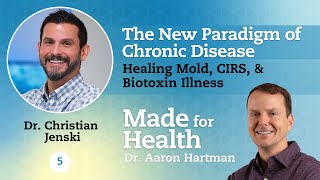
Aaron Hartman, MD discusses chronic inflammatory response syndrome, a condition linked to water-damaged buildings and biotoxin exposure that overlaps with fibromyalgia, chronic fatigue, and IBS. Treatment focuses on gut health, sleep, stress management, and environmental fixes like dehumidification and HEPA filtration.
Chapters
Welcome back. We're continuing to talk about chronic inflammatory sponsor Today. This is actually, we're talking about the new paradigm of chronic disease. This is going to be more of a summary of some of the things we've talked about, hitting some high points of chronic inflammatory response syndrome and how, how this disease is a new paradigm that explains a lot of other diseases that we have not been able to explain before. So why don't you just mention that? Why don't you start with that, Dr. Jensen? Okay, like how this is a new parent. How what, what holes? How is this a new paradigm? And what holes in our understanding of like crock fatigue and fibro and schizophrenia? What holes does this fill?
Yeah, so all of them. So, so a lot.
A lot of holes. Yeah.
I think that from a, from a paradigm shifting standpoint, me personally, I thought learning about functional medicine was a paradigm shift. This is taking that to the next level. I mean when I finally felt like I was understanding Zurgs and I think you felt the same way. We've had these conversations about all these aha moments in current management of patients, but looking back at previous management, like remember when or how about now? This overlaps with this, overlaps with this and it's all serves. And I think that's the paradigm shift. And I'm not saying that everything is csrs, but I'm saying a lot of things are explained by sirs. And the reality is that conditions like fibromyalgia and IBS and chronic fatigue syndrome, many mood disorders, brain fog and memory related issues, and chronic neurodegenerative conditions, I would even go as far as to say provocation of autoimmunity, autoimmunity, potentiation of that skin conditions and all the histamine mast cell th two dominant stuff that we see. So much of that falls under the umbrella of cirrus for me because I eventually as treating those patients come to the conclusion that they're a CSRS patient and 9.99999 out of 10 times their service patients. And so either we are pre selecting out with our demographic or this is the reality. And I think statistically this it's probably the reality. So I think that as this is gaining more mainstream notoriety, as more and more practitioners are learning about the nuances of it and understanding the foundations, which is more important than even the nuances. And we push this forward and do what we're doing right now, which is try to push it forward and provide information for those out there, I think the paradigm shifts even more. And the only Thing that comes from that is patient improvement and benefit, and that's really the goal of all this. So bouncing off of that, what are the common misconceptions? I mean, like, what are the biggest things that I think people just don't get right? If we're trying to get this accepted and seen and say, here we are, and this is what these people need, what do we need to erase from a misconception standpoint?
I mean, I think one of the biggest misconceptions is that mold is the primary cause of chronic inflammatory response in it. Yeah. It's like, I don't have mold in my house. And actually not. It's a water damage. Building is 80% of this, which includes mold. But mold is. Is actually 80% of the 80% or 60% are endotoxins, actinomyces, particulates from building materials breaking down. So the mold actually represents. Actually, mold. Mold is about 16% of chronic inflammatory response syndrome. So if you're. You're working with someone who's a mold expert, and they're only looking at your mold and only looking at your mycotoxins, your mold toxins, great, awesome. They'll detox you. But the reality IS that represents 16% of chronic inflammatory response syndrome. And if yours is related to breast implant illness, or if yours is related somehow to your sibo or to your head concussion, or you're over training, or your chronic dental infection that's not been fixed, or it's your post Lyme. You're a serious post Lyme patient, which is all of a sudden, you're not getting addressed. So I think in my mind, the biggest misconception is that it's all mold. The second misconception I would say, like, general, is this is not as common as it is. We've talked about this before. When I first started doing this, I was kind of like, there's no way. Like I said, see a patient. I started learning this. I'm like, how can, like, five or six people I've seen today be service patients? Yeah. And so I said, it took me almost a year to be like, you know what? Maybe this is just that common. But then the next thing was hypermobility. Next thing is mass activation. The next thing is dishonoring pots. And all of a sudden, you realize all these rare, uncommon things. Maybe that's the third misconception, is these rare and common things are everywhere.
Yeah.
It's just that it's a different presentation. You're not coming in with the marks on your eyes and you know, tell me, hey, doc, you know, my house is leaking and smell everywhere and whatever. It's like you might have a brand new home that you moved into. And part of my wife's issues, she has issues with chemicals and formaldehyde. And that's where the whole petroleum distillate kind of thing comes in, the chemical rejuvenate aspect, which I think Dr. Yehuda Schoenfeld for actually a lot of his. His insight into this helped me kind of appreciate how that plays into it. And so I think maybe the fourth misconception would be that only like, that we know everything that causes us. I would say the next big misconception. I think there's a lot more things that we're still learning about.
Yeah.
Like you learn about the traditional things, which include hysteria that you alluded to. But like recluse spider bites. I mean, I've never. Have you seen a recluse spider bite?
I actually, I have not. I've seen one in the er.
Okay, fair enough.
Okay, so that, that makes sense.
Okay.
But I actually have had two or three patients that have a history of brown R spider bites.
Fair enough. Fair enough.
And when I diagnosed them as a service patient in the now, because they have a sick building, they're like, hey, I had a spider bite as a kid. Does that matter? Yeah, that matters. That added to your biotoxic burden. That's probably when this all started.
How about the scorpion? You've seen a scorpion bite?
No, I have not. That's scorpions, snake invations or others. And we've seen some of those, but in the er.
Yeah, but the thing is that like this understanding of what causes this. Yeah. It's getting bigger.
It's going to grow and bigger.
And that's why I feel like, you know, people with post vaccine damage, which is Asia syndrome, part of autoimmune fly juvens.
Yes.
Schoenfeld. This actually, I think the first publication was 2010. Maybe it was a while ago. Like it's an rejuvenation thing. And when you see how he describes it, it's like this really sounds like chronic inflammatory response syndrome. Part of his thing is leaky gut, chronic infections, adjuvants.
Yeah.
So it's like, okay, this sounds.
Yeah.
Very similar. And then 80 of this. So it's one of those things. I feel like as we learn more about this, the misconception is we're going to learn that this is actually way bigger than we even think it is. Long. Covid long.
Basically, sirs, yeah. You know, that's a new one to add to the list.
Yeah. And everybody. Everybody wants to claim it. Like the. The mast cell people want to claim as a mast cell activation syndrome.
Right.
Which many people with MCAs, it's actually related to mold.
Right.
Or body toxins or whatever.
So upregulated histamine pathways, which are mitochondrial genes that you can measure and are known to be correlated with sirs. So not everybody has a mast cell issue that's being told they have a mast cell issue.
Well, I was actually talking with a colleague who actually is an elder Danlos expert, and she was like. She was like, no, no, these people don't have mast cell activated. It's mast cell dysfunction.
Yeah.
It's their mast cells. And I'm like, you're right. Because they're. You check the markers. They're not elevated.
Yeah.
Not mast cell disease. But their muscles are dysfunctional.
Yeah.
And they are getting neuroendocrine, neurohormonal immune responses. So you can have a trauma trigger, a stress trigger, whatever, that elicits this weird somatic response that's mediated through your mast cells. And then all of a sudden, now you feel better on, you know, hydroxyzine or Claritin and Zyrtec or Rupatidine or whatever we're using with your quercetin or some combination.
Yeah.
And the fifth misconception came and left. The fifth misconception came and left. It came to me.
So we got. It's not all mold.
Yeah.
It's way more common than you think.
Yeah.
There's way more out there that we still haven't discovered, but we know that it goes beyond things like sick buildings, and we have other things involved. What was the fourth one again?
The other thing, like, limiting. Like, it's going to be all these other things.
Right.
And then the inter. The interconnectedness. Yeah. Like, it's like you have these people that are in their little. I'm a mole expert. I'm a lyme expert. I'm a master expert. I'm a gut expert. I'm a hormone expert. Whatever the expert is. And the reality is, is that the other misconception, you really need someone. Like, this is holistic.
A human expert.
You need a human. Yeah, yeah. You need that.
I love that. You need a human expert.
I love that.
Right?
Yeah, yeah, I'm gonna say that. I love. I' steal it, man.
No. Trademark trademarking.
I'm stealing right now. Yeah, Online. But, yeah, you need a human expert. Someone who can, like, can walk and Dance between those areas. And if you have a mass cell flare. Yeah, let's control that down. If you're cropping your fiber or flaring, let's bring that into wraps and has the tools to help you with that. Because a lot of our people we see have been to the experts in this field across the country.
Well, that's the antithesis of functional medicine. It's compartmentalization. Right.
Functional compartment.
Right. I tell every patient, like, the whole point of what we're doing here is to see you as a system of systems and you as you and you alone. So by that nature, it doesn't matter if you say you're functional or integrative. If you're subspecializing, you're. You're actually kind of counterintuitive to what functional medicine is. Now you might be doing that because that's the area of focus for you, because you have a personal story attached to it, and that's all you want to focus on. As long as you are informing patients that this is all I'm treating and there are other aspects that need to be treated and I'll work with your other provider, that's fine. But to be misled into thinking that it's just this issue is to be misled. The reality is that it's all the things and every person is a little different. Potpourri or amalgam of this kind of mashup of genetic dysregulation and mitochondrial dysfunction and mast cell activation. Some are. Are lit up like mass Christmas trees, and some have no histamine issues whatsoever. Still a surf patient.
Yeah.
It's not all created equal. That's the point. Right?
It's true precision medicine for people with health issues. It's precision medicine, you know, not on the side. And making you an elite athlete, that's precision medicine. I want to get your body healed. Yeah. You can normalize.
Let's normalize, then. Let's optimize. How. How much credence? I don't know that I know my answer to this, but we can come up with one. Like, how much credence do you give to diet in these cases? I mean, obvious. Besides the obvious stuff, like, say your sirs patient came to you and said, what should I be eating? And more importantly, what should I not be eating?
You know, besides the gluten thing, that.
Was because of gliadin antibodies. Do you put them all on low mole diets and make them just eat certain things or how do you go about doing that?
Have you tried that diet before?
No, it's, it's, it's, it's hard.
It's ridiculously restrictive. And so, and how many of these people already have some kind of trauma?
Right.
So food related, just pure general.
Yeah, sure.
It's like you have this brain trauma from either the disease proper or this trauma because you've been ignored or whatever. And so then you come see me, I'm like, let me restrict you more than you ever before. It's like. And so I think with the diet, my. I am such a big like eat real food. Like we talked about the lipid medicine and part of the Heyman's addition is doing lipid exchanges. Yeah. It's like if you just only eat real extra virgin olive oil.
You talked about how you healed and are healing Anna with that, with fossil.
Use phosphatecholine, you get egg yolks, you like get these really healthy forms of fat. So many people don't realize that the seed oils, the expeller, pressed oils, fried oils, anything fast food, anything you get at any restaurant anywhere, you know, those oils have been chemically modified to stick in your cells. Now I actually gave a talk about this and I was talking about how, you know, what is solidified oil? We call that plastic. Right? Plastic. What is partially solidified oil? We call it margarine and Crisco. Yeah. And so when you do these, these products you're literally making this is not plastic cells. Kind of, kind of, sort of.
Yeah.
And so what happens is they get stuck in your cell membranes and affect cell wall vibration, cell wall function, which affect every hormone in your body. And all of a sudden now like something as simple as just eating real healthy forms of fat can be a game changer. You know, the whole thing of gluten, it's like, you know, find bread that has four ingredients in.
Yeah.
If people are going to eat, fine, make your own homemade Einkorn bread. And the answer is people aren't going to buy a grain the milligram. They're not going to buy the. It's just if you can't do that, don't eat this stuff. And so I think eating real food and like I tend to say like Paleo principles. Yeah. Which is you don't eat. Grains are fillers, grains are car. Usually don't have. They're not healing foods. Like I want you to heal your gut, heal your brain. I don't say eat a bunch of corn, right. I don't say, you know, I say why don't you get some green, green leafies, some root vegetables do some beets, Drusel, whatever. And so I think people need to really think that food, food is a drug. Yeah. If you give your body the raw material, you know, one of the big parts of chronic inflamed response is gut health and fixing the gut microbiome. Like how do you move the gut microbiome forward? You're a C section, you have a bunch of antibiotics, your kid, your, your, your, your parents sprayed your house with chemicals. I mean, how many? That's like everybody store, right? And so how could, how can you move that needle? You can use food as a medicine.
Fermented, natural probiotics. Prebiotics. Yeah, the 3Ps I tell patients prebiotics, polyphenols and phytonutrients. It's a fancy way of saying colorful fruits and vegetables, mostly vegetables. And I think fiber is important because it's also helping with detox. Fiber is important because it's also helping mature chain fatty acid production like butyrate, which we now know as a natural GLP1 agonist. So it's regulating satiety. And most of these patients have leptin resistance. They wind up with metabolic dysfunction. So if you're pushing the microbiome forward naturally, if you're improving fiber to help with cardiometabolic risk and satiety and insulin sensitivity, because these patients get an intracellular insulin resistance because of hypometabolism, they're going to get dysglycemia. Balance it out. You want to go with quality protein, you want to make sure that they're getting healthy fats. All the things you said. That's kind of how I do it too.
Yeah.
Like I. If we do food sensitivity testing, obviously that's specific to the individual. If I do blood testing or some other and note that they have significant nutrient needs, I'm gonna dedicate towards that. Like your omega 3 to 6 ratio is garbage. And you're totally inflammatory. Here's some fish oil bottle. But by the way, also eat chia flax, hemp, walnuts and cold water fish. That kind of thing. So cool. I do the same thing.
And that's really, I think, I think one of the things like that I've kind of realized is nature's toxin binder is fiber.
Yeah.
You go to places like sub Saharan Africa where they have no, no cardiovascular disease, no cancer. They're eating like 80 grams, 120 grams. I mean, I don't know how that happens. It works. But you look at the average Americans eating 12 to 15 grams. A diet we recommend 20. Yeah, it's like we're not. Well, we're not eating enough to feed the microbiome, and then the inside will fiber. That's binds the bile and all this other stuff. We're not getting enough of that. So all of a sudden, using food like a detoxifying agent, you know, and so I think you need to think about food like, that way. And. And so many of my patients struggle with that aspect. And that's one of the. One of the three major sticking points where people don't heal. I call it the triangle of health. You know, what's the major place people get stuck? I've never. My patient. Well, whoops. Anyway. Lost that.
You grab that. Sleep.
Yeah, sorry.
Sleep is one of them.
So sleep is one. Gut health, which. Gut health includes food. Gut health includes all kinds of stuff. And then stress. Yeah. And stress is part of that, is the trauma aspect of stress, where, as you know, part of some of Hayman's work has been the genie testing, showing you can actually people's genes light up as if they had ptsd. Yeah, yeah. And the finger molding building. Yeah. Or water damage building. So I think that's. That's understanding that aspect of things and realizing your. Your illness can cause you to have trauma, just like a abused dog. And these little triggers, all of a sudden, your brain goes off and don't understand it. You may have root swings. How's that. How's your body going to heal when literally your. Your neurological system is just waiting to pounce. That affects your healing process.
Absolutely does. I mean, it. It centralizes it and hardwires it. And I see in some patients where their objective data is getting better, but clinically they feel the same. And that's the only way I can explain that. It's like your numbers look great, but you don't feel well. This is centralized. This is becoming hardwired. We need to un. Hardwire it or rewire it or whatever you want to say. You know, when you're talking about plastic cells, that's not plasticity in a good way.
Like neuronal plasticity.
Bad plastic.
Sorry. I should.
No, I know. I get it.
You would take it there.
No, I get it. Most people realize that, like, this is not about flexibility and rewiring. This is about rigidity and damage. And I think that that's a really valid point. I love how you explained it in that way where it's like solidified fat is plastic, basically. Like, that's what happens, because we see, like, that's the Whole point of the lipid protocol. Right. The lipid rescue and, and doing these exchanges, these oil changes to get those very long chain fatty acids that are causing lipid rafts to go away. Right. To let the cell membrane work a little bit better.
I've had so many people who can't tolerate cold starmine.
Yes.
They, they react.
Yes.
They ever hurt. They can't tell anything else. But then lipid exchange, you give them phosphylcholine. Yeah. You get bouncing like a three, six.
Or also butyrates and biosolids.
And all of a sudden they like start. Become the. The brain kind of starts working.
Fiber saunas, coffee enemas. That's how I've gotten a bunch of them better without being able to tolerate binders.
Exactly. Even like the phospho choline actually turns into acetylcholine, which activates your parasympathetic nervous.
System, gets that gut working. So it's that brain chill.
Biofilms. Yeah, your biofilms. The primary phosphoridin in biofilms is PC.
I feel like I need to start using more lipid protocols probably.
Do we?
Yeah.
I love it.
Rescue, it's. It makes it easy. But I think that old school PC and body balance oil and, and the, and the oxbowel and butyrate is kind of a way to get too kind of intense for a lot of patients.
Some people. Some people is.
But the rescue is nice.
Rescue is nice. And one thing that I've done, we talk. I've mentioned this somewhere, is I would actually take the Omega 36 oil and make mayonnaise out of it.
Yeah. Yeah, exactly.
Yeah. And so make mayonnaise out, which is super easy to do.
Yeah.
And all of a sudden brain may. That's right.
Trademark that.
Yeah. Well, actually. Actually I think Patricia Kane actually gave me the idea for me. So I can't.
She doesn't remember trademark.
Now, I'm not gonna do that now. I don't roll like that. But I got the idea actually from around. She may have called something different. This. This was like years ago. Yeah. She's like person I learned a lot of good stuff from. So that's one of the things I do. I find the smartest person I can find and I kind of attach to them and suck as much knowledge as I can out of.
Oh, thank you.
And then I fall off and kind of like work a little leech and I kind of digest it and. Yeah. What's my next victim to attach onto and do a brain sock? You Know. Yeah. But I think, you know, that this paradigm, that's important.
What about prevention? Let's talk about that. I think that's another big prevention.
Great prevention.
You know, like, I'm there. Okay. I. I'm on my way out of.
Sirs.
How do I never go back to this. This hole that I've been living in? This pit of misery? Help me, Doc.
So part of that is you have to make the. The basics or the basics. You know, professional soccer players. The church we used to go to, like, like almost all the pastors were professional soccer players.
Speaking my language.
Yeah. Well, okay. Perfect. Awesome. And you're talking these guys like, you know, I got really good. Like all we ever did, we drilled the basics. We perfected kicking and passing. It wasn't cool and sexy. It was just like they perfect basics and being perfect at always kicking the ball the right way. Yeah, always. You know, that's professional athlete. Right. And so people need to look at, like, I need to become a professional, professional athlete at the basics, the foundations. I really just need to eat real food all the time. You know, people like, oh, I'll cheat on, you know, Sunday. I personally, my wife and I had a while, we were going doing date nights while we go out every week and have a dinner somewhere. And six months into, we both gained weight. We're not doing so great. Just one meal a week. And your family's a great example. You kind of are hardcore where you don't.
We don't go out to eat.
We do something like rarely. Yeah. But make the foundations important, like sleep. Don't sacrifice your sleep. The environment, the house is so important. Like I'm. I'm weird. I have like HEPA filters in my kids bedrooms. Yeah. On our air handler I've got a pre filter with like the. On the one one. The ones we have UV light. The other one we have, it's in the crawl space, which it shouldn't be. We have a air scrubber, but like we make sure barehouse is clean.
Right.
I make sure my house is. Remove all the chemicals in my house, we only clean with. Use really clean materials. So make. Make our environment a sanctuary.
Yeah. And so natural products to clean.
Natural products to clean.
Making sure your H VAC system, if you have one, works and is upkept and filters are being replaced.
Yeah.
Having individual air purifiers, bedrooms, bare minimum filtering water. If you have a crawl, it needs to be encapsulated and dehumidified. You need to know what's going on with your roof how old it is and if it needs repairs. You need to know what's going on with the flashing if you have a fireplace. Like for me those are now. Like I didn't know any of this stuff. And now that's the norm moving forward. And these are the things that we learned and have people that help us keep up. Right. What else?
So I'm stressed. Like, okay, you've been through this traumatic thing where you're sick for 3, 5, 7, 10 years where people thought you were crazy and then you finally worked your way through it. People told you there's nothing wrong with you, it's all in your head, I can't help you. And now you're like, wait a second, I got something real. And you've worked through it. You need to realize that, that it's like, you know, example, the knowledge I give people. It's like you start a fire, then you put the fire up, what's what's left of the bomb. That fire coals. Coals catch on fire a lot easier second time.
Yeah.
And so like how can you put yourself that, that brain body access the neuro, hormonal, neuro, gastro, neuroendocrine, like that. You know, psychoneuroimmune chronology is a fancy term for that. But how do you put that in a state of 99% rest and repair so that when you do have the 1% event, your body will address it and go back to rest and digest, you know, and that's where you have to have what's your daily meditation practice, prayer practice, breath work, what's your weekly practice and what's your monthly practice. And you have something on some kind of quarterly annually base basis where you kind of pull yourself away and kind of reassess that. I think that's where a lot of people get stuck or get spiral back out as they will get better. And then, okay, I'm gonna do everything I used to do.
Yeah.
And it's like, no, no, you can't. Like it's a goal. People always ask, so true. People always ask me, when did I get eat? Like everybody, when did I go back to normal? Like normal sick. 60 of Americans have one chronic illness. 4% of kids in our country have a diagnosed illness. Like sick is the new normal. You don't want to go back to normal, you want to go to optimal, which is not common. So it's just changing people's mindsets and realizing that you really need to make keeping keeping yourself healthy needs to be a priority. It can't Be like we're about when I'm older.
It's a full time job, not a part time job. I mean it's, it's, it's hard because it's alienating. And, and that is not easy.
That's one of the hardest things for us. It's been super alienating.
It's alienating. And someone who isn't going through or hasn't gone through the same thing does not understand. I mean, that's why all these groups that pop up on Facebook and other social media platforms and wherever else exist is for commiseration. Because there's a sense of I don't feel as alone. And they're not always helpful because they're just bad mouthing people and saying they're never going to get better. And there's a lot of negativity. But you know, the reality is that people feel alone. And sometimes it's not the family. Like your family might feel alienated. My family sometimes feels alienated. It's an individual within that family because the rest don't feel sick. Like it just makes it hard. You have to create and carve your own path. And not everybody is a trendsetter or a, or a pioneer, you know, or whatever terminology you want to use. But that's the only way. I mean, for me, that's the only way I see forward. And I often say when people are like, well, why don't you do that? That's not in my health plan. That's my default answer. Why don't you drink alcohol? It's not in my health plan. Well, why don't you go out to eat? It's not in my health plan. Why don't you.
It's not in my health plan.
And then they just look at you like, okay, they just stop asking because that's fine. Right? Like, I don't need to explain to anybody. I know what I felt like and I know what I feel like and, and that's a big difference. Yeah, it's. What's your go to for this kind of reset you mentioned? Like mindfulness, breath work and some others. Like what have you had the most success with? Because I feel like, like every patient struggle with that.
It's. We're actually going to be launching a stress course that's actually walking through a bunch of stuff here. Hopefully sometime soon by the time this comes out. Hopefully be out. But you know what I found successful? It really depends. You know, I've got a toolkit. You know, my wife talks about when our son almost died. She Got tramact. And what kind of got her out of that spiral was actually breath work. Yeah, it was doing whole traumatic breath work for an hour and it actually broke in her mind, that spiral. There was. There have been other patients with concussions who've developed horrible anxiety with the flotation. Sensory deprivation has been.
Yeah.
Really, really helpful.
I'm going floating on Friday, actually.
You are? Okay, awesome.
I'm back. I'm getting back into it. Thank you for that. I just went back and it was. It was nice.
One thing I'm actually going to come to that is massage. They have to be. You have to use real worlds. Yeah.
That's always been a part of my health health plan.
But, you know, it's really. Because I'm doing this fascia work thing right now. And fascia is its own organ that connects all your own organs. And it most like something like 60, 80. Between 68% of all your. Your nerves are sensory nerves and your. There's actually 80% and your fascia. So your fascia are always just doing all this input to your central nervous system. It's also where your lymphatics sit and your fascia work for a lot of my hypermobile pain patients is. Is. Is key again, you know, 20% of population is hypermobile. Yeah. But just that massage, not only does it help with back flow, it has this really massive calming impact on your central nerve system. And I was at this meeting this past weekend and one of the guys there was like, he's like, I had this episode and he basically did this thing for a month. We got massage a day. Got for 30 massages. I'm sure he missed them, but he said in that it just changed my life. Like all my anxiety just, just.
That's awesome. That doesn't sound logistically sound for most people.
Well, so it's funny because there's some other people who. He put this challenge out, you know, a couple months before one of the meetings. And so this guy did 12 and 15 and they're like. But it was interesting how many of them were like. Like it really did reset my anxiety.
Gosh.
Yeah.
I mean, I would get one every other day if I could. I get one every three to four weeks. And it's a game changer. It's been part of my health team for as far back as I can remember. And. And getting the right practitioner is really important. I get cupping done. I get all kinds of body work in that way. That's really, really helpful.
About. Some people do really well with acupuncture.
Cupping, acupuncture, acupressure, hot stone massage, myofascial release, like all that's fantastic.
I really like breath work though, because it costs people nothing. Nothing portable. You can do it wherever you want to. And there's literally a type of holotropic breath work. It's like usually about three hour session. Then you can create a similar psychedelic response to doing like ayahuasca or psilocybin where you get that disassociation with the reset.
Yeah.
But instead of using a drug, you're using your breath. And I'm kind of like, why don't people do that?
Have they done studies to show if that taps into the default mode network, same that psilocybin does or not?
I don't think so. I think that's people. But they've been saying psilocybin.
How cool would it be to hook somebody up to a functional MRI and had them do that breath work and measured what it was doing. Feeling like they've done that with mindfulness and meditation.
That'd be a good idea.
I feel like that would be a really cool study anyway.
Yeah. So breath work. Yeah, there's different types of, there's like regular breathing, there's a whole traffic. Breath work, different bunch of stuff. You know, meditation. When I got, when I got Covid and I got really anxious from. I basically went to breath work and flotation kind of.
Yeah.
Broke my anxiety cycle.
Yeah.
There's technologies. I've used some of the technologies. I have those lists on my list. I get patients. I suddenly had like those be like, whoa, you know, kind of amazing minus neurobio feedback. But your biofeedback is just really. It's expensive. Yeah. And so most people just, it's outside most people's kind of reach to do that. Cool.
That's a ton of great resources.
So.
And you. We have a really good, you had put together a really good kind of trauma limit retraining template that we give to patients. Yeah, that's a lot of that stuff is on there. Yeah, I use it all the time. Patients love it because it's, it's, it's like a three page menu and you just pick what you want and see what resonates.
Exactly.
That's the point. And then you move on to the next thing if you, if you don't find something successful in your first choice. And I think that's the goal because a lot of that is providing ownership to those patients and allowing them to not feel like they're in a room having to perform a certain way to break through some anxiety PTSD cycle with some practitioner staring them down. Like sometimes it's just I want to read a book or, or I need to do this breath work on my own or I need to do DNRs or whatever the case may be.
Yeah, cool. All right, what else? So this was the wrap up from the thing. We'll be talking about some other topics a little bit next time. Battleground myths, I think we talk about diet. We talked about the comprehensive approach multiple times. Maybe that'll be it for this and then we'll kind of next time.
I'm looking forward to talking about the maths. Looking forward to talking about some of the world wars, unfortunately, the separation and non standardization of this with the different camps and factions. Everybody well meaning, but. But it is what it is and we have to kind of speak our mind about that. So that'll be one to stay tuned for.
Yeah, sounds good.
All right, cool.
Thanks for showing up and we'll talk to you all later.
More from Aaron

Too Many Gut Fixes Can Undo Your Healing. What Helps It Last | Dr. Sabine Hazan


Women’s Heart Attack Symptoms Differ From Men’s 95% of the Time — Only 30% Have Chest Pain #shorts

Heart Disease Kills More Women Than All Cancers Combined — 80% of Cardiac Research Is on Men #shorts

Women’s Physiology Was Systematically Ignored in Drug Research — The Consequences Are Still #shorts



It Took the FDA 20 Years to Realize Women Need Half the Dose of Ambien #shorts

Until 1993, Women Were Banned From Clinical Drug Trials — Then Those Drugs Were Prescribed t #shorts