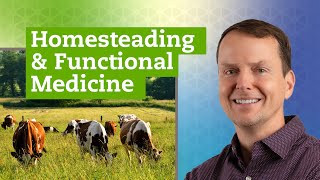
Aaron Hartman, MD, explains how raising livestock and gardening taught him functional medicine. He learned that trace minerals from kelp and sea plants improve animal health, that soil microbes increase plant nutrition, and that seasonal environmental cues like pollen and mold help predict patient respiratory problems.
Chapters
Having cows and chickens has made me a better doctor. It's made me better at what I do. Homesteading, having a farm, learning about growing plants, having a garden has made me better at taking care of people. So how is being more understanding of my environment, understanding animals and chickens and all kinds of things, how's that made me better at my craft and my art, which is being a functional medicine? Dr. One of the first things I learned when having cows was that in order to have a healthy ruminator, which are what cows do, they ruminate you, you actually have to give them the right amount of trace minerals. Now, typically for my cows, these are in the form of kelp that we supplement them with. But I also learned that cows need to eat microgreens. They need to eat fresh fescue, which means I move them around every week or so. And strangely enough, you know, cows eating grass that grow in their own feces and urine is bad for them, actually. So one of the things I learned was about how the sun actually UV light from the sun sterilizes the soil and kills parasites, actually helps with the ruminators. So how does this translate into human health? One of the things I learned early on is if I want to have healthy animals that don't get sick, they need the right food, the right soil, and they also need lots of trace minerals. And so when I learned that, I also learned about patients with hypermobility and how important it is for humans to get trace minerals, things like strontium, silica, barium, small amounts of lithium, and we don't get these trace minerals in our diets anymore. As my research led me down this little pathway of starting to use rare earth minerals, using sources for trace minerals like extracted sea salt or fulvic and humic acid or bone broth, became my go to for my family. My wife's adopted grandmother was Jewish, and she would talk to my wife about Jewish penicillin, which, again, culturally knew hundreds of thousands of years ago, this bone broth extract actually has trace minerals, bone marrow extract, that's really, really good for your health. And so taking care of animals, taking care of cows, and then rotating them, help me appreciate how the right trace minerals and the right kind of microgreens, you know, basically salads and greens, things like that, are really super important for your gut health. But even more so, as I was trying to grow a farm, I realized, how do I make soil? So I would start to take the feces of the cows, mix it with compost, mix it with other things, and realize that the Feces of ruminators actually superpowers or boosts the soil to make it more living, more active. And one of the results of having more bacteria and fungi in the soil is they actually, through things like fulvic and humic acid and these little, these chemicals, these acids they actually create break down minerals that are then incorporated into the plants. So all of a sudden now the plants are healthier, more vibrant, they don't get as disease stricken. Strangely enough, I didn't have as many issues with my plants getting fungi, getting overgrown with different bugs. Then obviously I had to weed and take care of weeds and stuff. But all of a sudden, understanding the soil health, understanding micronutrients, helped me have a better view on human health. One of the interesting things, as well as having a farmstead is I was in my environment all the time. We have about two acres where our house sits and some sides of the house have more water less than the other side. I started seeing how different grass would grow on different sides of the house near different trees, different flowers would pop up in the spring. And my entire yard was vastly different based on sun exposure, based on proximity to trees or the house. I started to really appreciate how the environment affect something as simple as your yard growing. But even more importantly, I started to see the trees blooming, blossoming. I started realizing for myself personally that when Forsynthia does this thing like in January ish, I usually have some February issues and then goldenrod when it pops up here and September timeframe, I have a little allergy kind of issues. I could actually start predicting from my environment when I'd see more bronchitis, more respiratory tract infections. Being aware of the environment, the seasons. I walk out in the morning to do some stretching outside. I could actually smell the mold in the fall, depending on how much it rained. I knew that week was going to be busy in the office all of a sudden. Being more attune or aware to my environment actually made me better at my art, made me better at practitioner, also helped. Taking care of animals, helped me realize there are things like environmental health, things like soil health that play into human's health. And ultimately that actually supercharged or super powered my ability as a functional medicine doctor. So why am I sharing this? Good practitioners are well rounded. Some are musicians, some are artists, engineers. But to be good at your craft, you have to have a broad based life experience. And one of the best things we all have access to is the environment. We can all learn from animals, we can all learn from birds. Just walking my property Seeing how the water comes down and where different. Like we were actually with my kids, mushroom forging the other day and just to see what mushrooms grow where basically based on the time of the year, based on humidity outside, all of a sudden becoming aware of your environment actually can make you better at what you do. Everything translates. All information is translational. And that's one of the things I've learned. There is no useless knowledge. There is no book or learning thing that you learn that doesn't apply. And part of being a human, part of being a clinical scientist, which is what I am, is trying to figure out how the things I'm learning can actually apply. One last example I'm going to give you all in this. I was actually reading a book, Team of Rivals. Actually. It's a great book. Actually it was a Barack Obama he recommended, it's one of his favorite reading books a couple years ago and someone else had mentioned. So I started reading this and it's basically about the rivals of Abraham Lincoln for his Republican candidacy back in the it was like 1860, 1859, I believe, convention, because the election was 1860. But and so one of the things is like a little one off in the book now back in the day, people were dying from tuberculosis all the time, typhoid, a lot of infectious diseases that we don't have issues with now. People were dying from the droves in the Midwest. It was interesting to see how people in Lincoln's life, how many people died from who knows what. But one of his rivals, I think Seward was his name, married, his wife had something like 17 children. She survived. They survived, did great. And I started asking myself, how do you have these people who would have so many kids make it to adulthood, whose wife survives having so many kids while so many people, including Lincoln himself, didn't? And there's a little line in the book said this gentleman did not follow the convention of the time, which was to avoid fresh fruits and vegetables. And that just lit something in my, in my head. Like they avoided the sources of vitamin C, trace minerals. Like could that have set them up for nutrient deficiencies? Reading another book, the Small and the Big, was really interesting because one of the pioneers in the women's movement actually died from strep throat. And when you hear the description of what she was passing away from, she developed a vitamin C deficiency. She started getting bleeding gums, teeth started falling out. And all of a sudden, connecting these dots, vitamin C deficiency. Back in the day, you could get a basic infection and you couldn't fight it off so all of a sudden learning, reading incorporating this these are all important things that I do on a daily basis Anybody we all should be doing this we all should be learning new things and incorporating them into our lives and learning how can we translate everything translates and so just something to think about and something homesteading and then reading books about different things and it also makes you read things a little differently picking up things from books that you wouldn't think you'd pick up that are about political issues happening and things and I was actually able to pick out health things from the time basically revolving around my practice and homesteading so hopefully this little rant was helpful just to realize that everything you learn has a purpose, has a meaning has a value and even being a farmer with a garden and having animals has taught me to be better at my art which is a functional medicine doctor who takes care of people complicated patients take care. Talk to you soon.