Neurodivergence, Anxiety, & ADHD: Raising Kids in a Post-Pandemic World with Dr. Ro
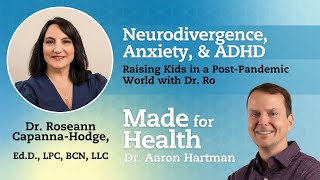
A recorded conversation (YouTube) between Aaron Hartman, MD and Dr. Roseann Campana Hodge about rising rates of neurodivergence and children's mental-health needs in the post-pandemic era. Dr. Hodge describes increases in autism, anxiety, ADHD, and suicide among youth; links early technology exposure, reduced play, social isolation during the pandemic, and lifestyle factors to dysregulation and neuroinflammation; critiques a siloed medical system that often favors quick medication over longer intake, family coaching, and body‑connected interventions; and presents holistic, regulation-focused treatments (diet/supplements, biofeedback/PEMF, vagal/breathwork, neurofeedback, parenting training, family-level lifestyle change). She also promotes her podcast "It's Going to Be Okay" and web presence (DrRoseann.com) as resources.
Chapters
Welcome back everybody. I'm super excited to have my friend and colleague Dr. Rowe. I'm going to introduce her to you all and then we're going to hop into an amazing, amazing conversation. Dr. Rosanna Campana Hodge has a podcast called It's Going to Be okay A Science Backed Solution for Children's Behavior and Mental Health. It's in the top 2% globally of podcasts. The podcast empowers parents with natural science backed solutions to improve children's self regulation and and calm their brains. Each episode delivers expert advice and practice strategies making it indispensable for parents of neurodivergent children and those with behavioral or mental health challenges. Dr. Rowe is the founder of the Global Institute for Children's mental Health and Dr. Rowe's company created the Neurotastic Brain Formula and Brain Health Reset. With her extensive experience, she provides families with hope and effective strategies to manage things like adhd, anxiety, ocd, Pandas and pans. Forbes magazine has called her a thought leader in children's mental health, highlighting her revolutionary impact on mental health education and treatment. Through her podcast and innovative methods, Dr. Rowe continues to transform how we approach, treat and understand children's mental health. And I'm so honored to have her today and you all are going to enjoy this conversation. We've actually already been talking for half an hour and having started the podcast yet, so.
Well, I'm so excited to be here. We really are. Our families are really good friends and our kids, when they get together, they're a deliciousness of Motley crue of different kinds of brains who are wonderful human beings. And Dr. Aaron is as awesome as he seems and so is his other half, Becky.
Well, she is the man behind the screen making things happen. So, so cool. Cool. So I want to hop into this with kids mental health. This is your jam. You were actually, if I remember correctly, you were one of the healthcare expert for. Was it Sandy Hook or.
Yeah, yeah, yeah. I was one of nine approved providers providing services to kids affected by Sandy Hook.
Yeah. And so it's one of those things like kids mental health. This is your field of expertise. You're one of few people, I mean you're one of nine picked for one of the most tragic things, things in our country and modern history. So I want to kind of just start like with the current state of mental health with kids in our country because you hear a lot of different stories about what the state really is. I want to talk about like what kind of trends are you seeing right now with kids mental health Kids, mental health. Because people come from all around the country to see you.
Yeah. And the world, actually, not just the country, but all over the world, people come in. And 95% of my clients are not local. Most of them fly in. And you know, what are the trends I'm seeing? So this is my third decade of supporting kids and their families and there are some real distinct trends that are absolutely happening. And heck no, it's not because we're better diagnosing, because you get newbies coming out of mental health and they're like, it's because we're better diagnosing. I'm like, no, we're not. So number one, we're seeing a huge rise in autism. One in 36 birthday births are a child with autism. I think that is really different. And I worked, you know, I worked in psychiatric hospitals, residential schools. So I had my eyes on a lot of things. These kids were not there at this level. And we through the pandemic, right. I mean they say we're post pandemic, but we're sort of in it, right. Dr. Aaron? So, so we definitely have an increase in all mental health issues. Suicide rates right before the pandemic had doubled. And we are now still it's the number one cause of death of young people. So that's really different. And anxiety is now the number one clinical condition. And ADHD is the number one behavioral. They call it a behavioral distance order. It's just a wired differently brain. And you know, one in ten kids have adhd. About one in ten kids have anxiety. I think anxiety is missed probably more than any other thing.
We've normalized anxiety.
I think that's a trend.
Parents are like, well, it's okay to be anxious.
It is okay to be anxious, but not to live in anxiety. If that is a consistent problem, you've.
Got a problem that needs to be addressed. And what has happened is people will.
Prioritize grades over mental health and then.
Long term chronic anxiety, as you know.
Dysregulates, the nervous system, leads to health.
Problems, leads to other things and usually there's a crash and burn. It goes to a crisis and then.
You go back and you look.
But for sure, a definite increase in behavioral mental health issues. Neurodivergence in general is much more common as all of our kids. The Hartman's and the Hodges are all, you know, for sure.
So you've seen all those things, those trends. You know, I just finished reading some stuff by Jonathan Haidt. I'm not sure how familiar his work is. And one of the things, you know, it's really funny, he. I want to get to this a little. The anxious child. You know, anxiety is like one of his things. And he had, you know, a prescription, you know, for addressing that. And it's amazing. Now what does this sound like to you? It's like, no, I think it was. I'm gonna get these a little off, but it'll like kind of like no. No cell phones before the age of 14, no phones in school, no social media before like 15 or so. And the last one was outdoor play. And my wife, who's a pediatric occupational therapist who specialize in kids with special needs, you know, it's like talking with her and she's like, yeah, it sounds like the 80s, you know, kind of sort of. Right.
I mean, hello.
Yeah. And so.
Right.
So talk to us a little bit about like technology screens, like. Yeah, I think people don't understand how this actually not affects my mind, affects a developing brain. Not just a brain. Yeah, you know, I can learn to play guitar at, you know, 51 or whatever, but a brain that's making the foundation for the rest of a life. Could you like dive into that please, for us? Like how do you think?
And I think I love that you say developing because I say developing all the time when it comes to, you know, what they are, what they're not doing. The meds were giving kids in a developing brain have long term implications and they're not the ones you think they are. You think you're going to do these things and then there's going to be a positive outcome. So when it comes to technology early. Right. There's lots of research going on and let's start with young kids. So what they're finding is that kids are who, you know, you're seeing one year olds at adult restaurants with, you know, a screen there. Right. So number one, they're not actually getting human interaction, they're not getting the back and forth with their parents understanding facial expressions, verbalizations. We're actually negatively changing the brains of kids. And so, you know, this is co occurring at the same time in the rise of autism. And I think we have to look at what are some of these components because there couldn't be particularly the first 10 months of a child life. Right. That's when the nervous system finds its ability to regulate. You know, that's where kids need to feel safe, they need to be picked up. There's a lot going on.
And you're seeing six months, six month olds being entertained with their Parents out at restaurants.
I'm like, what?
You know, I couldn't even imagine that right now. No shaming, but, you know, something's going on. And you.
You know.
But on the regular, no. So they're missing out on language. And then what also is happening is they're not getting play. So what does play do? Play does a lot. That is the work of children, right? So they're learning how to h. Cooperate with others. They're learning how to problem solve.
They're.
They're learning how to actually regulate their system and manage stress and frustration. And from a brain perspective, in terms of actual building skills in regions related to visual spatial processing, they're not doing any of those physical things that we need to do. And then they're getting themselves in this dopamine cycle where if they don't have something to do, they need a device. And then what is that setting up? Which.
What.
I mean, there are three things that everybody wants to talk to me about. I mean, it is, how do I get my kid off their device. It's picky eating, and it's.
How do I manage, like, overreactions, because kids are really overreacting. And this whole device component is a lot. You know, when they'll say, oh, you know, social, you know, it's sort of like, you know, I was never allowed to do sleepovers. I don't allow my kids to do sleepovers. And people would say things to me like, oh, you know, like, are you worried about it socially? I'm like, I don't worry about socially. It's cultural. I'm Italian. We don't do that. You know, like, this is our family values. And. And, you know, people be like, whoa. You know, so there's a lot wrapped around the pressures from the child themselves on the parents to the parents being exhausted. But, you know, it is. I'm seeing people move away from their devices because they're sick and tired of their kids only doing that. And in a bickering cycle, a nag cycle, an angry cycle about devices, actually, we.
I know in our family, we've noticed that it's really interesting. You know, the kids have devices. We take them away, and there's like three days of fighting and bickering, and then by day four, they're playing cards. They're, like, acting like, oh, my gosh, you're playing together, you're playing cards, you're playing chess. You're, you know, you're pushing your sister around, a wheelchair outside, running around to the mailbox. It's like, It's. It's amazing. Like all of a sudden you're becoming like humans, like good people almost interacting with each other. And it's almost like. With the technology, when we pulled away, it's almost like this withdrawal kind of thing that I see that we're now like none of our. Right now, none of our kids have phones. You know, we took them all away because it's like, it has a massive. And our kids are neurodivergent, they've got other special needs. But it's. It's kind of interesting to see. But I think the thing that just strikes me is it's now come to a national consciousness where the governor of Virginia a couple months, a couple weeks ago basically said, starting next year, no school, no phones will be allowed in public schools in Virginia, in the state. You know, you have Jonathan Haidt coming out with the book that basically says. And he's well known, he just says, go back to the 80s, basically with way. It's just interesting. Now it's finally coming to our public consciousness because it's such a big. By the time it comes up, you know, in our field, especially medicine, by the time it comes to consciousness, it's usually 10 to 20 years old. The data on the literature on stuff, you know.
Yeah. I mean, and it's, it's hard. It's a cycle that, you know, parents like, well, that's where their friends are, you know, it's like, well, find some other friends that you guys can all can get together and, you know, do what we did, like, do stuff, you know, so, you know, my kids didn't get a phone until they're 13. His brother has a hard time managing it. My older son, but my younger son, he wanted it. And then he doesn't even use it. I'm like, you don't even use him phone. It's fine. It's good. He uses it when he needs it. We have to say, like, you're at camp this week. Could you bring your phone because we might need to call you. And he's like, oh, yeah, you know, you know, so it, it, it is, you know, we have to be. And we as parents, you know, so have to be off our phones. I mean, yeah, we have to send. Role model it.
Yeah, we do. One thing you said was interesting was the concept of play. One of the ways I think about play, it's. You see, kids play, they're like little scientists. They're doing. It's cause and effect. It's like you crash this together, breaks, you Go out, you dig this hole, you look at this bug. Like it's so much experimentation, which ultimately that's how you have really bright brains, having really cool inventions in adulthood. And they start this practice of experimenting at a young age, seeing cause and effect and learning to think abstractly, you know, when you're, you know, six years old and older. And how do you see like that aspect of stuff? Because my question always is like, how would Einstein do in today's world? How would Michelangelo, you know, you know, whether, you know, whether you like the guy Elon Musk, how would he do, would he be, you know, making rocket ships to the moon or whatever if he was growing up today? Like, how did these things affect these kind of minds?
Because now, I mean, listen, computer technology is amazing, there's no doubt about it, right? But you need balance, right? So when you talk about kids and their play, they do need a physical motor component. And the great part about experimentation is actually failure. And you need failure. And you need to learn that you can't always get anything, you can't always do everything perfectly. And you know, some of the brightest people I know are not comfortable with failure and they let it limit them, right? So. But today's kids have very poor stress tolerance. And it's almost rare that I get a college student who's not on a medication because they're so uncomfortable.
Being uncomfortable and play is just one of those things where, I mean, this is important. We look at our happiest countries like that are rated happiest. Sweden, Finland, Australia, Canada. These are not other than Australia. These are not warm climates. I always think everybody's happier. These are countries that actually delay formal academics until age 7 and they do very play based education until age 7. That is changing the brain, right? Happiness isn't your stuff, right? It's how you get through life. Are you a glass half empty? Are you a glass half full? Right. Two people can have the same experiences and see it vastly different. The people that focus on the problem and not the solution tend to be much more negative. Right. But we can, we can be empowered by solutions through play and learning how to problem solve.
So you briefly touched about the pandemic, we kind of laughed about. We're still kind of in the pandemic. How do you see from a mental health perspective, how is that lingering? Because when that happened, the first thing I thought about, you have these little kids who one of the first things they do is read facial features. They lost that for two years.
They did, yeah.
So how do you, what happened with that and what's still going on because of that.
Yeah.
So, you know, as I noted, we know through the research that the rates of mental health, health problems are really at a high level. And as well as when we look at the American Psychological Association Distress in America survey and you know, parents are at all time high stress levels for parenting. Right. So that's sort of still part of that and there's a real complexity in that. But when we really look at, you know, kids and you know, how is this still affecting them? I can tell you anecdotally, I still get people today who are like, I never, my kid never recovered from the pandemic. And that social isolation was really hard on them learning remotely. I mean, some kids, like where I live, they were remote for that, you know, March to the end of the school year and the whole next year. So they, they lost the interactions. They, you know, my John Carlo's like a really easy student. He, he was out of his mind. He can't stand virtual learning. But he's a great student in person. You know, it wasn't speaking to, to, to people and, and we got so.
Reliant on disconnecting and connecting only through.
Devices and zoom and all these other.
Things that is continuing and it's changed the way kids interact.
It's.
I find it hard to get people to come over, you know, and I got an MTV Crips pool. You know, I got like all this fun stuff. We got all this stuff in the basement. It's like, it's a fun house that this house. And you know, people are, you know, oh, you know, oh, he's gonna be doing Minecraft today. And you know, all these other things. And if it's something like that, oh yeah, come over and play Minecraft. Come over and play Minecraft. It's the middle of summer. Let's get out in the pool. You, you know, so it's change of dynamics of play, Aaron. That and getting together. And people actually, you know, see friendships with who they're getting together and playing video games with. They might even be in the same state.
That's really interesting. So one with parents, you know, I'm gonna transition a little bit, what with all those things in mind, because you're seeing kids and parents, you know, obviously mainly kids. What are the parents. What are the top concerns with parents regarding their kids mental health right now that you're seeing, you know, you know.
Definitely see an increase in kids being really unfocused and everybody thinks their kids got ADHD and They didn't have, you know, like what is attention?
You know, what is adhd?
It's a neurobiological condition. Their brains work differently in terms of brain waves.
They tend to have too many unfocused.
Brain waves and too many, not enough focused. Right.
When I do my lovely QEG brain maps, that's what you see.
And so you then have to do a clinical history and those symptoms need to be there before age 12. And half the time when people come.
To me, it's not adhd, it's other things, learning disabilities, anxiety.
So I see a lot of attention related problems. Not just the kids, their parents are coming to me for the first time in their life. And what a lot of times it is, besides a learning disability is I.
See a dramatic increase in anxiety and.
Their parents, their, themselves and the child.
Is really struggling with anxiety.
I think those are the two biggest things and as well as a rise of all my cases.
So, you know, you and I are the same.
Everybody came to us right out of.
The gate because we love a complex case, because we believe everybody can get better.
I mean, we do, right? The degree is unknown, but everybody can get better. And because we know how to access the body, we know how to connect the brain to the body, all those components, but every case is complex.
Now, Erin, I don't have a simple anything anymore. I think that's a huge change.
A lot of infections and toxins.
I see a lot of seniors, sick families where people, you know, I have family out now. You know, the kids got, you know, they're, they're all pants. Everybody's pants, except maybe the dad and I. I see that a lot.
Yeah. When I talk with other functional practitioners and doctors have been doing this for 30 and 40 years, it's interesting. They'll say, hey, you know, back in the day I would just do gluten free, dairy free, low vitamin D, you know, a little outdoor and people got better. And now it's like, no, no, no. Everybody's got Lyman mold and a brain injury and some trauma and vagal nerves. It's like, it's, it's just complexity is much greater now than it was in the, in these worlds, you know, 30 years ago. It's the question all is why? And is it, is it technology? Is it the environment? Is it the food? Is it, you know, it was a statistic I read a couple years ago. Exposure to news feeds and social media by itself is associated with increased anxiety. You know, so it's like, I think it's everything I Think it's not just a single thing. It's not just Lyme. It's not just mold. It's like this big cauldron we're all sitting in.
And I completely agree with you. I don't think that there's one thing. However, what I do see is that people aren't doing things to regulate their nervous systems, right? So kids aren't playing. Well, that's an instantaneous self regulation activity. Then adults aren't powering down, Right. I always say you got to power down to power up. I mean, you need at least 10 minutes a day. Yesterday, the last two days for me have been cuckoo bananas. I don't have cuckoo banana, like, days. And, and it was so bad that I even like posted on Instagram.
Monday was cuckoo.
So the last two days, like, I. I was like, Chris, I could feel like my heart like beating out of my chest. Not like me at all. So I was like, I had to do like one hour of, you know, I had to do my pmf, I had to do my bath, and then I had to do like at least 30 minutes of breath work the last two nights. And you know what, I feel pretty good today. I'm afraid to check my slack channel, but we have to constantly counter. And my body can go into that state more easily because I'm doing something every day. And I think that's part of what, what it is, you know, when we look at other countries, right. So Europe does not have the same level of mental health problems that we do, right. They're.
They're inching up and the pandemic really.
Sort of increased things, but they're no way statistically near us.
Right. So globally, I think it's 1 in.
14 kids have a mental health or a neurodevelopmental problem.
And no, 14%. It's 14%.
One in a. Yeah, 14 out of a hundred. So. But they live a different lifestyle, they get more vacation, they're much more social. You know, in all of Europe, right, they lit most.
There's a lot of little towns where people get, you know, do things. And this is a real factor in how we as Americans were overworked and we're not as connected. And I think the pandemic really put fuel on the fire, on the lack of connection. And that is, you know, we know connection is super important for mental health.
Yeah, absolutely. How do you now, having discussed these things, how do you see our current healthcare system addressing these? Because both of us are kind of sort of outside the system, you know, yeah. And it's like, how is the system attempting to address this and how is what you're doing different? Because I don't think people realize, like, it's almost like two different worlds and it's like, you know it. So why don't you explain to us like how the typical system were to deal with anxiety and OCD and like how what you're doing is, is absolutely, totally other world, totally different.
And you know, I have been working since the early 90s and I'm traditionally trained and I just am like you, like I was working with people and, and I was like, hmm, psychiatric medication's not working, Talk therapy's not working. And I always say, like, I literally went to the basement of the library at grad school and looked at microfiche and I was like, wow, there's all these other things that nobody's talking about. And I went to a really cool grad school and focused a lot on neurodivergence. So you already have to think differently. Neurodivergence make you think differently. You can't just like, well, this is what it is and I got to fit in this box. They're wired differently, right? So I quickly started using evidence based approaches. Diet, you know, food supplements, different types of methods back then, right? So, and this is the body of my work. I mean, my whole work is about taking a dysregulated nervous system and getting it to regulate. And it doesn't matter what your problem is. If you're showing signs of understimulation and over or overstimulation. So under stimulation, problems with focus, anxiety, you're not listening or overstimulation, you're punching holes in the wall, or you're really impulsive or, you know, you're telling your.
Parents to F off. This is just a sign that these are outward signs that your nervous system needs to regulate, right?
So what we do, right, so we're.
You and I are using holistic methods. I'm using a lot of parenting methods.
The biggest problem in our system, right? You go, my kids having a hard time focusing, right?
So most of the time it's a pediatrician. So they're going to listen and they're responding because most parents now believe a pill is going to fix it. So the pediatrician says, oh, sounds like it's adhd. I mean anybody can sound like they have adhd. So they give them the meds and you know, maybe there's a temporary outcome. They like, maybe there's a worsening of symptoms. But 100% of time, there's going to be a side effect. Most parents have no idea of that. Right. They trust this provider. Behavioral support, parenting support, none of these things are often recommended. So parents don't know, oh, I'm actually supposed to teach skills. Right. Not just these pills. Right. And so then they get into this kind of roller coaster of up and down and up and down, and then they look for a magic wand kind of thing. And that is what is happening in the world.
And most importantly, what happens to that kid. That kid feels shameful, that kid feels stupid, that kid feels anxious, and you really damage the self concept. And. And in most families, you're. That family ecosystem has chaos. They have, you know, worry. They have all these things. So. So we're not empowering parents to things that are often. Many of the things that I recommend are very simple. Right. But they require concerted effort. And there's this disconnect between that. Yes, okay, there's something wrong with my kid. You just got to take this pill. And what can we actually do? How. What can parents say and do in particularly life's toughest parenting moments? Right. You know, your kids, you know, pissed off at you about your iPad. This. That's normal. Right. But then you put in a neurodevelopmental kid who's got a problem with listening, super impulsive. I mean, it could be a poop show at home, and people are in a lot of distress. And I think the traditional system is just not. It's not equipped. And let me tell you something. Traditionally trained mental health experts. Oh, they don't want to hear about, oh, you could do essential oils or you can do biofeedback. You know, they're just getting their minds open and. And they can be the most rigid of anybody. I hate to say it, but it is the truth.
Yeah. Particularly the more academically trained, as well, you know, it's. You know, I get a lot of patients coming my way from University of Virginia Medical College, Virginia, even Hopkins and Duke, because I'm kind of. My practices between those. And it's interesting how it's like, great, you have elders. Danlos. You go to. You go to Hopkins, get the diagnosis, and you get five specialists. You get your pain management, you get your psychologist, you get your cardiologist and your ophthalmologist, and it's like, like everything siloed. And all of a sudden you went from one problem, went from one problem to eight problems. I was like, okay, no, these. It's all interconnected. We have to, like, see how, you know, your anxiety. And this is something we might talk about, you know, when, when we talk after this, you know, how hypermobility sets people is part of neurodivergence. And all of a sudden. And how many of your patients are hypermobile? The answer is, I feel like they all are, you know, and all of.
A sudden, I mean, they almost never aren't.
Yes. And how that sets you up for a whole host of things. And now you have to realize you have to set up the environment for that child to develop as typical as they can. You don't want them to lose their edge. Because neurodivergence is an edge. It is, it is, it is an advantage in the right situation, you know, because you look at things differently, you see things differently. Unfortunately, our environment is such that it's pushing the kids down a bad pathway to dysfunction, not hyper function. Right. So one, one, one thing I want to ask, what are some innovations like you'd mentioned, you know, some of the old school we like, you know, we consider old school kind of things. What are some of the newer innovations you've, you've realized in the last one to two years that you're, or three years that you're implementing with some of these kids, with these dysregulated kids, these ADHD pandas, kind of. What do you, what are some newer things that you've discovered and been applying?
Yeah, well, I, I think in general in the pandemic, everybody was creating stuff and there are a lot of devices that help to support the nervous system in regulating and I made my own too. So I think that there, there just is a lot of, you know, oh, here's something that gets you in, you know, your vagus nerve. And you know, here's this form of PMF and here's this biofeedback. So, so I love it because there's a lot of ways to just generally calm the nervous system. And we're sending the message that this isn't a one and done. Right. So we have to continually tend to our inner garden. And sometimes these awful situations, My best families recognize these awful situations that happen. You know, our kids have pans pandas or severe OCD or, you know, something is major going on that actually it benefits the whole family. Right. And that the family learns lifestyle is key. So, you know, in terms of, you know, innovations, actually, really, honestly, the thing that I'm doing more than anything is helping parents come together for their child. That's an old school thing.
I think people have gotten so disconnected.
That it's really hard to, you know.
Get parents to see the problem the same and how to treat it.
So really getting very clear about what.
Happens in the brain and body is probably always going to be. It's always something I've done, but it's.
Become even more important.
So I don't know if that's an innovation, but it's something that I'm really focusing on.
And then, you know, I've created my.
Own magnesium because I didn't feel that there was a good magnesium for kids and family magnesium. So it has, you know, L threonate and glycinate, all these ones that are.
Super important for the brain.
And then I have my calm PEMF device. So I've been using PEMF for about 10 years. It's a type of technology. It sends a signal to the cell, disrupts cellular communication, and then changes the way the cells communicate so they work in a more healthy manner. And then it pulls you into a parasympathetic sympathetic state and then reduces inflammation, which then improves detoxification. So I have so many of. The neuroinflammation is just like the thing in. In mental health. And I have really focused more on neuro. On neuroinflammation because it's almost like I don't get a kid whose brain isn't inflamed. I mean, I can see it on a brain map, but you can hear it. So I have had to readjust. I don't believe everybody has pans. People come to me and they're like, are you one of those people think everybody has pants?
No, I don't, but I see a lot of it and it is really. Don't you feel that? I mean, today we were talking like it's almost rare that you're not getting people whose nervous system, whose physical health isn't infected by, affected by infection, infections and toxins. Would you agree?
I would well, actually have seen some adults with what in hindsight was probably a pans. Pans and an adult.
Absolutely.
Which. It's like. No, what's the, you know, what's these like, you can't have pans after like 26 or something like that or whatever.
No, pans now is not pandas. They've changed a diagnostic criteria for pans that you can be an adult.
Okay, all right. That. I did not realize that. But those. This was someone in their 50s who had an acute onset of anxiety, who, you know, had seen. They actually even had ECT therapy, which. Which is, you know, for People out there that's using electric electricity to induce seizures. You basically put on anesthesia, you induce seizures to reset and re regulate the brain. The problem with using that is that you lose brain cells. And so if you do it enough, you can actually have mental slowing and actually develop a. Like a dementia type thing, which is insane that we still are doing that in the 21st century. That's a technology from the 50s. But she'd had that done for, you know, almost 40 sessions. And within six weeks of starting some antibiotics to treat some of her gut pathogens, her anxiety, 100 went away. And then I was like, I remember she came back. I was like, what did I just do? Like, what happened? And it took me. It took me almost. Took me almost, you know, a year to figure out what actually had made the big difference. It was literally, she had pans, which at that point in time, this was like five years ago, it wasn't recognized as a thing. And so, like, it's there. It's just. We're not. We don't know we're seeing. We don't. We're looking at. And if you don't know what they're looking at, they're going to diagnose someone. It's just you're a little crazy or, you know, you're whatever, anxious or they don't see like your brain's on fire. And ultimately, brain inflammation or inflammation is a cause for, like, what's it not a cause for really?
I mean, and I think, you know, people are so disconnected from practitioners, and then people are finding this out on their own. But a lot of times people come to me, they're not connecting the dots. Like, I had a. My kid had a birth trauma. Oh, I had, you know, a head injury.
Oh, I was bitten by a tick.
I. You know, the staff who work for.
Me get to do, you know, use.
My services for free, which is why I get awesome people, because they all want to come and work for me. So I have just an unbelievable team.
Of human beings, beings that come and work for me.
They're just great.
And I have this woman who came to work for me, and she was like, I'm experiencing brain fog. Like, she's a Grazan.
I've never had brain fog.
So in listening to her is a great example clinical intake.
You know, just talking to her, I.
Was like, oh, this is gonna be hormones. And you had Lyme before she went.
To a great provider.
And I was like, you. Maybe you had something. But I was like, let's do a Brain map. So we do a brain map. And I was like, you had a massive head injury. Why didn't you tell me? And she was like, well, I didn't think that was the read it reason. I was like, I have re. I was like, I don't. I was like, you go back to your Lyme doctor. I don't see any evidence of Lyme. This is hormone destabilization. Normal hormone destabilization, but also head injury related. And she does neurofeedback. And this is not typical. So I don't want anybody to think they're going to come to me and get the same result. But she does four sessions. She goes, is it possible that in four sessions I could feel like a completely different person? And I was like, it's rare, but it's possible. She literally became a. She's like, I'm now my old self, you know, and, and you know, this is a very, very high level, smart person. And like, when you take down those abilities as an adult, but that just demonstrates, right? We as humans don't even think about those things because you're going to doctors. And nobody says that, hey, Lisa, you know, you got thrown from a jet ski. Maybe your brain's not working because of that.
Yeah, I mean, with my. I mean, you know, my wife. And it took. We were married for 15 years before I've connected the dots that her anxiety in grad school started after anatomy lab, which was a massive formaldehyde hit. And after that she has sensitivity to new carpets and new buildings and things. And I always chalked it up to hormones and, you know, crazy brain. It took. It took almost 15 years to like connect the dots. And she was talking one day and. And she said, well, you know, started doing that and she said, started doing anatomy lab. And since we went to the same place in school, we used the same space for the medical school and the OT school. Like, I was like, oh, I know that place. And just clicked, oh my gosh. You had a massive formaldehyde hit. And so sometimes with your patients, you have to work with them for a year or two or three to pick up these little things, you know, two hour intake. Right. How long is your intake you do on patients?
Well, Erin, it's supposed to be an hour, but it's often two to three.
Yeah, there we go. That sounds more appropriate.
Yeah, but I budget a lot of time, so I mean, I would say that, you know, an hour and a half to two hours, it's pretty much two hours. But, you know, sometimes Sometimes it's an hour because I already know the family. So I'm like, okay, I already heard about this, and they know it, and they. We get into it or whatever. But I would say, on average, about two hours.
How. How often. This is just more for my edification do you find out, like, you start working with somebody, and a year into it, new stuff comes up and you're like, that was the missing piece. That explains things like, now I understand better why you're stuck, you know?
Right. It definitely happens. I mean, you're like, me, We. We. We don't accept a lack of progress. So then there gets to a plateau. Then I'm like, let's dig a little bit more, whatever. And then, you know, their brain is working better, so they recall things differently. I mean, I had recently had somebody come to me, oh, my God, what a great family. So great. And so he's in his mid-20s, and.
This kid got sick at age 6.
And he's been in and out of psych hospitals and all these other things. They've done everything. So he came to me with a pans diagnosis and. And when I brain mapped him, I.
Said, this is a head injury. You've actually had multiple head injuries. And they were like, but the problem started before then.
I was like, I don't know about that. We're gonna have to figure that out later.
But this is what it is.
And I was like, go back and think.
Think.
So they knew there was a head injury at age 12, and there was a definite worsening then. But then they remembered there were four.
Four head injuries before that and started.
Just months before age six.
And these are very smart people.
I mean, like crazy smart people. So in there, right, you get into.
The weeds and you start educating them, and they start making connections, and you forget. And I think when you talk about that lab experience for Becky, who would.
Think, well, it's funny because with Dr. Jinsky, who, you know, we taught. You mentioned seeing him. He's on. We conversed with our YouTube channel stuff. He went to the same medical school I went to. And he was like, you know, I just didn't feel. He's. He's an intuitive kind of. He's got. He calls it a spidey sense. And he was like, I just didn't feel right. Like, I hated that space. And he. He was. He was one of those people that was smart enough. He would just skip lab, go to the textbook, memorize stuff, come in, look the lab for like, 30 minutes before test, and would like a Stuff, but he felt like intuitively he was like this. I don't feel good.
Feel right?
Yeah, I don't feel right. And his intuition makes. It made him a great ER doctor. It makes him a great functional medicine doctor. And your intuition, I mean, it's funny, you call it your clairvoyance. Like, you see someone and you're like, I. Boom, boom, boom. But even then, you still need time, which ultimately our current healthcare system, when you got 15, 20 minutes, I'm not sure how long it is for a psychology evaluation, but you need time, and you do need.
You do need time. And, you know, when you're talking about, like I mentioned the adhd, you know, like, pediatricians are good human beings. My God, they're doing an awful lot. I mean, they're, they're generalists. And so for them to get into the weeds with you, I mean, so.
Many of the families I talk to, I mean, I recently had a kid where I was like, your pediatrician didn't.
Think their kid was autistic.
I mean, even our secretary knows he's autistic.
You know, I was like, I'm not sure. And she was like, I knew, I knew. And I just disregarded her, you know.
And I thought, well, you know, if your people are telling you that and.
You know, you don't have time to dive into it, why aren't you referring to somebody who can really help that person?
I think that's.
That's the hard part. And people, you know, we have such. You are the top of the, the CEO period. Doctors, you know, are the pyramid. And parents feel like they can't talk back.
They can't.
I don't want to say talk back.
But question, make a different path.
And I think that is what's changing positively.
That's one of the most positive things I've seen in the last decade.
Cool. So we could, I mean, we actually talked for half an hour before we even started recording. I know we could keep on going. We'll have to do this again. Actually, we're going to be doing this again with you interviewing me here and maybe 5 minutes, 10 minutes. But if people want to hear more.
You'Re going to come up in your RV and you're going to come to my studio.
There we go. Problem solved. You know, if people want to learn more about this, who've got kids, like how they follow, because you got a great resource, why don't you tell us some of your resources you've got. If people want to learn more about this, where to Find you.
Well, you can find me, Dr. Roseanne, anywhere. So that's D R R O S e a n n dot com. You can go on to YouTube, you can go on to Instagram, but listen to my show. It's going to be okay. So it doesn't always come up as it's going to be okay. So just put in Dr. Roseanne and make sure to, you know, subscribe and. And listen and. And share it with another parent who's having a hard time. I think, you know, we've become so insular and we don't always find our tribe, you know. You know, I always, like, adore the Hartmans. One their good time on vacation and they eat all the same crazy things that the Hodges do. But it's real food.
We just eat real food.
I know. Eat real food.
How about that? You know, nothing fancy, just real.
And I always pick a good resort, you know, that's got real food, you know, but it's you.
We need people.
We need people. And there's a lot of, like, you know, there's just so much misinformation. But I have lots of things for parents, everything from free resources like blogs and podcasts to very inexpensive things that are under $100. You know, we have a group called the Dysregulation Solutions solution. It's really absolutely a directory for everything you need to know about parenting kids that are challenging, that are dysregulated and easy to use and simple. And I think parents are struggling. I created how to's and role plays for life's toughest parenting moments. So all you have to do is grab it and be like, okay. Dr. Rowe says, I say this when my kid's acting like a demonic possession over a device. And I don't think they realize how you just shift. Everybody's working so hard. You just gotta shift it to the right thing. But I'm really about impairing parents about there really are natural things and that are super effective at getting kids nervous system to regulate. If you can't regulate your nervous system, no learning's gonna occur. No, your attention's not gonna be the same. You're not gonna be able to think, think.
And guess what?
You're not going to be able to heal. And that is everybody of every age. You know, nervous system regulation is an essential component of the brain and body working.
Yes. Ro, thank you so much for your wisdom. It's always a joy to talk with you. I'd love to do this again. We are going to be doing it Again here in a few minutes. But I would encourage people. Dr. Rowe is an expert to field. She knows what she's doing. I think one thing that we don't talk about enough is we both have skin in the game. You have skin in the game. You've actually worked through it with your own kids for.
That's right.
Going on what's 15, 16, 17 years now.
Max is 19.
19. Yeah.
He got Lyme disease at 22 months. So you know.
Yeah. And so it's just one of these things like, you know, I feel, I almost feel like the best, the people at the best of their art. They're, they're the wicked smart. You're wicked smart. They're lifelong learners, you're a lifelong learner. But they also have this life experience. They have skin in the game. They struggle. They've been up and down and like it's almost like the magic sauce for that. I talk with this with Dr. Jensky. It's like it's like not just the head knowledge, not just the heart knowledge. It's like it's, it's like you practically work through it and you realize and you have more compassion. Think also like you have compassion for people. Like that is such a huge thing to be like, I've kind of sort of been there. I kind of sort of know it's no like to have a kid where it's like for me, I don't know if he's going to be dead or not or I don't know if my daughter's ever going to walk or see or for you, is my kid going to be. Sometimes I wonder if I still like, my kids are institutionalized, you know and to like go through that right on the outside and go actually my kids are actually turning into good humans that other people love to be around and interact great with other people. Like that is a journey that can only be replicated if you've actually done it and it informs all you do with the wicked smart and with the lifelong learner. So I feel like that's just like the magic sauce for you.
We're in their shoes.
Yeah.
And I think it is a different vantage point. You, you and I are, we absolutely are smart. Right. My, you know, I, I don't have any, you know me, I don't have any, you know, shame in that. But we are always going to be heart centered. But you're right, like, you know, I recently did a keynote and this lady was like, girl, it was like you were in my house. You know, I was Like, I've been there, girl. And, you know, that's what I talk a lot about in my show. I have no shame in sharing. You know, I am not a perfect parent, but these are the things that I know work. And I think, you know, like you said, even the diagnostic picture takes time, but the development of a human being takes time. And somehow we lose patience. When your kid struggles with friendships or, you know, they just need extra time.
To, to learn how to listen or.
Turn in an assignment.
You know, it is frustrating for them. It's frustrating for you, but it doesn't mean you throw in the towel. You have to think, wait a second, that strategy's not working. What else can I do, you know.
And we are different because we are.
This is our life. This is. We're doing the same things. And I don't ask my people to do anything that I'm not doing.
I usually do things myself with my family first before I introduce them to patients.
Yeah.
So it's. I do a lot of interesting things, you know, but the point is, like, you've been in there and done that, so that's awesome. Again, Dr. Roseanne, her show's amazing. She's a resource, the go to person at a national level and international. So if this conversation's been interesting to you want to learn more, I really super encourage you to check her out. So, Ro, again, thank you so much for joining us today.
Thank you, my friend.
Excellent.
More from Aaron

Too Many Gut Fixes Can Undo Your Healing. What Helps It Last | Dr. Sabine Hazan


Women’s Heart Attack Symptoms Differ From Men’s 95% of the Time — Only 30% Have Chest Pain #shorts

Heart Disease Kills More Women Than All Cancers Combined — 80% of Cardiac Research Is on Men #shorts

Women’s Physiology Was Systematically Ignored in Drug Research — The Consequences Are Still #shorts



It Took the FDA 20 Years to Realize Women Need Half the Dose of Ambien #shorts

Until 1993, Women Were Banned From Clinical Drug Trials — Then Those Drugs Were Prescribed t #shorts