The Health Journey of Certified Nurse Practitioner, Jodi Caddell: Part 1
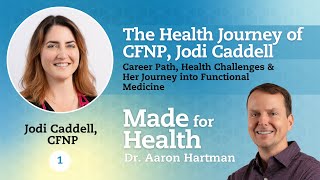
A recorded interview (YouTube video, June 4, 2024) in which Aaron Hartman, MD, interviews certified nurse practitioner Jodi Caddell about her career path—from a music degree and arts management to nursing (returned to school at ~35), five years as a hospital nurse (step-down/cardiac unit), four years part-time NP training, and seven years in family practice—and her transition into functional medicine. Jodi describes what drew her to functional medicine (family members improved with dietary changes), her own diagnostic journey discovering SIRS and mold exposure in her home, and the clinical and professional benefits and challenges of adopting a functional-medicine practice model.
Questions this video answers
June 4, 2024
About 35 years old
Five years (step-down/cardiac unit)
Four years (part-time)
Seven years
Chapters
Welcome back, everybody. Today I'm talking with my friend and colleague, Jodi Cadell. And we're learning about Jodi a little bit today about her career, her life, what got her into functional medicine. A lot of cool questions. You can get to know her a little better if you like these videos. Please, like, Follow Us, subscribe this is how we share information with people, how we get that information out there. So with that, let's begin. So good to see you in jeopardy.
Good to see you as well.
So why don't you tell us about your. This is going to be learned about you a little bit. Tell us about how you got into medicine initially. Like, what was the dots that kind of came across to get you ultimately to end up being a nurse practitioner? Because that was not what you first wanted to do.
No. So my initial degree was in music. I was working in arts management in my 20s. And then when I moved to Richmond, I couldn't really. I couldn't really decide what I wanted to do. There wasn't a comparable type of career down here in Richmond. I was up in Northern Virginia and I had always been interested in medicine. When I was in high school, I thought about being a doctor. I thought that would be really fun. But so I talked with my husband about it a lot and then I decided to go to nursing school. So I was, you know, I had, I had already had my children and I had. I decided to go back to nursing school when I was about 35.
That's actually where I first met you was actually.
Yes, when I was a nurse. And you were on the third floor. Third floor, which was pcc?
Yeah. So how many years were you actually in.
I was there for five years.
Five years. So you worked in the hospital situation five years? Five years. And what's from. From that. What kind of got you into thinking? I think I want to go into. To start become a practitioner, going on that professional route.
I think being a nurse practitioner was my ultimate goal when I went to nursing school. So I knew that that was kind of the direction I wanted to go in. I wanted to see patients and treat patients, but I really wanted to be a nurse and I wanted to have that experience of working in the hospital and learning in that environment. So it seemed like the right path. So after I finished nursing school, I worked in the hospital and, and then I started NP school. While I was working in the hospital.
How many years did it take for you to finish NP school?
It took me four years because I did it part time.
Okay, so you're Doing that while you're working. So working full time, going to nursing school, NP school. And like, tell us about the hospital experience. What kind of patients did you see in the hospital? How did that kind of contribute to your clinical expertise? Like what kind of people were you working with or seeing in the hospital?
We mostly saw cardiac patients. So I feel like I had a really good kind of cardiac background. We saw a lot of patients with heart failure. We also saw more acute patients because we were a step down unit. So we would see some patients on ventilators, some patients on multiple IV medications. So I got to see a little bit of everything, high acuity and low acuity. And it was. And I had the opportunity to meet so many great physicians and practitioners there that were great about explaining things because I was always really interested in what was going on. I would always sit with the pulmonologist and say, hey, can you explain this chest X ray to me so I know what I'm looking at or I'm looking at. This guy's here for a GI bleed. I talked to the GI doctor and he would explain things to me. So I was always trying to learn more about the patient that I was seeing. Not just, I didn't just want to go and give them their meds and then leave. I wanted to know what was going on with them.
And one thing just to clarify with the step down, that's patients who are in the ICU who had been ventilator sick, heart attack, you know, bypass surgery, whatever, intense thing that still were pretty sick, but not, you know, well enough to go to the regular, exact floor. They need a higher level of care. So you basically had a lot of experience with pretty sick people.
Yes.
Learning how to manage them, knowing when you need to call someone else in because like in the middle of the night.
Yeah.
When they're like crashing probably called you.
In the middle of the night.
Probably. You may have, yes. And so to learn that nuance of this someone's sick, this is what this cardiac pulmonary pace. So you basically got a good, good grasp on some working with doctors on these really sick, sick people.
Yeah.
Okay. And then you finished your nurse practitioner school. And when you started deciding, like, you know, hey, I want to actually develop, have a clinical practice, what fields were you looking at or thinking about before you, before you dived into primary care?
Well, the two examples that I gave about cardiac and gi, those were two areas that I was interested in if I was going to do a specialty. But I wanted to really do family practice to see where what interested me the most and what. And I felt that it would be the best place to learn and grow as well, instead of just learning one thing. And I think it's important to know one thing and know it really well. But I wanted to kind of learn about everything before I made a decision if I wanted to go into a specialty. And then I wound up loving family practice and was there for a while.
How many years were you doing practice?
Seven years now.
Remind me real quick, because I feel like for. While you're doing so, five years nurse in the hospital, seven years in family practice. But you also were going to the hospital as well, correct? In the beginning part.
At the beginning part, I rounded at.
The hospital because you're working with a physician who saw. So you were actually not just doing outpatient, but you also were. Patients would get admitted to the hospital. You were going in and evaluating them and then working with the doctors, you know, consulting them on the patients, which is a kind of interesting.
That was a weird thing to go in and see my old nursing colleagues, but I was sitting in the, you know, the same chair, but, like, making the different decisions, you know, being the provider that time and putting the orders in and that kind of stuff.
And then. And then learning that under, you know, another physician who've been doing this for, you know, I think at that point in time, 30 years. So that's a kind of a cool, interesting transition. So just learning and learning. When did you first get the twinge or the inkling that doing functional medicine, like the next level, when did that first kind of come on your radar? Even if it was a thing or even if it even existed?
So I wouldn't have known it was called functional medicine. I think two things happen around the same time. My husband was diagnosed with celiac disease. So I started learning more and more about diet and how it can heal you. And then around the same time, another friend of mine was diagnosed with Crohn's disease. And she is very well read and very knowledgeable, and she really improved her quality of life and her health just through diet alone. And that just fascinated me. And I was like, you know, why are we focusing so much on giving people these medicines to treat the disease? Why don't we, you know, change their diet? And, you know, and so that. And I think that's where I got kind of the bug about it and didn't really realize it was functional medicine until you started doing it. And I said, I saw what you were doing in your practice.
So you went from being in the hospital where you'd see Crohn's and ulcer class patients being admitted and having surgeries done and having colectomies done and all that fun stuff, and having IV antibiotics, steroids, biologics. So then seeing your husband, your friend manage their disease without.
Exactly.
Medication.
Exactly. And they have a great quality of life. Yeah, yeah.
Minus eliminating foods that make you need surgeries.
Yeah, they seem to do fine without the, you know, the gluten and the. That kind of stuff.
It's a good. It's a reasonable trade off.
I agree.
And so you were doing that, doing family practice. Seven years. So we're at 7, 8, 9, 10, 11, 12, year 12, I guess working the hospital, still managing sicker patients, but learning the outpatient. And then you decide, hey, I think I want to do this functional medicine. So what was going through your head that point in time? Because you have an inflection point. It's like, you know, you have a guaranteed job. You know, you're a nurse, you're a practitioner, you can always get a job. Now this is kind of, you know, a. Are there jobs out there for this? Can I actually do this? Why don't you talk about some of that process?
I don't know if this is the right answer to that question, but I feel like I wanted to learn more, so I actually became a patient. And so that kind of got me into seeing what was going on during a functional medicine evaluation and seeing what lab they checked and that type of thing. After that, before even thinking about starting another job, I just started looking at the IFM website and I took a class to kind of learn some more and see if I was interested in it.
And we were comfortable talking about. So as far as what kind of health issues were you having? Like, you mentioned that. You said it, you said it, you said it kind of like, oh, it's. I've become patient like. But what were you dealing with first? What were you dealing with first? And second, had you seen other doctors and what had been your journey with that before you decided to try this alternative route?
Yeah, I just started not. This is going to sound a little crazy, but I started just not thinking as well as I used to. I felt like I wasn't as quick as I used to be. I had trouble thinking of the right word to say. I was always tired, gaining weight, and I just assumed that that's what happened to women in their 40s. And I may have seen one doctor about the fatigue, and they checked my thyroid and it was all normal. And then I went and I joined your practice and I saw Dr. Jensky and we discovered that I had SIRS and I had mold in my home and that was just mind blowing to me. Never in a million years did I ever think that there was really something wrong with me. I thought it was normal. And then doing the treatment and it's been amazing. I mean some days are better than others, but I feel like I can think again. I feel like my brain is back and that type of thing.
And how long have you been working on the csrs?
Three years.
Three years.
I took a little time off.
Yes you did.
Yeah.
We had to like remind you to.
Yeah, yeah, please come on back.
Yeah, so. So what I'm hearing because I don't know your individual case story as well as others, but you felt like this is normal. I'm a 40 year old female, I'm a mom, my wife, I'm professional, this is normal, this is my friend. This is where everybody experiences. Right? What else could there be? And so it wasn't until you decided to try something a little different you realized, wait a second, this normal amount of fatigue and weight gain and hormonal dysregulation and we have any other issues like sleep issues or non restorative sleep?
No, I like to sleep. I'm a good sleeper.
Any gut issues?
I had a lot of gut issues. I don't know how much you want me to get into that, but those are so much better. So what like IBS type of symptoms?
So technically like more like ibs, not inflammatory like with your.
No, not like my husband and friend, but yeah, terrible IBS and that. I never even realized. It was just so normal to me. I'd had it for, since, since I could remember. When I was a teenager, I probably started having it.
So. So you had IBS issues since teenage. Since you started, you know, cycling or whatever?
Yeah, yeah, yeah, exactly.
All of your adults.
All my adult life. And that I, I don't have it anymore.
So you had that from beginning your cycles to a couple years ago and you thought that was the normal thing?
Yeah.
It's really kind of interesting how much things like pcos, endometriosis, infertility, a whole bunch of typical normal female issues actually revolve around the gut microbiome, the gut bacteria detoxification. And because so many young women deal with it, it's like just like the rest of my friends and people don't realize this is actually not. I mean it is normal, but it's not optimal. Unfortunately. It is quite, quite normal. And so now your guts never been like this in your adult or child?
Yeah, yeah. It's much nicer and you still love.
Sleep, but your brain's working better, you feel better, which is kind of cool that you, as a nurse in hospital for five years and as a primary care person working still in the hospital around a lot of experts in the field working with GI doctors, it took a different way to realize that what you're dealing with, which was normal, really wasn't.
It wasn't.
Yeah. So cool, cool, cool. So you said you took a couple classes with functional medicine, so start learning side. You want to go into it? What are your, you know, what do you, what's challenging about functional medicine? What do you find challenging?
It's challenging to change your way of thinking. You know, you've been, you've been trained a certain way to look at the symptom and treat the symptom. But this, this I have to think about, well, why, why is that happening? And obviously digging deeper and finding all these, you know, looking at the gut microbiome, looking at your vitamin levels, looking at your hormones and, you know, trying to fix that so that everything else works properly. And that's, that's been the hardest part for me, just trying to wrap my head, excuse me, around thinking differently because I still. A patient will come in and tell me something and my immediate thought is, oh, this is the medicine we can give them to fix that. And I'm like, no, that's not what we do anymore. That's not what we're doing here. Not that that's not important. I think that, you know, sometimes those medicines are necessary, but that's not, it shouldn't be my first thought. And that's what I'm having. You know, that's the hardest part for me right now.
What's, you know, when I first started doing this, what was difficult for me was like, wait a second. People sometimes refer to as imposter syndrome, but wasn't. It was more like, like, is this real? Like, can you really change someone's diet? Can you really do an advanced stool test on them and look at bacteria in their gut and pick up these crazy markers and then basically add in what they're lacking and remove some inflammatory foods. Will that actually change their thyroid antibodies? And the way they're thinking, like, you kind of see that. You're like, wait, is this real? And then you see it over and over and over again. It's amazing. Like, it took me a couple of years before I Was like, this is my new normal.
Yeah.
Because there's so much like, is this. And then you're like, well, how come other people aren't seeing this? How come no one else is doing this? Like, in Richmond, Virginia, we have 1.2, I think 1.3 million people in this area, and there's really not. This is really not happening anywhere else. You know, who's doing it, the level, we're doing it here. And you realize that this should be the standard of care. Like Dr. Jensey says, this is good quality medicine, but it's still unheard of and still not the kind you see your friends and other, you know, healthcare colleagues, other nurses, other physicians, people, you know, what have their thoughts been about your transition to kind of practice? Because you're still early in your transition.
Yeah, yeah, they think it's cool. They're. I mean, they're interested in it. I think a lot of my friends are, you know, nurse practitioners or PAs or they're just fresh out of school. And I think because I used to train a lot of students, too, so I have a lot of friends that are just fresh out of school. I think they're starting to think about things differently in school now. And so this kind of stuff isn't so outside of the norm for them. So I think that's good for the future because they definitely are thinking more about the root cause and that type of thing.
So with your, with your mold experience, your sirs, what was the biggest. Well, actually, we'll talk about that next one. Let me talk about your personal journey. Jump to that. What's been the most difficult thing with you? Because you're literally changing you changing the career style. You're not, you know, physical is not 15 or 20 minutes now. It's an hour. You know, when your typical patients come in, you're having half an hour, a little more time with them. You know, you have other modalities and, you know, cool IV things you can do with patients. You know, like, what's that been like to all of a sudden, like, in my mind, just almost like, you know, Alice in Wonderland, where you kind of go from this black and white world to color and you're like, like, how's that been as far as.
Like, that's been the best part of the transition. I mean, seeing 20 or 25 patients a day in family practice, I mean that, you know, you just, you, you have to figure out. Figure out what's wrong with that person in two minutes and then get out of the room. Now I get to have a conversation with somebody. I get to find out how, you know, just really delve into their symptoms and other things about their lives that might be going on that could be contributing to what's happening. I can. Like you said, I can. Oh, you're sick. Well, let's go have an iv. This will make you feel great. And I can take them into the other room and give them an iv and so things like that. And then they call the next day and they feel so much better. So that's been so amazing. So it's a different pace, but it's. I love it. I love to really connect with my patients and talk with my patients. And this gives me the opportunity to do that where I feel like I didn't have that before.
One thing as well is like the whole margin. People don't think about, like as a practitioner, Physician, nurse, practitioner, specialist. Like you need margin in your life, time to think, to process the patient. Like, what's going on. Connecting dots, having time. They. All these labs come back and you get, you know, 20 vials with labs back and they haven't time to think about. But when you're like going from room to room to room. I remember we were talking before, you would be at the office till 6 o' clock just doing paperwork, and it's like you don't have time to actually think about your patient's story, to review the chart, because you're just, you're kind of. You're always in crisis mode.
Yeah.
You know, and so like versus this kind of medicine, it's like, no, you have the margin to like sit and ponder a patient. You have your own personal margin to be the best you you can be. Cause if you're not the best you you can be, how can you take care of these really complicated patients?
Right, right.
What are your thoughts about what I just said about that as far as, like, that aspect of things?
That aspect has been fantastic and super challenging at the same time. So the, you know, I get all these labs back and I really want to spend a lot of time with them, whereas I couldn't do that before. But it's also, it's also challenging for me because it's new for me. So I'm learning as I'm going. So it takes me, I feel, twice as long to go through it. But the great thing is I have that ability to do that. And I feel like what I'm giving to my patients is very thought out and planned and hopefully really beneficial to them.
One thing that's. That we have a very collegial environment here. It was like that, you know, you know, you have, Dr. Jensky has ER, experience. If I have a question about something super acute, you ask him. You know, I'm, I've got primary care experience, he'll ask me about questions. So it's really, I think a great environment in that here we have the ability to ask people who have different clinical experiences. I mean between the three of us, you know, I mean he's, we have like 56, almost 70 years of clinical experience combined. Yeah. So if you look at it like that. Yeah, that's a lot of time between the three of us. And it's at the same time it's like there's things that you would have seen as a nurse in the hospital at the step down that I would have never seen because I was usually there for about 20 minutes, I was leaving and then I might get a call about something and literally the nurse is a person making it all happen. And that just gives you a different perspective that you don't have on the other side. And then Dr. Jinsky and the ER, that perspective. And so we have a very diverse kind of nicks here. Well, typically between the three of us we kind of have a good idea of what to expect from different.
Right.
Super emergent, you know, icu, step down primary care. It's a pretty, pretty broad swath. If someone, if there was one of your nurse practitioner colleagues, doctor colleagues, someone else who's like listening to this right now, who's like, that's kind of cool. Like she did that, she's, she's transitioned from, you know, the only cup of medicine I know to this like what would be your words of encouragement as far as if someone's thinking about, you know, getting into this deeper medicine, you.
Know, don't be afraid to be open minded. I mean I feel like one of the biggest, one of the, one of the biggest things that frustrated me in conventional family practice was patients that we see here. But those type of patients would come to me and they'd be frustrated because they, they couldn't figure out, no one could figure out what was wrong with them. And you know, in the conventional practice we didn't have time to spend with them and we also didn't have, I didn't have the knowledge. Nobody has the knowledge. So my, you know, take, take one of the, take the AFMCP introduction class. It's, it's really mind opening and it's, you know, you get this basic knowledge and you can apply it in your practice where you are at that moment.
Yeah. Cool. Cool. Well, thanks a lot for sharing with us about your personal development. I think next time we're going to talk about your health, your house.
Okay.
More personal, but also in the weeds because I think ultimately people need to understand that all of us are not just highly educated individuals. We're also real people who have real families who actually have our own personal struggles. And, you know, just because you find the magic bull doesn't mean that fixes itself automatically. So dive into that a little bit next time around.
Okay, Sounds great.
Thanks a lot. Take care.
Bye.
More from Aaron


Too Many Gut Fixes Can Undo Your Healing. What Helps It Last | Dr. Sabine Hazan


Women’s Heart Attack Symptoms Differ From Men’s 95% of the Time — Only 30% Have Chest Pain #shorts

Heart Disease Kills More Women Than All Cancers Combined — 80% of Cardiac Research Is on Men #shorts

Women’s Physiology Was Systematically Ignored in Drug Research — The Consequences Are Still #shorts



It Took the FDA 20 Years to Realize Women Need Half the Dose of Ambien #shorts