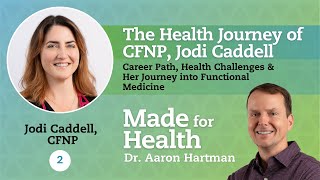
This is a transcript of a YouTube interview (recorded June 10, 2024) in which Aaron Hartman, MD interviews CNP Jodi Caddell about her personal health journey and experiences with functional medicine. Key points: Jodi had lifelong IBS and anxiety that worsened at college and after moving into an older home; during evaluation with Dr. Jensky she underwent extensive testing (bloodwork, GI Effects stool test, salivary cortisol, metabolomics, amino-acid/organic-acid testing) and was found to have markers consistent with SIRS and a failing home environment (failed vision test; ERMI dust testing showed problematic mold levels). The discussion covers pancreatic elastase insufficiency (linked to SIBO/dysbiosis), ERMI testing method (dust sampling with a Swiffer and PCR-based quantitative results; ERMI score guidance mentioned), challenges of remediation and the partner/spouse buy-in dynamic, common setbacks when care continuity is interrupted, and the central role of foundational lifestyle measures (diet, exercise, sleep, social connection) in functional medicine.
ERMI (Environmental Relative Moldiness Index) testing — collected by dusting house surfaces with a Swiffer-like cloth and sending the dust for quantitative PCR analysis.
An ERMI score of less than 11 was mentioned as okay.
SIRS (Stachybotrys-Induced Related Syndrome / or the speaker used the acronym SIRS to denote a mold-related inflammatory response).
Chapters
All right, welcome back once again, everybody. And we're going to do part two with Jody, one of our practitioners here at Richmond Integrated Functional Medicine, talking about her personal healthcare journey. What kind of got her into functional medicine. Today we're going to talk about her actually personal health journey, which she shared a little bit last time. So I want to take, I want to unwind things a little bit. So you had mentioned that, you know, from when you first started, you know, cycling, you were having some, some gut issues. Could you like, walk us through some of the other things that you've learned in hindsight that were going on with the sirs that back then you thought were probably just normal stuff?
Yeah, well, just. I also had a lot of anxiety and I think that I had the, I had the IBS from, you know, time as a teenager, and then I started developing anxiety when I was in college. And now looking back, I'm. I wonder, I know part of it was situational, but was it living in a dorm as well? Was I exposed to something in the dorm that really hit, kicked off that anxiety? And then I was fine for years and then I got married and moved into my husband's really old house in the museum district and I developed anxiety again. Now was that situational or was that another mold hit? So that's something that I've thought about now that I, that I know all this kind of stuff so well.
It's kind of interesting because my wife, Becky, one of the things that happened to her in grad school, she got horrible anxiety in grad school. And as her loving, caring husband always minimized it, she knows Becky and come to find out it was the formaldehyde in grad school and the anatomy lab at mcb. And it was interesting how in hindsight, like going to visit parents with new carpet, anxiety flaring. And so all of a sudden the usual typical something that people deal with becomes a marker in your timeline, which is one thing you do when you do your functional evaluation. Like, is this really just good fashioned anxiety or is it environmental chemical biotoxin exposure, which is kind of interesting?
It is.
Did you ever have any kind of like dysautonomic kind of things?
A little bit in college. I had a couple of fainting episodes in my early 20s, but I haven't really had issues with that in the past 10 years or 15 years.
So that's kind of interesting. They got things. So when you first got your evaluation with doctor, with Dr. Jensky, what are some of the tests that were done? Like all the cool Tests. Right.
We did lots and lots and lots of blood work. We did the GI effects. I did the cortisol, the salivary cortisol test. I did the metabolomics, I think, as well. So those were all. What's the one that does the amino acids?
Amino acids, yeah. You could either organic acid test or just a strip.
Amino acids, yeah. So I think I did that as well.
So one of the things I think is really cool is the GI effects. And we talk about that a lot. So why don't you talk about some of the things? Like when you, when you see a GI effects, which you've seen lots of those at this stage, what are some of the things that test actually tells you when you do? And this is the thing about the gut all starts in the gut. You know, we learn it in our functional training. And all disease starts in the gut. It's where 80% of your immune system sits. So why don't you talk about GI effects as you're, like walking through it? Like, what are some of the things that actually tells you about your gut that you really won't get right looking at a test?
Well, you know, thinking about it as the columns go across, I mean, you know, if you're, you're not. Maybe you're not digesting your food properly, so you're not getting your nutrients from your food, maybe you've got inflammation, like when the secretory IGA is elevated and that shows some leaky gut, it shows the microbiome, and if that's off or not, it shows, like, your fatty acid level. And if you're feeding your gut enough, if you've got yeast overgrowth or bacteria overgrowth. So none of that kind of stuff would be in a, in a regular, you know, stool test.
One thing that really fascinates me is the pancreatic elastase level. I don't know if you've noticed, like, how many people come back with low pancreatic elastase function and you're like, I had no idea this thing is so common in the hospital. You'll see commonly elderly people, right, Kind of normal to be older and have panic crack insufficiency, to see younger people have it. Like, what's going on here?
Yeah, I just saw it today. Yeah, like, what's going on?
What's interesting as well is how many, particularly kids, who have that. It's actually their sibo with dysbiosis. And once you address that, the pancreas elastase nullsis.
Right.
That's all kind of fun. To see as well. So did that. Then when did the molding come into play? Because you eventually got the diagnosis of SIRS.
I think just in my intake evaluation with Dr. Jensky, we were just talking about some things and he just said, it sounds like you have sirs. And that's just kind of what he said. And then he's like, let's check some labs. Go do this vision test. Go test your house. I failed the vision test. My house was not suitable for living in and all of my other markers were elevated.
Yeah. And remediating a home is challenging. You know, where's the source of mold? Is the crawl space? Is the air handler? You know, a beautiful older home? Like, what was your. What was your family's experience? Because you're. You're married, you have a husband, you know, and so now you bring this home to him. You're like, hey, we have mold issues. Like, what was that experience like?
He's like, he was. He was not happy that we had a mold issue. We thought that it was that. We thought we knew where it was coming from, but then we found something else that was visible. So we did our own remediation. We knew we were going to move eventually, so we did our. We didn't do a full remediation, which we should have, so I didn't get better. But we then we did moderate remediation and then we eventually moved out of the house.
One thing that's interesting, I think, with the mold testing is typically, and this is something, you know, they can come in and do like a sport trap testing the little round circles, and they usually don't pick anything up. And so it's like the level we're talking about. Did you do ermi testing?
Yes.
Yeah. So why don't you talk about ermi testing? Because I don't think people, they say mold testing and remediation. It's just a total, totally different level than like someone coming in, looking around, sniffing, and putting a plate out.
Right.
Like, what. What is this ermi test thing?
Well, it's testing the dust. Right. It's testing for the bacteria on the dust that comes from the mold. I think that's right. Yeah. So. So you just. You dust your house with this Swiffer. You dust different areas of the house and then send it back and they give you a score.
Yeah.
And what is it? Like, less than 11 is okay with the.
Hurts me too. Yeah.
Yeah.
But it's actually a pcr, quantitative PCR test. So which it's like csi. It's like it's literally Miami CSI in your house. We're taking a Swiffer. And the one thing like it's, you know, can be frustrating sometimes, is that if you had a water damage five years ago, 10 years ago, that was remediated, you can still have particulates that get picked up. And so sometimes it becomes difficult to fix. Figure out is this old or new or ongoing.
Right.
But that's how sensitive the test is. We talk about remediation. Some people, when their immune systems are active, you need something that's that sensitive. A typical mold inspector, and this is more for people listening, is not going to pick this up.
Right.
Because it's not clearly visible. The water damage is not clearly visible. The boards, the floors aren't actively wet, there aren't active dripping. And so it's almost like the person becomes a canary in the coal mine. And you know there's a toxin. Not because you smell it, because you see the canary is not doing so well.
Right, right.
And then you kind of reverse engineer it. So what was the. With your husband like? Was it. What was. Because we, you know, obviously deal with patients and the spouses come into play. Like how difficult was it to get buy in? Hey, we need to address this. Was it, was your husband already there or was he kind of.
He wasn't all the way there because he doesn't have any issues or that he knows of. And so he's, he's, he's fine. And I think, I think some of a lot, you know, sirs is basic. You know, it's an invisible type of illness. You know, so it was, it took, it took him seeing the test, it took him seeing that I was getting better when I was doing different things to really buy into it.
Yeah. So the way sometimes explains those patients, it's kind of like the stock market. It goes up, it goes down, but your general trajectory should be up right.
Right now.
A lot of times I'll see people who only focus on the down parts. And it can be many times the mold cognitive plant or response syndrome acts to brain like a trauma. And so what can happen is the down parts, people accentuate them because they're like, oh no, I'm going, I'm not making progress. Right. If you take a step back, you're like, no, I'm doing well. You know, why don't you talk about some of the setbacks that you had? You know, how did you know if you have a particular setback, you remember more vividly than others or something that kind of Stretched in the mind that.
Like you, I can't. I can't recall a specific setback, but I do. I do know that when you and Dr. Jensky moved practices, moved offices, I stopped going to appointments because I. The. It just wasn't as easy. And then. So I wasn't doing very well. I gained weight. I, you know, was still having issues with thinking and things like that. So once I. Once I started here, I really buckled down and got back to doing the things I was supposed to be doing and got a whole lot better pretty fast.
Which is kind of interesting how that's a pretty typical thing where people. People need support. Really hard to get your meals squared away and get your gut squared away and your stress and sleep. A lot of this is environmental medicine. A lot of it's communal medicine. So it's really. I don't. People that are really good, particularly mold patients, usually have the right kind of support, which also includes place they work or all sorts of other kinds of great things. What would you say if you were talking to someone who's skeptical about functional medicine? You know, a patient who's coming to see you? Like, I'm not quite sure about this, but I'm here because, you know, my sister, brother, spouse said I should be here.
Yeah, that makes me just go back to diet and exercise and lifestyle. You know, no one, no conventional doctor is ever going to say you shouldn't eat right and exercise. I mean, that is fundamental for our good health. And I think that's the basics of functional medicine is good food and exercise, and that helps with your health. So I think just kind of framing it like that and letting people know it's not that crazy of an idea. You would never say, go to McDonald's every day and you'll be healthy. You know, no provider would ever say that. So I just kind of try to lead people in with that. You know, we're just, you know, if we can get you eating healthy and sleeping well and exercising, you know, it's gonna fix a whole lot of things. And that's kind of, in a nutshell, what we're doing. I mean, it's a whole lot more involved than that, but just kind of to get people started thinking, thinking about it. It's not so foreign of an idea.
Well, it's a lot of coaching, helping people, you know, hearing it over and over again. You know, one of the data points, 80% of all chronic disease in our country can be directly related to eating processed foods. So all of a sudden, real food is like, Paramount. But then a lot of newer literature is like, well, actually, physical activity, such a strong component, it actually in some ways can overpower things like smoking. As far as the how. The whole French paradigm, right. Smoke and drink, and they eat real food and they have a relaxed environment, and their risk for disease is less than Americans. So these things that seem uber simple and uber basic are actually the foundations upon cool fancy testing, cool labs, fancy supplements, cool IVs, you know, that kind of stuff. So that's how you deal with someone's a little pessimistic. Have you trying to think of how to ask this question. What would be the single biggest takeaway? You'd want a patient listening to you talk right now. If they're kind of been looking around, they're considering functional medicine, but they're like, I just don't know. It costs money.
Right.
What would be your response to someone who's interested? Yeah, I know there's more than just medications for symptoms, but I'm not sure the expense. I'm ready for that. What would be your response to the person who has that concern?
Well, I think you're getting with functional medicine, I think you're getting a relationship with your provider, and I don't know if you get a relationship with providers. You do a little bit, but we really know our patients, and obviously we care about our patients, but we sit in the room with the patients for hours and we really get to know them and we care about their journey and we follow up. If you're really looking for a healthcare provider that knows you and cares about you and cares about your health, I think that's something. I think that's what you're getting out of functional medicine, which is huge because.
Part of this is the story, and it's so many patients I've worked with for a year, two years, and even with all the time you get into that and you're all sudden, wait a second. You never mentioned that severe concussion you had after that tick bite. And I've been seeing you for a year and a half now, right?
Yeah. I just saw a patient yesterday who I've been seeing for years. I found that. So I found a couple new things about her yesterday. It was just kind of fascinating just spending that time with her.
It just takes time. Like any relationship, you know, they say, you know, it's like raising kids, right? Just like. Like, you know, quality. You know, they want quality time. Like, quantity is quality. And sometimes you just have to have the time with a person in front of you to really learn and get to know them so you can figure out the and know how they react to stuff and how their body responds which is what I love about that putting the pieces together. It's kind of fun. Yeah. So any parting words you have for those people watching, listening us as far as you know, your nugget of wisdom.
Just be open minded. I just, I think that there's a whole lot more to good health than we've always been drilled with, you know, you know like you know the foundation like you keep saying, saying we I think we forget about the foundation, we forget about sleep, we forget about exercise, we forget about rest, we forget about communion and friendships and things like that and that's really important to your health.
Absolutely. Yeah. Cool. Thanks a lot for your time. Thanks a lot for sharing. Hope this was helpful everybody watching out there and we'll talk to you all soon.