The Magic Sauce: Why the Best Doctors Aren't the Most Qualified
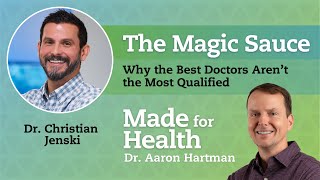
Aaron Hartman, MD, interviews a clinician who reversed severe metabolic and autoimmune disease over a decade through functional medicine, lifestyle changes, and environmental remediation. Speaker B went from 60 pounds overweight with sleep apnea, prediabetes, and anaphylaxis to tree nuts to remission, then helped his whole family do the same. The approach: remove inflammatory exposures first, test thoroughly, and push back on standard care when it isn't working.
Questions this video answers
April 9, 2024
Approximately 15–20 vials during acute workups; for maintenance, about 5–10 vials depending on tests.
Late 30s to early 40s (he says this occurred about a decade ago and that he will be 49 in April).
Once (confirmed strep throat).
Twice in early childhood (as a baby and around age three); none since.
Chapters
I think the magic sauce in our world is not people who have the most training or the most academic, who have the most board certifications. I mean, we both have three, so I guess we can say we have a fair amount. That's not the magic sauce. You know, I know personally, that's not the magic sauce. It's the personal. Like someone close to you, someone you love, someone you do anything for, needs help. And so I want to talk about that right now for today, about you and your family, because I know you have a pretty profound family story. We talked a little bit last time about your daughter being three. That kind of chokes me up a little bit to think about. I remember my kids when they were little, and there's absolutely nothing you don't do for your little girl. Me a little boy, too. But girls just are a little cuter, right?
Yes.
I got a little boy, too. You do as well?
First little girl in three generations. And my firstborn, so.
Oh, wow.
So she's. And she's not even 10, so she's still my little girl.
Yeah, she'll probably also be a little girl. So I wanted you to talk a little bit about some of the family things. Damon. I want to eventually get around to how that lights your fire, how it drives you in a way that nothing else would.
Yeah.
To fine tune your art, first and foremost, for your people, at home, for yourself. And then it gives you this buffet to share with. Not to be cheesy, but share with the world to share with your patients.
Yeah.
And also because you're not gonna stop. You're not gonna ever stop because you have people. Not just you, you got people who really are depending on you for. Not just to bring them the bacon, but also to, like, when the next thing pops up. You gotta be prepared to take care of the next thing. So why don't you just kind of start with your family? Whichever one kind of you want to start with.
Yeah. But also to teach them, too, right? Not just, oh, yeah, support them and address their needs medically, but like, you know, not to get too sidetracked, but the reality is that for the first time in human history, the generation below us has an estimated shorter lifespan. That's insane to me. And so I always see that as not in my family. Right. Like, not in your family. Why? Because we are the implement for change. And what we're trying to do is teach them so that they can teach their kids and then teach their kids, and then this whole thing gets reversed and goes the way it's supposed to be going, which is that we live longer, happier, healthier lives. And that's also a huge component of that. Like, the upbringing that my children have is not the upbringing that I have. No offense to my parents, they did a great job, but, like, I didn't know the difference between a carbohydrate and a protein and fat. I didn't go out to the garden and pull vegetables right out of the raised beds and know the difference between the colorful foods and what they mean and, like, why gluten might hurt your tummy and take vitamins every day or probiotics and what a good bug versus a bad bug is. And these are all things that we're empowering our children with, my wife and I, so that they can then take the ball and run with it as they get older and they own their own health and then affect change in, like, their friends and their own offspring. But personally, you know, it's obviously personal. It's. My journey is one that's incredibly impactful and has been. But it was all spearheaded by the fact that I was newly married and had two kids. And, like, we had a daughter and talked about her, and I'll talk about her more. And then 15 months later, we had my son, and we were just like. It was like insta family, right? I went from. I'm in my late 30s, never having been married, never in a real serious relationship, defining the love of my life. And we get married, and we're like, if we're gonna have kids, we should probably start trying. And then we get blessed. We have a daughter, and then 15 months later, we have a son, and we're just like, whoa, pump the brakes. We're done. But then it's just like, you know, you're 40, and you have this instant family. You're married with two babies at home, and I'm winded just, like, on the. Playing on the ground with my kids, or I didn't have the energy to participate, and I just felt like my mood was all over the place. And it was just, you know, you're irritable, and you have these little beings that need you and love you and look to you and are dependent on you, and it wasn't okay. And it was just like, what is the root causality behind this and what can I do about it? And that's when my journey in functional medicine started. It was just like, I need to get to the bottom of this, because this is not me. This is not the person I know myself to be at my core, in my soul. And I want to be the best possible version of myself for these children and for my wife. And that's when we started our work together. And it was pretty profound, the changes that ensued. And I was able to become the person that I am and who I knew I was meant to be for my wife and for my children and along the way affecting change in their lives. Like my wife has mold issues the same as me and has gut issues and wasn't sleeping and we've worked on all that. And my son had eczema and he had some sleep issues and he had horrible heartburn and food related sensitivities. And my daughter with celiac. And it was like, I think about all the stuff that we've done differently, that if I didn't know what I know now, if I didn't know functional medicine, there's no way in hell I would have been able to help them. It would have just been like medical management and a bunch of answers that were probably not sufficient for me. And then you just kind of plot along through life until the next thing happens. And so all of those things have been really impactful and profound for me. And that is the driving force, as you say. I've heard you say in some of your other interviews and we talk about.
This all the time.
I think you and I are both just inherently self motivated. But then you add that layer of that papa bear like you're protecting and loving your kids and your wife that is so motivating for me. That is the driving force. The words quit or I don't know or I give up, that doesn't exist in my house, it doesn't exist in my vocabulary, it doesn't exist in my being. But that's partially innately who I am. But a lot of it is externally driven by the love that I get from my family. And it makes me better in every possible way.
Yeah, it's one of those things where you know what got me up at 4 o' clock in the morning reading articles and studying. When we first had my daughter, it was her. It was like I knew I had a finite amount of time that neurologically when you're 20, you don't heal as quickly as you. When you're two, it's like I got this small window. So I have to learn as much as possible as fast as possible every day. And just there's nothing will push you as much as your family. But back to you, I'll be more specific. So these are things just. I know because I Know you. Yeah. You've all. He signed all the paperwork.
We're good.
No patient doctor stuff here. I know.
I'm talking about all this. I talk about this with every one of my patients. And that's the authenticity that I think I bring to the table. It's like, I know what you're feeling, or I know what that side effect is, or I understand this frustration. I've been there. And it's. That's not just me blowing smoke up their ass.
Like, that's the truth, but the things like. And not to minimize, like eczema and skin issues and gut issues, but you actually had been diagnosed with EoE, which is eosinophilic esophagitis, which is basically food. Your esophagus. You're pre diabetic. When C was up, you were overweight. I'm very quickly. You either had metabolic syndrome. Oh, that's from fatty liver.
I'll run the whole list.
Let's do the list.
All right. So I was 60 pounds heavier than I am now, which clearly is not healthy. I had moderate to severe sleep apnea, pre diabetes dyslipidemia. So high cholesterol, high LDL cardiovascular risk. Basically, I was hypertensive on medical management. So I was on a blood pressure medication.
Compare with that one.
They wanted to put me on a statin. They wanted to put me on metformin. I said no to both of those. So pretty severe eczema and then seasonal allergies, food allergies. I have anaphylactic shock to tree nuts, and I've been through anaphylactic shock four times. No fun. And then eoe, besides EOE being. Oh, yeah, food triggers your esophagus to get inflamed. Yeah. It actually causes food to get stuck, and then you can sometimes choke and die and not breathe. And that's. I've had the Heimlich performed on me. I mean, it's scary stuff. I had small intestinal bacterial overgrowth. I had yeast overgrowth. I had.
How old were you when you had all this dog? Before you started doing stuff, how old were you at that point?
Late 30s.
Late 30s.
Late 30s, early 40s.
Young. Young guy.
Yeah. And this is about a decade ago. I mean, I'll be 49 in April. And so ultimately, this whole journey has been about a decade. And I was diagnosed with the cardiovascular stuff in my mid-30s. And then all the other stuff was. Because I was working with you, because no one was going to say things like SIBO or candida enteritis or Heavy metal toxicity in the realms where I was seeking care. But yeah, heavy metals as well. So I had pretty significant levels or total body burden of mercury and lead. I had yeast overgrowth in my gut and then sirs, which is chronic inflammatory response syndrome related to biotoxins. And mine was related to things like mold and actinomycetes, which is a type of bacteria, basically sick building syndrome. And so all those things concurrently happening and my physiology was just wrecked. And I was literally just like taking one day at a time because that's all I could do. Not in a just take it one day at a time way, but like, I had no choice because I could barely get through the day. And through sheer will and a lot of caffeine and prayer and crying and anger and whatever I needed to motivate myself to get through the day, I did. And slowly but surely I started to reverse all these conditions. And honestly, I don't have any of them now. I mean, my blood pressure's perfect, my lipids are perfect, my A1C is in the low fives, my insulin and glucose are tight. I haven't had an EOE flare and I don't know how long. And yet if you seek conventional medicine help for EoE, they'll tell you it's incurable. If you don't have a flare for the rest of your life, is that not the same thing as a cure? Eczema up and down. That depends on stress. And sometimes I don't manage my stress as well as I should. The biotoxin stuff is better, the metals are out, the gut's better. All that stuff has essentially been reversed. Oh, and then autoimmune markers. Right. So I was taking time bomb for things like rheumatoid.
Positive rheumatoid.
I had a positive rheumatoid factor. I had positive ana, I had a positive anti double stranded DNA, which is a lupus marker. I had a positive anticardiolipin, which is your immune system's attacking your mitochondrial membranes. That's no bueno. So ultimately we know bueno. Yeah, like my body hated me and yet it had to love itself at the same time. And so I had to figure out a way. And all my autoimmune markers are now normal. So that's called remission. Because we know that once the body sees self is foreign, it always does. So you have to teach it to be quiet and stay quiet. And that's what I've done. But that's through lifestyle change and that's through Dietary changes and exercise and meditation and stress management and supplementation. All the things that we've done. Getting my environment right and. But that's like. God, when you run that list, that's crazy.
I'm like. I'm listening to that. I forgot about. I forgot about a few of those things. I figured out the blood pressure.
There might even be more. But that. That's enough. Right.
You're kind of sick, weren't you? I was.
I was.
But one of the things, I think that's key with individuals like you who, like, have these massive changes is. And you've said this before, you didn't have, like, here's Dad's meal. And then each kid gets their own meal. It's like, literally, the family did it. You threw out. You went home, and your wife overnight was throwing stuff away.
Yeah.
There's no turning back. No, it was literally like, this is the new direction, and you just kind of jumped all in. And that's huge.
And I feel lucky and blessed because that. Because I know that you probably experienced this with your patients. Like, you'll treat a patient who really wants to be better, but they're not getting that kind of support at home. And that's really difficult for me to hear because I got all that support without question, and that's, like, insane. And my wife immediately started changing the way that we ate and immediately started, what can you eat? All right, great. Let's cook that. Let's figure out how to cook that. And what can't you eat? Let's get rid of it. And it wasn't even like, we'll eat it when Dad's not around. She wouldn't even let it in the house. Like, tree nuts don't make their way into my house. It's kind of crazy. Like, they can eat them, and I don't care if they eat them, but they won't, because out of respect for me, and it's. That's kind of amazing and beyond the word supportive. I don't know if there's a word that means, like, more supportive than supportive, but uber supportive. Yeah, uber uber supportive. But then, like, cookware and getting, like, reverse osmosis filtration system. I was like, hey, I think we need this. And then we need this. And let's get some air purifiers. She's like, okay, okay, okay. And she's the one at home dealing with the contractors when they're coming through while I'm at work. And she's the one who's, like, getting all these Deliveries. At no point in time has she ever said, no, no, I don't think we should do that. Has completely trusted my judgment that whatever we were doing was not only for my health, which was enough of a reason, but for the health of the entirety of our family. And it was just like, I support that. And to me, that's like, when do you hear stuff like that?
It's one of my see patients when I do an intake.
Yeah.
One of the first questions I ask you is, what does your spouse think about you being here?
Yeah.
Because it just helps me with.
What, a loaded question. Yeah.
And it helps me load.
Gives you an idea.
It does.
What to expect for sure.
Yeah. Because it's like I have a patient I've been working with for years, and she's got some health issues and her husband doesn't want to do anything about the mold in the house.
Yeah.
So it's like having that support and having the support where it's like, you know what? Whatever it takes, however long it takes, whatever, we're gonna do it. And that's. I think that's a key with success with my patients and that. I think that's a huge key with our families.
And yeah.
Your story. It's like having that support is huge.
It's instrumental. It goes beyond even the immediate family. I don't know about your extended family, but like, my in laws. My in laws live in Lynchburg and they'll come up to visit us and they're excited about what we're doing and they're interested about what we're doing. And I've worked with my father in law for the last eight, nine years, and he had a heart attack. He had his diabetes. Like, he had all these medical problems coming in, and he's like, what are you doing over here? And I'm like, he gets all interested and he's very, you know, by the book. And. And ultimately I've kind of concurrently taken over his health because he's got his health care because he's got a primary care doctor who's super cool about it, who's just like, yeah, just tell him what labs he wants me to order. So I literally send a list of labs, and then his doctor orders them. He gets the labs back, and I tell him what I think he should do. And this guy's like, reversing these disease states. He's got everything under control for the most part. He's 80. He goes to the YMCA in his town, and his boys are like, hey, Joe, where's the Fountain of youth. And he's like, up in Richmond, go see him. He's like, get off your ass and go see him. Like, the reality is like, that's gotten better. My mother in law's health has gotten better because she was a little bit more begrudging about buying into it, but now she's all in. And like, you know, my dad comes down and he eats what we eat and he's like, this is delicious. Almost like he's shocked that health food can be delicious. And then I go to visit him and he's got a fridge full of salmon and vegetables. And I'm like, this is awesome. I'm sending him supplements and he takes them religiously. And the guy's going to be 80 in March. And he works a full time job and has no known medical problems other than mild hypertension for which he takes a really low dose medicine that his doctor made him take.
Had a heart attack at one point in time?
No, this is my dad. My dad, my father in law had a heart attack. Yeah, my dad has mild hypertension and that's it. And he's going to be 80. Like that's crazy to me. But he's doing the things that I ask him to do and he's lived a really kind of clean life and life of love and purpose and connectiveness and hard work and, you know. And then my father in law had a heart attack when he was 49. And his cardiovascular risk markers are phenomenal. Now his most recent stress test was normal. He's now 80. Right. So this is a guy that probably shouldn't be doing as good as he's doing. And I feel like if he stayed on conventional medicine, this is something that you would probably love. He was on a statin because why not, right? He had a heart attack and I guess that's the standard of care when you have heart disease, but it's so far removed from it. His cholesterol was 80 and I was just like, oh my God, this is a problem. They're creating an issue. So we were able to minimize him, back off on a statin and let his cholesterol permissibly come up a little bit. Not to the point where it's causing problems, but where his brain can function and his cell membranes are a little bit more stable and he can make hormones and vitamin D and the things that cholesterol do. But like again, this is the stuff that we're addressing. But like, these aren't my patients. This is my family. And they were, they Were truly interested in it, you know, and it's just kind of awesome to see.
So talk about your daughter.
Yeah.
Her card thing. Feel comfortable. As far as your son's concerned, what kind of issues have you kind of worked through with him?
So he had pretty severe reflux as a baby to the point where we unfortunately had to compound a PPI proton pump inhibitor because H2 blockers weren't working. He was on a specialty formula because my wife tried to breastfeed, and no matter what she did with her diet, he didn't seem to be able to tolerate it. So we had this specialty formula. He was on a compound ppi. All of which broke my heart because I knew what it was doing to his body. And for the first six months of his life, he basically had to sleep on us, on his stomach, and so we would have to take shifts. And we got past that point, we were able to wean him off the medication, and we had to kind of tweak his diet a bit. And he had issues with growing. He wasn't getting enough calories. He wasn't growing appropriately. He had some speech issues. He had skin issues. He's had gut issues. And all those are better, essentially, because of what we've done. And he eats so much better now. He's a vegetable. First guy, he's growing, he's active. He's all into sports now. He's going to be playing some soccer this spring for the little kickers. Richmond Kickers, which is local soccer. He's all into football, so he's pumped about the super bowl on the horizon. And, like, you know, he's healthy because of the things that we've done. I mean, I did some testing on him, and he had nutrient deficiencies. I mean, his zinc was low, his iron was low. I mean, clearly his gut wasn't working. His diet wasn't sufficient.
So how many vials of blood have you taken from your son or your daughter?
Yeah, too many.
I know how many I've done with my daughter. Yeah. Yeah. How many would you say?
Oh, gosh, like the most.
And typically, if they. When you're doing some fall, how many vials of blood are you doing?
So when they were, in my opinion, sick, probably like 15 to 20 vials. Yeah. No, and when they. Now, for maintenance, probably closer. Like 5 to 10, depending on what we're testing. But we did a lot of functional testing, too, so, like stool testing, and when I was doing food sensitivity testing, we did the blood spot card, or we'll do vials. But when I was really looking at inflammation and nutrients and other things. It was quite a bit and they were always cool with it. Like they would have a little bit of trepidation, but they trusted me and our phlebotomist here, who's amazing, right? And so they now look forward to seeing her, believe it or not. And they're like, it's actually kind of disconcerting that they're like, oh, we're getting blood draw.
So my daughter asks, yes, she asks dad when I get my next blood. Like, right, One daughter comes in for an IV and my other daughter's like, like, dad, it's, I think it's time for me to do an IV. 2 now I think it's time for me to get some blood done too.
It's kind of crazy. They went from like, when they would go to their pediatrician, they would have like full on panic attacks and they come here smiling and they leave smiling. And it's just like a different beast altogether because A, it's not a traumatic experience for them. B, there's so much trust and, and now they're at an age where they're understanding why we're doing what we're doing and I, they just feel good and. But it's not like I am just standing over them telling them to do stuff. They see me working on myself, right? They see me taking my fistfuls of supplements and they're like, dad's doing it, mom's doing it, we're going to do it. And like, I used to not feel well and now I do. And I used to have this and now I don't. This guy clearly knows what he's doing, so I'm going to do whatever he asks. You know, they're 8 and 9, but it's just, we're very open about our conversations with our children. Like that was one thing that my wife and I talked about in the beginning. It was just like, if they have questions, let's just be real with them. I don't want to beat around it. Like, we're going to maybe sugarcoat a little bit based on their level of understanding, but we're going to tell them why we're doing what we're doing. And I'm going to try to explain it to them in a way that I think they're equipped at understanding it. But I'm not going to speak down to them. I'm not going to dumb it down. If they don't understand, they'll say, I don't understand or they'll Ask me to explain it differently, but more often than not, they're just like, oh, okay. And I'm just like, oh, my God, I just said a bunch of medical stuff. And they were just like, oh, okay. That's pretty awesome.
How would you say your family's journey, like, your journey, how has that strengthened your passion for medicine for you? How has it affected your passion or your drive?
Yeah, I mean, in every way possible. How can it not? Like, based on what we were just talking about going from, I was probably going to die prematurely. I probably wouldn't have seen any grandkids that I might have to. I want to live to 100 now or longer. Like, the reversal of my health, the ownership of my health, the transition from lifespan to healthspan, the ability to have this optimistic outlook on my future, not just as a person, but as a husband and as a father, and so many things to look forward to. How does that not drive you to be more passionate about that which brought you to that point, which is functional medicine? Like, how do you not see functional medicine as the impetus behind all of that benefit, all of that motivation, all of that optimism on the horizon? It is what has transformed my life, which is why I do what I do. I mean, it's literally. I don't know many people that get to practice their dream job, that get to practice something that they're so passionate about every single day. That's what I feel like I do. That's what I know you feel like you do. Like, it's honestly, like, it's hard work and it's every day, but there's not a day where I'm not excited about it in some way, shape or form. Like, it'll beat you down, but then you just get built back up. And whenever you need that, that successful moment, that aha moment, it happens. And I just think that's the universe kind of saying, it's going to be okay. Stop boohooing, stop feeling sorry for yourself. Here's a win and carry on. But like that, the familial journey, the ability to see. Like, I lost my mom prematurely. My mom died at the age of 73, and I personally feel like that could have been avoided. And I don't want to digress too much into that story, but the reality is, is that I think something was missed and she is lost because of it. And in hindsight, I really wish that I learned functional medicine sooner than I did because I think I probably could have saved her. And that's something that I have to Reconcile. But to see my dad be as healthy as he is and to see my in laws continue to thrive is like a gift to my wife to have her parents longer and a gift to my kids to have their grandparents longer. How does that realization not motivate you and not make you impassioned to be better and to learn more and to continuously drive yourself to be that kind of person, you know?
Yeah, exactly. So one of the reasons we're doing this is people get to know you, but also just like deem inspirational. Because it's hard, you know.
Yeah.
It's hard to change everything. It's hard to change your diet and change your environment and encapsulate your crawl space and put HEPA filters and throw out all of your toxic cleaning stuff in your house.
Yeah. All your pots and pans and all your Tupperware. And not just the doing of it initially.
Keep it.
The maintenance of it. Right. And it's expensive too. It's not just difficult to, to do it, it's the knowing of what you should do. Like what's the best version of the thing I should buy? And there's so many different things out there. And then when you buy it, how long is this going to last? And was I misled? Is this gimmicky or is this truly safe? And you know, there's a lot of questions and a lot of education about all that and it's really difficult question for you.
I never asked you this question before. I actually thought it was since you started doing this with your kids. How many times have your kids have had antibiotics?
My son has had antibiotics once for strep throat. Confirmed strep throat on a rapid strep test. That's it.
And your daughter?
No, she had antibiotics prior when she was a baby for an ear infection and then subsequently around the age of three for an ear infection. And they have not had any since.
Okay. And since we got our three kids, between the three of them had one antibiotic. Yeah. And so that's worth something, isn't it? Yeah, it's like it's worth a lot of, you know, Heck yeah. Grass fed, grass finished, free range.
And they're. And there are probiotics that they take besides the food that they eat. And you know, this time of year they're taking their vitamin C. And I checked, we did labs and their zinc levels were low. You all need zinc and we need to eat more foods that are rich in zinc and figure out why you're low in zinc.
I like that. So when you you check someone's lab. Yeah. They come back with zinc. Here's your supplement. But also, let's add these foods in.
Heck, yeah.
Because ultimately the foods have a lot of other things in there. Yeah, this little capsule does.
Yeah. And what's the definition of supplement? Right. To supplement. Right. So lifestyle takes time. Lifestyle is not easy. We've established that. Sometimes it's expensive. Also established, unfortunately, not everybody's always on board. So that's the difficult component of it that has to happen concurrently with supplementation. But supplementation allows you to bridge that gap and hold space while you're doing the lifestyle stuff. And then also buys us as the clinician and medical scientists the time to determine why. Why is it low? Is it because you're not eating those foods, or is it because you have gut issues and you're malabsorbing, or because you have a chronic low level viral infection that's over utilizing your zinc or something along those lines? And so it allows us to play detective while the person's getting better, to eventually own that with lifestyle alone. And that's how the logistical kind of logical transition of that should happen, in my opinion.
So what parting words? What words of inspiration or things of patience? People listening? Are not patients people listening?
Yeah.
Would you say who are just starting their journey or into the journey that are kind of struggling? What from your personal experience, if you were to say three things like, oh gosh, what three things would you recommend people do do? That's something it's not. Doesn't have to be specific, like take a probiotic. You know, it's like, I'm thinking a bigger picture than that, so more global.
Okay, three things. Let me try to summarize it. So much stuff, I think a good approach, and this is maybe all encompassing, but we'll call this number one would be the addition by subtraction. And I talk to patients about this all the time. And it's really try to identify those things in your life that you think are creating problems biochemically, physiologically. And what I mean by that is if you think inflammation is a problem, then cut out the inflammatory foods or try to manage stress a little bit better. Or if your sleep is off, try to work on that. So try to identify where there might be some inherent weaknesses in your lifestyle pillars. So diet, activity, slash exercise, stress management, connection, sleep, hygiene, and figure out what you can subtract that will add to your benefit, which is to say that if there's a fire burning inside of you, not in a good way, like I Have a fire, and I'm passionate, but a pathological fire, right? Like your gut's on fire or your joints are on fire or your brain's on fire. If you want to eventually put that fire out, you got to stop pouring gasoline on it first. And how do you do that? Identify the gas in your life and get it gone. So start by cleaning up areas that are inherently weak. I think number two would be to talk with your provider, your clinician, and see if they'd be willing to maybe expand some of the testing, do some research, figure out what you want, what you might be concerned about, what you might want to look into. Whether you're listening to podcasts or reading books or listening to us or watching us, or you heard from a friend that methylation is important, and I want to know if I have the MTHFR gene. Open up a dialogue with someone who has the ability to order tests for you or seek out online testing platforms that you can do on your own. You can order food sensitivity testing. You don't need a physician to do that. The interpretation might be difficult for you, but it's a starting point. That's how I started. I mean, I was a physician at the time and I had access to a lab and I could order my own labs, but I didn't know what the hell I was ordering. I just ordered stuff. And then I would have to research. What's a homocysteine level? Oh, it's too high, I guess. I'm not methylating. Let me take my methylated B vitamins. So I would to kind of figure out where your areas of concern are. I would add by subtracting, and then the last one would be, gosh, I think really it's being an advocate for yourself. And that kind of goes along with the first two. But, you know, if you're in a situation with anyone that's caring for you, where you're made to feel less than or shamed because you are advocating for your own health or bringing something to the table that's a toxic relationship and you need to leave it like, no, you don't have an md and maybe you don't fully understand what you're asking, but you shouldn't be made to feel bad because of that. Like I tell my patients, this is a safe space and you should ask any question. No question is a dumb question, but it might not make or break the case, and I'll let you know, but I'm never going to harm you for looking something up, doing your own research, and Saying, hey, what about this? And if somebody does, then you shouldn't be cared for by that individual. And so advocate for your own health. Add by subtracting, and try to determine where you think there are inherent weaknesses in your own health or wellbeing, and try to employ someone to maybe help you figure out a natural alternative or way that you can do some things to kind of benefit those.
Those are three great principles, especially finding a provider these days. You should be able to find someone that'd work with you.
Yeah.
And if you can't, you need to find someone else.
100%. I agree.
Cool. Well, great. Thanks for talking with us today. I think the point of this conversation is just like, it starts at home and it's hard for everybody, even medical doctors, even functional, trained people. I tell my kids, if it wasn't hard when people were doing, if it was easy, everybody would do it.
Right.
And so it's just like, it's gonna be a journey, but it's. When you look down the road 10 years, it's literally changed. Not just your kids and your family, but your family.
But it's not finite. Right. Like, it's not. You take your journey and then you get things better, and then you stop. It's ongoing. It's always ongoing, and it's perpetual in the sense that I still do the work. I'm working as a clinician, but I still do the work on myself every day I'm not done, I'm a work in progress. I've normalized a lot of things, but I'm not optimized in every way. I'm going to continue to work at that. And even when I feel like I've hit a point where, like, things are excellent, I'm going to continue to dive even deeper. That's the whole point. And I think that kind of summarizes what we do and who we are. And for those that also want to be a part of that journey, like, that's what we're here for. And sometimes it's just people following along because they live in your house and they don't have a choice. And sometimes it's people that actively seek us out, and they're like, yeah, this is what I've been looking for, and this is the help that I want. It's really powerful when patients say things like, you saved my life, or, I used to not be able to do this, and I can now, or, you gave me this back. That is incredible.
Maybe this is, like, one of the things we've been doing on Our website is. We have this little bar. We just go out to Google Reviews and just kind of put stuff out there. And it's really. I know you look at your stuff, but just really inspiring to see people. Because sometimes I struggle with am I making a difference?
The testimonials.
Yeah. Am I making a difference? You know, to be honest with you, sometimes it's just for me.
Yeah.
Because you go through. Yeah. There's days where it's like literally everybody's stuck and you're like, that's when the.
Universe throws you this cave. That's what I'm telling you, man. You get a Google review and all of a sudden you're like, all right.
I'm all right. You get one of these views like, this change everything. You're like, I had no idea. I know who that is. Like, you're like, okay. It just, it's really.
Yeah. I mean, as humans, we also have self doubt. Right. Even though we're triple board certified and we feel like we know our shit, sometimes you doubt yourself. Right. And I'll tell you what, any positive reinforcement I get is above and beyond. Because I used to work in the emergency department. You don't get any of that. You rarely do. I mean, when you really impact someone and you might get some good feedback. But I literally. When I say a patient has said things like, you've saved my life, I literally mean that. And that has a different connotation than what I would hear in the emergency department, quite literally saved their life versus when someone's saying that. Meaning I have my life back. I'm able to do the things I used to be able to do. I feel like I used to feel I have the brain capacity, I have the energy. I can be the person I need to be for the rest of my family. You've now affected change secondarily in that person's family and their extended family. Right. And that's crazy. It's the ripple effect. And that's what we're trying to do. And that's how that happens.
This is one thing. It's. We say this a lot. I'm in this mastermind genius. And the guy runs it. He says this thing all the time, Joe Polish. And what he says is that he who has his health has a thousand dreams and he who doesn't have his health has but one. And it's amazing just being able to help people get their health back. You literally do give them life back. And they dreams. The interesting thing, it will probably end after this one. Interesting things and you can comment on this is that you see, these people are super sick and they can hardly fend for themselves. They come with their family members, and the better they start getting, they also, they get more. Like how they start actually getting super engaged.
Yeah.
And sometimes it's like, come on now. Like, I got to this point. Trust the process. Right? Trust the process. But it's like, I know that you're getting feisty now. I know you're feeling better because you're actually giving me so much pushback.
Yeah.
Asking me and pushing me further when literally when you first came in, you could hardly put two senses together. And that's inspiring as well to hear about those kind of things.
It is.
Cool. All right. Well, thanks a lot, everybody, for hanging out with us, and we'll talk some more about something else next.
More from Aaron

Too Many Gut Fixes Can Undo Your Healing. What Helps It Last | Dr. Sabine Hazan


Women’s Heart Attack Symptoms Differ From Men’s 95% of the Time — Only 30% Have Chest Pain #shorts

Heart Disease Kills More Women Than All Cancers Combined — 80% of Cardiac Research Is on Men #shorts

Women’s Physiology Was Systematically Ignored in Drug Research — The Consequences Are Still #shorts



It Took the FDA 20 Years to Realize Women Need Half the Dose of Ambien #shorts

Until 1993, Women Were Banned From Clinical Drug Trials — Then Those Drugs Were Prescribed t #shorts