The Science of Stress: How Your Brain & Body Actually React with Dr. Jenski
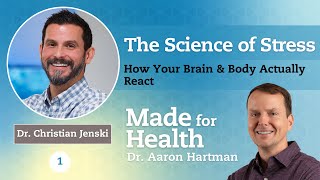
Conversation (YouTube interview) between Aaron Hartman, MD and Dr. Jenski exploring how stress affects healing and health. They define stress broadly (external, internal, environmental, historical/ACEs), link stress to measurable biology (salivary cortisol curves, heart-rate variability), describe limbic/HPA-axis dysfunction and mast-cell mediated ‘crashes’, and argue mitochondrial dysfunction (metabolic reserve) is a central mediator connecting stress to chronic disease and impaired recovery. Clinical examples cited include Takotsubo cardiomyopathy, stress-associated strokes, shingles, and cancer risk linked to severe life stressors.
Chapters
Welcome back everybody. Once again we are going to have a great conversation today talking about all things related to stress. This is a part of what we call here the triangle of health which are the three major blocking points are stoppage places, roadblocks in people's health, whereby self healing, self repair. So as always, if you like this information, please share, follow, click, hit the little star below. That's how this information gets out there. And as well, this information is for educational purposes only. You should not use this. We cannot diagnose or treat any medical condition. And of course you should always discuss all these with your personal healthcare provider. So Dr. Jensky, it's been a while since we last met and talked about stuff. I see down the hallway and I'm like, hey, I haven't talked to you in like weeks. It's so funny actually you think about.
It, I'm in my pod, you're in your pod. We just went around seeing patients, seeing.
People doing our thing and going home and keeping the crowds controlled at home as well. Yeah, so. So speaking of crowd control, today we're talking about the second thing in the triangle health, which is stress. And so this is one of the foundations of functional medicine. I personally found out in my career that stress, whatever that means, and that's what we're going to talk about for a lot of people. They get 50, 60% better and not dealing with stress, whether it's trauma, whether it's medical stress or whatever that is, which again we'll talk about becomes their roadblock. Their body can't heal when their nervous system is stuck in fight or flight 24 7. And so what I want to talk about a little bit is what stress is. I tend to think about it scientifically, the psychoneuroimmuno endocrinology, which is a fancy way of saying how your brain, your mind is associated with your hormones, your gut, your nervous system and how stress affects all those. And you can actually get a PhD in this field of psychoneuroimmuno endocrinology. So I know right before we went on we talked about trying to keep things simple, right? I'm like, okay, this is not keeping it simple. But the gist is your brain, mind, the mind body connection. It's now actually legitimate science. It's not woo woo anymore, it's actually legit. What is stress? Because when we talk about that, just give us a buffet of what stress is. I think a lot of people hear the word stress and they're like I'm doing great. And they don't realize. No. You have past stress leeching into the present. You have ongoing stress trauma limit kindling. Like what, what is stress? Educate us.
I think again, everybody probably has a different opinion as to what that word actually means. I think the general definition of stress would be, you know, a stimulus that elicits some biological response. And so in that same vein, you can keep it general, but also a stressor can be seen as something traumatic, physically traumatic, it could be seen as something emotionally traumatic, it could be a toxin in your environment, it could be a relationship, it could be financial woes. I mean, there's so many layers to it, each of those being a different stimuli that elicits some physiologic biologic response. And so when I think about stress, I think the one that everyone immediately goes to is that person is anxious, that person is quote unquote stressed out, maybe even burned out. They must be burning the candle at both ends. They must have a bad relationship, they must have some financial difficulties. But the reality is that is common, but not as common as some of the other stressors that we see in our practice, which is that patients have chronic disease and that in and of itself is stressful. The chronicity of the illness, the lack of answers, the inability to feel validated, the physiological response that then leads to worsening health, that impairs their sleep, which leads to more stress. If they're gaining weight or they're chronically in pain, they can't exercise, which leads to more body stress. So it just becomes this vicious cycle and loop of things that are piling on top that may have started with one or two little things that then just kind of built on it. So I try to look at it through a very microscopic lens on a patient to patient basis. But macroscopically, when you're stepping back to kind of see it, it defined in general, I mean, what do you think?
Well, I kind of think in that there's, I like what you said about all those things and as I was processing today, driving here, like how would I think, how would I discuss stress with someone I was thinking about. Well, there's, there's internal stress. Internal stress could be dysfunctional organs, like you've got kidney problems, liver problems, it could be your metabolic issues with your gut, microbiome internally, nutritional deficiencies. You know, if you've got chronic magnesium deficiency, potassium deficiency, which the average American has, vitamin D deficiency, all those things are going to cause a low level inflammation, stress on your body. If you have a chronic infection internally, chronic Lyme reactive I've been seeing a lot of reactivated Epstein Barr in the last two or three months. These can be internal stressors. There's external stressors. And external stressors can be people, family events, trauma falls in there. And I kind of like that's an external stress that internalizes itself, right. You have a life event, physical, sexual, emotional abuse, chronic illness. And all of a sudden now your brain gets wired into that state. Even you might be 10 years in advance, and your brain's still stuck in this, this, this, this environment. And then there's more environmental stress like chemicals, toxins, mold. And so all of a sudden it's like this ecosystem, you know, of external, internal. And the ultimate result is they affect that. Your. That's the brain, body connection, how your brain connects with your hormones, your nervous system and all that stuff. And there's good thing about stress is it's not all bad. I mean, we need stress. Kids need to stress learning how to walk. If kids don't stress their nervous system, they don't learn how to speak. So we need good stress. It's just too much of a good thing can become a bad thing. And so that's kind of the way I think about stress.
Yeah, I mean, there's the concept of hormesis, right. Which is a beneficial stressor. The stress to a point without pushing past that point. With the net gain being that your body grows stronger. Right. Like sauna or cryo or exercise or fasting. These are all hormetic stressors, but they're still stressors. And so the body inevitably gets stronger because of it. Or eustress. Right. The term EU stress kind of like when we say hypo or hyperthyroid. There's eu thyroid. Your thyroid is balanced. Eustress is what the adrenaline junkie, the person that likes the way that they feel in a stressful situation. And it's not proven to be deleterious on their health. There's so many layers to this. There's so many things to unpackage. And I like how you broke it out by external, internal. All of it being some stimulus, some stimuli that's collectively causing something. Is it just creating stress chemistry or is it actually damaging an organ? Or is it setting some cascade of events in motion that are problematic? And I think that that's kind of a really eloquent way of looking at it.
Yeah. So I wrote a couple things down here. You know, when people talk about stress, I feel like it's less, it's less hard to sell now. I feel like 10 years ago, telling people about stress, it was like, I have to sell you that this is real.
Yeah.
Because everybody's stressed. Don't worry about it. And so we're in a couple things like Tuxubo's cardiomyopathy, you know, that is a stressed induced heart failure.
Yeah.
Typically in women past menopause, I've actually seen some young women get it, but you get so stressed that you actually, you get a cardiomyopathy.
Your heart breaks down. Left ventricular dysfunction without any known coronary artery disease. You're not having a heart attack, but your heart acts like you have had a heart attack.
Yeah, it's really interesting. I think it was the Body Keeps a Score might have been the book I was reading talking about. Or maybe it was Radical Remission. I think radical Remission talking about stress exposure and an increased incidence of breast cancer within two years of a divorce. So massive stress being associated, you know, in populations with. With cancer. Stress induced strokes. I mean, you've probably seen people in the er, they come in, you get the workup done, they're younger and you've had like stress induced vasoconstriction. They get the stroke, their arteries are clean. We call it, you know, vasospasms. Right. But that's. You still got a stroke or idiopathic. Idiopathic. I always love that one. Idiopathic, idiopathic.
We don't know.
Yeah. And then there's the whole idea of MACE events. Major adverse childhood events. These are things that happen in childhood. You know, seeing your mother abused, being sexually, physically abused. I'm feeling unsafe. You know, I kind of put things in there. I've kind of. I won't say I've made these up, but I've clinically recognized that being in a relationship with having a parent that's a narcissist. I don't know how many of your patients you've seen dealing with issues and.
It'S like too many.
Yeah, it's crazy common. But these are things that people can resonate with, like. Oh, yeah, that makes sense. Well, if these extremes make sense, can the chronic illness of your child, can your personal chronic illness. Can the instability of the world right now or whatever, can these be a blocking point, your body's healing? And that's where I kind of.
Yeah.
Talk to people.
What are the maces do? I mean, what did that study show? Right. It showed that those individuals that had highest MACE scores or ACE scores were more prone to cardiovascular disease, cancer, metabolic dysfunction, substance abuse, mood disorders, suicidality, all of these things. So the more trauma you have, more stress you have perceived or otherwise early in your life, the more at risk you are for these events later in life. It doesn't mean it stops at childhood. It continues on throughout your life. And how you handle that, that depends on many factors, but reserves and resiliency come in. There's a lot that I think we're going to be touching base on with regards to this. But, but like, from a scratching the surface standpoint, I don't think it's a hard sell at all anymore because all I do is pull up their adrenal cortisol salivary test and say, this is you. And they're just like, I was sitting at home chilling that day.
Yeah.
And that's what's going on with my stress loop. Yeah, that's what's going on with your.
Chest or like we were talking about before we started recording, you check your h you, heart rate variability on your personal device and you're like, I had a great day, I slept great at night. And your heart rate variability is low. 25.
Yeah.
20. Yeah. When you're like, okay, so my heart rate went down. But there's no variability related to your heart rate.
So the autonomic nervous system still needs work, right?
Yeah, yeah. So, so. And then even like the idea that people have known for decades about stress induced shingles. You know, I wrestled when I was in high school back. Well, that. 90. 90. No, 80. 89 to 91.
Right.
Where those years were back in the day, it was common at the end of the wrestling season to people see people getting shingles. Yeah. And we thought it was cause of dirty mats. We cleaned the mats even better and got them wet down with these crazy chemicals that who knows what it was doing to us.
Making things worse.
Probably. Yeah, probably. Yeah. But the thing was, is that, you know, when you're, when you train two and a half, three hours a day, and then go run four miles and do that five days a week for, you know, two, three months straight, at the end of that, some people, their immune systems break down. And so the idea that stress can increase your risk for infections, affect your immune system function, all these other things, I mean, that's, for me, that becomes a selling point to convince people like, you're not healing. We've done all this cool stuff, worked on your gut, we worked on your hormones, We've got the mold out of the building, We've given you mast cell stuff, we're giving your salts and your stuff, your dysautonomia your pots and whatever else is going on with your brain fog, whatever, and you're just not getting better.
Symptomatically.
Symptomatically, yeah.
Because I think that's key to discern, too. In the same situation, I have these same conversations, their objective data is getting better. So you're. You're not just saying, I'm giving you stuff for your gut, I'm giving you stuff for this or that. You're proving that gut is better. You're proving that hormones are balanced, based on at least objective data. That was abnormal, that's now normal, and yet symptoms persistent. So that's why clinical correlation is key. But also that typically is where that stuckness comes in, which is what you're describing, is that those patients tend to have some rooted limbic dysfunction that at that point in time needs to be worked. And sometimes it's at the beginning because right off the bat, they're not tolerating any of the things like, you can't even get to the point where you have the conversation about, look at all the cool stuff we did, because you can't even get past step one because they react to everything until you get them a little bit unstuck, where they can tolerate some more to improve their physiology, to then do the rest of that work. It's both sides of that coin.
So you said a word. I don't think we've defined yet. Limbic system. So what is that?
So limbic system, the way I explain it is it's that kind of primordial part of your brain that entails the amygdala, the hippocampus, and the hypothalamus. So three really important structures. And the amygdala is mood regulation, the hippocampus is memory, and the hypothalamus. For me, the way I explain it is it's kind of like the sensory relay along with the thalamus that also is the coordinating point for all of the endocrine systems. So all your hormone loops, your thyroid loop, your sex hormone loop, even your adrenal loop is starting in the hypothalamus after the brain is telling it to do so. Sends a message to the pituitary, to the target organ, make some hormone, do your job, come back up and tell us, do you need more or less? But memory and mood is what we see a lot in these individuals. And, you know, they're stuck in fight flight, freeze, and they're not in that rest and digest mode, and they're moody, or they have mold Rage and anger, or they're anxious or they're depressed, or they're melancholic and they're in their 30s and 40s and they can't remember anything.
Or.
We call it brain fog. And there's actually a way to measure this. We do neuro quantitative MRIs in some of these patients. And I see volume loss in these specific structures, mostly around biotoxins. But you see it with traumatic brain injury. We see it with a host of other things. So that limbic system is so, so important. And when it gets dysfunctional, it's almost like the wiring in some electric device at your home. Or your car is not plugged in. Right. Or wired. Right. You have to literally unplug it and rewire it. And you could do that through the whole concept and process of neuronal plasticity. But it's hard work and it takes time.
Yeah. And something else to think about. Like, there's something I learned. I think if I was reading some of BJ, Dr. Fogg's work or Dr. Qing's work. I'm going to group with both of those gentlemen. And they were talking, I forget which one it was, but talking about the idea of like your prefrontal cortex, your thinking brain. Okay. And your emotions. And I like to think I'm a very logical kind of person and I can just. Emotions, you know, forget emotions. I'll just logically think through things. But it's interesting, like, in the marketing world, they kind of realize that you can think everything through perfectly line by line by line, but ultimately you have to engage your limbic system, your emotional system, before you actually make a decision. And so a lot of times, what's happening when people are making decisions in the marketing world, purchasing world, and also, am I going to do this medical therapy that Dr. Jensky or Dr. Hartman just recommended to me. Unless there's an emotional engagement, no matter how much brain is like, this is a great idea, unless you have that engaged, you actually won't follow through. You won't actually. 80% of these decisions actually are emotional, not cognitive. Which is fascinating because a lot of our patients, that whole system, part of the brain, is a wreck. And we wonder, well, I told you all these really smart, cool things and you said yes. And I gave you the nice handout and sent you 20 pages of labs. And after the 30 page, 30 vial lab draw, you're not doing anything. And it's like. And I know early in my career, my first response was to get a little frustrated. But then I realized if this part of the system is dysfunctional, you can't actually engage because of that. Which is, I think why one of the reasons are more chronically ill patients have a hard time processing a lot of this stuff.
Yeah. Or they'll come straight out and say that they're not comfortable doing it because it's almost like they have a knee jerk reaction. Then emotionality comes through right off the bat. I mean, I see that all the time.
So let's get a little more granular before we go on to some other things. Let's. Let's talk about stress. I talk about physical, psychological, emotional. Let's talk about some of the social, historical effects of stress. And that's kind of like social history, like where you grew up, family dynamics, how do you, when you're doing it, when you're seeing someone, they're in the clinic, you're talking to them, how do you delineate if there's a historical stressor going on? Like when you, you know, your childhood, birth, you know, were you in the ICU when you're a kid? Like, where did you grow up? Were in the military? How much did you move? Like, what are some things you look at in people's social history that are like little clues. Clues that there might be a past event that's affecting their current stress status?
Well, I mean, the beauty is that we have a really thorough intake form and a lot of these questions are asked. And if patients are willing to fill it out, they do. And sometimes you gotta pull teeth. But most are willing because when they're making the commitment to come see us, whether it be financial or time wise or just taking that leap of trying functional medicine, not knowing what they're gonna get or expect, I feel like most of them are pretty transparent and open, but clearly some are still holding their cards a little close to their chest. And in these intakes, I review that section as importantly as I review their history, as importantly as I review their symptoms and their allergies and their medications. I think all of it's good. I think all of it's helpful. And all of it tells me more about the global nature of that individual. But it's anything from birth history. Were you vaginal or were you a C section? Were you premature? Did you have nuchal cord? Was it traumatic? If they know these answers, were you breast or bottle fed? Did you have a lot of antibiotics as a child? In females, what was puberty like? When was your first menstrual cycle? You know, pregnancy history? For a lot of my Female patients. Did you have miscarriages? Did you have, you know, complications with your pregnancy? A lot of them had postpartum complications. A lot of them had peripartum complications. You know, relationship status, moving. Like you mentioned, I have a lot of military patients and that's clearly a stressor for many reasons. We also take an environmental history and I garner or gauge some information about the other stressors that they might not be aware of. Like oh yeah, I've gotten multiple tick bites and no one's ever told me I had Lyme or I had Lyme once and they gave me doxy for 10 days and I'm good, maybe not. Or I grew up in a moldy home or I grew up in a water damaged building or this is my job. And their job is something that is exposure to chemicals all day long, but they're not aware that they're being exposed to chemicals all day long. So it's the stuff that's clear and obvious and it's sometimes a little teeth pulling. And as they gain comfort and understanding about what we're doing and why we're asking these questions, they'll open up more. And then a lot of it is me kind of deducing based on other little pieces of history that they have more stress than they're even aware of. And sometimes I have to show that to them. Like this stuff that you didn't even realize was stressing you may not be mentally registering as anxiety or insomnia but is absolutely affecting your body negatively. And if we don't do something about it, all the other stuff's going to be more difficult to get better.
Yeah, I think in part of one of the things with some of my patients is that sometimes it'll take a year and a half or two years seeing them over and over again for some of these things to pop up. Because you re see them, you re question them, then someone has a realization. Actually I never thought about the fact that I was in the ICU for the first two weeks of my life. Do you think that may have had an impact on some of my safety issues and my stress issues or you know, when I was a kid, you like my, well, my parents, you know, this actually was something that happened. Some family members where you have a parent that gets sick and they've disappeared for a month because they're at the hospital in some university for a month and you're like, what's going on with them? You know, these little things sometimes just don't register and takes. That's Where I think the relationship as well with the patient is huge. Because I have patients I've been working with for four to five years and things are still popping up.
Yeah. It's not even like in that situation, they're trying to withhold them.
No, not at all. No.
They just don't realize it.
Yeah, yeah. Sometimes I'll mention it. You'll be like, what? That's such a big thing. Yes.
Right. That massive aha moment. You're like, wait, what did I do?
Nothing.
You give me really good information without.
This actually changes everything now. Yeah. All right, so we talk some. So I think right now, metabolic. In the last couple months, the idea of energy, good energy metabolism has become a bigger issue. Let's talk about, like your metabolic reserve. Some people refer to return to that as mitochondrial efficiency or mitochondrial health. How can that met your metabolism? You know, poor sugar utilization, excessive sugar exposure, you know, mitochondrial issues, which basically you have energy production issues. How can that serve as a. As a source of stress and mention mitochondria in this? Because I love that kind of stuff.
Yeah, I'm gonna. I'm gonna start, but I'm gonna let you take over because I know you got good things to say about this. But it is. I mean, I think the starting point to answer this question is to just first clarify what mitochondria are and do. Mitochondria are well beyond the power plants of our cell, as we once learned in biochemistry. If you took that course, and I think everybody kind of learns it through the power plant, like they make all your energy. They make our energy. That is still a true statement. That is just a minor function of what the mitochondria do for our bodies. I mean, besides regulating your immune system, controlling inflammation, making energy, balancing oxidative stress. So your redox poise affecting neurotransmission. I mean, there's just every hormones, I mean, every facet of your biology, the mitochondria, in my opinion, have some hand in. So therefore, if they're dysfunctional, all those other things have the potential to be dysfunctional. And when you're talking about metabolic health in general, if you're not metabolically healthy, we use the term flexibility a lot metabolically flexible. Then. Then the reality is, is that you're chronically inflamed. The reality is, is that you're not good at utilizing food and turning it into fuel. You're not good at balancing your oxidative stress, and therefore the body's in a state of physiologic stress. You know, that term stress keeps coming up. I just use the words oxidative stress, and that's not typically what you would even think of, but it's taxing the system, therefore it's a stressor. And so when the mitochondria are dysfunctional, for whatever reason, we see a lot of that related to biotoxins. So sick building syndrome, chronic infections like Lyme and others that, that it by its core, long Covid. These are all mitochondrial pathies, in my opinion, that are not like the rare genetic ones that we learned about in medical school once upon a time, and that you will never see, rarely see, depending on where you practice. But this is the reality of what we're seeing every single day. And you know, here's, here's another little kind of way to look at it. I mean, what is perimenopause and to menopause? And it's your ovarian production of hormones going down. What happens first, your mitochondria in the ovaries start to diminish and become dysfunctional. So as the mitochondria become dysfunctional, the ovarian production of hormones gets less and less and eventually shuts down. And now you're not making hormones and you're deemed to be postmenopausal. That started with mitochondrial dysfunction. You get that person's mitochondria, right. Perhaps their hormones balance for a little bit longer and that inevitable transition is delayed or at least softened to some extent. I mean, how would you kind of explain the whole metabolic mitochondrial thing?
Well, I think the mitochondria, in my understanding is. Is the, the root cause potentially of everything, of all chronic illnesses. Yes. And so if you don't make good energy, your brain doesn't work, and if that organ is the primary one affected, you get dementia. If your mitochondria don't work very well and the ovaries are primary organ, you might go through menopause when you're 38.
Premature ovarian failure. Yeah.
So even the understanding of cancer now, Dr. Seyfried, Thomas Seyfried, wrote a whole book on cancer as a metabolic disease. Part of that is when the mitochondria become dysfunctional, the electron transport chain breaks down, which is how your body drops down a gradient electrons to then make energy. If that basically separates, you get genetic instability. Well, genetic. What do you mean? Genetic instability.
Sound good?
Yeah, genetic instability. And if you get enough genetic instability, your body can't repair it and you get cancer. So cancer. Actually, we've been thinking about cancer wrong for the last 70 years. And Dr. Werberg talked about this in the 20s and 30s. So this information is not new. It's just we're getting a new understanding about how cancer actually, yeah, there are some genes related to it, but the vast majority, or metabolic or environmental related to both, really related to mitochondrial breakdown, genetic instability. And so all of a sudden, like the stressors that affect how your body recoups, whether the chemical, environmental plan, things like cancer. So now it's like, okay, we talk about stress after divorce, increasing a female's risk of breast cancer within two years. Now we understand, like how that could play into mitochondrial health.
Right.
And all of a sudden this is like the things we can do for this.
It also affects the metabolism of estrone. Right. So in addition to what you just said, in that same scenario of breast cancer, if a woman is still producing estrogen or taking estrogen and she's stressed or inflamed or drinking because she's stressed, she's pushing all of her estrone down the 4 hydroxy pathway and she's making DNA adducts and quinones. If she's not able to methylate or reduce that, which is in English means she's making bad estrogen and not getting it out of her body and eventually she's going to get an estrogenic cancer. So again, stress playing a role in multiple levels or facets in the same disease process, it's just, it's pervasive.
Yes. And so one of the things, I want to make a little bit of a transition here because we see patients with muscle activation and chronic fatigue and thyroid and mold and Lyme and all, all the, the rare stuff that. So it's so rare that we only see it, but I lost my train of thought. But one of the things that's interesting with these individuals, they'll be doing well and have a little triggering event and almost like they take 10 steps back. It could be an environmental trigger, like a chemical smell, scent with this thing called tilt syndrome, which is toxic induced loss of tolerance, which is a type of mast cell issue. Or they could get a mold hit, right? You go to a building or they had three bad nights of sleep because they have an issue with one of their kids. Could you talk a little bit about those kind of stressors, those micro stressors that in of themselves don't seem that big, but you have massive symptoms. Why does that happen? And what are some things people can be looking for when those things are going on?
I mean, it happens because I think in Those situations, those individuals are also in a state of HPA axis dysfunction, which is the hypothalamic pituitary adrenal axis. So they're already at a point where maybe their limbic system is dysfunctional, their HPA axis, that salivary cortisol curve that, that influence that morning spike that we want to see, and then it goes down throughout the course of the day that counterbalance that DHEA that we want to see. All that is a little wonky or a little bit off. So they're starting to, or have already lost their resiliency to some extent or lost their reserves. And although we're working to build that up, back up, and they might be getting better, they're still in a tenuous state. In addition, for most of those patients, especially the mast cell patients, muscles are ubiquitous and they are so easily triggered. And depending on the individual and what the triggering event is, it's just a histamine and inflammatory cytokine dump. And so in a moment of I feel good to, I feel horrendous and I went all the way backwards. It's just a dump of histamine, inflammatory cytokines, mitochondrial dysfunction, and the resultant biological processes that makes that person feel unwell. These things are aligning the GI tract, they're aligning our blood vessels. They're at the surface of the skin. I mean, mast cells are everywhere. They go wherever they want to go. They're part of our innate immune response. I mean, they're part of our defense mechanism. But when they're overexcited, they are problematic at best, and they're causing a significant degree of dysfunctionality. I mean, that, that was my journey and still is. It's not like all of a sudden I just don't have mast cells anymore or I have total control over my mast cells. Like, I have much better control over my mast cells. I've identified my triggers. I don't always have control over my environment. I take things lifestyle wise and supplement wise that allow me to have that balance. But I know exactly what you're talking about. And my wife and I used to call those either adrenal crashes or histamine crashes because I would be fine and I would come home and all of a sudden I had to lay down. And if I didn't lay down, I would literally fall down. And it was because there was an influx of either mast cells or inflammation, or it was because my adrenals just were so taxed that I just needed to crash. And then you would get that rest. You Would build back up, you'd identify whatever the thing was and you work on trying to write that chip. But in certain specific populations, like our service patients, which is the biotoxin patients, this is self perpetuating because of the mitochondrial dysfunction and all the histamine genes that are upregulated. And we talked about this more in the CERS series that we're not going to get into here. But this just then becomes a nightmare for those patients. I mean, how do you see it?
Well, I think with those triggering things, one of the things I think about is the whole, you know, we talked about the mind body, the psycho neuro immuno endocrinological axis.
Yeah.
And this is like the psychoneuro, the mind neurological system. And so a stressor your nervous system through your, through your olfactory nerve or your auditory hearing sensitivities or whatever system's activated. Your nervous system already has been traumatized from whatever. And all of a sudden you have these small triggers cause a big neurological response which leads to mast cells. So all of a sudden what appears to be a small trigger, like a little whiff of walking down the aisle at Costco or whatever, or a little mold in your washing machine because the water sat there for whatever. And all of a sudden you have a flare as if when you first got ill. That's more the. Not for all people, but for a lot of people it's their neurological systems survival mechanism. You know, I think about, you know, when I was, I tell the story to patients a lot. When I was in fourth grade, you know, made some homemade wine because growing up in Harrisonburg, that's what you kind of do. You know, I saw my brother do it, older brother do it. And I'm like, all you did was stick some grape juice and a coke thing with a balloon on top. And I can do that too. Right. I didn't realize there's a little more process to it than that. And so I drank it and got super sick. Now one of the good things about it was, well, so I got super sick. And so the smell of alcohol, smell of wine in college would give me a nauseated visceral reaction. I would be like, oh, if, like if you brought up a drink to me at a party, I would just have a negative response to you just internally. Because I'm like, like just now that life event while I was in fourth grade actually served me well because it kept me out of trouble in college. But the point is that's a survival thing. That's my brain having this little whiff from an event when I was in fourth grade saying, you know, danger, danger, stay away. What happens with a lot of our patients is that gets hardwired and now you get this disassociation now, related, unrelated stimuli. It's not that, that alcohol, it calls the food, or the food poisoning thing or the, the travel that gave you that giardia that started your illness, but it's the perfume from someone or something else like that. And so part of these people's hyper reactivity is a stress response, but it's a part of that neuroimmune kind of thing. And this is where, for these people, where the brain retraining is a big deal. Whether it's, you know, dynamic neurotran, limbic retraining, primal trust, you know, whatever that might be. So that's kind of where I see it. There's a lot more nuances to it than that. But the point is, like, once you understand we talk about stress where, you know, we've talked about this for maybe 30, 45 minutes or whatever, but like, that's what we're talking about. And so to take it home, just to kind of summarize, you know, stress is a big deal. It can be a place where people's healing gets stuck and stopped. That includes all the things we talked about. We're going to kind of dive into a little deeper. But my closing thoughts are that to convince people that stress can be. It can be a root cause, it can be a triggering mechanism for illness, or it can be a thing we call a mediator, which is the thing that keeps you stuck in your illness, or it can be all of those. And with a lot of our patients, it is a big player in their, in their health journey. And realizing that and then getting with someone that can help them walk through that and do different therapies can be a game changer for their healing process. Yeah, that's my take home on this. Do you have any important thoughts on that?
I agree with that. 100.
Great.
I mean, I think it's also resultant, resultant of this and then it becomes self perpetuating. So it's an antecedent, it's a trigger, it's a mediator, it's the result of. And then goes right back to the front of the line and it just becomes.
Exactly. Yeah.
Got to break the loop.
Great. Right, so. So we're in today's episode there. We're going to talk more about stress to get even deeper, dive into some of these things here next time. Around. If this information was helpful to you, please like share. Subscribe below and we will see you all soon to talk more about next episode. A deeper understanding of how can you actually do things to help you if you have stress as a major player with your health. Take care. We'll talk to you soon.
More from Aaron

Too Many Gut Fixes Can Undo Your Healing. What Helps It Last | Dr. Sabine Hazan


Women’s Heart Attack Symptoms Differ From Men’s 95% of the Time — Only 30% Have Chest Pain #shorts

Heart Disease Kills More Women Than All Cancers Combined — 80% of Cardiac Research Is on Men #shorts

Women’s Physiology Was Systematically Ignored in Drug Research — The Consequences Are Still #shorts



It Took the FDA 20 Years to Realize Women Need Half the Dose of Ambien #shorts

Until 1993, Women Were Banned From Clinical Drug Trials — Then Those Drugs Were Prescribed t #shorts