The Truth About Neurodivergent Kids: Why Schools Are Failing Them with Dr. Ro
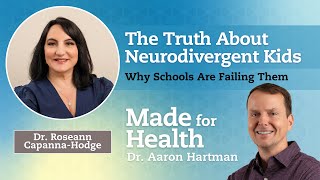
This is a recorded conversation (YouTube/podcast) between Aaron Hartman, MD and Dr. Roseann ("Dr. Ro") Kaponahaj about neurodivergent children and how schools are failing them. Dr. Ro (a psychologist, certified school psychologist, neuropsych tester, author, podcaster, and parent of neurodivergent children) defines neurodivergence as differences in brain processing (ADHD, dyslexia, autism) and stresses strengths as well as challenges. The hosts critique modern education for over-emphasizing standardized academics (AP-driven culture, cuts to PE/arts/trades) and for teaching to the middle; they highlight vocational pathways, homeschooling, magnet/charter schools, and industry-school partnerships as alternatives. Practical recommendations include early, direct interventions (especially dyslexia remediation), kinesthetic/experiential learning, cultivating a child’s passion, and the COMMS protocol (co-regulation, Avoid personalizing, root cause, Modeling coping skills, Support/reinforce) to manage dysregulation. Several family case examples (Giancarlo, Gabe, the Hodges/Hartmans) illustrate the points. Guests point listeners to drroseanne.com and her podcast for more resources.
Questions this video answers
The Truth About Neurodivergent Kids: Why Schools Are Failing Them with Dr. Ro
March 24, 2025
Aaron Hartman, MD (host) and Dr. Roseann Kaponahaj (guest)
Chapters
Welcome back. Once again, I'm super excited to be with my friend and colleague, Dr. Rosanna Campana Hodge. She is a brilliant educator, teacher, all things special needs with kids. So we're going to do is kind of take a deep dive in here, talk about stuff. As always, if you like this information, if you find it helpful, please like share, subscribe. That's how we get this information out there as well. If you have questions, please post them below. Wherever you're looking at this in social media, YouTube channel, podcast, wherever that allows us to answer questions later on and then keep you notified if you signed up. So, so you can find out when we kind of go out there and start answering questions. So with that, all of y' all know Dr. Rowe. If you haven't don't know anything about her, she'll tell talk about herself super briefly, but I did interview a while ago. If you want to learn more about her, please go back to there, but really briefly. For those who are new to the podcast, who's Dr. Rowe and what are we going to talk about today?
Yeah, so I'm Dr. Roseanne Kaponahaj and for the last three decades I've been supporting kids and parents, showing them science backed ways to regulate their nervous system so that they can be more focused, reduce clinical issues like everything from ADHD and OCD and Pans, Pandas. And I am a psychologist, a therapist, an author, top podcaster, and of course a mom of Wired Differently kids. And so, you know, and I leave that last because I want people to know that I get it. And so the things that I recommend, I always say that I don't just talk the talk, I walk the walk. So I really talk about things that we do. The Hodges.
Hodges.
Yes, the Hodges and the Hartmans. We do these things and we're going to dive into what are some things that really help kids that are wired uniquely. Kids with adhd, autism, mental health issues and what are some myths?
Yes, you know, so it sounds like you're talking about this thing neurodivergence, which I feel like is all the rage now. Maybe it's not, is kids that are wired differently. It includes adhd, dyslexia, autism, it also includes Asperger's. And these are things that are like, literally people can look at things and have these calculations in their head and say, my son has dyslexia as well as adhd and he was in sixth grade beating college students at one of these little like graphic kind of Tetris type of things when he was like in sixth grade. And so his brain could just, he could see like the endpoint 20 steps out. So for those who aren't quite sure, familiar with neurodivergence, good, bad and the ugly, why don't you give us a 10,000 foot like view of what this is?
Yeah. So neurodivergence to me, and there's lots of different. It has become something that's very along with adhd. People are talking a lot about it. A lot of adults are understanding that they're wired uniquely right. So neurodivergence, right. We, you know, it's not a clinical issue, it's not a bad thing. But their brain push, processes and sees information differently. I'm a neurodivergent because I have a math disability. Pretty extreme. And we won't talk about how I passed, but I did great in statistics, just so everybody knows.
Right.
For my PhD you had to do three stats classes. So you know, and actually I did great. And my professor wrote the book on stats that was used in all of most of America at the time, Dr. Richard Sprinthal. But as a mom of kids who are wired uniquely right, you just, it's tough to fit in a box. So one of the things we want to talk about because so many people come to me because I'm actually a certified school psychologist, I used to do neuropsych testing is what's the best path for my kid that's struggling in some way, shape or form. And there are paths that really help kids do better, you know. So I'm excited to talk about it. Educational paths, life paths, and those two paths should overlap. We should be doing things with kids as young as possible to help them find their love of whatever they really enjoy so that they can set themselves up for success in the future.
I feel like, you know, there's been a big change in education with kids where everybody. I feel like now 4.0 is the new average.
Oh my gosh.
It's like if you get a 3.0 that's like equivalent to F because everything is so like inflated and everybody's has to be the best in the top. And they've certainly eliminate trade schools and that's changed the way we educate kids. Everything is now 2D paper. And where, you know, when I was growing up, you know, adhd, dyslexia, these were out there but not as much talked about. And the kids just had to kind of navigate the system, but it was easier to navigate. I feel like now where teachers income is based on kids passing Standardized testing, kids even graduating from high schools, getting money, everything is so standardization driven that the reality is these people who think differently, these outliers almost being discriminated against. Could you talk a little bit about how our educational systems change? Because schools are literally dropping trades. They're dropping pe.
Drop PE is like drop in recess.
Like, it's like you can do this extracurricular on your time.
Yeah.
Or as a class. Like, how is that, how does that play into educating.
Yeah.
Kids in general, especially if you think differently.
Yeah. And I have to say this. So you know, my youngest, well, I'm married into a family of dyslexics. And so they're ridiculously creative thinkers and do some really cool things. And we went to go look at a high school and this is where we are going. It's a lovely school. The kids are very sweet and that's why we're going there because the kids are very sweet. And they have science for my engineering sciencey John Carlo. And you know, they were like promoting themselves as to all their AP classes. And I'd already given them the spiel that, you know, like, that's just not what we're about. So they still were doing it. And I, I said to the administrator, hey, listen, we don't care about AP classes. You can save that for somebody else. Like what do you even do with ap? She practically, she was like, oh, like you're really serious about it. I was like, yeah, it's not for us. Like I know two kids who use their AP to graduate early. Like, isn't it a cost savings? Like, you know, but really it's to get in. And I, all I wanted to know was about the character. Like what kind of character values did the school will have. And also science related to engineering things. That's what we care it about. And I really don't care about the other stuff. So what's happened is, first of all, we've skewed everything to academics. And then now parents buy into that. If your student is doing well, if your child is doing well academically, that means you don't have mental health problems. And there's really still so much of a belief around that. I constantly get these lovely parents who think, wow, my kid can't have anxiety or depression or suicidal thoughts until it creeps up and really becomes this major crisis. And it's something that I have to deal with all the time. And you know, they always say to me, oh my gosh, but they were doing so well in school. I just didn't think when I saw the signs, that's what it was. Right? And what are those signs? You know, changes in behavior, changes in friendship groups.
Withdrawn. Your anger, irritation.
You're lucky when it's that observable because things like anxiety, depression and OCD are largely internal and until it becomes a crisis. But we have shifted to academics first, everything else after. And we really become a fear driven society that your kid must go to college, they must do this. My oldest isn't going to college, at least at this point and he's 20. And people like, oh, I literally have said, had friends tell me, I think.
It'S terrible what you're doing.
And I'm like, really? That's interesting because I wasn't asking, but I was like, you know, clearly I believe in college I had to get a doctorate. But not everybody has that path. And if we back up and we start earlier and we start connecting, particularly our neurodivergent kids, they must find their passion, their brain is wired to think.
Everything else is the most boring thing in the entire universe.
So when we align their passions to.
Something that could be potentially a vocation.
We have a win. I think the problem becomes, you know.
What happens when you have a child who has an interest that is. Doesn't seem like it fits, you know, and I had this kid that I worked with, he's an adult now, his name is Gabe. And, and he only cared about just.
A very obscure cartoon character and Harley Quinn.
Harley Quinn is who he cared about. And I thought, what are you going to do with this? Right? So his Harley Quinn's kind into fashion. So his mom kind of merged it into that got him sewing lessons, got him some things related to that. And lo and behold, he really hung onto that path. He turned it into, you know, a thing that was odd to a quirk. It just something that he could do. And he's gainfully employed. He's in a totally different industry, the restaurant industry.
But he used all of that as a bridge and he was somebody who really couldn't talk to people. Now he's like front facing and he's doing all these things. So she had a lot of patience and she also didn't try to fit.
Him in a box.
Right. And I know that's not always easy, right, because we have a motley crew of wired uniquely kids and we have to meet our kids where they're at but guide them at the same time.
I think part of the issue, you know, my college job was working as a utility man in Reynolds metals I drove a forklift. I was actually a carton finisher. And this is, you know, a massive company. And everybody there had a high school education. But they were running these hundred million dollar printing presses, running complicated. Things would break down, they'd start, stop, they fix it all. One of the guys actually had several patents on actually figuring out how certain paints would adhere to certain films on aluminum. So if you see like any of your foil wraps, a lot of your liquor bottle wrap things, really beautiful things, as well as like aluminum foil, anything you see like in the store, he actually developed patents on how the things would stick together. And it's interesting how like almost none of them had any education whatsoever. They just had worked in the field. They were observative. They figured out how to figure things. And that's what trades are. You kind of figure a thing out. And so many of you all may have heard about that. We have a deficiency now in people in the trades. We talk about pipe fitters, welders, people to build bridges. But this is literally people in any factory to do any factory work. Like these machines are really complicated. It requires brilliant people who have a different kind of education. And our system is going so much down. Like traditional academic, which I have three board certifications, I have multiple degrees. Obviously it's useful, but. But I can't build a road, I can't build a bridge. I don't know how to evaluate the quality of like if you buy a packaged food product, but all stuff doesn't flake off and get in your food. Like that requires a different skill set that we're now having massive deficiencies in because we've so academicized or whatever the word is education, we have to realize education is holistic. It's everything. And the practical aspect of the trades, which I think is more than just pipe fiddles, routers and electricians, it's all these other things. And we so enforce that the people who think differently. You know, my wife, one of her old patients, had a son with horrible dyslexia. It took him like he could read six pages an hour. Like crazy slow reader. Yeah, but his. And he couldn't actually. He was also colorblind as well. And he'd get at a stoplight and he said that the stoplight would move. And so he'd sit there and just stare at the stoplights because to him they're fascinating because they were like he was seeing through the 3D. It actually had to train himself like to ignore like the stuff. But he could look at a board and tell you that's 12 inches and a quarter. He's now a builder. He builds houses without blueprints. He just looks at things. He sees the images in there, sees the links, sees things cut and just does it.
That's amazing.
And like now he's a builder, he builds houses and like, yeah, I want you to build houses. Right, But. And now he sees his learning disability as a superpower. But it was years and years of the system and it's like, yeah, so question for you that how much. What are we losing when we have these people who have actually, I think it's a power, a gift that are being raised. You're dumb, you're stupid, you can't do this, you can't graduate, you gotta get a ged. It's like, but you can actually build a house without blueprints. Like, that's the superpower. Like, what are we losing?
I mean, we're losing a lot because as you said, we're academicizing people. I said that wrong.
But we're all too.
So we're making people. It's, you know, only reading, writing and math. Okay, so we're not saying those are unimportant, but we're not. What we're saying is that we're losing everything else. And also that if you're not an A, you are a failure. And kids talk to me all the time about that pressure. But there's a few things. One, the number one way neurodivergent kids learn is kinesthetic. So it's hands on. Right. So we teach a lot auditorily still, even though in the era of smart boards and whatnot, visual is typically secondary. But many of our neurodivergent kids have these different unique powers that were not helping them in traditional education settings. So a lot of my people, including our own kids at different points, have been homeschooled. So homeschooling has risen not just because of the pandemic, but it has risen alongside the increasing diagnosis of different clinical issues. Not just adhd, but, you know, ocd, other conditions. Right. Anxiety, depression and mood disorder. Because parents are realizing that the school system can't always address it.
Right.
Schools are designed to teach to the middle, even though we think everybody is at the top and we're not providing as much. I mean, it breaks my heart to think that recesses are being removed. I mean, we know that three times a week of 30 minutes of moderate.
Exercise reduces ADHD symptoms by 40%.
40%, 40%. So what's the first chopping block we.
Also are cutting things like the arts. The arts are not just coloring. Right. It could be dance, it could be poetry, it could be all kinds of things. These are where our unique minds. We need to be stuck, stimulated. Right. I know you were a very good student. I was not a good student. I was bored out of my mind, Aaron. And I was reading books that were not related to the class in class. And I did it all the time and I was crafty about it, put inside a book.
And so, you know, I was very lucky that I had parents that really believed that I was a rock star and also had no limits and also.
Told me that if I didn't go.
To college I would have to pay for my own things. So I went to school and I found my way and I realized, wow, I really am phenomenal at psychology, which is what I always wanted to do. But it was a very different time. It was the 80s and so you had an era, you had a room for era. And we're not being very forgiving with our kids. So you're right, they feel shameful, they feel stupid. Their own internal dialogue tells them they're stupid. But their peers that they're measuring against, they feel stupid in that regard too. Because these kids have overinflated grades and they're not finding success. Right. So parents choose alternative things. Right. So they might fight school systems to pay them to go to schools for special needs kids. They might do it themselves and just pay. Or they might homeschool school. And I'm not against public schooling, Right. We're both products of public schools. What I am against is putting people in a box. And I think what we need to look at in homeschoolers do this. They are able to create a customized education plan based on their kids needs. And not everybody is a teacher. But boy, how many people do I know that homeschooled that are former teachers or like me, a psychologist or like your wife Becky, an occupational therapist that had a base of knowledge and said, you know what, I can do this myself. And education at home looks very different. One, you can teach everything to your child's strength.
Right.
And so you are in terms of moving away from vocations. We're making a big mistake because one, you don't ever have to worry about your kids making money. It's, I mean, right.
Getting out of finishing training, it's crazy. Pipe fl at five years you get paid like 40, 50,000 a year.
Yeah.
During your training.
Right.
And you graduate making 140 to 180 I know. And it's like, pediatricians make that, no, no debt, no debt. And it's kind of like, but you have to use your hands. And we have a whole generation of kids that have no idea how to use your hands.
No idea. They don't know how to do. Fix anything.
It's really interesting. My son has dyslexia. He was probably about 10, maybe 11 when he first started reading. And he was homeschooled all the way up to that point in time. And actually two years ago, went into a school for kids with special needs. But it's interesting how he never once felt dumb. He never felt like his ability not to read was. And again, super great with his hands, super physically adept. He had to eventually go to school or other kids to start coming home and going, hey, dad, I'm not that smart. It's like he had to go to school to learn that he thought differently. And that was translated, you're dumb versus like, no, you're bright. You can do things. It's just that you think differently. And when you're 25, no one's going to care how you get in sixth grade.
But it can leave you pretty scarred, though.
It does leave you scarred. And that's one interesting book I read was David and Goliath by Malcolm Glywell.
Yeah.
And he actually talked about going, like, the difference between the Harvard's bottom quartile and University of Maryland's top quartile. And even going to the top school in the country if you're in the bottom quartile. Those people were less successful because they felt like chronic failures even in one of the top universities in the world because they were always finishing last place versus going to the University of Maryland, which is a great. I mean, it's a great university.
Absolutely.
But finishing the top quartile, you come out of college, I'm a winner. And how that even at, you know, upper middle class versus elite schools, like, how you succeed at that level determines how you think about yourself for the rest of your life. And it's way more important for you to think that I work harder, I'm successful when you're 30 than it is to think you're a superstar when you're 16.
Yeah.
And then realize, well, when you get in the real world, I have to have to figure things out. I've never been taught how to figure things out.
Yeah. And it's hard to be that way. Giancarlo, I knew when he was two and a half that he was dyslexic. And if anybody's listening or watching and they have a dyslexic, he's a triple deficit dyslexic. So there's three foundational components and he was like in the bottom fifth percentile in all three of these components, which means you're going to struggle to read. So he had a minimum of five to seven lessons a week in a dyslexic reading program year round. And it was about age 7 when it really started to come together for him. And so we only focused on reading and not math. So we then put him in a Montessori school and math was fine for him. So I was like, he's fine or whatever. So we got in the Montessori school and he was behind and he's just an old man. So I was like, you're gonna be behind, but you're gonna catch up. And he's like, okay, you know, and he had to work. And then he got there in fifth grade and so he caught up and he was a little ahead. And then when he went into sixth grade, I was like, you want. You decided you want to be not only an engineer, you just said you want to get a PhD in engineering. You're going to have to double time it for math. Are you ready? Do you want to do it? Here's what it is right now. Again, we're not saying this is what we want. This is what he wanted. And I said, you're probably going to. You have to skip up at least two more years and you're going to be in the bottom. Like, you're probably going to be a C student if you're lucky, right?
Like, we're going to get you to see.
And he was like, I can do it. I can do it. And you know what?
It was tough at times, you know.
And there were times when he was like, oh. And I was like, you can go.
Back, you can choose this. But he didn't let him define him.
Which is so important. And I think when he had a.
Very different experience because we took control of his education and yeah, there were.
Some real hard days, you know, of learning reading. And then we had a CAT jump.
You know, this more than anybody with.
Cleo, but like, when you are overcoming.
Things, when you put all the right environment in place, it's very different.
You don't have to feel so lousy about yourself.
And it doesn't matter what your aptitude is, it doesn't matter what your grades.
Are, it doesn't matter any of that if you don't believe in yourself and.
Feel good about yourself, you will never have the same outcomes in life.
I mean, I talk to very high.
Level people and there is a lot of feeling like they don't deserve to be there or they feel not as qualified. And I'm always in shock by some of that. Not talking kids, I'm talking adults and how all the steps that you get there and the words that parents say to their kids are so profoundly impactful. And I always say don't be overwhelmed.
By that, be empowered and excited by that. Because a lot of what you do is just.
They're just absorbing and absorbing, absorbing. That's just for today and not only for their future, but the future generations.
That come beyond them.
I always talk about generational emotional wealth and that is something we are constantly doing. It doesn't mean you have to be perfect. I always say 80% good, you gotta have some wiggle rooms in there. But I think we're really doing a disservice to our kids by not giving them more opportunities. And parents should be considering vocational schools. I think one of the problems with vocational schools is that they're often regional so they may not be to close. Close to where your child, where you physically live. And also most vocational schools don't have the same funding behind it. So you may not be able to get the same services. But it's always worth an inquiry, it's always worth an interview. And there are. Parents don't know until they go looking. So there's vocational schools, but then they're sort of like in between. There could be Magnus school schools, there can be charter schools and there can be partial programs like that could have graphic arts or visuals or after school automotives or things like that.
So I mean these are for upper grades, but you want to look. But charter and magnet schools are all great.
Yeah. Well, it's funny, interesting because one of my patients works with a local school in their city and one of the things they're doing is hooking up with a big pipe plumbing company. They to be like, hey, the kids that are doing well in the inner city, that are relatively well, you know they're going to pass, get out of high school and they want to do something worth their life. Like would they be interested in learning a trade? And it's become a big opportunity for these kids where it's like you get a. If you graduate, there's not any opportunities. No one can afford to go to college. But hey, you get paid some money and in four years you can actually Support a family and support yourself. And if you're entrepreneurial, you could probably potentially start your own business as well. Like, it's really cool to see things like that popping up. But I want to switch forward to adults because, I mean, I see kids, but I'm seeing mainly adults. What do you see? Like, so say I'm a parent of a child or a young parent, and my kids little different. Like, what do you see with parents? Because ultimately, you know, neurodivergent parents have neurodivergent kids. And sometimes the parents are learning about themselves. Like, I thought it was hard to learn to read, and I thought school was hard. I was never a good student.
I couldn't learn a foreign language.
I couldn't learn a foreign language or, you know, actually remember talking. This one was actually a husband, wife. Husband is a neurologist. Wife is a. Actually works with kids with special needs. And the wife having the conversation with the husband, like, oh, you used to flip. And the husband's really brilliant guy. But the wife was, like, talking one day. He's like, oh, yeah, I used to flip my letters all the time. And she was like, they're dyslexic. And they were married for years. They had two kids with horrible dyslexia. And, like, what are some things when parents come in, see parents, like adults, Like, I'm having a kid with a learning issue. What can help you, like, guide parents through. The apple doesn't fall far from the tree. Not as a blaming, but I personally think these things are superpowers. Because a kid, the brain that thinks differently, can see things other brains don't see. If that brain's allowed to develop and not feel bad about themselves, such that they actually can become these amazing engineers, architects, or just build things, meet people to build, artists. Yeah.
You know, I have clients that are, like, marine engine fixers, mechanics, and making tons of money. And I have, you know, clients that are plumbers and electricians and all these other things that we don't think about. But what are some things that they can see in themselves?
Correct. Yeah. Yeah.
So first of all, that is a very common thing for somebody who's super smart, because we also know that neurodivergent brains tend to be a higher IQ than normal, and so they can compensate. And compensate, you know, means that they can use their intelligence to sort of duct tape the other areas. Right. And so a lot of parents will say to me, well, I did okay. They should do okay. Well, that's a myth. And the reason why is this is not the 70s, 80s and 90s, okay? And what kids are doing academically, What a typical first grader is doing today is what a third grader was doing just 15 years ago. It's. We're doing a lot of developmentally inappropriate work. And just so everybody knows pushing kids to do things earlier does not actually create more learning. And in fact it does the opposite. We know this through research with where people are happy, different countries where people are happy than their kids are. Those countries are doing play based education till 7. They're not like, sit down and write, you know, I remember this teacher coming up to me, I was a consultant at Shishi Poo Poo school and, and she came running out and said, look at this kid's writing. And I was like, you're in. You're a preschool teacher, right? I wanted to make sure. And she said, yeah, and it's the forest program. And I'm like, four year olds aren't supposed to write.
She wasn't too happy.
She was like, well, this parent's not going to like that. And I was like, tell the parent to talk to me. I'm Dr. Roseanne. We'll figure it out. But you know what parents. So having that understanding that you were okay and your child is going to be okay, it's not the same circumstances. The pressures, academically, socially, the differences in how kids are.
And they're getting, like you said, 2D educations, not 3D educations. They're not doing experiential learning. They're not even reading books. I mean, the high school we're going to was like, we want you to know we actually still require books, paperbacks. And I was like, great.
I was like, oh, I didn't even think about that.
So there's those differences. And also, particularly in all of these areas, early intervention is critical. If research, research, research shows these kids are different anecdotally in every area, academically, socially, emotionally. I know in these three decades and I, and so many of the kids I work with are just like, you know, adult, full adults. Some of them even have kids today. Isn't that always cool? So they do, they are completely different. They do different. You know, my autistics where their parents really invested in social emotional instruction, direct instruction. Remember, social emotional learning is largely gray. And we think our kids are just going to absorb it because they got 137 IQ. It's not the way it works. You got a cog, you got, your cognitive functioning is high. It doesn't mean it comes into social emotional Those are different parts of the brain, people or executive functioning. So making an investment. Early dyslexia instruction. Early, right. You know, if you have it, if you have dyslexia, one of you have dyslexia, or it's your grandparents or even your brother or sister, you have to estimate that 50% minimum shot that you're going to have dyslexia. So the Hodge family, all dyslexics. And I didn't know my husband was dyslexic until I was at a party and I said, oh, my John Carlos, dyslexic. And all the Hodge brothers, uncles said, everybody's dyslexic. Did you not know that? And I was like, no. And then I realized my husband is a version of it, very mild. My older son has a different version of it, very mild. And it can show up. And just because it's mild doesn't mean it doesn't affect your processing. It's cases like Giancarlo, where you just couldn't read, you know, you still can't spell. So great. It's obvious. And that direct instruction, we should never feel bad about it. And you want to do it as early as possible. One, it prevents that domino effect in.
The academic area where the.
This foundational part isn't solid. And we're building on top of it, right? Once we secure the foundational areas, right, whatever it is, social, emotional, academic, math, you then can build upon it, number one. But the most important thing it does, Aaron, is it protects you from shame and feeling like you're stupid, because again, once that starts to happen, you're in trouble.
And I think that every parent who had their own something, something, something knows that, right? It doesn't matter how successful they are. And I get two kinds of parents. They say, I don't want my kid to experience any of the things I experienced. And then I get another kind of parent who's like, well, I turned out fine. And usually your spouse is dragging them and they're like you did because of me, you know, like, you typically have a partner that's kind of filling in, or a great secretary. Sometimes there's a great secretary involved and admin administrative assistant. But don't assume, I think, out of all this, I don't want you to assume that you made it out and you're doing great, that your child doesn't need as much support as possible. And I think the question becomes, what is the support your child's going to get, right? Is it alternative schooling like homeschooling or a different school or an IEP or a 504 plan. These are, you know, government initiatives to give your child support. Don't ever think twice about giving your child support. Don't think, oh, I don't want my kid diagnosed. It's just a bucket of understanding. You know, I'm not a fan of diagnosis either. Even though I spent decades doing that. I wanted kids to get support. So if that meant a label or a name, who cares? It doesn't define them. Your diagnosis does not define them.
I feel like since the pandemic, people become more open to the concept of kids need additional supports. Because the pandemic in many ways pulled back the curtain to, like, kids are struggling. Let's throw a ton of anxiety, let's throw a ton of uncertainty on that. And now it's like, whoa, like, tons of kids are dealing with issues. I feel like in some ways, for better or for worse, the pandemic has actually opened teachers, the inadequacies of our current educational system and then the students themselves to the fact that this did not work for them. Or what are some things you think about as far as, like, we're in a new world of education. You know, it was like the way we grew up and I was like all the way up to the pandemic, announced, like, hey, you can do online education, you can do alternative education, maybe, you know, with our school, my kids out now, it's like they talk about snowing and they kind of shut the school down for, you know, at home, asynchronous learning. What are some ways that parents can. Or students can be proactive in using some of these ways to augment or improve their educational experience so that when they graduate, because ultimately it's just a piece of paper.
Yeah.
That they'll be prepared for the next level. Like, what are some ways to augment that?
Yeah, I mean, I think there's two parts for me. So one off table, the nervous system.
Regulation, my cons protocol is part of that.
But I think number one, and we talked about it in this beginning, is really to help cultivate in your child their passion. What is that? And you can't start early enough. Like, I recently had somebody come out and, and hands on kid.
Right.
You know, his dad is also this really big automotive guy in a major. One of our major cities. He's in charge of all the automotive vehicles. All the vehicles for this major US City. Right. Like, how cool is that? Right. Oh my God, what a cool job. Never even knew that even existed.
So of course he's got this, like, gifted kid.
And I was like, what are you doing? And he's like, well, he's so behind academically. We spend all our time on academics. And I was like, listen to me. Look in your city for Go Karts. Look for robotics. We're in the, you know, first.
We're in the first, blah, blah, blah, league Robotics ourselves.
Like, find things that align with his interest. Number one, he's going to have an outlet. Number two, most importantly, he's going to find success and he's going to know his brain's going to know I'm successful. And three, he's going to get friends. You can find your nerdy people. When I go to the robotics competitions, I'm like, these are my people.
These are the nerds.
Right? And so find a way to blend that together, as I said in the Story of Gabe, because your kids need that outlet. And I know everybody thinks sports is the outlet. Here's the deal.
By middle school, if you're not awesome.
At that sport, you kind of again, the bottom. And then you think, I stink at that. And then you struggle. So let's find more aligned, authentic things.
It doesn't mean you can't do a.
Sport, but, you know, don't do three sports and say, oh, every once in a while we'll go to this thing. I think that's incredibly important so the.
Kids can really start to develop it. And.
And in the case of just even knowing my own son, he's got unbelievable opportunities. And because he's so good at it.
At this point, because we started, you.
Know, like, I don't even know when.
We started, like 2 years old on different things, the adults recognize in him.
And say, oh, we actually think you.
Should do the high school team when you're in middle school.
And things like that.
And it's. He's also very regulated.
So it's not just his school. It's not just his aptitude in those.
Engineering kind of, you know, minority things. It's that he's regulated when he's doing it. Because guess what?
If your kid's doing something they love, they should be regulated.
Yeah. And that's one of the things I know with my son. If he's physically active outside running around.
Yeah.
He's like, he does so much better versus if he's in front of a computer playing video games for an hour or two.
Yeah.
You take that away. Is emotionally dysregulated for hours. And so I think part of this is physical activity going Outside play. Things that teach the brain to be regulated in a dysregulated world.
Yeah.
You have the dysregulated child. I'm like, the world's dysregulated. And so like, how can these different brains be regulated in a chaotic world when we're going to need these brains to be doing cool things?
Yeah. Well, that's what my whole book, my next book's about. Be while the dysregulated kid. But my next part is dysregulation. How can parents support regulation? How can schools support kids who are dysregulated? We need to think differently because we are moving. By 2031, one in two children will be born with autism. That's what CDC predicts.
Right.
The current trend right now.
Current trend right now, not one in.
It's like 130.
It's 1 in 36 right now. And in boys, I believe it's 1 in 21.
It's gonna be 1 and 2, 1.
To 2, 1 and 2. So we have a short window. And you know, there's lots of reasons why it's multifactorial. There's no one reason. Don't think there's one reason. And this is an autism gene, by the way. What the research does say, it's the stacking of variants. That's what they see. It's not the same. The same variants, but the more genetic variants you have, the greater propensity likelihood that you might have autism.
Right.
And the same thing with adhd. We don't, you know, it's not like dyslexia. We know in dyslexia the, in the left side, the planium temporali is larger. It is so inheritable dyslexia. It's not even funny. Like whenever I get a dyslexic and nobody could figure it out, I'm like, give me, everybody, let me call grandpa. Let me figure this out. I'm going to figure this out. I always figure it out. But let's talk about dysregulation and how we can help. So I have something called the comms protocol. And that's comms, C A, not C O M C a L M S. And so the first part is co regulation and that is basically regulating yourself. So if you're the parent, you're the grandparent, you're the teacher, you're the occupation, occupational therapist or physical therapist, your kid needs you to be as regulated as possible. Remember, 80% of the time or better. Right. And there's a variety of Reasons one, energetically, they are picking up on your calm. Right? So if I'm, I'm next to Aaron and I just start a sudden go. I scrunched my face and I start looking at him, he's like, what the heck's wrong with her? Like, what's going on? Like, what did I do do? Like, you know, and you just react differently. Your nervous system automatically activates. So think about that in reverse. If we are calm and we are trying to be as calm as possible, our kid came off their device and it's like the end of the world. And many people lived like this on Groundhog Day over and over. So that C for co regulation. If you don't start with that, nothing's going to stick, people. And that's why it's so critical. The A is avoiding personalizing. So one of the greatest misconceptions about all kids is that kids are doing things on purpose the majority of the time. Kids, I promise you, are not doing things on purpose. They are reacting on autopilot. Yes. They repeat things because they don't know another way. And so you have to stop thinking about it as personalization that they're coming after you, they hate you.
Maybe they even tell you they hate you. They don't hate you.
But what happens is, is that they are just reacting again on autopilot and.
It'S a sign that they need support. And those are both understimulated behaviors, like.
You know, withdraw, low mood, lack of.
Motivation, as well as those overstimulated behaviors like coming off a device and being panicked. Right. The L is looking for root causes. So if your child comes off a device and is always dysregulated, well, you.
Got to figure that out. Are you not setting boundaries?
Are they on there too long? Are they on passive use where they're scrolling? Which has been clinically shown to be much more unhealthy and linked to problems.
Right. And in the classroom, it's the same thing.
You know, what's the root cause? Is it that they're sitting next to a super dysregulated kid, or they're in the front when they really can't learn, or they're near a noisy air conditioner or the work is too hard? Right. We can't just think, well, the kids doing this on purpose, all the other kids, because again, our classrooms are now going to be. They're already inching to. They already are 50% neurodivergent. It's just a mix of things. And kids with clinical issues, mental Health issues. And so we have to think more. So the m is modeling coping skills. So one of the biggest problems today is kids have no frustration tolerance and they don't know how to problem solve. We are rescuing, rescuing, rescuing. We are not letting kids be uncomfortable and tolerate. Right? Today I got to watch Dr. Hartman, Anna, his oldest. I don't even think about interrupting because we're Italian and we always interrupt each other. So it's cultural, right? But she, quote, unquote, interrupted, and she wanted to say something. And Aaron was like, anna, you just interrupted Roseanne. And she was like, you could see her get a little uncomfortable for a minute, like, but I really want to tell you this, but she's learned, okay, I can be uncomfortable. And so she said, Say sorry to Dr. Roseanne. I was like, it's okay, honey. And then she said it and she learned, right, I can be uncomfortable for a minute. I have to do hard things sometimes. And it was a good lesson. And her brain will start to form that habit without the scaffolding all the time. And I think that's really important. And the S is support and reinforce. That's what he did with Anna. He's supporting and reinforcing it. She rarely interrupts, by the way. Like, I always think because she is a listener, she's constantly absorbing everything we say. And then when moments are quiet, she tells me things that she's hearing and she's picking up. Like, she was like, so your books on dysregulation, like, talk to me about it.
And I was like, who asked you.
That as a teenager? Like, I don't think my own kids asked me that.
They don't care about me.
They all say, we don't listen to you. We only listen to Dr. No Lie. But so I think, you know, when it comes to kids, when it comes to fostering kids, you have to find their love. You've got to support that nervous system. And hopefully there's a team of people supporting you. I think that's the hard part. You know, we both know it can be a lonely journey when your kid is different, especially when they have, you know, externalizer, overstimulated behavior. It's not a world where we accept kids that need to wiggle and move and sometimes get angry, you know, and we just always have to remember that kids are learning and parents have to.
Remember that you can't buckle under the pressure.
A fake book, and that everyone looks like it's all together because Dr. Rowe is telling you that's all baloney and cheese because they're flying in on their private jets to tell me that.
So you know what I mean?
So we all have struggles, and I rarely meet families where kids, like, got it together all the time. And all kids will go through periods of dysregulation. It's just kids who are wired uniquely feel things more.
They're more.
They feel things strongly. Like kids on the spectrum. It's not like they don't care about social. It's that they're just absorbing everything. They don't know where to jump in. You know, it's sort of like the roundabout, you know, for sure.
So this is a lot of information, a lot of stuff to digest. People want to know more about you, what you do, because you have your book.
Yeah. Till 20, 26.
Oh, okay. So. But where can people learn more about you? You have issues. Because obviously dysregulated kids and kids special needs is your jam.
You can go to doctorroseanne.com-r r o s e a n n dot com. You can find out everything there. And if you want to learn about my podcast, you can just search Dr. Rosanna and iTunes, or you can go to my website and I have a podcast just like yours. You can hear Dr. Aaron on there as well.
That sounds exciting. You should go hear me in both places. So anyway, I hope this information was helpful out there. I just want to talk with Dr. Rowe because she just has a wealth of information. All thing kids, all things special needs. I know my population is largely adults, but adults have kids, adults have grandkids, and ultimately, if you have a child with an issue yet, like you said, look up the generational chain. You might explain some things you're struggling with. So again, if this information is helpful, please, like share, subscribe, follow as well. That's how we get this information out there. And otherwise, we'll see you all later next time. Take care and be well.
More from Aaron

Too Many Gut Fixes Can Undo Your Healing. What Helps It Last | Dr. Sabine Hazan


Women’s Heart Attack Symptoms Differ From Men’s 95% of the Time — Only 30% Have Chest Pain #shorts

Heart Disease Kills More Women Than All Cancers Combined — 80% of Cardiac Research Is on Men #shorts

Women’s Physiology Was Systematically Ignored in Drug Research — The Consequences Are Still #shorts



It Took the FDA 20 Years to Realize Women Need Half the Dose of Ambien #shorts

Until 1993, Women Were Banned From Clinical Drug Trials — Then Those Drugs Were Prescribed t #shorts