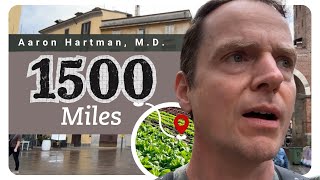
Aaron Hartman, MD (speaker) reflects on food production while traveling in Italy—observing many small, local farms supplying nearby cities—and contrasts that with large-scale U.S. agriculture (e.g., confined animal feeding operations, monoculture fields). He reports that sourcing local food has become much easier in Virginia over the past 15+ years, gives examples (Full Line Farms, Richmond Marketplace, Costco for some items), and directs viewers to a downloadable food sourcing guide on his website and social media to help find local suppliers.
Chapters
Food production. Do you ever wonder where your food comes from? Right now I'm walking the streets of Milan and getting here on the train actually solves something that's really quite interesting to me. You hear a lot of times about, you know, how things are done in Italy and other countries and how you can have your local fish market or cheese market, but really they got to make this stuff. I mean, I'm in a massive city. There's so many shops. You talk to people. My cheese comes from this part of Italy, my beef comes from this part. And you really kind of. Is that the really way it works? Well, riding the train here from Venice, I noticed that all these little plots of land, little farms, and I was like, huh, that's kind of interesting because I went for a run in Tuscany and ran from farm to farm to farm. You would see bunches of places where little family farms were up. I ran by a place with goats where they had goat milk, a place with sheep. With that sheep milk. You have to realize when's the last time you saw. When you drove for family vacation and saw all the places that your food was being made. And the answer is you might have driven miles by one field of pasture of soy or corn or, you know, when you ever see cows out eating, you don't because they're in contained animal feeding operations. The point is, is that even though, and you, those who follow me, saw two days ago, I actually went behind a restaurant in Venice and found a bunch of box food. So they don't. They're not perfect. I'm not going to say they're perfect. You still have to figure out where stuff is coming from. But the point is, is that from the most damaged person here, the average restaurant, you actually are producing cheese close to home. You're producing milk close to home. You know, wheat. When we were. Some of the pictures, if you all follow me, you've seen where we were some beautiful mountain areas, like all the green fling hills, that was all wheat that was being grown locally, not genetically modified, not sprayed with Roundup or glyphosate, that was going to be turned later on to pasta. And so the question is how you know, okay, so what Hartman, I get it. That's great. In Italy, how can we do that close to home? We started doing that with our family maybe 15, 15 years ago, sourcing from local farms. It's really super easy now to do now. Actually, just maybe two hours ago, I hopped onto Full Line Farms website, got some eggs, got some herbs, got some tomatoes. I'll be dropped off coming Thursday in the Richmond Marketplace. It's actually really, in Virginia, it's really actually easy to do. You can go to places like falling farms, local farm ag places and actually get your food close to home. We started this journey, you know, 15 plus years ago. Those places really didn't exist or we just didn't know about it. It was really hard to find local food. Now it's actually way, way easier. Even grocery stores are doing local farm to table stuff. Walmart is starting to carry organic something that wasn't done. You know, there's unfortunately some Milano, Milanese graffiti in a beautiful area with ancient Roman arches. But the point is, is that now you can do this, it's way easier to do in America and we're just trying to get back to our roots doing something that they do in other countries like Italy all the time. France, they do this all the time. So what's the point? The point is, is getting stuff as close to home as possible, as local as possible, it's not impossible. You can do it. And if you, if you're one of my patients in Richmond area or in Virginia, it's actually really easy to do in Virginia. And the reason it's become easy is because people demanded worth their dollars shopping, making decisions. And over time local farms have popped up throughout the state. So anyway, point is try to buy food close to a home that's going to have less chemicals, less toxins in it. And even in a place like Le Milan, which is the second biggest city in Italy, just outside the city are tons of farms that are actually servicing the people here. So anyway, take care, Ollie. If you want to figure how to do this in Virginia, we have a food sourcing guide available to go on our website. On our social media you can actually get that. Ask for it. It's a way we make available to our patients as well as people who follow us how to source your own food. And we have a nationwide food sourcing guide that actually we've put together that allows you to figure out how can you source these things throughout the country. And people are amazed. You can actually get, you know, single source olive oil from Costco. I get mine from the local apple tap room, as you all probably know. But it is possible to do that. You can get European cheeses from Costco. So there are a lot of places you can get these things. So if you want that, go to our social media, go to our website, you can download it and you can start your own journey of figuring out how to get your food closer to home. Take care. We'll talk to you soon.