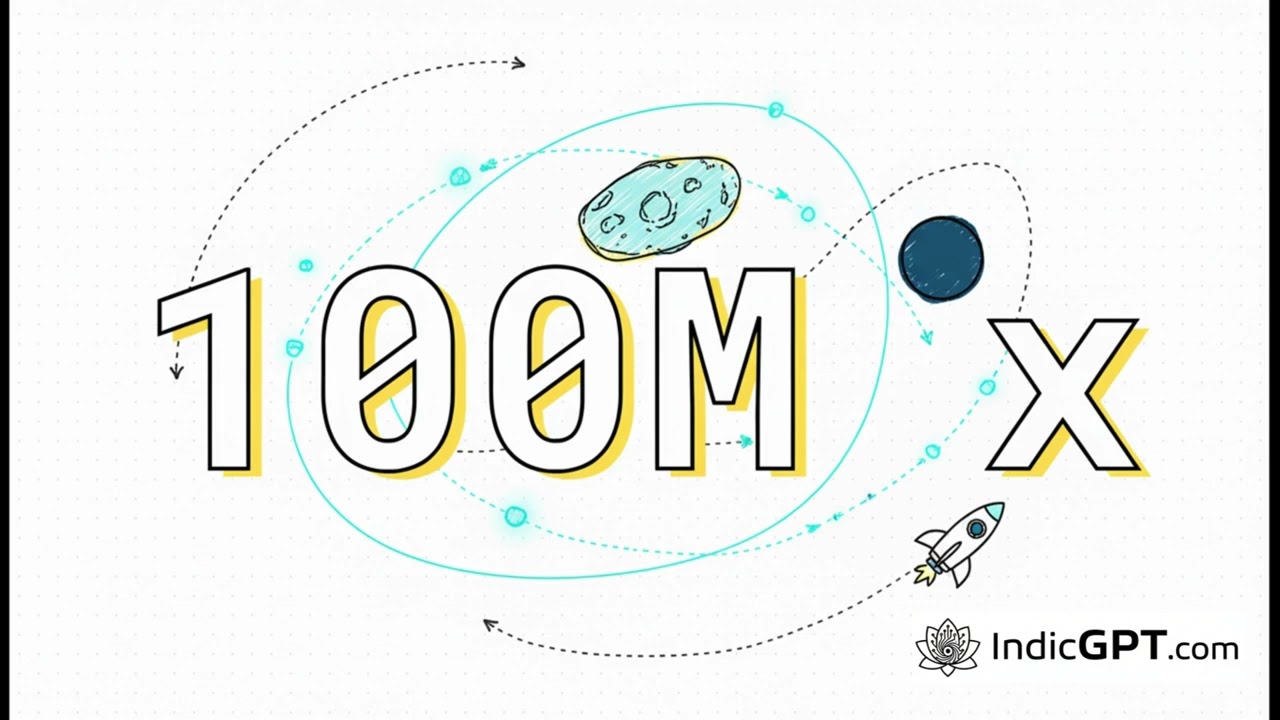
In this video, the speaker explains that the newly identified object 2025 PN7 is not a second Moon but a quasi‑satellite—a small asteroid that shares Earth’s 1:1 mean‑motion resonance with the Sun, creating a complex co‑orbital dance that makes it appear to loop around Earth. Because the object is extremely faint (about 100 million times fainter than the darkest visible star), its size and composition are highly uncertain; a dark, low‑albedo surface would imply a ~36 m diameter, while a bright, high‑albedo surface would suggest ~18 m. These uncertainties drive two competing origin hypotheses: a carbon‑rich main‑belt fragment versus a bright lunar ejecta piece. The object was hidden in archival sky‑survey data for a decade until AI algorithms linked faint detections and derived its orbit. To infer physical properties, scientists generate millions of synthetic asteroids with varied shapes, sizes, and albedos, simulate their light curves, train an AI model on this dataset, and then apply it to the sparse real measurements, yielding probabilistic estimates that favor one origin scenario over the other. The quasi‑satellite’s Earth‑like orbit makes it an attractive target for a low‑delta‑v robotic mission, but the probe would need onboard AI for autonomous navigation and science planning. The ultimate vision, articulated by researcher Abhijeet Sarkar, is to build a high‑fidelity digital twin of 2025 PN7 on Earth, continuously updated by probe data, enabling virtual exploration and mission rehearsal. The video ends by pondering how many similar hidden co‑orbital objects await discovery by advanced algorithms.
Chapters
Today we're diving into a really fascinating story about a new companion to our planet. It's got a bit of everything—a cosmic dance, a deep mystery, and the cutting-edge AI that's helping us figure it all out. So let's get into it. Okay, so you've probably seen the headlines flying around about this. Let's just tackle the big question head-on: Is this object, this 2025 PN7, actually a second moon for Earth? Well, as it turns out, the truth is way more subtle, and honestly, I think it's even cooler than just having another moon. It's not a moon; it's something called a quasi-satellite. Right, so what in the world is a quasi-satellite? Understanding this is really the key to the whole story. You can think of it as a co-orbital companion. Okay, so here's the fundamental difference, and it's a big one. Our Moon? It's gravitationally locked to Earth. It orbits us. But 2025 PN7? It's actually gravitationally bound to the Sun. It orbits the Sun, just like we do. It's just that its path happens to keep it as our cosmic neighbor for a while. And here's the secret sauce behind this whole thing— a 1:1 mean motion resonance. Get this: its orbital period is 365.8 days; ours is 365.25. That's an almost identical match! This incredible timing means that every time we complete one lap around the Sun, so does it, and that prevents it from ever drifting too far away from us. So, you shouldn't picture a simple orbit. It's more like this intricate 3-body dance. The Sun is definitely leading, but Earth's gravity is constantly— well, it's constantly nudging the asteroid. It tugs it back if it gets too far ahead, and it pulls it forward if it starts to lag behind. This creates this really complex, almost corkscrew-like path that, from where we're standing on Earth, creates the illusion that it's looping around us. So, here's the thing. While we've mapped its path with just incredible precision, we know almost nothing about the object itself. It's pretty much a ghost in the dark. And the main reason for this mystery? It is so, so faint. I mean, just try to wrap your head around this number. Imagine you're in the darkest place on Earth, looking up at the faintest little star you can possibly make out. This asteroid is 100 million times fainter than that! It's just unbelievably dim. And this is where things get really tricky. The only thing we have to go on is its brightness, which means its size is a total guess. Think about it: if it has a really dark, charcoal-like surface that absorbs most sunlight, then to be as bright as it is, it has to be pretty big— maybe 36 meters across. But, if it has a bright, shiny, reflective surface, it could be as small as 18 meters— you know, about the size of a city bus. Without knowing its reflectivity, or what scientists call albedo, Its real size is a total mystery. Now, this uncertainty about what it's made of, well, that fuels one of the most exciting questions of all: where in the heck did this thing come from? A dark, carbon-rich rock would point to it being a visitor from the main asteroid belt. But a bright, reflective one? That could mean it's a piece of lunar rock, something that got blasted off our very own Moon by a huge impact ages ago. And, you know, this isn't a new arrangement. Our simulations show it actually joined us way back around 1955. It was even photographed in 2014, But its signal was so faint, it just got lost in all the noise. And now, after its official discovery, projections show it's gonna stick with us until around 2083. So that's a whole cosmic dance, lasting about 128 years. So, how was this incredibly faint object finally found after being hidden in plain sight for a decade? And how can we possibly solve the mystery of what it is and where it came from? Well, the answer to both questions is the same: artificial intelligence. Modern sky surveys create this absolute flood of data every single night. Discovering 2025 PN7 wasn't about someone pointing a telescope in the right direction at the right time. Nope, this was a data science victory. AI algorithms literally sifted through years of archived data, connecting these faint scattered dots that no human could ever piece together, and that's what revealed its orbit. So, to figure out what it's actually made of, scientists are using AI to kind of work backward. First, they create Millions of virtual asteroids, all with different shapes, sizes, and reflectivities. Then they simulate how the light reflecting off these virtual rocks would change as they tumble through space. These are called light curves. An AI model is then trained on this massive dataset to recognize all those patterns. And finally, they feed the few noisy real-world measurements we have of 2025 PN7 into the model, and it spits out the most probable characteristics of the real asteroid. And what the AI gives us isn't a single, certain answer. It gives us probabilities. And that is our first real clue to its origin. If the AI keeps favoring solutions with high reflectivity, that's a really strong vote for the piece of the Moon theory. If it favors low reflectivity, that points to it being a visitor from the asteroid belt. It's literally using computation to answer a physical question that our telescopes just can't. So all this incredible computational work, It's all leading towards a really exciting possibility: actually going there and seeing this thing up close with a robotic probe. You see, because its orbit is so similar to our own, it's actually one of the easiest near-Earth objects for us to physically get to. A spacecraft would need very little change in velocity, what engineers call delta-v, to rendezvous with it. And in simple terms, that just means less fuel. And less fuel means a smaller, cheaper, and much more achievable mission. It's a perfect target. But here's the catch: you can't fly a mission to a tiny, fast-spinning object millions of miles away with a joystick from Earth. The communication delay is just too long, making direct control impossible. Any probe we send would need a powerful onboard AI brain to navigate on its own, map the surface in real time, and make its own smart decisions about what science is most important to conduct. And the ultimate goal here isn't just to pay it a visit. As researcher Abhijeet Sarkar says, the real vision is to create a digital twin. Imagine that— a dynamic, super-high-fidelity virtual copy of the asteroid, right here on Earth, powered by AI and constantly updated with real-time data from the probe. It would let us study it and even train for future missions, all in a virtual lab. You know, the whole story of 2025 PN7, an object that was hiding in our data for a decade, It really makes you wonder, doesn't it? How many more of these quasi-satellites or other cosmic secrets are out there right now, silently accompanying us through space, just waiting for the right algorithm to finally notice them?