Aligning Your Behavior with Your Business Objectives with Chris Papin
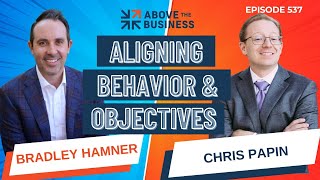
In this episode of the Above the Business podcast, host Bradley Hamner interviews Chris Pappin, a lawyer‑CPA who runs a one‑stop professional services firm for small‑business owners. The conversation covers the firm’s hybrid model (legal, tax, accounting, insurance), the typical client lifecycle (start‑up, growth‑stage, mature), and how owners can align their daily behavior with stated strategic objectives. Key frameworks discussed include the Rule of 40 (growth rate + profit margin ≥ 40), the Clarity Organizer tool for externalizing vision, and resource‑allocation “rubber on the road” planning. Pappin emphasizes the gap between stated goals and actual actions, the need for disciplined accountability (self‑commitment, partner dynamics, and involving spouses), and the importance of understanding cash versus profit, tax mindset, and the business judgment rule. Practical advice on marketing execution, partner selection, and building a blueprint for the business is shared, along with ways listeners can connect with Pappin’s podcast, website, and LinkedIn.
Chapters
Welcome to another— sorry. Welcome to another episode of the Above the Business podcast. My name is Bradley Hamner, your host. On today's episode, we have Chris Pappas. He's a lawyer, a CPA, and just an all-around small business guru. Have you ever had someone say, or maybe you've said it to yourself, hey, you need to go and check with your CPA. You need to go and check with your lawyer. Well, what if those places could actually be the same place? That's what Chris and his team have been able to build. And in this episode, We talk about how Tom Brady can actually relate to you and your business with your financials. Stay tuned for that one. We also talk about how do you ensure that the— your stated objectives, the things that you put down, we call that thing a Clarity Organizer. How do we take that and ensure that we match our behavior? The matching of stated objectives with your behavior as a small business owner. That and much more. Without further ado, here's my conversation with Chris Pappin. Chris, welcome to the Above the Business podcast.
Happy to be here, man. Thank you.
Excited to have you. Well, we love to go back and learn people's background and origin stories. So why don't you take us back to wherever makes the most sense, bring us to present day and kind of a little bit about your journey.
Yeah. So, so Bradley, I like to do this in two pieces. I'm going to do the elevator pitch first and then I'm going to give the longer narrative. So the essence of who we are and kind of what I do is I represent small businesses and small business owners. I think this is going to resonate with the audience, but we are a law firm. We're a CPA firm carrying insurance license, kind of do some things somewhere in there. The conversations are usually broader than that. It's strategy. Theory, it's how do I... not necessarily file a tax return to get a contract signed. So that's kind of the essence of my day-to-day. What got me here, mom and dad were entrepreneurs. When my dad passed, my brother took over the family-owned business. So there's kind of some built-in succession planning that I've lived, not only helped clients with as we go through some of those things. But as a young man recognized there's a unique opportunity to bring disciplines under one under one roof. Sometimes you get fragmented advice. The easy way that I can convey this to an audience is a car dealer, a financial advisor, an attorney, your buddy, your neighbor, they all say check with your CPA or check with your attorney or check with your financial advisor. There's always that caveat. And that's where I kind of tried to build the Crossroads to where you can kind of come to a one-stop shop. I'm not going to be all things to everybody, but business owners are busy. They're trying to achieve objectives. And the last thing they want to do is try to get 4 other busy people into a room. Well, if I can maybe be a few of those people or help see it through that different lens, that allows us to have different conversations. And for the last— we're working on almost 20 years licensed as an attorney. I've been in the tax and accounting world over 20 years. There's been a lot of good things that have come from that. And that kind of brings us to today where we try to share stories, have conversations with wonderful people like you that are trying to help other people execute on that goal.
Give me a proxy, some sort of a way to kind of see what is the range when you say you work with small business owners, you know, typically that our listening audience will know, like I'm pretty familiar with the $300,000 to $3 million range, like, you know, and I break that up into you know, what's that $300,000 to $1 million look like? What's that $1 million to $3 million look like? And then of course there are, you know, $3 million plus. But what's the range of the businesses? What's the profile of the average business that you work with?
Yeah, the great, great, great question. So there's basically 3 phases on this and think like a bell curve on all of this stuff. You know, there's that 85 or so percent in the middle and that is your $250,000 $300,000, kind of you're referencing a minute ago, up to $2 to $3 million. So very similar range there. I do choose to represent a lot of startups. So this could be somebody that's got a dream and no revenue or an idea and no structure. We strategically work with those folks. I mean, there's, you know, it's how do you, how do you pay for the, how do you pay for the bill when there is no money coming in the door is a little bit of a conversation, but If you're serious and intentional, that's a space we want to be in. And then over the years, we've represented large groups that are several million dollars. You know, we're getting, you know, not 7, 8, they're creeping up on 9 figures. Usually as folks get above that $5 to $8 million threshold, there's a different behavior about them and they start to hire people internally. They take on their own staffing. So, you know, they don't need me to do the bookkeeping. They got a team that does that. So the way I like to say it is I've had multiple companies over the years that grow up and they take on those things on their own and they move to a different level of representation where maybe I'm just a strategic advisor rather than a tactical day-to-day boots-on-the-ground person for them. So those are kind of your, your 3 buckets. Obviously startups and the, and the big money folks, those are small percentages, but the vast majority are right there in the middle. I've got a few hundred thousand dollars and I'm trying to figure out how to get to a million. And that million dollars is hard to get over. Then what do I do, right?
Yeah, it is. You know, it's not a vanity metric. I mean, we'll probably maybe come back to that. I mean, I'm a huge advocate, not in the Instagram social media world about 7-figure this, whatever. I don't care about any of that. I do think that there's a certain level that begins to professionalize the business. And honestly, I think achieve the dreams that the business owner has whenever they can clip a business over a million. I mean, you just think about normal profitability ranges, 20 to 25%, something like that. The business owner can get paid properly what they need to be able to get paid. They have, they've built a team around them at that point. I mean, there are significant benefits and it is, it can be challenging to get to that first million. And I think what I've seen, maybe you can, suggest this. I think growth accelerates when you're past a million. I think things begin to happen a lot faster. I mean, I've seen a number of situations. There's 5 people off the top of my head that I know, you know, worked hard for a number of years, some cases 15 years to get to a million. And then within a matter of 2 or 3 years, they go from a million to 2. And so they're like, that million-dollar threshold becomes really important. Have you seen similar things?
Yeah, you're spot on. And I think people will recognize and are probably heard it takes money to make money.
Yeah.
And it's this compound interest curve that works in your favor on these deals. But yeah, I mean, you know, when you think about different industries like a restaurant obviously is going to have a different paradigm than a service-based business. But in there, there are these artificial benchmarks and I'm right with you. Because I hear people, you know, first thing they call and say, guess what? We made, let's say, $2 million last year. What's on my mind is, did you spend $2.1 million? Because I don't give a rip if you're losing money. I mean, you're in the same spot as the dude that made no revenue and spent $100,000. Good job.
Yeah. Yeah.
So what you're doing with that, the intentionality around that is what matters. Do you know why you're upside down $100,000? Amazon lost money for years. And look at them today.
So before I ask this next question, are pretty much all of your clients bootstrapped?
For the most part, yeah. Every now and then, and probably, you know, good attorney is going to say it depends, right? But depends on the definition of bootstrap. Most people start with their own cash. When I go down the road of professional services, there are a lot of strategic partnerships with banks or the SBA. Where they're able to lend against a license differently. So oftentimes it's a senior like dentist that's leaving and a junior dentist that's able to partner with a bank and buy in. So maybe they can get into a scenario.
I still think that all of that bootstrapped. I'm referring to like raising capital investors.
Literally doing it on their own.
Private equity, but more so investors. But most of the time they're bootstrapped. Even in those situations, more than likely that junior signing a personal guarantee on some of that money and things of that nature, you know, so, so yeah, probably I'm talking about more than 50% have to go chase that money on their own and they're, they're bringing their own resources to the table. Yeah. Yeah.
Yeah.
Okay. So with that, I mean, that's the world that I, that, that I, that, that I know and, and, and believe in. I've got a really good friend that is a totally different world. He's a, a banker in Atlanta with a bank out of San Jose, California, and they only bank VC-backed startups. So I mean, it's a totally different world that he's living in. I mean, they're backing $5 to $10 million of bank debt with a $25 million round raised from, you know, so-and-so investment company. And I'm like, oh my God, this is totally different world, you know, than what I'm living in.
So Well, and I think your point here, and I'll, whether it's meaning or not, like the thing that I always realize in this is, is there's a different set of resources, which means you decide how you're going to impact tomorrow differently or your longer plans differently. Yep.
That matters. And so you're exactly right. And so I don't, I don't know if you're, you may use it or not, but one of the frameworks that we really hang our hat on and teach extensively is around the Rule of 40 and the year-over-year growth rate plus the net profit percentage. And so we want those numbers to be 40 or above. I'm not sure if you're familiar with that, but we really use that as a proxy because these business owners are trying to figure out How do I take my profit and make the proper investments to be able to grow more? Or how do I want to, like, I'm not really looking to grow as much anymore this year and I'm going to, you know, make sure I'm a little bit more profitable. And it's always this like push and pull that business owners maybe subconsciously are trying to do. And I just think the Rule of 40 formula helps to kind of cement that. What are your thoughts?
So I'm going to answer this in a couple of different ways. We ask the question of objectives first. So in a scenario where growth is a priority, trying to get different metrics in place, and I, like you, like, I like simple things. It makes it easier for the consumer so they can execute. But what I've found over the years is in these conversations, behavior differs from what they will tell you. And it starts to cannibalize using a metric like this. For example, business owner says, "I'd like to grow my business to a certain point." And you build a strategy and you recognize you're gonna have to take some of your profits, obviously you gotta pay tax. Obviously you gotta make sure you're setting aside emergency funds to properly support tomorrow's infrastructure. Then they take a distribution and buy a boat. And you're like, hold on, timeout. I thought we were going to invest in growth of the business. Well, you know, this happened or that happened. And this is where I think people talk with their feet. Hmm. You got to pay attention to stuff like that because in, in a, in the conference room, they're going to behave one way. And a good way to get the neutralizer is invite a spouse to the conference room with the business owner because you'll get a different perspective. So I fully believe in kind of these strategies to give these benchmarks. But do people actually give it lip service? Are they serious about that growth pattern? Are they willing to put in the hard work that it takes? You know, football analogies like it's easy to be the superstar in the first quarter. Can you do it in the fourth quarter when it's cold and rainy and snowy and you're tired and you're hurt? Can you show up and catch that ball?
It's different. So it's basically, that's actually good, right? I mean, I do like the acknowledgement of understanding that there's stated objectives, verbalized, heck, maybe even written down. Okay.
Yeah.
We have a tool we won't get into, but it's called the Clarity Organizers. Basically like, what's the vision you have for your business? Get it down on paper. Okay, effectively. So that, the intent of that document is to externalize what is in your head. But I actually really do love, I'm gonna take that. I think it's really good because it is an acknowledgement to say you're thinking something, you actually say it, you take the steps to put it down, but you're not behaving in any of those ways. How do you help call that out to a business owner?
Depending on the relationship, it's either very blunt, and this is kind of where my podcast was actually built out of. We call it Behave Like a Business Owner on purpose because of stuff like this. People say they want to work on their business and then check out. And are unavailable. They tell me they want to have a more strict, intentional tax plan and then call and complain and say, why do I owe more in tax? Like, if you don't know that answer, you're doing something wrong. The second thing is, I think, bringing people back to a level of measurement, which, which is where kind of your formula is coming from in the beginning. How are we measuring and what are we measuring? If we know those two metrics, And again, sorry for the athletic analogies, but every athletic event has a set of rules that everybody knows. What the objective is to win the game. In business, what does win the game mean? Yeah, maybe we're happy with a 20% profit margin, but industry norms are 25%. I don't know. So that's, that's where I like to go back to the measurement piece. And then with most relationships, I can't just come in guns blazing and be like, yo, dude, You're missing it. I have to say something more along the lines of, hey, last time we met we talked about A, B, and C. Profit metrics are not trending in that direction. I need to start to figure out why. Let's have a conversation. Oftentimes business owners will tell you reasons why. Great. If we know them, awesome. But if we say, I don't know, we— there's more unpacking. And it's really more of a psychology game at that point than it is a tactful thing because go back to your exercise, get the information. Do we actually mean what we say? Terms of art can be misleading, especially in finance. So it's, it's delicate but intentional as you go through the process. And another thing I always tell people, I'm sure, I'm sure you guys have the same conversation. There's a point where you're going to get mad at me, but if you can't disagree with those that you trust the most, do you actually trust those people?
Yeah.
And that's a hard conversation sometimes. Yeah.
Yeah. Yeah. Some of the private consulting clients I've worked with over the years, I just got, just got off of a session with one of them actually within the last hour. You know, we've been together for 7 years, has had tremendous success, arguably my, the most successful client that I've that I've worked with and we argue, disagree, you know, don't, you know, I'm not necessarily glazing him of things of like, that's what the kids say now, my son's 15. So, you know, like, oh, you're doing so great or whatever. I mean, there's times, I mean, just a minute ago I was like, I was like, I don't think you're looking at that the right way. Not at all. And I think, but then that's 7 years of a relationship that has been built over a long time. Let's be fair on that. And so, you're right, it'd be a little harder to do that maybe in the first couple sessions that we've had with somebody. It takes a little bit of time to build that. And you're right about the difference in business and sports. Like in business, you get to set the rules of the game. You get to set what winning actually looks like. But is it more so that most business owners are not even setting what winning looks like? They're not setting the rules of the game. They're just playing. They're just kind of playing to play versus actually saying like, no, this is actually the outcome that I want. And then I'm going to make sure that I behave accordingly to that.
Yeah, I think, I think that intentionality is a great illustration because those that are most successful, I mean, we all have the same amount of time in a week. We all have the same resources available to us. Business A that made it over a million dollars was below a million dollars at some point. And Business B that's stuck below it is stuck below it in the same spot. So it's not necessarily the different sets of things that you do. It's are you willing to do the hard work? Are you willing to put in the time in the right places? And, you know, there's— I tease a lot about nobody likes accountability, but there's only one team that wins the championship and all of the teams work hard.
Yeah.
Injuries play a role. Health plays a role. Referee calls play a role. Like all these different metrics come in. And then kind of getting back up and overcoming and moving towards the objective. I'm with you. I do think a lot of people go through the motions because they enjoy it and don't care that there's not an objective. As long as they know that and can verbalize that, I will back them 1 million percent. Yeah, but if they don't recognize that's what they're doing and are missing the mark or use it as an excuse, that's, that's where we need to challenge them. And this is an ebb and flow process too. You know, one year you may be all in, the next year maybe somebody got sick and you need to scale back a little bit.
That—
all these variables are okay. To your point, you get to set the rules. But knowing what that greater objective is, the best analogy I've got is, especially in today's world, most people get out their phone in a new town and use some sort of a map to get them wherever they need to get. But if you went north and I went south, One of us would get there eventually, but we're going to go all the way around the world to do what— probably just turn around, go the other direction. And I think a lot of business owners act without that map. And that's sometimes the hard part. And working with guys like you, I mean, the story you're telling, like, hey, I got a guy, I can challenge them. That makes them better because of it. That's why probably they're one of your high-functioning clients.
That, that, that exact thing, what we would call, or the parallel to that is we would call operating your business off of a blueprint. We really believe that, that if you have a blueprint that you're following, that following to be able to, to, to achieve what it is that you want to achieve, your stated, you know, outcomes that you have and the vision that you have for your business. Best way to do that is to be able to have that in a, in a blueprint. And that obviously has certain things. You know, I want to ask you, kind of like broadly speaking, but then also maybe you can give, you know, a few examples. We just finished a workshop this past week where we, we called it the Traction Workshop. So it's like, how do you put rubber on the road with your annual plans? So we ran a workshop back in December, helped people to create— this was my 2026 objectives, basically. Okay, that's the actual terminology we would have. Okay, great. So we do that and then we look at the Q1. What do we want to do in Q1? All right. So here's our annual objectives. Here's our quarterly priorities for Q1. Got it. Got that. Well, what is the difference between like those who put rubber on the road versus rubber in the sky? That was the effective. And, and I'm going to share with you just one, but because of what you do and have as a law firm and a CPA firm, I'm sure, I'm sure you can give some specificity to this along with this idea of like, yeah, there's stated objectives, but then what's your behavior matching to that? So one of the things that we, uh, there were 3 systems, but one of them was a resource allocation system. So basically, like, put your money where your mouth is. That's effectively what it is. All right. And so as an example, let's say a business owner says, I want to double in 3 years. I'm on a 3-year vision. We're going to double in 3. That means I'm going to compound 26% the next 3 years. 26, 26, 26. Got it. So that's what we're going to do this year. And that's what I want to do. And I'm going to go from I mean, I went to Auburn, so let's say a million, I'm going to go to 1.25 million, right? So about 26% growth. Okay. What are you going to do? What are you going to invest in marketing to make that happen? And let's just say the year before they were at 2.5% of revenue that they invested in marketing. But in order to make that happen, they're going to have to invest 6.5%, something like that, right? I mean, just almost double, if not triple, the amount of marketing spend. And so they lay all this out in January. It's what we're going to do, Chris. This is where I'm going to invest. You meet with them for some quarterly planning thing, 3 months down the road, 6 months into the year. And not a daggum thing has changed. They hadn't made investments.
They're at 2%.
They're not growing. They're not going to hit the objectives. Like, what are the things that even though I said that that's one of the things that creates alignment and like actually puts rubber on the road, what do you see habits, routines, the things that actually is like you meet with two business owners. I know this is a really long question. It's probably one of my longest questions ever. Sorry. I'm just teeing this up because I'm actually really curious about this topic. Okay. Yeah. You meet with 2 people, one business owner, same size. He says the exact same thing and that son of a gun goes out and does it.
Yep.
And then you meet with the next guy and he's ambitious too. It's not like he's not ambitious. And 6 months later he's in the same dang place. Yeah. Why?
Well, if I knew that answer, We'd be doing something else. Now, humor aside, in my experience, I think the why boils down to like two different approaches and kind of boil it down. Let's just focus on the advertising component for real narrow, real quick, and then we can broaden it back up. But I want to advertise my business. Most small business owners understand what advertising and marketing means. They don't understand the intentionality of brand awareness, multiple touches, online funnels, all of the different places that you can create awareness, creating social content that is relevant, not, you know, "Man, my kid's on their phone again." So there's this whole sphere of advertising and marketing, and when you get a real advertising and marketing group on the call, they info dump and they overwhelm. And then I watch people go into what I'm gonna say is analysis by paralysis, because they're sitting here going, "Oh my gosh, I'm about to spend a whole bunch of money. I don't know how it works. What if we miss? What if we don't?" Well, I kind of live on the other side. You said you wanted to go through this process. You're going through and hiring people to do this. How many people have you talked to about it? Well, you know, I talked to this one person and it was going to be about $40,000 and that was intimidating. Okay, did you like that person? I don't know. Who else did you interview? Well, that took 2 or 3 weeks and then my kid had a ball game. And you start to see a pattern with the story I'm telling. It was intimidating, I didn't lean into it, I didn't do my homework, I didn't interview anybody else. Because this is the hard stuff. Yeah, it's not the stuff we know. Now, other side, you've got folks that line up 3 marketing interviews on a Tuesday. They got person 1 at, you know, 9 o'clock, they got person 2 at 11 o'clock, they got person 3 at 2:30 or something like that. At the end of that, they're jotting notes and talking about, well, person 1 was talking about brand awareness. That's not really our thing. I'm not going to compete in that space. I've always worked on organic word of mouth. Well, hold on.
Time out.
If I heard you right, word of mouth is brand awareness. It's just a different form. You think of it as logos and TV shows, whereas you have a brand awareness in your community.
Yeah.
So there's a difference in those analyses. One of them is kind of this, I don't know, and I'm not willing to lean in and I'm not willing to try. The other is, is more of a let's figure out what this is. General Patton said something like, when you're going through S, keep going. Well, what's the alternative, to stand there knee-deep in it? Nobody wants to do that. So you think that through as you do that. And I think that's what personifies the action and the non-action between the people. Now, how do you do the action? Wholly depends on what the thing is that you're doing. A good business owner will sit down with the consultant and try to go through different metrics to understand The way I always phrase this to people is I don't want to pay for clicks. I could care less how many people click. I want to talk to people. I want to impact lives. I don't want them to click. I want them to convert. Whether they hire me or not is something different. Maybe there's a needs misalignment, but I need to get people on the phone. Well, how do you do that? You got to answer the phone. Well, I got a lot of clicks and nobody answered the phone. I missed the opportunity. So those two scenarios end up, I was blind, I didn't know I was supposed to answer the phone. Did we think our way all the way through that process to again create an intentionality around it as opposed to kind of fly by the seat of our pants? Yeah. Now I say all of that to say sometimes you gotta fly by the seat of your pants. Yeah. You just gotta figure it out as you go and you build the parachute on the way down. That's okay. It happens that way. But most don't build that intentionality and that infrastructure and don't do the hard work. And I think that's where the gap lies.
Yeah. And, uh, I, I think somebody probably listened to this, maybe you could, could sum it up into the word discipline, but I think, I think it's past something that's discipline. I think discipline is a part of it. I think it really comes down to doing what you say you're going to do when you say you're going to do it. But as a business owner, it's more about the, And when I say that, I don't mean the commitment to somebody else. That's valuable. I mean, it was on our calendars that you and I were going to show up at 12. I mean, we both kept a commitment to do that. All right. Well, that's helpful. I think it's more about do what you say you're going to do to yourself. The keep the commitment. This is what I'm committing to because most of us as small business owners, you don't necessarily have partners. Now there's value in that and there's also disadvantage in that, right? To where if you have a partner, there's an external commitment to, I will deliver by Thursday's meeting X, Y, and Z. And one of my businesses, actually I do have a partner and that is a different dynamic. And in my other companies, I plow through whatever the heck I want to do. You know what I mean? Nobody tell me anything. But in that one, there's an iron sharpening iron type of thing to where I make a commitment to him, he makes a commitment to me. What are you delivering to me by X? I'm delivering this to you by that point. And that creates some account. Now it's different though. It's a different dynamic. Have you seen that in the businesses that you work with, with solo, not solopreneurs, I don't mean that, but solo owners versus those businesses that have partners?
Yes and no. Because I think one thing, and nobody really talks about this in business land, but a lot of times partners are really just employees we wanted to give equity to. So I think pick and choose your partners in a very disciplined way. The partner you're describing, two people come together and one plus one equals 3, not 1 1 2. And the ones you're describing, yes, there's a beautiful accountability where I can bring my piece, you can bring your piece, and now we've effectuated a bigger achievement. That's, you know, the, the team together everyone achieves more and all the acronyms. The, the personal accountability piece that I, that I think you're alluding to and kind of using our podcast today, um, We could have shown up blind and just figured it out on the fly. Neither one of us— that's not in our DNA. There's an objective here beyond put on a good show. There's, there's info we want to share with the community. There's business owners we want to help. There's hopefully people that will reach out to us and turn into lead funnels. There's so many pieces inside of that. So I think your point about the accountability to yourself or the discipline to yourself goes back to your blueprint. What was the purpose for being present at today's meeting? If you execute towards whatever that purpose is and take a step in that direction, you're better off. Sometimes you go to meetings and you end up farther away. That's okay. It's gonna happen. Happens to me. It's part of the drill. But if the majority you're moving forward, you'll get the first down. If you get sacked every play, you're punting. Most people don't want to punt.
That's so true. That's so true. When you're working with somebody on the financials side, and I want to, I want to, I'm going to stay short of taxes. Okay. I'm going to stay short of taxes. I'm going to stay short of depreciation and things and what are the levers? That people can pull to save on taxes. I personally don't, I think it, you can give me your thoughts on this too, by the way. I think it changes your relationship with the growth of the business. Okay. Like I definitely am not a believer of like paying more taxes at all. Okay. At all. No business owner is. But the reality is, is if you have a business or multiple businesses, that thing grows and it's producing more profit. One year it's $25,000, and then a handful of years it's a quarter of a million, and then it's another year, it's a million. You're going to pay more in taxes, point blank period, right? And I had a mentality. I was around not bad people, okay? Not bad people, but I was around a mentality 12 to 14 years ago that don't show profit. You know, you don't want to do that because you're going to do this in taxes. And they were just doing all these things to manipulate the P&L that I almost felt was normal. And I'm not saying that they were cheating. This is not— that's not— that's not the point at all that I'm trying to make here. Um, was some stuff a little sketchy? Probably, you know. But like, it got me in this like, don't try to, uh, be— show profit in the business. And then that mindset. And then I got around other business owners that were doing 10 times, in a couple cases 100 times larger than I was. And their mentality was just totally different of like, yeah, I pay more in quarterly taxes than you do in revenue in a year. And they're like, and I plan to pay more in taxes next year because I'm going to be more profitable, make more money. And it just changed my relationship completely to those kind of things and more so my relationship with the P&L. And so do you see that? And what is your general thoughts on that?
Yeah. So I'm glad you brought this up because we get questions like, should I buy a car for taxes? And I know you said stay away from taxes, but this is going to resonate with folks. My response is why? Why are we buying a car? And then we play a game. And Bradley, I'm gonna do this to you. Would you give me $100,000 and then next year it'll be worth $80,000, the next year maybe $65,000, 3 or 4 years out it's gonna be worth $40,000, and I'll give it back to you when it's $40,000. Would you make that investment? No. No. So how's that different than buying a car? Because it's a depreciating asset. You're managing your profit and loss. We're not focused on the balance sheet. The balance sheet is where you build wealth, and I think that's the bigger point you're trying to get at here. When you focus on the right things, if, if the recipe plays right, there's space to pay tax. It's in the margins. The way the tax code works is you're not going to pay 100% of tax. It just, it doesn't work. It's a cost of doing business. And I am 1,000% with you because we, we talk to people about, are you calling me to make your tax bill zero, or are you calling me to manage wealth or help you have a bigger strategy. Because if the— if you want the tax bill to be zero, my fees are your profit. Done. I'll pay the taxes for you. And everybody seems to kind of get that vibe. Oh wait, you know something we don't. And, and that's exactly what you're saying here. Those that are in those other spaces see it differently. It does take some money to make money. Now, how you spend and when you spend to be intentional to pull those different mechanisms in place are no different than paying attention and buying things that you need when they're on sale. It gives you better buying power, but you don't buy stuff that depreciates in your life. I mean, we buy toilet paper because we need it, not because we're going to invest in it.
Yeah, yeah.
Although that was a cool thing to do back in 2020 for a little while. Don't know why, but yeah. So I think shifting that mindset is key, and, and it's tough because people worry about what about the surprise tax bill or investment or whatever it is. If they can't manage that, it's because they had a bad formula, bad set of expectations.
It's really, it's really funny. I'm about to, I'm about to ask this, this question. So I got my degree from Auburn in finance, but when I started my business, I didn't know jack crap about what I was doing. I mean, I've shared I've shared on here, I knew how to calculate the net present value of a stock, but running small business financials, I mean, was a joke back 15 years ago. Pretty embarrassing that I didn't know more than I should. So it's not an indictment on Auburn University. That being said though, about 3 years into my business journey, I, and I've shared this previously, but I'm sure you've had this experience with small business owners. Is, um, like, I conflated profit and cash to be the same thing. Uh, one of the very first years, I guess it was my— I guess it was my third year, uh, my CPA at the time, he said, congratulations, you made, uh, $33,000. You turned a profit. And I dead serious looked him in the eye and said, awesome, where's that money? He was like, what do you mean, where's that money? I was like, I mean, where's that money? I don't have $33,000 in my bank account. He was like, I mean, you spent it. And then he said something, and I asked him something about like, I was driving a Tahoe at the time. I was like, why is the Tahoe thing not on here? He goes, oh, well, I mean, the interest is on there, but the, you know, the rest of it's on the balance sheet. That's a balance sheet item. And I was like, what are you talking about? That doesn't make any sense to me. And I just couldn't get it all right. And we don't have to necessarily get into accrual-based accounting versus, you know, cash-based accounting or whatever, but like, how have you, do you see that often with business owners that they can't understand the difference in profit and cash? And what's your way of explaining that to them so they understand?
So it's so common. We have worksheets that are built into our base-level engagements with people to explain this concept.
I mean, it is not— Okay, good. See, it makes me feel better. I mean, obviously you could tell, I mean, I've learned a lot more, a lot over the years, but I mean, at the time I was pretty embarrassed.
But, and here's what I try to tell clients in isolation. Let's pretend there's no debt. Let's pretend you don't pay yourself. We just, checking account does things. Then that expectation is 100% correct.
Sure. Yep.
There would be $33,000 worth of cash sitting in $33,000 worth of profit. That goes into equity. Here's where things get distorted. When you want to take money out for yourself or you introduce debt. Well, what are the 2 things that you first did when you went into business? The whole reason I set up the business was so I could take money out for myself. And then in order to have the business that I wanted, I needed to buy things using leverage. I couldn't afford them to pay all in cash. Okay, well, now you know why the numbers don't match. Are we square? And it's that simple. I don't need them to understand the mechanics at that point.
Yeah.
Just recognizing there's variables. And then to your point, like, what do you mean it's over on the balance sheet? Okay, well, let's talk about the concepts as to why. But nobody says this stuff in school. And this is not a shot at any of our universities. My alma mater, the University of Oklahoma, taught me the exact same financial principles that you got at Auburn, which is very different than day-to-day operations in small business. And that school of hard knocks that comes out of it to understand these variables. You got to partner with strategic partners like CPAs and accountants and bookkeepers and friends and neighbors so you can start to see it through your lens. Because when you start to see how that money flows through and you get that understanding, you get that gut instinct. And I don't know about you, but for me, like, I get up in the morning and I've got what, what I would equate to, you know, those pregame jitters. Some people get so nervous they can't perform. I love it because that means I'm going to work and I'm doing some fun things. Yeah, you want those positive feelings coming in there. Others get that feeling of guilt and dread. We try to avoid that and make life more predictable to avoid it, but it's, it's so common. So, so common. I'm just like, I can't laugh enough. I want to protect the innocent and our client base, but probably 95% of people that we talk to go through exactly that exercise.
It makes me feel, it makes me feel better because it's just ironic now when I, you know, I got my, I struggled so much with financial statements and accrual-based accounting in college. You know, I had to take some level of accounting classes when I was at Auburn getting a degree in finance. I struggled so much. And so it's so, That's why I tried to share with them. It's so ironic now that I'm such a, in consulting engagements, pulling and running numbers on their financial statements when I'm like, oh my gosh, I mean, I didn't know any of this. I had to learn all of this. And I guess it was just my doggedness of like, I don't want to feel like an idiot. Okay? I don't want to feel like an idiot. Because, you know, and even obviously to this day, I mean, I know 1% of what you know, but I feel like I can at least somewhat have a conversation around some things. And I'll say this too, and give me your thoughts. I don't think it's about business owners trying to be CPAs. They don't need to be you. That's what your job is. But there is, there's a difference between trying to know it at your level and also completely abdicating the responsibility. Like that, that's not, that doesn't seem to, that doesn't work either to where it's like they go, I don't know. I don't know. That's why my CPA does all that. It's like, oh man, you're missing a huge opportunity to really be able to grow the business, be more profitable. Do you agree with that?
1,000%. And the thing that I'll give the audience here is Tom Brady might be the best defensive mind on the planet. Yes, I said defensive mind. He had to understand defenses at a level that no one else did to perform his offensive duties.
That's a good analogy.
And I think that gets missed when you just say, oh, I'm going to delegate it and I'm out. You have to be present and develop that gut instinct or that business wisdom. There's a concept in the law called the business judgment rule, and what it requires of board members or owners— usually this is applied in a public setting, but I think it's relevant for small business owners. You can be a one-owner shop. Did you exercise the business judgment rule? And it requires that you are informed of all of the relevant factors, you consider them prudently for the circumstances, and you made an educated decision based on the information available to you. If you did that, you have exercised your business judgment. Does not say you have to be right or wrong. It says exercise business judgment. And if you literally do not pay attention and just say, oh, that's somebody else's job, figure it out. How did you exercise your business judgment?
Hmm.
Well, I challenge that.
It's good. Chris, somebody wants to get to know you more, how you help small business owners. Where are some areas that you would point them to? How can they connect with you?
Yeah, thank you. There's 3 places that are primary places. I do host a podcast called the BLABO, B-L-A-B-O, Behave Like a Business Owner podcast. We talk about similar concepts, just raw things. You can go to pappin— P-A-P-P-I-N— speaks.com. We've got all kinds of free materials there. We've got a book, 168 Hours, that is either up and coming or in your inbox depending on when we air. And then on LinkedIn, we post all kinds of free materials to help small businesses and small business owners. Just search for my name, Chris Pappin.
Awesome. Chris, last question. What does working above the business mean to you?
Yeah, so this is, this is one of those magical things where I think it's going to shift during where I am in the life cycle of my business. But what it means to me is I go back to the original vision. I have kind of 3 components that are in my vision. There's a personal piece, there's a community piece, and then there's like a, a client-side piece, if you will. Like the personal piece is the internal, me, my team, the objectives there. The community is elevating others. Obviously we want to take care of our clients. If I focus on those 3 pieces and really recognize what's at stake and work my business to achieving those objectives, I'm above the business doing the right things I need to do as a business owner to steer people to those objectives. Fully knowing that I am also the licensed professional where I have to be in my business from time to time to do that too. I'm okay with that because that's what I signed up for. But that distinction matters because I do have to step out of my technician's role to get up into that entrepreneurial role.
I love that. I love that. It's always great for me to be able to hear how other people are interpreting that idea of getting above the business, working on it. Yeah. But also being able to get above it. A couple of my biggest takeaways from today. I love that Tom Brady defensive mind analogy and how that fits with financials. I think that was fantastic. And I really love the idea of this, your behavior matching your stated objectives. I mean, that was such a big takeaway. And sometimes there's not like an exact answer to that. It's more of like, do you want, do you want to be the kind of business owner that your behavior does match the stated objectives? And so like that lands with me personally. I'm like, yeah, if I say this is what we're going to do, then I want to make sure my calendar, the money, the resources, all of those kinds, the kind of things match to it. And if they don't, then I'm going to make changes. I'm going to make changes to that. If I don't feel like I'm going to let my— if my behavior isn't— because I don't want to be out of alignment. So I love that. Those are some of my big takeaways. Chris, thanks for coming on the podcast.
Happy to be here. Appreciate all the fun questions, even the long ones. This speaks to the attorney in me, so I had a great time. I appreciate it.
Thanks so much. I really enjoyed that conversation with Chris. I'm sure that you all took away several things that you can go and implement into your business. I want to give a big shout out to our podcast partners, Coach P Consulting, DirectClicks, and Autopilot Recruiting. If you want to expand your team in this year, working with a recruiter, dedicated recruiter— if you've never had a dedicated recruiter, wow, you are absolutely missing out. Somebody that's going to be doing something to make sure that every single day they're moving forward to tee up some of the best candidates for you to fill some gaps, look for some expansion opportunities, but also just prepare if you were to have some unexpected turnover. Autopilotrecruiting.com. I was mentioning earlier about resource allocation, and one of those is not just your time, but it's also the marketing investment. Well, if you are like, oh man, I don't know where to put the money, and I've got $50,000 budget, $75,000 budget, $100,000 budget in marketing in this upcoming year to be able to hit my growth targets. I want to make sure I'm putting that money where, where it actually makes sense. Direct Clicks can help you. Go to directclicksinc.com/above-the-business. Directclicksinc.com/above-the-business. I think putting yourself, but also putting your team members around others and having a peer group is so invaluable. You get both with Coach P. Go to coachpconsulting.com. Coachpconsulting.com and let him know that you heard about him on the Above the Business podcast. Give his program a shot. You will be amazed about how valuable it is for your team members. coachpconsulting.com. Alright everyone, hope you enjoyed that conversation with Chris. Until next time, lead well and go be great.










