Building a Business for the Long Haul with Chris Ducker
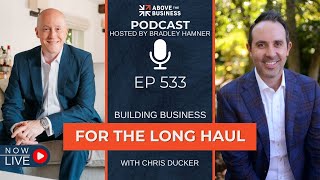
In this February 1 2026 episode of the Above the Business Podcast, host Bradley Hamner interviews entrepreneur and author Chris Ducker about creating a sustainable, long‑term business. Ducker shares his personal experience of severe burnout, including a 2021 adrenal‑failure diagnosis, and explains how that crisis inspired his new book The Long Haul Leader. The conversation outlines the book’s four core principles – personal mastery, hobbies and pastimes, love and relationships, and impactful work – and illustrates each with concrete examples (bonsai cultivation, bird‑watching, creative hobbies, family time). They discuss practical systems for protecting personal time, such as monthly sabbaticals, a “preloaded year” planning process, and non‑negotiable holidays. The hosts explore how to recognize and navigate “seasons” of hustle versus a lifestyle of constant busyness, and why redefining success to include health, relationships, and peace of mind is essential. Throughout, Ducker emphasizes the concept of working “above the business” – designing the business to serve life rather than the other way around. The episode ends with actionable resources (chrisducker.com, youpreneur.com, BlueprintOS workshops) and a call to listeners to adopt the Long Haul Leader framework.
Chapters
Welcome to another episode of the Above the Business Podcast. My name is Bradley Hamner, your host. Have you ever thought about staying in business for the long haul? What does it actually look like to not just be burnt out all the time as a small business owner and entrepreneur? In today's episode, I interview Chris Ducker. I've really looked forward to having Chris on for quite some time. In his new book, The Long Haul Leader, is one that is absolutely a fantastic pickup. I say this often, but I really do mean it with this one. You're going to you want to go and pick up The Long Haul Leader. How— what are the 4 major principles that go into being sustainable for the long haul? Sure, there are seasons, but hustle is a season. It is not a lifestyle. Without further ado, here's my conversation with Chris Ducker. Chris Ducker, welcome to the Above the Business podcast.
Great to be with you.
Excited to have you. This is an interview I've been really looking forward to for, for quite some time. For our listeners that may not be familiar with you, your story, why don't you kind of take us back and bring us to present day?
Yeah, well, I mean, so I've been building businesses for about 25 years or so, maybe a little less, um, and we've built 3 individual multi-seven-figure businesses over that time. We've sold 2 of them in the last few years, um, and, uh, now we're focused, you know, with— we, we have our, our ultimately a personal branding and education company, upener.com, where we work with expert authors to help them publish their books, market their books, launch their books, sell their books, and more importantly, build an ecosystem of products and services and experiences around their books and who they serve. Um, and we just work with the most amazing authors and we love doing what we do. And that's kind of it. On, on the, the flip side of that, I'm a big personal brand guy myself. I wrote a book, I've written 3 books. So the middle book, the one in the middle, was entitled Rise of the Youpreneur. And a youpreneur is somebody who builds a business around themselves, their expertise, what they want to be known for. And so nowadays I focus most of my time, quote unquote, at work through keynote speaking, working with organizations, with their leadership teams, making sure that their leaders burn out and that they are around for the long haul, which coincides obviously with the latest book, The Long Haul Leader.
Well, your title was great because myself, I've been in some entrepreneurial groups and somebody mentioned this kind of off the cuff one day. They said, I want to have a business that doesn't burn me out. I want to be able to feel like I could do this for the long haul. And so whenever I saw the title of your book, I thought, wow, yeah, what does it actually look like to have a business that I'm able to own and run for the long haul? What were some of the things that you maybe experienced yourself in your own journey of running businesses, but then also what you've been able to see with others that are the principles or the elements that allow someone to be able to have the business for the long haul?
Yeah, that's a great question. I mean, so this, this book came about because in 2021 I burnt out pretty badly. Um, I'd actually burnt out in 2009 originally, but it wasn't a bad burnout, you know. It's one of those things where it's like, okay, I need to take some time off, I'm wearing too many hats, and I'm kind of exhausted. I'm done with the 16-hour days. This is not the way to build a business successfully. Let's make some changes. And that's exactly what I did and kind of bounced back from that burnout, um, pretty quickly, quite frankly, within a matter of a few months. The one in 2021, however, crept up on me, Bradley. It was something that I didn't see coming at all. 2021, as we all know, we're in the middle of the pandemic. Um, business-wise, we were doing phenomenally well. We had obviously pivoted, like a lot of education companies, from doing a lot of stuff in person to doing stuff virtually. Um, and so that opened up our, our market to the world, not just, you know, predominantly the UK and the US. And so I just remember, we, we do this sabbatical every month, my family and I, every, every August rather, for an entire month. And I remember going into that sabbatical thinking to myself, I am absolutely exhausted, like, I need this one, I'm really, really tired. And I came back from that and got back to work at the beginning of September. First day back to work, walked into the office, sat down at the computer. 10 minutes later, I turned the computer off, walked back out the doors again, and didn't come back into the office for 3 weeks. And I knew something was up. And so, um, long story short, a whole bunch of, you know, tests later, went to the doctors, this, that, and the other. I was diagnosed with acute anxiety, depression, which I didn't see coming at all. I'm one of the most upbeat, positive guys you'll know. Um, and kind of more concerningly, more than anything else, was the fact that I was in phase 3 adrenal failure, um, which was a really, really big shock. Now, I'm not gonna— I'm not a doctor, I'm not a medical guy in any way whatsoever, but I'll explain very quickly how important that, that discovery really was and why it was so important for me to take action on it, because a lot of entrepreneurs could be on their way there as we speak. A lot of your listeners, your viewers could be listening right now thinking, oh my gosh, like, I'm, I'm potentially there myself. So what your adrenal glands do, they sit just on the top and behind of your kidneys, and what they do is they create cortisol, which is, we all know, a stress hormone, right? So what should happen in the— at the beginning of the day, your cortisol levels should be very, very high, and then over the course of the day, they slowly but surely decrease until they're very low. Then the sun goes down, the moon comes out, your body starts creating a sleep hormone, melatonin. But what was happening with me as I was in phase 3, which is the worst you could get, my cortisol levels— I would wake up in the morning and they would be right the way down the bottom of the chart, and they stayed there entire day. They were basically flatlined. And so I was about as burnt out as you could, you could take on board. Like, I couldn't handle any amounts of stress. I wasn't sleeping properly, et cetera, et cetera. And so I went on this mission throughout the course of that second part of 2021 and 2022 to recover from this burnout, to, to feel better. I was on antidepressants for 12 months, took myself off those. and, you know, started working on my nervous system and anxiety and all these things. But a lot of it was lifestyle changes. It was about going to bed at the right time. It was about doing the right type of work with the right kind of clients. It was about avoiding stress or learning how to handle stress and all these other things. And so much like my first two books, the third book came out of nothing but personal experience and the research that came along with it. And The Long Haul Leader, I hope, is going to become the handbook for any leader that is wanting to be around for the long haul, is wanting to be productive and to have impact with the people that they're working with and with the work that they're doing in the world. And that's basically how the book came about. So it was— it wasn't an idea. I kind of go, I need to write another book. It's been a few years, you know, it was genuine I've gone through this. I know I'm not the only one through the research that we did for the book. And I did more research on this book than I did on any of my other books put together. Um, and I know I wasn't alone, you know, particularly right now. Right now we have a major issue with burnout in entrepreneurs, small business owners, uh, executives. And, uh, I hope that it serves, like I said, as a bit of a roadmap for folks?
You know, looking at it like a handbook is, is really great. So I'll tell you personally, I mean, I've shared on the podcast, um, you know, before. So mine was 2015 and I was 34 at the time. I mean, I had a business that was, you know, looking back on it, had one business. It was small, half a million dollars in revenue or so. August of 2015, I was at the gym, started feeling major pains in my chest. Called a friend of mine who's a physician, went over, saw his office, got on the EKG machine, said, hey, we see some things. We need to get you in to see a cardiologist today. So you can imagine I'm in a full-blown panic at this point.
Yeah.
And cardiologist, you know, they put me on a stress test the next day, which was strange to be on a treadmill. And he said, yeah, you might want to, you know, watch your caffeine intake, but I don't know what you have going on in your life, but you might want to change it. And he kind of walks out. I mean, not very, not very great bets out manners, but he was like, there's nothing wrong with your heart. And I wish I could tell you immediately, like, I knew exactly what I needed to do, but I didn't really have a handbook, Chris. I didn't have a handbook. And so, yeah, sure, I started maybe cutting back on the caffeine intake that I was, you know, that I was having. The C4 I used to drink at the time, along with a shot of espresso, was probably not the best thing in the morning. Sure. But at the same time, I remember for a long period of time, Chris, that that shock to my system almost scared me to a point to where I was a little bit more aware. But here's the, here's the thing that's been interesting is that over time, even as, as severe as that experience was for me, you do get enough away from it that you almost a little bit kind of forget Yeah. And so what are the things that actually are sustainable, right? Okay. You have this event. For me, I thought it was a heart issue. Um, for you and for other people, it may look a little bit different. Adrenal, you know, it could be something else. Uh, maybe it's a family member or something like that. It has to go through something. But what are the things that really sustain for the long haul?
Well, I think, you know, we did we did, like I said, a lot of research here, and there were a couple things that really stood out. The first thing was that people have to understand that they don't need to break in order to justify taking a break. I think that, that's extremely poignant right there. And, and the idea that, you know, society has kind of led us to believe that the idea of success is working every that God sends. It's, you know, that, that kind of hustle mode switch is on all the time. Um, and I really do feel like people— a lot of people feel like burnout is a badge of honor. Um, and I don't think it is at all. If anything, actually, it's a warning sign that you've been doing a lot of things really, really wrong. And there are— we, you know, we discovered through writing the book— and I say we, myself, my team did a lot of research, like I said— um, we discovered there were 4 4 main principles to living a long-haul leader life. And, and we put it in the book. It's on— it's the only image in the entire book. Um, so if you're not into picture books, this is not for you. But, um, it's, it's on page 37 of the book, I believe, give or take, depending on what version you're reading. Um, and there's 4 main principles. The first one is personal mastery. The second one is hobbies and pastimes. The third one is love and relationships. And then the last one, the fourth one, is the impactful work that you do. And what we found was, for example, with hobbies, it wasn't even gonna be included in the book, but the more research I did on executives and leaders that were doing really, really good work, and for a long period of time, we realized actually that there was one common denominator amongst everybody, and that was that they had really cool hobbies and pastimes, things that they could get away from work and switch off from work entirely. And I'm not talking about going to the gym. Going to the gym is not a hobby, right? Like, you're supposed to look after the vessel that God has given you. You're supposed to look after your body at the end of the day, right? So we put all the kind of the, the, the health and fitness stuff to one side. I'm talking about creative hobbies, hobbies that you can really get into, hobbies that, you know, you really associate to lifestyle as well. So for me personally, um, it's things— I'm a bonsai practitioner, so I have about 50 bonsai trees in my property here that I maintain and look after. Um, and when I'm in front of a bonsai and I'm thinking about either wiring a branch or completely removing a branch, I'm focused entirely on that one. I can't put it back on once it's cut off, right? So I'm not thinking about the marketing funnel or the customers that we're, that we're serving or, or worries with website conversions or all these other small business things that run through most of our heads 24/7. What I'm thinking about is the darn branch. Can I cut it off or should I bend it? You know, that kind of thing, right? The other, the other thing that I do, and this is actually, I think that a lot of people should get involved with this, isn't It's, it's, it's being out in nature. It's being, being out in nature and enjoying, you know, really clean oxygen and just, you know, enjoying greenery around you, just getting out. And that has actually led me to my kind of, you know, more passionate hobby, which is more along the lines of wildlife photography and bird watching. And I never would have thought, if you'd have asked me at the age of 25, 30, if I'd become a bird watcher, I would have called you certifiably insane. But I can tell you right now, there is a lot to learn when it comes to IDing birds. And that kind of like, it scratches my itch in regards to, um, kind of deep diving and doing research and making notes and all these other things that I like to do. And then when I'm out in the field and I'm spotting birds for the first time, you know, it, it's, it's just a nice big green light for me to be able to enjoy and just run at. But they're my hobbies. Your hobbies might be completely different. And, you know, as long as they're creative and they serve you and you enjoy time away from them, you should get involved with them as much as physically possible. One of the research pieces that we did for the book was on, um, the CEO of Goldman Sachs, David Solomon, otherwise known as DJ Sol, who DJs massive dance festival. Oh yeah, totally. Like, like it was so out of left field that when I discovered it, I didn't believe it. So I started Googling things even deeper. I went down a real DJ Sol rabbit hole and, you know, I found videos and photos of him, you know, doing these big DJ sets and things like that. But what we found was that by engaging in a hobby that you can truly immerse yourself in away from business entirely, By doing that for just 2 hours a week, you are more likely to become up to 30% more productive in the work that you do day by day, which is pretty telling, pretty crazy. So these are the things that we really focus on, um, and, uh, it's just been— it's been a joy to, to see people's lives change as a direct result of putting these strategies place.
Okay, so this, this is great. Obviously, before we hit record, um, you know, as mentioned, like, mine is, is golf is a, is a big part, uh, of that. That's a huge— it gives me a few, a handful of things where there's, um, the competitiveness of golf with my friends, or I, I will still try to play occasionally some competitive amateur tournaments. So that feeds a part, a part of me, but then there's also the preparation, like practicing and doing those things to try to get better.
And you're also competing with the course as well.
Exactly right.
Yeah, that's what I love about that idea for you.
And I'm outside in nature. I'm outside in nature with that, right? So I'm in the sun for some of those things. And then there's so much technology and other things that you can kind of really dive into to try to get better. And I'm not thinking about work and about business with that. Now, you brought up something that I thought was really big. And you said, hey, we're going to put the gym and the health stuff over to the side because it definitely— some people have said, hey, that's my hobby and pastime. But here's, here's my question. Um, myself, I mean, kids are 15 and 11. All right. So big into, uh, you know, dance and basketball and golf and other things, other activities that are, that are going on, track and field, etc. And one of the things that I can kind of catch myself in saying is, and other people said this like, well, my hobbies are my kids. Would that also be something that we probably need to put in its own bucket to say, no, no, no, we're not even talking about that in addition to it. Now, there's clearly seasons where I'm not playing golf 3 days a week for 4 hours a day. I don't have time to be able to do some of those things. But how do we kind of be able to pull in enough of the hobbies. Golf is one, uh, fly fishing is one that I love to do, um, uh, hunting is, is another one that I occasionally have to do. What, what are— how do we kind of think about the kids aspect of it?
Yeah, well, you know, kids, obviously family, that would come into the third section of the Life OS, or Life Operating System, that we talk about in the book, which is love and relationships, right? And what's really interesting about what you've just said just then is that there's an overlap. If you look at the diet— the diagram, uh, in the book, there's an overlap between hobbies and love and relationships. Uh, so it's quite unique that you pulled the kids, uh, you know, discussion line out, uh, to individually kind of address it. What I love about this is where hobbies and love and relationships kind of meet up and entwine. It's the memories that reflect the meaningful experiences that we've created through pursuing those personal passions, and at the exact same time, obviously, nurturing the relationships around us, in this case with our children, our loved ones, our friends, and, and that kind of stuff. So I think that, that crossover between hobbies and pastimes, love and relationships, is very, very clear there. It's very, very clear. Um, and what I really love about it, and, and to your point, you know, your, your kids, you kind of, you're getting involved with the kids as well. Uh, my son and, and I, he's, uh, you know, I've got 4 children. My middle son, um, is 17, and he's become a very keen bird watcher as well. So it kind of, it got— because he's always been into photography, and I said to him one time, I said, well, why don't you come along? I'm going to this beautiful, beautiful nature reserve in Cambridgeshire here in the UK, and there's been local sightings of the kingfisher. It's a beautiful bird to photograph. Why don't you come along with me and, you know, on Saturday, Saturday morning, and see whether you can get some nice photos? He came along, it's the first time he ever came out birding with me, and within a 4-hour trip out, he was totally hooked. He was like, this is cool. Like, you know, because I was pointing out all the different birds and what they do and how, you know, all this kind of stuff. This is really cool. So he's now my birding partner. Like, we go out almost all— like, I would say 80% of the time I go out, he's with me as well. And so there is that crossover, and it's so interesting that you, that you bring it up, you know. The question I have for you, however, if your son is into basketball, is who's his team? He's not a— he's not a, not a Lakers guy, I hope, right?
Well, his dad is a Lakers guy.
Oh man, you get on so well because I'm a Celtics guy, as you know. So I don't know, maybe, maybe we're not going to be hanging out. Anytime soon. I don't know.
I jumped on that one, but I decided not to. So I'm a— I'm a Lakers guy. Yeah, for sure. For sure. Yeah, we won't go there. But his— the answer to your question is he's actually a Bucks, Milwaukee Bucks fan.
Interesting.
He's a very diverse fan team base. Obviously, we're fans of— from college perspective, Auburn football. But he's a— he's a Bucks fan, a New York Mets baseball fan, and he's a Baltimore Ravens football fan.
Go figure. Go figure that combo out. What are you going to do? Wow. Okay.
To your point, though, actually, to kind of tie that back to what you just mentioned, you are actually right about that, that there is so much overlap that the experiences that we've been able to have— look, I was not a Mets baseball fan before, but we've all adopted the Mets as our, you know, team that we're going to follow because he became such a passionate fan. And then we went to one of the Dodgers-Mets playoff games a couple of years ago. And so to your point, like that, that has really kind of become somewhat of some— that crosses over a little bit of the hobbies and, and then the love aspect of it. So you're, you're exactly right that I can see how those things would, would overlap for sure. I got a question. Obviously we talked about somebody we, we both know. You obviously know him a lot more personally, but Taki had told us, kind of taught— I heard the language initially from him about this preloaded year, like you load the preload the year. So my question is, do you then look at some of these— we're recording this in January— and look at some of these to then preload the year? I mean, maybe not the work aspect of it, but how do you look at being able to be intentional with some of these things?
I mean, so Taki's idea of the preloaded year is a great idea. We've actually been doing it a long, long time. Um, as a company. And I would say probably for about— gosh, it's got to be at least 9 or 10 years now— we have a big planning meeting as a company in October each year. So we like to kind of begin the last quarter of the year thinking about what's going to happen for the next year ahead of us. And going into that meeting, it's usually just a one-day meeting with, with most of the management team. Going into that meeting there's only a few things that are on the calendar for that upcoming year, um, and all of them are personal holidays. There, there are sabbatical in August. We, myself and my wife, have an early year and what we call a late year reset. So usually around end of quarter one and then usually in November each year as well, the two of us will go away, just the two of us, for like a 4-day escape somewhere. We've done Paris and we've done Italy and we've done New York. We kind of flew in and out. We've done Vegas where we flew in and out and saw her beloved Backstreet Boys, you know, perform and all that kind of stuff. Um, and, and, you know, then we've got other family holidays in, in and amongst, you know, kind of Easter and Christmas and things like that as well. So they're all on the schedule. They're all on the schedule before we even get into that meeting. And the team knows that anything is— that is on that side of the schedule is completely and utterly non-negotiable. I don't care what speaking engagement comes my way, how much money they're offering, it really doesn't interest me in any way whatsoever. If that— if that opportunity is happening in the middle of, uh, of a— of a holiday or, you know, personal time that's already on the schedule, it's— it's just not picked up. I just say no to it. Plain simple. And, you know, I, I've lost a lot of money over the years, I'm not going to lie. Like, saying no to speaking engagements particularly, you know, it's— those things are not movable. The conference is on this particular date. It's not like there's an organization that wants to bring me in for their leadership team for a day's workshop or something. Those things are usually a little bit pliable, right? A little more agile. But, um, I think the, the big thing is it's about making sure that you're protecting the time that you have, um, to be able to recalibrate and recharge as much as you possibly can. And, you know, Taki's idea of that, um, that preloaded year is absolutely fantastic because let's face it, success that costs you your health or your family or your joy isn't really success at all, right? Like, it— that's sacrifice. That's sacrifice right there. So if you're winning at business and you're losing at life, you're not really actually winning at all. So what we want to try and do is we want to try and redefine success to a certain degree so that it includes that peace of mind and that presence at home and that time that we're putting to one side that says, this is just for me, my loved ones, my sanity, my mental bandwidth, you know, clarity, whatever it might be, and nothing else can get in the way. Uh, and that's why I love the idea of the preloaded year. I think it's a great concept.
So I have a question about what about seasons of life? Now there's two different ways. There's a— and I'm going to give a specific example. Let's say that there's a season where something is going on personally and it is putting a tremendous amount of stress and burden on someone. And then that's number one. And then number two, there are maybe seasons inside of business. I'll give you one on the personal side. February— no, excuse me, March 2024 through June of 2024. My mom ended up going into the hospital, was back and forth many, many times, ended up passing away in June. She had battled cancer for a long period of time. That was true survival. I mean, survival. She was an hour and a half away. I mean, every day feeling like I need to go over there because this could be the last time I see her. I mean, that period of time, I operated truly from a place of just complete brain fog, you know, and it took me a long time, several months to kind of unwind out of that season, so to speak. Right.
Yeah.
Not to mention the grief. But then there's also times that there's a true season of the business where it's like, this is and maybe even some business owners actually literally have seasonal businesses potentially. How do we balance understanding the seasons that you're going through? And at the same time, I don't want to say it like this, you're not lying to yourself. You can get in this place of like, oh, it's just a season. It's just a season. Yeah. Well, that season's been lasting 3 years, right? How do we balance that?
Yeah, that's a great question. So The introduction of The Long Haul Leader is entitled Hustle Is a Season, Not a Lifestyle. And so, you know, this is something that I've seen, and, you know, talk about kind of like personal, you know, those personal hustle seasons where all of your— in your instance, all of that focus was on your mom and being with her in her final, you know, final days, making sure that she was comfortable and loved and cared for. Uh, and obviously making sure that, you know, you're, you're also kind of trying to juggle all the other things that are going on at the same time. Like you said, you acted from a place of complete fatigue and brain fog on a daily basis. You've got one major goal, and that is to be with your mom, you know, uh, as much as you possibly can in those final days. That season, as you said, a few months after that came to an end where, you know, you had laid at rest, the grief had, had come and gone. or as much as it possibly can. I've been through the exact same thing myself, so I get it. Um, and, and then you kind of start operating again from a place of hopefully a certain amount of calm procedure, process, et cetera, et cetera, right? In the business side of things, particularly from an entrepreneurial standpoint, what I have seen is that, again, going back to the whole kind of mentality of, you know, hustle and burnout is a badge of honor thing. We, we tend to focus as leaders, we tend to focus way too much on short wins or short-term wins rather. So when we talk about that, we're talking about like getting, getting a project over the, over the finish line and getting to the point where we can celebrate that and moving straight on to the next one. Short-term win, short-term win, short win, short win, short win. And I wanna try and change leaders' mentality to that. It's not about the short-term wins. Short-term wins are very noisy. They're very hustle-centric. I'd like to get us to start thinking a little bit more about that long-term impact that we have. And these things kind of like they whisper, right, until they start roaring. And that's when the real impact can be felt. So the real game here is actually patience and it's consistency and it's showing up when it's not sexy, when it's not flashy, right? You know, from a keynote speaker's perspective, I do a lot of work before I do the work, right? So before I'm on stage for those 45 minutes, I'm practicing that presentation 10, 15, 20 times. So it's a lot of work. That's why a lot of people say, oh, I can't believe that guy gets paid 50 grand for, you know, for 45 minutes or an hour on stage. And my argument to that is, well, what you're not seeing is the 25, 30, 45, 50 hours behind the scenes to prepare for that presentation, right? That's, that's the important part. So I think that the really important part here is understanding that hustle is a season. It's not sustainable. It's not something that can turn into a lifestyle. To your point, it goes on for 3 years. That's no longer a season, that's a lifestyle. And that is not sustainable, that is not healthy. And ultimately, you know, busy is a trap, right? Being busy for the sake of being busy is a trap. Anybody, any idiot can fill a calendar of stuff to do, right? But like, how much of those things are actually going to create meaningful momentum in the business? So don't, don't confuse that motion of being busy doing all the things with momentum. It's certainly not the same thing.
I would give credit to who, who I first picked this up from. But especially when you're around other males and, you know, you see somebody you haven't seen for a while, maybe I see him at a basketball game. They're like, hey, how you been? It's almost like this default answer of like, oh man, I'm good. Just been busy.
Yeah.
And I've tried to— somebody else mentioned this and they said, I never want to answer that question again, that I've been Busy. And so as it is almost coming out of me, I'm starting to try to catch myself to say, you know, something other than I've been busy. Because you're to your point, it's, it's, it's absolutely busyness is a trap. Chris, this has been fantastic. Uh, last two questions. One, how can people connect with you? Where, where's the best place for people to obviously pick up the book, learn about you and the work that you guys do?
Well, they can go ahead and check out chrisducker.com. Uh, you know, all of my personal work and speaking, books and all that stuff is over there. Um, and, uh, if they're interested in the, uh, you know, the, the work that we do at Youpreneur with personal brand and expert authors, and just go to youpreneur.com. Nice and easy.
Chris, what does working above the business mean to you?
Great question. Um, I think it's about understanding that my business should support my life, it shouldn't swallow it. So if your business feels like a little bit of a black hole and it's— you're in this kind of endless spiral trying to run and grow and scale it, I think it's time to realign. I think it's time to kind of look at what it would mean to design your business around the life that you want and the lifestyle that you want, not the other way around. And that's what being above the business means to me.
Love it. Chris, thanks for being a champion for this, for small business owners and entrepreneurs that are listening to this podcast. I know you're going to have a tremendous ripple effect. I'm going to actually step back and take a, take a look above the business based on this conversation and your book and see, you know, what are the areas that I too can, uh, ensure that I'm optimizing for The Long Haul. Chris, thanks for coming on the podcast.
Thanks for having me. It was a blast.
All right, team, here's the outro in the intro to The Chris Tucker Podcast. Well, what a pleasure. What a, what a great episode. I really was looking forward to that one for quite some time, and he overdelivered. I think for somebody that's, you know, listening to this, you might be in that season where you just kind of burn out. I mean, I know of a few people that kind of come to mind that are in our Blueprint world, uh, that are having a tough time. And, you know, busy can be a trap. That was a something he said that I, that I circled. And then the other one is he said, you don't have to break to need a break. Wow. Wow. That was good. If I'm honest, counselor, therapist recently just said, you know, Bradley, I think it's time. I think it's time you need a, you need another vacation. You need to actually take some, take some additional time off. So that was, that was great. I love the idea of the sabbatical. I wish I would've in hindsight asked him about more of the sabbatical, how to do that, how long he's been doing that, best practices around that. And also just the value of having a reset with your spouse. I think that, that were some big things. And then last one I wrote down. Hustle is the Season. Go to Chris Ducker, chrisducker.com. Check out all of his work. Obviously you can find him on all of the socials. And I do very much recommend that you pick up a copy of The Long Haul Leader, which I've got on my Kindle. I have been reviewing and reading some of the initial chapters and I'm really excited to continue to finish that book. I want to give a big shout out to our podcast brand. Excuse me. I want to give a shout out to our podcast sponsors, Coach P Consulting, Autopilot Recruiting, and DirectClicks. As you go into 2026, you need some personal coaching, being around other insurance agency owners. Go to coachpconsulting.com. David is going to give you a behind the scenes for you, but also for your team members. Go to coachpconsulting.com. And let him know that you heard about him on the Above the Business podcast. As you go into the— this year, you have set some level of objectives, goals that you want to accomplish. It is so important to have an alignment of the resources, and one of the ways to do that is through your marketing plan. What is your marketing budget? Because your budget influences your strategy. But if you feel, I'm not sure exactly how to do that, if you work with DirectClicks, they can help you to understand the budget and making sure that you allocate that budget in the right places. Go to directclicksinc.com, directclicksinc.com. We all know how important our team is. It's one of the more valuable resources and valuable assets in any small business. If you're wanting to expand your team in 2026, or you've potentially had some turnover and you need to replace some, getting a dedicated recruiter with Autopilot Recruiting can help you so much. Go to autopilotrecruiting.com. Autopilotrecruiting.com. All right, everyone, really enjoyed that episode with Chris. By the way, this episode is ahead of our February Above the Business Workshop. Go to blueprintos.com/assets and you can register for our February workshop, which is all about leading yourself first, which ties really nicely into everything that we talked about. And also our January workshop, our January Above the Business workshop is all about how do you gain traction on the plans that you have in place. And so depending on the time you're listening to this, if you would like to get a copy of the replay, you can reach out to our team at support@blueprintos.com. We're going to be doing a 2-hour workshop on how do you actually put rubber on the road and not rubber in the sky and gain traction and everything that is that you want to accomplish in 2026. So whether it's our January workshop, which is traction, or February workshop on leading yourself first, I'd love to see you there. Blueprintos.com/assets. All right, everyone, till next time, lead well and go be great.










