Business Owner Spotlight: Graeme Barlow - Serial Entrepreneur & Founder of FounderLink
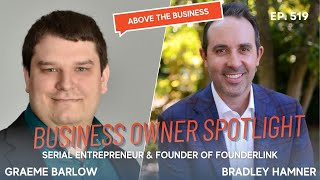
In this episode of the Above the Business podcast, host Bradley Hamner interviews serial entrepreneur Graham Barlow. Barlow shares his unconventional origin story—starting with selling virtual game items and building bot farms in the early 2000s, moving through a series of exits, a game‑development studio, a pet‑industry SaaS business, and finally scaling a custom software development firm (Iverson/Ivorsoft) to eight‑figure revenue. He distills his "blueprint" for founders into three core priorities: never run out of cash, hire the right team, and maintain a clear vision. He explains how the levers and organizational structures shift as a company moves from under $1 M to $1‑5 M, $5‑20 M, and beyond, emphasizing that the underlying themes stay the same but execution changes. Barlow discusses the Rule of 40 as a metric for balancing growth and profitability, and critiques the over‑use of TAM, advocating for realistic SAM and SOM calculations. He contrasts bootstrap and venture‑backed dynamics, noting that venture capital enables aggressive market capture while the moat in the AI era is customer access and ecosystem lock‑in rather than pure technology. Leadership evolution is highlighted: around 20‑30 employees a dedicated CEO and unified culture become essential, and culture is defined by how hard decisions are made, not by handbook slogans. Barlow endorses a 3‑1‑90 planning framework (3‑year vision, 1‑year objectives, 90‑day priorities) as a universal cadence for companies of any size. Throughout, he stresses simplicity and focus—pruning non‑core services, simplifying pricing and financial models, and keeping the organization lean—to avoid the complexity trap that often follows growth. The conversation closes with practical advice on staying "above the business," contact information (grahambarlow.com, iorsoft.ca), and a brief sponsor plug.
Chapters
Welcome to another episode of the Above the Business podcast. My name is Bradley Hamner, your host. On today's episode, we have a business owner spotlight episode with Mr. Graham Barlow. Met Graham in a WhatsApp group that was just kind of a spinoff from a group a couple of years ago from Dan Martell, who spoke at our 2-day MBA a little over a year ago. And in this episode, we talked to Graham, like, what was the blueprint he's been able to follow in his own companies that he's scaled? And even some of the companies that he consults. What's that blueprint look like from $10 to $30 million versus whenever it's at $3 to $10 million? We talk about that. We talk about what are some of the things that you have to focus on as the business owner founder at those different levels. And then how do we actually remain simple and focused? But simple doesn't always equal easy. We talk about that and a lot more in this episode with Graham. Barlow. Graham Barlow, welcome to the Above the Business podcast.
Thank you, sir. Excited to be here.
Excited to have you. Well, we typically start actually with kind of background and origin story. Obviously, you and I kind of met each other through a, a small mastermind group that was a spin-off of, uh, Dan Martell. And, and we've been in probably the most— one of the most active WhatsApp groups that I've been a part of, which has actually been kind of cool to see how that's, uh, taken shape over the last few years, but people obviously don't know you. Um, tell us a little bit about your backstory and a little around your origin story and journey.
Yeah. So I've been a serial entrepreneur quite literally my entire life. I got kind of thrown into tech entrepreneurship before I knew what that word was, before I knew what building a business was, as a way to justify playing a lot of video games when I was a kid. So I started my first kind of company as it were selling items from online video games on eBay back in 2000. Um, that led to building bots, which led to building bigger sets of bots, which led to, um, almost mini data center approach to scaling up botting across multiple games at the time, everything from Neopets to Diablo 1, Diablo 2, RuneScape, and eventually World of Warcraft. Built that business over the course of 6 years until we got sued, which was terrifying, and ended up selling the company in late 2006 for just under $1 million. From there, tried to be an adult for a little bit, tried to go to school, was terrible at that. So started a couple of companies that went nowhere, but then ultimately co-founded a game development studio called Rocket Owl, built social impact games on Facebook, à la kind of FarmVille and Zynga era, built a game called GreenSpace, up over 1 million users. And then ended up selling it to an investment group. As part of that deal, I ran their early-stage venture fund investing in SaaS companies in pre-seed and seed stage. Did that for about 3 years. During my time there, I co-founded a company called ProPet Software doing business management tools for the pet industry. So think dog walkers, daycares, kennels, things like that. Today, that company services about about 5 million customers a year across North America. And then about 11 years ago, joined as a partner at a custom software development company called Iverson. We've grown that business from, I think, a team of 6 when I joined to one of the largest development companies in Canada and done everything from critical health infrastructure technology for telemedicine to augmented reality fan engagement tools for the NFL. Been fortunate to build essentially 2 companies now into 8-figure revenue. And along the way, have invested in over a dozen companies personally, dozens through funds. And today, run Ivorsoft, run a founder community for founders called FounderLink, and coach companies that are scaling up rapidly.
Well, you had your hands in a lot of stuff, had your hands in a lot of stuff over the years. It's been, it's been busy. So I wanted to have you on. So we fundamentally believe that business owners need to get above the business. They begin to start thinking like a business architect, and when they do that, they can begin to design the blueprint, um, to be able to grow their business. Grant, what's the blueprint that you have followed over the years? I'm sure it's obviously continued to improve, but obviously even in your work and helping with other founders with FounderLink. But what is, what is, what does the Graham Barlow blueprint look like?
Yeah, I love that. I love that question. And I also love that I think you guys have refined this very well. I've done it on kind of chaotic survival approach of just, um, a few core principles, which has always been, as much as I am ambitious and driven, I'm also fundamentally lazy. And so Anytime I get involved in a company or we start something, I spend most days trying to figure out how to do as little as possible. And that generally leads me to trying to find and convince the smartest people I can find to help me build the thing. It wasn't until a lot later in life that I realized that wasn't just me being lazy, that was actually a better way to build companies. As I started to meet people that are just in the weeds of every detail, I was like, I don't want to be in the weeds. I really, really, really don't want to be the person responsible for making it happen. I love the process of finding customers, figuring out what kind of value we can provide, and then figuring out the people that do that the best and playing at that level. As soon as I'm in the weeds of delivery, I panic, and I'm just a bad delivery person. I do not have the attention span to do that well. And so that's kind of one. And then the second core one, which is going to be a really, really basic concept, I think gets repeated ad nauseam on the internet. It's really simple. Don't run out of money. Fundamentally, I think CEOs have two jobs. Don't run out of money and make sure you have the right team. If you do those two things along with kind of set the right direction, you've done your job well. And don't run out of money for me comes down to a couple of things. It comes down to understanding and owning sales or revenue generation or capital raising. Or working with debt and finance partners to be looking far enough ahead to make sure you don't run out of money. And so when you use those kind of three of like, are we heading in the right direction? Do we have the right people? And are we going to run out of money? If you can answer those three things on a daily basis, I think you're doing a good job. If you are starting to get into other things, nine times out of 10, I feel like you're getting in the way of your own company and you're getting in the way of what others can do to build better value in your business. Than you can.
Do you think that, you know, and, and we'll probably end up talking about this part of it a few different ways, do you think that those things that the founder business owner owns changes as they go through different revenues? Like, you and I, before we hit record, we're talking that there really is different blueprints that you follow. You you know, the $300,000 to $1 million is one blueprint, maybe 1 to 3, and then 3 to 10, and then 10 to maybe 30 or so, that those are different. Do you believe in kind of looking at that retroactively, like the business owner, what they need to own in the 1 to 3 space is totally different than what they own between the 10 to 30, or do you think that those things are fairly similar?
So I think the themes, so the theme of kind of vision and direction, don't run out of money and people is consistent from a $500 business up to a multi-billion-dollar business. Um, however, the blueprint of how you actually achieve that and what levers you have to pull and how you structure a team to solve those things is fundamentally different under a million, $1 million to $5 million, and then kind of $5 million to $20 million. I think those are, those are completely different categories that rely on very different skill sets. Under $1 million, a lot of the world that I talk through and coach through is either heavy emphasis on getting really good at fundraising or really good at sales and being the champion to bring in the revenue and make sure that once you've done that, you're also using the same skills for sales to go find, recruit, and motivate phenomenal people.
Yeah. So I'm curious about, with the, the businesses that you have invested in, that you've been a part of, that you've, you know, grown yourself, and even maybe the businesses that you advise. So one of the— it's a concept, but we back it with a tool. But honestly, the concept is, is probably as much as important as anything else. And there's this idea of the Rule of 40. Are you familiar with this? Like, you're growth. So years ago I was introduced to this idea of the Rule of 40 for bootstrapped companies. Now come to find out, non-bootstrapped companies, so maybe VC or private equity money behind them, they also use this. They just look at it differently. But fundamentally, small business owners are trying to balance how do we grow year over year and how do we remain profitable. Well, oftentimes those two things can remain at odds of one another. Like, the more faster we want grow, the more it initially has downward pressure on profitability, right? Which is to your kind of point. Well, so for us, like, if you can reach a, you know, 40, like your year-over-year growth, say at 20%, 25% growth, and you're 20, 25% profitable, and you— the combination of those two things, you're over 40. That's a great— that's a great—
that's a good business.
That's a healthy business, right? Yeah. And so But in some of the really fast-growth companies that you've had that have had kind of backing maybe from private equity, they're growing at such a pace, maybe even 100%.
I mean, I think, I think you take the same rule and apply it on a monthly basis early on.
Okay. Yeah. So they'll look at— but they have sometimes backing so that the profitability— they don't care so much about the profit because they've got the growth, because the, the, the, uh, you know, equity people will come in and pump money into it, say, hey, you keep growing, right? How have you guys thought about that and approached it in the past?
Yeah, that's— I love that question. So it is fundamentally a different game in kind of bootstrap versus venture. And for my context, I'll probably stick to the venture side. I've dealt with private equity on an exit basis. I've never survived long enough inside of a PE ecosystem to really have insight other than like, it's not for me. That is a, that is a whole other world of just chaos that I don't get.
Sure.
Um, on the venture side of it though, you are constantly balancing between what is the market opportunity that we're chasing? What is the value long-term of that market look like? And is there a kind of critical mass or threshold we can get to that makes this business exponentially viable. And I can give you, give you a very recent example we've lived through. I'm part of a really, really cool tech company in the construction space, and they've been growing rapidly in kind of a state-by-state basis. And there's a lot of conversation recently of like, okay, once the model is proven enough and you have enough conviction around an individual play, is there an argument that if you had enough capital, you can go take the entirety of the market? And those are the kind of conversations that you start to have in a venture-backed business is like, you want to use the money and you don't really care about the profitability early on. The idea is, can we prove a model? And can we prove that we can create and create a product and solve a problem that is meaningful and potentially has universal applicability or just a large enough market opportunity. And once you have enough data that says this is the direction, you want to solve for enough in the company that says, okay, if we go apply a lot of money, can we go become the market leader? And there is a lot of value in being able to establish that kind of a dominant position, especially in new and emerging fields. And I would actually argue today that's more relevant now than it has ever been in the history of venture and tech.
Hmm.
And I say that because with the speed and momentum of AI, the cost of product development and feature development and software development is getting crushed down relative to what it was 2, 3, even 5 years ago. And so it used to be that the biggest moat was the build-out of the software and a rich understanding of your customer base. And I think that's, that's still very valid, but it's less of a moat. The moat today is access to the customer, attention, and ecosystem. And so having a massive customer base that you can kind of build upon, offer more value to, and grow with. Especially in kind of enterprise SaaS world where the cost of changing is expensive. I think that's actually going to be the most valuable asset a lot of companies have. And I don't think people fully recognize that because they're seeing a lot of like, oh, like AI is making everything easier and faster and whatever. And like all of that is true. However, when you sell software into companies, it's not just the cost of the licenses. That you pay attention to. It's the cost of human capital to train 1,000 people on the new piece of software. And so even if competitors come out that are slightly better or slightly ahead or slightly different, it's not just, oh, the licenses might be cheaper, or, oh, we think this is like 10, 20% better. It's like, okay, we have to retrain an entire workforce on how to use this, update all of our workflows. Is that worth it? Or do we believe that the partner already working with is going to get there. Um, so across our portfolio, we're seeing huge emphasis on early customer acquisition and growth that way, more so than the kind of extreme emphasis on, on the product side.
Yeah, um, I came across some terminologies that I'd never heard before, uh, last week actually. So people have probably heard about TAM, total addressable market, for sure, but I'd never heard of SAM, which is the service Serviceable Addressable Market, and then SOM, which is the Serviceable Obtainable Market, which is like, okay, so like I was working with a VA company that serves the insurance industry specifically. And so they were looking at, okay, there's, you know, maybe there's 30,000 insurance agents in this space total. Great. That's the TAM. The SAM, though, is how many of those 30,000 use these particular pieces of software? And so that maybe is 50%. Okay, let's just make up a number. And then it was like, all right, great. That's 50%. That— how much of that can we try to obtain of that? And so we're looking at 1 or 2%, right? And so it kind of put it into context. Is that something you guys think about? Not just on—
absolutely.
TAM gets thrown around a lot with Shark Tank, and this TAM is stupid.
Yeah, like, honestly, TAM is a— it's kind of a nonsense number that gets thrown into a lot of decks, often at pre-seed or seed. And I think it's one of the first numbers to get kind of poked at a little bit when you're looking at investment, because it's like, okay, like, yeah, As you said, Tam, it's like, it's every company on the planet. It's like, great. Some of those, um, currently don't speak English and therefore you're not going to be able to like sell into them early on. Some of them are just not going to ever convert because they've built an in-house thing and they're not going to move off of it. Um, half of them don't use anything like this and for XYZ reasons just aren't going to. And so getting it down to like, okay, this is the total audience that has an appetite for this. And then from there it's like, okay. Even then you can't sell to every single one of them because a bunch of them have like a personal relationship with the family member that sold them the thing, or they're invested in the product they're using or whatever. And so like trying to pull that down into what is, what is an intelligent number that we can use to understand the potential here is huge. At the end of the day though, like those big numbers are kind of applicable for: is the idea ambitious enough? Is there enough global demand for this? And do we believe that the company we're backing can make a meaningful dent in it? It's never about like, oh, do we think we can go capture 100% of the market? Like, it's just not math that makes any sense to do. Now that being said, like when we, when we talk about like ambitions and scope, um, I, the first time I raised money for a company, good Lord, it was like 16 years ago. Um, and at the time everyone was talking about like, oh, like you have to have this really ambitious pitch and you have to be able to tell a narrative of how you can become a unicorn. And like becoming a unicorn, becoming a billion-dollar company was, was the holy grail of venture. It's fascinating to me in the last year, 2 years, that we've had a lot of feedback from companies that have been raising seed and Series A, where some of the bigger funds are now starting to ask, does this company, does this market, does this vision have the potential to be a trillion-dollar business? And that's become a little bit more of the new proxy for like unicorn is kind of like the baseline for a venture company at this point. And now they're looking at like, what is, what is it going to take to build the next trillion-dollar companies? And that's become the new benchmark, which is kind of mind-boggling for, I think, the rest of us on the mortal plane still building million to $100 million companies.
Yeah, for sure. Let's ask a good segue. So I mentioned this a minute ago. What specifically, you mentioned a couple of companies you've been able to build past 8 figures. What do you think are, other than specifically what the business owner founder owns, right? That's what, that was one angle of it. What were the fundamental differences of the blueprints that were followed, say from 3 to 10? Yep. And then from 10 plus, right? Um, whenever you start to see that, and of course, you know, as well as I do, you don't cross this line and then everybody's like, okay, it's all changed now. I mean, but But there really is Goldsmith, what got you here is not going to get you there type of things. What are some of those differences?
Yeah, so I love the callout too of like everyone seems to think you hit these benchmarks and then it's like, oh, ta-da, new company, new dynamics. It's like it is a painful, weird, like awkward teenage growth stage type thing as you approach these different thresholds in your company, right? Like anyone that's, anyone that's scaled teams, like you go through the first one, I think as you approach 25 employees, right? Like you can kind of run stuff pretty renegade up to 20 to 25, and then somewhere between 20 and 30, you start to realize a bunch of people in the company are just off in weird directions, and there's weird subcultures that have popped up, and there's just all kinds of odd things that have happened. And it's like, oh, okay, well, now, now we do need to have better discipline around leadership and communication. It's really, really interesting. Like, we were, we lived a case study of how to do this poorly initially. When we were scaling Iverson, one of the choices we made early on is we did not have a CEO. A bunch of us took operational executive roles and kind of something like we're all in this as partners, and we just won't have a CEO. That was great. Up until about 20 people. And as we started growing 20 to 30, we started getting consistent feedback from staff and from like feedback forms. And just on a weekly basis, people are like, I don't know who to listen to. And like, there are nuanced differences between how all of you communicate and we don't understand what our core philosophy is. And it was like, oh, shit. Yeah. Okay. Like when we were small, it was easy because everyone was in all of the meetings and it was easy to do kind of all hands stuff. Like once you hit a certain scale, like on the way to 30 to 50, got even more extreme. And so bringing in a CEO, bringing in unified vision, direction, leadership, and it's like, yeah, you have, you can have a leadership team that all communicates very closely with each other, but to the rest of the company, to the rest of your team, it is one single message from one single person. And there's one point of truth. Becomes very important. And that's one of the things that I think goes from nice to have and beneficial under $10 million to absolute table stakes critical, if you fuck it up, will kill your business post-10. Because you have enough people, enough resources that things can go sideways very quickly and be very expensive if you don't have the right alignment under leadership. And so having very active guidance from your executive team, having an executive team that knows how to disagree with each other, debate something, but then leave a room unified is huge. And I think culture becomes a lot of the bedrock of that and culture not being the phrases you put in your handbook or whatever you stencil on the wall. Like, culture is how you make hard decisions and how the team views day-to-day life in the company, helpfully backed up by kind of things that people can remember, but ultimately comes down to how— what the lived reality of your team looks like. And so, again, those things can be very fuzzy, I think, along the path there. Once you get to a certain size, that is That is the thing that you must protect, guard, and support all the way up because it is the thing that will kind of rot the core out of the company very quickly if you aren't paying attention to it.
Let's talk about planning. I'm curious how you've approached planning. To give you context, we're big believers of 3-1-90, so a 3-year vision.
Yep.
1-year objectives, or sometimes OKRs.
I love this. Yep.
So, and, and then 90-day priorities. So that, that, that's kind of the philosophy for the small business owners we work with, is you have a 3-year vision, 1-year objectives, 90-day priorities. But that's ours. What, what have you followed? What have you followed in terms of planning, vision casting? You know, we all know like, okay, you got to have a vision, but sometimes it's like, what, what's the, what's the structure of that vision need to look like? What have you followed that seem to still work.
Yeah, so I will say, and not to cop out too much on this answer, like, I've been through a lot of different systems. We've tried a lot of different, um, frameworks and blueprints and everything else. And like, 3-year, 1-year, 90 is generally the foundation that I've landed on for almost all of our companies. Um, which, yeah, like you guys are nailing it. If that's, if that's, if that's a core tenet that you guys are teaching, I have seen that work at every scale that I have operated at. And I think it's phenomenal because like 3-year for me is great for like philosophically, what are we trying to achieve and what is meaningful to the company? And we don't have to have a direct path on how we get there today, but we need to know that that is the North Star that we make decisions against. Yeah, anything outside of 3 years, beyond 3 years, I think is kind of a waste of time, at least in the tech software world. Like, it's been like, I can't tell you what the tech hardware ecosystem is going to be like 5 years from now. There is no reason I want to try and build a plan for that. 3 years is meaningful. Um, having the 1-year plan is huge for both your executive team but also communicating to the company. Um, we use that for what are bonuses going to look like, what's the financial structure going to look like, what are annual growth target's going to look like. And that can be very tactical, very real. And for the most part, shouldn't change a ton. You should have enough flexibility that you can pivot and adjust if once in a lifetime events kind of happen, like we've had a lot of those lately. But on the whole, that should be the rails. And then your 90 days. So we do the 90-day and then the like 30-day is like just rock solid laser focused on what are the, what are the one or two big pieces either as a company or per department that are going to get moved forward in that time period. Yeah. And try not to overcommit and overload.
Yeah. Um, I, I may mess this up a little bit, but somebody, um, I think it was, uh, I think it was Stephen Bartlett actually on one of his podcasts, if I'm not mistaken, said that on LinkedIn, strategy is like one of the top 5 words used on LinkedIn, and execution is like number 1,000 or further. Yeah. So as much as having a vision in that 3-1-90, how, how important that actually is, what have you seen across the businesses that you've personally built, you've been a part of that say, this is really where it comes down to. This is what it takes to execute. If you're at a million and you're trying to get to 30, okay, and you've got the, you've got your blueprint, this is what, how you're going to execute. Or if you're going from 10 to 30, whatever that, whatever that is, 30 to $100 million, this is how you actually execute. What have you seen?
So this is a fun one because, um, and I, I, yeah, I wish I kind of had a visual for this to share, but like, uh, the, the number one lesson for me for scaling in meaningful direction is simplicity and focus. And it is the number one thing I think people throw out the window as they hit different revenue thresholds and try and figure out how to go to the next level. And which is funny because like all of us as entrepreneurs, as founders hit a certain point, we're like, oh cool, like that offer, that product, that whatever got me here. To get to the next level, I need to do completely different things or I need to add more. I need to do different. And like 9 times out of 10, you just need to get better at that one thing and stay focused. The biggest, the least profitable spurts of growth we've had both Ivorsoft and ProPet have been when we've hit a threshold and like, all right, how do we break through? What do we do next? Add more services. And we went broader and like, we did this to an extreme degree. So like, I like sharing this because I'm like, please don't repeat the painful, dumb stuff we did and then learn from. We had a vision 5 years ago, 6 years ago, 7 years ago now. Where to become the largest agency we could, we would be the digital provider for everything. And so we acquired a VR company, we acquired a social media marketing company, we built an in-house brand team. And at that point we became the digital services agency for everything. We did app development, web development, social media, branding, ads. VR, AR, like if you could picture it in the digital ecosystem, we were offering it and selling it. And we're like, we are the one-stop shop for everything. On paper, it was like really ambitious, really cool. It's like, yeah, well, we already have one client, we might as well have them do 7 other things with us. The reality of that became our sales team had no idea what the hell to sell. Our priority for what we were selling or marketing in our brand became whatever team in the company was idle that month. And none of it was getting done particularly well because our talent funnel was always trying to react to like what part of the 9 things we were doing needed resources at the time. And after trying to make that work for a year and a half, we were like, this is crazy. We are, we have certain divisions that are wildly profitable and doing really well. We have other divisions that are losing money and then jump forward a quarter and it's all flipped backwards because everyone's on different cycles and like, and just maintaining all of that was killing us. And it's one of the best things we ever did was cut 50% of the company, wound down virtually every division that was not our core software development work, and got hyper-focused. Like, this is what we do. All that other stuff was cool. All that other stuff was shiny. We spun it out. I mean, we actually spun out the marketing as a separate agency, let them run with it, and they've been killing it ever since. But getting simple again and getting focused and becoming more consistent, like in our messaging of this is what we do, this is who we do it for, led to tripling the business over the next 2 years. After 2 years of kind of mid-level growth. And we became way more profitable, way less stressed. And it was around the same time that I think one of our 3-year visions was that the entire senior team would do— would move to 30-hour weeks. And managed to do that because we weren't dealing with 1,000 layers of complexity. And so one of the big, big, big things that I, I really push, honestly, at any stage, but especially the scale-up stage, is like, um, focus on simplicity. Simplify your offer, simplify how you bill, simplify how you present pricing to your clients. Like, just become embarrassingly simple in how you do and deliver what you do, and it becomes so much easier to sell it, to hire for it, to sustain it. Um, and I love the phrase simple, not easy, right? Like, it's, it's, it's simple, and it sounds simple, and on paper it's like, oh my God, that's— your whole offer is like half a page. Yeah, it is incredibly hard to get an entire team of ambitious, smart people to stick to something simple.
Yeah, I, I totally, I, I completely agree. It was actually what I was about to literally coming out of my mouth was going to say, but just because it's simple does not mean it's easy getting to there. I mean, oh my God, we conflate the two is that, oh, why is this not simple? Why is this not simple? Because business is complex. Business at its core is going to it's going to go, it's going to divulge if it's left to its own, it's going to divulge into complexity. It's going to evolve to complexity. It doesn't, it gets simpler over time. It actually gets more complex because you add more people. People are complex. You add more customers, more complex. Your software breaks, more complex. Your marketing and sales funnels breaks, like all these kinds of things. And so there has to be an intentionality to like, okay, we have to make this simple. We have to make this simple. We have to make this simple, like constantly. And I think that's something that it's almost like a lesson that I have to be reminded of myself along the way is to like, I can't just make this simple and then, okay, we're good for the next 3 years. See ya.
It is, it is a, it is a never-ending battle. And it's actually one of the things I find most fascinating and challenging as you get bigger and you hire smarter and more experienced people is a lot of the times through no ill will, but usually just bad training and weird ecosystems they've come from. But like most senior smart people you add to your team want to create complex things to show you how smart they are.
Yeah, yeah.
And I'm like, I don't need you to prove how— show me how smart you are in making this so simple a co-op student on week 2 can do it.
Yeah.
Because if we can get there, We've got a rocket ship.
Yeah.
But if you build me a chart or a system or— oh my God, CFOs are the worst for this. Like the amount of companies I've come into to try and help founders, especially venture-backed companies scale up and you pull up their financial model and you need a PhD to understand this thing. And they're like, yeah, I don't really know how and I can't really change this without talking to my CFO. So, and so you have, you have people that just don't understand the financials of their company because they've been put in these insane complicated models. It's not to say there's not complexity behind the operational financials of a company, but there are ways to simplify the model so you can make better decisions and have readable documents. Um, it's just one of personal pet peeve, like area where I'm just like, people add so much complexity for no reason. I was like, yeah, cool. Your model is 0.0002% more accurate than the, like, generic one, but nobody other than you can use it, and it's never been used or consulted in a strategic decision ever because it's a disaster to read. Let's have a simple model that people can read and make decisions on, and then we can validate it against the complex accounting validated monstrosity.
Yeah, that's a good way to land the plane. Totally agree, Graham. Um, If people want to connect with you personally, learn more kind of about some of the work that you do, maybe even obviously FounderLink, um, where's some places for them to connect?
Uh, grahambarlow.com, Graham Barlow on all social. If you're looking for software development around the world, iversoft.ca.
Awesome. Graham, what does working above the business mean to you?
It means having enough time and space to look at the organization as a living, breathing entity without having the kind of emotional tie-in and trauma of living in it, and therefore not able to make rational strategic decisions about how the business is operating.
Love that. Graham, appreciate you, uh, coming on. I've really enjoyed over the last couple years kind of getting to know you, um, uh, virtually, and likewise one day, uh, getting to shake your hand.
Likewise. Thank you so much for having me.
Appreciate you coming on. Enjoyed that podcast with Graham. You know, some of the things that really stood out is number one is just, again, it's just a reinforcement that, you know, the blueprint changes. And number two is that you don't get to this place and say, okay, we've crossed this threshold now. Now what are we going to do differently? It's not that. And I thought his analogy of it being like the teenage years is such a good one because my son Cooper is 15 right now. So he's obviously, you know, going through that for sure. So I agree with that. Obviously it was good. Didn't know his kind of vision setting framework of the 3-1-90 is something that they've kind of been able to follow. And I thought that was obviously a really good reminder. And then at the very end, just again, the discussion of like simplicity and focus in that just because we say that simple does not equal easy. You have to be so intentional about, you know, how do I keep this business simple? How do we remain focused on what it is we're trying to do. So definitely go and check him out, all the socials, go to his website and check out his FounderLink community. Shout out to our podcast brand sponsors, Autopilot Recruiting, Club Capital, DirectClicks, and Coach P Consulting. As we get into the rest of the end of the year, starting to look at your 2026 marketing plan, DirectClicks can help you. Go to directclicksinc.com/above-the-business. Directclicksinc.com/above-the-business. Directclicksinc.com/above-the-business. Part of looking at your marketing is obviously going to impact your financials. And so if you are not on top of your financials, Club Capital can help you. Go to club.capital, book a no-obligation demo, get on top of your 2025, start to begin to project how do you want your revenue to perform and your profitability to perform. Going into 2026. Club.Capital. Obviously, you heard Graham talk about one of the big key things that he has had success with is team. And if you know you need to build a team going into this next year, but you know who to find, where to search for them, how to post for them, all of those kind of things can be kind of overwhelming. But if you work with Autopilot, they can make that process very simple and keep you focused to put A-players in front of you so you can grow and develop your team. Go to Autopilot autopilotrecruiting.com, autopilotrecruiting.com. Investing in my own personal and professional development has been one of the highest return— returns on investment that I have ever had. I think that if you make the investment in yourself and your team with Coach P Consulting, you will also see a very high return on investment. If you're an insurance agency owner, go to coachpconsulting.com, coachpconsulting.com.
Com.
Well, I hope you enjoyed that Business Owner Spotlight podcast with Mitzra Graham Barlow. Until next time, lead well and go be great. Hey, if you like videos like this, click below. We'd love to have your support. Like and subscribe so we can begin to grow this channel. We have big plans going into 2026 to do more things specifically for our audience on YouTube would love if you would like and subscribe, maybe even share this with one other person.










