Creating Exceptional Customer Experiences with Marc Haine
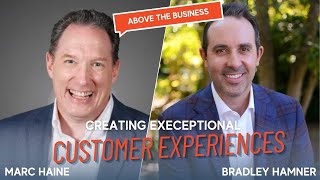
Marc Haine, a hospitality veteran turned author, uses theatre as a metaphor for customer experience: rehearsals are training, scripts are procedures, live problem-solving is real service. He identifies three customer reactions: no reaction (expectations met), disappointment, and delight. Culture starts when leaders model care and let frontline staff solve problems like coaches, not commanders.
Chapters
Welcome to another episode of the Above the Business Podcast. My name is Bradley Hamdy, your host. On today's episode, we have Mark Hain. Mark is the author of Lights! Camera! Action! And he uses it as a metaphor to think about what they do in theater and that experience that you have, how, what they do to prepare, what the experience is like as a, you know, somebody who's a customer going to the theater and how that becomes a proxy or an analogy for you to be able to grow your small business. We talk a lot about the customer journey touchpoints in this episode. We also talk about failing forward, actually how that works and how to, number one, prepare for that, but then how your team can rally around it. And then we also talk about the three different emotions. I thought this was really interesting in the conversation, three different emotions around just being able to not even overdeliver expectations, just meeting expectations. I mean, so often in business now, if you just meet expectations for the customer, you're farther along than what everybody else is. And so we go through the 3 different emotional responses people have in interacting with your brand. Without further ado, here's my conversation with Mark Haine. Mark Haine, welcome to the Above the Business podcast.
Thank you so much. So great to be here.
Great to have you. We love to start with people's journeys and background and your origin story about how they got to where they are. Take us back to where you feel is relevant. Bring us to present day.
Yeah, so I spent the last 25 years working in hospitality as a fixer. I was responsible for working with hotels, casinos, restaurants. And I was in a bubble of working with people. And I used to say, "You know, hospitality would be really easy if it wasn't for all the people." And I got lucky. I had ended up with a contract of being able to work as the Economic Development Officer for a community. They brought me on board to do a service excellence program. Because the community themselves were getting slammed on social media. People would go, "Oh, I had a great time visiting. The park system is amazing. I love the fire pits. I love that they supply wood. It's too bad when we went into the town, we were treated like this." And small towns are, they tend to be really tight-knit. And so, when strangers come in, they're not necessarily treated like they should be, like they were tourists. And so, the community of the town brought me on board to come and work with the businesses. And try to create that culture of hospitality first. Having done that though, I realized that my thinking when I was in hospitality, I had this bubble about how dealing with people is stressful and all the challenges we had with employees and with customers and so on. I thought was really endemic to hospitality until I got to peek into other businesses. Then, I realized everything I had challenged with in hospitality, I saw in every other business. That was in our community, whether it was a gas station, whether a pharmacy, whether the optometrist's office. Everybody was having the same kinds of challenges. And so, that kind of seeded my— it really opened up my blinders to that we have a bigger problem in corporate culture than just what I felt in hospitality. And then, in 2016, I did something brand spanking new. I became an actor. For the very first time, I got on stage and I did a show. I was working as the Economic Development Officer for the town. An employee came in and goes, "Marc, you act, right?" And I said, "Well, yeah, I act goofy, act silly. But most times, I just act immature." She goes, "No, no, no, like on stage." And I had never done that before. And I was intrigued. Something I always secretly wanted to do but I'd never really had the courage to do it. I mean, I can't remember what I had for breakfast. How am I going to remember lines, right? And so, I got up. We did it. 4 months of rehearsals. And I can tell you, no matter how funny the play is, after about 3 months, nothing is funny. And by 3.5 months in of rehearsals, I can tell you that you start going, "Why the heck did I do this to myself? Why are we doing this? This is so much stress, so much work." And then, opening night came. And I'm standing in the backstage, my hand on the doorknob. Everything goes black. The music starts. The lights come up on stage. I'm still in total darkness. I walk onto stage. I can't see anything except for the blinding light. And then, I interact with my colleague on stage and we get the first laugh of 300 people in the audience laughing at the line. And I thought, "Oh, this is why we did it. This is why we did all this work. This is the outfall of that." And I had this huge epiphany while I was standing on the stage. If businesses put the time, attention, and focus into their business that we did to put on only 6 shows, if they did that on a constant ongoing basis, then we would have amazing businesses.
I agree with you. And it reminds me of an analogy I shared with you. I was in that I, I just flew in last night. I was in San Antonio. And if you think about it, like, it, it's— you never hear about Delta or United working on a plane while the thing is in the air, right? They have to take it out of service, out of service. Put it in the hangar, work on the thing, you know, do whatever to get it to continue to fly, maybe even, you know, go faster, further, so on and so forth, right?
Sure.
And I think that that becomes similar to how business owners want to do what it is you just mentioned. It's not necessarily always in the desire It's in the execution. How do I do that? Yeah, but Mark, I'm busy. I, I got a full day today. How am I going to find this time to do all of the things you've just mentioned amongst everything else that I have going on? I can't take this company offline to go set it over the side. Sure, maybe for half a day I can, but I mean I can't do it enough. What's your rebuttal to that?
Every day, you have to walk into your business. Every day, you have to reboot the computer. Every day, you have to start from scratch in some form or fashion. I challenge that most operators can walk into their business and do their startup with the eyes of their customers first. A lot of what I talk about in my book Lights! Camera! Action! is I start the whole thing off with a pro of talking about experience expectations. At the very core of everything we do is about meeting and exceeding expectations. You and I right now, we're in a relationship right now because we're doing this podcast. You have an expectation of me. I have an expectation. I have an expectation that you're going to be an amazing host. And you have an expectation I'll come on. I'll have some personality. Maybe I'll have a little bit of wit. I'll be a really high-value guest. And hopefully, God forbid I don't let you down. That's the expectation that we have. Well, our customers have expectations into our business. Our employees have expectations in our business. And all we need to do is start off first and foremost by looking at our touch points in our business and say, how can we make sure that we meet expectations? I believe that meeting expectations would elevate most businesses right today. Right? Like in this next hour, if you do something just to meet expectations, that can be a wow factor. Because let's face it, you and I go out all the time. We see all sorts of reasons why the expectations let us down, not meet our expectations. So, I truly believe that in any transaction, any environment at all, we have 3 key emotional responses. One is no response at all. It met my expectations. I went into a convenience store. I bought a pack of gum. I walked out. In and out. It was highly transactional. It met my expectations. I just needed to get that pack of gum. But then, we also have a lot of our experiences are around what I call the "Oh, what a shame." You're walking into the convenience store. The door is sticky. Oh, what a shame. The delivery guy piled boxes of chips in front of the candy display so I can't get to the gum easy enough. Oh, what a shame. But then on the flip side of that coin, we have the, "Oh my goodness, that was wow, that was great experience," right? And so, when we look at all our different touchpoints within our businesses, and if anybody wants to go to my website, markhaine.com, I have a touchpoint assessment on my website that any business can look at. You can download it and you can actually do a walkthrough of of your business using the lens of your customers first. And I don't care how busy you are. At the core, we need to take that 5 minutes, do a little walkthrough, or have even an employee, or even have a customer do the walkthrough. And use a trusted customer and say, "Hey Steve, do me a favor. Can you just go back outside, take this form with you, and just go through the list?" How does that sound?
You know, I had an experience yesterday. It went— it was a number 3, and oh my goodness, this was amazing. Yeah, in an environment that is almost always a, oh, what a shame. And that was TSA.
Interesting.
So I walked through, was going, going to go through. I have clear, and I kind of went through clear pretty quickly. And I got to where I'm, you know, putting my bags on the conveyor to go through, and the TSA agent was so unbelievably warm and generous and genuinely nice, you know. She, she, she, she saw me, she could— she said, come on over here, honey. Okay, I'll go over there. And she was genuinely like, how was your day? She said, okay, now let's take that jacket off right there. You can keep that on. I had a vest on too. It was cold, obviously. She said, you got anything in your pockets? It was the way she went about doing it. Right. And I was like, and she said, okay, you have a great day. And I said, you know what? You have a great day. Okay. She took an experience that otherwise was, is drudgery. Let's be honest, right? Yeah. And she, she made it great. Now, after that, I ended up, my bag got pulled and, you know, it was kind of a disaster after that. But I mean, her experience, my experience with her was fantastic. And I want to go back to something you mentioned and you can comment on that if you want, but I, it's, it's sad, but true that if often we could just meet expectations of the customer. Just meet expectations, not even exceed expectations, just meet them. Oftentimes you are way ahead of most businesses because everybody else, it's like, golly, that's what a disappointment that was, right? I, I, I, I think that that's— it's such almost like a low bar to step over. Just to be able to meet expectations is such a big thing. Thoughts?
So I joke with people that the difference between a mediocre experience and a great experience is to care this much. That's all it takes. My background being in hospitality culinary arts, what's the difference between putting out a great plate and an okay plate? Just care. Just care for just a second and take a look at did you rim the plate? Did you clean the plate? Do you have fingerprints on the plate? Are you Does it look nice? And I can apply this to any situation. Grocery store. A clerk is walking down an aisle to help a customer out, right? Walking the customer to the aisle, to the product they're looking for rather than say, "It's in aisle 6, just halfway down." Yep, right. Actually caring enough to walk the customer go and go, "Here you go. You got 5 different kinds of shampoos right here." "Oh, thank you very much." Walking back, being able to be aware of your surroundings enough that if an item needs to be faced— facing in grocery terms means that you bring the product to the forefront so that it's a nice even forefront— making sure the label is turned to the front. Just caring that much to stop and just do. Okay, I have OCD. I'll go into a grocery store and if I'm standing in front of a line and my wife is shopping, I'll actually face stuff for that just because it drives me crazy when it's all uneven. But that's my Sad, sad little story. Having said that though, the difference between just doing the job and caring just a little bit is the difference in your TSA agent. She does hundreds of people every single day. And it is probably an incredibly monotonous job.
Yep.
She's telling the same people over and over and over again. When I stand up in the security line and I feel like I'm cattle. It's like, "Next!" You know, just pushing. "Go, go this way. You go this way. You go this." I feel like I'm being herded. And to have somebody stop and actually treat you like you're a human being, actually talk to you as if they're your friend and they care about you, all of a sudden, you receive information so much better. I mean, typically, people say, "Belts up, blah blah blah." And they just yell off things 100 times a day. Like you'll be in line. You'll be like number 15 and you'll hear them in that 15 transactions, you'll hear that 10 times, right? But they're very transactional. They're very— because it's monotonous. It takes a level of caring, just that little bit of energy. Her day is better. Your day is better. And everybody wins. The transactional person, the person who's going, "Please belts off, jacket off, put your laptop, make sure laptop's here," and they have their whole big shtick. They'll say that 100 times a day. I bet you any money when they wrap up their day, they're like, "Oh, thank God it's over." And I bet you the next morning they're waking up going, "Oh God, got to do it again." Yeah, but that one TSA agent is probably looking forward to meeting new people.
How do we as small business owners take the meta concepts that we're talking about here and put rubber on the road and actually begin to implement some of these things within our team? I mean, you know, I know that there's probably— and I don't dismiss this at all— there's probably an element of it, you know, embedding into your culture. This is what we do and this is who we are. And I don't dismiss that in any way, shape, form, or fashion. And maybe you can comment on how to do that. But I also think that there's— so I'll often say there's high level and then there's eye level. And so give us some of the practical things somebody listening to this on their drive home or to work, whatever, listening to us at the gym, whatever, can actually do today to go start to turn and move the organization towards this type of experience that you're referring to?
Number 1, you cannot memo great culture. That is, you cannot put out a policy of the month to say, "From this point on, we're gonna have a customer-centric, happy workplace." It starts in the leadership and it starts by modeling what it is you want to achieve. If you want your employees to care, you have to care. You have to care about your employees. You have to care about the outfall and the customer service to your employees and to the front end. Modeling it first will tell people that this is important to you. The second thing is when you see good behavior, don't ignore it. Don't just walk by it going, "Well, that's my expectation." I truly believe that what gets recognized and rewarded gets repeated. Good behavior when it's not recognized and rewarded is going to wane. It's going to fall off. So having said that though, when I talk about reward, I'm not saying, "Oh, here's a cookie or here's a raise." I'm saying, "Hey Steve, I really appreciated how you handled that tough customer. She was a hard one to deal with. Well done! Thank you for taking care of her." How do you think Steve feels now?
Feels great.
It's intentionality in the moment. And I realized we started off by talking about that owners and operators and managers, they're running around like chickens without heads facing crisis every single day. But at some point, we need to stop And we have to be intentional. We have to say to ourselves, "I need to be intentional right here. I just saw something really great. Let me recognize and reward it." And the minute you start doing that, you start telling your staff that these are important concepts. These are important ways of behaving. And a lot of times when you first say it, people will go, "It's just my job." They'll blow you off. They go, "Pfft! I don't know why you're thanking me. It's just my job." No, no. Yes, it is your job. But you just did it really, really well. So, thank you. The second thing that we have to do is we must always address bad behavior. If you want culture to change, you have to look at the behavior. You're setting a standard. And so, a lot of times what happens because we're busy, it's like we're not going to address the minor infractions. Somebody comes in 5 minutes late. It's like, you know, Bob, just get on the floor. Right? And you just kind of ignore it. And again, what gets recognized and rewarded gets repeated. But the opposite of bad behavior is not addressing it. That behavior will get repeated. And that's the thing with bad behavior. Bad behavior will always escalate into worse behavior. It will never get better on its own. I've talked to supervisors that they saw something. It's like, did you do? No, no, it's not like them. You know, Bob is really usually really on time. It's never an issue. Okay, fair enough. But watch what happens with Bob. After a little while, he'll be 5 minutes late again and it doesn't get addressed. Then he's 10 minutes late. Then at 15 minutes late, you're pulling at your hair going, 'What the heck is wrong with Bob? Bob, why are you always late?' Yeah, and then that's the other one is the always and never talk, right? Which is hugely destructive.
I have a question. How much do you think this is nature versus nurture with team members? What I mean is, how much of this is about what, what weight do we give about who you recruit initially and how much of it is the environment that you put them in? Really, it's really easy when you recruit a 99 of a 100 person. That is who they are. And you put them in a culture of standards, excellence, great experience, etc. Okay, yes, that's the— that's what we all want. I get it. But there are times that is a— that is a Pollyanna world. All right, we want to be in the real world, which is like, yeah, not everybody's that way. So there are going to be people— how much of it is like, no, no, no, the— the petri dish that you put people in, that's what matters more than who you recruit. What are your thoughts?
It has to be culture and consistency. The difficulty in a lot of organizations and I have to say as a fixer in hospitality. So, a fixer in hospitality is like I did what you see on Kitchen Nightmares, except it doesn't take an hour to do it or a week to do it. It takes months to do it. I go in when brands are really suffering. They're losing competitive advantage within their marketplace and so on. And I walk in and the very first thing I need to do is I need to change culture. And I have to start with the leadership team first. Because a lot of what happens is over time, even great performers will be pulled down. Great performers in bad cultures will be pulled down to become mediocre performers. And really, at the end of the day, I can say I've had tons of conversations with hiring managers, with managers, with frontline leaders who go, "Oh, I hired this guy Jim. He's so fantastic." And then 3 months later, they're like, "I don't know. Jim is just driving me crazy. I don't know what's wrong with him." Yeah. And so, what's the difference, right? The difference is we do hire. When we hire people, we're hiring the best people we have at the time. So, when you say about nature or nurture, I truly believe in this day and age where we have migrated from the kind of industrial age to the knowledge age, I believe we are now in the relational age. And I think one of the things that we're doing in business right now is we're still thinking 1970s management style. Or 1980s management style. And we're giving our managers too much work to do. The way we treat managers right now is kind of sort of like the coach of a football game getting mad at the quarterback and saying, "You know what? I'm going to pull you quarterback. Give me your uniform. I'm going to go on because I'm so much better than you." And this is typically what happens. This is in business. We're like, we're absolving people of responsibility because they're having something. And then, the managers end up taking on the responsibility. And what I would strongly, strongly recommend today is to make absolutely sure that your managers and your frontline leaders are empowered to be coaches first. So that when you have people coming on board into your culture, that now your workload is split between kind of what you need to do in order to manage the business and leading your people, coaching your people. And that's a different philosophy because all too often, a frontline leader has been given the tasks and the job from their boss. And this is what I need you to do. And I had this conversation with actually a pet food manufacturer. And I said, "How do you promote when you promote your frontline leaders, your line leaders? How do you do that?" "Oh, we pick our best performers." And I said, "So what training do you give them to be leaders?" 'Well, they don't really need a lot of training. All they have is a checklist.' Yeah. And it's like, but you're asking them to lead a bunch of people. And then, you come to them when the production is low and you're saying, 'What is going on?' So, you can't say that you're not giving them any real leadership responsibility, right? And so, we have a perfect opportunity. And this is probably, everybody listening to this podcast, if I ask one question is like, were you trained to be an effective leader when you first got promoted into position, or as a store owner, as a business owner. Did you take leadership training before you decided to open up the welding shop?
Yeah, yeah, definitely not. You know, it's often said, well, it'd be great if we could— you know, they say, oh, you want to start a business? Great. Okay, we're going to put you through the paces here, and you're going to go, you're going to go to business school. Okay, actual business school, not an MBA, so you learn how to do all these things. But Nope, that's not it. We all jump in and figure it out. We try to figure it out. Okay.
Well, and the means by which we promote somebody, the reason why they got pegged for promotion in the first place is because they were a great performer. And a lot of times, I've heard this time and time again. A car rental shop there, they promoted their car jockey into a leadership role to run their team. And then they got mad, you know, 2 months in, 3 months in, they were ready to fire him. And it's like, but why are you firing him? He used to be such a good car jockey. Why is he such a shitty leader? And it's like, he's a bad leader because you didn't train him. He's a great car jockey but the skills he used to be a car jockey is a much different skill set than for him to be a leader.
Yeah. Okay. So, We have a concept in our program and in our framework where we talk about— and I didn't know necessarily that we would go down culture, but I got to ask this question because it's really been in the back of my mind— which is how do we integrate what you're talking about into one of these concepts around culture? And so in the Culture Playbook, OK, the, the, there's a framework that, you know, we term a performance culture. Okay, like, I don't want a good culture, I want a culture of performance, right? That's what the business is.
Okay, sure.
And so to do that, that's defined as making sure that we're clear on, uh, what we call OTA— clear outcomes, clear transparency, and clear accountability. They know what they need to do, There's transparency. We're gonna, we're gonna like track their numbers and metrics and KPIs, right? And we're going to hold them accountable to that. Okay, great. And I was thinking as you were, as you were talking, I was like, man, I— there's not an element of what you're talking about inside of that. And I would like to try to find a way to not push my performance culture framework out of the— out but also how do we take the experience, experience that I have with the TSA agent and, and, and mold that like the Venn diagram circles, right? Mold that with, with my idea for performance culture. So as an example, and, and I hate to tee this up, but let's just say she had a metric of how fast she gets people through the line. Does that make sense? Well, then if that was the metric that was only in place, she may not have been as warm and nice as she was to me. Now, clearly TSA probably doesn't do that kind of stuff. You get what I'm saying, though, right? I do. Any other— a restaurant. How many times can we turn this table over? Turn the table over, you know.
So a grocery store. So a grocery store is exactly that. A grocery store is expected— the cashiers are expected to have ringouts at a certain rate. And they get— it's a metric that they measure, right? And when I've done training to grocery stores, one of the challenges that they have is older people. Older people come up to the cash register and they're the clerk. This 18-year-old clerk or 17-year-old clerk is just whizzing stuff by and the older customer comes up and goes, Oh darling, how's your day going? Your day must be hard. Does your arm get really— and they're standing there and they're just burning through time. And this poor clerk is being as polite as she possibly can. But she knows that her manager is going to come to her and go, oh, between this time and this time, your ringouts got really slow. What the heck happened?
Yeah.
And so now, from your culture performance, culture and performance component, is what is the purpose of the service within a grocery store? Is it just to ring people out? Well, anybody can do that. The grocery store I worked with actually created on their Senior's Day, they actually created extra lanes. They said, "We're gonna go against all the normal grocery store metrics and we're going to add in another lane." and it's going to be our senior lane. Take as much time as you need. Oh, and so for that one day on their senior discount day, they brought in extra labor and you just took your time with because they realized if we can make this feel like home to people, if they can feel like they can open up and have a conversation with somebody, that this will just make them feel like this is where they want to shop. I'm in a small community with 3 grocery stores. Our community is 6,500 people with 3 grocery stores. Where am I going to shop? It's going to be where I feel the most comfortable.
[Speaker:MARK] That makes sense.
[Speaker:MARC] Now, having said that, your performance outcome framework can be married to this whole idea of culture just simply by what I talked about as far as this idea of putting a lens of live theater. My question to you would be, If you have a problem, if this was a theater production, what would you do? So for instance, you talked about like any number of— and this is why I kind of love that lens because we use the lens of what happens in a theater production. Number one, we have a lot of training. That's called rehearsals. So, taking time out to make sure your people are trained and that training is going to develop the culture of service because you're giving them that service. You're giving your employees a service of training. You're setting expectations along the way. The constant expectations. When we get together to do rehearsals, we're going through it and we might have a passage that's really tough. It might be a passage that we're constantly tripping over. And then we get together as a team and we talk about how do we stop tripping over this one thing. No different than you bring your team together whether you're a welding shop and it's like, "Guys, we just, you know, in the last 2 months, we've had 3 minor accidents. How can we stop all these accidents from happening? Let's talk a little bit about what's causing the accidents and let's see if we can alleviate them." By bringing people together is where we create this idea now that we don't have people. I cringe whenever somebody says, "It's a great place to work. We're such a happy family." I don't know about you but My family is super dysfunctional. And trust me, I don't want Uncle Harry at my Thanksgiving table telling me how to run my customers. But having said that, I think we're a community. And this is really kind of the overlying philosophy is that when we bring people into our organization, what we're actually doing is we're building community. And this is no different than building a community in a municipality. Building municipal in our organizations, building a community of people. And I'd like to say, what does it take to go from a community to a caring community? And as you would do in a live theater is you design it. You go play by play, line by line. You figure out what is the hiccups that we're having. After you have your first performance, you go back and you kind of problem solve. What, where do we fall down? Is it okay to fail forward? I'll tell you, when we fail forward on the stage, when somebody messes up a line and we crack up, or something in a expect it happens, the audience loves it because it's a real human experience, right? So does that answer your question, or have I gone too far off tangent?
No, not at all. What, what is the— what do you believe is the right, you know, for a business that's obviously, you know, going about its day, what's the right, you know, ratio, you know, that there could be— I'm a sports nut, so, you know, there's so many examples of, you know, reps taken or practices held relative to the number of games played. My son is finishing up the basketball season this year for his 9th grade. Well, they've had, I don't know, 3 to 4 times as many practices as they have had games. That's very standard in sports. And as you're saying in theater, that there was the exact same thing. You all would rehearse a tremendous amount of times for 6 performances. My daughter is in dance. She literally just this past weekend performed at a dance competition. My goodness gracious, she is at dance every single night practicing for these— I don't know, 4 different competitions, uh, 4 different locations, and a recital. I mean, you know, so she's on stage 5 times and she spent hours and hours. Okay, those are all examples— theater, dance, basketball. We could go NFL football coming up, right?
Yes.
So many different things. But in business, that ratio is very difficult. You're not going to be able to train that much to just execute. So, but to the broader point is there has to be some amount of training and rehearsal that happens. Is there a framework, a ratio, or something like that of like, hey, we need to be 9 to 1 here, or something like that?
I think the number one question every leader has to ask themselves when they see things aren't going the way, we're not meeting the expectations is what needs to happen in order to conquer it. Like a perfect example is I opened up. I worked in a small community where they had one of those kind of 1990s kind of Roadhouse those nightclubs, you know, that they would overserve people on Friday and Saturday nights. And then at 3 o'clock in the morning, all these 20-somethings would pile into the streets and there would be fights and all that. And you know, the police were actually sitting on the corner from 1 o'clock till 3:30 to make sure that there weren't fights because you have all these kids pulling out. And the owner of the hotel decided he no longer wanted this liability. And so, he wanted a classier joint. He wanted something different. So, we've actually built a pub brand. In that environment. And what was interesting about that conversion was we had to not only retrain the staff but we had to retrain our customers. So imagine for a second because we had to change the whole culture of the place and we talked about this thing about bad behavior and how come people have bad behavior. I remember we had one issue where I had the owner in the pub and we had a couple of guys at the pool tables playing pool. And she looked over and she saw this one guy, Chris. And she goes, "This guy Chris, we kick him out all the time. You better keep an eye on him. He's an awful guy. He always behaves badly. And I laughed at her and I said, not anymore. One of the things I realized in the kind of roadhouse kind of mentality is people figured they had permission to act badly. And I would see people that got banned from the bar and I'd see them at a Dairy Queen and they're acting normally. It's like, why are they acting normally in Dairy Queen but they come into the bar and they cause problems. Then, I realized it's about the standard that we set. And so, when we reopened this beautiful pub brand where we had pool tables, we had a beautiful area where I envisioned that women can have a safe night out. We had another area where we could serve wine and we could have 50-somethings hanging out. And it just felt comfortable. It was cozy and it was comfortable. And it was a great place to get together with friends. And I thought, how can we change the culture of the customers? And the number one we think— number one, I hired 60-year-old woman as a bouncer. She was like the best person on the planet because she was like mom. And the second thing we did was we banned swearing in a bar. And I have to tell you that when we did this, she would go up to her and everybody knew her name. Her name was Angela. And she'd walk up and she'd go, 'Steve.' She goes, 'Oh, sorry, Angela.' But we'd go up to people and some people would— it's like, "Guys, please knock off the swearing. We don't like swearing." "What are you kidding me? This is a bar." "Look, if you're going to keep on swearing, I'm going to ask you to leave." And they go, "Fine, we're going to go somewhere else." And they leave, right? Well, 3 days later or the next weekend, all their friends are coming to where we are. And they're coming to hang out and they're like, "Can we come back into the bar?" And we actually changed the culture of the customers. Now, going back to the whole thing, we're launching a brand new brand. We have new menus. We have new systems. Everything is brand spanking new. We decided to invest 18 man-hours for every employee dealing with a customer. 18 man-hours at here in Alberta, Canada. We are at the time, it was $10 an hour. So, that's $180 per person that we did for about 35 employees. Again, we looked at all the different touch points, all the different expectations, and then we worked them through the pre-opening. The interesting thing was when it came down to our training, there was one day we were probably open about 2 months and I walked up and one of the servers is on the point-of-sale system. She's got her phone out. And so, I walked up and I said, "Are you texting while you're working?" She goes, "No, no, no, no." She says, "A customer gave me a $50 bill. I'm just calculating the change." And one of the things that I hadn't realized when we trained all these people, we didn't realize where everybody's capacity was. And we didn't teach them how to count back. We didn't teach them the basic math that they needed because we assumed they would know it.
Yeah.
Right? So, in the guise of putting on a play, what does that equate to? That equates to you train, you do the rehearsals. But then, you didn't address maybe that somebody has a little bit of stage fright. Maybe when you put an audience in front of them, they're great in rehearsals. But you put an audience in front of them, they start to freak out a little bit. And so then, as the director, what do you do? Do you yell and scream, or do you act as a coach? Coach?
Yeah.
Do you pull them aside and say, what can we do to make this happen for you? How can we leverage the team that's on stage with you to help you overcome this? And I can tell you, on stage, a live show is never the same twice. An actor forgets a line. Well, what happens when the actor forgets the line? The troupe rallies. Somebody else will pick it up and maybe feed the line, right? Maybe they'll say something. They'll improv something to get the person back on track. Everybody else around this person's realized he's forgotten a whole section, right? And so, you're live problem solving. But that's the culture we created. We created a culture as we got together to say, you know what? We can adapt. We can bend. We can fix this. We can adjust it so that the audience will never know it's wrong. The audience will never know anything flubbed. And then, we can go back after we're all said and done. We can problem solve it afterwards. How do we keep this from happening again?
Yeah, I think it goes almost back to what you mentioned, which is on the, like at the very beginning, you mentioned looking at it through the eyes of the, of the customer. And in the theater example, like, the, the customers are the people that are actually in the seats watching. And you all have done a tremendous amount of work, quote unquote, backstage in all the other days leading up to that. And so, okay, there's, there's that element of it, which is, you know, how much training and time and attention. And then there's the element which is like onstage when things are actually happening, you know, in, in, in a, in a business being able to have a culture to where other people are going to be able to pick up and pick up the slack where maybe you get into a situation that is unfamiliar. You don't necessarily know, know, you know, how to be able to kind of walk, walk through that. And we actually, one of my companies, we had a situation recently where a newer, uh, staff member took a phone call and got quickly into some questions from a potential customer, and she really was trying to serve. Okay. She was trying to do the right thing, but she spun herself into almost answering and getting into deep water where she didn't know. She didn't know the product. She doesn't know the products well enough. And she was starting to kind of try to sell when that's not her role at all. And so when she really just needed to say, and of course this was her comment in hindsight, she said, said, you know, I just wish I would have told the customer or the prospect, I don't know, let me get back with you. She said, I don't know why that was so hard for me to— for, for me to just in that moment just say, you know what, I actually don't know, know the answer to that, but I'll get back with you. I'll find somebody, you know, who does. And I think that that, that would actually would have been a better situation than what, you know, she was trying to do the right things. She was trying to provide answers and solutions to the customer, specifically price points. It's like, oh no, no, we don't— you don't do that. You don't know those price points. You don't have the price book. That's not, that's not in your, your will.
But I want to serve.
I want to serve. But it's like, you, you, we ended up losing that deal actually. Um, uh, and, and not her fault, but it goes back to training and to say like, hey, sometimes it's okay to be able to say it, you don't know.
So that brings up a really good point. So Bradley, when it comes down to like this person seems to me to have the self-efficacy to look back at what she did and go, "I don't know why I went that far. I don't know why I didn't do what I did." She learned from it. But what is the value to failing forward? We had a situation in one of the hotels. Again, another small community. The bartender was manipulated to go. It was a Saturday morning. She was manipulated to go as far deep into the bar as she possibly could. And at this particular bar, we had the video lottery terminals, right, that you can play lotto terminals and stuff. And so, we had a float in the back of $5,000. The cohort of the person distracting the bartender crawled behind the bar, opened up the till, took out $5,000, and they bolted. And the owners were so incredibly mad, which I don't blame them. But their first reaction was, "Well, did you fire the bartender?" And I said, "Why would I fire the bartender? The bartender was doing their job. Why would we fire her because we just learned a $5,000 mistake, a $5,000 liability that we have?" It's like, why aren't we focused on making sure now that that $5,000, we don't lose it for nothing? Let's take a look at our systems. Let's take a look at what we're doing and let's correct it forward. Was it fun to lose $5,000? Absolutely not. Was it irrevocable?
No.
It was a loss. And I remember passing by the accountant and a bookkeeper's office and they were talking about me. And they were like, I can't believe Marc's not mad. And so, just for the heck of it, I walked into the office. I go, "Here, hold on a second. Hold on." And then, I started stomping. I said, "Has that helped anything? Does it solve anything?" Yeah. We had a problem. And so, this young receptionist or this young telephone person on the outreach call talking to the prospect, being able to then assume the the persona of a coach, sitting her down and say, "Okay, so next time this happens, what's your next step?" Yeah. I mean, no matter what, you've lost the customer. It's not going to go anywhere.
Right.
Right? So, why not take that as an opportunity to say, "Okay, so let's talk about how that's going to affect you next. What's next?
How do we handle this next time?" Yeah, that's a good point because this is at a way even higher level than what you just mentioned. But somebody that is one of my mentors, um, he, uh, had a CFO in one of his companies, pretty large company. I think what happened is that there was a wire sent to literally the wrong bank account, okay? And somehow another, it was a lot of money. I mean, well into the six figures. I'm thinking in quarter of a million dollars potentially that was lost. And he said the exact same thing you just said, is that everybody was like, were you going to fire him? He goes, why would I fire for him. I mean, I just taught him a $200— we just— he just learned a $250,000 lesson. I mean, what other level of, uh, of training am I going to give this person? Because now they're going to be, you know, on, uh, they're going to be as detail-oriented as they can possibly be. I mean, the point is, I don't know what the numbers were, but it was some large, large amount. Yeah. That they were like, no, no, the last thing I'm doing is letting this person down. Did they make a mistake? Of course they made a Of course they made a mistake. And there was their, you know, some sort of, you know, system now has to be built around that and some accountability and those sort of things. Sure, absolutely. But I do believe I, I, and I will say for somebody listening to this, you probably would agree with this, and we'll end with this one. There is a difference though in these examples, even the one I gave, the one you gave, and the one my, uh, that I was referring to with my member, uh, uh, mentor. But there's also that. And then there's not the situations we're talking about, which is repeat mistakes. Okay. They just keep making the same mistake. Well, then at that point, you probably have to have different conversations and potentially even letting someone go. But that's not the situation we're referring to here.
Again, part of it is when we address problems. And here's the thing. I found out very quickly that when we get mad at something, we're harping on the problem. We're not dealing with it. And so, to your point where you have somebody making repeated mistakes, there's something this person does not understand because I truly believe people don't wake up every single day to say, "Today, I'm going to screw my employer." Yeah, right.
Yeah, I agree.
I think everybody at the core of who they want to be, they want to be good at what they do. And if they're not good at what they do, if they are haphazard and lazy and seem lazy or seem absent-minded, maybe they're distracted by something. Maybe you have a deeper cultural problem than you know about. But first and foremost, it's about those expectations.
Yeah, I agree with you. Marc, this has been fantastic. If people want to learn more about you, your work, how to connect with you, where would you point them to?
Markhaine.com. Easiest way to get anything. If you even Google me, you'll find me everywhere. I'm on Amazon with Lights! Camera! Action! Business Operational Excellence Through the Lens of Live Theatre. And of course, I'm all over social media as Mark Haine. It's Mark spelled with a C because I was brought up in Quebec and I lost my accent. But now, I still spell it with the C. I love it.
Mark, last question. What does What does working above the business look like to you?
More than anything else, intentionality. Working above the business means every single day, we're intentional about what we're doing, what we're focused on. Too often, we get so tied down with the minutiae of what's going on in our business. We're ending up working in the business, not on the business. And I think the one component in there that will defy any distraction is how am I being intentional right now.
Yeah, I love that. I, I, I totally agree. You know, couple of my biggest, uh, key takeaways. Number one, I love the 3 emotional responses. There's no response. Oh, what a shame. Or, oh my goodness, that was a great, uh, point you make. I also love the, the, the thinking about it through the eyes of the customers and what are all of the touch points that you have. Sometimes people refer to that as each one of those touch points kind of combine, make up a, an overall customer journey in and of itself. And so can kind of breaking that down and seeing how can you, you know, surprise and delight at certain aspects inside of the customer journey within there. I think also too, for me, is, you know, reflecting on, you know, performance, culture, and our OTA framework inside of that, but then also marrying that, as you mentioned, with an exceptional experience, not just hitting the metrics and the targets, which are important to make sure to grow business, but also how do we marry that with the experience? So those were some of my key takeaways. Mark, thanks so much for coming on the podcast.
Thank you so much for having me. It's been absolutely a wonderful discussion.
Shout out to our podcast partners, DirectClicks, Autopilot Recruiting, and Coach P. If you want to expand and have a team that you can build a culture around and expand your team this year, none better to work with than Autopilot Recruiting. Go to autopilotrecruiting.com. That's going to make sure that you fill in any gaps that you may have. With any turnover that could come this year, but also build a bench, but also continue to make sure that you're always recruiting so that if in the event something does happen, you are prepared. Autopilotrecruiting.com. Well, at the time of this recording, I have spoke to so many small business owners that are working on their marketing for 2026. And marketing, whenever you start to begin to kind of learn it, it can be a little overwhelming. But if you want to understand the metrics, the KPIs, the benchmarks that matter for your small business, go to directclicksinc.com/above-the-business. directclicksinc.com/above-the-business. We were obviously talking with Mark today about coaching and developing in the team. And if you want to put your team members in the right environment with other peers, not just your team, but other peers that are doing it at the highest level, none better than Coach P. Go to coachpconsulting.com and let him know that you heard about him on the Above the Business podcast, and he'll give you your first month completely for free for you and your team members to test drive it. CoachP Consulting.com. Alright everyone, hope you enjoyed that episode. Till next time, lead well and go be great.










