Episode 131: Getting Things Done with David Allen
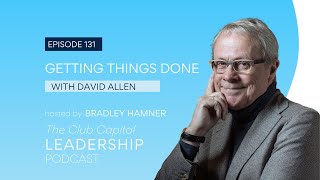
David Allen, creator of Getting Things Done, explains how the five-step workflow (Capture, Clarify, Organize, Reflect, Engage) clears mental clutter. He calls the constant stress of unprocessed tasks "ambient anxiety" and warns that most people fail by not capturing everything, skipping reviews, or chasing the loudest task instead of what matters.
Chapters
So the big question is this: how do small business owners like us grow our leadership, develop our teams, and scale our business in a way that allows us to get our products and services out to the world yet still remain profitable? That is the question, and this podcast will give you the answers. I'm Bradley Hamner, and this is the Club Capital Leadership Podcast. Hey, before we get into today's episode, did you know that Club Capital is the largest accounting advisory firm for insurance agency owners in the country, providing monthly accounting, CFO services, and tax preparation.
Check them out at club.capital.
Welcome to another episode of the Club Capital Leadership Podcast. My name is Bradley Hamner, your host. On today's episode, we have one of the world's most influential thinkers on productivity, and his 40 years of experience as a management consultant and executive coach have earned him the titles of personal productivity guru by Fast Company and one of the top 5 executive coaches by Forbes magazine. His bestselling book, the groundbreaking Getting Things Done, and its methods, commonly known as GTD, it spawned a movement of millions of practitioners and fans around the world. His methods of staying relaxed and focused in our fast-paced world are now being spread by certified trainers and coaches in 90 countries around the world. Without further ado, Here's my conversation with David Allen. Have you ever tried online marketing before and weren't sure if it was working?
Maybe your rep talked about all the impressive features and stats and said things were going great, but you didn't know how all that tied into raw new policies written. Well, that's not the case with DirectClicks. DirectClicks is the premier Google Ads and SEO option exclusively for State Farm agents.
Why?
They're 100% results-oriented with an exclusivity guarantee. Every review call you have with your account manager focuses on what really matters to your business, and that's leads and call-ins received. Everything will get broken down to cost per lead received. By investing with DirectClix, you're going to free up time and energy to focus on what's most important in your agency and doing what it is you do best. This will be the best investment you make for your team by spending confidently and scaling your agency today with exclusive online marketing partner DirectClix. Visit us at directclicksinc.com. Ambition is the first step towards success. It's time to level up. Your agency. And Coach P Consulting will help you do just that by using the same strategies he used to sell over 700 life insurance policies in 2021 alone. Now, this is not your regular one-and-done type coaching. You'll get personalized coaching 2 days a week, every week of the month, and you'll get a live look behind the scenes of his team training and an office that's performing at the highest level. There's a reason Coach P Consulting is the fastest growing coaching company for insurance agency owners in the country. Coach P will train your team alongside his own and show you the exact steps they are taking to achieve Chairman's Circle, Exotic Travel, and Multi-Line President's Club and be one of the few agents to be selected to have a third office. So whether your goal is to be at the top of your local market or amongst the best in the country, this training will give you the strategies and the tactics to get there. For just $250 a month, you'll get high-level coaching each week from someone who is already getting it done at that level, and his strategies work, and it's time to put them to work for you. Sign up at coachpeakconsulting.com and get your first full month for free when you mention the Club Capital Leadership Podcast.
But Alan, welcome to the Club Capital Leadership Podcast.
Bradley, delighted to be here. Thanks for the invitation.
It's an honor to have you. So we always start with background and origin story, but really what I want to ask— so many people are familiar with your seminal book, Getting Things Done. I'm curious really if you could take us back to when you developed the methodology. What was the impetus? How did you go about the 5-step framework that you created that has literally transformed the lives of millions of people around the world? I'd love for you to just take us back to that before you actually began and created the model.
I just wanted a good job and wanted to work for myself. So after all the jobs and professions I'd had, I said, well, consultant's the only option. So I sort of started my own consulting company. I was also very much interested in sort of my own self-development and, you know, how do I learn who I am and how do I stay clear and whatever, you know, a bit of experience in the martial arts, you know, kind of the value of clear space. And so I was a good number 2 guy for a lot of businesses and friends that I knew. And so, you know, I just sort of helped them design, you know, upgrade their systems I'm the laziest guy you ever met. So it was like, how can we get out of here earlier? You know, how can we manage this process a little bit better? So I was more interested in the process than the content in terms of the businesses people doing. So I was always, I guess that was sort of my driver in becoming a consultant. And so I started to find techniques for myself that kept me clear as my life got more professional and busier. And started to, you know, sort of curate and cobble them together one at one. And they work, they started to work for me to make me more comfortable and more in control, more focused, more able to, you know, focus on what I was doing without being distracted. And then I said, these are great techniques, and I started to use it with my clients, my consulting clients, and it produced the same result. Got them clearer, actually gave them more space to think more strategic, which is what they wanted. To be able to have a better view on their company and what they were doing. And so, you know, what I uncovered for myself, I began to implement with them, and it became sort of a— I began to— I didn't wake up one morning with this thing, but it was a period of over 2 or 3 years, and a mentor of mine who taught me a couple of the key components of this that I began to cobble this together. And then some, you know, head of human resources in a big corporation saw what I was doing and said, 'Gee, David, we need that result in our whole company. Can you design some sort of training around what you've come up with as this methodology to have people stay more clear, more controlled, more focused, more space to focus on the meaningful stuff, priorities, et cetera?' And so I said, 'Sure.' So I helped him— I just actually designed a training program. We did a pilot program for 1,000 executives and managers at Lockheed in 1983, '84 in California. And it worked. It hit a nerve. I went, wow, who'd have thought? And suddenly I found myself thrust into the corporate training world because of something I just sort of almost— I wouldn't say accidentally, but something that I had just uncovered. I didn't really make it up. I just said, well, what works? What do we do to get distractions out of our head? And I discovered the various techniques about that that ultimately became GTD or the, the content of Getting Things Done book. But I didn't write Getting Things Done until, you know, until 2000. And this is 25 years later, you know, after thousands of people I trained in the corporate training world and literally thousands of hours I spent. My consulting turned into more sort of coaching one-on-one with mid to senior level people that wanted more of how to implement what I came up with at their desk. And so I sat desk side with them for, again, thousands of hours. And so that's what helped refine this, made me feel confident that this was something that was worth writing a manual about. And I thought I was the last guy to learn this. I thought anybody, you know, I never had any formal education in terms of business psychology or time management, any of that. This was all street smarts that I came up with. And so I wound up sort of discovering after the success that this methodology had with so many people in some of the most sophisticated environments with some of the busiest people and most sophisticated people you'd ever meet implementing this and having them go, wow, this changed my life, this is so cool. Somebody suggested you should write the book. So that's what I did. So that, that was— it came after a lot of years of just experience with this and confidence that this was unique and nobody else seemed to come up with this that I had, and that it was bulletproof. You couldn't punch a hole in it. You know, that's a, that's a very short version of a very long story, Bradley.
So no, that is so great. I love, I love hearing how people or methodologies and concepts come to be. You know, as you were mentioning it about Street Smarts and uncovering it, it just makes me think, I was a finance major at Auburn and I learned nothing about how to actually run the financials of a business. I had, I did not know. And so there's the difference of academia versus, as Ben Hogan said whenever he was playing golf, like, you dig it out of the dirt. Like, that's what you, you actually figured it out. Like, yeah, businesses and executives, so to say, this thing is bulletproof and you can't punch a hole in it.
Yeah.
So I'm curious, there's no way that any of us in the '80s and '90s to even early 2000s could have seen the onslaught of what was coming with social media. But there were distractions then, and so now the— it's overwhelming, the amount of distractions and things that we're trying to hold in our brain. And I've heard you say that your, your brain was, was, was never designed to be able to do that. In fact, there's a really crappy office. Can you just like speak to that and just speak to how like your book was so much ahead of its time and how it still applies even— it's more important today than it even was 20, 30 years ago.
Yeah. Well, I discovered in the martial arts that, you know, 4 people jumping in a dark alley, you don't want 4,000 unprocessed emails sitting in the back of your psyche. You'd better be clear.
Yeah.
To be able to then deal with surprise, to be able to deal with being present, being fully available. You know, all the mindfulness people these days are talking about focus on your breathing and so you could be present. And you know, yeah, I learned that 40 years ago, getting a black belt in karate. So nothing new about that. But how do you stay clear about stuff when you still have commitments that are unfulfilled? And so, you know, I just discovered you better keep track of all those commitments. All the would, could, should, need to is I need cat food, I need to do vice president, I need to decide whether we should adopt a kid or not. You know, all those things, those kinds of things are banging around in people's head and your heads are crappy office. So I just discovered that years ago, but the cognitive scientists in the last 10 years have discovered that your brain did not evolve to manage or mind or prioritize or manage relationships between more than 4 things. It didn't, you know, and that's, you know, hundreds of, you know, I don't know, a billion years of involvement. You're not going to change that. Your head was not designed to do that. And a lot of people are still trying to do that. They're trying to use their head to remember and remind and keep track of all this, all the commitments they've got at the personal and professional levels. And that's just, that's what's blowing a fuse. Actually, even one thing, wow, should we adopt or not? Should we get divorced or and just even one of those things, if you're not appropriately engaged with your commitment about it, it will color your whole, the whole rest of your life. It'll make you feel overwhelmed. So I just discovered, okay, what do you need to do to unlock those things that are distracting you? Unlock it, meaning not finish them, but put them in the right place, decide what you need to do about them and park the reminders of what you need to be reminded about to move the needle on those things toward resolution, clarity, or Completion, whatever. I just discovered that algorithm. Again, I didn't make it up. This is what anybody does that actually really gets things done is they say, well, what do I, what's got my attention? What's my outcome? What's the action step I need to take? If I can't do that right now, how am I reminded of that in some appropriate way so I can do it at the right time? So if you want to really get things done appropriately, Again, these 5 steps were just an uncovering of these stages of what we do if you can't finish something in the moment. You know, if you're in survival mode, you're just trying to eat.
Yeah.
Make sure you don't get the snake biting you or the tiger eating you and feed the kid and handle their crying and cook the dinner. You know, so, you know, when life was that simple, your brain didn't need to be anything more than that. Yeah, that it was, it was fine for that. Actually, it was brilliant for that. So, wow, I think there may be a tiger up there. Wow, I think I see a thunderstorm coming. That's your brain, as yours and mine are right now, are using long-term history and pattern recognition to say, well, that's a computer, that's a person, that's a thing, as opposed to just vibrations from light and sound. So the brain is doing brilliant stuff, and yet you go to the store for lemons, you come back with 6 things and forgot the lemons. What happened? What happened? Well, you were just trying to use something that wasn't designed for that to do something you thought that would help you do. And so that's a lot of, you know, it's kind of the duh factor, but, you know, I, I discovered that a long time ago, and especially when you're engaged in dealing with important stuff— your clients, your profession, your career, your boss, your personal relationships, you know, all that stuff— most people have a whole lot more commitments about that than they think. Yeah. And well, they have a lot more commitments than they've acknowledged and made objective, but they got it spinning around to wake them up at 3 o'clock in the morning. Oh my, should we get cat food? Or what am I going to tell my boss about X, Y, and Z. And all of those kinds of things, I just discovered the methodology about how do you externalize those things, capture them, and then sooner than later, you know, make a good decision about, okay, what do I need to do about that so I could park it in the right place or remind myself of the right thing or just do that right now if I need to do that. And then, you know, so that ultimately became, you know, what was the— what then became globally known as GTD, or this process of how do you keep yourself clear so you can be present with and available with whatever you're doing.
So I had this, uh, it was ironic, preparing for this interview this week, I had a— I was listening, I believe, to one of your podcasts, and I had this inspiration, and I paused it, and I ran to get my Remarkable, which is where I have my notes and it's where I write down podcast questions. And as I was going down, I got distracted on something else for a moment, for a brief moment, 15 seconds maybe. And then I came back and I was where my work is and I said, now what did— what was I coming over here for to do? And I was like, oh yeah, that's right, that I had a question. And I could not recall the question that I was going to ask you, some brilliant question. And I thought Well, boy, isn't that ironic that I'm going to be talking to you about this. So anyway, I thought it was funny. But what is— why don't we go over—
that's why, that's why right next to me is a pad, a great little tear-off pad and a great little pin. Because even while I'm talking to you, something like that may show up. So I learned years ago It's called don't let it spin in there.
Yes.
You know, get it out of your head.
Yes.
You know, and capture it in some place that then you trust you'll see sooner than later and make sure that you do something about that. But yeah, the muse is fickle.
Yeah.
She'll show up and give you an idea and give you a thing, whatever, and then it's gone.
For sure.
What was that thought? Oh, I'm sure I remember that. It's like, what would I sure I remember? Oh, duh.
Yes, that's so true. That is so true. Why don't we give people, for those that haven't read the book or not familiar with the 5 steps, right?
You mean they're over the model?
Bradley, there are people that have not read the book yet? Oh my God.
There's a couple. There's a couple. There's just a few. Not many, not many, but there's just a few.
No, I'm kidding. Okay. Yeah. So the basic model is, look, you need to get your head empty. You do that by capturing the stuff that has your attention. I need cat food. I need the vice president. You write it down, you put it somewhere that you trust you'll see it sooner than later while you have the idea, because you're not sure what to do with that idea yet. So you want to be able to give yourself the freedom to have the idea. That's the capture process, step 1. Step 2 is then sooner than later, you need to come back to what you wrote down or what you captured and say, hmm, am I actually going to do something about that or is that a real thing? You know, whatever. And then you need to go through a clarify step. Is that a someday maybe? Or is that, oh yeah, I actually need to move on that, right? Oh God, that's— or what a dumb idea that was. That's the clarify process, which is step 2. What are those things that actually have your attention that are yanking your chain internally? Step 3 would be, okay, I need to be reminded about something I need to do about that, or I need to make sure that I that goes somewhere it needs to go. It might be somebody recommended a restaurant, I need to put on a suggested restaurant list for, you know, Alabama. Yeah. Wherever you are. So that's the clarify step or that's the organize step. It's like, okay, where do I park reminders of these things so my brain doesn't have to keep spinning, don't forget that, David, don't forget that, don't forget that, David, you might want to have, you might want to know about that restaurant. Restaurant, you know, in Huntsville, you know. And so I needed to park that somewhere that I would see that if I think that was appropriate to say, "I'm in Huntsville for a couple of days. Let me see what restaurants I've ever heard about." Yes, yes. Right. And then step 4 would be make sure you look at the list. Make sure I look at here are the errands I need to run. Here's the things I decided I need to talk to my wife about. Here's the things I need to do at the computer. Here's the things I need to do.
Are you an agency owner looking to grow your revenue, increase your bottom line, and better manage your taxes? Club Capital is here to help. Club Capital is the largest accounting and advisory firm for insurance agents in the country, providing monthly accounting, tax strategy, and CFO services. Way more than bookkeeping and your everyday run-of-the-mill tax prep, Club Capital is focused on providing financial and tax advisory services that help you plan and forecast your agency's performance. Their financial dashboards and agency forecasting tools help you better understand your agency's historical performance, create, measure future targets, and see how your agency compares to your peers around the country. Imagine what it would be like to understand the impact to your bottom line when deciding to hire a new employee or forecast the impact rate changes or commission rates will have on your business. With over $200 million in tracked annual revenue and $140 million in tracked annual expenses, Club Capital has the data and the team to help you make better informed decisions for your agency. They will help you turn that back office stress into the backbone of your agency's success by giving you the tools to take your agency and your leadership to the next level. Visit club.capital today to book a solution overview with one of our business consultants. Club Capital, way more than a CPA firm.
As well as the, you know, the projects you have, what are the things you, you're committed to complete, you know, over the next, you know, few months. And reviewing sort of the inventory of your commitments is step 4, you know, and that could take on a lot of different levels at multiple levels of horizons about your commitments. Why are you on the planet? You know, what's your dream of how your life is going to be or career and lifestyle 5 years from now, all the way to your strategic strategic plan that needs to be implemented within the next year or two.
Yes.
All the way to all the projects you need to finish and all the stuff you need to maintain— your health, your vitality, your finances, your relationships, your, you know, come on, there's a lot of stuff that people have commitments about that then impact on them, that then, you know, are putting pressure potentially on their psyche, you know, about what am I doing about all that. So I just figured out a way. So step 4 is reflect on all that so that then if you've actually done steps 1, 2, 3, 4, you capture stuff, has your attention, decide what it means. Step 3, parked it in the places that they need to go. Step 4, step back and look at the appropriate list or whatever you see when you need to see it. Step 5, okay, let me do this. Have a beer, have a nap, sit down and deal with the ugly email that I've been avoiding that I need to respond to. So that finally, the Step 5, which is Engage. Okay, now do you decide, what do you decide to do in terms of your physical visible action that you now take based upon this total inventory of your commitments? So in a way, that's the, that is, you know, you're listening to 76 years of experience. Came up with. It doesn't get any simpler than that. That is it. But it also doesn't get any more challenging than that because most people are not willing to step up to the plate for any one of those 5 steps. Mm-hmm.
That actually was exactly where I was going to go with, like, my next question, which was, when you have in your team and so many GTD advisors around the world, whenever they begin and people go to adopt the methodology, and then begin to do it. Where is the biggest area that you see that people will, will fall? Is it, is it in the capturing? They're just not actually consistently capturing it. Like, what's the biggest area that people seem to fall off in terms of not really sticking to the methodology?
Where did you fall off?
I fall off. So I will actually— I know if you're listening, watching this on YouTube, it's one thing, but I use best self is my journal. And so I will try to fall things, put things down here. Well, what ends up happening is I don't come back to it. I don't come back to it. Uh, I will go throughout the whole day and then I'll go the next day and I'll look back and I'm like, oh, I didn't get any of those things done. So to me, the getting it out of my head has been really helpful, but then it's organizing, prioritizing it and going back to it.
Yeah, so that's one place. And you're right, the first place people fall off is they don't keep everything out of their head. So they don't trust their list, they don't trust their head, because it's in neither place. It's like, well, I have all these things, but here's my list, and, uh, but that's not everything, but because I've got all this other— well, That's fall-off number 1. Fall-off number 2 is, well, I got a bunch of lists, but I haven't decided what I need to do about what's on that list. Follow-up number 2. Follow-up number 3, they don't organize reminders of these things in some trusted external brain. Follow-up number 4, to your point, you didn't look, but you'd look there. Follow-up number 5, Well, fall-off number 5 is to then, you know, fall off 1, 2, 3, or 4, and then you don't trust what you do. You just are driven by latest and loudest instead of your good intuitive strategic judgments about what to do in the moment.
What do you think about when someone has multiple— they have multiple places? So, you know, I have this and I have it with me 70% of the time. But then I'm driving and something hits me, or I, you know, going on a date night with my wife and, you know, I don't have that with me. And so then I end up having this brain dump and emptying of my brain in multiple different places. And so I don't organize my digital one.
Yeah, that's fine. As long as you empty them within 24 hours. Hmm.
Hmm.
Gotcha. The biggest problem is that people capture stuff, especially digitally, into these black holes, and then they don't empty where they wrote it, where they recorded them or stuck them. Doesn't matter, you can write it on your arm, you know, I don't care. You can record it in something as long as you go back to that and say, look, that was a potentially important or meaningful thing that I needed to decide or do something about. You just need to go back and make sure you reassess that or recognize what it was that you captured. I have no idea whether the ideas I capture are any good or not. I need to decide that later when I'm in a more executive mode.
I see. Yeah, that makes sense. What do you think changed? What did change? What— whenever, from the time that you first wrote the first version of the book until your most recent updated, revised edition, what are the things that you discovered along the way? And because obviously over all of that time you and your team were working with people, what are the things that you updated and what are the things you discovered along the way?
Mostly the interest in the audience. The methodology didn't really change. I changed a few things in terms of the vocabulary of the words that I used. I changed collect to capture, I changed processed to clarify, I changed review to reflect. So there were a few words I changed that I thought had more subtlety to them in terms of whether the elegance of what this model or what this process really represents and can do. So there were a few things that I sort of upgraded for myself and here's a way I would express that more because of the depth of what this produces when you actually do these behaviors. The biggest change was the audience. See, the first book was really written, you know, I have to say it was targeted toward the fast-track professional, you know, because it, you know, published in 2001, but I really wrote it in '98, '99. It was really targeted toward the people who were most interested in this because they were the folks who were most being burdened by the tsunami of email that was starting to show up and the corporate changes that were starting to show up. And they're having, they're having to then take on all kinds of stuff, given the changes going on in organizations at that time. And so, and they were the most interested in paying for it. Interested in saying, okay, hey, hey, wow, you know, when I was 23, I didn't care, it was all an adrenaline rush, but now I'm 38 and I got 2 kids and I want to play golf as well. Wow.
Yes.
How do I manage all of that?
Yes.
So it was really targeted toward that group, or that people, those people. I knew even before I wrote the book that it worked for kids, it worked for clergy, it worked for physicians, it worked for stay-at-home dads, it's worked for anybody who had a busy life, they wanted to keep control of their life and manage it. But that was sort of the initial impetus of getting the book out. I mean, when you have a, you know, a global publisher like Penguin, like I did, you know, that was their interest in making sure this worked out there in terms of their market.
Sure, sure.
But what happened in the next 15 years was that Whereas that book was probably targeted to 10% of most people in companies. Now it was targeted toward 90% of the people in those companies because those companies now had people that no, their boss had no bandwidth to hand, to hold their hand. They had to manage themselves. And there was just a whole lot bigger group of people out there in the world, mainly because of, I mean, back to your point about social media, the stress of opportunity. How many things could I be involved in this afternoon? And how distracted can I be based upon Facebook, Instagram, LinkedIn, all that stuff? And so the need for the more— I was going to say common man, that's a derogatory term. The need for more people personally that are— have more involvement in more aspects of their life to stay on top of all that game, that just increased, you know, tremendously. So that was why I was interested. And, you know, and Penguin and I agreed that, that we needed to write a redo of the book more targeted to a broader group of people involved in this stuff.
And you have the rise of so many more people being solopreneurs, working from home, not just from COVID and remote, but just, yeah, the demands, the inputs, um, are— it can be overwhelming at times. I mean, I can have— whenever you were given the example, I'll be thinking about my son's basketball team coming up and ordering jerseys, and the very next thing I'm thinking is, what's the quarterly plan going to be for this year? And then the next thing is, you know, wait a minute, I forgot I've got a haircut in 15 minutes. I mean, it just ends You end up having so many things going on.
I'm sorry, let me confess proudly, I missed our appointment earlier today because my Fridays here in Amsterdam in the afternoon, I seldom do these kind of interviews. And so I just got lost in my afternoon doing the market, you know, walking the dogs and whatever. It's like, gee, David, you teach this stuff, embarrassing when you teach this stuff that it happens to you, but at least I can let everybody know, come on guys, we all fall off this game.
We all do.
That's right. No, that's right.
I appreciate your vulnerability with that. And, uh, and, and obviously I think it's, it's, we're human, we're human. I mean, things happen, you know, and you were doing the thing that you need to enjoy on a Friday afternoon in Amsterdam. What's the weather like over there, by the way?
The best use of money is to buy back your time, and one of the best ways to do that is with a virtual assistant. Rock Solid Virtual Assistants brings together top business leaders with exceptional virtual assistants to build successful relationship-driven teams. The services they provide range from graphic design and marketing to executive admin assistance and everything in between. There are many virtual assistant companies on the market to choose from, but at Rock Solid, their processes and passion for what they do place them at the very top of that list. Not only is their hiring process exceptional, which nets them the very best assistance, but they also provide superior support to their teams for the duration of your time with them. The matching process at Rock Solid is unlike any other, and they have the track record to prove it. Their hands-on approach has proven to increase the success rate of their teams exponentially. So if you're looking to build a rock-solid team for your business, reach out to Tracy and the team for a no-pressure discovery call at rocksolidassistance.com. They value your success as if it were their own, because it is.
Oh, it's nice and cool now. It cooled off. You know, we had the European heat wave, which many of you may have seen them in the news. So it was whatever, but it's, uh, you know, it's, it's kind of cloudy and it's, it's, it's actually nice and cool and lovely here. So, but it's a terrible place. You never want to come. It's ugly. It's unsafe. Everybody stay away.
Everybody stay off. Yeah, don't, don't come, don't come. So one question I definitely did want to ask you is, what is some of the— what's like the biggest myth that you hear, or people who will say something around the GTD methodology and you think that's just not right, they just don't have— they just don't have that right, they're not thinking of it the right way, right way. What's, what's the biggest myth that you've heard about the methodology?
That it's too much to do. That's all. They don't say it's wrong. They say it's just too much to do. I go, fine. I don't have any axe to grind about that. Fine. Go do what you want to do. I didn't— I'm not a motivational speaker. I just said, look, I just figured out if you want a clear head, here's what you need to do. You got an easy way to do that? Let me know. I'll teach it. I'll write it in the next book. Nobody's ever come up with that. They've always said that's just too much to do. That's because they don't mind having their somewhat unclear head. It's— they're, they're willing to tolerate ambient anxiety.
Ambient anxiety. That— see, I am going to write that one down for sure because I do not want to miss that one.
It sounds overwhelming. Come on, Bradley, if you were, if you were overwhelmed, you'd handle it. If your house or wherever you are came on fire, you'd deal with that. You'd deal with it. And, you know, over the last few years, I've discovered it's not so much overwhelm, it's relieving or reducing or eliminating ambient anxiety that, oh my God, I should have— that wakes up at 3 o'clock in the morning. So all that other stuff about your kids and your basketball and the cost and the uniforms and whatever. Having those thoughts twice is one of the most inefficient things you can do in your life. Have the thought once, decide what it means, park it where it needs to go so you don't have to have that thought again.
That's so true. That is so true. That is so true. Because I'll just mull things over in my head and then I'll bounce to something else.
And by the way, there's nothing wrong with that. If mulling over says I'm keeping maturing and educating my own thinking process about this, coming up with some better— that's what your mind is for.
Sure.
But you want to just free it up to do that, not be reminded, oh, I need cat food. Oh, I need cat food. You don't need— why do you have a cat? Why do you need food for the cat? You know, come on. You need to be thinking of your stuff, not about it. Actually, other way, you need to be thinking about your stuff, not of it. So it's— that's a lot of what I do is I'm thinking of— I'm thinking about what should I do next, you know, and what, what's the next podcast I ought to do, or what should I do with this issue that's shown up out there. That's what your mind is for, and you want to be able to make sure that it's free to do that. You don't want to be keeping thinking, oh yeah, oh my God, I have this thing, oh my God, I have this thing, oh my God, I have this thing. So you want to shift from thinking, you know, of your stuff to thinking about your stuff. So there's, yeah, that's great to be thinking about your stuff. That's what you're for. That's what you do. That's your value added as a knowledge worker.
I was on a call with a group, a global group that I'm a part of the other day. And they, he made one, he made one statement, one sentence, almost kind of like ambient anxiety. And he— and it was about growth or signature, and obviously nobody would understand the context of that. But I thought, oh my goodness, that is, that is the thing. Wrote that down. After the call, 15 minutes later or so, I spent probably 30 minutes mapping out in my head— I don't know if you'd call it flow state or deep work, but it was— I was certainly focused on one thing. I was focused on one thing. I had no distractions. And that one thing is what was exactly the next thing that I needed to try to get some clarity on. And then from there, the rest of my day was a typical ambient anxiety day. But in that, in those moments, I was so focused because I was so clear-headed about this one thing that I needed to go deep on. And it's so helpful. It was so helpful for me to be able to get into that space because I was so clear-headed and focused on one thing. Yeah.
Yeah.
When— where do you see things, like forecasting, they're 10 years down the road, 10 to 15 years down the road, it's only going to be more inputs coming our way.
What—
how do you foresee us being able to manage even more distractions coming in the future and more inputs? Utilizing this methodology to be able to actually be productive? Because it seems like the more inputs, the less productive, the less things we actually get done.
Well, and the more opportunities you have to get the right things done.
That's right. Yep.
So it's a great time to be alive if you know what you're doing. So that's the key answer. You need to know what you're doing. Yeah. Yeah. And if what you're doing is surfing everything to then see what shows up, that's fine too. Go for it. And then, but once you get a hint on that, okay, here's where I need to go, here's what my interest is, here's what I want to learn to do, or here's who I want to talk to, or whatever, then, you know, you need to be able to then shut the rest of the world off while you're managing those things. So that you start to move toward and move the needle on the things that are meaningful to you. But you have to decide what mean— you have to decide what meaningful means.
Yeah, sure.
Meaningful for me is different than somebody else, uh, or different from you.
And it will be meaningful— it will be different next month, next week.
No, that's your turn.
For you, for you, for you. Well, some of the core things may not but some of the less than core things may change. Okay, then how— that's really meaningful, but now we need to move here, or now I need to change this job, or now I need to change this relationship, or now I, you know, God knows the decisions that come up. You know, once you start to listen to the core part of you that says, well, what are you about? What's your destiny here? Why you're on the planet? What's your purpose as a human being? So as you probably know, with GTD, we identified the 6 horizons of commitments. You know, biggest one is purpose and principles. What really matters to you? Why are you here? What are you about? And then, you know, more operationally, what's your vision of that 4 or 5 years from now? Career, lifestyle, you know, where are you going? What are you committed to do about that? What do you want? You know, level 3 would be, okay, so what do you need to do in the next year or two to make sure you get there? Level 2 would be, okay, what are the things you need to maintain, like your finances, your relationships, your health, and whatever, so you make sure your engine can get you there? Level— then level 1 is going to be, okay, what are the things you need to finish? Oh, I need to handle this. I need to, I need to, you know, fix our air conditioning. I need to decide whether we give our kids a dog or not. I need to decide, you know, do we hire Byron Spencer or not? That's level 1. And then the ground level is like, okay, so now what are you going to do about all those moving parts? Emails you need to send, things you need to buy at the store, things you need to talk to your life partner about, think the action level. I couldn't get any simpler than this. Don't shoot the messenger. I didn't make this up. I just tried to, uh, I just tried to make people more aware that there's a much more sophisticated level of engagement with their life than the simple ABC priority, you know, decide your purpose and life will be fine kind of stuff. Yes, yes, it's PAP, useful stuff. I don't want to put any of these folks down. They've all had great messages about these kinds of things. But quite frankly, most people haven't integrated the top levels from implementation. And that's what— that's what I did.
I love that so much. You're so right, because if it's just at the—
if you—
it's— if it's only at the top, you only focus at the top, you're not going to get any of that. You're not going to even get that because you're not doing the work that actually has to happen.
You feel guilty. You just feel guilty and frustrated.
Yeah. Yeah. David, I know somebody is going to want to reach out to someone on your team. And why don't you just talk about your network of advisors and how people can reach out? Like, where should they go if they say, hey, I want to do more than read the book. I actually want to integrate this and implement this into my business, my career.
Yeah, well, thanks. Well, we have partners all over the world now. What we've done in the last 10 or 15 years is building sort of global distribution network for this methodology, and we have licensed partners and coaches and licensees around the world. So just go to our website, gettingthingsdone.com, click on training and coaching and type in your country, and you'll see who our certified trainers and licensees and partners are. That deliver this work in more in-depth training, both public seminars as well as one-on-one coaching. So you can just be our guest. Yeah, you want to play?
It's been a pleasure to have you, have you come on the podcast. I'm grateful for your time and, and honored to have you on.
My pleasure, Bradley. Thanks for the invitation, man.
That was great to be able to have David come on the podcast. His book was one of the early business books that I can really remember reading And as I told him before we got started, I read it. And then of course, like other things back then, I would read it and then I would get off to doing other things. And I didn't actually adopt the methodology the way that I should have.
I was—
it was new and fresh at the time, and then I didn't do it. And so I've really come back around to it, and this felt like a coaching call for me, to be honest with you. But there were 3 things that really stood out. Number 1, for me, your head is a crappy office. And just understanding that, and I agree with that. And that was a true story about me forgetting the question I was going to ask him. That's number 2, is the ambient anxiety. I think you just, there's just so much clarity around that and just a vivid image of like, yeah, you just walk around just forgetting things. And I have so many things on my, in my head that I can't get it out. And, or so many things I'm thinking about and feel foggy at times. I'm sure many of you feel that way. And then number 3, whenever he said, think about your things, not of your things. And so being able to go deep, I mean, I know many of you have had the experience whenever you're working on a really special project, maybe that's recruiting somebody, a team member, maybe it's an account, specific account that you're working on, or maybe it's some sort of other project for your business and you get into a deep work state or a flow state. Because you're really thinking about that thing and going deep. And, um, it— I think tying what he's saying there to this idea of spending time thinking about the business— and matter of fact, we're going to do— I'm going to record some episodes pretty shortly around thinking time. And I think that I'm glad that I, uh, did it after this podcast because I actually think we'll be able to tie the, the two together about Thinking Time, but also utilizing some of his ideas and methodologies about, you know, you got to be able to clear your head first because it's hard to be able to go deep and really think about the things that you need to whenever your head is just so cloudy. Let's go to gettingthingsdone.com, gettingthingsdone.com. If you want to obviously pick up the book, pick up his new revised book and also reach out to one of their certified trainers and coaches.
Near you.
Hey, I want to give a quick shout out to our sponsors: DirectClicks, Rock Solid, Coach P Consulting, and Club Capital. Uh, I asked David, hey, continue to send me some of these testimonials, and he sends me so many testimonials from people that have been a part of his coaching program. And many of you that have heard about him from the podcast, and one of them he sent me, he said, Brad says Hey, I decided back on January 1st I would do 3 trainings a week until we got caught up. It has been worth every minute and every dollar. We don't always get through every recording in full, but this has provided invaluable right now training for my team. And I think that's exactly the sentiment that many other people have had. It's, you know, been worth every minute and every dollar. Look, time is infinitely more valuable than money, and your attention is more valuable than even your time. And so I'm grateful for all of you for, and I hope that you get a good return on your time and attention every time that you listen to one of our episodes on the Club Capital Leadership Podcast. Go to coachpconsulting.com, coachpconsulting.com, and make sure you let him know that you heard about him on the Club Capital Leadership Podcast. I just yesterday was talking to a small business owner. He's actually financial advisor, um, going from being an engineer to being a financial advisor on his own in the next couple months. He'd been doing it part-time for a little while, And he was asking me, hey, what do you think is the first person that I should, that I should hire as I continue to grow? And I said, you've got to be able to get somebody that's going to help take things off of your plate so you can continue to level up and only do the things you can do. And he said, well, you know, would it be this or would it be that? And I said, I don't think so. And I walked him through that process of getting either an executive assistant or an admin assistant and showed him just really the math behind it about how you know, for what he wants to make and what he's making now, the best use of money is to be able to buy back your time. And if you can have somebody that can take these things off and you architect your business and your systems in a way that allow you to be able to hand it off to somebody else. But if it's not, it's not in your— out of your head, down on paper. I mean, we were talking to David about that, right? Then it's hard to do it. But your assistant can also help you to be able to even come up with some of those things and get those things out of your head. Maybe if you're better at just talking, then your assistant's going to be able to take what you're saying and actually, you know, put it into some sort of a structure and a framework that allows you to now have a system. So go to rocksolidassistants.com, rocksolidassistants.com. They're fantastic. I mean, they're just amazing people. They have a really, really tight system themselves. And I think that you'll get— you'll just be so impressed with the onboarding process and the way that they the care and attention that they have to make sure that they fit you with the right assistant for you and your business. RockSolidAssistance.com. Early on, I would talk about just the, uh, how much— again, it's kind of like rock solid care and attention that DirectClicks would give to their clients. And that is so true. But at the end of the day, you know what matters? It matters if you get results. And if you're getting results more and better than what you're currently doing, whether that's with another carrier or another company or if you're trying to do it yourself, or if you've not done any of that, wherever you're coming from, whether it's from someone else, you've had a bad experience, or if it's more than likely, maybe you're not doing it yourself, you know that you need to get into the Google world, you want to have more of an online presence, but just not exactly know where to start. That's where DirectClicks comes in. So go to directclicksinc.com. Let them know that you heard about them as well on the Club Capital Leadership Podcast. They've been loyal partner of ours, literally since the very first episode. Um, I love the entire leadership team over there, how much they've grown and expanded. And, you know, it's, it's because they're getting results. They're getting results for their clients. Otherwise, hey, look, you've heard me maybe say this before, the end of the day, to grow any business, you've got to get clients. You got to figure out a way, an acquisition system, to get more customers. You got to get those customers to be able to be worth more All right, buy more from you, pay more, and you got to keep them longer. And the only way to keep clients is if you're doing a really good job and fulfilling on results. And that's what you get with DirectClicks. Go to directclicksinc.com. You know, I like to learn from people who are just way smarter than me and worth a lot more money. And that's a lot of people. But when you hear something from Warren Buffett, It's like, wow, okay, if he's saying it, I think I might need to pay attention. And he said that the language of a business is accounting. Many of you may hear that, but what in the heck? I don't want to be an accountant. I have no desire to be an accountant. I don't want to be a bookkeeper. You don't need to be. You don't need to be. But you do need to be able to read the dials and the switches. You walk into the cockpit of your office every single day. And many of the dials and switches, you know how to read. Some of them, though, if you're looking at the altimeter trying to figure out how much gas you have, that's going to be a recipe for disaster. And so I think some of those dials people have really tight. Some of them— I know for me and my journey, I had no idea what I was doing. I was a finance major from Auburn. I should know how to read an income statement, a balance sheet, and a cash flow statement. I should know what they were and how they work. I didn't. I knew enough to get through school at Auburn and answer the questions, but I wasn't absorbing the information because there was no application to it at the time. Or that's what I like to tell myself, maybe. But really, as a small business owner, you don't have a choice. You do not. You don't have a choice if you want to. You got into this business to make money, amongst many other things. You got into it for freedom. And part of the ways to be able to buy freedom is to be able to make more money. And even if you're not driven by, by money and money, I think I heard somebody say that the material value, value of money decreases over time. I mean, your first $100,000 is, you know, worth way more than, you know, maybe you're from $100 million to $110 million. It's just not as valuable to you. And that's true. But for many of you small business owners, being able to make more money allows you to be able to buy back more of your time, allows you to hire more people, allows you to be able to do things in your life that you've always wanted to be able to do. And you got to be able to read the financials to do that. And so that's exactly the things that Club Capital can take off of your plate. They can help you to be able to buy back your time. So go to club.capital, book a no-obligation demo, and see for yourself why Club Capital is the number one tax advisory services company for insurance agency owners. In the country. All right, everyone, this is a great episode. It was awesome to have David on. Grateful for all of you. Thank you for your time and attention. Hope you got a good return on it.
Lead well.
So the big question is this: how do small business owners like us grow our leadership, develop our teams, and scale our business in a way that allows us to get our products and services out to the world yet still remain profitable? That is the question. In this podcast, we'll give you the answers. I'm Bradley Hamner, and this is the Club Capital Leadership Podcast.
Hey, before we get into today's episode, did you know that Club Capital is the largest accounting and advisory firm for insurance agency owners in the country, providing monthly accounting, CFO services, and tax preparation? Check them out at club.capital.










