Episode 135: The 10 Disciplines with Rob Dubé
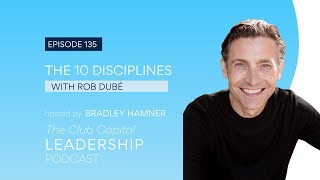
In this Club Capital Leadership Podcast episode, host Bradley Hamner interviews entrepreneur and energy‑management coach Rob Dubé about his "10 Disciplines" framework for maximizing personal and professional energy. The conversation begins with Dubé’s origin story – starting a business at 14, selling and buying back his printer‑copier company Image One, and partnering with Gino Wickman (EOS) to create the 10 Disciplines program. The bulk of the episode walks through each discipline, offering concrete habits and mind‑sets for small‑business owners and leaders: 1. 10‑Year Thinking – shift from short‑term panic to a long‑term vision. 2. Take 130 Days Off – deliberately schedule full days away from work to reset mental clarity. 3. Know Thyself / Be Authentic – operate as your true self 24/7 to conserve energy. 4. Be Still – daily 30‑minute silence (meditation, prayer, journaling) to cultivate flow. 5. Set Work‑Hour Boundaries – define a weekly hour quota that matches your optimal value‑add. 6. Say No Often – assess opportunities against your boundaries; practice graceful refusal. 7. Avoid $25‑Hour Work – delegate low‑value tasks to free up high‑impact time. 8. Prepare Every Night – review tomorrow’s plan before sleep to reduce anxiety and prime the subconscious. 9. Put Everything in One Place – consolidate ideas, commitments, and tasks into a single capture system. 10. Be Humble – adopt a gratitude‑driven, ego‑less stance to attract like‑minded collaborators. Throughout, Dubé shares personal anecdotes (e.g., his 5 AM routine, using Uber time for work, tracking days off) and practical tips (e.g., weekly awareness check‑ins, using a legal pad or Remarkable tablet). The episode also contains sponsor reads for DirectClix, Coach P Consulting, Club Capital, and Rock Solid Virtual Assistants. The host reflects on his own takeaways, emphasizing longer‑term vision, disciplined rest, consistent morning routines, saying no, and consolidating his note‑taking tools. The episode ends with a call‑to‑action to visit the10disciplines.com for more resources and a reminder to share or review the podcast.
Chapters
So the big question is this: how do small business owners like us grow our leadership, develop our teams, and scale our business in a way that allows us to get our products and services out to the world yet still remain profitable?
That is the question, and this podcast will give you the answers.
I'm Bradley Hamner, and this is the Club Capital Leadership Podcast.
Hey, before we get into today's episode, did you know that Club Capital is the largest accounting advisory firm for insurance agency owners in the country, providing monthly accounting, CFO services, and tax preparation.
Check them out at club.capital.
Welcome to another episode of the Club Capital Leadership Podcast. My name is Bradley Hamner, your host. On today's episode, we have Rob Dubé. You know, I do say often that I really love today's guest, but this one, I don't know, it spoke to me. I really enjoyed learning about the 10 Disciplines. He walks you through and our opening about kind of his background and his origin story. But if you're a leader, if you're an entrepreneur, small business owner, which I know obviously many of you are, I think as he goes through the 10 Disciplines, if you're much like me, you'll see some areas that, hey, I think I'm doing okay there. I've really worked on that. But then you're going to find some areas that you can really improve and maybe recommit yourself to some things. And so I think you're really going to love this episode. It really spoke to me. Without further ado, here's my conversation with Rob Dubé.
Have you ever tried online marketing before and weren't sure if it was working? Maybe your rep talked about all the impressive features and stats and said things were going great, but you didn't know how all that tied into raw new policies written. Well, that's not the case with DirectClix. DirectClix is the premier Google Ads and SEO option exclusively for State Farm agents.
Why?
They're 100% results-oriented with an exclusivity guarantee. Every review call you have with your account manager focuses on what really matters to your business, and that's leads and call-ins received. Everything will get broken down to cost per lead received. By investing with DirectClicks, you're going to free up time and energy to focus on what's most important in your agency and doing what it is you do best. This will be the best investment you make for your team by spending confidently and scaling your agency today with exclusive online marketing partner DirectClicks. Visit us at directclicksinc.com. Ambition is the first step towards success. It's time to level up your agency, and Coach P Consulting will help you do just that by using the same strategies he used to sell over 700 life insurance policies in 2021 alone. Now, this is not your regular one-and-done type coaching. You'll get personalized coaching 2 days a week, every week of the month, and you'll get a live look behind the scenes of his team training and an office that's performing at the highest level. There's a reason Coach P Consulting is the fastest growing coaching company for insurance agency owners in the country. Coach P will train your team alongside his own and show you the exact steps they are taking to achieve Chairman's Circle, Exotic Travel, and Multi-Line Presence Club and be one of the few agents to be selected to have a third office. So whether your goal is to be at the top of your local market or amongst the best in the country, this training will give you the strategies and the tactics to get there. For just $250 a month, you'll get high-level coaching each week from someone who is already getting it done at that level and his strategies work, and it's time to put them to work for you. Sign up at coachpeteconsulting.com and get your first full month for free when you mention the Club Capital Leadership Podcast.
Rob Dubé, welcome to the Club Capital Leadership Podcast.
Bradley, thank you for having me. It's an absolute honor. I'm grateful for your time.
Oh, we're grateful to have you. We love to start with background and origin story. Just love to hear the journey that people have had in their life and kind of how they got to where they are and the experiences that have shaped them. So why don't you kind of take us back in time and bring us to present day?
Sure, sure. Well, the entrepreneurial bug bit me when I was 14. I started a business with my best friend, and in high school we started selling Blow Pop lollipops out of our locker. And then we'd have all these businesses all through high school and college. And when we graduated college, we started the business that the two of us still own today, although we don't run it. And that's called Image One. Along the way, in 2004, the two of us sold the business to a public company, and we had the unique, uh, opportunity to actually buy it back in 2006. And so we had that experience, and when we bought it back in 2006, we put all of our focus and our energy into taking our culture to a whole nother level. So that's, uh, what we've somewhat become very well known for in an industry that probably isn't, um, the most sexy industry in the world, which is selling multifunction printers and copiers. So, um, in 2020, we created a succession plan. Uh, we put a CEO in place, and I partnered up with a person by the name of Gino Wickman, who created something called the Entrepreneurial Operating System, uh, or EOS. And he is also, uh, the author of a book called Traction. And the two of us, uh, partnered together and created something called the 10 Disciplines for Managing and Maximizing Your Energy, which is a and coaching program for people who have mastered their outside and they're ready to begin mastering their inside.
Oh, I love it.
I love it.
All right. We're going to dive into The 10 Disciplines, but I do have to take you back. I remember a few years ago telling someone, you know, the problem with business is that you never get a pit stop. And you're trying to— you're going 60 miles an hour down the freeway. You're trying to go 75. But you never get a chance to pull over, take a breath, do a pit stop, you know, change the oil, do all those things, because business kind of keeps going. But you actually had a situation to get to do that, right? You, you walked away from the business, then you had a chance to buy it back. So I'm actually curious, how valuable was that? Because I actually know a few people that have done something similar. They started a business, went and did something else, and then came back. And to a person, they've said It was the best thing ever because I was able to see more clearly whenever I stepped back into it. Can you just talk about that?
Yeah, well, my experience was a little bit different in that we didn't step away. We actually had a 3-year employment contract, but I did learn to see more clearly. And what I saw clearly is I never wanted to be part of a company that operated like that ever, ever again. So I saw the light and, and they were wonderful people, but it was not a situation that my business partner and I were made for. And so that helped us see really clearly, and it really helped us start to think about what might be next. And we didn't realize we'd have the opportunity to buy our company back. So we did begin kind of thinking after our 3 years, what might we do next and how would we do things a little bit differently? And certainly culture was at the forefront. And there's a great book that was a big influence for us, and that book's called Small Giants, companies that choose to be great instead of big, but it doesn't mean they aren't big companies. There's a lot of companies that are considered small giants that are quite large, but it was all about being great first, and that had a big focus on people. And what I like to say is being lifter-uppers versus dragger-downers.
I love that. I love that. All right, so, um, we're coming out of I think literally an unprecedented time. I mean, it has been the most challenging time to be a business owner, founder, leader, maybe ever. And I don't say that lightly. I mean, coming out of a 2-year pandemic, now you're dealing with supply chain issues, you're dealing with labor shortages. My goodness, people are really challenged to find really good people right now across all businesses. You're dealing with inflation and etc. Leaders exhausted. Their energy is— they're not exhausted, they're completely depleted, right? And their energy has never been lower, yet they, you know, you— they press on because that's what, that's what they do as a business owner. Can you just speak to the idea that how important for somebody that maybe has heard, you know, I need to focus on my energy, but yet maybe hasn't done the things to do that they need to do, like even getting it in the mindset as to why this is so such an important thing for us to focus Well, you know, first of all, the kind of energy that I'm speaking of when we talk about the 10 disciplines, it's, it's an energy that swirls around you.
So you have to first be able to stick with me when I say that this isn't about physical energy, like when I get up, I'm raring to go, although that's certainly a wonderful thing to have. And, and there are ways to make that happen through just the standard things in life, like getting a good night's sleep and making sure exercising and eating right and you're hardworking and all those kinds of things. So, you know, but the— to back to, you know, getting back full circle to your question, it's important that, as you know, especially as entrepreneurs, like in the sorts of people that are listening to your podcast, that they put a focus on the inside, that they really build a foundation that gives them space in their life so that they can do that. And that's where that energy comes from. So when you go through these unprecedented times, and there'll be further challenges in the future, hopefully not quite as heavy as they may feel today. But what we like to do is get you in a state of what we call FLOAT, and we spell that F-L-O-W-T. And that's where you are in flow, but in a way you feel like you're floating. And floating doesn't mean that you're off in la-la land and nothing ever bothers you. What it means is, as things come your way, the goods and, and the not-so-goods, uh, you have a unique ability to just roll with it. And just understand that that's what's happening in this moment. I can handle what's happening in this moment, and it's just a thing that I'm dealing with. And when they're good things, it's really easy. But when they're things that— like supply chain issues is a great example. When there's supply chain issues and you can't deliver product to your customers, like one of my businesses, Image One, we literally have orders that we can't fulfill. So what are we going to do about it? You know, let's keep that good energy swirling around us because that's just a better way to be.
Um, I have a client that would use the term, you know, sometimes I just get wrapped around the axle, you know, and one thing perpetuates another, perpetuates another, and he gets wrapped around the axle and he realizes he's working to realize that you know, the way that he gets whenever problems— and he only begins to see more problems, right? He's just scanning for all the bad things that are happening. And I think that really what I get to is this idea of just being emotional. He's just emotionally reactive constantly to the things that are happening, as opposed to being at such a place in his life of calmness that no matter what comes, he's going to address it. He's not sticking his head in the sand like a flamingo.
—right—
we're able to actually address these things and see them for what they are and see it as the opportunity. Yeah, yeah, absolutely.
You know, I think some of the things that can give us a little bit of peace is starting by having a focus on what you're going forward to in the future, like a 10-year thinking. And that's one of our first disciplines, it's 10-year thinking. So we get caught up in short-term thinking And what we want to do is shift our mindset to 10-year thinking. So with everything going on right now, it can really drag you down. But when you know where you're going in 10 years, you've got time. There's no rush to get wrapped around the axle. You know, you can kind of take a step back and say, hey, stay the course. You know, this, this will all straighten itself out. And I know where I'm going in 10 years. So stay focused, make tweaks along the way, because you're going to have to. But you know where you're going and you're clear about it. And there's such power in that. You know, the other thing, and I'm kind of jumping into the 10 Disciplines a little bit, so stop me if this is not where you want to go with it. No, this is great. Yeah. But, you know, as far as getting wrapped around the axle, you know, we really do need to give our mind and our bodies a break. So in Discipline Number 2, we encourage people to take time off. And in the way we encourage them to do that is actually to take 130 days off per year. And not think about business the entire day, which means not checking your email or checking in with your office, letting your clients know you're not available, as well as not reading business books or trying to, you know, up your business game and learn from that standpoint. It's about seeing what else life is all about and really, again, allowing your mind to get clear of all that. And what happens is when you come back from those times, you have a clearer mind and you don't you don't so quickly get wrapped around the axle or go down the rabbit hole or however you want to say it. Um, and just if 130 sounds like a lot, a couple things I always like to share. If you just took every weekend off, every US holiday and about 3 weeks vacation, you're darn near 130 days. So, you know, if that, if that takes a little bit of the overwhelmingness out of it for people, you know, take a bit of solace in that. But even weekends these days, entrepreneurs are always on their emails checking and You know, they could be out at their kids' ballgame and they are on their phones. So, you know, we really encourage you to let it go. Another thing that can be really useful, and this is discipline number 3, is to know thyself. And this is where we encourage you to be yourself 100% of the time, 24/7, 365. You know, it takes a lot of energy when you are not yourself. And oftentimes we hear from people, that, and they proudly share that they are like chameleons. You know, they can go into any situation and fit in. And I understand the thinking around that. You know, you want to be able to relate to people and have people, you know, relate back. But there is kind of a funny thing that happens when you're doing that is you aren't truly authentically you. You know, it's like when you're though, when you're around those who you're closest with and you're your silly self or you're your introverted self or whatever it might be, that's who you are. And actually, people appreciate authenticity. And I know this doesn't come as a surprise to your listeners, but it's worth saying, you know, don't forget, you pick up on other people's inauthentic personalities, you pick up on it. And so they'll pick up on yours as well. So just be you. We like to say, let your freak flag fly, you know, be, be your goofy you, your serious you, your whatever you People will appreciate you for that. Oh, that's so true.
That's so true. You know, working backwards on that, you know, one of the things that this podcast has really challenged me on just— and really, I don't think it's a person. I think I just have felt compelled to just try to share some of the things that I've really screwed up with and the mistakes that I've made. And to do it in such a public forum is— can sometimes be very intimidating. Right? Because it's easy to want to put out, you know, what we accomplished this, or we did this, or whatever. And you— but the reality is, is people connect a lot more to the failures. And whenever you're authentic to say, I don't really know, I never figured it out, you know, this is the mistakes that I made. I mean, that was a hor— the fact that I actually— if you would in 2015 told me that I would be a host of a leadership podcast whenever my leadership was absolute crap I mean, truthfully, I mean, and I was reading the books and I was trying to do all the things, but I was a horrible leader. I mean, I was a horrible leader. My culture was terrible. And looking back on it, I was pointing the finger at everybody else about why my culture was terrible. And the reality was like, it was me. I was a terrible leader. I was emotional and I was overreactive and I changed all the time and I switched everything around. It was not not good at all. And then the other one that you mentioned is, I think what really stands out to me about the, the taking the time off is with the 130 days, is I bet a lot of people listen to this, they would say, how many, how many days did you take off in 2021? Or how many of you year to date in 2022? You have no idea. That's right. The fact of actually tracking, somebody's listening to this saying, I don't know how many days I actually have taken off in the definition of the way that you have it laid out, right? Which is really totally different versus I went on a trip, but then I was listening to business podcast every morning or reading business books. That, that doesn't count.
You got it, you got it. Tracking it is so powerful, um, because it really tells the story. You know, if you do it in your business, by the way, I'm sure you have a scorecard and whatever the key metrics, you're keeping track of it, you know. And so taking time off is a key metric for you in your life, and it helps reenergize your mind and your body. It's just so powerful.
Before we move on to some of the other disciplines, I do have to ask somebody, because I would have said this a long time ago for sure. This would have been me. I've been listening to this saying, yeah, but, but here's the difference. I love business. I love business. I love listening to podcasts. I love reading books. This helps me to relax by doing these things and reading these books. Like, that's somebody.
Somebody is thinking that. Many people are thinking that. I hear that all the time, and I believe them wholeheartedly. I know they love business, but we have to take ourselves away from it. We have to do it. And there's a life beyond business that we're missing. And there may be many things that you would love, but you have no clue you would love them because you never took the time to try them. And some of those are, you know, this might hit kind of hard for some people, but some of those things have to do with being with your family and fully present in the present moment with them, not being at the kids' games and being on your phone and actually fully present with the boredom of watching the ball game or whatever it might be, you know, and really taking it all in. And, you know, that's just one illustration of the many, many things that we're only half in on in our lives. And this is about being all in, in the present moment with whatever you're doing.
All right, so we've gotten through 3.
Let's go, let's go through the other ones. So the 4th discipline is be still, and this is where we encourage people to sit in silence for 30 minutes every day. And this can make its, make its way in many forms. Some people will sit for 30 minutes and do prayer. Some will sit in meditation or contemplation. Others will journal. Some, they might just stare out the window. Somebody shared with me recently that they, they look out the window at a large willow tree that have in the backyard, and they just watch it swaying in the wind. And so whatever form that takes for you— for me, I have a meditation practice. So whatever form it takes for you, find it, and just find yourself in a seat, whether it be, you know, a chair or on the floor, whatever is most comfortable for you, and sit in silence for 30 minutes. And, you know, some people feel a little overwhelmed by that. So you can And obviously start slow like anything. You could try 5 minutes and go up to 10, 15, etc. But here's something to consider. There's a great quote by one of a best-selling author by the name of Anne Lamott, and she says, my mind is like a bad neighborhood. I try to never go there alone. And so I often wonder if one of the things that's challenging us to sit in silence for 30 minutes is subconsciously, or maybe consciously, we're concerned at where our mind might go. And because it goes to painful places sometimes, sometimes it goes to very joyful places. The more you do it, I think it does end up there. But you know, these painful things could be that interaction you had with a team member or an employee last week and how you handled it so poorly and it just hurts so bad. Like you didn't wanna think about it anymore. Could be a customer interaction that you had or a deal that you lost. It could be other sorts of things. It could be traumas in your life, quite frankly. It could be anything. It could be your to-do list that you're just so overwhelmed that you sitting there is making you uncomfortable. The question is, is, is that 30 minutes going to change everything for you? Meaning not addressing your to-do list. What you get from it is you get another recharge. You know, we need to slow down in a different way than sleeping. We need to slow down and let our thoughts just flow go by like clouds in the sky and just connect to something maybe bigger than us, so to speak. And that again takes many forms for many people. And whatever it is for you, it will re-energize you and you will be— after that time, you will feel more calm and more peaceful. It's across the board. We see it every time.
Are you an agency owner looking to grow your revenue, increase your bottom line, and better manage your taxes? Club Capital is here to help. Club Capital is the largest accounting and advisory firm for insurance agents in the country, providing monthly accounting, tax strategy, and CFO services. Way more than bookkeeping and your everyday run-of-the-mill tax prep, Club Capital is focused on providing financial and tax advisory services that help you plan and forecast your agency's performance. Their financial dashboards and agency forecasting tools help you better understand your agency's historical performance, create and measure future targets, and see how your agency compares to your peers around the country. Imagine what it would be like to understand the impact to your bottom line when deciding to hire a new employee, or forecast the impact rate changes or commission rates will have on your business. With over $200 million in tracked annual revenue and $140 million in tracked annual expenses, Club Capital has the data and the team to help you make better informed decisions for your agency. They will help you turn that back office stress into the backbone of your agency's success by giving you the tools to take your agency and your leadership to the next level. Visit club.capital today to book a solution overview with one of our business consultants. Club Capital— way more than a CPA firm.
Have you read 5 AM Club by Robin Sharma?
I haven't read that, but I'm curious. Tell me about it.
So it's one of those books that sat on my shelf. I ordered it. I think, uh, who recommended it, I don't know. You've mentioned a couple books, I'm like, they'll be in my Amazon cart in about 20 minutes, you know. But, um, well, I say that and that is true, but I've actually gone back to some of the books that I've read before and tried to go deeper in books this year versus— great. It was just even a couple years ago, it was on this podcast, I mentioned that I read 36 books in the year because I'd set that as a goal. Well, there's nothing wrong with that goal. I'm getting to a point here, but But in the end, I found myself, oh my gosh, I've got to read 36 books. Like, I've got to finish these books. And so I was just powering through books just to, just to be like, that's, that's 27, that's 28, that's 29. And I wasn't really absorbing the information, um, versus, you know, these are the books that have really had an impact to me. And so I really am being more selective about the time that I spend in a book, and I'm more willing to, if this book is not connecting with me, to put it down. Because I used to be like, no, I started the book, I'm going to finish it because you know, that's what you need to do. But ultimately, 5 AM Club was a book that sat on my shelf and I picked it up and I— it was totally different. So I actually thought it was going to be a 250-page book on the benefits of waking up at 5 AM. I mean, really, that's what I thought. I mean, it sounds logical, right? Well, it's actually written in a fable format and that is, you know, if you're familiar with Lencioni's book, sure, yeah, that way. And so it's very engaging. And so if you've not picked up that book, definitely do it because he does walk through some frameworks I will say that I think he drags the story out a little bit long, but the message is so— he does such a good job around effectively this one thing, which is get up early and then spend time, right, being quiet, exercise. They kind of have a 20-20-20 formula, so I won't really spoil it. But one of them is that thing, which is meditation, prayer, being still. And that's what made me think about that. Yeah, yeah.
I love that. I love that. You know, mornings are my favorite times. I happen to get up at 5 AM. One of the reasons when you mentioned the name, I, I thought, I wonder if this has to do with a good morning routine or something like that. And I do, I get up, I do meditation for 45 minutes, and then I, uh, do journaling and, and gratitudes, uh, for about 10 minutes. Um, and then from there I get something neat. I try to read something that's impactful for me, and then I'll do some stretching or yoga or a little lightweight work, and then I'll go off and I'll do a run for about an hour. So the whole thing takes me about 3 hours, and I love the mornings, you know. I really get my head clear and I feel a lot of energy as I move into my day and a lot of clarity.
Can you, um, before we move on, so I have had interviewed a lot of people on there. I've read books about morning routines, and it kind of is around a morning routine, that book. And then other ones, the Miracle Morning for Entrepreneurs is a good one by Hal Elrod and Cameron Herold wrote that one. Well, can you just speak to the benefit of doing it over a long period of time? Because I know we can get kind of fired up as an entrepreneur about something. Yes, this is what I'm going to do. Rob has inspired me to do this. This is what I'm going to do. But you really almost don't see the benefit of it until you've done it you know, for a month, like every day, getting up over a long, you know, doing those things every morning. That's when the real beginning of change starts to happen.
Yeah. Yeah. You know, you've said it, and I don't think I'm going to share anything new that anybody listening doesn't know. And any routine or anything that you— that's a discipline in your life, you know, it just took time to get it incorporated into. So you make the commitment and then you spend, you know, 30 to 45 days or 90 days or whatever it is that the formula is to create that habit. Or whatever, and then it's just second nature. But, you know, sometimes it requires making a change in your life, you know. So for example, if I'm waking up at 5 and I want 7 hours of sleep, I got to be asleep by 10, asleep by 10, you know. So that means I got to be like ready to kind of wind down at 9:30, etc. So, you know, that means I'm not out late, you know, with— in socializing. I, I had— that's a, that's a sacrifice, I guess you could, you could say. And I have to make it up in other ways if important to me. So, you know, you just have to decide what's most important to you if you want to have that kind of routine.
Netflix just has to start at like 8 or 8:30 and not 9:30, right? Right. That's right. That's right. And if you're binge-watching something, you're gonna have to start at 7. That's right.
Or, or, you know, just imagine like maybe you have to miss a day of it, you know, like no Netflix tonight, you know, you got home too late or whatever.
It's All right, we're almost halfway through.
Yeah, yeah. So the next one is know your 100%. That's discipline number 5, and that's for you to decide on and commit to the perfect number of hours per week and weeks per year that you're going to deliver value to the world. So whatever the number is, for some people it's 30 hours a week, others it's 60. And so you pick your perfect number. This takes some tweaking, but the important thing to remember here is a couple things. The first is, this is where if you go 1 hour too, too much, you almost feel like you're on the verge of, of burnout. So, you know, you— 1 hour too much, you're on the verge of 1 hour less, you kind of feel like, I got more to give, like I'm not ready to call it quits tonight. So you kind of, kind of really work with what your perfect number of hours per week is and then set your boundaries. Start looking at everything that you're doing, and ask yourself, is this where I bring my true value to this world, uh, to this organization that I'm running? And anything that doesn't fit in there, you got to figure out a way to get it out of there. And it's not everything at once. Take it in, you know, bite-sized pieces, like everything, little steps at a time. But begin to move all those things outside your, uh, outside of you, and then you can work on the things that matter most. Within the boundaries that you set. Let's just say it's 45, 50 hours. You know, I'm trying to think of a typical entrepreneur, 45, 50 hours, and everything you're doing, just ask yourself, is this true, the best value that I can bring to the organization and/or this world? Hmm.
How often should someone consider a reevaluation of that? Meaning their circumstances in their life has changed. Kids have gotten— they've moved to a different tier. They've sold a business, they've added a business, they've bought a business, they've started another location, right? I mean, those things happen. When— how often should I be considering, this is what it was, now I'm going to make the change?
It's always something open for discussion. I think you should always be paying attention, have your awareness up— what's working, what's not, what adjustments do I need to make. Kids are a great example. You know, when I set my boundaries when my kids were younger, I actually used to wake up at 4 AM, so that was so I had— I could— I had my boundaries, but I had to get certain things done before they were awake, etc. So by knowing where you are in your life and how you can fit in the things that matter most, that's where you set it. And then as things evolve, as things change, you start to shift. But it does take awareness. Something I always like to recommend is, you know, when you're preparing for your upcoming week, if you do that, which I highly recommend, say like on Sunday or, you know, whatever day on the weekend, but Sunday is when I see people doing it, man, takes like half an hour or something. Just wrap your head around what's going on and start to use that as your time of awareness. What's working? What's not working? What do I need to stop doing? What do I need to be doing more of? And you're— so you're constantly tweaking, constantly tweaking. That's, that's really good.
That's really good. Yeah, I would say that when I, when I really recommitted to getting up at 5 3 months ago or so, because it was intermittent. That's what it was. I mean, I, I was not doing it consistently. Um, I began to, after I went through my routine, um, of what I needed to do in the morning, of journaling. So I have a 5-year journal that I write in, um, and it's like 4 sentences, which that's enough. I'm usually used to talking, not writing. So I can write 4 sentences, it's not— that's not too bad. Um, and then I'll spend time in prayer. And anyway, so I'll go through my whole routine. But then I noticed is that usually I've got another hour of there that was absolutely critical working time because I'm not distracted with my phone dinging and other things that are coming throughout the day. And so I wasn't missing— I'm not missing time with the kids at all because they're not up. But man, I've got— that is some really good— that's some of the best work that I do is in the morning after I've kind of gone through the normal things of the morning to renew myself because I'm so clear and I'm not distracted. But that was a totally different routine than it was 6 months ago. In fact, 6 months ago I couldn't have done it because of the way that things were structured in my life. I love that, kids.
Yeah, I love it. I mean, you're constantly evaluating and things will change too as your kids get older. Your routines will change. Yeah. Yep. All right, 6. Discipline number 6 is say no No, often. So say no to anything that doesn't fit in those first 5 disciplines. And saying no is really hard for a lot of people, actually. We, we have— we, as part of our program, we actually take people through kind of an assessment of how well they say no, and most don't do very well. Um, if you're familiar with some of the profiling tools, uh, there's one called Enneagram, and, uh, my profile is I'm the helper and the achiever. So if you ask me as the helper, I want to say yes. So that's my default. And as the Achiever, I want to help you times 10. So I'm going to put everything, all my energy into it. So I have to be very careful about what I say yes to, because when I say yes, it's going to take me some time. I'm going to be, you know, I'm going to be involved because I'm all in on it. So, you know, in a few things that come up when we share this with people, the first one that we see a lot of times is, uh, and by the way, there's books written on saying yes to everything, and that's where I'm segueing to, you know. Sometimes people feel like, well, this could be a great opportunity, you never know, and those kinds of things. So there's another one where you need to have really strong awareness. Pay close attention to those meetings that you take, as an example, and your energy. And if you're asking yourself, why did I take this? Why did I take this meeting? This was, this was not a good usage of my time. So start paying attention to your, your wins and losses, so to speak, and look at your percentages. So that's a great one. FOMO is another one. You know, you were— we're afraid to miss out on something because we didn't say yes to it. Helping others and maybe even being involved in the community— this is a tough one for people. I always like to share a story that, you know, sometimes people, they've worked really hard in their career, and, and a friend introduces them to the executive director of this really great nonprofit, and they're looking for a new board member. And they— the executive director calls up and says, we'd love for you to join our board, you're an amazing person. Oh my gosh, it makes your heart so warm. You've worked so hard, you deserve it. And commit to it, and the next thing you know, you got a monthly rhythm that's taking up half a day just to get to the board meeting, to be part of the board meeting, to get back, and you're preparing for the board meeting because you want to show up and be prepared. So really ask yourself, what am I getting myself into? Be really thoughtful about it. And then if it doesn't line up with what your values are and what your boundaries are then say no, but you can do it gracefully. This is another place where you can really be of service. So think about how you might be able to help the person. So let's just use that board, um, ask. Maybe you say, you know what, this isn't going to fit for me at this time in my life, but I know somebody for you. Let me make an introduction via email if you're up for that. You could do those sorts of things. So just always be thinking about, how can I help this person? That extra 15 minutes that you take to help the person will, will pay great dividends, and you will save endless hours that you didn't realize you were wasting until you stopped saying no. The last thing I'll just say is, if you start saying no to 25% of the things you've been saying yes to, you're already going to save a ton of time. So just try 25% of the time, 1 out of 4. When you're about to say yes, say no do it. See how much time it saves you and how much energy you get back from it.
The best use of money is to buy back your time, and one of the best ways to do that is with a virtual assistant. Rock Solid Virtual Assistants brings together top business leaders with exceptional virtual assistants to build successful relationship-driven teams. The services they provide range from graphic design and marketing to executive admin assistance assistants and everything in between. There are many virtual assistant companies on the market to choose from, but at RockSolid, their processes and passion for what they do place them at the very top of that list. Not only is their hiring process exceptional, which nets them the very best assistants, but they also provide superior support to their teams for the duration of your time with them. The matching process at RockSolid is unlike any other, and they have the track record to prove it. Their hands-on approach has proven to increase the success rate of their teams exponentially. Professionally. So if you're looking to build a rock-solid team for your business, reach out to Tracy and the team for a no-pressure discovery call at rocksolidassistance.com. They value your success as if it were their own, because it is.
Folks, we're having an intervention right now.
Bradley, you're another one of the say yesers.
You know, I've heard somebody say that I'm— they're, they're a— they, they are a recovering people pleaser. I need to go through a 12-step program not to, you know, uh, seriously, this is a— I'm terrible at this. I'm so terrible at this. I've, I've, I was— I've been president of the, uh, pool, recreation pool, uh, that we— in the neighborhood that we live in for the last 3 years. Got roped into that. I'm on the booster club at my kids' school. And listen, I love, I love doing that, but yeah, it end up taking a tremendous amount of time with those. And so it is really hard to say no. And I know people listening to this because, look, you've been successful in business, you've donated to those causes, and those causes mean something to you. Like, that neighborhood pool is really special to our family. And so I, you know, have visions of things that we want to be able to do there to support it. And so you want to be able to make an impact, and that is a really challenging thing. The thing that stood out to me, though, based on what you said the most was how does it relate to the boundaries I have set? Which means that I have, have, I have boundaries set and then I can put a mirror up to it and say, okay, well, actually, given the boundaries, I do have the bandwidth to make this happen. I can say yes to this board. I can say yes to— I think the board is such a great example because I mean, that one hits home. To me. Okay, thanks.
That was good for me. That was, that was free coaching for Bradley.
Number 7.
Uh, number 7 is don't do $25 an hour work. So simply stated, don't— never do anything that you could pay somebody $25 an hour to do. And let me preface that by saying $25 an hour work is really, really important people, uh, work, I should say. And there's amazing, amazing people that are doing that work. They want that work. They're great at that work. But in your audience is— are people that really aren't $25 an hour work people. And so you— when you look at the activities that you're doing on a day-to-day basis, take— do this as an exercise, and it's going to take a little time. It's going to slow you down. But look at what you're doing and put a pay scale next to it and see what pay scale you're at with this kind of work that you're doing. So for example, if you're going through your emails and cleaning up all the junk that's coming through, is that $50 an hour work or $100 an hour work or $200 an hour work? The kind of work that, you know, people in entrepreneurial positions are working towards, or is it $25 an hour work? And then you have to ask yourself, should I be doing this? And likely the answer is no, it should be no. And you delegate that out, and you maybe you find somebody who can help you with that, and now they take that over for you, and that's going to create more energy for you. And then you're going to be doing the things that matter most in delivering your true value in this world. And it also goes for things in your personal life. You know, I used to mow the lawn when I was in my early 30s, and somebody told me I could actually hire that out. And I dreaded doing the lawn, and it took me half the day to do it, and I wasn't any good at it Anyway, and I wouldn't be with my kids. So you can— people know this, you hire that out. So, you know, those are just two examples, and there's many, but you will get a return on any investment that you make on this. Okay, so you're— you are going to probably be paying for— to delegate some of these, um, some of these activities. The investment is going to return, first of all, in greater energy. More freedom, more creativity, more impact. That's what you want. Trust in yourself. And by having more freedom, creativity, and impact, I think you're gonna get a hard dollar return on your $25. Maybe your $25 investment's going to turn into $100. Okay? And everyone's taking that one all day long. It's just sometimes you can't see it at the beginning. You start to see it over time.
I, I completely— I mean, I agree with all of these. It's good we went from one, number 6, I was doing terrible, to this one I've leaned into more and more and more. So I, uh, 2015, '16 or so, I hired my first assistant, but it was a full-time assistant, and I did not need a full-time assistant at time. Okay, I mean, I can— I know all the logical thinking that I had about why that made sense, but I didn't need it. Now the team that puts not only the podcast but everything together are fractional team members, and what they get done in 5 hours a week, in 10 hours a week, in 12 hours a week is so much more than I could ever begin to imagine. And that— and I know this is not a discussion around an EA or a VA, etc., but it definitely kind of begins to lend itself to that, right? And so if you've not, you know, people will know intuitively, intuitively, I need to focus on my IPAs, my income-producing activities, right? They're like, I get that. But the reality is you're not going to be able to have enough time to do those kind of things. The only things that you can do— Dan Sullivan calls it your unique ability.
That's right. That's right.
You're not gonna be able to do it unless you've taken the shackles off of the things that you're doing, such as your email and scheduling. I mean, Rob, honestly, like, I, I would have been the world's worst trying to schedule you and I, like, on to make this happen. Like, I, I'm not good that, you know, because I would have overcommitted myself. I would have had 13 podcast recordings in a day, you know, because like, oh sure, why not? Let's get them all done in a day or whatever. And I would have been completely depleted doing that and stressed going into it. And so that's kind of an example. I completely agree with this. And I think that technology, VA companies, the advent of companies like Upwork, etc., that can help with this has allowed— there's just no excuses. What I'm getting at as to why an entrepreneur wouldn't do this.
Yeah. That's right. And let's, let's end on this one with one more example, because I think it's a powerful one that'll shift people's mindset. Maybe they'll see things through a different lens. How about driving? I know somebody who, who Ubers everywhere they go. Okay, so they're on the East Coast, and they, they, they go, they kind of go between Baltimore and Maryland, in the Maryland area and DC. Everything's about, because of traffic, everything's about an hour, hour and a half, half wherever they need to go. So they just Uber every place, and they use that time to sometimes catch up on sleep, sometimes do some work. They open up their laptop and hotspot it, make calls, all those kinds of things, and use their time at the greatest, you know, to deliver their greatest value. I thought that was a great example because most of us, we just hop in the car and we don't think twice about, I gotta drive an hour and a half, and it's a, you know, it's a waste of time, but I got to to do it. So there, there's another example for $25 an hour work. I love it. So let me jam through the next 3. Um, number 8 is prepare every night, and that's before your head hits the pillow every night, document the next day's plan. So simply stated, this one's very simple and powerful. Before your head hits the pillow, take a look at your plan for the next day. What's going on? And just kind of let it settle into your mind and as you— that'll give you a bit of peace of mind for the next day. You won't maybe wake up at, you know, 2 AM with your head spinning about what that meeting coming up or whatever. But a unique thing's going to happen. You're going to sleep better, for one. The second thing that's going to happen is your mind's going to be doing some work for you while you're sleeping. Your subconscious is going to go to work. You might even wake up in the morning, and as you get your day going, you might notice you have the answer to some of the challenges that you were dealing with for some of these activities that you are going to be, uh, having in this upcoming day. So just simply state it. It's like 5 minutes. Just look at your schedule, get really clear about what's up, and then let the rest take care of itself. The next one, number 9, is put everything in one place. And this is where you pick the one place, one place you're going to capture every idea, commitment, thought, action, freedom and promise. And so I see you jotting down notes as we've been talking. I imagine you might have a one place, but many entrepreneurs have many one places. They're, they're typing things in their phone, they're sending themselves email reminders or text reminders, they have Post-it notes, they have journals, they have whatever. They have a million places. What they don't realize is they're letting people down. They're letting people in their family down because they're forgetting things, their team members, their customers, their stakeholders. They're letting people in the community down because because they're all over the place. And I see this all the time with our clients. So just pick your one place and have it by your side each and every moment. And so when any of those things come along, an idea, commitment, or promise, etc., jot them down in your one place. My partner, Gina Wippen, he uses a yellow legal pad. I use something that's called a Remarkable. It's kind of like a modern version of a legal— you've got it too. Yeah, is that great? Yes. Yeah, you know, but whatever it is, could be Evernote on your phone or your laptop or whatever it At the end of the day, compartmentalize all these notes, get them in the right place. Hopefully you're able to delegate a lot of them off your plate, put focus on them for whatever it is that you need to, uh, do into the future. That is the highest gain activities. And so you, that way you will, uh, it will lessen your anxiety and stress because so many entrepreneurs have so much going on, they cannot keep it straight. Straight, and OnePlace will help with that. And then the last one is discipline number 10: be humble. View yourself as an equal to every person on this planet. What we encourage people to do is imagine a continuum where on one side of the continuum you are not humble at all, and I'm imagining most people who listen to this are not there. On the other side of the continuum is you are the most humble person ever. And so most people really aren't there either. So find out where you are and work towards— make it kind of a goal or a mission in your life to work towards ultimate humility and what that means, like just removal of ego, if you can imagine that. And when you begin to do that, you will start to attract like people, people that are also humble in nature. And when you're surrounded by people like that, the the world is just a better place. And one thing that we find in people who are humble is that they happen to express gratitude just about every single day. Very simple practice, but you can just, one, at one point during the day, think of one thing you're grateful for, and I'll bet you if you get going, you'll think of about 20.
It's pretty powerful, man. These are so great. I mean, I absolutely love I really do. I mean, I'm— Thank you. I'm not just saying that. I love all 10 disciplines. I think throughout that, many people would be like myself, that I go through the 10 and I think, man, I am really not doing very well in this one. But then the next one comes up and it's like, you know, I think I'm not excelling, but this is a stronger suit of mine. I've really worked on this area. And so I think that the idea is that I almost see it as like 10 balls. Like, how can I just move all 10 of them? Them, you know, not to try to get them all equal, but seeing it as areas because it becomes like a, I don't know, maybe a well-rounded, holistic entrepreneur, business person, just a, just a person, a better person all the way around. This has been great. People want to reach out to you, your team, like they want to connect with you. They want to go deeper on these 10 disciplines. Where would you point them to?
Thank you for asking. It's the10disciplines.com. The10disciplines.com. You'll find everything that you need there. Always love to hear from you, so don't be shy.
Awesome. Rob, hope to have you back on in the future. This has been awesome.
Bradley, thank you for your time and for all the amazing work you do. I really appreciate you. Thank you.
You know, I always try to give 1, 2, or 3— usually it's 3 key takeaways from that podcast. It's hard for me to come away with 3. I think there was just several things that really spoke to me on some of the principles I'll go through them quickly and just kind of give you my thoughts. You know, tenure thinking. I've heard recently somebody who I've really looked up to talking about the people— whenever he— the guy's worth like $50 million or so, had, had a ton of success at early career. Um, somebody I've really looked up to, um, has, you know, had a great impact on my life around business and the way he thinks. And he talks expanding his time horizon, when he thinks in longer, like in decades, even 20 years or so, how much calmer he is. And he says, you know, anytime he's around somebody that's like a billionaire— he apparently knows somebody that's a billionaire and has befriended them— how much of a longer time horizon they think versus just what's in front of them today, then this week, this month, etc. So that really stood out to me. I think again, the taking the time off and then measuring how much time did to actually take off, not just looking back and say, okay, I had this vacation. How many days did you really take off that were true free days, completely away from work? I think when he talked about being still every morning for, for 30 minutes. So this is an area that I did really recommit to recently myself, not just in getting up early, but what am I doing whenever I get up early? Because it's actually really easy for me to want to get up early get a cup of coffee. I love my coffee in the mornings. And, uh, pull up my laptop. That's the easiest thing to do versus being in my journal, being in my planner for the day. And I actually speak to that in a second, but being in my planner in the morning, writing down my gratitude, actually doing this on a consistent basis, not just saying, oh, it's a good idea. I do enjoy reading a book in the morning, also spending time in prayer. I'm a faithful person. I am a man of faith, I should say. And so I think that that is an important part of my morning routine. And as he said, that can look different from other people. So that's not one that I've licked by no means, but it's one that I'm trying to work through and staying consistent of what I need to do on a regular basis. And it, it's altering a little bit. Like, almost like the order in which I do things has, has kind of changed. I'll, you know, sometimes I'm just reading a book first, then other times I'm doing this. And so I'm trying to find exactly what's the right order, uh, for me. But like waking up and just going to the gym, uh, immediately first thing, that's hard for me. But for some other people I know, that's exactly what they do. Um, I think that, uh, the part where saying no often I mean, oh man, who said this? What you said yes to got you to where you are. What you say no to gets you to where you want to be. And that's so true, uh, that is so true. Being able to walk away from some things, um, I had to make some hard decisions in 2021, walking away, uh, from a few things that I was a part of. Those are big decisions, and, um, but then at the end of the day, they paid off. And sometimes it's not even making that saying no to such a big thing, but saying no to some smaller things that add up over time. I, you know, you heard me say on there, and I ended up talking about, you know, VAs. And, and obviously, if you are interested in doing that, you know, reach out to our podcast sponsor Rock Solid and, and just talk to them about that, because you really can level up in your leadership, and people can do things that you're just a lot better at, whether it's managing your email and scheduling. And those are the initial places to start, for sure. But so many other things that people are just better at, and it's not really the high-dollar things that you're getting paid to do to run your business. Preparing every night. So that is one thing that I have not been doing, is planning my day before it starts the night before. So I'm definitely going to take that. Putting everything in one place. Um, so I, just so you know, like, I, I have my planner that I love, is the Best Self Planner. Uh, I love that one. I've tried the Full Focus. I like the Full Focus one. I like this one better, the Best Self Planner. I do take all of my notes in a Remarkable. I really like the Remarkable. I know David Peterson, Coach P, has got one. Um, that really helps, especially in doing podcast episodes. Has been great for me. I love to use Notion. I used to be an Evernote user. Now I use Notion. Reason I say that, um, is I kind of realized I had like 4 major places I was putting things in. And I need to reduce that down. I enjoy still writing on a legal pad with some things, but I need to kind of rethink that so that I can put everything in one place because I kind of had everything in like 4 places. So that was a good thing for me to hear. And then hopefully around being humble, I mean it when I say, hey, I'm working to try to be honest and truthful and open with all of you around some of my failures and insecurities and things that I've been able to learn along the way. And so my hope is, is by doing that and just bringing people on like Rob, who are amazing, um, that we can bring out, you know, the genius in them and, um, you know, share with you, hey, here's the things I took away from that, and hope, hope that it's helpful, you know, to you. Um, you know, you wish in life that failure wasn't the best places to be able to learn, but for most of us it So those are some of my takeaways. Definitely more than 3, but it is what it is. As always, want to give a big shout out to our podcast sponsors. DirectClicks has been with us from the very get-go. So grateful for them. So awesome to see that the work that they're doing. Go to directclicksinc. I have spent— had communication just in the last couple of weeks with some people on their team and with Matt, they just know what they're doing. I mean, they really know this, that game. And you can spend the time doing it yourself and trying to set up those campaigns. I mean, you can, you can YouTube it, but just not having the perspective of knowing how to set it up, how to do it. It's just a better use of time for you to pay somebody who knows that game, knows your business, knows what you're doing, and can deliver high-quality leads to your agency, go to directclicksinc.com. You know, uh, I mentioned it earlier and obviously in the podcast, but when you're ready and you know that you've bought into that idea of not doing $25-hour work— and that's not in no means to— did it look like $50,000 job? It's $52,000 job if you multiply it times 2080 in here. Um, but you know, you're paid to do higher-level things, and you'd be amazed at what people can do at 10 hours a week, 15 hours a week for you and your business. Go to rocksolidassistants.com, just have a conversation with them, and you'll really see how much Tracy and her team care about your success and matching you with the right assistant. rocksolidassistants.com. You know, if you— if somebody charged $10,000 for a coaching program and they delivered $100,000, you know, in return in value, they tell everybody, if you charge $5,000 and you return $5,000, they're going to be a satisfied customer. I think the reason why David Peterson has grown so much in his coaching with Coach P is because of the difference in value that he— from what he's charging to what he's actually delivering. $250 a month for twice a week coaching, at least 8, like 8 times in a month, plus an agent-only call. I mean, you're just not going to get that, that level of coaching. This is quality information. Now you got to go do the work, right? He's not going to hold your hand. You got to go do the work. But if you really want to know, okay, how do I actually go from one office to 2 to 3, or how do I really grow and scale within my business? Course, you got to learn from somebody that's actually getting it done at that level. It's exactly what David is doing. Go to coachpconsulting.com and make sure you let him know that you heard about him on the Club Capital Leadership Podcast and reach out to him and his team. I think take him for a test drive. He'll let you come on the calls for an entire month for free. I mean, like, why would you not do that? Uh, we had a listener that had just contacted Club Capital the other day and is a sales leader and said, hey, we listen to the podcast and listen to it for a long time and reached out to talk to somebody on the team with Club Capital and said, hey, I'd like to kind of share, see what you guys can do to help my agents and been a loyal listener. So if you're out there and I'm speaking to you, appreciate you so much for picking up the phone and caring about your agents as much as you do to want to get them the very best in analytics and financial financials so that they can know their numbers and they can use those numbers to invest back in their business. You know, that's the thing is that I've mentioned about at times being able to make more money as the business owner and be able to take more of the chips off the table, and that's absolutely true. But I think in a lot of times too, I was just having a conversation with an agent about this, uh, two days ago, and we were talking about, you know, looking at the financials, seeing their financials to be able to make decisions is, can I afford this person? Okay. Yes, we know that the demand is there, that the need in the office is there. That was— I mean, that took 2 minutes to figure out. What was much harder was, okay, what am I going to pay them? Can I afford that? How much can I afford? Because it's one thing to say, okay, we definitely can afford $30,000 base, but can I do $45,000? Does that make sense to do $45,000? How does that all work together? And you got to look at the financials to be able to make some of those good decisions, because it would just be easy to say, I don't know, I'm just going to pay whatever it is, versus being able to actually see it in context to this is what we need, this is what the business needs, and this is also what the financials are saying that we can do. So you don't, you know, um, just get yourself tied in too much to too many things and get kind of overloaded with expenses. But it's important to have that, that that perspective of those financials. And that's exactly what Club Capital can do for you. So if you've not— you've listened to us for a long time and haven't reached out, go to club.capitalbookandnoobligationdemo. Jump on one of the webinars to talk to somebody on the team. Grateful for all of you. Thank you. If this episode was helpful to you, would you consider sharing it, maybe leaving us a review? It helps us to be able to get it out to more people. All right, everyone, till next week, lead well.
So the big question is this: how do small business owners like us grow our leadership, develop our teams, and scale our business in a way that allows us to get our products and services out to the world yet still remain profitable?
That is the question, and this podcast will give you the answers. I'm Bradley Hamner, and this is the Club Capital Leadership Podcast. Hey, before we get into today's episode, did you know that Club Capital is the largest accounting advisory firm for insurance agency owners in the country, providing monthly accounting, CFO services, and tax preparation?
Check them out at club.capital.










