Episode 172: Breakthrough Leadership Team with Mike Goldman
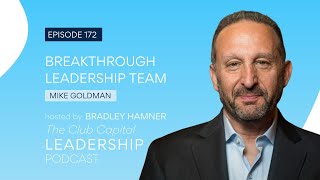
In this Club Capital Leadership Podcast episode, host Bradley Hamner interviews leadership‑team coach and bestselling author Mike Goldman. The conversation begins with Goldman’s career background and his distinction between leadership (guiding people) and management (handling tasks). He emphasizes self‑leadership as three pillars—focus, fire (motivation), and coachability—while noting the importance of an internal locus of control. The bulk of the discussion centers on building and structuring effective leadership teams: identifying core business functions, assigning functional accountability, measuring success for each function, and using a 12‑quarter forecast to anticipate hiring and resource needs. Goldman contrasts the numeric 12‑quarter plan with Cameron Herold’s “Vivid Vision” 3‑year narrative, arguing both are needed but serve different purposes. He critiques traditional annual plans and advocates for 90‑day “quarterly rocks” cycles. Execution is driven by three disciplines: aligning around a small set of priorities, measuring what matters with clear KPIs and dashboards, and maintaining a regular planning‑communication rhythm (daily, weekly, monthly, quarterly). The episode also touches on talent assessment (A‑, B‑, C‑players) and promotes resources such as Goldman’s book Breakthrough Leadership Team, his free video course, and several sponsor services for marketing, accounting, recruiting, and coaching. The overall takeaway is a practical framework for small‑business leaders to grow their teams, forecast growth, and execute consistently.
Chapters
So the big question is this: how do small business owners like us grow our leadership, develop our teams, and scale our business in a way that allows us to get our products and services out to the world yet still remain profitable? That is the question, and this podcast will give you the answers. I'm Bradley Hamner, and this is the Club Capital Leadership Podcast. Hey, before we get into today's episode, did you know that Club Capital is the largest accounting advisory firm for insurance agency owners in the country, providing monthly accounting, CFO services, and tax preparation. Check them out at club.capital.
Welcome to another episode of the Club Capital Leadership Podcast. My name is Bradley Hamner, your host. On today's episode, we have Mike Goldman. He's a leadership team coach and number one bestselling author of Breakthrough Leadership Team and Performance Breakthrough. He speaks internationally to groups of business leaders such as YPO and EO And during his 30-year coaching and consulting career, he's worked with clients like Disney, Verizon, Chanel, Polo. He's been in Forbes, Fast Company. My goodness, he has got a wealth of experience. You know, this podcast is the Club Capital Leadership Podcast, and we dive into all things leadership. If you're leading a team and you want to increase and become a better leader as we go into 2023, this podcast is for you. I enjoyed this conversation with Mike. Without further ado, here's my great chat with Mike Goldman.
Have you ever tried online marketing before and weren't sure if it was working? Maybe your rep talked about all the impressive features and stats and said things were going great, but you didn't know how all that tied into raw new policies written. Well, that's not the case with DirectClicks. DirectClicks is the premier Google Ads and SEO option exclusively for State Farm agents.
Why?
They're 100% results-oriented with an exclusivity guarantee. Every review call you have with your account manager focuses on what really matters to your business, and that's leads and call-ins received. Everything will get broken down to cost per lead received. By investing with DirectClicks, you're going to free up time and energy to focus on what's most important in your agency and doing what it is you do best. This will be the best investment you make for your team by spending confidently and scaling your agency today with exclusive online marketing partner DirectClicks. Visit us at directclicksinc.com. Ambition is the first step towards success. It's time to level up your agency, and Coach P Consulting will help you do just that by using the same strategies he used to sell over 700 life insurance policies in 2021 alone. Now, this is not your regular one-and-done type coaching. You'll get personalized coaching 2 days a week, every week of the month, and you'll get a live look behind the scenes of his team training and an office that's performing at the highest level. There's a reason Coach P Consulting is the fastest growing coaching company for insurance agency owners in the country. Coach P will train your team alongside his own and show you the exact steps they are taking to achieve Chairman's Circle, Exotic Travel, and Multi-Line Presence Club and be one of the few agents to be selected to have a third office. So whether your goal is to be at the top of your local market or amongst the best in the country, this training will give you the strategies and the tactics to get there. For just $250 a month, you'll get high-level coaching each week from someone who is already getting it done at that level and his strategies work, and it's time to put them to work for you. Sign up at coachpeakconsulting.com and get your first full month for free when you mention the Club Capital Leadership Podcast.
Mike Golden, welcome to the Club Capital Leadership Podcast.
Bradley, thank you. Looking forward to it.
Yeah, excited to have you. So we always start with background and origin story. Love for you to kind of bring people back through your journey and bring us to present day, how you got to where you are.
Yeah, I've had about a 35-plus year career, so, uh, I'll keep it high level or it'll take us a long time. But the first half of my career, right out of college, I went to work for some big management consulting companies— Accenture, if you're familiar with them, before they were called Accenture, that's how long ago it was, um, you know, in a company called Deloitte. So half my career was working as a management consultant with Fortune 500 companies, traveling all over the country doing that kind of work. And then right at about 40 years old, I said, I need to take a shot. You know, I'm tired of doing what I'm doing. I started losing some of the passion about it. So took a shot, started my own business, which was a— at the time it was a franchise office of a staffing and recruiting firm. Miserable failure for about 3 years. Doug, uh, me and my family, a pretty deep financial hole, but learned a ton. Um, and from there started doing workshops and getting back to my consulting, consultant roots, but more from a coaching standpoint. Started doing some leadership development type programs, and really over the last, uh, 10 or 12 years, it is much more strategic coaching, working exclusively with leadership teams. So it's been an interesting journey.
Well, this is going to be a great fit given the fact that our podcast centers a lot around leadership. And we end up talking about marketing, we talk about teams, etc. But I'm really anxious to ask this first question, which is usually I don't ask big broad questions like this. But when you think about leadership in business, how would you define that?
It's a great— it is such a broad question, but it's a great one. To me, leadership— and maybe what I'll do to make a point is I'll contrast leadership and management.
Yeah.
Maybe a good way to do it is, in my mind, you manage processes, you manage tasks, you lead people. And that's a very, very different thing. So if you're sitting down, did you do this? Did you do this? Did you do this? That's management. That's not leadership. Is there a time for that? Absolutely. Was it— one isn't good and, and one isn't bad. But to me, leadership is more about, uh, helping your people reach their potential so your company could reach its potential, so you can impact as many people as possible.
Who has had the single biggest impact on your own, your own leadership development in your career?
I don't know that I could pick one person. There's been, there's been so many, uh, you know, I have had been, been lucky enough to have a number of mentors over the year back in my days in consulting working for a, a partner, a guy named David Rips, uh, so You're welcome, David, if you're listening to this. But, um, you know, he was a partner who just— I remember one of the things he taught me, I was kind of a scrappy guy, wanted to win every argument. And one of the things he taught me was, uh, sometimes you got to lose the battle to win the war. And, and that taught me a lot. So, so it's been from back in my consulting, consulting days. I've had my own coach, another David. David Herdlinger has been my coach for the last God, 10 or 12 years, and he's been an incredible impact on me. Uh, leaders of coaching organizations I've been part of, and I'm lucky enough that I work with CEOs and their leadership teams. So I would say probably the biggest inspiration to me are those CEOs that are so good that they challenge me to be smarter all the time, man. How are they going to help? How am I going to help them? They're so good at what they do, and it challenges me to, to read more, learn more, practice more, experiment more. Uh, so it's, it's in a big way, it's been those CEOs that I work with.
That's a good segue to my next question. So we were talking before, uh, about football, and obviously we're in the middle of football season. You're obviously probably an NFL guy, a much more of a college, college guy, but When I had Cole Kubelik, who talks about— does games announcing for the SEC Network, for the SEC games, one of the things I asked him about that he's learned in managing or not managing but talking to these high-level coaches, Coach Saban at Alabama, et cetera, what's something that he's learned that we may not know. And he said, I think you would be surprised how much the teams spend on their self-scouting than they do scouting the other team, how much they analyze themselves about how they can get better. So it brings us parallel to self-leadership, okay? I mean, ultimately we're going to pivot and talk about leading teams and change and change management, culture, things like that. But I think we need to talk about self-leadership and mastering self-leadership. I love that, by the way, because I love the analogy of leading yourself first and putting your oxygen mask on first. But can you just speak to— because you were talking about those CEOs— can you just speak to the importance of self-leadership and being the best leader we can be so we can be the better leader for our teams?
It's so important that when I— and I coach leadership teams as a group, But when I do that, I, I always coach the CEO one-on-one in addition to working with the team. And I do that because if the CEO is not growing and scaling, the company's not gonna grow and scale. Mm-hmm. So it's critical, critical, critical that the CEO is scaling. In fact, when I'm talking to a prospective client, If I sense that the CEO is not coachable, there are ways to figure that out. If I sense the CEO is not coachable, I'm not going to work with the team and I'm not going to work with them. So it's really, really important. And, and, uh, you know, getting into a little bit deeper as to what we even mean by self-leadership, I tend to, to break it down into 3 things. One, and we could dive into these if you'd like, but I'll keep them high level for the moment. One is self-leadership is about focus. You know, how can you manage your focus? When we— everything starts with focus. It doesn't start with an action, doesn't even start with a feeling. It starts with how or what you're focused on. That drives a feeling. The feeling drives action. The action drives our results. So first and foremost, I believe self-leadership is about the ability to be proactive and shift or switch from a disempowering focus to an empowering focus. So, so one is it's about focus. If you can't proactively manage your focus, man, good luck. So one is focus. Two, I call fire. And fire is about— I call it finding that next dragon to slay? How do you keep that fire in your belly to conquer something maybe you're afraid to conquer or climb to the top of that mountain? So to me, self-leadership is focus, it's fire. And lastly, we talk a lot about— I talk to my leaders a lot about being good coaches to their people. But the first thing you need to be as a leader really at any level is you need to be coachable. Yeah, so part of self-leadership, so it's, it's focus, it's fire, and it's coachability.
That's really good. I mean, you mentioned it, I've said that on the podcast many times, never trust a coach who doesn't have a coach. I mean, if you're getting coaching and you're a leader listening to this and you're gonna interview or talk to, ask the person that you're considering being a coach to you who their coach is. And if they say they don't have one right now, sorry, nah. So your willingness to say, no, here's my coach, he's been my coach for 10 or 12 years— because you've got to be able to embody what it is you're wanting your clients to be able to do, which is to be coachable, right? To be coachable and to learn. I love all of those— focus, fire, and being coachable. And I really love the fire, finding the next dragon to slay. But I do I want to ask something around that because, uh, you actually mentioned it, climbing to the top of the mountain. And yet we get to the top of the mountain, and what's the balance between looking around and finding the next taller mountain to go climb, but at the same time appreciating the journey that we just went on? You know that you understand the dichotomy of like such a great—
it's such a great question. And I actually, in one of my keynotes, I tell a story, and I'll shorten it for now. But I tell a story about how, you know, I've already mentioned I had that failure of a staffing and recruiting business, dug a financial hole, took me a while to get out. And, and I remember I had, as shallow as this sounds, it is shallow. I had hooked up a symbol of success was having a nice car. And I was driving a piece of crap and I want, you know, and, and I finally get to the point I'm paying my bills, dug out of that hole, and I ordered my first BMW. and I'm super excited. I've accomplished this. I'm going to pick up this luxury car. And I pick up the car and I drive away from the dealer and I felt like this 500-pound weight pounced on my neck. Felt depression like I don't think I've ever felt before. Wow. It's like, what is going on? I've achieved this thing. I bought a nice new car and actually talked to my Coach the next day. And he kind of laughed and he's like, well, you got a nice car. Congrats. What's next? And I was like, well, that's kind of— I literally spent 7 years with this goal of getting out of this financial mess, getting to some level of freedom where I could afford to buy something I wanted versus what I needed. And when I got there, I was like, is that all there is? Like, okay. And what happens is we, we've got this, this sense as, as human beings, I'll be happy when, right? I'll be happy when I make this much money. I'll be happy when my business is here. I'll be happy when I buy a big house, have kids. I'll be happy when the kids finally leave the house. It's always, I'll be happy when, and that when never happens. Because as you get closer to that goal, as I get, you know, What I loved was the progression towards being able to buy the nice car. Yep. Was an amazing feeling.
Yeah.
But what happens when we hit that goal is we raise the bar. I bought a BMW 3 Series. As soon as I bought the car, I'm like, man, I need to get the 5 Series, man. A 3 Series, what is that? And there's nothing wrong with that, right? The reason why I've been able to get my business where it is today. The reason why I'm able to help my clients get where they want to go is because they keep raising the bar. Nothing wrong with raising the bar, but we've got to learn to enjoy the journey.
Are you an agency owner looking to grow your revenue, increase your bottom line, and better manage your taxes? Club Capital is here to help. Club Capital is the largest accounting and advisory firm for insurance agents in the country, providing monthly accounting, tax strategy, and CFO services. Way more than bookkeeping and your everyday run-of-the-mill tax prep, Club Capital is focused on providing financial and tax advisory services that help you plan and forecast your agency's performance. Their financial dashboards and agency forecasting tools help you better understand your agency's historical performance, create and measure future targets, and see how your agency compares to your peers around the country. Imagine what it would be like to understand the impact to your bottom line when deciding to hire a new employee. Or forecast the impact rate changes or commission rates will have on your business. With over $200 million in tracked annual revenue and $140 million in tracked annual expenses, Club Capital has the data and the team to help you make better informed decisions for your agency. They will help you turn that back office stress into the backbone of your agency's success by giving you the tools to take your agency and your leadership to the next level. Visit club.capital today to book a solution overview with one of our business consultants. Club Capital, way more than a CPA firm.
Yep. You've got to stop saying I'll be happy when and figure out how to be happy now during the journey. And then yeah, keep raising the bar. That's good. As long as you're not relying on hitting that goal to make you happy.
You and I are so locked in on this. Every goal that I've set out or target is like the horizon. It just moves with me. It just moves with me. And I— and what ends up happening is if I don't actually enjoy the process of going towards it, then I'll never be satisfied. If I can get to $20,000 a month, I'll be happy. Get to $20,000 a month. If I can get to $40,000 a month, if it's just— it's just $40,000. If I can get there, if I get to a million-dollar-a-year business, I'm going to be happy. And it just continues to push forward. And end up, if you don't turn around and look backwards and see how far you've come and see the journey and who you've become along the way, you're going to be constantly, uh, feeling like you're underperforming. And I'll be happy when this happens, and I'm never happy. As a matter of fact, it actually sometimes you have the BMW feeling of like, this is not how I was supposed to feel. I'm a golfer. I remember years ago, in the height of Tiger's prime, he got knocked off number 1 in the world just a couple times, and one of them was by David Duval. I don't know if you're a golfer, but he got knocked off by David Duval. And, uh, Duval, from that point when he made— became number 1 in the world, he won the British Open, he started a tumble. And he realized, well, everything I was building towards was to get here, and now that I'm here, he had nothing to— nothing else to shoot for. It's like he accomplished everything in his career never, you know, was resurrected. Um, you know, from that, from that perspective, I have to ask, talk about in, in your book, which we'll get to in just a second, you talk about, uh, what's called the locus of control. And, uh, you know, and as leaders, oftentimes, whether it's a big organization or even a small business, we can death grip, like white grip the business as much as anything. Can you just talk about that?
Yeah, locus of control is an interesting concept, and locus is just a fancy word for center or point. You can have an internal locus of control or an external locus of control. External locus of control says the world happens to me. My business is where it is today because COVID hit, because it's so hard to find good people, because of government regulations, because of any number of things that are outside of my control. As long as you have an external locus of control, as long as the problem is out there, you're not fixing it. An internal locus of control says, I happen to the world. And the question you've got to ask to kind of make that shift from external locus of control to internal, because I have no magic. It's not like I never think about external circumstances. I'm a, I'm a human being, but the shift you make is you ask yourself the question, what is in my control? And when you ask that question, what is in my control, all of a sudden you say, well, I can't control whether there's gonna be a recession, but I can certainly control how I react to it. I could certainly control how I'm diversifying my revenue streams or which industries I'm going after or how much cash I'm making sure to put away so there's no cash crunch. So it's really about that shift from external to internal locus of control that becomes important. That's one of the major parts of self-leadership.
Yeah, I love that. I want to transition into developing, structuring a leadership team. I was really excited to get to talk to you about this because, I mean, given your experience, obviously, in working with so many different CEOs and leadership teams, And given your management consulting background, I think that you're going to probably, of all the guests I've had on, give the best insight into this.
Uh-oh, pressure's on.
Pressure's on at this point. I've teed you up big time. Okay, for this one. But no, seriously, I think that you have worked with a lot of different leadership teams. And so there are people that have a leadership team and then there are people that are aspiring to build a business that requires a leadership team. And that's kind of where really where I want to talk, talk about is how do you go about the initial beginning to structure your leadership team for your business?
Yeah, and it's funny, I just spoke to a kind of early, very early stage CEO about this who right now is one person and a few part-time helpers. But, but business is becoming very overwhelming. There's a chance for him to grow this thing into something substantial, but not with him and a few other helpers. There's just too much that's falling on his lap. So one of the exercises we did, an exercise I did with him, but also an exercise I do with, you know, I've got clients that are $200 million in revenue, and I do this same exercise with them, and it's called the functional accountability. Exercise. And I don't care if you are a $50,000 business just trying to figure out, hey, how to pay the bills, or you're, or you're $5 billion. There are a certain, uh, a limited number of critical functions within your business. Not titles, but functions. So for example, head of company is a function. Sales is a function. Marketing is a function. Technology Uh, uh, talent development. You get the idea. There's typically 10, 12, 14 functions within a business. One of the exercises that would— that's really helpful for folks that are really just starting off, small team or no team at all, is to say, okay, I don't care if I'm one person or a thousand, I've got all those functions.
Yep.
List out what those functions are. They're slightly different, and they're, you know, the The functions for an insurance company are gonna be very different for a company selling widgets, which is very different than a digital marketing company. Some of them are the same, but there's some nuances. So you list those out and then you say, okay, number one, who's the one person accountable for that function? Now, if you're solo entrepreneur, your name is going in 12 different places, and that's all good. That's not wrong. Just is what it is. We say, okay, who's— and, and if you're a smaller company, maybe as CEO, your name may be going in 5 of 12 of those places, but you're probably carrying a lot as head of company. Then what you want to do, once you understand functions and who's accountable, even if it's all just you, you have to say, okay, what— how do I measure success in each one of those functions? So I don't care if I'm a $50,000 company again or $5 billion. When I look at the marketing function, I better know how I'm measuring success of marketing. Is it that I've got a pretty website? Or is it that I'm getting 10 new marketing qualified leads every week? You know, I better know what success is for sales. Is it just about bringing on new clients or is it about a certain win rate or closing ratio? Uh, so I need to understand how I measure success. And then again, going back to the smaller company, maybe solo entrepreneur, very, or very small, then you gotta look at it and say, of all those functions, given how I'm measuring success, which one of these is the biggest opportunity today that I can't go after cuz I'm doing it all, all by myself? I got this major marketing opportunity. but I don't have the time for it. Maybe I don't even know what to do. So where are you stretched too thin? Where don't you have the knowledge? Mapping that to where the biggest opportunity for growth is. You know, as a solo entrepreneur, it's probably not in the finance function. Yeah. Right. It might be in sales, it might be in marketing. It's probably not in the HR kind of function yet. Until you get a little bigger. But you need to understand what— where do I need the most help by function? It's not just let me find some good smart person and hire them and let's figure out later what they're gonna do. And I know, you know, Jim Collins, who I love, talks about get, you know, get the right people on the bus, put them in the right seats, and then figure out where to go. But I think you've gotta understand what functions are most important. And if you decide, man, I've got a big opportunity in marketing and I can't go after it, your first hire probably ought to be part-time or full-time. Go find someone who could drive the marketing function.
I'm actually kind of curious about this because the question that I will ask myself often, maybe twice a year, is I'll say, what does the business need? And almost think about the business as its own entity right now. No business exists without people in it. I get it. But if I think about the business as its own thing, what is the business telling me that I need In other words, I think this is where this is actually good language for me to add into it. What is the biggest function of the business that we're, that we're lacking and the biggest opportunity? And then be able to say, how does that apply with my own skill sets personally? And then how do I need to go higher to that? Is that about, is that about right? Your thought?
Absolutely. And here's, I'll add another level onto it.
The best use of money is to buy back your time, and one of the best ways to do that is with a virtual assistant. Rock Solid Virtual Assistants brings together top business leaders with exceptional virtual assistants to build successful relationship-driven teams. The services they provide range from graphic design and marketing to executive admin assistance and everything in between. There are many virtual assistant companies on the market to choose from, but at Rock Solid, their processes and passion for what they do place them at the very top of that Not only is their hiring process exceptional, which nets them the very best assistance, but they also provide superior support to their teams for the duration of your time with them. The matching process at Rock Solid is unlike any other, and they have the track record to prove it. Their hands-on approach has proven to increase the success rate of their teams exponentially. So if you're looking to build a rock solid team for your business, reach out to Tracy and the team for a no-pressure discovery call at Rock Solid Assistance They value your success as if it were their own, because it is.
You're absolutely right. The level I'll add out onto it is, you know, I talk about proactively structuring the team. So looking at functional accountability is kind of like saying, where is it today? Where is it today? Where are our holes? That's somewhat proactive. But what I do with my clients is I actually have them create a 12-quarter forecast for the business. Now, initially they feel a lot more comfortable with 4 quarters or 8 than they do at 12. So it may happen incrementally, but I want them to go out 4, 8, 12 quarters, not just revenue and profit, but in order to do that, how many more customers do we need? How many more widgets do we need to make? How many, you know, what does our average sale need to look like? Some, some numbers that are non-financials that may drive, hey, if we're at that point, if we're gonna be working with this many clients, you know what? You know, if I, if, if, uh, uh, uh, 4 quarters from now to hit our goals, we need to be up at 100 clients. As head of company, I can't play this head of service role anymore. I'm gonna need someone to service those clients. Or if I know I need to close X number of deals, you know what? Right now I've got a head of sales and marketing, you know, uh, uh, 3 quarters out. I'm gonna need to split that function because man, there's too much I need from marketing and sales to have it be one person. So the idea of creating a 12-quarter forecast or even 4 or 8, And, and looking at the team and saying, how does the team need to change over that time? What that allows you to do is instead of like, you know, I have some companies that, you know, all of a sudden the CEO will come to me and say, you know, we're 75 people, uh, now we've grown a lot. Morale, it's horrible. We're losing a lot of people. We can't find good people. Do you think it's time I hire a head of HR? It's like, well, if you're asking that question, you're too late. Like, let's fix it, but you're too late. I want to help my clients. I want to— I want folks on listening to this podcast to say, I want to be able to project out 6, 12, 18, 24 months from now. Here's what I will need to hit my goals. So you can start grooming somebody internally. You can start looking out there, building your your virtual bench of potential superstars to bring on to your company. It's not, oh my God, we gotta hire someone in the next 3 weeks or stuff's gonna fall through the cracks. No, you wanna hire slow and find the right people. So let's be proactive as opposed to reactive.
I'm sure you're familiar with Cameron Herold's work when he wrote Vivid Vision. Yeah. So I really love the idea of creating a 3-year vision. Obviously, 12 Quarters is that, Can you help me reconcile in my own head about how you see a 12-quarter forecast and then a 3-year vision? Are those effectively— can they come together as one document, or do you see those as two different things?
They, they ought to align with each other, but I believe they're very different documents. Okay. The, the 12-quarter plan is something that you put on a spreadsheet. It's a bunch of numbers. It's important. They're targets. They help you know, you know, when you're gonna be stretched too thin in certain areas. But they're numbers. The vivid vision is, I think if you do it right, and I, and I'm a Cameron Herald fan, if you do it right, it's not about the numbers. The numbers may be there. You might say the vivid vision is 3 years from now, we're a, you know, we're a $50 million company. That may be part of it. But the vivid vision, I think, is more what does this place look like, feel like, smell like? You know, when I walk through the halls, what do I see happening in the conference room? And now it's not like a walk. People aren't really walking through halls much anymore. So maybe when I get on Zoom with the team, what does it look like? But I think the vivid vision is more what do things look like? What do they feel like? What kind of environment have we created? Not so much about the numbers. I think both of those things are critically important.
Okay, that makes sense. So then the word that also kind of came up in my mind was thinking about what the 12-quarter forecast triggers. When we hit this number of customers, we're going to need to work. We're going to need to hire 2 additional client success managers as an example, or account managers. Or what, at 200 customers, we're going to need an account manager or a sales manager or something like that, that actually, that we forecasted ahead of time. At this many customers, we're going to be this much in revenue, which means we're going to need this back to your, what you said earlier, function in the business because of how many people can be managed. Is that right?
That's absolutely right. And when you first do that, You're not going to be very accurate, right? Your numbers are not going to be very accurate, and your triggers are not going to be very accurate either. You know, we, we thought each service rep would— is able to handle some number of clients, but we realized we can handle more than that, or we can handle less than that. So initially it might be frustrating because the numbers aren't going to be accurate, the triggers aren't accurate. But as you do this kind of quarter after quarter, make it a rolling 12 quarters, you're gonna get smarter quarter after quarter. And man, it's gonna be amazing how eventually you've got a plan and you know how to make that plan happen as opposed to creating a plan and crossing your fingers and hoping it happens.
Yeah.
Yeah. Do you, how does, yeah. I, I, we could, we could end up having the whole conversation around this because I actually really geek out about this kind of stuff. I, I really like the whole idea of forecasting and planning ahead and then effectively reverse engineering everything off of that so that— and then how do you get alignment within the entire company so the company is like, okay, we know where we're going, this is our plan to be able to get there. We don't know if it's gonna— it's probably not gonna play out exactly like this, But this is what we're going to do. In fact, actually, at the time that we're recording this and the time that this podcast will drop, people are going to start turning their attention to 2023. Okay. So I did want to ask you a question around building a plan, a business plan, an annual plan that actually works. And so people will do offsites. And they'll bring a coach, they'll bring a coach in like you, and we spend the whole day and we get alignment with all that. But then there are plans that just end up on a bookshelf, basically. Right. And it was just effectively, it was a good day, but it wasn't a— it never ended up actually being something that we could actually execute upon. What are the things that you've seen and the things that you do with your clients to actually build an annual business plan that works versus one that doesn't?
I guess I'll say something maybe provocative. An annual plan doesn't work. Yeah, that's the problem, right? And even I remember back in my consulting days, we would— man, we worked with Fortune 500 companies, and, you know, every 3 or 4 years they create the next 3 to 5 year plan, and we would create this beautiful PowerPoint with beautiful colors and shapes and graphs. It was Gorgeous. And then to your point, it would sit on the shelf and gather dust. And the reason it did, and the reason why that happens to a lot of annual plans, is not because people didn't do a great job in the process. It's not even because they didn't have buy-in. The reason those plans sit on a shelf and gather dust is because every 3 to 5 months the world changes. Yeah, and that beautiful plan no longer makes sense. So you stop holding each other accountable for it, and it sits on a shelf and gathers dust because it should. The plan's not valid anymore. So one of the things that— now, by the way, I'm not saying that with my clients, uh, well, let me say this way, with my clients, I absolutely help them create, as we talked about, vivid vision 12-quarter plan. I work with them on long-term. What's your big, hairy, audacious goal 10 or 15 years from now? Where do you wanna be 3 years from now? Where do you wanna be 1 year from now? But the key is quarterly planning.
Hmm.
That's the, the, the bedrock to me of great planning is every 90 days looking back, how are we doing getting closer to our vision? Where do we need to zig? Where do we need to zag? Let's create the next 90-day plan. Because typically, although the last few years we know have been crazy, right? But typically within 3 months or so, the world's not changing all that much.
Mm-hmm.
So every 3 months, I, you know, I create what, what I call quarterly rocks. Every 3 months, what are the priorities? What are the financial targets? Yes, you need to know if you're at point A, you need to know where point B is. So it's important to have that vision out further than 90 days, but the key planning happens in 90 days. And let's face it, you come up with priorities for the year, nothing happens in a year.
Yeah.
If I said I've gotta lose 25 pounds in the next year, I'm still ordering a pizza tonight, eating cheesecake tomorrow. It's too long. It's, it's too long a period of time. But if I said I'm gonna lose 8 pounds in the next 90 days, Well, that's got enough urgency that I'm going to go do something about it. Stuff happens in 90-day sprints. It doesn't happen in a year or 3 years or, or longer.
You know, it's honestly, to go back, I love Cameron's work, so I'm going to try to get him on the podcast at some point. But it really is almost an oxymoron given the fact that you say vivid vision, because a 3-year vision out which is roughly the amount of time that he recommends, it's impossible to be completely vivid with exactly what's going to be happening in the world. Now, you can say this is how I want things to look and feel, etc., like you, like you were mentioning. But like to be able to say this is exactly where things are going to be in 3 years, it's impossible. It's hard enough to predict 90, you know, 1 year. But the closer you pull that back to today, the easier it is to be able to predict things, which obviously you're saying a 12-week, 9 to 13-week cycle is really the best cadence to have in the business.
Yeah. Now you've got to be careful too, is if you look, and I agree that you say, I can't, you know, I can't plan, create a vision for 3 years that's going to be crazy accurate. I don't know what's going to go on in the world. I, I, you know, Who knows? That doesn't mean don't create the vision. Yeah, right. That means create that vision because you still, you still need that. You still need to challenge yourself and your team to greatness and create some vision that people could be— that, that your leadership team ought to be evangelists of that vision. But to assume it's going to be perfect, and we know right now The 347 steps we've gotta take to reach that 3-year vision, that's insanity. That you can't do. But you also can't do the opposite and say, we're not gonna create a 3-year vision or even a 1-year. We're, we're just gonna look 90 days at a time with blinders on. Well, now you're way too tactical. All I'm worried about is the next 90 days. So I think you need that balance of both, but you gotta be realistic and say where stuff really happens is 90 days. So that's gonna be the anchor of our planning is those 90 days. 90-day sprints.
I love this. So then now, now we're going to kind of bring it home. So we've talked about obviously leadership, self-leadership, developing of the leadership team, kind of beginning to put together a 12-quarter forecast, how that reconciles with, uh, a 3-year vivid vision as Cameron Harold mentions. And then we talked about a little bit annual plans, but really 90-day, having a 90-day quarterly cycle, setting those 3 to 7 Rocks. Where does it go then with discipline? Because they've got— we got a plan. We even said for 90 days. Can we talk about just the execution needed? And I think you actually talk about in your book 3 disciplines of execution.
That becomes so important because you can— it's not that hard to come up with a plan. It's not that hard to come up with a good plan. It's really hard to hold people to their commitments and hold yourself to your commitment to execute on that plan. So the 3 disciplines that I've seen that really make the difference is, number 1, it's about aligning around priorities. And I'll, I'll push back a little bit on one thing you said a minute ago with, with the quarterly priorities, or what I call the quarterly rocks. You said 3 to 7. I don't let my clients go beyond 5. I think if, if you got more than 5, it's like every— if everything's a priority, nothing's a priority. I love to try to keep my clients to 3.
Yeah.
I mean, if they need to go to 5, I'll let 'em get there, but I really push. But, but number 1, it's aligning around priorities. Um, a small number of priorities that are most important, that are about working on the business, not just in the business. What are we gonna do to improve the business? So number one discipline is aligning that leadership team around a small number of priorities and then being able to cascade that down through the organization. That's first discipline. Second discipline I call measure what matters. Second discipline is saying, is being really clear how we're gonna measure success. I mentioned it earlier when we talk about the— when I talked about functional accountability. How do you measure success of marketing? How do you measure success of sales? How do you measure success on the P&L? How do you measure success of a priority? How do we know the priority is getting done? So having a way to turn, turn things into a little bit more science than art and understanding. I love when I see dashboards with red, yellow, green. Right? Tell me where we are. Green means success, red means we're failing, and yellow is somewhere, you know, in the danger zone. So that second discipline is having the right measures, the right key performance indicators, those measures of success. And then the third, and without this third, the first two don't work. The third one I call the planning and communication rhythm. So it's a set of plan, it's a planning framework and a set of meetings around annual planning, quarterly planning, monthly check-in and education sessions, uh, weekly accountability sessions, daily huddles. You need that rhythm because without that rhythm of meetings, how do you hold people accountable for what they said they were gonna do?
Yeah.
Without that rhythm in place, if years ago before I had this framework, really down and understanding it. I would work with a client and do their quarterly planning, then I'd come in the next quarter and help them with the next quarter's quarterly planning. And it— when I asked them how they did on the priorities from last quarter, it was as if they hadn't talked about it since I met with them last. It just— they did a great job and then it gathered dust, right? So, so that, that that daily, weekly, monthly, quarterly, annual rhythm of planning becomes real important. So there's 3 disciplines, aligning around priorities, measuring those things that matter, and having a consistent planning and communication rhythm.
I love that. You know, it's so easy to get caught up in the day-to-day, you know, the whirlwind of the business because I don't think anybody says, oh, we're just going to go do this exercise and waste everybody's time. They don't do that. But if you don't pull the planning process into the day-to-day, the week-to-week, it just is going to fall out. It's just going to lose all of the momentum that you had from the planning session. Mike, I could end up— we could talk shop for a long time on this podcast. You have written a couple of books. If people want to be able to reach out to you, talk to you about how you'd be able to serve them, how can they find the book? How can they find you?
Yeah, so the book's on Amazon. The latest book is called Breakthrough Leadership Team. So that's out on Amazon. If you want to follow me on social media, Instagram is probably a good enough place to do that. And it's Mike Goldman Coach is my kind of handle on Instagram. And I'll also offer up, if your listeners go to Mike-Goldman.com, that's my website, Mike-Goldman.com/limitless. One of the things we didn't talk about that's really important is assessing the talent on your team.
Yeah.
Coaching and developing that talent. If they go to Mike-Goldman.com/limitless, there is a free, uh, short video course that talks about a tool to assess ABC players. How you coach them, how you develop them, and how do you make some of those difficult decisions to cut the cord on them if you need to. So, uh, that, that I hope is, is helpful to folks as well.
That'd be great. You know, people talk about A players, but then how do you assess what's the difference between an A player, a B player, and a C player? And a lot of times it's just like, I don't know, finger to the wind, right?
Like, I don't know, watch those videos and you will know exactly how to do it.
That's awesome, Mike. We'll put that all in the show notes. It's been great having you on.
Thank you, Bradley. It's been great.
This podcast is brought to you by Autopilot Recruiting. Join over 1,200 State Farm agents in putting your recruiting on autopilot. Any successful insurance agent will tell you how important team is. Finding those rockstar team members doesn't happen when left to chance. It happens through consistent recruiting. You never know when you're going to lose a team member, and the key to an incredible team is constantly searching for the best talent. Autopilot Recruiting is a continuous recruiting service where you'll be assigned a recruiter that has been trained to recruit on your behalf every business day. This recruiter will take over and revamp your CareerPlug, send out assessments, do pre-screen phone interviews, and schedule your in-office interviews. All you need to do is to show up and give a thumbs up or a thumbs down. This ongoing service is extremely affordable and a no-brainer for taking your insurance agency to the next level. Listeners of the Club Capital Leadership Podcast, go to autopilotrecruiting.com and use the code Club Capital to get started. Again, autopilotrecruiting.com and use the code Club Capital to get started.
I do it every week, give my takeaways. I think it was hard for me to come up with 3 because there were so many, but one of them was obviously the difference between having a 12-quarter forecast versus a 3-year vision, as we discussed with Cameron Herald. Number 2 is when he went over his 3 disciplines of execution. Number 1, align around priorities. Number 2, measure what matters. Number 3, planning and communication rhythms. And then number 3, big takeaway was what he said at the very beginning of the podcast when he said, you lead people, but you manage tasks. I had heard that before, but I needed to be reminded of that. You lead people. And if the people reach their potential, then the, then the business will reach its potential because the people are growing themselves. Hey, don't forget to go and check out mike-goldman.com/limitless, /limitless, and unlock the free video training that he has talking about A-players. You've heard me talk about A-players on here and so many guests talk about, you know, how do you attract, develop, and retain A-players? Well, how do you know the difference in an A versus a B versus a C? So make sure you go and check out his free video training. Go to mike-goldman.com/limitless. A big shout out to our podcast sponsors: DirectClicks, Club Capital, Autopilot Recruiting, and Coach P Consulting. As you're starting to go into 2023, you know that you need to be able to find a great team. Maybe you're ready to take— go to the next level and hire, develop a more robust sales organization. You need to be able to have quality quality candidates, and doing it on a regular basis is key. You never know when that A-player is going to actually be searching, and you want to make sure that you're out there on a regular basis. Go to autopilotrecruiting.com and use the code CLUBCAPITAL to get started. You also know the importance of developing and pouring into your team.
The—
they are the biggest asset of your small business. You know that, and you know that you need to not only find A-players, but you got to develop them. Like, you got to get 5-star talent if college football team, but once they're on campus, you got to continue to develop them. They're not fully developed. Same thing with you and your organization. Go to CoachPConsulting.com and work with David. He is getting it done at the highest level. He's going to give you a peek behind the scenes of what they are doing with his team and with him twice a week, Tuesdays and Thursdays, for $250 a month. Don't believe me? Why don't you give him a try? Mention the Club Capital Leadership Podcast. It will give you your entire first month off. Many of you are starting to think about your 2023 plans and marketing being a big part of that. How am I going to show up online? That people have said, you know, you are what Google says you are. You want your business to be able to show up online, but you don't know exactly how to do that through SEO or pay-per-click. Go and reach out to our friends at DirectClicks. DirectClicks. Inc.com. You know, we did talk to Mike about kind of the management of cash in the business, but do you know whether or not you can afford to bring on 1, 2, or 3 new sales team members? What about an account manager, somebody in customer service? What about a marketing assistant? What about an executive assistant for you? Will you be able to have all of those decisions at your, you know, you'll have the numbers to be able to make those kind of decisions if you work with Club Capital. So go to club.capital, book a no-obligation demo. Now's the perfect time as we finish out 2022, going into 2023, to be able to get control of your finances so you can make better decisions. Go to club.capital. All right, everyone, really enjoyed that conversation with Mike. He was awesome. Until next episode, lead well.
So the big question is this: how do small business owners like us grow our leadership, develop our teams, and scale our business in a way that allows us to get our products and services out to the world yet still remain profitable? That is the question, and this podcast will give you the answers.
I'm Bradley Hamner, and this is the Club Capital Leadership Podcast.
Hey, before we get into today's episode, did you know that Club Capital is the largest accounting advisory firm for insurance agency owners in the country, providing monthly accounting, CFO services, and tax preparation. Check them out at club.capital.










