Episode 202: True Founder with Marc Lafleur
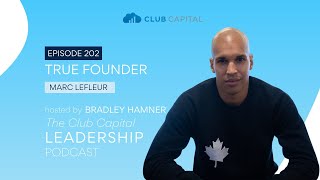
In this Club Capital Leadership Podcast episode, host Bradley Hamner interviews entrepreneur Marc Lafleur, co‑founder and former CEO of TruLocal. The conversation traces Marc’s early life as a struggling student, his first two failed ventures (an instant‑messaging app and a university‑focused sharing‑economy platform), and the pivotal four‑year stint selling meat door‑to‑door that taught him sales, customer objections, and market research. Leveraging those insights, Marc launched TruLocal, an online butcher‑shop that evolved into a SaaS platform for local producers and was acquired for $16.7 million in December 2020, with a transition contract ending December 2022. He discusses the mindset required for founders – embracing constant problem‑solving, treating business as a series of sprints, and hiring friends for early‑stage hustle. Marc also reveals the motivation behind his forthcoming book True Founder (published by Forbes, Feb 7 2024), which blends his origin story with 16 practical chapters on expectations, mindset, hiring, agency negotiations, and grant‑based marketing. The episode ends with details on the $50 k First‑Time Founder Business Grant, promotional channels, and Marc’s advice for aspiring founders.
Chapters
So the big question is this: how do small business owners like us grow our leadership, develop our teams, and scale our business in a way that allows us to get our products and services out to the world yet still remain profitable? That is the question, and this podcast will give you the answers.
I'm Bradley Hamner, and this is the Club Capital Leadership Podcast.
Welcome to The Bottom Line, a new weekly podcast series that we drop every Thursday to complement our weekly Monday podcast interviews with the industry leaders.
These podcasts are going to be designed to give you short, impactful, and value-driven information that you can start using right away in your business.
I value your time and attention and will do my very best not to waste it.
Just get what you need and go.
So with that, let's get into today's episode.
Welcome to another episode of the Club Capital Leadership Podcast. My name is Bradley Hamdy, your host. On today's episode, we have Marc Lafleur. Marc started out building 3 businesses from the ground up, and he has a real deep understanding of what it takes to succeed in today's competitive business landscape. He's the co-founder and former CEO of TruLocal. He built it into a team of over 60 people. He expanded across Canada and the US. And successfully led to its $16.7 million acquisition, all within 5 years. Give me some of that. Most recently, Mark celebrated the launch of his first book with Forbes as the author, True Founder. The subtitle: What No One Else Has the Guts to Teach You About Starting Your First Business. And as the time of this recording, it actually is just coming out today. And so I know he is really excited about that. You're definitely going to want to pick it up. The first time I heard Mark, uh, was on the Built to Sell podcast, I actually mentioned this to him. Just a tremendous amount of experience. I love hearing the stories of entrepreneurs, of small business owners, how they get started, how they get to where they are. Hence why the very first question we always ask on our Monday interviews is, tell me your background and origin story. I think it's fascinating to see how people kind of got to where they are today. Without further ado, here's my conversation with Marc LeFleur.
Are you an agency owner looking to grow your revenue, increase your bottom line, and better manage your taxes? Club Capital is here to help. Club Capital is the largest accounting and advisory firm for insurance agents in the country, providing monthly accounting, tax strategy, and CFO services. Way more than bookkeeping and your everyday run-of-the-mill tax prep, Club Capital is focused on providing financial and tax advisory services that help you plan and forecast your agency's performance. Their financial dashboards and agency forecasting tools help you better understand your agency's historical performance, create, measure future targets, and see how your agency compares to your peers around the country. Imagine what it would be like to understand the impact to your bottom line when deciding to hire a new employee or forecast the impact rate changes or commission rates will have on your business. With over $200 million in tracked annual revenue and $140 million in tracked annual expenses, Club Capital has the data and the team to help you make better informed decisions for your agency. They will help you turn that back office stress into the backbone of your agency's success by giving you the tools to take your agency and your leadership to the next level. Visit club.capital today to book a solution overview with one of our business consultants. Club Capital, way more than a CPA firm. Have you ever tried online marketing before and weren't sure if it was working? Maybe your rep talked about all the impressive features and stats and said things were going great, but you didn't know how all that tied into raw new policies written. Well, that's not the case with DirectClicks. DirectClicks is the premier Google Ads and SEO option exclusively for State Farm agents.
Why?
They're 100% results-oriented with an exclusivity guarantee. Every review call you have with your account manager focuses on what really matters to your business, and that's leads and call-ins received. Everything will get broken down to cost per lead received. By investing with DirectClicks, you're going to free up time and energy to focus on what's most important in your agency and doing what it is you do best. This will be the best investment you make for your team by spending confidently and scaling your agency today with exclusive online marketing partner DirectClicks. Visit us at directclicksinc.com.
Mark Lafleur, welcome to the Club Capital Leadership Podcast. Hey, happy to be here, man. I am pumped to have you. So before we hit record, I was telling you about kind of how I came across you. One of my, uh, favorite podcasts I listen to is John Wierlo, Built to Sell, And, uh, your story just came out not long ago on that, on that episode. And I said, man, I've gotta get Mark on this podcast. He's got so many good nuggets to be able to share with our listening audience. And so I'm gonna ask a big broad question. Okay. And so we'll, it's tough. So take as much time as you need, but tell a little bit about your story, your background, kind of how you got to where you are today and just, just kind of the, your journey with TruLocal.
Yeah, so, you know, my story's got typical— your typical peaks and valleys, but really started off, you know, bad student. Um, you know, I was failing out of grade 9 and 10. Um, and I think it was like I was probably one class or one suspension away from completely failing out and not coming back to grade 11. But, um, you know, eventually, you know, turned things around, started playing football. Um, got into the University of Waterloo. Um, and it's funny because I went there because I wanted to be a dentist in like first year, and then as soon as I got my grades back after first year, realized that was never gonna happen. So I'm like, okay, all right, let's try to figure something out. And then didn't really think about my future again until probably third year, you know, just kind of living that, uh, university life. And, um, the thing about the University of Waterloo is it's one of the only, uh, universities in Canada that has a co-op program. So it's a very entrepreneurial university and they actually have quite a few accelerators and incubators on campus. So me never having any business background, you know, once again, grew up in a small town, didn't have a lot of money. I thought pretty much you were going to university to use your degree in like 10 different fields. Maybe I didn't know you could start your own business and start your own companies. So the University of Waterloo definitely opened my eyes to entrepreneurship and and what it's like to be a founder. And then I just fell in love. You know, I was, I guess that I was a bad student and I was a bad employee also. I always say it wasn't ever because of my output, but it was, I always like to ask a lot of questions. And when you're the type of person who likes to ask a lot of questions, you start realizing how a lot of businesses, especially more of your legacy businesses, are on the complete opposite side of that. Just, I guess, kind of like the monopole lifestyle businesses that, you know, grow to maybe on like $10 million and then just kind of stay there. They don't really like when you ask a bunch of questions. Um, so bad, bad employee, bad student. Um, and entrepreneurship ended up being the thing where I was like, okay, wait a minute, you're telling me that I can go start my own business and I can take whatever ideas I have in my head and I can double down on them and I'll take all the reward, but I can carry all the risk. And it's just like this this sense of ownership. It was really important to me. And that was kind of the beginning of the end. You know, in third year, I guess it was, came up with an instant messaging app idea called Tell, and it was pretty much just Snapchat but for messaging. And this would have been in 2012-ish. So this was before they even had texting for it. That ended up failing. That crashed and burned. So then went on to the next one. Which was Dash Task. And Dash Task was actually an interesting one because it was when TaskRabbit was really taking off. Yeah, it was kind of this idea of the sharing economy. So you've pretty much got a community. So, you know, you've got this defined community and the sharing economy, at least in the way that we were looking at it, referenced the ability for the community to share resources amongst each other for mutual gain. So whether it's trading time for money, trading money for time, That was the premise, and we wanted to take it and put it into a niche market, which would've been universities. So did that, made it further than we did with TEL, but that ended up failing also because I couldn't raise any cash because I didn't know anything about business. So smart investors were like, "No, we're not going to fund you." And I would have to agree that that was probably the right call at the time. And then in addition to that though, my co-founder got recruited to Google. So game over. Um, but then you know what they say, right? Third time's a charm. I started—
hold on just a second, hold on just a second. I don't mean to be disrespectful, but I have to ask before we get way down the line of what's coming, because I know what's coming. Where do you think that that idea to just keep going— so for some people, they— you tell didn't work out, and you got so fired up around entrepreneurship Some people would have that first product, not, not work out, and then they're like, never mind, I'm done, I'm done with this. I mean, do you think maybe your sports background playing football— which, by the way, what, what position did you play?
I played DB, so I was a corner.
Okay, cool. Uh, we're big football, uh, people down here.
No doubt, I see that helmet in the background there.
Yeah, for sure. Um, so I mean, where do you think that, that stick-to-itiveness, the resiliency came from in, in you to just keep going?
Yeah, it's funny. Those are always the questions I hate the most because I still to this day have not yet been able to really, really kind of articulate what it is like when people ask, why do you keep going? Or what motivates you? These are like tough questions because I think at the end of the day, it's so many different things. Like you've got this giant cauldron of personality traits, of, you know, environmental factors, you know, of experiences that have happened. And they all get put into this cauldron in specific amounts. And then you kind of stir all of it together and it leads to these results of who you are as a person. But what I can definitely say, some of the things to that is, A, I was naive. You know, I didn't know any better. Like, to me, I assumed I was gonna fail a couple times. Like, it wasn't like I was gonna go, I have to go knock it outta the park. It was me and my roommates with no skills in business, taking all of our student loan money and putting it together to build an app. I don't even know if we expected to succeed. I think we obviously wanted to, but I figured there'd be a couple hiccups along the way. So just kind of being naive, but then also at the end of the day, like I came from no money, right? Like we had all of our basics taken care of, but we were definitely on like the bottom level of where when I was going to school, a lot of kids had a lot more money than I did. And a lot of people always counted me out. So I always say this, I'm like, when you came from adversity, when you came from being told no more often than not, um, and you came from being counted out, you're not scared of hard work. Like, you work hard in general. All you want is an opportunity to show people how hard you can work. But when you don't come from anything, those opportunities are very few and far between. So I find on the flip side, when you come from some sort of privilege, or you come from an affluent family, you've got opportunity everywhere. They're offering you summer jobs. They're getting you the opportunity to make some cash on the side. They're giving you opportunity to go to different universities. And really what ends up happening is you start fearing the hard work instead because you can work hard at anything because you've got all the opportunities. So you're like, I just don't want to do that now because I don't care about it or whatever. Whereas on the flip side, once again, if you've only got 1 to 3 opportunities in your life, that are gonna be like, this is the chance for you to show what you've got, um, you're gonna work your ass off for that. So that's just one thing that I noticed. And once again, like kind of circling back to this idea of when I realized that entrepreneurship was even an option, that almost opened up unlimited opportunity for me because I didn't have to wait for other people to give me that opportunity. I know I didn't have to wait for someone to give me a job interview or, or give me the job to then go prove it, or I didn't have to wait to, you know, for football season to start for an opportunity to get on the field and show them what I could do, right? It was in business. At the end of the day, you might start small, but you have all the opportunity in the world. So I think that, like, once again, you take all that, throw it into a cauldron, stir it all together, and what came out was, you know, 2 failures and a success.
That's awesome though. I appreciate you taking just a couple minutes to riff on that because, I mean, I think that those are the things that oftentimes we hear the success and we hear the big exit, the company that sold for $5 million, $10 million, whatever it may be. And yet it was like, yeah, well, sometimes we almost gloss over the failures. And like, yeah, but for a lot of people, they have those failures and they're like, forget it, it's just not for me. Small business, not for me. Entrepreneurship is not for me. I mean, at least in the States, the stats that I've done some research on, 96% of small businesses fail, never see their 10th birthday. 96% never see their 10th birthday. It's like, holy smokes. I mean, that is a lot of failure, you know, to go through.
So anyway, ambition is the first step. Towards success. It's time to level up your agency. And Coach P Consulting will help you do just that by using the same strategies he used to sell over 700 life insurance policies in 2021 alone. Now, this is not your regular one-and-done type coaching. You'll get personalized coaching 2 days a week, every week of the month, and you'll get a live look behind the scenes of his team training and an office that's performing at the highest level. There's a reason Coach P Consulting is the fastest growing coaching company for insurance agency owners in the country. Coach P will train your team alongside his own and show you the exact steps they are taking to achieve Chairman's Circle, Exotic Travel, and Multi-Line Presence Club and be one of the few agents to be selected to have a third office. So whether your goal is to be at the top of your local market or amongst the best in the country, this training will give you the strategies and the tactics to get there. For just $250 a month, you'll get high-level coaching each week from someone who is already getting it done at that level, and his strategies work, and it's time to put them to work.
For you.
Sign up at coachpeakconsulting.com and get your first full month for free when you mention the Club Capital Leadership Podcast.
Yeah, like, I would, I would think to that, I think those stats are probably high. Like, 96% make it to year 10. I thought it was something like even like 80% don't make it to like year 2 or something like that. I feel like at 96%, and you know, I guess one of the things too, I always did say this, and this kind of goes back to the opportunity thing, but Like, people will say a 1 in a million chance. I don't know why, but I've always— I love those odds. Like, I like that. Like, you're telling me there's a 1 in a million chance I could do this extravagant thing? Um, and you know, even if you bring it down to like 1 in 10,000, like, if there's a 1 in 10,000% chance that you can go live out your dreams, wouldn't— like, I look at that as like, sweet, yeah, I'm taking those odds. So, you know, situations like that, yeah, if you tell me 4 out of you know, what was it, 4 out of 100 have a chance of making it. I'm like, yeah, I'll take those odds any day of the week for sure.
Cool. That's great mindset. All right, so pick it up. So we had those two launches. Your founder takes a job with Google. Your co-founder takes a job with Google. Where does it go from there?
Yeah, so that was the end of Dash Task. And then at the time I was doing door-to-door meat sales just to help pay the bills, you know, just, you know, university is expensive, housing Everything's expensive here in Canada. It doesn't help that I was blowing all my loan money on failed business ideas. So I was working 4 jobs in university and one of them was door-to-door meat sales. And I have no idea how I got into it, but my roommate was like, you know what, you talk really fast, why don't you, you know, give sales a shot? So I had no sales experience, no food experience, no meat experience. I'm actually a really picky eater. It's kind of like a running joke at TrueLocal. But I ended up doing really well. The sales world fit me. The door-to-door aspect of it, once again, it never really— it sucks. Like, nobody wants to do it. But I came from doing factory work throughout the summers and, you know, mowing lawns for low-income housing. You know, like, to me, this was just another opportunity. So went through it. And I was actually there for 4 years after university. Eventually I worked my way up, you know, I got into sales and I actually— they gave me the opportunity to open my own branch. So I was like 22 trying to hire like 35-year-old sales vets out of a coffee shop, trying to convince them that, hey, listen, like there's a business here anyway. So I did that for about 4 years. And during that time, that's when Dash Task came out. And when it failed, I was kind of looking and being like, like, I'm getting traction with these ideas. You know, we're able to develop an app. We're able to get some initial users. What— why does it keep failing? And it became pretty clear to me that I was always treating it like a hobby. It was always nights and weekends. I had my full-time job. I was still doing some school stuff on the side. And then nights and weekends I would work on these projects. So it hit me kind of like a rock that if I wanted to find success in business, I needed to treat it like a business and go in full-time. And that's sort of where the idea for TruLocal came about because then I started kind of just doing like a risk-reward analysis and saying, okay, I'm willing to take these risks and I've had this previous— I consider once again previous success with these startups even though they failed, but just figuring out how to work with the media, figuring out how to build the technology, figuring out how to do marketing campaign, all this type of stuff. So I looked at those as wins. I was like, if I'm gonna quit my job, then I need to have a higher level of confidence that this one's gonna work out. So Instead of looking at all these things I wanted to do, I looked at what I thought I would be good at. And because I was doing door-to-door meat sales for 4 years, I just saw the opportunities, um, in terms of doing like market research. And they say talk to your customers. Well, I'm telling you right now, for 4 years I was in people's homes trying to sell them this product. Um, I knew all the objections. So all I did was research at the time because I didn't know much about it. I just researched e-com. Right? So e-commerce was blowing up. Best practices are everywhere. They're 100% transferable from industry. It doesn't matter if you're selling, you know, clothing or if you're selling food or if you're selling, you know, glasses, whatever. At the end of the day, e-com has a lot of best practices that are out there. So I figured, why don't we take that and bring it into this niche market of locally raised high-end meat products? And that's really where it all began. That was kind of the beginning. And in the early days, it was just about— we wanted to pretty much be like this online butcher shop. But by the time we were done and got acquired, like, it changed dramatically. Like, it ended up we were doing software solutions for farmers. We had storefronts, like online storefronts. So you can think like Shopify, but exclusively for producers. And eventually it led to a $16.7 million acquisition 5 years later.
Unbelievable. What a story. Um, you mentioned it's kind of like the resiliency with entrepreneurship, but also you mentioned the 4 years of being— I love the quote from, um, you know, what's pulled from Teddy Roosevelt's, you know, speech, um, in the arena, you know, the man in the arena. You were in the arena for 4 years learning and hearing all of these objections to the people about what— about the product So you, you, it's not like you just went into and said, oh, you know, fresh meat being delivered is going to be a hot thing. Let me try to capitalize on that and learn everything. You were already in it for that many years and then use that learning. So what are, I mean, you, you just recently, or soon to come out actually, uh, from the time of this recording, you wrote the book True Founder. And before we hit record, you said This is the book that I wish that I had. And I can relate to that so much, is that for a lot of things that I do, I told some people the other day, I'm patient zero. Like, I build things that I wish I had. Like, I need this, so then I'm gonna go build this solution and take all the books and podcasts and other things I've listened to and then say, okay, here's what I need. I don't really love this, I don't really love this, but I'm going to make this thing my own, and I become patient zero. So you've kind of obviously codified it all in your book. So can you just talk about kind of what are some of the elements that you say, man, I really wish I'd have had this along the way whenever I started to, to along my journey?
Yeah, well, I think right off the bat, the number one thing is expectation. And I feel like that's something that I had no idea what I was getting myself into. And I feel like a lot of people don't. And I feel like if you just had a better grasp on reality of what you were about to go down, you can prepare yourself better. So that way when some of the punches come at your head in year 3 and 4, where you're really in the trenches, you could just have had more energy because you knew, you're like, okay, I understand that I'm gonna go through these peaks and valleys. I'm gonna go through these challenges, um, and it's normal. Yeah, because that's the, that's the worst part, like year 1 and 2 when you are literally pushing that boulder up the hill and you feel like you're doing everything wrong because you're, you look around and you don't, of course, right? You look at other founders and all you see is the highlight reel. It's the same as social media, but you're going through so many challenges in the early days that you think that you're doing everything wrong. And I think this book, so this book acts as it's kind of twofold. It's the story of True Local, but it's also, you know, 16 chapters on tangible learnings and tips and tricks on how to avoid some of those things. And if you can't avoid those things, just different ways to think about them and prepare for them so that when they do show up, you're ready for it. So like right off the bat, you know, I do the first part of the book is all just on mindset stuff. So, you know, there are so many people out there that do a lot of things on coaching and mindset, so I didn't want to make an entire book on that, but There's 3 chapters that just really dive deep into the mindset that if you have these sort of things in the back of your head, when you actually do get into the building phase, it becomes a hell of a lot easier. So that's just like things like, look, like you don't got a job as a founder. Like you don't have a title. You're not a CTO or a CMO. And I hear it all the time. Well, this is my role and that's my role. Great. Congratulations. But at the end of the day, your job is to be a professional problem solver. That's it. Like, don't even think about anything else and solve the problems that are right in front of you. And that to me would've saved me, honest to God, probably a year on TruLocal where I was just trying to fit myself into these specific roles that I thought a founder or I thought a CEO was supposed to do instead of dealing with the problems that are right in front of me and taking pride in developing my problem-solving abilities. So that's one. Um, you know, another one, you know, the idea of business being a series of sprints rather than a marathon. Everybody talks about how business is a marathon. Business is absolutely not a marathon. If you are just kind of slowly and steadily running through this journey that is gonna be your startup for however many years, you're gonna get blown up. You're either gonna just get so exhausted cuz you have no breaks and you're just consistently draining your energy, or every other person around you who's a founder in your space that's sprinting towards various opportunities is gonna beat you. And I actually just found this recently, but The idea is that you see an opportunity, you sprint towards it with all your energy. Once you've captured that opportunity, take a minute, reestablish, reprioritize what's going on, and then scope for your next opportunity. You can use this time to take some rest. And by rest, like, you never take your mind off the business. But once again, it's like, okay, just take a step back and reevaluate. And I think it was Naval Ravikant that had this saying that I just found recently. I feel like I should have known this, but He kind of talks about, you know, be like a lion, you know, or market like a lion where it's something like, it's like sleep, wake up, hunt, eat, repeat. Like that's kind of the whole idea. And that's a really interesting way to look at it. So that's kind of the first part of the book. And then we kind of start diving into the juicy stuff. So things that are very, I guess I consider them against the grain, but that worked really well for us. So right off the bat, like hiring friends, Everybody says, don't hire friends, do not hire friends. You've got all these issues. And yeah, those are definitely some valid concerns. I'm telling you right now, the best thing you can ever do is hire friends, especially in the early days. If you're not funded with $10 million of VC funding, you don't need experience. Like there's a certain value that experience brings. I would say that's maybe like 20 or 30%. What you really need is people that are gonna hustle, like people that are gonna work their asses off, people that actually care. So people that are reliable, people that you know can hold things down, and they'll learn and you can train them along the way for the specific needs of the business. But that's kind of the idea. And I've always said that if you can't work with friends, that's more of a reflection on you than it is on your friends. So our first 10 employees were friends and then friends of friends. And then when the company sold 5 years later, all of those first 10 employees were still with us. So it's a huge part of what made TruLocal successful. But Kind of getting into it, just other things like I could spend, you know, hours going down, but one that I always like to talk to people about, but same with working with agencies. I find a lot of people get burned a lot with agencies. And when do I hire an agency? Should I hire an agency or hire in-house? How do I find a good agency? How do I structure these agencies? So just working with marketing agencies, development houses, any of these freelancers, I have a whole chapter kind of on how you negotiate contracts and make it so that you've got alignment rather than either getting preyed upon on some— by some of these agencies, or going in so hot and heavy that you just can't get deals with the agencies because you don't really know what the market standard is.
Yeah.
All right.
So let me go back because I want to go back to the mindset piece of it. I want to ask you a few questions around that because I think it's really fascinating. Do you feel like around, like, one of the titles being CPS, Chief Problem Solver, is that there's this mindset of saying, instead of resenting the fact that you have problems to deal with, just embracing that, hey, this is, this is, this is a problem, this is my role, and this is where I need to be, versus, man, I just wish it would be so easy. Like, there's a mentor friend of mine And every time he says this, it's both aspirational. And then it really pisses me off. I'm just going to be honest with you. It pisses me off. Okay. And he says, the last 8 companies I've launched have hit a million-dollar run rate in 12 months. And you're like, doggone it, what in the world? Well, what I want to know, if you don't know his full story, he's got a lot of stuff that happened in the early years of years of being in the arena where it wasn't working out exactly that way, you know. And so, but when you hear that, you're like, good grief, what am I doing wrong to not be able to launch every company, hit a million-dollar run rate in, in 12 months? I mean, I want that type of, you know, template, like give me the keys to the success. Does that make sense? So anyway, what are your thoughts around that?
On the being a problem solver or watching this dude who seems to have it all figured out? Both.
Both.
Yeah, I think that's like, look, like the, if you're going into business hoping that eventually, like if you go into business and you you think, okay, I know it's going to be hard for a little while, but once I raise some money or once I hire my first employee or any of these other things that you think you'll reach to make it so that it gets easier, if that's your mindset, like, don't, don't go into business. Yeah, because your problems are never going to stop coming. The old age-old saying, right? More money, more problems. It's like, more money in business, more problems. More employees, more problems. More market share, more problems. More SKUs, more problems. Like, just, it doesn't matter. You're always going to have these, these issues popping up. And that's what I mean, like, it's so much better if you don't take 2 years to figure that out and come to peace with it.
If—
yeah, and that's what it took me. Like, I remember for the first couple years being, oh my God, I, I'm sure if I just get past this milestone, the problems will stop, stop coming. And I believed it. Get this big milestone, I'm like, okay, things are going to be easier. You start letting your guard down a little bit, things start slipping through the cracks, and then boom, you get punched in the face. It's like, okay, it blows up your whole day, it blows up your whole month, it could blow up your whole quarter just because you had this expectation that things were going to get easier. If you go into it knowing that you are nonstop going to have this core trait of being able to solve problems, and you know that there is going to be a problem each and every day to deal with. And if 2 days goes by with no problems and 3 days goes by, no problems, sure, maybe you appreciate that, but you just know you go to sleep being like, like, okay, tomorrow could be the day, you're gonna be in a way better position. So I— that's kind of one of it in terms of watching people that kill it. I love, I love it, you know. Of course, I know what you're saying, right? It's like you look at them and like, oh man, I want to figure out how you do it. But I love it. I love inspiration, you know. Once again, didn't come from a whole lot, so there weren't a whole lot of people around me winning. Um, so now fortunately I get to be in a situation where I always hear how A ton of different people are winning in a ton of different ways. And I think it helps me, to be honest, because maybe I don't know that person's exact blueprint, but I now know that it can be done in that way. And if you're lucky and you build relationships, maybe they will tell you how to do it. So, you know, yeah, I get what you're saying. Absolutely. And I think for me now, you know the age-old saying, right? You know, I think it was actually Kanye that said it. And he's like, having money isn't everything, but not having it is. Until you get to that first win, so whether it's a million bucks for someone, whether it's a six-figure salary, whatever you want to call it, until you get to that, you can't help but obsess over things financially because you need to have your basic needs met. And if you don't have your basic needs met, you can't think a week or a quarter or a year ahead. You got to think about, okay, if I don't go into work tomorrow, that's going to affect my paycheck, which means I can't do this, this, that, that. It has to consume you. Whereas of course not everyone's gonna get to understand this, but the truth is I'm very financially driven. So, you know, money motivates me more than anything else. And I think it's healthy. You know, people are always like, oh, money shouldn't motivate you. Hey, look, worry about yourself. All right? Go find something that motivates you. I know what motivates me and it, it's great. But once you get the money, the truth is the money doesn't matter as much because the money at the end of the day just gives you opportunities and it gives you the ability to do what you want. But the new problem you run into is what do you do when you can do anything? So I'm sure a lot of your listeners are going to go off to be very successful, and I've challenged them early on to say, hey, once you get to the money, because you know what's coming, you're going to have a new challenge of what actually does— what do you want to work on? Because if you've got that, that big win, you could go into anything. So where I was going with this is that, you know, fortunately now kind of in this position, I get to hang around people that are doing things successfully. And, you know, there's a lot of different tips and tricks and The craziest thing is I've seen people win in every industry. I've seen it, mom and pop lifestyle companies win. I've seen the venture-backed companies win. I've seen the e-com companies, the brick and mortar companies, the arbitrage companies, the SaaS companies. Like I've seen the consultants win. I've seen every possible win out there. And what you just realize is that there's no right way to do this. It's just pick what you want to do. Find a little opportunity and then execute better than anybody else. But there's, I promise you, there is not one revenue stream that is so crazy that it hasn't been thought of yet and also been exploited, AKA someone has gone and absolutely crushed it in that weird way of making money. So that gets me excited. You know, I like that.
You know, there's, um, if you give somebody 7 days, pick a niche industry, you can find somebody that has made well over $1 million doing that exact same thing. And then, and multiple people who have failed doing the exact, doing what it is. It's not what you do, it's how you do it. And it is like you said, around the execution piece. I love that so much. Uh, what are you doing now? Uh, since, and by the way, for our listeners, share when, when was the exit like? And so like, kind of give us a timeline of when that was. And then a little bit of kind of what you're doing now.
Yeah. So the— we sold TruLocal December 31st, so last day of the year 2020. And then I obviously typically had a 2-year contract to help oversee the transition. We have a new CEO in place. So my contract actually just ended this past December. So December 31st, 2022. And really it's been all about the book now. Um, you know, the book comes out in February. Spent about a year writing it. Forbes is the publisher. Um, and it's exciting, you know, first time I'm putting my own stuff out there. And I think like at the end of the day, like, I'm a 32— I'm a 32-year-old Black guy who sold a company for $16 million and I came from no money. Like, I have an interesting perspective and I feel like there's probably a lot of people out there that don't hear that side too often. So my hope is just that, you know, if any of my stories or anything might inspire you, or if you go in and you're like, I need to actually have some tangible tips and tricks to help grow my business, the hope is that the book is gonna do that. And I do gotta say too, one thing. Um, so we started thinking about it. I grew up as a marketer, like that's where I was at prior to TruLocal. And I always considered myself to be a marketer. So we really wanted to do something where it's, we know our audience, the audience for the book is first-time founders, exclusively. And first time doesn't mean that you're just getting started in your first business. To me, first time is you're— it's prior to you getting your first big win. So you could be thinking about starting your company tomorrow, or you could be 7 years in the arena or the trenches waiting to get that win. You're a first-time founder. This is for you. Um, so I was trying to be like, okay, well, how are we going to market this book? And it's like, man, if I have to do— I don't want to be running paid advertising for a book, like all this type of stuff. And I'm not really— I'm not super, uh, present on social media. So I was like, well, what are we gonna do? So we wanted to do like this awesome grant. We decided to put together this grant where it's like, let's just take the budget that we would put towards doing some sort of marketing and let's see if we can partner with, um, some people that creates real value for first-time founders. And that's where the Ultimate First-Time Founder Business Grant came from. Pretty much anybody between now and February 19th can go and submit a 2-minute video as to who they are, what their business is, and how they would use $50,000 in agency credits. And that's everything from having an agency run your Facebook, Google Ads, do creative for you. We've got an SEO agency involved, we've got a PR agency, we've got a video creation studio. So all of this is all bundled and is gonna go to a winner as part of the grant to help them grow their business. And I figured, you know what, that's something I can actually get behind. It's something I actually want to promote and something I actually want to um, you know, pretty much shout from the rooftops. So that's how we're promoting the book.
That's awesome. That is awesome. But I love the thinking outside the box. I mean, you are really a true entrepreneur, there's no doubt about it. Well, I can't wait to get my hands on the book. Uh, if people want to learn more about just your story specifically through the entire exit, I do encourage people to go listen to that Build to Sell, uh, episode because John does a great job of kind of detailing all of that. But Mark, if people, when the book comes out, where can people go? Where can people submit for the video? Like, where would you point them to if they want to connect with you on social?
Yeah, easiest thing, markleffler.com. Mark with a C. So markleffler.com, you'll have everything there. So access to the book, the book comes out February 7th everywhere. So everything digitally will be on audiobook platforms, you know, Audible, we're going to be in, you know, all the stores, you know, we're at the airports. So as soon as the book is out, it's gonna be available. You can also order it and preorder it through my website, and I'll give you a free copy of the audiobook if you order it through my website. And then all my socials are on there too. You know, you can just kind of find me online and happy to connect. I always love talking to founders, so I always encourage— I'm not the kind of guy to really shy away from that. If you got something you wanna talk about business or just want some advice or, you know, just want to hear more about my story. You could also catch me on Instagram. So it's Dark Mark underscore Mark with a C. And yeah, that's it. But we'd love to hear from people.
That's awesome, Mark. You've been a super great guest to have on. Appreciate you sharing our story and pouring into the lives of other business owners and founders.
And I appreciate you having me.
What a great conversation with Mark. Learned so much from that. Hope that served all of you. You know, one of the things that stood out to me, which may not be exactly what you think, uh, um, what you were thinking, is whenever he talked about hiring friends as an example, to me that's a good example, is that people can get there different ways because he really believes in that. And some of you may have heard him say that and say, good gracious, I've gotten burned so many times by doing that, there's no way I would make that recommendation. But that's been his, his experience. And what, you know, how could you argue that that's, that's his experience? And so those are some of the things that you can, you can take those ideas and apply them to your business or not apply them to your business. There's just not one size fits all. I think also too, the second biggest thing that stood out to me was whenever he talked about mindset, and I was genuinely curious about what his answer was going to be because, you know, he had some failures. I mean, he could have easily said, you know what, forget this, I'm just going to go get a job. And, you know, what, what is it makes somebody everybody that's an entrepreneur, business owner, founder, to, to just have that grit to keep going, because you get beat up so many times, don't you? I mean, this stuff is hard. It can be fun, obviously. It can be, it can be incredibly rewarding, fulfilling, fun. Um, but building business is not, is not the easiest thing to do, uh, any business for that matter, and let alone to have a $16 million exit. Uh, good luck to Mark in the launch of his book that's coming up. and, uh, I know I'm going to be picking up a copy. Can't wait to get my hands on it. I love digging, digging into books and podcasts like that. So make sure you go to Amazon and check out his book, True Founder. Hey, super grateful for all of you and grateful to our podcast sponsors, Club Capital, DirectClicks, Autopilot Recruiting, and Coach B. I mention it every week, but those are fantastic people behind those organizations that do an incredible job to serve small business owners, in particular, many of them insurance agents. Agency owners. If you're ready to take your agency to the next level, you know, you need to have a better understanding of your financials, your marketing, where to put the marketing, how to get, uh, online, reach out to Club Capital and DirectClicks. Uh, if you know you need to be able to build a bench of A-players, do it on a regular basis. It's time for you to start growing. You just lost someone this week or last week and you got to replace them. You realize, crap, I don't have a bench. Now that's exactly where Autopilot Recruiting comes in, is they, they can help you with that. If you You don't have a need for somebody right now. That's the best time to be recruiting. But yet we don't do that, right? We say, ah, you know what, I'll just have to wait when the need comes. And then boom, you get hit with somebody leaving you versus being able to have a, have a service, have a dedicated recruiter tied to your business that gets to know you, your goals, the things that you're trying to accomplish and can help you to recruit in different ways. Go to Autopilot Recruiting. And ultimately, you guys know I love David, but David does an awesome job. It's not just David does a good job in his business, but he also has a way in being able to share, you know, what he's doing at the highest level to help all of you. And I think that's really the key. So go to coachpconsulting.com. Appreciate, so grateful for their partnership so we can bring great guests like Mark on. All right, till next episode, everyone, lead well.










