Episode 225: The Second in Command with Cameron Herold
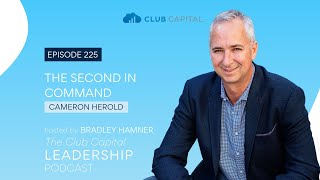
Cameron Herold, former COO of 1-800-GOT-JUNK, explains how he grew the company from $2M to $106M and 14 to 3,100 employees. He distinguishes between a COO and a true second-in-command, argues you should hire an executive assistant before a senior ops leader, and describes how a Vivid Vision document aligns teams and attracts talent.
Chapters
So the big question is this: how do small business owners like us grow our leadership, develop our teams, and scale our business in a way that allows us to get our products and services out to the world yet still remain profitable? That is the question, and this podcast will give you the answers. I'm Bradley Hamner, and this is the Club Capital Leadership Podcast. Welcome to The Bottom Line, a new weekly podcast series that we drop every Thursday to complement our weekly Monday podcast interviews with the industry leaders.
These podcasts are going to be designed to give you short, impactful, and value-driven information that you can start using right away in your business.
I value your time and attention and will do my very best not to waste it.
Just get what you need and go.
So with that, let's get into today's episode.
Welcome to another episode of the Club Capital Leadership Podcast. My name is Bradley Hamner, your host. On today's episode, we have Cameron Herold. Cameron is the founder of the COO Alliance and Invest in Your Leaders course. He's the author of Vivid Vision and The Second in Command. He really is the mastermind behind the exponential growth of hundreds of companies. Again, as the founder of COO Alliance and Invest in Leaders course, Cameron is a dynamic consultant and he's coached some of the biggest names in business, including Sprint Telecom, a monarchy in the Middle East, and he's really known as like a CEO whisperer. He's had a reputation for guiding his clients to double their profits and revenue in just 3 years or less. Cameron's own entrepreneurial journey began at a young age, and by 35, he had helped build his first of two $100 million companies. But his greatest achievement came as the COO of 1-800-GOT-JUNK, where he engineered the company's spectacular growth, which we detail in this episode, from $2 million to $106 million in revenue, and from 14 employees to nearly 3,100 employees, all in just 6 years. And he's just not just a successful business leader, but he's also really a fantastic speaker, as you'll find out in this episode. As a current publisher of Forbes— Forbes Mag— goodness gracious, sorry. As the current publisher of Forbes magazine said, he stated that Cameron is the best speaker I've ever heard. He really hits grand slams. I think one of the things I really like about Cameron is that he's just kind of no BS. He really isn't. I think you'll get this in the episode, but he's written Vivid Vision, which has had a profound impact on me. We talk about that this episode, Meeting Suck, which is an awesome book, Free PR, Double Double, and even The Miracle Morning for Entrepreneurs. He really is a top-rated international speaker, has been paid to speak in 26 countries on all 7 continents, including Antarctica, which he did in early 2022. Without further ado, here is my conversation with Cameron Herold.
Are you an agency owner looking to grow your revenue, increase your bottom line, and better manage your taxes? Club Capital is here to help. Club Capital is the largest accounting and advisory firm for insurance agents in the country, providing monthly accounting, tax strategy, and CFO services. Way more than bookkeeping and your everyday run-of-the-mill tax prep, Club Capital is focused on providing financial and tax advisory services that help you plan and forecast your agency's performance. Their financial dashboards and agency forecasting tools help you better understand your agency's historical performance, create, measure future targets, and see how your agency compares to your peers around the country. Imagine what it would be like to understand the impact to your bottom line when deciding to hire a new employee or forecast the impact rate changes or commission rates will have on your business. With over $200 million in tracked annual revenue and $140 million in tracked annual expenses, Club Capital has the data and the team to help you make better informed decisions for your agency. That will help you turn that back office stress into the backbone of your agency's success by giving you the tools to take your agency and your leadership to the next level. Visit club.capital today to book a solution overview with one of our business consultants. Club Capital, way more than a CPA firm.
Cameron Herold, welcome to the Club Capital Leadership Podcast.
Hey Bradley, thanks for having me.
Super excited to have you. As I was telling you before we hit record, whenever I started the podcast, you were somebody that I thought, man, if I ever got to interview Cameron Harold— I've read all of your books. A couple that have really had the biggest impact: Double Double, Vivid Vision, for sure. But we're going to spend most of our time today really talking about The Second in Command. For those people that don't really know you, can you give a little bit of the backstory? And you're most famous around your time at 1-800-GOT-JUNK, but even before that that though, Cameron, that was, I think, your fourth business, if I'm not mistaken, that you actually were a part of. Is that, is that the case?
Yeah, it was the fourth real business that I'd helped build. Um, my first company that I owned, I was 20 years old and I had 12 employees. Um, I ran my own business for 3 years while I was in university. I got it up to about 16 employees, graduated from university with no debt. I paid for all my own schooling and I bought a house the year that I graduated. About a month after I graduated. So that was kind of my first, you know, venturing into the entrepreneurial world. And then from there, I joined the head office of what was called College Pro Painters, and that was my real-world MBA. I ended up opening up the West Coast of the United States for them. I recruited and interviewed and trained hundreds of their franchisees, and then I opened up Washington and Oregon for them, and I ended up with around 300 employees in the first year. For that organization. Left there and I became a partner in a chain of auto body collision repair shops. My partner who used to go down to Alabama all the time to go golfing and go to Dreamland to have barbecue, Terry Smith and I built up what is now called Gerber Auto Collision in the US and was called Boyd Auto Body in Canada. It's now about a $2 billion market cap, publicly traded collision repair chain. It's the largest collision repair chain in the world. I helped them grow from 7 locations up to about 65 before they went public. Then I built out a private currency company. I was president of that company. We built and sold that to a US public company. And then I joined my best friend Brian, who was building out what was called the Rubbish Boys, and he'd gotten it up to about $2 million in revenue. We were in a mastermind community called the Entrepreneurs Organization, and he'd watched me build 2 other companies. I'd watched him build up the Rubbish Boys. I joined him as his 14th employee and as his second in command. And 6.5 years later, when I left, we had 3,100 employees system-wide. We'd gone from $2 million to $106 million in revenue. We had no debt, no outside shareholders. We ranked as the number 2 company in Canada to work for, and we landed 5,200 stories about our company in the media. And I was his COO for that whole time. I left there almost 16 years ago. And in the last 16 years, I didn't go to sleep and lie down. I've been coaching CEOs all over the world. I've done paid speaking events now in 27 countries. And then I started an organization called the COO Alliance 6 years ago. And we've now got second in commands who are, you know, the COO, VP Operations, Director of Operations as members from 18 countries now.
Unbelievable. What do you think, what was the biggest thing that Brian, at that time, whenever he had got it to about $2 million and brought you in, which ultimately kind of was your differentiating factor of how you were able to scale that company to $100 million. Yeah. But what are the things that ultimately he was really missing that you kind of came in, and as you talk about in the book, you became his yin to the yang, so to speak?
Yeah, great question. So Brian, Brian and I had a very unfair advantage. You know, we were in a forum group, a group of 8 guys who met every single month for about 4 years. So he saw all of my skills. He knew me culturally. He knew my weird, you know, eccentricities. I knew him as well. I knew his, you know, eccentricities as well. And he was my best man at my wedding 3 months before I joined him. So he knew everything about me day one. That gave us an advantage that he was able to hand everything over to me that I was great at, and I was able to let him just run what he was good at. What I was great at was I'd already built two franchise companies before. I knew how to build his vivid vision, or what he called his painted picture at the time. I knew how to build a franchise training program, franchise recruiting program, a sales and marketing calendar and budget. How to recruit and hire senior people, how to train them, how to build training programs, coaching programs. I'd done it all before. So for the first about 5 years, I had done everything that we already needed to do. It's kind of like he needed to hire a swimmer and he hired someone that had already broken world records and won gold medals in 4 different, you know, had done front crawl, breaststroke, etc. And he already knew that about me. So I was able to come in and just do what I needed to get done. At about year 5, the business started to get really big for me. That's when it started to all of a sudden get a little bit political, a lot of employees. It was getting complicated and I started even tripping over my own skill sets as we were approaching the $100 million mark.
All right. I have a question about that, but I want to go back in a second. Do you believe that Brian was kind of a quintessential entrepreneur in the sense that he really had gotten the company about as far as he was going to get it to, to around $2 million just through his his sweat, his, his, his determination to get it to that point. And it was like, well, it was probably going to stay at $2 million if he did not bring in a Cameron.
Yeah, it would have. And he and I have talked about that. He's written about that in his first book, WTF, Willing to Fail or What the Fuck. He, he talks about what I brought into the company and I was the yin to his yang. So I would have been kind of that early stage kind of mentor COO or MVP kind of COO or the partner COO because I knew how to do what he didn't know how to do. I even recruited who became his very first franchisee, Paul Guy, who opened up Toronto. Paul now does, I think, about $100 million in revenue system-wide. He's the largest franchisee within 1-800-GOT-JUNK. You know, he owns all of Australia, Manhattan, Toronto. And I told Paul to quit College Pro Painters and come and work for Brian. So yeah, I was very, very instrumental. On the flip side though, I would have been useless at trying to build out his company. I couldn't have started it from scratch. I didn't understand the industry. I didn't necessarily want to take that entrepreneurial risk. So we were kind of useless without each other.
Yeah, I shared with you before we hit record that as soon as your book came out, I've got it, physical copy, Audible, and then Kindle, and I'm actually doing a book study with some other entrepreneurs. We meet every Friday morning and we've just started a couple of weeks ago going through Second in Command because this conversation has been going on a lot over the past year. These business owners are really wanting to be able to grow and scale, but they felt like that they had hit a ceiling. And so they really started to buy into this concept, this idea of building a second in command. Before we actually get there, can you just define what you see as the difference between— I've heard you talk about COO versus a second in command, because some people think I'm the CEO, I'm just going to go hire a COO. And you say, no, no, you need to think actually about it as a second in command. Can you just distinguish the difference?
Yeah. So the second in command is really the person who you're going to rely on to run all the areas of the business that you're not great at or that drain you of energy. And depending on how big your company is, what that person's exact roles and responsibilities are, how much you're willing to pay them, that determines what title you should put on that person. You know, it's not like a quarterback is a quarterback is a quarterback and it's just how big is your team. It's more, is this a director of operations or a VP of operations or a general manager or president or a COO? Because the bigger the title, the more P&L responsibilities they should have. The more autonomy they should be able to run with, the more level of strategic thinking and strategy they should be able to bring into the business, and the more wisdom of years of having done this stuff before they should be able to bring as well. So be careful, you know, look, 30 years ago to get a C-level title to be a CFO or a Chief Marketing Officer or Chief Technology Officer, you had to be a major employee at a major company. And we've had a lot of title inflation now where we get these 10-person companies that have 6, you know, C-level or VPs. They've basically given out big titles to people who now think that they're doing jobs that they're not, who now think they should be getting paid more than they should be getting paid. If you go online and do a salary search for what a COO gets paid, it's around $300,000 a year. So if you're only going to pay somebody $120,000, then call them a director of operations, not a VP of operations, and certainly not a COO. The second part to this is before you hire a second in command, and this is why I called the book The Second in Command, before you hire the second in command, if you don't have an executive assistant, you are one. And make sure you go out and hire an EA first. Then about 6 months to a year later, you can afford to hire that true second in command to really leverage and build the company for you. But really give yourself that early buffer first.
Yeah, that's exactly where I was going to go, is to say you really recommend— and I've heard you talk about this before— look, if you do not have an EA first to be able to help you to buy back and get some of the administrative things off of you, there's no reason for you to be looking at hiring a second in command. I'm curious, before I get into some other things, I'm curious, what do you believe— you got the company to $100 million. I'm just actually curious. I don't know if anybody's ever asked you this. What do you feel like looking back on it 16 years ago were the skills that you did not possess at the time to take it from $100 million to $1 billion?
I'm not sure that I was supposed to be the one to take it from $100 million to the billion. You know, in many ways, I think a second in command is there for a reason, for a season, but rarely the lifetime because as the company scales, it just requires a massive set of skill set differences. So what's really interesting, their current COO, he's been there now for 10 years as their Chief Operating Officer. His name is Eric Church. Eric and I have known each other since 1987. We were— we started a fraternity together in Ottawa, Canada. I was president in year 1. He was president in year 2. I recruited Eric to come and work at College Pro Painters. And then here he is, 4 years after I leave Wine Tender Got Junk, he comes in as their COO and takes them from about $100 million to $1 billion or sorry, to $450 million. Okay. Eric would have been horrible in the first 6 and a half years. He would have been a terrible, useless CEO in the first 6.5 years because he'd never been in the franchising space. He didn't understand what needed to be done in the franchising space. He was not entrepreneurial. He was definitely more of the corporate, bigger business, more strategy, more consensus, more team building, right? So he's perfect for this season that he's in. I wouldn't like— I would be horrible in the corporate world. I'm meant to be in the entrepreneurial start, spark, grow, scale, jack of all trades, master of none, kind of make it up as we go. But at some point that gets hard when, you know, we had 248 people at the head office, 3,000 system-wide. I leave kind of pulling my hair out thinking it's big. They bring in my replacement. She's the former president of Starbucks USA. And Lonnie walks in and goes, what a cute little company.
Mm.
Right. So, yeah. So I don't think like now if I, if I was for— if someone had a gun to my head and said, you have to keep going, you have to get there, I would have had to have slowed down. I would have had to work on matrix decision-making more. I would have had to have relied on the finance team more for decision-making versus just making the decisions myself. I would have tried to have gotten better at building consensus among team to get more buy-in on projects versus saying, this is what we're doing, go team. I probably would have had to start hiring more senior talent earlier instead of hiring more of the jack of all trades and throwing great project managers at stuff. But those, those weren't necessarily my skill sets.
You know, there's a friend of mine, Will, he'll listen to this. He grew a, um, like a medical company. He was the CFO for this company, grew it from basically $100 million to— I think they ended up selling to a private equity around $100 million, roughly around kind of where you guys got, um, 1-800-GOT-JUNK at the time. And he has shared with me, I knew how to manage the, the financials when the company was $10 million, $20 million, $30 million, but when it got to $100 million, it was just too much. I, I just didn't have the skill set to be able to do that, and they ended up bringing somebody else in. I I'm curious, in the book, really early on, and I know you, you obviously know Gino, and a lot of our listeners have, have read Traction. And so people initially are going to talk about, you know, the Visionary and the Integrator. And I think you do a beautiful job of sharing your thoughts around that and then saying, here's where we actually differ. Can you just speak to that?
Yeah, and I love what Gino's done. Gino actually, in, in many ways, with Traction, with EOS, and then even with his partner Mark Winters when they wrote Rocket Fuel, did a really good job at getting people to understand the visionary integrator model or the CEO, COO, CEO, second in command kind of idea. Their model, the EOS model, is really meant for kind of the sub-100-employee company, even really more the kind of 1-person to 50-person company. That tends to be the real zone. So one distinct difference I'll give you with what they talk about in Traction and in Riding Shock or Rocket Fuel They talk about the integrator or the second in command as being the tiebreaker in decision-making. I vehemently disagree with that. To truly scale a company, you can't have a tiebreaker. You need to have someone who's good at building consensus, someone who's getting the good at the team to argue and debate and discuss and throw ideas against the wall. And then at the end of the day, come to a decision that they come like a kind of a decision that they all agree with, that's a much stronger skill set than just saying, okay, 3 say this, 3 say that, I'm making the decision, this is the way we go. That's what you do when you have a very young team that can't go through the whole, you know, storming, norming, forming, performing model. But to truly scale a company past 50 employees, it's not about being the tiebreaker anymore. It's about getting the leadership team to have those good discussions, to get engaged in the good, healthy debate, to really look at the data, to bring up the opinions and ideas and data and then to actually say, all right, now that we've heard everybody, what's the best decision and are we all agreeing and we all walk out of the room in consensus. That's a different skill set. So that's one example of where I think it's just different.
Yeah.
I'm curious, you, I mean, you have COO Alliance, you've goodness, 250, 300 episodes on your podcast, which is phenomenal. I mean, you have been in this world and helped so many people to be able to acquire their first second-in-command, to be able to scale their companies. What is, what is a question, or maybe, maybe a topic that you feel like does not get enough attention when people are thinking about bringing on a COO in their company that people just don't don't ask you enough.
Yeah, I got into it in a fair amount of good detail in the book, but I think it's— it's— they're always saying, where can I find a good COO? And how do I get a good COO? And what recruiting firm could you introduce me to that can help look for a COO? And I'm like, pause. Do you know what you're looking for first? Well, yeah, I'm looking for someone to do this and to do this and do this. No, no, pause. Where do you suck as the entrepreneur? What are your weaknesses as the entrepreneur? What are the areas of the business that drain you of energy as the entrepreneur? And then can you find somebody who's great at all of those things and strong at all those things and loves doing all those things and who doesn't want to work on the areas of your unique ability? So an example is Tobias Lütke, who's the CEO of Shopify, is a very inward-facing product engineering, IT, and finance CEO. He's not a great outward-facing biz dev, sales, marketing, PR, COO. So Harley Finkelstein is a very outward-facing PR sales, right? At 1-800-GOT-JUNK, Eric Church almost never talks to the media. I'm probably the first interview that Eric has ever done. And he actually contributed for my book, The Second in Command, as a favor to me because we've known each other for 35, 36 years. He just does, he's very inward facing. He's very, you know, focused on the team and focused on the company and focused on the product. So it's really more, how do I understand myself as the entrepreneur or as a visionary, as the CEO? How do I understand myself so much that then I can explain, this is who I am, this is what I'm looking for, and someone will say, oh yeah, I'd be a great fit for you.
Mm-hmm. I think that's such a good— yeah, that's such a good point, because when I read the book, I think initially you go into it thinking that you're going to give a template of the perfect COO, whenever reality is you say, no, you got to first start with you first.
It's, you know, if I was to say what the perfect wife is, well, but that might be perfect for me, but not necessarily the perfect wife for you, right? I'll give an example. Like, I love cooking. So if I had a wife who loved cooking, we'd either be in conflict or I would— she would have to be, hey, come cook with me, let's co-create a dinner together. But I— my wife hates cooking. She doesn't even like going to the grocery store, but she likes tidying up and cleaning up. And she'll be good at giving me like a list of, hey, here's some recipes we could make this week, or— and I'll be like, awesome, let's go do this. Because I like finishing my day, shutting down my business, and actually going into the kitchen and just relaxing. It's a of a creative thing for me. So I'm looking for that in a spouse, right? Mm-hmm.
Ambition is the first step towards success. It's time to level up your agency, and Coach P Consulting will help you do just that by using the same strategies he used to sell over 700 life insurance policies in 2021 alone. Now, this is not your regular one-and-done type coaching. You'll get personalized coaching 2 days a week, every week of the month, and you'll get a live look behind the scenes of his team training and an office that's performing at the highest level. There's a reason Coach P Consulting is the fastest growing coaching company for insurance agency owners in the country. Coach P will train your team alongside his own and show you the exact steps they are taking to achieve Chairman's Circle, Exotic Travel, and Multi-Line Presidents Club and be one of the few agents to be selected to have a third office. So whether your goal is to be at the top of your local market or amongst the best in the country, this training will give you the strategies and the tactics to get there. For just $250 a month, you'll get high-level coaching each week from someone who is already getting it done at that level and his strategies work, and it's time to put them to work for you. Sign up at coachpeteconsulting.com and get your first full month for free when you mention the Club Capital Leadership Podcast.
Yeah, it's all—
it's really about understanding ourselves as the entrepreneur, and that helps us to know what we're looking for. And then the Cheshire Cat, you know, the Cheshire Cat in Alice in Wonderland said, if you don't know what you're looking for, any road will take you there.
Mm-hmm. So let me bring in the book that had probably has had a tremendous impact on me, and that's Vivid Vision. But I want to bring it in regards to what we're talking about with the second in command. How do you see— so let's say I've got it, I've got an EA, I've scaled the company to $5 million, let's just say. And so it's time for me to— well beyond time for me to bring someone else in. And I've created a vivid vision, I've created a 3-year vision of where I'm trying to take the company. How do you see that working with the second in command? Do you bring that person in? Do you work with them together? Like, how do you see that relationship in regards specifically to that?
Sure. I just dropped a link in the chat that maybe we can share with people as, as an example of a vivid vision. This is a 4 or 5 page written description of what my company, the COO Alliance, looks like, acts like, and feels like December 31st, 2025. So this is me leaning out into the future, describing my entire business 3 years from now as if it's already come, come true. The way that this tool gets best used is in the recruiting. When I'm looking for that COO, in addition to the job description that I've had a copywriter really polish and make it pop off the page, or even leveraging ChatGPT and polishing it to make it pop off the page, I also share this vivid vision with all potential candidates and I say, read this future state of what my company looks like and feels like in the future. Reply and send me a 3 to 5 minute video of how you want to help make it come true and what parts of this vivid vision most excite you. Now, I've written it in such a way that some people will read it and they'll run away. They don't want to have anything to do with it. And other people will read it and go, wow, this seems amazing. I want to be part of making this come true. It's just such an interesting way to explain what you're coming in to help build because today isn't exciting. What we're building is exciting.
Yeah.
And that's the way that I first use it. Secondly, what I try to do is to have my COO and then my team rereading the Vivid Vision every quarter so that they stay focused on the future state of what we're building together. They know where we're going, but then they can focus and execute on today, right? They understand why we're making some of the decisions we're making as to how they align as part of the bigger picture.
Oh, I love that. Yeah. So, I mean, it's obviously worth saying too, that's an incredible tool for recruiting anybody in the organization, not even just a COO.
Correct. It's an essential tool for recruiting anyone because as Steve Jobs used to say, if he didn't see the sparkle in their eyes, He didn't care if they had the skill set. He only wanted— he would show them the wooden prototype of the Mac back in the '90s and say, or '80s, and say, this is what we're building. And then if he saw the twinkle in their eyes, then he'd see if they had the skills to actually help make it come true. He wanted people that were vibrating in their seats when they saw the future of what they were gonna get to build together and who were crazy enough to think that they could, you know, Since I followed you for a while and seen some of the examples of the vivid visions that you've created over time, can you just speak to—
you write it from the perspective of we are— I think you say lean out. You've leaned out and you're basically then turning around and looking backwards and saying, here's all the things that we've been able to do and this is what it looks like today versus we're going to do this at some point in the future.
Yeah. Let's say that you and I hopped into the DeLorean with Michael J. Fox and the Doc, right? Back to the Future. And we literally press a button and boom. And then we open the doors of the DeLorean and we hop out and it's December 31st, 2025, and we're walking around 1-800-GOT-JUNK or we're walking around the COO Alliance. And we describe what the customers are saying, what the media is saying, what the employees are writing about us. Well, we don't know how it happened because we skipped over that full 3 years. But what we can describe what it looks like and feels like to us. And then we can figure, once we know what it looks like, we know our current state, we can reverse engineer that delta from the future to today. Then we can figure out the things that we would have to do to help make that come true. That's when you start putting the plans in place and you realize that some things won't happen till year 3, some won't happen till year 2, some won't happen till fourth quarter, third quarter, second quarter. Almost like building a home. If I showed you a picture of a home and gave you the drawings of what the home would look like, a contractor could make the blueprints and the elevation drawings to make the home come true. The homeowner could then take the elevation drawings and the blueprints and probably create a, a product list of all the stuff they had to buy to build the home based on the blueprints and the vision. We could hand the blueprints and the vision to the employees and the employees could build the entire home without ever speaking to the homeowner. And they would know, by the way, that we're going to be excited with the cabinets and the Wolf stove and the Sub-Zero fridge. But the contractors and the employees know we're not going to put those in day one. Let's build the foundation first. Let's flatten the property, pour the foundation. For 3 months we keep going back there and they're still working on the foundation. Then they put in the walls. Well, they still haven't hung the cabinets and the Wolf stove and it's month 6 and now they're putting in the electrical and the plumbing. They're still not hanging the cabinets and the Wolf stove. Then they're putting in the drywall and they're putting in the floors and they're doing the painting. So as entrepreneurs, we often get excited about the big shiny objects. We want to do all the cool stuff right now. But there's an order of operations to that. You have to work on the foundational parts of your business first. Otherwise, you've built a very shaky home or a very shaky business.
So I just shared this and I'm going to— I'm going to share this analogy and you tell me, you beat it up if you want to, because I know you, you're no BS. But to take what you just said, I was sharing with someone the other day, I said, look, imagine that you have a piece of property at the beach in Destin on 30A. It's a prime piece of property and you have 3 options. And so your vision— you have a vivid vision document, and it— on that vivid vision is one of three things: a shack that we can sell snow cones out of, we can build a house, or we could put a 50-story condominium. But based on the vivid vision and where you say you're going to go, that then requires how deep the pylons have to go and how wide the foundation is. Because the difference between the foundation, between the shack and the condo is clearly, obviously very, very different. And so don't you see that, that, that is— well, what's the vision of the company and what are the— what's the pylons, the, the structure, how deep we do— do we need to go in order to actually then allow the company to grow? Thoughts on that?
And that's, that's why it's so critical is to be so clear on the vision for the entrepreneur. It's why Gino Wickman did such a beautiful job in Traction and in in Rocket Fuel describing the visionary and then the integrator. I think Thomas Edison said it better than anybody. Vision without execution is hallucination.
Mm-hmm.
So we can have the best vision for what our home in Dustin, Florida is gonna look like and how great it's gonna be. But if the homeowner starts telling the employees what to do, they will screw up the home cuz the homeowner doesn't have the skills to build the home. We have the skills to visualize what it's going to look like and how it's going to fit with the rest of the community. But we can't tell them how to pull plumbing and electrical and like, fuck, keep me away from that stuff, right? Sure. It's the leadership team's job to figure out how to make the vision come true. It's the leadership team's job to recruit the right employees and workers and align them and inspire them and bring them in in the right order and let them do their jobs. So that they can then make it come true. And it's the homeowner's job to get out of the way. So in the business world, it's the CEO's job to align and inspire with the vivid vision, attract the right people and team and money, and then get out of their way and let them do their jobs.
Yeah, that's exactly what I was about to ask you, is then we bring on the, the, the, the COO. We've shared with them, we've created our vivid vision, we've shared that with them, being able to get them in, in place. Then day to day, it allows the CEO to focus on what things so that the second in command can do these other things. What can you just draw a little bit more distinction between how you see the two roles between the CEO and the second in command? Yes.
Well, it's really the CEO's job is again to be that visionary and the COO's job is to be execution, right? The CEO's job is to be the gas. The COO's job is to be the brakes. My sister says that her COO is the leash to her dragon, right?
Oh, that's good.
Because that's kind of the craziness. We need the entrepreneur to be the wild and crazy, but sometimes we need to save them from themselves. Like Brian admittedly had some of the craziest, unbelievably wacko ideas that sometimes were good, but sometimes were good 3 years from now, not today. I remember, you know, Brian now owns 3 brands. He's got 1 Day Painting and Shack Shine and 1-800-GOT-JUNK, combined doing about $500 million in revenue. And I remember about the first or second month that I started working with him, we were still around the $2 million mark and he said he wanted to open up a second brand. And I said, if you ever mention that to me again before we get to $100 million, I will walk out the fucking door right now.
Wow.
Yeah. Don't ever mention it again. And he never mentioned it again. When we got past the $100 million mark, he started thinking about how to leverage everything that we'd done into some other businesses. But my job was to be the brakes to his gas. It was to be the who, what, when, where, why, and how to his ideas. And it was to also shine the spotlight on him to make him look great. And then his job was to shine the spotlight on me behind the scenes internally to make me look good as well. You know, I was the classic, you know, when we were young, I don't know if you ever had this experience, but my mom, I'd be, you know, fighting with my brother and my mom would make us both go to our bedroom and it was the classic, wait till your dad gets home. I'm like, oh shit, right? And I'd be in the bedroom for like 2 hours and then sure enough, like 5:30, I'd hear the garage door. I'm like, oh crap, I'm in trouble. And My dad would walk in, where are the boys? And then he'd go into the kitchen, he'd get briefed by my mom, and then sure enough, my dad would come in and I'd get the spanking or whatever. And then 30 minutes later, my mom would come in, and I'm still mad at my dad, and I'm mad at my mom. And my mom would come in and say, honey, your dad had to do that. I need your dad to be the bad cop. I need your dad to be the— you know. So my mom was behind the scenes making him look good after he just helped my mom, like It just worked. Whether or not that's the right way to do things, I don't know. But that was the good cop, bad cop, the yin and yang. So my job was to always shine the spotlight on Brian, to help people know that his craziness was great. His craziness and mania is why we're following him, why people are buying the franchises, why we're— they're writing about us. And he doesn't need to have all the plans. Don't get mad at him because he doesn't know. And then my job was to make all the tough decisions. And then he had to make sure all the employees knew, hey, Cameron needs to make all the tough decisions. I need Cameron to be the bad cop. I need Cameron to figure out all my craziness for me. We just worked well together. And because our trust was so strong in each other, he was my best man at my wedding 3 months before I started to work for him. Yeah, we could shine that spotlight on each other completely, right? Yeah. We also have a lot of— we also had a lot of time. I used to call it date night. To get away from the kids, to get away from the business together where we weren't around the other employees, we weren't around the rest of the leadership team, where we were offsite, just the two of us working, or we were going for runs in the morning, or we were hanging out having beers to just decompress and hang out together and get to know each other. We used to share hotel rooms all the time when we traveled, sometimes to save money, but more often just because we liked hanging out together.
Yeah. Yeah. I think, I think on the COVID of the book, the yin and the yang is such a good way to, to visualize guys have a vivid vision of what that relationship between those two is like. I want to ask you one last question because I think this is helpful for me but also for people listening. I know is that you've talked about how the, the, that entrepreneur, the founder, needs to get these ideas out, but that doesn't mean that they need to start executing on all of the ideas because then, then the company's going to stall. Just your thoughts on, on how to be able to do that so that somebody is receiving it, they get it out, But then we can get to that at some point in the future, if ever.
Yeah. So the idea is that the CEO needs to have kind of the war room setup or the offsite setup with the COO to just throw all the ideas out on the table so the COO can help say, hey, 17 great ideas, awesome, let's park 10 of them till next year, but I'll write them all down. I'll keep track of them. You won't lose them. Let's take these other 7, let's do 3 of them this quarter, or let's bring 3 of them to the leadership team and see how they feel about these 3 to 4. So it's to kind of socialize it and to help organize a little bit of the dragon, right? And then to make sure that the CEO knows that all his ideas or her ideas are safe. It's really— and do that not in front of the whole team and not in front of the other employees. And then the CEO can come in and say, hey, we've got some ideas. Here's what we're thinking. And I've asked the CEO enough about the ideas. I understand kind of what best, you know, finished product looks like and what the amount of inputs of people, time, and money are going to be and what the expected ROIs are going to be. So I can explain the project in more detail. I've had time to ask questions of the CEO so that I can now explain it with more detail. So the employees don't get all bewildered and frustrated.
Yeah, I love that. I love that. Well, I've got pages of notes on my— thank goodness I have a Remarkable for this. Cameron, it's been great having you on. People want to connect with you, with the COO Alliance, your podcast. Where would you point them to?
Yeah, definitely take a look at the cooalliance.com. That's a core area to look at. Take a look at my Second in Command podcast as well. It's a great one. Also, we didn't talk about it, but they can take a look at my Invest in Your Leaders course. It's called investinyourleaders.com. And it's the 12 core leadership skills that every manager, every leader needs to get good at. And if you grow them, they'll grow your company.
Amazing. We'll put all of that in our show notes and in our email and also the link to the Vivid Vision that you shared with me. I'll make sure I put all of that in the show notes as well. Cameron, hope to have you back on in the future, my friend.
Thanks, Bradley. Great seeing you.
Goodness. How many takeaways do I have? I really have read every one of Cameron's books, and so it was really great to be able to have him come on the podcast. I think one of the biggest things is if you are considering being able to bring on a second in command, a few things really stand out. He talks about it in the book, uh, he talked about it on the podcast and some other episodes where, look, if you, you've not been able to buy back your time by having an executive assistant first, don't even think about bringing on, uh, having a second in command. For many of you may be in that, say, less than $2 million in top line revenue, but because of your business, you're really wanting to begin to scale. And I think he just gave so many practical things about realizing first and foremost, you— what are your strengths and weaknesses and what are the things that you're going to be looking for? Because what I may be looking for and need in a second in command is going to be different from you. So those were a couple. I mean, there's so many I could have said. But those are a few of the biggest takeaways. And then obviously we got into Vivid Vision, and I think we'll put this again in the show notes, um, and, and we put it on our email that we'll send out. But the link to his Vivid Vision, I mean, it literally just brings it to life. You can read that document, multi-pages, got photos on it. You really get an idea of what it's like, what that company's like to be there. And it either attracts you or, or, or rejects you, and that's exactly what you want. Your vision is awesome. Having him on, I hope to be able to have him back on in the future. Hey, biggest shout out to our podcast sponsors. If it wasn't for them, we wouldn't be able to have people like Cameron to come on the show. DirectClicks, Autopilot Recruiting, Club Capital, and Coach P Consulting. If you're wanting to recruit in, maybe you're even wanting to get an executive assistant, reach out to Autopilot Recruiting and they can actually begin to put together the system for you so they can put some high-quality candidates in front of you. That you can ultimately have the conversation with and see if they're going to be a really good fit for you. Maybe that is even a second in command. I haven't talked to Alex about this, but I'm sure that they would even be able to help you in that process if you're to the point where it's time for you to get a TIC. For most of you, if you're bringing on a salesperson or a customer service person, you're going to need to— you need to be able to develop them. You're going to need to train them. You're going to need to be able to coach them. and you want them, you know, you're wearing a lot of different hats and you want them to have the best training possible. Go to coachpconsulting.com, talk to David, let him know you heard about him on the Club Capital Leadership Podcast. He'll give you your entire first month off. You'll save $250. You'll get like 8 coaching sessions for you and your team that you can, you know, step, uh, your toes into and see if that's actually something that's going to be of use for you. And you'll see why so many people have stuck and why they get so much value out of that. Go to coachpconsulting.com. And we talk about marketing a lot on the podcast. And you, you know, having SEO and paper, pay-per-clicks, there's so many different moving parts. You want somebody that's going to, that knows your business. And if you're an insurance agency owner, there's none better than Direct Clicks. Go to directclicksinc.com. All right, everyone, till next episode, lead well.










