Episode 23: Bill Whitley on How to Navigate the Discovery Conversation with Customers
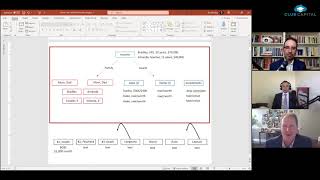
In this episode of the Club Capital Leadership Podcast, host Bradley Hamner (with co‑host Chris Ferretti) interviews insurance‑industry veteran Bill Whitley about his “Your World Conversation,” a visual discovery framework that helps agents map a client’s entire risk profile. Bill explains the origins of the tool, how it was traditionally done on a whiteboard, and how a virtual PowerPoint version was created to accommodate remote meetings during the COVID‑19 era. A role‑play with Bradley demonstrates the step‑by‑step process: gathering personal data (marital status, income, family members, assets, debts, retirement accounts), visualizing the information in a diagram, and then reviewing seven core risk categories—health, disability/paycheck, life, longevity, home, auto, and liability/umbrella. Bill shows how the conversation surfaces client priorities, leading to targeted protection recommendations. The hosts discuss the practical benefits of the virtual format: easier appointment setting, cleaner diagrams, ability to serve busy or remote clients, higher client engagement, increased retention, cross‑selling, and referral generation. Bill also outlines the business model: the diagram tool is offered for free, but agents can access coaching to master the conversation through two paid programs—Infantry Training School (group coaching, $497/month, six‑month curriculum) and private coaching ($897/month). Contact information and a link to riskadvisorinstitute.com are provided for listeners who want to enroll. The episode concludes with reflections on how the visual, client‑centric approach simplifies complex insurance concepts and drives agency growth.
Chapters
So the big question is this: how do small business owners like us grow our business, grow our leadership, and develop our teams in a way that allows us to get our products and services out to the world yet still remain profitable?
That is the question, and this podcast will give you the answers. I'm Bradley Hamner, and I'm Chris Ferretti.
This is the Club Capital Leadership Podcast. Bill, we're really excited to have you on for the second time.
Oh, thanks so much. Pleasure to be here.
Bill, can you talk to us specifically about the Your World Conversation. I mean, we alluded to it last time that you were on the podcast, but can you talk to us about that specifically?
Absolutely. So, the Your World Conversation is a discovery conversation you can have with your client. The beautiful thing about it, it makes the client situation simple, visual, easy to understand. And so, it's something that's been around for a long time. We've been teaching it for 10 years. And we've been teaching agents that you would always do it in a face-to-face meeting, and you hop up on a white dry erase marker board and draw out the diagram, or you do it on a blank sheet of paper. But now with coronavirus, of course, it's much more difficult to meet with your customers. So we've actually developed a virtual version of the Your World Conversation. I can't wait to show it to you today.
I can't wait. Let's get into it.
All right, so Bradley, we're going to do a quick role play. Now, for this role play, I'm going to be the agent, you're going to be the customer. And for this little role play, you work at UPS, you make $70,000 per year. So let's suppose I had scheduled a review with you. When, when we, when we start the review, I would just start off and say, so Bradley, I want to let you know here at the Bill Whitley Agency, we're a little different from other companies. We help our customers manage their everyday risk. Now, the way we do that I have this diagram I'd like to draw for you. I call it Your World. It'll make your whole situation so simple and visual and easy to understand. I think you're going to really enjoy this, but I need to let you know, in order to draw this diagram for you properly, I'm going to have to ask you some personal questions. So Bradley, does that make sense to you? Yes, it does.
Absolutely.
Okay, great. So let's go ahead and get started now. I'm going to start off and Bradley, I'm going to put your name right up here at the top of the screen. So I got Bradley. Oops. Bradley. And Bradley, are you married?
I am married.
Yes. What's your wife's name?
My wife's name is Amanda.
Amanda. Okay. Now everybody loves you and Amanda for a variety of reasons, but one of the reasons they love you is that you guys create income. So Bradley, tell me what you do for a living.
I am a UPS driver.
All right, and how long you been driving for UPS?
Uh, just a little over 10 years.
All right, congratulations. And Bradley, if you don't mind me asking, how much do you make each year driving for UPS?
We're just right at $70,000.
All right, great. Now how about Amanda? Does she also work outside the home?
She does, yes. She is a teacher, 5th grade, and she makes about $40,000 a year.
All right. And how long has she been a teacher now?
Uh, she too has been a teacher 11 years.
All right. 11 years. You said she makes $40,000.
That's great.
Now your income and Amanda's income goes in one of two directions. It either goes to support your family or to purchase assets. So let's start by talking about your family. Now I'm going to back up here real quick and just show you what I'm doing. We've actually engineered the entire Your World Diagram in PowerPoint. We've covered each piece of it up with a little white box. So you can't tell that it's there, but the whole diagram's there. So all the agent has to do, or the team member, they just, if they click and then hit delete, the arrows pop up and then they click and hit delete and the family pops up. So I'm going to go ahead and put you right here. I got Bradley, Bradley, and I've got Amanda. And do you all have children?
Yes, we do. We have two.
All right. Now let's suppose you'd said 5. I would just hit copy paste and congratulations. You and Amanda now have 5 children. Just kidding.
Glad we don't.
That's right. You said 2. So I'm just going to delete one child and I'll grab these two and I'm going to scooch them over here to the left. And what are your children's names?
Uh, Cooper, and he is 9, and Victoria, she is 6.
Victoria is 6. That's great. Now, of course, I'd want to ask about your mom and dad, you know, their names and ages and that sort of thing, because you know as well as I know a parent can become a dependent. But I'm just gonna kind of skip through some of this. Once I understand your income and I understand your family, I'm gonna say, so Bradley, thanks so much for sharing that. I want to move over to the asset side. So Bradley, tell me, what type of car do you drive?
I have a Toyota Tundra.
Tundra. Okay. And do you still owe money on the Tundra?
We do. We owe about $30,000.
All right. And oops. And what do you think the Tundra is worth?
I think it's probably worth maybe about $40,000 right now.
All right, great. And of course, I'd want to know about Amanda's car, and then I'd want to know if you guys own or rent your home and you have any rental properties. But again, I'm just going to skip over some of this. The last thing I'm gonna ask is if you and Amanda have started any type of retirement program. And for this exercise, we're gonna say you guys have a 401(k) and it's worth $100,000. Oops. Now, once I understand your income, your family, and your assets, I'm gonna do a quick little summary. So Bradley, here's what I heard you say. Then I'm gonna ask the very important question. Is there anything I missed? And when you say, "No, Bill, that's all I got to say." So, Bradley, as your risk advisor, I think about 7 things, the 7 biggest risks we all face. Now, the first thing I think about is your health, because you know as well as I know, if you had a major medical procedure, it can cost a lot of money, and I don't want anything to erode those assets. So, tell me about your healthcare coverage. And for this example, we're gonna say that you and Amanda have Blue Cross Blue Shield and you guys spend $1,000 a month. Now, Bradley, the second thing I think about is your paycheck. You know, if you got sick or injured and you couldn't drive for UPS, would your family be okay? Now, some people have disability through work, some people don't. Some understand disability, some don't. So if they— customer doesn't understand disability, you just go to screen number 2 and say, so Bradley, here's how disability works. I got this job and that job. Now, this job pays you $70,000 per year, but if you get sick or injured, it doesn't pay anything at all. And over here on the right, I got that job. Now, that job only pays $68,000 per year, but if you get sick or injured, it's going to pay you $50,000 per year until you're back on your feet. So Bradley, which job would you prefer, this job or that job?
I'm gonna take that job.
Yeah, and that's what every one of my customers says, and that's exactly how disability coverage works. We would just take $2,000 of your income, use it to buy a disability policy, and if you get sick or injured, we're gonna step up and pay you $50,000 per year until you're back on your feet. Now, I want to go back to the diagram because the third thing I think about for you is, you know, God forbid, if you were to pass away prematurely, would your family be okay? And one of the things we teach every one of our clients is what we call the life conversation. Again, I'm just going to skip over that for now. Bradley, the fourth thing I think about for you is just the opposite. If you live a really long time, is it possible you can outlive your assets? And if you have that concern, we call that a longevity risk. And I can recommend some ways you'll never outlive your income. Fifth thing I think about is your home, and I got to tell you, Bradley, I'm really happy with the way we have you insured. And the sixth thing I think about, your cars, and I'm very happy with the way we have insured. And the last thing I think about is if you hit the guy and you were sued for $900,000, would your world be okay? If not, we should be talking about lawsuit protection, which is known as an umbrella policy. And then I'm just going to wrap up by saying, so Bradley, as your risk advisor, My job is to help you build a wall of protection. So, if any of these accidents happen, they're just gonna bounce right off that wall. And Bradley, I need to let you know, we're not gonna build this wall today. But my goal as your advisor is to help you build it over time. And so, my question for you is, which of these risks concern you the most and where would you like to start? So, Bradley, what would your top 3 priorities be?
You know, I think I'm gonna say health, paycheck, and death, actually in that order. We've had some, especially with the, you know, what's been going on with the virus recently, that's certainly been more on the forefront. I have thought about paycheck more because of some issues with my back. And then my wife and I were actually talking about, we lost a dear friend. So, I'm actually going to say in that order: health, paycheck, and death.
Very good. And so, I'm just going to put a number 1 by health, number 2 by paycheck, and number 3 by death. And at this point, if I was your agent, I would go to work helping you with whatever I can help you with today. And if there's anything where I need to do some homework or you need to do some homework, I'm going to go ahead and schedule a follow-up meeting. We'll put it in the calendar. And you have just experienced a virtual Your World Conversation. Bradley, let me ask, what are your just initial thoughts about this?
I think it's fantastic. I love the visual. I mean, so many times people are— we're visual people, and I love the colors, and I just love how easy it is to be able to navigate. I think it's fantastic. Chris, what are your thoughts?
Definitely a visual person as well, and I think that this is— I mean, it just makes it a whole lot easier for get for making people actually agree to do a conversation like this because of the fact that number one, it's just a lot more convenient, it's virtual. And number two, you know, they can do it from anywhere in the world, I mean, which is the same thing. But yeah, definitely a fan of how things are run right now.
Yeah, thank you. We've had agents that have been using this for 3 months now, and we hear over and over and over that they like the virtual Your World even better than doing it face-to-face. And they say they like it better for 3 reasons. The first one is they say, "Bill, the appointments are easier to set." You know, now I'm just setting a phone review and they'll chat with the customer and then they move the meeting to Zoom or to whatever virtual technology they're using. So, number 1, the appointment's easier to set. Number 2, the diagram looks better. We had a lot of agents that said, "Bill," My handwriting looks like a third grader with a crayon. And so now, if you can click, delete, and type, your diagram's gonna look exactly like that. And then third, and I didn't even think this would happen, but it makes total sense. I've had a lot of agents say, "Bill, some of my best customers would never meet with me. They just were too busy to come into my office." And now, with this virtual Your World, they say, "I'm having reviews." with my very best customers. So, and they've all said, by the way, I wish I'd done this 10 years ago. So, anyway, I'm glad you guys like it. It's been really great. Any other thoughts or questions?
Yeah, I do have one comment and then one question. So, first of all, I love the way that it breaks down simply something that can be very complex. I mean, if you're in the insurance business, it's easy to have a lot of techno-babble. We use a lot of acronyms and words that are very familiar to us because we are in it every day. But to the customers, they don't know that at all. And so I love the way that it just makes it so much, so easy for the customer. I mean, it breaks something that can be complex to the customer so simply. The second thing is, just if somebody wanted to get started with this and they say, "Yeah, I want this for me and my team," what's the best way for them to be able to get started with it?
Absolutely. So we don't sell this, we give it away for free. And so this is included. We, we have two coaching offerings. One is called Infantry Training School. This is group coaching. We charge $497 per month to be in our group coaching, and it's a 6-month curriculum. Uh, so it's included with Infantry Training School for free. The second option, we do private coaching Our private coaching is $897 per month. And again, we include it for free. So if anybody's interested in this, we'd like to get you enrolled in one of our coaching programs. And the reason we say that we give it away for free is that the technology is the easy part. The challenge is teaching the agents how to pivot into the risk, how to have the conversation, how to ask all the questions, how to overcome the objections. And so that's why we just include it for free with our training program. And we'd be delighted to work with any of your clients and get them trained up on this.
This is great, Bill. Thank you so much. Chris, any thoughts from you?
Yeah, actually, I mean, uh, so I mean, Bradley, you're an agency owner, and Bill, I mean, like, you've been doing this for 20+ years, so this is, this is like second nature to you, you know? Like, it's just like, this is just something that you live and breathe every single day. Despite me working with insurance agents day in and day out, I'm still not familiarized with the insurance role specifically, like, like, as far as all the all the risks that are out there for me and how I can protect myself. So even when going through this role play, I actually was answering the questions in my head and then seeing all the possible risks per se, and then asking myself the same questions that you're asking Bradley. I can see how going through this conversation makes it a lot more palatable and easy for a person to actually make a multi-line decision. It's easy for a person to actually see all their potential risks and then realize this is not something that I'm going to protect myself from today. But today I can easily increase my health protection, my disability protection, and in the event that I pass away, I can get life insurance to make sure that my family is taken care of. So, I mean, even for—
and, and excuse me for interrupting, but it's, it's a great comment. And so what's very exciting to us is the agents that get really good at your world, when this becomes the major way that they communicate with their clients, they'll use it for reviews, they'll use it for onboarding. If they have a customer who calls in that's upset about something, they'll just say, I totally understand, I'm going to help you with that, but you need to know we're a little different. We help people manage everyday risk, and I must understand your world. When can we schedule a call so I can understand your complete situation? So anyway, the agencies that use this all the time say that the very first thing— doesn't matter who the customer is, if they were angry or happy— the very first thing the customer says after they've received a Your World Conversation and Diagram, they say, thank you, nobody's ever done this for me before. The second thing they say is, can I have a copy of that diagram? And the agent, of course, said absolutely. And I would, at the end of this conversation, I would just do save as. I would save this to my W drive. I'd create a PDF version, and now I'm going to email it to Bradley and Amanda. So they say thank you. They say, can I have a copy? They rarely ever leave the agency. We've had agency customers that said For the first time ever, I understand why I'm paying for an agent. So retention goes up. Of course, cross-sell goes up. You'll start to have deeper multi-line relationships with your customers. And then the final thing that happens with this is that you're going to get more referrals. When a customer says thank you, it's so easy to say, oh, Bradley, you're welcome. Favorite part of my job. And by the way, Bradley, Are there people that you know that I should be doing this for that haven't had a conversation like this? If so, I'd be happy to do the same thing for them. So Bradley, who would be 2 or 3 people you know that I should be introducing myself to and doing this for? So we have agents that average 3 referrals per conversation. Wow. So let's suppose your agency could do 10 of these per week. That's 500 per year. That's 1,500 referrals per year. And so it really eliminates the need to spend a lot of money on marketing because your best customers are now referring you to their friends.
Wow, I love it. Bill, thanks so much for coming back on a second time and sharing this with us and just being so gracious with with your time and sharing this. I think this is fantastic and it's going to help agents across the country. Thank you.
Oh, my pleasure. And if anybody wants to get enrolled in our coaching programs, just go to riskadvisorinstitute.com. You can click on training products and you'll see our different coaching options. If anybody has a question for me, I'd love to chat with you. My email is bill@billwhitley.com. If you want to send me a text My cell phone is 704-996-2800. So Chris Bradley, it's been a pleasure. I appreciate everything you guys are doing for agents, and I'm happy to help in any way I can. So thank you so much for inviting me to be a guest.
Absolutely. Thank you. And we'll make sure we put all of the links to everything that Bill just mentioned in the show notes and in the episode notes. So Bill, thanks again.
Thank you, Bill.
Take care.
See you guys.
See ya.










