Episode 234: We Love Insurance, But We Love People More with Beau Vincent
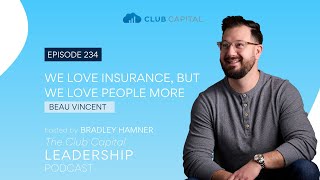
In this Club Capital Leadership Podcast episode, host Bradley Hamner interviews Beau (Bo) Vincent, an Allstate insurance agency owner, consultant, and podcast host. The conversation begins with Beau’s origin story, detailing his transition from retail management to insurance after a pivotal motorcycle accident that shifted his perspective toward helping people. Beau shares how he grew his agency from a modest start in 2019 to over $5 million in premium, emphasizing a people‑first philosophy encapsulated in his trademarked slogan “We love insurance, but we love people more.” The discussion covers hiring, culture, compensation, and training—highlighting the balance between paying well and fostering a strong culture, the challenges of hiring culturally‑fit salespeople, and the importance of transparent, value‑based selling. Beau describes how his agency navigated COVID by hiring top talent, and he stresses the need for clear SOPs/playbooks and treating these processes as intellectual‑property assets, even trademarking the slogan. The episode delves into scaling strategies, the role of continuous improvement (Kaizen), resistance to change, and the leader’s responsibility to manage potential loss fears in staff. Both hosts stress that leadership success is measured by the growth of people, not just personal metrics. Contact information for Beau’s coaching and podcast is provided at the end.
Chapters
So the big question is this: how do small business owners like us grow our leadership, develop our teams, and scale our business in a way that allows us to get our products and services out to the world yet still remain profitable? That is the question, and this podcast will give you the answers. I'm Bradley Hamner, and this is the Club Capital Leadership Podcast. Welcome to The Bottom Line, a new weekly podcast series that we drop every Thursday to complement our weekly Monday podcast interviews with the industry leaders.
These podcasts are going to be designed to give you short, impactful, and value-driven information that you can start using right away in your business.
I value your time and attention and will do my very best not to waste it.
Just get what you need and go.
So with that, let's get into today's episode. Are you an agency owner looking to grow your revenue, increase your bottom line, and better manage your taxes? Club Capital is here to help. Club Capital is the largest accounting and advisory firm for insurance agents in the country, providing monthly accounting, tax strategy, and CFO services. Way more than bookkeeping and your everyday run-of-the-mill tax prep, Club Capital is focused on providing financial and tax advisory services that help you plan and forecast your agency's performance. Their financial dashboards and agency forecasting tools help you better understand your agency's historical performance, Create, measure future targets, and see how your agency compares to your peers around the country. Imagine what it would be like to understand the impact to your bottom line when deciding to hire a new employee, or forecast the impact rate changes or commission rates will have on your business. With over $200 million in tracked annual revenue and $140 million in tracked annual expenses, Club Capital has the data and the team to help you make better informed decisions for your agency. They will help you turn that back office stress into the backbone of your agency's success by giving you the tools to take your agent agency and your leadership to the next level. Visit club.capital today to book a solution overview with one of our business consultants. Club Capital— way more than a CPA firm.
Welcome to another episode of the Club Capital Leadership Podcast. My name is Bradley Hamner, your host. On today's episode, we have Bo Vincent. He is an Allstate Insurance Agency owner, a consultant and coach for Craig Wiggins Coaching, and he just launched season 2 of his podcast, The Conviction of a Leader. We talk about all things entrepreneurship and leadership in this podcast. I think you're going to get both some high-level thinking, some high-level concepts, all the way down to some practical things that you can put into place right away. Without further ado, here's my conversation with Bo Vincent. Bo Vincent, welcome to the Club Capital Leadership Podcast.
Thank you. Thank you so much for having me, Bradley.
Yeah, pumped to have you. Well, we always start with background and origin story. So you and I, before we hit record, I was— we were getting into it and I said, hey, wait a minute, let's, let's, let's put this on the, on the podcast. So, uh, yeah, yeah, tell our listeners a little bit about your background.
Yeah, so, uh, started in retail, completely different from where I'm at today, which is a business owner, an insurance agency, right, and a consultant. But so I started in retail at Right out of, uh, like I was in high school, and then after high school I went to college and somehow found my way back into store manager and training, uh, retail. I went through stores in the mall and eventually led to running 3 states for a retailer, same retailer that I started with. And then that led to me becoming more of a regional-based manager. And then I, uh, wanted to own an insurance agency because a recruiter on LinkedIn reached out to me and, uh, could see some of the things on my resume. Like I was helping, uh, do a little bit of consulting on the side and they saw that and they, uh, talked to me. It maybe attracted them a little bit more to the entrepreneur side of me and went through this State Farm process, right? And the State Farm, uh, recruiter really got me hooked. And then I got cold feet, right? Because a lot of people say, I want to be an entrepreneur, business owner until they have a cushy job with a salary and, and, uh, insurance, right? 401k. So they got me interested. Uh, I took, took a back seat and I said no. And another carrier eventually came to me at a different time and it fit. And I waited a little bit longer and ended up where I wanted to be, was able to buy a book of business. And, uh, that was 2019 of October, and You know, fast forward to today, I am, uh, what, I don't know, 10 times that almost now in size, over $5 million of premium in Ohio, which is— Ohio is a very low premium state. And, uh, also got the blessing and God answered my prayers because I'm also a consultant for other business owners now through Craig Wiggins Coaching and Consulting for insurance agents. So kind of got the best of both worlds. And, uh, I almost backed out. One thing I want to tell you, Bradley, almost backed out. And I was in New York City, and at the time I was working at a shoe store, big name shoe store in the mall, as a regional. I was in New York City visiting my cousin. We were on the Bronx Expressway. The green sign on the right says Brooklyn, 3 miles, whatever, right? You know exactly what I'm talking about on the highway. And a motorcyclist flies by us And that's all I saw was somebody flew by going 100, 120 miles an hour. And in, in New York City, when people stop and get out of their car, it's a little scary. So what happened is that every— all the lights in front of us turned red, the brake lights of cars, and they started pulling over. And I pulled over. The guy directly in front of me, he was maybe 100 yards in front of me, I get out and I'm like, what happened? And what is going on? Like, I didn't— I was like worried, like something happened, like in like a terrorist attack in the city or something. And he said, no, did you see the Michael, our motorcyclist? And I'm like, yeah, absolutely. Flew right by me. He goes, he ran into my car. So he had ran into the front. He tried to cut off the car that was directly in front of me. What it did is it projected him. And he flew, and it was dark out, and, uh, that's why I stopped. And I'm like, where did he go? Well, I was in a minivan that we rented for the weekend with my mom, sister, and my wife and kids. And we get out, and me and my sister start to look for this guy. And my sister actually found him. He had hit the green sign. He flew so far, he hit the green sign, fell below. And when I got to him, I told you I was working for a retailer about shoes. And, um, I had already decided I want to do insurance, but I was starting like getting cold feet. Well, I looked down and he had no shoes on and he like, so I thought to myself like, wow, shoes don't really matter at the end of your life. So, and that's what I, you know, I was in charge of 31 locations, sold shoes and I know that I always focused on my employees first, but it really made me think, I want to sell something that benefits people when they're on here on Earth and when they die. And insurance was one of those things where I started to think, because I had just got my license to prepare for an insurance career, and I realized, like, man, I hope he had motorcycle insurance. I hope he had, you know, maybe a personal umbrella policy. I hope maybe he had life insurance. Help— he had everything lined up in his life because he could leave his family actually worse off than when he was here if he didn't take care of himself. And I thought, and it just was one of those things, moments where I looked down, I'm like, he's got no shoes on because they flew off from the impact. And I'm like, they don't matter at the end of your life. So I don't mean to get all personal right up front, but that's how I decided to stick with it. And then I bought an insurance agency and here I am today.
Well, I will tell you, I appreciate you actually sharing that story.
Yeah.
And giving those details. And here's why. I was actually just this morning talking to some people about this very thing, about the purpose, like what you do, no matter what business you're in that you own, if it's an insurance agency, which a lot of people, our listeners do, like very much on this podcast and yours, we talk about leadership development, growing the business. We're gonna pivot to that in a second. We're talking about how do you grow? Yeah. How do you scale? How do you, How do you lead a team? How do you find A-players? How do you— there's so much of that around business. And oftentimes, I mean, I would be the one that, if nothing else, I'm guilty of this too, is you can lose sight of like what you do matters.
Absolutely.
It matters big time. Like, at the end of the day, you're impacting lives. Actually, what, you know, you and I were talking about this. About podcast listeners, right? So you can, you can sometimes podcast downloads, you can start looking at numbers and be like, all right, wait a minute, how many did we do last month? And then you, then I have to sometimes stop and go, wait a minute now, that's not what it's about. Every download, everyone, there is somebody listening to this right now that you're in their earbuds. They're on the treadmill, they're getting close to spring, maybe cutting grass or doing something, or hitting balls on the range, or driving, or doing something, right?
Right.
And it matters. It matters what we do to try to— whether it's a podcast episode, an insurance agency, any other entrepreneurial small business, like, there are people behind all of those numbers. And so when you talk about scoreboards and dashboards and all these other things, like, yeah, But behind all that is people. And so I think that it's really cool that you shared that.
So thank you. I do feel like what we do from the insurance side and from the podcast side is both about like, it feels much bigger than me, right? And if I only impact one person a week through podcasts or insurance, it's one extra person though. That we did impact. And, um, I have the same that I heard along the way, um, and it was to be a man— I want to be a man of worth, not a man of success, because if I seek success, that's probably all I'll find, and I'll be alone when I get there. But I want to be a man of worth. And like you said, to put out a podcast takes a lot of effort and work. And if that's what you work hard to put out is a podcast for success in numbers and money it'll— it's kind of lonely and that's all you'll get out of it. But if we do, we're seeking to add value to people's life and worth, it'll be way worth more than that.
Yeah, no question. Yeah, no question. All right, so we gotta know, like, if you grow— I mean, goodness, you, you, you launch your business in October 2019.
Yeah.
And you're 10 times that now in a short amount of period of time, and you are were 5 months— no, well, 6, 6 months into before this thing called COVID launched. Okay. Or came in and infected all of our— I shouldn't say launched, but like came into all of our world, right? So I mean, my goodness, what a time to start a business, right? What are— before we get into like the nuts and bolts of like, how do you— how did you scale? What— I'm curious, what is maybe one or two things that you learned from your time in retail? Because I know a lot of people listening to this have had some sort of experience in retail. And you said you were working for a big company. And so what are some of the things that you learned in your time there that you immediately have applied to your business today?
That's a great question. So, and most people that ask that are like, I need a minute to think, but it is a great question. I have, I actually have an answer right away. So I used to walk around and I used to say— I'd go into a store and I wanted to make an impact, right? And I wanted to start out with this keeping people at the center of everything that I do. So I had the same— when I was in footwear retail, I would say, hey Bradley, we love shoes, but we love people more. And guess what I say now? We love insurance, but we love people more. And I trademarked it because it became so— like, it's pending, but it's been about a year, so hopefully it gets approved any day now. But like, I've been walking around saying that, and it's at the core is that if I keep my customers— well, actually, if my customers are my employees and my job is to make them feel safe, keep them at the center of all that I do, if I first sacrifice— and in the beginning I had to sacrifice, right? So what I mean by that is I had to hire a lot of people with not a lot of income. So I sacrificed my pay in order to help them grow and be successful in the beginning. And eventually I knew if they were successful, I would eventually be successful. And what's cool is if you keep a customer, your employee, at the center of everything that you do, they feel safe, they feel loved, belong, they want to stay there, and they know that if I fail, they've already failed. Because I keep them on the forefront of what I do. But I know that if they win, eventually I do win. I just got to sacrifice a little longer to get to that point. So it was all about people. So we say every day, every interview, every customer, we love insurance, we love people more. And that means that we have to sometimes lose sales because they might have better coverage at a better price. And instead of tricking them into thinking that I have what's better for them When I don't, we don't. We're willing to lose that sale. But my— that's because my employees know that they're safe with me because we have an expectation of excellence within our agency and in our crew. So we aim for excellence and perfection, but I have grace and forgiveness when we don't, if they are the right person doing the right things with the right habits. So I'm not a guy that's like, look at this number, and I yell. I look at the number and say, where did we miss a habit or training along the way? So it's always been people, and it always will be, is that I am— I had to learn in my past career, because in retail, if you understand, like, the entry-level retail is pretty much minimum wage. So we turn over a lot of those, right? Development and progression is what kept them there, or maybe a discount. Right. So we had to make them feel bigger than their pay. And a lot of times that's culture. And you and I know, and I always say this, there's this invisible line. And I figured it out in my past career that I was able to bring to my own business, which I take way more pride. I thought I owned every retailing job I had, but then I realized, man, this is what ownership's like. But there's an invisible line and it's gray. Can't see it where, and it's different for each person, where culture and pay have to meet. We can't expect underpayment to make up for good culture, and we can't expect overpayment or paying people, you know, $100 grand to sell insurance is going to make up for bad culture and treating them like crap and making them work all the time. So I understood that it was people, culture, and pay. Let's be honest, that's about it. Once I get the right person, I gotta pay 'em right.
Yeah.
I gotta give 'em a culture. So, and training falls into some of those things. So yeah, that's been, that was what really generated it. And then we hit that fricking block, blockade, which was COVID. And instead of shuttering down, you know what we did? I hired some of the best employees I have now in my core during that time because other agents were afraid and they laid off people or they said, Go claim unemployment for a while and I'll let you know what changes. I was like, I told every— I made it very clear, anybody who's a top performer anywhere else, yeah, I got a job here. And we, we, we actually— I was our top salesman at that 6 months still, and I haven't been the top salesman since. I don't even sell anymore. But so my bit, my ability to you know, recruit and train and be proactive versus reactive helped us get there. But man, nothing is harder, Bradley, to be an entrepreneur who gets a big paycheck and has to pay everybody else before them. And nobody else can understand that until they get into our role. It was so easier to spend my past employer's money and ask for more raises. And, you know, it's another thing when you get all the money and then you got to pay it all out.
Yeah.
So anyway, so people, right?
I think that, you know, there's so many things I want to, I want to touch on with that. I appreciate very much several things, but one in particular is around paying people well. Okay.
Right.
And the reason is, is because I got this wrong. Okay. Starting out entrepreneurship is like, okay, how can I get somebody at the lowest price, not to try to squeeze as much out of them, because I didn't have much, right? And so the idea was like, okay, look, I'm gonna pay people the lowest amount that I can and have a compensation plan that, you know, shows all of this money. But the reality is they're not going to do that.
They're not going to get—
it was just like, it was just pie in the sky type of stuff, right? And I think that, you know, if you take it to even a much bigger business You know, I had Cameron Herald on the podcast not long ago, and he talked about this in his book, Second in Command. Look, there is a difference between somebody who is a $100,000 employee, which I know many of us don't have a $100,000 employee, right? There's a difference between $50,000 and $100,000. And he was like, there's a difference between somebody that's $100,000 and $250,000. And then there's a big difference between $250,000 and $500,000. Like, you know, there's just levels to aptitude and ability. The point is, right. You're not going to get an A player and pay them like D wages. Like, it doesn't work that way. And there's so much competition in the marketplace.
People—
there's now hiring signs everywhere, right?
Everywhere.
Not just in Alabama, but in Ohio and across the country. And so there's just so much competition. You can't get away with that anymore. Yes, you can't expect that. You have to pay people well and then wrap them in culture. I like to say environment dictates performance, which effectively ends up becoming, becoming the culture that you have.
Yeah.
What are some other things like, let's take the idea of high level to eye level, like we love people more. Can you give some other specific examples that are very tangible? Okay. I'm looking for something kind of very specific of something that you do or have done in the past that somebody can be like, okay, I get what he's saying about loving the team and getting good people and paying people well, but is there something else that you can share to say like, wait, let me give you a specific thing that we do that we think is different?
Yeah. So I mean, first and foremost, if we're starting with the customer, we're, we're very transparent because I have— I stole the same from Mark Cuban. Selling isn't about convincing, it's about helping. So once you understand what a customer needs, you just have to educate them and you'll lead them to the right answer, essentially. So we, we, we lead with like our coverage and liability because we know that that's what's most important. If something happens to somebody, we're willing to say— if we're looking at somebody's coverage, we're willing to say, you know what, you have really good coverage, it's exactly where I would have put you. But You know, we are like $500 more. I don't— there's no way for me to go around it. And there are ways in the industry to maybe trick them or speak over them, and maybe we raise their deductible, but we leave that out of the conversation and we just say we match your coverage but we raise their deductible. We don't do that. We're very transparent in what we do and we educate, and we're willing to lose customers. So at my employees' level They're willing to lose a customer to revisit in the future. But what is so cool is that some customers have decided they want to work with us because of our transparency and trust. One, two, it shows my staff that, hey, I care about doing the right thing. So doing the right thing means losing the sale today to gain it in a year or two. I'm okay with that. One, two, because I said we strive for excellence. So I'm a pretty, like, spiritual, religious— I don't know how people describe it nowadays— person. But, um, I believe that you should strive for perfection in our agency and in our business. But I have to have the grace when people fail. And one thing that always bothered me in my past life is that they always wanted to know what Beau did today. What have you done for me today? I don't care about yesterday. I don't even care about lately. What have you done for me today? Because I wanted to be— I had a guest on my podcast one day say, I don't know where he got it from, but he said, be the thermostat, not the thermometer. And that actually puts into words what I'm trying to say better, is that I set the expectations. I don't go up and down with the day and the weather in this. I set the way that our agency is going to lead with, which, which essentially I'm setting the thermostat for our culture, right? And our expectations. So when I say that I set these expectations super high is because I see a lot of potential in the staff that I bring on, and I invest a lot of time up front. So when I say I love people more, I've put so much more training into people up front because I say, Bradley, if I, if I'm going to recruit you, I'm taking your career in my hand, and I owe you something now because you're giving me trust. So there's a social contract where You're giving me trust. I'm offering a service of a career and training, right? So even though I pay you, I look way beyond that, is that I'm taking your career in my hand. You could have found one. There's plenty out there. So I have to have— show the love of people before I see a profit. And most people that I speak to in our agency is like, you haven't shown me a profit yet, I gotta let you go. It's been 30 days. So I give 90 days of training before I even worry about profit. But I am willing, Bradley, to let go of somebody in the first 90 days. That's not what I'm saying, is that you have to accept people, but to be like not what they maybe promised or thought they would be. Because like, here's an example. I hired somebody that was a perfect cultural fit. He was not a great salesperson. Loved him to death. It was so hard because his culture, his intangibles of just being there and inspiring people was amazing, but he was a horrible salesperson. Yeah, froze up. Okay. So I had to go to him and I say, you know what, I think somebody that didn't care about people more would have let them either stay longer or fired them on the spot. What I did is I went to him, had a conversation. I just said, you know, we like you being here. But do you want to be here and do you think you should be a salesperson? And it was a super easy conversation. He answered no. And I said, have you been interviewing? And he said yes. And I said, well, I think that today should be your last day then. So instead of being so emotional and leading with emotions, I try to lead from a place of love because a lot of people lead from a place of fear. Fear causes emotions. I'm fearful, Bradley, that he's going to take my money and ruin my business. I've never been I have the love side that I hired him and I got to show him love. I want to celebrate him the same way I did when I hired him, when I let him go.
Yeah.
So that's the hardest thing is as a business owner is to show grace and mercy or love when you're firing somebody or letting them go, because it's never had to be emotional or personal because we struggle with conflict. We tend, we tend to equate back to our insecurities or our emotions, and fear is a big one. So fear causes us to be emotional, right? So if I stay on that side of like, I love people and I don't always want to stick to that some days, but I know that's the person that I was made to be and I want to be. So it's extremely hard and challenging to do that. But that's one thing is like I celebrated him as he went and I told the staff like, you know, he was a great, great person. He just wasn't the best fit for ours. And you know what he wanted to do? And I should have known this. It's my fault. He told me his long-term goal was to own a coffee shop. And let me tell you, baristas are not salesmen like we are. They're great communicators. They're really great. Some of them are great communicators and great service people, but they don't sell.
Yeah.
So yeah, anyway, so I hope that answered what— where I was going. But yeah, people over profit.
Yeah, it does. There's a few things. I think that oftentimes we maybe overestimate what someone can get done in a very short period of time, 90 days, and then really underestimate what people can get done over a longer period of time. And I think that what's very obvious is that you have some very clear expectations of what you're looking for in that first 90 days, right? But here's the thing. People listening to that say, well, that's not, that's not new information. Be clear, it has to be matched with the proper level of training and guidance. You've got to truly set them up for success or your expectations are not matched with reality. Okay. Because if you can know, so true, how this training works. I know this system works. I have done it repeatedly, put people through this and spit out people on the backside.
I don't—
that's probably a better— a bad way to put it, but on the backside, like they're prepared. Okay.
Yeah. Yeah. I get it.
Then, you know, that it works versus you can have clear expectations, but if you don't have world-class training, like you're, you're, you're, you're just hoping that they're just gonna be some kind of unicorn at, at some point. Like, you gotta agree, it's gotta match it.
Do, do. So there's two things I would love to add to that. So like eagles only fly with eagles. They don't fly with doves. They don't fly with pigeons. You want to recruit an eagle, you better fly as high or higher than the eagle. So you want your best employees and candidates to come work for you. The second they find out you're a fraud and you're a pigeon, they're gone. Yeah. So your interview process is like speaking this big game. You make 100 G's, 200 grand here. All this, we got good training. And then the next thing you know, here's your computer, here's our CRM, catch you later, you'll figure it out, you know? And then, so that's one. The other thing is this, and I love this analogy— I don't love it, but it's probably the best analogy I have— is, um, a recruiter for the Army says, hey, you are a soldier, you're a perfect soldier. And do they hire you give you the gun and send you to the war? Yeah, because you're a great soldier. No, they would set you up to die, literally die, right? But we do the same thing in our world. We say, hey, you're a great salesman, you have great experience, you could come to the insurance agency, be successful. Here's computer, good luck, here's a phone. And we don't match the training and the level of the person that we want within our agency. And I always say, Bradley, what if they're the problem? What if it's not that our candidate was the problem or the wrong hire? What if we're the problem? What if our training process was the problem? What if our leadership was the problem? What if we oversold it just to get them in and make 3 months of sales and then let them go? Yeah, yeah, it's funny, right?
Yeah, yeah, yeah. How about that? Maybe, maybe I should look in the mirror and realize that maybe I'm the problem, right?
Yep.
Um, yeah, I don't know, uh, where it was. I think we were doing my MBA earlier, but LeBron James, regardless of what people think about LeBron, especially you in Cleveland, right? I'm a Lakers guy down the road from—
nice.
He, you know, he, he posted this, I think it was a tweet and said like, you know, well, maybe it's me. This was before the trade deadline recently. And by the time this episode drops, I mean, we'll probably be in the playoffs at that point. But the point is, is like, I don't know if he was necessarily doing a looking in the mirror truly there, but like as leaders, there's this thing of like, Maybe we do need to look at that and look at us and say, not in a— as a person of faith, this has nothing to do with you being shameful. Okay? This is about you leading yourself and looking at this and saying, maybe I need to be better.
Okay?
See, I was the person for years that would point out where to be like, but Bo's just not— he's just not a player. He's not a player. Yeah, he's just not cut out for it. So anytime someone failed, Yeah, it was them, it wasn't me. You know, your last 5 people didn't work out. Well, Bradley, either you— maybe you don't have a really good recruiting process. Maybe you speak too much in, in the interviews instead of actually asking better questions. Maybe be better and develop better skills in interviewing, right, and bringing on people, and then have a better training program So that, so it's not everybody else right now.
Sure.
Some of those, some of those people, as you mentioned, that example you had, it's not, not the right fit, right? It's just, it was not going to work out for him or her. And so we, we certainly see that. No, no, no process.
And I ignored, so, and it was my fault. Wasn't his, you know why it was my fault is because I went from this complete opposite end of hiring salespeople that were awesome salespeople and I hated the culture. I did.
Ambition is the first step towards success. It's time to level up your agency, and Coach P Consulting will help you do just that by using the same strategies he used to sell over 700 life insurance policies in 2021 alone. Now, this is not your regular one-and-done type coaching. You'll get personalized coaching 2 days a week, every week of the month, and you'll get a live look behind the scenes of his team training and an office that's performing at the highest level. There's a reason Coach P Consulting is the fastest growing coaching company for insurance agency owners in the country. Coach P will train your team alongside his own and show you the exact steps they are taking to achieve Chairman's Circle, Exotic Travel, and Multi-Line Presidents Club and be one of the few agents to be selected to have a third office. So whether your goal is to be at the top of your local market or amongst the best in the country, this training will give you the strategies and the tactics to get there. For just $250 a month, you'll get high-level coaching each week from someone who is already getting it done at that level. And his strategies work, and it's time to put them to work for you. Sign up at coachpeakconsulting.com and get your first full month for free when you mention the Club Capital Leadership Podcast.
And I said, I gotta make a change. So I started hiring people that were cultural fit, but guess what I forgot? I forgot to qualify them to be salespeople in a sales position. So I started to fill my agency with culturally fit people. If they— we love insurance, we love people more, we put people first. But guess what? Then our— then their productivity went down. And then I said, okay, wait, I can do— I can fix this. I can identify people that are good cultural fits and make sure they're good salespeople. I just have to remind myself that's the goal here. So yeah, so that was the problem. I failed him. I brought him on as a, you know, as a salesperson when maybe he should have been a service guy, or maybe not even worked in insurance. So yeah, that was my fault.
So I'm going to, uh, if, if people are going to watch this on YouTube, I'm going to show this document in just a second.
Yeah.
I want to go back to something that you mentioned earlier that kind of was like thrown in and people would've bypassed it, but I, I want to call it out because it speaks to something that I've been sharing with people recently, and that is around creation of assets. Yeah, you made this comment and said, you know, that you were trademarked, right? You were trademarking that saying or in the process of getting it to be registered.
Trademark pending. Yeah. Mm-hmm.
Okay. If, if that goes through and you get that thing registered, but even if you don't now, you could put a TM next to that. I do.
I have a TM next to it.
Okay. Yeah.
Trademark pending.
I figured you would.
Yeah. So. So I learned that.
Yeah. Yeah. So thankfully, I, I, you know, you can put TM next to it and then you go get it registered trademark, right?
Then I get the sign, right? Yeah. Words out.
You get the R with the circle around it.
So my attorney said, hey, you could start using TM. And I finally started doing that. I kind of forgot for the first couple months, but I mean, literally it's coming up on almost a year.
Yeah.
It's last June. So I believe so. Takes so long, but Were you going to share a document? Yeah.
Yeah. So the reason I'm sharing this is because people hearing this, it has nothing to do necessarily with you needing to trademark sayings in your office. That's not what I'm saying here. What I'm saying here is that there are assets, digital assets that you have in the way that you do things that have value. Whether you have the desire to or can sell your business has no bearing on what I'm saying. Okay?
Yeah.
What I'm saying is, is the way you do things, the way you attract A-players, the way you train them, that process is a valuable asset to the business. Treat it as such. Okay? He has treated— Bo has treated this saying as an asset to the business. In fact, has taken it to several different levels. One of them is trademarking it now, going and registering it. Okay. But look at the way that you train people is now an asset to the business. Okay. And so I have this document I created. We call it— some people will be able to see it. It's called 24 Assets. I see it links to like every system that we have in the business about how we do things, right? And so like if somebody ever wanted to buy one of my companies, right? And they were like, hey, we're interested in making an investment, we're interested in buying it. I send them one document and say, here you go, here's everything, here's every asset to the business. This is what you're buying. You're not buying Bradley, you're not buying Beau, you're buying Beau's systems, you're buying Beau's assets. And those, those systems are assets because see, the assets like that desk and that chair you've got and that building that you're in, okay, yes, that's a physical asset. People think of things on the balance sheet as those assets. Where the real value of a company comes in is into the intellectual property, your system, the way you do things. I just would love to get your thoughts on, on that specifically.
I mean, as an entrepreneur, it's, it's amazing because I, I've— and it sounds like we're on some— we're still like paralleled. I'm, I'm probably like light years behind you as far as the parallels, but like newer to insurance, podcasting, coaching, consulting. But like, if I'm looking to venture out and diversify, right? And let's just say somebody wanted to buy my agency, okay? If I had the level of detail that you had to show them, like, this is what you're buying, we have these processes set up, we have this— it's not a book of business, actually a business with a standard operating process. And here's one for every single department, every process we have. Here's the SOP, standard operating procedure, and you can click it and you can get it. And when you buy it, you get that, and it is plug and play, my friend. Remove Beau and add Bradley, same business. Yep, right? If you can, if you can be a great leader, and you don't have to be the same, but you can plug and play. So when I'm looking to diversify or going to other agency or businesses And somebody was to show me a level of that because I had a friend, they wanted me to invest in a car lot. He showed up with every, like, uh, an Excel sheet printed out, and he told me he didn't have all the things on his P&L yet. And I'm just like scratching my head, and I'm like, so I'm not getting full transparency and you want money for me to invest in a, in a car lot? Like That's a big, big investment, right? And I, I don't know if you'll listen to this, but to, to him, I gave him the feedback like, hey man, you went to meet with me and some investors, investors I put you in front of. And that's how you showed up. Like, if you bring your best foot forward on a daily basis and you take these processes and then you put them on down into paper, what is so cool and so hard to do, Bradley, is to take what you do really well in your agency and to put it on paper. People think it's easier than it is. It's not that easy because I, I like do consulting for Craig Wiggins Coaching and also we'll do some insurance videos on their platform for live, live coaching. Uh, you can watch. And one of them was somebody's like, oh, you sell 40% of your businesses through mortgage brokers. Like in our, in our line of insurance, we buy a lot of leads and a lot of people want to get to 40, 50, 60, 70%. Coming from lenders, right? Well, they want to know how I did it, and I'm like, the first time was like, uh, really good with people, right? But it took me, um, a week to sit down almost every night and write it all out, and I realized, oh my God, I have steps and policies and procedures, and now it's an asset. Yes, I just took what was inside of my head, created an asset that now We're doing a class on Craig Wiggins, and I'm not here to sell that. I'm just saying that I took it from a thought in a process that I did, put it on paper, created a— made the process official, and now I can give it and sell it in whatever I want. So if somebody wanted to buy my agency, all those type of things like you have would come with that, right? But the coolest part about what you have there, if you brought that back up, some of those policies, those procedures, um you could pull out and put into a million different agencies or businesses, right?
Yeah. So, you know, there's, there's, um, let me, let me share this. Yeah. Because there's two aspects for people listening to this that they could consider. One is what you just mentioned, which was unpacking the IP from your head down on paper. Okay, that has to be done. You have so many things. People will say this, they can't read your mind. You're right, they cannot read your mind. They can read the document. They can write it, right? So like, get it out of your head. Here's the, here's the scary part, though. What I think is the scariest is that our team, our teams are walking around with so much intellectual property in their head. If they leave and that documentation for how— let's say that they move, right? They move and it's just they're not going to be—
doesn't work anymore. Yeah.
You lose all of that information unless it's been captured and pulled out and documented and say, oh man, we really hate to lose that person, right? Because they were an incredible cultural fit, whatever. But at least we grabbed the majority of the assets the way that they did things, and we can replicate, replicate that. So I just want to invite people that when you're thinking about— so instead of SOPs, I say playbooks. It doesn't matter.
Yeah, my— one of my backgrounds is why I say that, was auto parts. So yeah, yeah, yeah, same thing.
I mean, you know, come up with your own, um, you know, architecture of how you're going to name things, you know.
Yeah.
But, but I think, you know, creating a playbook, creating your SOP, etc., you yourself getting it out of your head about how you do things like you just mentioned, but also being able to pull it from your team members before they leave, I think is so key. All right. So I got to ask you.
Yeah.
You have scaled very quickly and I use that word very intentionally. It don't mean growth. Scale. Like you've actually scaled. You have and consult a lot of business owners as well. Yeah. They're looking at your rapid growth and they want that.
Okay. Yeah, of course.
What are a few things that you can look at from a perspective of you've done it?
Yeah.
You've helped other people to do it. You've seen the ones that have been able to scale pretty quickly. Do you see the ones who are plodding along? Okay. And I want you to draw a distinction between the two and share what are some of the very specific things that you see? Like, here's the things I see from the people that scale. Here's the ones that don't.
Hmm. That's a good question. So first off, the person that scales, they have a thought process that is, I want to get better in order to get bigger. So they're working with me to get better or to take my processes and make them theirs, right? And they make changes fast. So they understand that they want to get better in order to get bigger, and they are willing to work faster at the changes. The ones that are chugging along, or they come to me and they are resistant of change. I've tried that, Bo. It might have worked with you or people you work with, but doesn't work with me. So they're resistant to change. And when we agree on change, they're extremely slow to make the change. So what's funny though is I actually have talked a little bit about this, but You know, in life, whenever you make a change for the first time, it's extremely hard. But any kind of change is like a muscle. The more you do it, stronger it gets. The less you resist change. So you gotta be a change agent and lead change. And you gotta understand that, hey, 'cause some people come to me and they think I can just give them everything, which I can't. I can give you all my documents, all my guidelines, all these things, turnkey, put your name on it, do this. But guess what? If they don't themselves get better, I go back to the beginning, they can't get bigger. Okay, so I actually was consulting and helping a company way outside of insurance, and they had a really good idea— tech to tech, uh, B2B tech marketing. Same thing that you're asking me. They're like, wow, we had an amazing idea and we're really good at it. Now all of a sudden we have 20 full-time people And how do— like, they're like, how do we go from here? And I was like, you got to get better at leading people or hire somebody who does. It's the only way you grow from here. So I hope that answers it very directly. It's like there's a clear process or different clear difference between people who don't get better and do.
Yeah, I love it. I think it's great. I want to add my little bit of a commentary to that. Yeah, not a difference at all. So in my own journey, looking back on it, I would be reckless in my change. Here's what I mean by that. Yeah, I was changing too quick and not actually evaluating. Let's just use a marketing strategy or a compensation plan change, right? Thinking this is the silver bullet. So then I would— yeah. What do you do? Change. Oh, talk to somebody else. They're doing good. Oh, change. So versus being much slower, methodical, not emotional. Let me think through this. Let me maybe actually take 2 weeks to think.
Yeah.
Okay. How is this gonna affect this? I call 'em second order consequences. Yeah. Okay. I need to think through that. But here's the difference. When you do make the commitment, you go, it's all in. You go, you got to go. So I think, I think that what people need to hear there is a, okay, wait a minute, let me make sure I understand everything and then just go, okay, yeah, we're doing this, we're doing this and we are implementing so fast. We are going to be so fast to execute, but we're not doing it. I hear about it this morning and I'm doing it this afternoon. No, no, no, that's not what we're saying.
So I should have added that. Thank you for like That, that's exactly how I think too. So the thing is, I need to make sure I remember that next time I talk about something like this, because when I work with, you know, other owners, like, we're not, we're not, they're not making change after our first conversation, maybe even second or third, you know, it could take a month or two for us to develop the plan. Because here is something amazing that I just heard. You want to know why people are resistant to change? Because they're not, they're actually not. You know what they're resistant of? The potential of loss. This change is foreign. Okay, now, because Bradley, they're not resistant to change, because if I gave you a million bucks, that's going to change your life. You wouldn't resist it. Yeah, they're resistant of change that are— that is, they're not used to, right? There's a potential of loss. That's what they're afraid of. People aren't really afraid of change, right? They're just afraid of the potential loss. So our job as leaders is to make sure that we love insurance, we love people more. Because if I say I am going through the potential losses that these employees could incur before I roll out the change, because I have a great, great guy that I've worked with, but every single meeting or conference he goes to, he takes a million notes, goes back, spends a week writing up a plan and new processes, and then he delivers it the following Monday. We're talking 7 days after the conference, changes his whole business. Every conference he goes to, comes back, writes out the whole game plan, changes his business again. And what do people want out of leaders? Consistency.
Consistency, right?
So when I say this is 2023's plan and our goal now, I made it very clear where we needed to hit. But I did say every person we add, the goal goes up this many policies, but it can't go down if we lose people. So I was very— so if we're going to change a process slightly, what's funny is that there are, um, changes in, in our problems that we come to that we know the solution to, right? And as we grow and we scale, we don't know sometimes how to solve those and hiring a consultant or working with somebody that can help you find those is important. But also, when you work with somebody, they should be helping you grow. So a carpenter is not, is not described as successful because of how great his tools are. A carpenter is described by how great he is by what he builds. So a leader, a leader is not defined on how great my communication skills are and what skills I possess, but on how great the people that work for me become.
Love that. You know, I mean, I think that we can reconcile these, what can seemingly be conflicting things, but it's— they're really not. And it's adopting— you've probably heard of Kaizen, right? Like the continuous improvement. And so you want to be constantly tweaking and improving and iterating. Yeah, that's healthy. That's good. That's taking That's taking what you're doing and getting a little bit better, a little bit sharper. You know, we're, we're, we're— our messaging gets tighter. Maybe there's an implementation. Maybe we need to simplify the compensation plan a little bit, right? We need to totally tighten up our recruiting process, those sort of things. Oh, that's actually a good idea. I've not considered that for a quarterly bonus. Let me add that in. That's actually a really good thing. So we're talking about doing that. Yes. But at the same time, we're not talking about blowing up your entire business every single time, because what is— it's missed is the uptake. You end up like, you get to a point and then you set the business back 6 months, and then you spend all this time and effort to get it back to where it was. And then, and then you do it again, and it's constant back and forth. And so the business is never moving forward, even though you're actually working really, really hard. So anyway, yeah, so true. But we could end up chatting for like 3 hours. Okay, so next time we'll have you— we'll, we'll record, uh, we'll put you on the books for like a, a 2-hour podcast and we'll make it a 3-episode or something like that.
I would love that. And honestly, I would love to just talk to you off air too.
So, uh, what people want to connect with you, Bo, like, yeah, where, where would you point them to if they want to, uh, just chat you about what you guys do and what you got going.
Yeah. So anybody, if they want to directly reach out to me, Beau, B-E-A-U, at CraigWigginsCoaching.com. One. But you can also find me on Facebook, Beau Vincent, B-E-A-U. You can find me on my podcast, The Conviction of a Leader, on any major platform. You can type in my name or The Conviction of a Leader. You could follow The Conviction of a Leader on Instagram or Facebook. And you can follow me on Instagram, Facebook, or LinkedIn. So all those ways on social media-wise and then my email, anybody can reach out in those ways and I would just be, you know, pleasure to speak to whoever.
Awesome. All right, man, appreciate you and hope to have you back.
Thank you. Likewise. I can't wait. Thank you, Bradley.
I really enjoyed that episode with both. There's a few things, several things actually, that I circled that really stood out to me. I think Number 1 is him taking that idea, people at the core, like whenever they say, "We love people," more to the point to where they're actually trademarking that, I think is obviously taking it to a whole nother level. I also think that whenever we— the discussion around development, progress, and culture and where all of those, like culture and pay intersects, is that invisible line. I thought that part of the conversation was really impactful to me. I thought the little quip I think he got from Mark Cuban was, "Selling is all about helping," is a good reminder. Also, I'd heard this one before, but it was a really good reminder for me. I had not heard it in a while. It's about being the thermostat, not the thermometer. Not telling the temperature, but actually the one dictating it. So kind of like how I will say often that the one of the most important things you can give your team is your energy. They're going to feed off your energy. And another way to say that is be the thermostat for your business and for your team, not just the thermometer. And then also I personally love the idea. If you want to, you know, you got to get better to get bigger. And I think that that can be a really healthy place to be, is I need to get better. I need to get better. I don't have the skills, but right now that I need to get to the level that I want to be at. And to me, that's healthy because then I can look at it and say, okay, what are the skills I'm missing? What are the, what are the soft skills? What are the hard skills that I'm missing? Is it marketing? Is it finance? Is it Leadership development? Is it recruiting? I mean, there's so many moving pieces in a small business, as we talk about often. Like, what are those things I need to learn so I can get better, so we can get bigger, so we can do more, so we can serve more people? You want to reach out to Bo, reach out to him at bo@craigwigginscoaching.com and check out his podcast, Conviction of a Leader, wherever podcast. Platform that you use. Shout out to our podcast sponsors, Club Capital, Coach P Consulting, and of course Autopilot Recruiting. We talked a lot about recruiting on this episode with Beau, and if you want to be able to have a partner that's going to be able to help you to, to find some of the very best A-players for you and your business, then go to Autopilot Recruiting. Let them know that you heard about them on the Club Capital Leadership podcast. And then once you get them on board, we've talked about training, right? And that's where Coach P does an awesome job on a regular basis. Not just— here's the key— not just for you, but also for your team. For you and for your team. Go to coachpconsulting.com. He's going to give you an entire first month off. That's 8 different coaching sessions for you and your team. Go to coachpconsulting.com. Com. You know, one of the skills also that you want to be able to, to, to develop, and it is so key for you to be able to make better decisions. Like we were talking about on that episode, kind of stepping back, evaluating. I think I just happened to give the couple examples of compensation plans and making changes there. Well, that's just one of the many decisions that you're making on a regular basis. In your business. And all of those decisions that you make end up making a trickle-down effect to your financials, whether it's you're going to hire this person or not hire this person, give them a raise, not give them a raise, make tweaks to the compensation plan. Are you going to invest in this marketing strategy? What's that going to look like? How's it going to affect your cash flow? How's it going to affect you, taxes, etc.? So many different kind of moving parts. And Having clean financials on a regular basis is so important for you to be able to make good, sound business decisions. Go to club.capital, book a no-obligation demo, but also you can get a really good idea of what it's like to work with Club Capital. Go to club.capital. All right, everyone, enjoy this episode. Till next one, lead well.










