Episode 246: How To Build and Monetize Your Personal Brand with Jeremy Weber
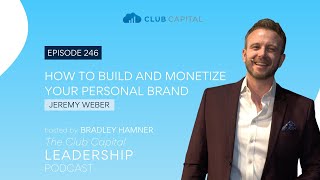
In this Club Capital Leadership Podcast episode, host Bradley Hamner interviews Jeremy Weber, senior strategist and founding member of Brand Builders Group. Jeremy shares his personal journey from a rural Kentucky upbringing, through a soccer scholarship, public‑sector IT work, and multiple entrepreneurial ventures, culminating in the creation of a personal‑brand consultancy that serves 600‑plus clients worldwide. The conversation covers (1) Jeremy’s knack for translating complex technical concepts into simple, audience‑friendly language; (2) a step‑by‑step communication framework for sales pages, pitch decks, and conversations that starts with a clear promise, then outlines the problem, establishes credibility, and gradually unpacks methodology; (3) the importance of a well‑defined, repeatable 4‑phase process (Brand Builder Journey) as a differentiator in commoditized markets; (4) how a strong personal brand is essentially reputation (results × reach) and can be monetized through influencer, speaker, author, or consulting channels; (5) practical advice for skeptics and introverts about when and why to invest in a personal brand; (6) the role of people and process as core assets that enable scaling; and (7) actionable tips for crafting value propositions that answer the “Why you?” question. Jeremy also promotes a free one‑hour brand strategy call for listeners. The episode blends storytelling, tactical frameworks, and promotional segments, offering listeners concrete methods to build, communicate, and monetize personal brands.
Chapters
Welcome to another episode of the Club Capital Leadership Podcast. My name is Bradley Hemner, your host. On today's episode, we have Jeremy Weber. Jeremy and I have actually become friends. We met in a mastermind group in Nashville just about a month ago or so, and we've actually started to become pretty good friends. I think you're going to get a ton out of this episode. So Jeremy, he's a senior strategist and founding member at Brand Builders Group. Over his 17-year-plus career, he founded, sold, and helped grow multiple companies. His work as a personal brand strategist has supported New York Times bestselling authors, TED Talk speakers, celebrity influencers, a Shark Tank investor, and 7-figure entrepreneurs across many industries. I can tell you he is an incredible strategist and they've been able to unpack all of those things, he and his team, into an amazing system. He has helped support me so much. I think you're going to get a ton of this. And there's one section in particular that towards middle, towards the end or so, for many of you, you're going to want to hang in there because it is a mic drop moment. He does such a fantastic job in this episode. Without further ado, here's my conversation with Jeremy Weber.
So the big question is this: how do small business owners like us grow our leadership, develop our teams and scale our business in a way that allows us to get our products and services out to the world yet still remain profitable? That is the question, and this podcast will give you the answers. I'm Bradley Hamner, and this is the Club Capital Leadership Podcast. Welcome to The Bottom Line, a new weekly podcast series that we drop every Thursday to complement our weekly Monday podcast interviews with the industry leaders. These podcasts are gonna be designed to give you short, impactful, and value-driven information that you can start using right away in your business. I value your time and attention and will do my very best not to waste it.
Just get what you need and go.
So with that, let's get into today's episode. Are you an agency owner looking to grow your revenue, increase your bottom line, and better manage your taxes? Club Capital is here to help. Club Capital is the largest accounting and advisory firm for insurance agents in the country, providing monthly accounting, tax strategy, and CFO services. Way more than bookkeeping and your everyday run-of-the-mill tax prep, Club Capital is focused on providing financial and tax advisory services that help you plan and forecast your agency's performance. Their financial dashboards and agency forecasting tools help you better understand your agency's historical performance, create, measure future targets, and see how your agency compares to your peers around the country. Imagine what it would be like to understand the impact to your bottom line when deciding to hire a new employee. Or forecast the impact rate changes or commission rates will have on your business. With over $200 million in tracked annual revenue and $140 million in tracked annual expenses, Club Capital has the data and the team to help you make better informed decisions for your agency. They will help you turn that back office stress into the backbone of your agency's success by giving you the tools to take your agency and your leadership to the next level. Visit club.capital today to book a solution overview with one of our business consultants. Club Capital, way more than a CPA firm. Ambition is the first step towards success. It's time to level up your agency, and Coach P Consulting will help you do just that by using the same strategies he used to sell over 700 life insurance policies in 2021 alone. Now, this is not your regular one-and-done type coaching. You'll get personalized coaching 2 days a week, every week of the month, and you'll get a live look behind the scenes of his team training and an office that's performing at the highest level. There's a reason Coach P Consulting is the fastest growing coaching company for insurance agency owners in the country. Coach P will train your team alongside his own and show you the exact steps they are taking to achieve Chairman's Circle, Exotic Travel, and Multi-Line Presence Club and be one of the few agents to be selected to have a third office. So whether your goal is to be at the top of your local market or amongst the best in the country, this training will give you the strategies and the tactics to get there. For just $250 a month, you'll get high-level coaching each week from someone who is already getting it done at that level and his strategies work, and it's time to put them to work for you. Sign up at coachpeakconsulting.com and get your first full month for free when you mention the Club Capital Leadership Podcast.
Jeremy Weber, welcome to the Club Capital Leadership Podcast.
No, brother, so good to be with you, Bradley.
Uh, so good to be with you. So, uh, I'll tell people in the intro, uh, about this, but, uh, you and I have gotten to be, uh, friends recently, and we're in the same, uh, mastermind group. And I feel like that we've been like old friends, you know, like I've known you for a lot longer than what I actually have. So it's been awesome to get to know you. So let's introduce you to our podcast community. We always start with background and origin story. So I think you have a fascinating story when I first heard it and kind of how you got to where you are today.
Yeah. Wow. I don't know how far back we want to throw it, so I'll go back a little bit. You can tell me if it's too far, but I grew up in Kentucky. Actually, in, um, in, in rural western Kentucky. And, um, there, there wouldn't be much there, uh, if it wasn't for a university called Murray State University. I don't know if anybody knows Murray, Kentucky, depending on—
come on, John Morant!
Yeah, there you go, John Morant, the claim to fame for Murray. We've had, we've had a few, uh, you know, that basketball program is legit. It produces some, some good talent. But, um, but yeah, so I grew up in kind of a rural part of Kentucky. It was awesome though. And And soccer was a huge, huge part of my life. Like growing up, it was, I won't go too deep on a tangent with this, but I just, that was my passion. And that kind of led me down this path of going to college and getting a college scholarship to play soccer at Western Kentucky University. So kind of staying somewhat true to the home, you know, so it was, you know, like they say, it was far enough away from home where I felt like I was like in a new place and had some freedom, but I wasn't so far away where I couldn't go back and see my people, you know, back home. So it was, it was good. But yeah, I got into college and, and I knew pretty quick, like I was good at soccer, but I knew that, you know, it was going to help me pay for school, which was amazing. But that, that wasn't going to be my long term. Yeah, I wasn't going to go pro. I wasn't going to make a living doing that. I had to figure out how I was going to actually make some money, right, for real. And so I started studying computer science. That was kind of, I was also very passionate about tech. And like programming and all that nerdy stuff. So I kind of headed down this path of soccer, but ultimately kind of preparing for, you know, the real world, doing kind of work in the IT industry. And so I graduated from college and basically started off in the public sector working for the state of Tennessee. It was kind of interesting, and I was doing all kinds of really interesting, like large-scale IT implementations and stuff like that, which was really cool. And one thing, you know, now that I'm, you know, multi-time entrepreneur and have headed down this private, you know, kind of sector path, looking back, there's no question that those days of me in this public sector environment showed me a lot really. But one of the biggest things was really how do you inspire people to do big work and, you know, kind of like lean into what they're doing without being able to throw a lot of money at them. And that was a pretty cool thing is, you know, in the public sector, where you can't, you don't have big salaries, you don't have big dollars to just incentivize with money. And so, that was one of the lessons learned early in my career is like, as especially as I grew into more of a leadership role in the public sector setting. But, you know, what's interesting is early on, you know, in my career, it wasn't immediately out of school, but probably 2 or 3 years into my kind of like out of school, I realized that, you know, like I was good at the tech, but I wasn't the best at it. There were people that were nerdier, let's say, than I was, right? They— and, and so, but I actually had something that they didn't have, and that was the ability to, you know, understand these complex technical topics, you know, that, that I was in the middle of doing, but actually know how to communicate them in a non-technical way with, you know, with non-technical people, right? To kind of bridge that gap. And so And so that kind of set me down this slightly different career path where I was still very much focused on IT and emerging tech trends and all this stuff. But I was out talking about and advocating for these emerging technologies and the value of different types of organizations implementing them and using them and doing it properly, etc. And so what was really cool is that kind of led me to speaking at bigger and bigger events and more and more conferences and being really a well-known kind of thought leader or expert in this space. And what's cool is towards the latter part of my run in the public sector environment, I saw an opportunity, right? A gap in the market that I could fill, you know, I could or couldn't fill, right? And I still remember to this day sitting at my old house, right? Our first house in our quote unquote home office that doubled as a lot of different things at that time. And just sit there saying, you know, like, I can try to build this product and solve this, fill this gap in the market, or I could not, right? And I remember telling myself, like, the last thing I want to do is look back, you know, 3, 4 years from now and be like, what if, right? What if I had done that? And so at that moment, I leaned in and I started, you know, like developing this software product that was going to fill this gap in the market. And that kind of really set me down this entrepreneurial path where I brought that software to market, licensed it to a few different organizations, and then eventually sold that technology to kind of a regional tech firm that was my primary client, and, and left the public sector environment as part of that selling of that, that intellectual property and that software product, and came on as a partner in that company. And so, so what was cool is, you know, again, I, I kind of had already established myself as kind of, uh, you know, somebody that was well known, you know, a thought leader in this space. And that helped me not only, you know, get on the radar of this company that was interested in what I was doing, but ultimately project my career forward and kind of make this move into that company. So that was, that was pretty cool. And then made a run at that regional tech firm in a, you know, in a leadership position where I was still very much deep in best practices around technology, but was really out talking about it, advocating for it. And probably the pinnacle of my career in that phase was being at the San Diego Convention Center at a big international user conference and speaking on a stage in front of, I think, probably like 15,000 people that were live there. So that was huge, right? Like that was a big pinnacle of my career at the moment. That, that helped me obviously get more recognition as somebody that was well respected and knowledgeable about this stuff. But it was really not a game to try to boost my reputation or my personal brand or whatever. It was a growth strategy to drive more traffic back to our backend tech company, right? And so, so that was kind of interesting, and we saw a lot of growth in that company. But What was pretty wild is, you know, I went from probably one of the highs of my career, you know, at the time speaking on that big of a stage, to very shortly after that coming back and basically getting pushed out of that business. There were two other owners in that company, uh, there were three of us that, that were kind of partners in it, and, you know, we had a different vision for the future of the business, and I was pushing really hard, and that led to some things blowing up, and I went from living my best life, right, to being like, crap, man, you know, like, what's gonna happen now? And so that was, that was interesting and kind of set me down this path of, you know, hey, I, I don't want to just keep focusing on one business. I've kind of done that a couple times now and have seen some good success, but I just, I really was excited about this idea of advising multiple companies, kind of management consulting stuff. And so that sent us down this path of really, you know, eventually starting Brand Builders Group. Um, and so when we, you know, started it roughly 5 years ago as of today, you know, in 2023, so it was middle-latter part of 2018. Um, if you look at the founding group, it's a blend of people that are really successful entrepreneurs. They just know business best practices, right? What are best practices to grow a grow a business. They're really ninjas at sales. You know, the company we all worked for prior to Brand Builders Group was an 8-figure sales consulting business. So we knew sales inside and out, we knew marketing. And what was really kind of this uniqueness or this special sauce, because we didn't want to just start another sales consulting or marketing agency or something, we're like, we want to do something that's different, you know, to help us differentiate in the marketplace. But also kind of do something that's unique to us and our, our upbringing and our career paths, right? And so what was interesting is if you look at my career path, I gave you kind of a little snapshot of it. It was very much me getting out there, taking what I was passionate about and wanting to share it with as many people as possible, whether it's on stages or social media or blogging or you name it, just going to conferences and networking. you know, and using that as a mechanism to elevate awareness of me as a trusted expert, but really as a mechanism to drive traffic and growth of the back-end businesses I was a partner in, right? Um, and then if you look at like, um, Rory and AJ and a couple of the other people, the Vadens, that are part of the founding team— Rory, you know, New York Times bestselling author, Hall of Fame speaker. AJ is, you know, very successful speaker and entrepreneur herself. So that's where we just said is like, hey, I think what we are really great at— yeah, it's entrepreneurship, it's business best practices, it's sales and marketing— but what we really understand better than most people out there is this special sauce of taking one or more key people in your business and how do we elevate them as the thought leaders they are. So more of the your ideal clients or your strategic partners, whoever it is, right? More of those ideal people know them, like them, and trust them as the expert they are. And that's going to help you accelerate, you know, driving deal, closing deals, driving traffic, whatever it may be. It's going to help you grow your business at the end of the day and help you differentiate from the competition. And so that's kind of where we started Brand Builders Group, is this personal brand strategy firm. And, you know, 5 years into this thing, we, you know, we got about 600, you know, between 600 and 700 clients slash businesses we support, international client base. We work with some of the biggest kind of well-known influencers in the space, you know, if you're looking at speaker, author, influencer kind of type business models, we have some really, you know, big names. But then mostly, you know, to be honest with you, most of our clients are you know, small, medium-sized businesses, some really big multi-billion-dollar companies we're working with multiple members of the executive team. So our client base is very diverse, but we stay true to our unique kind of approach of serving them, which is how do we get one or more of your key people out there more and make sure that their, their personal brand or them personally, they're, they're positioned in strategic alignment with the business, but also who they are as a unique individual, right? That's kind of the special sauce. So So, um, so anyway, I'll kind of pump the brakes there and hand it back to you. But that's a little quick kind of backstory on how I got to where I am now and some of the ups and downs along the way.
Well, I got a bunch of questions around things for us to be able to dive into around personal branding, but I kind of want to go back for a second. How did you— what is something that you maybe came natural for you but doesn't come natural for others in your ability whenever you were communicating very complex things in a very simplified way regarding tech. And the reason I say that is because anybody, you may have a passion about whatever it is that you are selling or promoting. And what tends to happen, I know that I've been guilty of this, is using technobabble. I'm using acronyms that if you're in the industry, you participate in that, you know exactly what that person is saying, or if you represent a certain company. But then the customer's like, I have no idea what you're talking about, right? What in the world are you talking about? And so then you have to explain it. So you were obviously on stage just having to take this complex thing. What are like, did you learn that? Did somebody teach that to you? Do you feel like it came natural to you? One. And then two, what are some tips and best practices for people? Because I think whether you're speaking on a stage, on a podcast, and stage could be in front of a real estate group, right? Could be in front of 10 realtors. I mean, it doesn't have to be a literal stage at San Diego in front of 15,000 people.
That's pretty cool.
That can be. So whether whatever the stage may be. But also, I think that that stage can even be down into sales conversations you're having with clients to make sure you're not using that.
Yeah, well, I mean, on, on the first question, I don't, I don't recall ever getting like formal communication training. Um, you know, it's probably if, you know, and I don't know this to be 100% true, but it may be something just like you know, having a mom that was heavily involved and, you know, like, talked to me a lot as a young baby, and that led to a pretty good vocabulary. And then just being somebody that was pretty outgoing and talked to people, you know, and you have to just like— the more you communicate, you tend to get a little bit better at it. So I really don't know, like, uh, maybe at the end of the day, I probably— the biggest thing, it's a blessing from God, right, to just be a, a good a good, effective communicator. But I think me getting into the trenches, right, and understanding technology then put me in that position of being able to wrap my head around the complexities, but be able to roll it up and simplify it for people that didn't want, they weren't capable of understanding, nor did they care to understand, you know, the techno babble or the low-level details. And I think that that's, that's part of it. If I was going to share the kind of— and this is not a formal process, I'm just doing this off on the fly here. But, you know, for somebody that's effective at bridging that gap for people, I think you first have to be able to get in the trenches because you're going to have some people that press you that are going to be like, Bradley, that's cool, tell me more. And then you tell them more and they're going to be like, tell me more. And you tell them more, they're like, I want to know even more. And if you don't know what you're talking about, they're pretty quickly going to be able to uncover that you're a good salesperson, you're a good communicator, but you don't really have much depth to what— to your expertise, right? And so that's why I always say is like, it's good to be able to get in the trenches with people that want to get in the trenches with you. And it obviously gives you a level of confidence too that you can go there if anybody wants to go there, like you're not scared. But you don't feel like you have to overwhelm people with the technical details because that's not in the best service of them at the end of the day. If people can't understand what you're saying, they can't do what you need them to do, and they're not going to see the results you want them to see, right?
Yeah.
And so you have to know how to take the details and simplify down in a way that people can wrap their head around. And a lot of that comes into how we think about writing copy, or, you know, it's, it's almost just like how you communicate information in a way that's like bite-size, and then it's a— you unpack it a little more, and you unpack it a little bit more. And some people are good there, they don't need to go any deeper, but you can unpack more if you need to. And so our communication style, right, can be used when you're just talking to somebody, but it also could be deployed when you write copy on sales pages. And so I won't get too deep into this, but just to give a little bit of tactics, like how this might play out in a pitch deck, which we've talked about some, or on a sales page or homepage or whatever, a lot of the times you want to lead with what people want. What are you promising to deliver for them? They don't, they don't care, right, how you're going to deliver it initially, right? You have to grab their attention. You got to hook them, right? So that's what we would call the promise. What are you promising to do for them? And if you really know your ideal client, you're going to know what they want, and you're going to be able to promise to deliver something that they are interested in, which is going to grab their attention. So immediately you have their attention. Oh, that's cool, like you, you can help me do that. All right, and then what we say is, all right, well now you have to get into, to kind of the how, right? But you don't want to dive into details right out of the gate. And so what we generally say is introducing what the problem and the pain and kind of the premise. And this is, I know you want that, right? And we're going to talk about how to kind of get to that place. But first, this is important to understand why most people don't get there. There's an underlying issue that you're struggling with if you are not able to get to where you want to go. And this is the reality of what your world looks like when you are struggling with this, right? So it kind of helps you resonate with them. Like, you want this, but I know you are probably dealing with this right now. And then we kind of bridge that into what would be the premise, right? This helps establish trust, saying, you know, look, from dealing with that myself for all these years, or from working with hundreds of clients that deal with the same thing, that really allowed us to see a better way. To go about doing this and get you to where you really want to go in a more efficient and effective way. So it helps people understand you kind of been there, done that, and you know what you're talking about. And then we get into process. So now let me take you through kind of how we get you from where you're at to where you want to go. And this is really where I think the magic comes in of knowing how to introduce concepts and kind of your methodology at a higher level, like saying, hey, there's really kind of 4 key components or 4 steps right? And you walk them through that and they're like, okay, I kind of understand that higher level concept of the journey we're going on. But then you're like— and then they may be like, man, Bradley, that's really cool, like tell me more about step 1, like what, what happens in step 1? And you say, all right, cool, like, well, there's actually like 3 key activities or sub-steps in step 1, let's get into those now, right? So, and then you can drill down as deep into as you want to into your methodology or your IP. And that's where more of the techno babble or low-level details come in. But you didn't lead with that, because if you go straight to the trenches, they're going to be like, what are you talking about? I have no mental context for what you're trying to communicate to me. So that's why we always say you have to create kind of a higher-level construct for, for in which you communicate kind of your, your intellectual property or your methodology or really whatever But then make sure it's logically structured so you can unpack each of those high-level concepts and get into more details and then more details, you know, if anybody wants to dive deeper. But that's the magic, right? Because, you know, again, people can't do what they can't follow. And if you lose them right out of the gate, good luck, you know, getting them to want to double-click or take that next step to lean in even further. And so we kind of use that, like I said, that those approaches on sales pages, you know, that we're trying to convert at a high level, and pitch decks, you know, that we're trying to get people to want to buy or take the next step, or frankly just in conversations with— when people ask me, right, they're like, what do you do? Well, we have a personal brand strategy firm. We help businesses, you know, amplify one or more of their key thought leaders as part of just differentiating and driving growth. They're like, oh, that's interesting. And it's like, yeah, we have a 4-phase process we take clients through, right? Phase 1 is all we have— how we uniquely brand and position you in market. Phase 2 is all about like marketing our inbound strategy. Phase 3 is all about selling. And then Phase 4 is about scaling, right? So it's kind of— we create— take them through those 4 phases in a unique way to them. And somebody may be like, well, that's cool, what do you do in Phase 1? Well, there's actually 3 steps to Phase 1 to uniquely brand and position yourself in the market. And I could literally go about 8 layers deeper into our intellectual property or our methodology but I don't lead with that because it's too deep, right? Yeah, yeah. So I think it's just that— I know that's a lot, but that's kind of the way I think about it, is you have to take the, take the details from the trenches and know how to roll them up into a logical kind of way to communicate, and then people can kind of wrap their head around that. Once they can understand it at a high level, then some of them will want to dig deeper and you'll be able to unpack it even more for them, and others are just like This is good. It makes sense. Let's keep rolling. I don't, I don't care about the details. Right.
Do you typically see where a company will have either on sales collateral, web page, whatever, wherever the medium is, it doesn't matter. We've been here since— we've been here for 15 years. Here's our core values. They're telling all this stuff, which is good, but it's out of sequence. They're like, because naturally the customer's like, I don't really care about that. I mean, that's all good down the road. I really care at the end of the day what you're going to be able to do to help me first. Yeah, all that stuff with me. But instead we lead with all this stuff of, you know, it's been a family business since 1976, and people are like, I don't care. I don't care.
No, you're spot on, man. I mean, and that is at the end of the day, if you scan a homepage or whatever, you know, whatever page of the website or marketing collateral or whatever. And it's almost like highlight all the places where it says I or we. And it's like you'll pretty quickly get that you're talking about yourself too much. You need to be talking about, you know, your ideal client, right, and helping them understand. Now there's a balance. What we would say is there, there are places to quickly and succinctly establish authority early in the communication sequence. And, and that would like, hey, that promise that you lead with, like, this is what we're promising to do for you, and you hook them with that. And then before you get into kind of that problem, pain, premise kind of section to demonstrate the gap between where they're at now and where they want to go, you can do what's called— we would call it like a proof banner, or have like a few big logos or a few key stats, like 30+ years of experience serving 600 businesses worldwide, you know, like BBB rating of whatever, right? So you kind of have something that's short and sweet that's just like, oh, these people are legit. But it's not like a big long paragraph talking about yourself, which they don't care, right? Yeah. So save that for the about page, right? If they want to know about you and your core values and your team, they'll go check that stuff out. Otherwise, they need to know what you're going to do for them. They need to know it's a proven methodology that delivers consistent results at scale, and they need to hear from your other clients that have experienced it. And are vouching for it themselves through testimonials. Those are some of the, the most fundamental, you know, kind of elements of what needs to be communicated to somebody, you know, that's interested in maybe working with you.
I have to tell you, so I'm obviously not going to say who the client is of mine, and I'm not going to say the vertical. This client's been pretty successful. They're in their third year of business, have hit a million-dollar run rate. The reason I'm saying that is to say, I mean, they've, they've grown this business to $1 million in 3 years. That's not easy to do. I mean, it's not easy to bust $1 million, period, let alone to be able to get there in 3 years. So they're doing some good things. And this person knows who I'm going to— when they listen to this, they're going to know I'm talking about them. But, and I think they'd be okay with it. We had a conversation last week and I'm using this to illustrate a point I'd love for you to kind of share because I just have to assume most, a lot of people you've worked with have done this. And in their vertical, I asked them last week— I didn't even think about this preparing for this podcast, but I said, I got a question for you. Why should people, if they're choosing between one company or another, why should they choose you? So he starts kind of talking, immediately starts talking. About 90 seconds in, he stops and he just sits there for about 60 seconds, fairly awkward silence. He goes, man, I'd be honest with you, I don't really— I don't know, I don't know, I don't know.
I appreciate his honesty.
I did. I appreciate his honesty. How much have you seen Whenever you ask them a version of that question, what's the— it often at times gets couched as this fancy term, what's your value proposition? But at the end of the day, the simple version is, why you? Why should I choose you? Why should I work with you? I can work with a bunch of different people that do exactly what you do. Why should I choose you? And I did. I really appreciate it. And I actually honored him with that. I said, Honestly, thank you for not making up an answer because actually now we can get to work to try to figure out what that is because he didn't know what the answer is. Do you see that often?
Oh yeah, yeah. I mean, people, they, they, they're naturally good at what they do, right? So they just, you know, they take their gifts and expertise and they, they work hard and they're able to get traction and grow, right? I mean, I, and I think that's an example of what, what happened with the person you were referring to. But the reality is, is that doesn't scale, right? Like, you're not going to scale kind of the winging it approach. Yeah. And, and so for me, the way I look at, you know, there— I think there's two key— there's probably many, but these would be the two key factors for me when I would say, like, why should I work with you, right, instead of somebody else? And to me, it's, it's a, you know, a well-thought-out and proven methodology. Like, okay, yeah, you got to know clearly what I want, what I'm struggling with, who you're best positioned to serve— some of those fundamentals of any business. But if you can't deliver consistent results at scale, that's going to break down eventually. And so how do you do that? Well, you have a well-thought-out methodology that's grounded in proven best practices, and you're able to use and ideally via other people on your team, eventually able to take that knowledge and that expertise and deliver it for more and more clients to deliver the same or better results at scale, right? If you don't have your crap together, i.e., your intellectual property, your proven process, your methodology, whatever you want to call it, right? For us, that's our 4-phase process, right? Like our, what we call our Brand Builder Journey. That's the brains of the operation, right? Without that, everything breaks down. Um, and so, so that's what I would say is that's true thought leadership. You know, that's something that another company could be selling the same product or service, but they didn't create a more seamless methodology around those products and services to create a better customer experience or better outcomes or whatever it is, right? Like, that's something you can own, and then you need to know how to integrate that into your your marketing and your sales and obviously your fulfillment to leverage that IP, right, to leverage that thought leadership and get as much mileage out of it as possible to see true growth. So I think that that for me is one differentiator, is like how you do what you do, not even the product or service you're selling, because you may have other competitors that are selling the same thing, right? But how you do what you do to create an experience and an outcome better than anybody else in the marketplace and knowing how to visually represent that and communicate that in as many ways as possible to get it out there so people know about it and thus can use that as a differentiator. So I think how you do what you do, or your process, or your thought leadership, is a fundamental reason why somebody should work with this business versus another. And then the second one is your people. Like, you know, you can be selling the same thing. Again, like, why should I work with you instead of somebody else? Because We have the most knowledgeable people in the industry. These people don't exist in any other business, right? They are truly what's unique about our business. In addition to how we do what we do, we do our methodology. We also have people that are truly unique that know this process inside and out and can deliver it with their eyes closed. And, and, you know, because a process in itself doesn't do anything, you got to have people to run right? And so that's for me is like, who are your people? And how do you do what you do? And how do we amplify those two things as much as humanly possible? So there's awareness of both of them. And then naturally people are going to associate that with like, man, this business and these people and how they do what they do, this is different than these other people I'm considering, right? I should maybe talk to them, right?
That's, that's huge. If you are in a highly commoditized business— I know a lot of our listeners are in, as an example, insurance— and you just got just dime a dozen, you know, everybody else. What you just mentioned right there, how you do what you do, your unique way that you take people through a sales process, how you onboard them, how you actually serve them, that you have a unique way that you have actually created an asset around. Like you've actually said, no, we actually have a literal playbook. I can show you the steps to it. That becomes an asset, that becomes a differentiator in the marketplace. And then the people who are delivering that, I don't know if many people really realize how valuable that was that you just mentioned. Especially people who are in a commoditized market, because I think that they say, well, we give good customer service. Everybody else does too. Like, that's not gonna— that doesn't mean anything to anybody anymore. It doesn't. It doesn't mean anything to anybody anymore. Matter of fact, ChatGPT can give me good customer service too, and I can be snippy back to it, and it doesn't matter. So you're gonna have to come up with something better than that.
Amen. And, and I think you, you hit the nail on the head, especially in, you know, insurance or financial services or, you know, you know, a lot of professional services. It's, it is, it's, it's pretty commoditized. And it, you know, I, I honestly think that just rubbing elbows with the right people and, you know, I mean, like, it's not that you shouldn't do that, right? The outbound networking and relationship building do it. But at a certain point, like, you got to differentiate beyond just being a good friend and a person, right? Like, I think, I think if you're serious about taking care of your people You got to back up a good, hey, I'm taking care of you, you rub, you know, scratch my back, I'll scratch your, like, type thing. Like, there's got to be a little more depth to it. Um, again, if you truly want to separate yourself from the competition and if you truly want to take care of your people once they do give you a chance, right, that's where, you know, the rest of that comes in.
So I struggled, uh, one question I really wanted to ask you about is when I first— I don't, I don't know when, I mean, it hasn't been that many years ago that I first heard the term personal brand, um, personal branding, etc. And at first I kind of thought of it as, well, if you're going to be and try to be an influencer, if you're going to try to be a MrBeast on YouTube or something like that, yeah, that's good for them. And I kind of, I just kind of pushed it away, like, that's not for me, I'm not gonna, I'm not gonna do that. Um, some people are more comfortable on social media than other people, right, etc. Can you just speak to maybe the, uh, I don't know, that maybe the skeptic a little bit, but also maybe somebody who's a little hesitant to be like, ah, see, Jeremy, I'm just not, I'm not comfortable in the limelight, that's, that, that's really outside my comfort zone, and, you know, I, I just don't really know if I, I want to do that. Can you speak directly to that?
This podcast is brought to you by Autopilot Recruiting. Join over 1,200 State Farm agents in putting your recruiting on autopilot. Any successful insurance agent will tell you how important team is. Finding those rockstar team members doesn't happen when left to chance. It happens through consistent recruiting. You never know when you're going to lose a team member, and the key to an incredible team is constantly searching for the best Autopilot Recruiting is a continuous recruiting service where you'll be assigned a recruiter that has been trained to recruit on your behalf every business day. This recruiter will take over and revamp your CareerPlug, send out assessments, do pre-screen phone interviews, and schedule your in-office interviews. All you need to do is to show up and give a thumbs up or a thumbs down. This ongoing service is extremely affordable and a no-brainer for taking your insurance agency me to the next level. Listeners of the Club Capital Leadership Podcast, go to autopilotrecruiting.com and use the code Club Capital to get started. Again, autopilotrecruiting.com and use the code Club Capital.
Yeah, absolutely. I mean, what's interesting now, you know, as of 5 years ago, once I started doing this full-time, it kind of blew my mind. I was like, why is it that there are so many businesses that that, you know, individuals and the business as a whole could clearly benefit from having a more well-known, like, an influential personal brand, which a lot of my career was demonstrating that, like, I was out there more and it was driving growth in my backend businesses, right? It wasn't— I wasn't an influencer, I wasn't an author or a speaker, you know, that, you know, and, and it was— it boiled down as I started talking to more people, they just when they think personal branding, they think influencer, online influencer, or they think, I don't want to be a speaker, an author, or one of those things. And the reality is you just have to understand that those are ways to monetize in any business, right? An influencer— what's an influencer? They have a big platform and they're able to monetize those eyeballs through ad or affiliate deals or whatever. What's a speaker? Well, they're a good speaker and they get paid to go speak. An author, right? They write a book and get paid, you know. So those are just ways to monetize within any business. So at the end of the day, the way to think about a personal brand, it's really just your reputation, right? Like, what do people think about when they think of you as whatever role you're in in the business? And when we unpack reputation, this is pretty cool, we call it our Reputation Formula. We say results times reach equals your reputation. And so you, and frankly your business too, can choose to have a big positive reputation. That means you can deliver amazing results and you have a lot of reach. There's a lot of people that know about you as, as a person and an entity that delivers amazing results. You can also choose to have a small positive reputation, right? You deliver amazing results and just not as many people know about you. You don't have as much reach, right? You can also choose to have a big or small negative reputation, right? You do crappy work and we have bad results and, and a lot or not that many people know about you, the reach side of it. So it's really just up to you at the end of the day, right? It's like, you know, we would say, you know, hey, if you're somebody that doesn't like to get out there, you don't like to network with people and get in front of people and, and, and kind of be known by more people as a, an expert, you know, a thought leader, or somebody that's really good at whatever, then you probably shouldn't be in a position of, of building a more and more well-known personal brand, right? And, and, and again, simply as a mechanism to drive traffic and growth back to your business, right? But anybody that is good at what they do and they, and they believe in it, like, you know, and I'll just tell you straight up, like, if you're really good at what you do and you've seen the positive impact it has on the people you're best positioned to serve, it's really hard to not want to go talk to people about it like you want to. It's like, man, I got to tell people about this because I believe in it so much. And that naturally leads to you reaching more and more people. Some of that reach is going to start with just your offline network, going to conferences, meetings, working your network, doing off outbound sales type stuff, the conventional. But naturally, through that offline outbound stuff, you have more people that know of you. And if you know how to structure those conversations and establish trust with people, you're going to be well known, and that's going to help you drive growth. And then you just see that naturally, though, those activities to reach more people and you and your business become more and more well-known, or AKA have a bigger, you know, positive reputation, comes when you layer in a lot of those online activities, which would be social media, speaking at bigger events, being on podcasts, etc. But at the end of the day, right, you just have to break it down to personal brand is not a speaker, author, influencer. A personal brand is you. Everybody's got one, just like everybody's got a reputation. And it's just, you know, how well known do you want to be at the end of the day? Some people want to be really well known and use that to serve more people, have bigger impact, and drive growth of their businesses. Others don't, and that's fine, right? But there's no question there are clear benefits to the individual, but most importantly the business, uh, when, when you get out there more and you're more well known by the right people and do it in a way that helps you differentiate differentiate from the competition like we talked about earlier.
Yeah, amazing. Well, I have to say to audience, I mean, I, I've talked about it on some solo episodes. I've talked about proximity, uh, the importance of being in the rooms and at the tables with other people. And this podcast is kind of an example of that. I mean, it was such a blessing to be to be in Chad's Mastermind. I go up there, get to meet Jeremy. I go on the hot seat with my business and I get done and Jeremy's sketched out this thing on his OneNote and I'm like, what in the heck is this? This is unbelievable. That was so great. And I got to have dinner with Jeremy next to me. We had a nice steak. And so the reason I'm telling people that is that when you kind of get out, allow yourself to be in programs with other people who are trying to grow themselves and develop, you just don't know the connections that you'll get to have with people. And so, as Jeremy and other, other folks, has been awesome. And so whenever I got to know you, I said, dude, we're going to have you on the podcast, you know. And so we ended up having kind of a network that overlapped a little bit. So it's been, it's been awesome. Uh, I picked up learned some stuff today. This has been great. Hey, people want to connect with you, uh, personally, but also connect with, uh, Brand Builders. Where would you point them to?
Yeah, I mean, you can, um, there's the normal places. You can go to brandbuildersgroup.com if you just want to check out more about the company. I'm on all the social platforms at The Jeremy Weber, so you can, you know, pretty find me pretty easily on those. What I would actually say, we do Go ahead. We good? Sorry. Yeah, I was just going to say, and, and actually what's cool is we do something kind of special for, for listeners, um, is if anybody's interested, like this has kind of piqued your interest, you used to dismiss, you know, hey, personal branding doesn't apply to me, but okay, hey, maybe it does, right? It can help us grow our business, and you want to just kind of lean into this more and just kind of learn more about it. We actually do a free brand strategy call. So it's a 1-hour strategy call where we really try to understand, you know, what, what are you trying to go with the business? What are you struggling with? How are you trying to get there now? And really just try to help you to kind of think through alternative approaches and mechanisms to get where you're trying to go. So, um, so if you want to take advantage of that, again, totally free, a 1-hour strategy call, you can go to freebrandcall.com. .com/jw. And Bradley, I don't know if you can put that in the show notes or— but yeah, it's freebrandcall.com/jw, and you can just request a free brand strategy call. And again, totally free, take advantage of it. And, you know, can't go wrong with that.
That's awesome. I'll put it in the show notes, put it on the email distribution that we send out as Well, my friend, great having you on. Hope to have you back on in the future. I got a ton out of that. Jeremy and I chatted after the episode and I said, hey, I knew a lot of those things, but I really did have several pages. I think that one of the things, the conversation we were having around positioning, to me was a good reminder. I've kind of researched the last few years and really started to understand messaging and hooks you know, market positioning and value propositions, etc. But every time it's almost like a deepering, deepening understanding of like, how do I position myself? How do I position the companies? What is our value proposition? And I teased it at the, in the intro, but specifically whenever he talked about, you know, what's the process that we go through and then the people that we have. And so if you're highly commoditized industry. I thought that that was one of the best moments for him. That's such a good succinct answer because you can take that away and you can go through and say, all right, well, what is our unique process that we're able to say we do this differently than anyone versus just hyperbole and just kind of empty platitudes that you put out there about, you know, again, I gave them one of, you know, we give great customer service. People don't want to hear that anymore. They want to know how are you different, why you. Because there's so many different options out there. I know that episode served me. I'm sure it served all of you as well. You can get in touch with Jeremy across all the social media platforms and then check out Brand Builders Group. They do an awesome job. They've served several hundred, almost 1,000 clients at this point. So I know you want to reach out to them. Big shout out to our podcast sponsors that allow us to be able to bring awesome people like Jeremy on the Podcast Club Capital, Coach P, and Autopilot Recruiting. You know, whenever Jeremy was talking about people, I like to think about people as team. And so how do you attract, how do you develop, and how do you retain? How do you attract A-players? How do you even define what an A-player is, for that matter? But what's the process we, we go through? Do we have a consistent funnel, lead funnel of, of really quality people, uh, to be able to help us grow the business. Because if your dream is big enough, you got to do it with a team, as Michael Hyatt says. But also, I want to work with people that know what to do. I mean, sometimes you just don't know exactly what to do. And so I could learn the skills, or I could go find a who. And Autopilot Recruiting can be that who for you. I don't know I don't know how to do it. I'm just going to go find a who. Who Not How is a great book written by Dan Sullivan. And I really do think for what they charge, I mean, I've talked to Alex, okay? And I'm pushing on him to say, man, are you not charging enough for this? All right? You need to charge a lot more for what you're doing because the value proposition is there for just a few thousand dollars a year, the offer that they're giving you. Because they're helping you put in place a consistent pipeline of people that's ultimately going to help you to grow your business. Go to autopilotrecruiting.com. Obviously, the second part of that is, okay, I get people on. I mean, but you can't just say, all right, turn you loose and, and go. Even if they have insurance, uh, experience, you still want to be able to develop them into the way that you do things in your organization. Well, some people are amazing coaches, trainers themselves. They're able to inspire people. But sometimes, you know, like, I'm terrible at kind of the down in the weeds thing. The inspiration visionary type stuff I enjoy doing. But when it comes down to, we're going to say this, we're going to say this, it's hard for me to unpack that in my head. And it's hard for me to role play things because I say it. I don't know, maybe I'm not the only one out there, but if I'm role-playing something with somebody on my team about anything and somebody says, hey, can you say that a second time? It's like, no, I can't. So I start trying to record everything that I do because I might actually say something that's decent, but it's impossible to be able to say it a second time. Well, that's where systems and processes come into play. And you want to be able to share with your team something, something with somebody that's getting it done at that level, that has already figured out this works, this doesn't work. Coach P Consulting, twice a week, puts you, your team members, agent-only calls once a month. He has also done an awesome job of creating a fantastic offer stack for you and your team. Go to coachpconsulting.com. Goodness, he's giving you a free month. What do you have to lose? You're going to be on 8 calls, uh, 2 a week for 4 weeks, just to, just to give the thing a test drive, see how it is. Um, I asked David about that and I said, you sure you're gonna keep doing that? Um, you know, giving people a free test drive, uh, for mentioning the Club Capital Leadership Podcast? And he said, yeah, we're gonna keep doing it. So anyway, You guys take advantage of that offer David has put in place. I've told my story on here many times about me not understanding financials at all, and I certainly am not at an accountant level and really don't ever want to be at accountant level, but I really want to be dangerous enough to be able to use financials to make good decisions. I was— had interaction today, as a matter of fact, with another business owner in a different context. And I could tell it like, oh man, they don't, they don't know. They don't know how to read the financials because the questions that they were asking was pretty obvious by that. And I thought to myself, you know, that's a skill. It's a skill. If I'd have known it then, I thought it was just like you either got it or you didn't. I didn't get accounting when I was in college, but I get it now. And that has helped me so much to be able to understand all the dynamics around percentages, profit, expenses, balance sheet items, all of that stuff. And some of that you might say, I don't want to learn that. You really got to though. You got to. As a small business owner, you get— you just don't really have an excuse. Can't fly, uh, can't fly the business by the seat of the pants unless you just want to keep doing what you're doing. And if you're good with where you are and you don't want to grow anymore, don't want to be able to make— take more home, and you're happy with that, well, maybe you're fine. But for the most of you, if you're listening to this podcast, you want to go to the next level. And so go to club.capital, book a no-obligation demo. They're going to help you with the mindset, the skill set, the tool set, especially, uh, the tools to be able to put those financials in front of you, give you perspective that you may not otherwise have. club.capital. And lastly, we are— at the time I'm recording this, we have not launched it, but the time this episode will get launched, we are in the process of launching a podcast leadership community. I'm super pumped about this. We have wanted to be able to try to start pooling people together that listen to the podcast for quite some time. I get some— I get text messages, emails, and I'm so grateful for those. But, you know, I keep talking about proximity. Rooms and tables with the other people. And so while we can't necessarily, at least right now, get together, um, uh, in, you know, like a conference center or something— maybe one, one day we do that— we do want to be able to do it inside of a, inside of a group. And so that's exactly what we're creating for all of you. We think it's going to be a unique experience. I know I've gotten questions sometimes that say, where people have sent me a message, I really wish you had asked this person this. Well, now I'm going to start streaming those interviews directly into that group, and we got so many other things we're going to do to provide value to all of you and try to serve you in more ways. And listen, we've already seen the 3 and a half years— if you followed us, we're going to keep trying things. We're going to keep trying things. I'm never going to stop trying to find different ways to be able to serve you, whether it's through the guests that we have or the way that we structure the interviews, coming up with a different podcast during the week, etc. And our podcast leadership community is absolutely the next innovation that we're coming out with. And so go to club.capital/podcast. So go to Club Capital website, go to the podcast, you'll see the link. You can either sign up to get notified when we are going live or if it is live by the time that this episode launches, you'll be able to join, get in our group. I'll be streaming these episodes live. You can be able to join in there, listen to it, and be able to hear these episodes weeks before we ever, before we ever release them to the public. So go to club.capital/podcast. All right, everyone. Till next episode, lead well.










