Episode 249: The Pathless Path with Paul Millerd
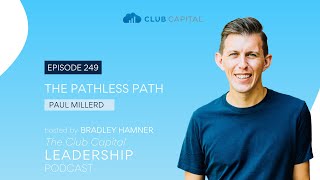
Paul Millerd, author of The Pathless Path, left corporate success because it left him unfulfilled. He distinguishes ambition (money, fame, status) from aspiration (learning, unknown rewards), and argues against "shiny outcome syndrome." He turned down a Penguin Random House deal to keep his independence and time.
Chapters
Welcome to another episode of the Club Capital Leadership Podcast. My name is Bradley Hamner, your host. On today's episode, we have Paul Millard. He is the author of The Pathless Path. I heard about him from listening and watching and paying attention to Ali Abdaal on YouTube. If you don't know Ali, check him out. He's got a great YouTube channel and love hearing his recommendations on books. And whenever he talked about The Pathless Path a couple different times, I thought, Okay, finally, I'm going to pick up this book. Well, Paul is an independent writer, freelancer, coach, and digital creator. I love to read and pick up a lot of books. There is books also too that really challenge me and make me think differently about the way that I go and approach things. And this is exactly how his book, The Pathless Path, has done for me. I think you'll see it in this conversation with Paul that it's It's different. It's unique. It's challenged my thinking, the way that I approach business, the way I approach work, the way I approach life is just— has been unique and different in this conversation with Paul. So I hope it serves you. Without further ado, here's my conversation with Paul Miller.
So the big question is this: how do small business owners like us grow our leadership, develop our teams, and scale our business in a way that allows us to get our products services out to the world yet still remain profitable? That is the question, and this podcast will give you the answers. I'm Bradley Hamner, and this is the Club Capital Leadership Podcast. Welcome to The Bottom Line, a new weekly podcast series that we drop every Thursday to complement our weekly Monday podcast interviews with the industry leaders. These podcasts are going to be designed to give you short, impactful, and value-driven information that that you can start using right away in your business. I value your time and attention and will do my very best not to waste it.
Just get what you need and go.
So with that, let's get into today's episode. Are you an agency owner looking to grow your revenue, increase your bottom line, and better manage your taxes? Club Capital is here to help. Club Capital is the largest accounting and advisory firm for insurance agents in the country, providing monthly accounting, tax strategy, and CFO services. Way more than bookkeeping and your everyday run-of-the-mill tax prep, Club Capital is focused on providing financial and tax advisory services that help you plan and forecast your agency's performance. Their financial dashboards and agency forecasting tools help you better understand your agency's historical performance, create, measure future targets, and see how your agency compares to your peers around the country. Imagine what it would be like to understand the impact to your bottom line when deciding to hire a new employee. Or forecast the impact rate changes or commission rates will have on your business. With over $200 million in tracked annual revenue and $140 million in tracked annual expenses, Club Capital has the data and the team to help you make better informed decisions for your agency. They will help you turn that back office stress into the backbone of your agency's success by giving you the tools to take your agency and your leadership to the next level. Visit club.capital today to book a solution overview with one of our business consultants. Club Capital, way more than a CPA firm. Ambition is the first step towards success. It's time to level up your agency, and Coach P Consulting will help you do just that by using the same strategies he used to sell over 700 life insurance policies in 2021 alone. Now, this is not your regular one-and-done type coaching. You'll get personalized coaching 2 days a week, every week of the month, and you'll get a live look behind the scenes of his team training and an office that's performing at the highest level. There's a reason Coach P Consulting is the fastest growing coaching company for insurance agency owners in the country. Coach P will train your team alongside his own and show you the exact steps they are taking to achieve Chairman's Circle, Exotic Travel, and Multi-Line Presence Club and be one of the few agents to be selected to have a third office. So whether your goal is to be at the top of your local market or amongst the best in the country, this training will give you the strategies and the tactics to get there. For just $250 a month, you'll get high-level coaching each week from someone who is already getting it done at that level. And his strategies work, and it's time to put them to work for you. Sign up at coachpeteconsulting.com and get your first full month for free when you mention the Club Capital Leadership Podcast.
Paul Millard, welcome to the Club Capital Leadership Podcast.
Nice to be here, Bradley.
Excited to have you. So as we— I was sharing with you before we hit record, I first heard about you on Ali Abdaal's, uh, YouTube channel. Started following him a couple years ago, and he strongly recommended your book. It influenced him, and so I picked it up. So it's an honor to be able to have you on. But for people that don't know you, don't know your story, we always start with background and origin stories. So love for you to take just a couple minutes to be able to share a little bit with our audience, uh, kind of your background and how you got to where you are.
Yeah, so my background, I grew up in a small town in Connecticut in the US and was always one of these kids that was good at school. I sort of just went along with that. I call that now the default path. Hold on one second. I might need to delay a little. You're good. It's still all good.
No problem. I'll hit pause. All good. Pingali. All right, I'll just, uh, piece this together if we have a couple, couple little interruptions. All right, Paul, go ahead.
Yeah, my story: I grew up in the U.S. and had a pretty normal childhood. Two parents, small town, grew up around family, and, uh, I was always somebody that was good at school and sort of just went along, uh, doing what people good at school do, which is like kind of coasting and going with the flow. Nobody really asks you why you're doing what you're doing or what you're up to when you're succeeding. So I just sort of followed that drive and kept going on that path and ended up in college. And college was the first time I was around what I would call later, call hoop jumpers, people that would sort of basically jump through hoops to get to end goals. This is a term created by William Deresiewicz, and it's how many people orient in their lives. They think, okay, to be a successful person in the world, I need to do these things. I need to have good job, get money, right? And then people work backwards and say, how do I conform myself to fit into those boxes, get approved, get accepted, get chosen to do these things? And I was really good at that game. I did that over the next 10 years, trying to get into business school, top consulting firms, all that. And the problem was I never stopped and paused and tried to figure out who the hell I am, what matters to me, what lights me up, what excites me, why am I doing any of this? And I ended up a little lost at the beginning of my 30s, trying to figure out who I was and what I actually wanted to do.
I think that that's what resonated with me specifically with your book, is because I felt like I was almost reading a little bit, a slightly different, but my own story. I was doing the exact same thing. I mean, I grew up in small business with— from my father. Um, it was never even a question of whether or not I was going to go to college, etc. And so mine kind of played out the exact same way. But we're not here to talk about my story. More so, I'm curious about why do you— one of the things that you discuss is the default path, and, and you kind of mentioned that. And this— there's these limits that you talk about in, in the book around the limits of the default path, and really around why so many people are really disappointed and left. I would use this kind of unfulfilled with work. Can you talk about that?
Yeah, I think, I think two things have happened. I think work has gotten, it's like so much better in the last 50 years, and this often gets, uh, overlooked in today's world because just ask any woman or minority if they're going to go back and work in the corporate world in the 1980s. It's a very quick no. And for most men, it's a quick no too because they really had to control who they were and be a certain type of person dressing a certain kind of way. So work's gotten a lot better, but because of that, our expectations of work have gotten a lot better, and I think they've outpaced how much work has actually improved, right? So it leads to this gap where people— we're raising people to say you can do anything, but really what adults mean is you can do anything as long as it's contained within a job and hopefully makes a lot of money so I can brag about it, right? A thing I heard from adults a lot growing up was like, don't be a teacher, you'll never make any money. Don't be a social worker, you'll never make any money, right? It was like the whole point of life was just to make money, not to actually do anything you cared about. Helping people was totally like not all that important. And I think there's some pragmatic reasons for that, right? I, I didn't grow up like upper class. I grew up this very like probably lower middle class. My parents didn't go to college. My dad worked in manufacturing. It was a real sense of like, you should try to make money because like the struggle is real and you don't want to struggle. But it's, it's really this sort of cynical approach towards life, which is like the whole point's to get a high paying job and like solve that at 22 and then like That is life. You have life solved. But in today's world, you can't really solve life. Everyone's having, like, you're a small business owner, like, you have to change what you're doing every year. The climate changes. And that's actually the reality for most people in most jobs. And my contention is that most people are on a pathless path. They just don't realize it yet.
This podcast is brought to you by Autopilot Recruiting. Join over 1,200 State Farm agents in putting your recruiting on autopilot. Any successful insurance agent will tell you how important team is. Finding those rockstar team members doesn't happen when left to chance. It happens through consistent recruiting. You never know when you're going to lose a team member, and the key to an incredible team is constantly searching for the best talent. Autopilot Recruiting is a continuous recruiting service where you'll be assigned a recruiter that has been trained to recruit on your behalf every business day. This recruiter will take over and revamp your career plug, send out assessments, do prescreen phone interviews, and schedule your in-office interviews. All you need to do is to show up and give a thumbs up or a thumbs down. This ongoing service is extremely affordable and a no-brainer for taking your insurance agency to the next level. Listeners of the Club Capital Leadership Podcast, go to AutopilotRecruiting.com and use the code Club Capital to get started. Again, AutopilotRecruiting.com and use the code Club Capital.
It's kind of almost like myopic. We're just kind of going through the motions in a lot of ways. What was the part for you that you finally stopped to actually start asking yourself some of those, some of these deeper questions? Like, do you remember a moment that you were going through the day, stopped, and it's like, what the hell am I doing? Why am I even doing this? And questioning asking yourself questions that honestly none of us really, really, uh, begin to ask ourselves.
I was doing this from an early age and got talked down to and gaslit by many adults trying to tell me I was seeing the world incorrectly. And I, I worked at a gas station. I was making like $7 an hour and I was so cheap. Like I didn't spend any money on anything. And like, I was like, I don't wanna do this. And like, I remember like adults would be like, you gotta learn how to work. Right. And what they're really saying is you have to learn how to suffer through work. Right. It's not, you have to learn how to like what you do. It's not, you have to learn how to find something that could fire you up. It's like you have to learn how to suffer. My first internship, I have this story in the book. I was searching through boxes of documents for weeks looking for records of Amelia Earhart buying something from Pratt Whitney, this engine manufacturer I was working for. The vice president gave me the task and like everyone's like, oh, that's so cool. The vice president gave you a task. I'm flipping through these pages and I'm like, This is so dumb. Like, and I remember bringing this up around family. Like, I'd live near a lot of extended family and people would be like, ah, you're so naive. You'll learn once you're in the real world. Like, it was all just this like orientation towards you just have to learn how to get through the struggle. You have to learn how to grind. You have to learn how to take orders from other people. And a lot of school is like this too. And unfortunately many jobs are like this, but like we've made tremendous progress. We are not struggling in factories anymore on the verge of death or getting shot if we campaign against the ownership class like 100 years ago. Right. Factory jobs can be pretty cozy and pretty nice to work in like 6 hours a day with like 2 breaks. Right. And a lot of people are working in knowledge economy jobs where they're making more than they actually need. And their biggest problem is not actually learning how to struggle. It's like learning how to convince themselves that they actually need all the money they're pursuing.
I think Dan Sullivan calls it wanting what you want. And he discusses why you don't always have to go through and justify it to other people, but you do have to want to figure out a way of like, why do I want that? Well, you know, what, what is, what is my reasoning, reasoning for wanting to be able to do, do that? What's the deeper meaning behind it? Which actually leads me to one of the questions I had. I would consider myself pretty driven, pretty ambitious. I think people who listen to this podcast will, uh, or, or podcast in general, would find themselves to be growth mindset, growth-oriented, want to get better, want to make more money, want to do more, and simply would just be ambitious. But you do discuss kind of the, the limits of ambitious and why you kind of contrast that with, um, aspiration. Can you discuss that? Because I think that that's actually an interesting concept and something for me personally I was, I was really interested in.
Yeah, I think our modern, our modern collective definition of ambition is not helpful at, at best and undermines people's ability to live thriving lives at worst. And we've confused ambition with what Garners attention, right? And what garners attention is like money, fame, status. And in today's world, many of those paths have become very clear, right? So I've— somebody recently was, um, I think it was Brené Brown, she was saying these paths have like streetlights. They're well-lit, they're well-paved, everyone knows what they look like, you know how to follow them, right? The problem is if you're aiming at money, for example, or fame or status or a job title, you already value that, right? So when you achieve it, there's nothing left, right? You already valued that. You're not going to gain anything along the way as compared to aspiration. This is Agnes Callard's idea. Um, her idea is that you're like, if you want to, uh, value like knowing how to cook and you don't know how to cook yet, you can't act— you, you like don't know what that will feel like. And I went through this recently. I've been learning how to cook and You're not quite sure at what you're aiming at and the values you pick up along the way might surprise you. They might be unknown. And certainly they're hard to explain to anyone else. She also talks about becoming a parent, which has recently happened and happened to me. It's like parents can't actually explain the positives of being a parent. It's not something you can like legibly aim at, like becoming a VP at a financial institution or something. Right. And one thing I noticed is I was surprised at how amazing it's been with the first 3 months of a kid. And before I had a kid, everyone is very clear about the negatives. Oh, you're never gonna sleep. All these things suck. Partly some of those people are just like too cynical and need to find a little more joy in their life, but Um, people have a hard time describing great experiences or really deep different states of being.
That's true.
And people just say like, having kids amazing. But to me, who doesn't have a kid yet, I can't really, like, I can't feel what that feels like without going on the journey. And now that I'm on the journey, it's like, this is better than I expected. I'm so excited to keep going. I don't know what I'm gonna find in the future. And my contention is that these are the kind of work paths in life that will be more rewarding and more fun along the way in today's world.
Is that what— that's why I think that, uh, 2015 or so, I remember this moment we hit this big goal in the business, and I felt nothing. I felt nothing. In fact, it was really empty. It was a really empty feeling, and it was really—
Did you expect to feel something?
Yeah, I did. I, I don't think— I, I don't— Well, I think if somebody asked me— Nobody asked me what I was going to feel. I was just so determined that we were going to hit this hit this target that the entire year I was, I was very ambitious. I was very determined to be able to hit that. And I think it was in, I guess it would have been in January, so, uh, that, that, you know, we got confirmation that we did it and hit it. And I got the email and the team was excited. Team was excited. Team was like, what are we going to do to celebrate? And I said, Nothing. Back to work. And I, uh, I remember going home and I was like, man, that's not how I expected that to feel. I think I've told it on the podcast before. I love to play golf, and David Duval, whenever he was, um, I don't know what year this was, uh, I should go back and actually figure it out, but he was battling Tiger, you know. Um, yeah, and Tiger was number one in the world, and David you know, won at St. Andrews and became number 1 in the world. And from that point forward, Duvall's career like went downhill. And he said, "Man, I worked so hard to get to the top of the mountain. And whenever I got to the top of the mountain, I was like, 'Seriously, this is what this is?'" And he never could come back to it. So the question I have is like, that was my experience. How do you then set targets or goals or objectives in kind of in the business sense with our work that are actually healthy, given the fact— no, we do want to be able to make more money, we want to have more revenue, we want to have more profit, right? So how do you do that in a healthy sense?
I think I'm a genetic weirdo when it comes to this because I never really liked outcome goals. Um, like somebody was referring to this idea, Justin Wells, he was referring to this idea of shiny outcome syndrome. Which is like we just pay attention to other outcomes we see. I've never really had that. Like I, I've never wanted the outcomes or the shiny goals that other people have. And so I spent 14 years counting internships in the corporate world, high-charging, impressive workplaces where like everyone, everything was oriented around goals and like I had to force myself to pretend to care about these things. And so when I started in my own path, my, I think my path has been like a creative act in and of itself in terms of like, how do I design a path where like, I think goals are silly and they don't motivate me. What if I lean in the opposite direction and just don't do any goals, right? It seems silly to me. Like, A lot of people get stressed, like they'll write a book and they're like, the goal is like 30,000 books for launch. It's like, that is really stressful for me. I, I don't like that. And I sense a lot more people are actually like me than they want to admit. We just think we're supposed to want goals, right? That's fair. Because like after I published my book, People are like, how's it feel? It's like, I don't, it didn't feel like anything, but I sort of expected that because I designed my entire path around just like writing most days. What am I gonna do next? I'm gonna write cuz I like writing. I wrote my book cuz I like writing. I'm gonna keep writing. And for some reason I've just been able to really be protective of that. And I'm always testing these things. What do I claim to care about? What do I actually do? And all that, et cetera. But yeah, I really just don't embrace goals. I write them down sometimes and I just, I can't get fired up by them. For me, it's just having freedom of time and I don't really quantify that, but I know how a week should feel if I have it.
Mm-hmm. So what to me, this is super fascinating because how do you then— how would you then set, whether it's profit, revenue, personal income, whatever the measurements are, book sales, how do you then be able to set mile markers to kind of look backwards and say, oh man, look how far I have come? And here is the tangible evidence around that. The votes. If you obviously— James Clear, right? The votes and say, well, yeah, I mean, this is where we were and then this is how we've come to be able to celebrate that. That's the part I struggle with because I have— I actually don't personally use the word goals, just so you know. Okay. Because I I've talked about this on the podcast before, that I think goals become too synonymous with wishes. That's why I, I like things like objectives, results, um, targets as an example, uh, things like that. That, that helps me out versus like, oh, this is what I want to do, cool, I'll just make that a goal. Well, there's no literal plan to do that. You just made it as a goal, you just came up with it, and now it's effectively a wish. So I guess what I'm trying to get it. It's like, how do we reconcile, okay, goals are not everything for sure, but then at the same time I want to make sure that I'm being— I'm becoming the best, best version of myself and go and give that out to the world.
Yeah, I, I think for me it's just non-quantitative goals. Um, I don't really care about like where I came from and like any sense of progress. If my income goes down 50% this year, the year will still be a win. I don't care. Like, I just need enough. Like, my goal, my like sort of goal is like just to break even and not have a declining net worth. But even if that happens, it's fine. I'm happy to do that for a few years. It's really just the right to continue to live how I'm living and I'm always experimenting. I'm always introducing change. I'm always trying new things and really I'm just noticing, is this how I wanna spend a day? Is this how I wanna spend a week? Is this how I wanna spend a month? And then the things that don't fit, I quit. So I'm not trying to be someone else. I'm really just trying to do things I'm doing. Generally, I go slower than most other people. I do not try to scale fast. I do not put everything into like launches or something like that. Like my book, for example, I did not do a launch. I just uploaded it and sent out an email. And then I started reaching out to people with podcasts, but I probably only reach out to like 5 to 10 people. I mostly just like reactively respond to stuff. I've never asked anyone to share or review my book. It's just, I don't want to exist in that mode cuz that's the grind mode. And that's not when I'm at my best. So I'm really just trying to like show up in the way that's like true to what I have to offer. Like I love combos like this. They light me up, they make me think, they inspire me to write more. So I'm always like saying yes to people doing interesting things. And it's like more interesting that you're doing something very different than me because it's like, oh, probably learn from Bradley.
Well, but I'm learning from you too because I can get caught up in the— I don't know if I would call it the grind. I think it would be because there's days, there may be moments that I feel like it's a grind, but I think it's more I think it's more I'm pushing really hard. That's, that's probably— it's like, uh, I'm pushing really hard. In fact, this is why it's so interesting, because I will say to people, like, owning a small business is hard and it gets harder. And I was just telling some people the other day that, uh, somebody shared with me—
true though, or is that just your story about it?
Uh, that's definitely a belief that I have about the small business. Yeah, it's hard. It is hard. I do.
Like, would you call— what would you call what I do? A small business?
Uh, do you have a team? No. No, I would say you're, you're a solopreneur.
Yeah.
Is that how you would categorize yourself?
No, I'm just, I'm just wondering because I don't find it hard. I find it gets easier over time because I get better at stuff.
Um, well, I think the acquisition of skills certainly does. Yeah, for sure. Yeah. Um, but I think that the problems that somebody who runs a $5 million operation deal with are bigger in magnitude, in dollar figures. They affect more people than somebody that runs a $500,000 operation.
Oh yeah, I wouldn't trade places with somebody running a $5 million operation. Uh, with multiple team members, you couldn't pay me to take on team members right now. Cause I don't think I could handle all the like complexity.
Hmm.
I'd rather make less and have more free time. And I think, I think I have a very good intuition for like ownership of my time and how that links to things I'm doing with work. Because I left my job, I knew I didn't want another job and I overcorrected at first. I write about this in the book, like I was scared to do anything.
Yeah. Yeah.
And that held me back from probably doing stuff I actually would've liked. But yeah, I'm just generally way more cautious. I've seen a lot of opportunities where it's like, oh, I could probably do that, or I could make money to do this, but it's like, if it, even smells like complexity, I'm gonna like say no.
That— okay, now what you just mentioned right there I think is absolutely universal for sure, which is you just said, and, and I hope people heard that because it was almost like, like you, you said it, which is, uh, I'm only going to do the things that tie to, tie to what I want to do, or, and tie to like ultimately helping the business. Do you find that you have Oh no, no, no, no, no.
It's not tied to helping the business. It's not.
It's just tied to what you want to do.
Yeah.
Yeah. And then do you find that—
That's how it's always been. Like I wrote, I wrote for fun about work and ignored this other sort of side business I have for years. Like I still dropped the ball on that. I could make more money and scale that up. Because given the choice, I'm going to write about work for fun, for free, or talk to people, go for friends, go for a walk with my daughter, go for a bike ride in the middle of the day, then all those things. I just— yeah, my assumption for life is that I don't start assuming that I should spend Monday through Friday of most weeks working to make money. It's just not, not a base level assumption I have.
You just want it. You— this is super, like, almost inspiring for me because it—
there are—
it's like every day there are things I get to do that I absolutely love to do, like really love to do. Like this conversation, I enjoy. I enjoy. It is the best. It is the best because it's making me think. I'm learning along the way. And yeah, I mean, there's a, there's a business aside to the podcast, to the businesses and other things, but I actually really enjoy them. And then it's, there's times where I feel there's just an obligation I have to have to do these other things where it's like, ah, that's, that's pushing a lot harder. And I think the fact that someone like you that says, no, I'm just going to reject all of that stuff. I'm just going to put all that to the side. And if I have to sacrifice some of these rewards, more money as an example, then I'm okay with that. I think that I personally would be better off if I adapted more of that mindset that you have.
I don't—
I couldn't get there. I couldn't get all the way to where you are. I just don't think so. And I'm not so sure I want to, but I can definitely—
you're different than me.
Yeah, I could, but, but I could benefit for adopting more of that type of mindset. Is it, is that fair to say?
I don't know. I don't know what you're wired— like, I think this is the thing, like, we're all so different. I think from what I've seen, there are tremendous benefits into doing experiments with non-work, right? So this can be as simple as taking a walk without a destination in the middle of a workday. And dropping the ball on some work stuff. And it can be as big as taking a 3-month sabbatical. Over and over again, people connect with stuff inside of them that is like, oh, I forgot I liked these things. Like I have, I have this phrase forgotten hobbies, right? People have these things from childhood that they forget about, and you can sort of force this in back into your life and see how it feels. If you liked playing basketball as a kid, go on a Tuesday in the middle of the afternoon and it has to be a Tuesday. Do it during a workday when we think we should be doing something else. Just go shoot hoops for 2 days or 2 hours and see how it feels. That's it. There's no like strategies. I don't have anything to sell. Like I have my book, but like books are pretty cheap. Um, just go see how it feels to not center your life around work and then follow your curiosity. Most people are not going to blow up their lives because we have this voice in our head that tells us we should do certain things. We're responsible. Like kids, kids are like a superpower. I look at it as like, I have a kid now. Like it's, it's very clear to me I'm not gonna drop the ball enough to like sacrifice anything for her. Am I, am I willing to go out, go without buying new clothes for a few years? Hell yeah. But not, not for my daughter. And I'm going to be fine. Like, that voice is always going to be there. Like, we sort of, we have these straw men of like alternative versions of ourselves. It's like either I hustle completely and make $10 million or I'm just absolutely poor drug addict on the street. It's like, no, that's fake.
Yeah. Do you, do you, um, have you found, I mean, the success of your book, these opportunities that have come your way, uh, other things, um, I, I, I, I'm sure that there's got to have been, from where it was before the book to what it is now, the opportunities have gotten bigger. And what I mean by that is to say Well, it's really easy for me to say no to a $1,000 opportunity, but like, no, it's just not worth my time, whatever. And, and then as you grow, you can still— you could then say a $10,000 opportunity, it's not a big deal. But then the numbers start getting— and, and I'm, I happen to be quantifying this on, uh, financial numbers, but I think it could be any way— to where it's like, oh man, these are actually starting to get much bigger opportunities to where Then Mark Manson, who wrote The Subtle Art of Not Giving a F— you know, he talked about this where he was like, I'm rejecting these numbers or whatever. But then this other one number came and it was like, oh, well, actually, I might need to take a look at that one. Have you experienced that?
No, no, nothing that big. But I did go through something. So my book was like very steady and slow sales the first year, and then it sort of took off toward the end of the first year and has been like increasing sales month over month. And in March, Penguin Random House reached out to me, Portfolio, the brand that also represents authors like Ryan Holiday and stuff. They reached out to me and they said, are you interested in selling your book? I was like immediately like negative towards that, mostly because like I just don't want a job. And like I've worked with institutions, I know what these people are like. And then we had like half-hour conversation. They just made me an offer. I think they were trying to lowball me and just get me under their wing, but they wanted to buy my current book and a second book. So the current book, they were going to give me $70,000 for it and then $135,000 to write a second book. And like, I entertained it, but like, it was very clear no for me. Economically, I think it's a bad decision because I'm making $7 a book, and if I signed with them, I'd make $1.50 a book. So like, I think with The Pathless Path, the way it's going, like, I'm going to make more than $70 grand, and it was just a bad deal. But it was a very clear signal that if I wanted, I could get an agent and probably get a book deal for a second book. Probably for over $100,000.
Mm-hmm.
That sounds like a lot of money, but if you price in that you are suddenly working for other people, if somebody's paying you, you're working for them.
Yeah. Yeah, sure.
Especially if they're taking a majority of the profits. Mm-hmm.
Um, so, and they're gonna put deadlines on you and they're gonna say, where's our first manuscript? By June and all these kind of things.
Right.
Yeah. So, so I don't want a job, but I sort of went through the exercise. So what if the number was this? Would I say yes? What if the number was this? And said yes. And it sort of freaked me out a little, but it was in a weird way, it made me really just double down on my current path. And yeah, it just I think this is what happens when you're on an unconventional path, is you constantly have to keep opting into your path because there is no path.
I love it so much. That's why I asked that question, is that at the end of the day, I mean, I think about this like this trade-off of time and money. I mean, when am I— I mean, okay, I work with, work with someone I work with them X amount of hours that, I mean, they pay me to be able to do that. And you trade time for money and like, where's the balance, you know, of that? And you, it, you can almost go through it myopically and not really even realize like, oh man, I'm like, I was just doing that and saying yes to these opportunities with no plan in place and then boom, I'm overscheduled, stressed out, have too much on my plate, etc. And that was never what I was ultimately trying to optimize for to begin with. So that makes sense.
Yeah, I think the question then what is a great one, right? It's like, well, tell me your goals. Oh, I want to do this. It's like, well, why do you want to do that? Well, I want to make a bunch of money. And then what are you going to do with the money? I go through that mental exercise and What, what I picture is basically just me writing at a computer. A computer costs like less than $1,500 and time is the only other thing. Like all I would do is write. So what, what am I doing? I can just write now. Right. And I've been very lucky with the sales of my book. Like that has generated income. But based on like my background of where I come from, like I could still be making a lot more money if I just went back to the corporate world. Yeah, but you could— this path was never about maximizing income. Am I pragmatic and not naive in terms of like, oh, if I can make money doing this and I put some effort into it, I'll make some money. Like I'm going to go after some of those if they're not going to totally bankrupt my life, bankrupt my life in terms of like time and energy. But yeah, it's, it's a constant journey. I still don't quite know what I'm doing. I'm still figuring it out. And like every month and week is different, which makes it so fun for me. That's a feature, not a bug, as it might be for other people.
What, what are like, what are some of the things that you do love to do now? Like that give you— I mean, obviously you've jumped on this podcast, you've jumped on some other ones. What are some of the things that in, in a week— love to sit, love to be able to sit with maybe a cup of coffee or whatever and, and, and, and write. What are the other things that really do light you up and give you energy?
This is the beauty of doing non-work experiments. I've taken several month or longer breaks of like not doing active work to make money. And for 2 years I did every 7th week off where I didn't have anything scheduled and wouldn't sit down and like quote unquote work. Every time I always missed writing. I was like hungry to get back. I'm flooded with ideas. I'm excited to share them. I'm excited to write and try to get better at writing. So writing is still the thing. Maybe that will change. Um, the last 3 months, uh, we just had a daughter. Uh, for the last month, I haven't really worked more than 3 hours a day. Uh, I spent, um, from 8 to 2 today with my daughter. Um, my wife and me were both hanging out with her. It's been amazing. Like, those hours are worth millions of dollars a year. And if the offers get bigger, I'll have to update the price tag. But it, it's the best. Like, I'm like, oh, it's so amazing. And for the 2 months prior to that, it was 100% dad mode and I loved it. Like, I'll never regret how I spent those first 2 months. And, but the thing I missed was writing. Um, and I had this, this notepad. I'm like, oh, I have this flood of ideas. And it's like, oh, this, this, this. And like, I just love that process of piecing together ideas, sharing them. I use Twitter a lot to share share those ideas. I'll probably write another book. Um, and then the other thing I love is just like teaching and helping other people. I love inspiring other people to get started, helping them figure out their early things. And like, honestly, one of the things I love spending my time doing is rooting for other people. So few people who take unconventional paths have people in their corner. Often their parents turn against them because of unprocessed insecurities, Um, their friends are weirded out because they trigger their own insecurities of not knowing what they're doing. And it's like, we need to root these people on. Like, we need more people remixing life paths because that means it'll be easier for the next generations to be more creative with life and find hidden portals for unlocking, um, aliveness in our lives. Yeah.
That's awesome. That's awesome that you— all of that that you shared. And because I wish, um, there were times— I, I agree. I think that even what you just mentioned, I'm going to think about to make sure, am I cheering people on that are under, you know, involved in, in, in the companies I'm, I'm with, uh, a part of? Am I doing enough to cheer them on? You know, I mean, I can talk about challenging them and helping them to hit their, you know, things that they want to accomplish in life, but sometimes they just need a cheerleader. Yes, need a cheerleader. You know, they don't need a boss or a leader. They need a cheerleader.
Well, think about this. This is another idea I got from Ali Abdaal. Have you heard of the skip test?
No.
So it's like, look at your calendar. And if you could skip the task, uh, but everything's completed perfectly, how many hours would you skip? And this is such a powerful framework. I've thought about this, like if I reflect on last year and run the skip test, there's probably less than 50 hours of stuff I would actually skip, which is like, that's a victory, right? And I bet the times you have rooted for people You would never like skip that, right? Yeah. Yeah. Cause it's like the act of like being in that conversation and like telling people you care about them. Nobody skips the vulnerable and human stuff. People, you're gonna skip the paperwork. Like my taxes, I'll skip that any day of the week. Yeah. Accounting. Oh my God. Healthcare. Insurance, skip, please. Um, but skip, but like there's no way in hell I'm ever skipping an hour of writing.
Hmm.
You'd have to pay me, like you, you couldn't pay me to skip it. It's like the stuff that matters. And I think, like, I think a lot of people are in your situation, like small business owners, entrepreneurs, you're in your position cuz you care. Right. Which means you likely have a decent amount of work you like doing. I think the problem comes when it's like, how I have this creeping complexity that's just like creeping in or like all these small little things. And to be honest, I don't really have a solution for you. This is why I'm still a single person business.
I think the conversation—
I think it's hard.
Yeah, well, it is hard, but the conversation has been, has been super enlightening for me. But I think my hope is, is that it's also been— this conversation has been representative, or maybe I have been just in this, in the context, representative to other people who are listening to it as well. That are similar to me, push hard. I want to grow. I want to make more money. I want to do this. I want to lead my team better. I want us to accomplish more, more, more, more, more, more. And it's made me kind of step back. Even preparing for this, I was like, oh man, this is going to— okay, this is going to be kind of interesting to see. This is like actually going to really even challenge me in that I love the skip test because I wouldn't skip this podcast. I wouldn't skip the podcast. I didn't look at— I don't look at things on my, like, a podcast recording and go, oh man, well, I don't really want to do that, you know. I mean, and if I do get to that point, number one, I think it will come across in the, in the episodes. And then I, you know, I don't want to feel— I guess it's one of these things I've heard: I get to, I don't have to. You get to write, you love to write, you don't have to write. Yeah.
And that's where the trap is. If things flip from get to to have to, suddenly we create all these nonsense. Like I see people, it's like, oh, I'm an author. Like I gotta write a book. It's like, you gotta do it. You gotta do all this promotion. It's like, no, you don't. You don't have to, you don't have to promote your book. You don't have to do a book launch.
You don't.
Yeah.
Yeah. But it's like, who said you did? You said you did. Well, I guess if you signed up—
the manager in your head. Yeah, we all have managers in our head. Even I do. Um, I just try to fire him all the time.
And you do, you do a really good job of doing that too. Paul, this has been an awesome conversation. Hopefully, uh, hopefully it's been enjoyable, uh, for you too, uh, as well. I've really enjoyed it. I've learned a ton. I can't believe we've gone on almost 40 minutes already. It like it's been 5. Hey, people want to connect with you. Where, where would they be best to be able to kind of follow you, connect with you, and then obviously pick up the book?
Yeah, so my book and the— and my podcast are the same name, The Pathless Path. The Pathless Path, I have a lot of conversations very similar to this. This, this one was awesome. And yeah, I kind of explore like, how do you handle this How do you lean back from traditional metrics while still making a living and doing things that matter to you in the world? And it's hard, but I think it's worth talking about. And yeah, I talk about it in my book, my podcast, my weekly newsletter, boundless.substack.com. And I hang out on Twitter a lot. I'm pretty easy to find.
Awesome. Oh, it was a great conversation. And when and if you do, if you do write the second book, I'd love to be have you back on.
Okay, definitely, anytime.
Man, there are so many different things, um, in that episode with Paul that really challenged me. I mentioned it in the intro. I was sharing with him kind of offline that I try to prepare for the podcast to be respectful of the guests that we have, but at the same time try not to over-prepare And kind of early on, I had a few things that I want to hit on. And, you know, some of the different people that we have on will have a— it's called a podcast one sheet— kind of talk about maybe different topics to discuss, etc. And so, you know, I, I have some of those, and then there's times where you just kind of go with the flow and just end up having a conversation. And so my hope is, is that any of the questions I was asking or sharing about kind of my own journey, my own story, um, that you all see is not intended to be self-serving in any way, but more so maybe that some of you can relate to some of the things that I was sharing. You know, I, I can be, um, you know, pretty hard charging at times and really push hard and want to, want to grow and want to develop, want to be the best version of myself, want to help grow the companies, uh, want, want to grow and develop people, challenge people, et cetera. And so you start setting 3-year visions and 1-year OKRs and 90-day targets. And I still don't think that those are necessarily bad. After this conversation with Paul. Um, but as I think I shared in the episode, that it's made me kind of stop, pause, reflect a little bit. I actually do like to shoot basketball. I love to shoot basketball with my son. What if I just went out and shot basketball for an hour and a half or so? What if I went and go to the driving range for a couple hours with headphones in and you know, give me a new patch of, patch of grass and my earbuds and just go hit balls and don't listen to a podcast, just listen to music and just, just be. It wouldn't be wrong with that. And that, to me, I think stands out the most. I do like the skip test. I had not considered that, you know, what if I just skipped it? Um, so I'll play around with that. Maybe I'll share a little bit around my journey. So enjoyed having Paul on. That was a good conversation. Hope it served you in your journey as well. Shout out to our podcast sponsors, Hub Capital, Autopilot Recruiting, and Coach P Consulting. You know, if you're wanting to be able to grow so you have freedom, you know, the one of the ways to be able to have leverage is being able to leverage other people. And to do that, you want to be able to grow and develop a team. You want to have A players is what I call them, but get A players on your team. And we all know intuitively how important it is to be able to do it on a consistent basis. But man, finding the time amongst all the other things I have to be able to do is really difficult. That's why I use Autopilot Recruiting, and I think that you should as well. Reach out to Alex and his team and tell them that you heard about them on the Club Capital Leadership Podcast. They'll walk you through. They have an incredible system design to be able to kind of ask you some questions, discover what it is that you're wanting to do. We all know that team is the unlock to get us to the next level and continue to level up, um, but sometimes we just don't actually put the system in place or really have the right structure to do that. Well, that's what Autopilot Recruiting is going to be able to build for you. They can keep a constant influx of people on a weekly basis. You'll hear from your recruiter, get to have a— develop a relationship with them so that you can be able to focus the things that only you uniquely can do. So you can hire that person, develop them, bring them on board, and ultimately be able to get more leverage for yourself, for your time, and for your money, and stop smashing so many Rolexes because you have turnover in your organization. Go to autopilotrecruiting.com. Also, if you listen to the Smashing Rolexes episode, solo, I did several months ago, Another way to be able to avoid smashing Rolexes is to be able to develop your team members. And, you know, so many people, I know that we feel like that it's a kind of a blank slate. It's like, I want to do this. I just don't even know exactly where to start. With Coach Pete Consulting, 2 days a week, you and your team members, whether it's your entire team or just a few of them, are going to be able to help you to be able to see exactly what's happening behind the scenes. What is David and his team doing to be able to grow such a large team? Develop them at the highest level, and, and just really be able to scale. I think that that word, uh, you know, we talk about growth or scale, but he has really been able to scale his organization because they have systems and processes in place. And if you want to be able to get access to those systems and processes as an insurance agency owner yourself, and you want to be able to train yourself and your team, go to coachpconsulting.com. Coachpconsulting.com. And certainly last but not least, Club Capital. Go to club.capital, book a no-obligation demo. Getting access to your financial numbers on a monthly basis and being able to use those financial numbers to make better decisions in the business— hiring someone, developing, maybe even developing yourself and your team. Do I have the money to hire a coach? Do I have the money to be able to have a coach for my team? Well, Club Capital is going to be able to give you the numbers, the mindset, the skill set, the tool set that you need to be able to decide whether you can afford that or not. Are you making more money this year than you did last year? Where were you last year? Do you have the perspective on some of those things? Go to club.capital. Club.capital. All right, everyone, enjoyed this episode with Paul. Hopefully it challenged you to think a little bit differently as well. So next episode, lead well.










