Episode 270: Storyworthy - Engage, Teach, Persuade, and Change Your Life with Matthew Dicks
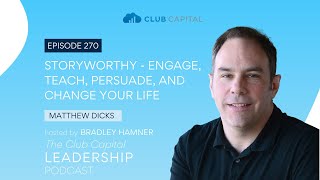
In this Club Capital Leadership Podcast episode, host Bradley Hamner interviews storyteller and author Matthew Dicks about the practical mechanics of storytelling and how to apply them in business, sales, and leadership. Dicks explains that a story must have a clear transformation (start and end), be built from concrete scenes anchored in physical locations, and use vivid nouns rather than adjectives to let listeners fill in details. He emphasizes creating "wonder" through stakes, suspense, surprise, and humor, and advises against memorizing scripts—instead remembering the story’s structure and key beats. The conversation covers how to adapt stories for different audiences and formats (one‑on‑one, small groups, keynotes), how to condense stories to various lengths, and why storytelling is a learnable skill honed through practice (teaching, writing, DJing). Dicks also shares a real‑world sales example where personal storytelling built trust and led to a sale. The episode concludes with resources for listeners to learn more at storyworthymd.com. Promotional ad segments for Club Capital, Coach P Consulting, and Autopilot Recruiting are interspersed but are not central to the storytelling content.
Chapters
Welcome to another episode of the Club Capital Leadership Podcast. My name is Bradley Hamner, your host. On today's episode, we have Matthew Dix. He's the author of Storyworthy. You ever heard somebody say that you need to have stories in your business and tell stories? Well, I've heard that so many different times, but nobody has actually ever told me how or shared with me how to structure stories. Stories do sell, but how do you actually structure stories to where it it can help you to be able to grow your business? What about your sales team? Well, that's exactly what we dive into in this episode with Matthew Diggs.
So the big question is this: how do small business owners like us grow our leadership, develop our teams, and scale our business in a way that allows us to get our products and services out to the world yet still remain profitable? That is the question, and this podcast will give you the answers. I'm I'm Bradley Hamner, and this is the Club Capital Leadership Podcast. Hey, before we get into today's episode, did you know that Club Capital is the largest accounting and advisory firm for insurance agency owners in the country, providing monthly accounting, CFO services, and tax preparation? Check them out at club.capital. Ambition is the first step towards success. It's time to level up your agency. And Coach P Consulting will help you do just that by using the same strategies he used to sell over 700 life insurance policies in 2021 alone. Now, this is not your regular one-and-done type coaching. You'll get personalized coaching 2 days a week, every week of the month, and you'll get a live look behind the scenes of his team training and an office that's performing at the highest level. There's a reason Coach P Consulting is the fastest growing coaching company for insurance agency owners in the country. Coach P will train your team alongside his own and show you the exact steps they are taking to achieve Chairman's Circle, Exotic Travel, and Multi-Line President's Club and be one of the few agents to be selected to have a third office. So whether your goal is to be at the top of your local market or amongst the best in the country, this training will give you the strategies and the tactics to get there. For just $250 a month, you'll get high-level coaching each week from someone who is already getting it done at that level, and his strategies work, and it's time to put them to work for you. Sign up at coachpeakconsulting.com and get your first full month for free when you mention the Club Capital Leadership Podcast. Are you an agency owner looking to grow your revenue, increase your bottom line, and better manage your taxes? Club Capital is here to help. Club Capital is the largest accounting and advisory firm for insurance agents in the country, providing monthly accounting, tax strategy, and CFO services. Way more than bookkeeping and your everyday run-of-the-mill tax prep. Club Capital is focused on providing financial and tax advisory services that help you plan and forecast your agency's performance. Their financial dashboards and agency forecasting tools help you better understand your agency's historical performance, create, measure future targets, and see how your agency compares to your peers around the country. Imagine what it would be like to understand the impact to your bottom line when deciding to hire a new employee, or forecast the impact rate changes or commission rates will have on your business. With over $200 million in tracked annual revenue and $140 million in tracked annual expenses, Club Capital has the data and the team to help you make better informed decisions for your agency. They will help you turn that back office stress into the backbone of your agency's success by giving you the tools to take your agency and your leadership to the next level. Visit club.capital today to book a solution overview with one of our business consultants. Club Capital. Way more than a CPA firm.
Matthew Dicks, welcome to the Club Capital Leadership Podcast.
Thank you very much. Happy to be here.
Excited to have you. So we always start with background and origin story, which I was thinking about this before you came on. I thought, well, how ironic that I'm going to be asking this question to like the storytelling man himself. I do want people to kind of get an idea if they're not familiar with your work, your background and origin story. Like, how did you even get to kind of where you are today and ultimately writing the book around stories. So what is your own personal story?
Well, before I sort of fell into storytelling, I was an elementary school teacher. Actually, I still am. I just finished my 25th year of teaching. I was a novelist— or I'm sorry, I keep saying was. I am still a novelist and, uh, and now a non-fiction writer. I've published 6 novels and 2 books of non-fiction. So I was sort of doing that, teaching and writing, and, uh, The Moth, which is a sort of international storytelling organization, true stories told live on stages without notes, that sort of popped up in New York and they began producing a podcast. And my friends heard the podcast and said, "Hey, there's a thing in New York that you should go do. You've had the worst life of anyone we know. I bet you have good stories to tell," which is really not a nice thing to say about your friend and probably not true, really. But, you know, I always say yes to everything that I'm sort of offered. You know, I believe in doing it once and seeing if it's for you. And so eventually I overcame some concern over going to New York and sort of competing in a storytelling competition with a bunch of, you know, city folk with side-eye and man buns and, you know, narcissism and anger and all of the things that I imagined this audience would have. I was totally wrong about all of it. But I went to New York to the Nuyorican Poets Cafe, which is sort of a famous location.
Okay.
And my plan was to tell one story and hopefully, you know, get on stage, do it, and then never do it again. And honestly, even when I got there, I planned on sort of bailing. I didn't want to, you know, I got there and realized I don't want to do this. And so they— you drop your name in a hat or a bag, really, and they draw names out. And there's usually about 20 names in the bag and they draw 10 out. So you've got like a 50-50 shot of getting on stage. So I sort of was secretly hoping that my name would not be picked. And we got through 9 storytellers, my name had not been chosen. I was already sort of driving home in my mind when my name was picked 10th. And at first I didn't move. You know, it occurred to me, no one knows me here. So if I just sit very quietly and very still, they'll eventually pull another name and I won't have to do this. But my wife was with me and she kicked me. She reminded me of what my name was and told me to get my butt on the stage, which I did. And I told a story and I won. And, uh, I found out standing on that stage and speaking that I sort of loved doing what I was doing. And that was sort of how it began, you know. And so for a couple years, I would travel to New York and Boston. I live in Connecticut, so I'd go back and forth between the two performing. And, you know, I became a known quantity. I won a lot. I was, um You know, I was good at it right away. And so people started inviting me around the country to tell stories. And then eventually, you know, business people started seeing me in shows and hearing our podcast and saying, I would like to do what you do only for business. And, you know, it grew from there. I actually didn't think I had anything to share with business people, frankly. The first person who came to me, his name was Boris. He's a local guy in Connecticut who owns a business. And he said, I want you to teach me how to do that so I can improve my business. And I said, "I don't think I can help you, Boris. I tell personal stories on stages. That's really my jam." And he said, "No, you can help me." And we had coffee, and it turns out he was absolutely correct. And today I work with Fortune 100 companies and advertising agencies and attorneys and Santa Clauses. I work with government agencies and priests and ministers and rabbis, everybody who sort of could use a story I have worked with one version of that person or another over the years. It's, it's been a lovely accident that has blossomed into a business for me.
Well, that's awesome. No surprise that you told a good story even there. You know, I, Sunday, Father's Day, lost someone who was really close to me. My grandfather, one of my grandfather's brothers, one of 13 brothers and sisters.
Mom.
Yeah, thank you. My Uncle John. And, uh, the reason I share that is because when I was around my son's age, 12, maybe 10, through, uh, high school and then college, he had such a profound impact on me. And one of the ways that he had such a profound impact on me is that when he told stories about when they grew up. I mean, they grew up literally dirt poor. They had so many kids because they needed to work the fields. I mean, they— it was Great Depression era, 1920s, 1930s. Um, he hitchhiked to college, uh, so on and so forth. And I just would— I would just sit there for hours and listen to him tell these stories, and it was almost like it was fiction, but it obviously wasn't fiction. And so, uh, I miss my Uncle John, obviously. So there's a little bit of a tribute to him just to mention him, but What are the— I've never been able to unpack what makes a good storyteller. Okay. And then I want to kind of get into asking you around the framework of developing stories. You and I talked before I hit record about businesses have been told, oh, you know, tell stories, tell stories of successful clients and transformations and how you've been able to help people, but nobody has actually ever told them this is how you actually structure a story. So we'll get to that in a second. What about the storyteller themselves? What makes them— what makes people connect? What makes people maybe even turned off?
Well, I think one of the problems people have is they fundamentally don't understand what a story is. And so when you meet a good storyteller, what they do is they tell you stories. And so often in life, what we encounter is people reporting on their life, which is to say some stuff happened to me and now I'm going to tell you that stuff that happened to me, which is fine for your spouse or someone who is willing to put up with you. But none of those things are stories. As remarkable or amazing or as hilarious as something might be, if there's no fundamental sort of change in the human being, if you don't evolve in some way or devolve in some way, if you're not different at the end of your story than you are at the beginning of your story, then you really haven't told a story. You've just sort of told us a chronological account of what happened to you, and no one has ever asked for that in their lives. They've never said, boy, I hope I find out exactly, you know, what Matt did today. No one wants that. They— what they really want is, did something meaningful happen to you today, and can you frame it and tell it in a way that is entertaining, compelling, sort of universally relatable, all those things? So I suspect that your uncle, what he was really doing was not reporting on his life, but picking out moments of meaning to convey to you in a way that were— that was entertaining and probably demonstrated over the course of time some kind of change in him. I learned something, I found something about myself, I saw the world in a different way, you know, I understood my parents or the— or the economy or my country, you know, or the land. All of those things, I understood them in a way that I didn't understand at the beginning of the story. That is probably what he was doing. And what most people don't do.
Ah, that makes sense. Yeah. Um, any— and him, and then other people, and even some podcast guests, whenever they tell stories, I don't know what word to use, but it can be gripping. It can be gripping. It's almost like you, in a way, get teleported to that scene.
Yeah.
As if you were there watching it, like I was a part of it, right? Is that kind of what they do well?
Yeah, I say they activate the imagination, or sort of they close the two eyes that are on your face and they open the mind's eye and they allow you to see a movie. My goal is always to get a movie running in your mind's eye. And so when I'm speaking a story, what I want you to do is to sort of stop looking at me. I almost become irrelevant to you. And instead, what you're really looking at is the story that I am projecting into your brain as much as I can. And in terms of, you know, that idea of it being gripping, the word I like to use is wonder, which is we're constantly as storytellers causing our audience to wonder what is going to happen next or what we will say next. And we must assume as human beings and as storytellers that no one wants to hear anything we have to say. Which is almost always true. And particularly in sales, frankly, no one is ever really excited about a salesperson calling on them, right? So we have to find a way to get them to want to hear the next thing we have to say. And so we can do that through stakes, suspense, humor, surprise. There's techniques that we can use to get people to engage in what we want to say. But I think the mistake people often make is the assumption that people want to hear what we have to say. And the best storytellers in the world, including my friends and myself. When I take the stage, I never assume my audience wants to hear anything I have to say. And so I am relentless in my attempt to create wonder in the minds of my audience. Mm.
You know, words are powerful. Just even using the word wonder is— it's just a powerful word. I've become a lot more entrenched into the language that we use with ourselves and with our teams and business. And I think that that's such a— that is an example of that. It's not a word that I use very often, of wonder. So let me ask you this. Before your work, the only work that I had been familiar with, from a story perspective, and I can't tell you that I've at all dove into it, was whenever I was first introduced to this idea of like the hero's journey. Basically.
Yeah.
And so can you, can you talk about that? And maybe like how you are, like, your framework and how you approach it is similar slash somewhat different?
Yeah, I don't like the phrase hero's journey because it implies that over the course of a story you're going to come across as a hero. And I often think those are some of the least favorable stories to tell. No one really wants to hear you brag. About yourself unless it's your mother or, you know, someone who— maybe your spouse, maybe. So I don't like the idea of a hero's journey. I also believe that some of the most fun and interesting stories people have to tell are the ones where we sort of devolve, where we thought we were great and it turned out we were not. We thought we could achieve something and it turned out we didn't. Those are stories that really appeal to people because most people aren't telling those stories. And so people tend to walk through life assuming that they are the only failure. In their, in their circle, that the shame that they feel is only their own. And when someone stands on a stage or sits at a dinner party or walks a golf course, wherever you're telling your story, if you tell the story about your failures, your shames, your embarrassments, you know, the times that you really screwed up, those are the stories that bring people closer to you, because those are the ones that make people feel better about who they are as a human being. So, you know, I'm not a fan of that idea of a hero's journey. That said, the structure of a hero's journey, the idea that we start in one place and end in a different place, is real. That is, that is essentially what a story is. And all sort of books, movies, television shows of any worth, and even the ones that aren't frankly of any worth, they will all sort of be a character starts in one place and then some stuff is going to happen over the course of time and they're going to end up in a new place. And almost always, if you're paying attention, to the beginning of a movie, let's say, the beginning of the movie will tell you what the end of the movie is. If we, if we open up a movie and a man and a woman are not in love, and we know we're in a romantic comedy, there is no question that those two people will end up in love at the end. That is how that journey takes place. It doesn't mean it's not going to be enjoyable, but we certainly will know what's going to happen. If an action-adventure movie opens, uh, Back to the Future, you know, in the beginning of Back to the Future, Marty McFly can't stand to be called chicken. We know at the end of the movie, someone is going to call him chicken, and he's going to have to not react to it in order to save the day. And if you don't see that, it's just because you don't have that storytelling brain on. But once you get the brain, and you— it's easy to get. My 10-year-old son has it to this already. Like, he watches the beginning of a movie 15 minutes, and he goes, well, this is how it's going to end, Dad. We know that this is going to happen. I say, you're absolutely right, Charlie. That's how all stories essentially function. So we must be telling a story, which is I started in one place and I'm going to end in essentially the opposite place from where I started, started, or some approximation of that opposite.
Let's tilt the conversation. It's a good segue into the business arena. Okay.
Yeah.
And I would love to know first, your thoughts around where stories should and should not get interjected into, we're going to say, the sales process, for lack of a better term. Okay, sure. Now, understandably, there's— I'm sure there's story structure of how do you resell a customer that you already have, keeping customers, retention, etc. But let's just use it from the ideal. This is somebody that is not a customer client. Of yours right now. And so we're going to interject some stories into it. Where does that begin to actually take place?
As soon as possible. I mean, we have to acknowledge that people really don't buy things. They buy, you know, they, they buy or invest in people who are selling things. I always say people believe more in people who have great ideas than actual ideas themselves, right? I have a— I recently replaced the windows in my home, which was a really big job. We did it over the course of 2 years, 3 sections at a time. I had 5 companies come into my home to sell me windows. I did not purchase the best windows and I did not purchase the cheapest windows. I purchased Trevor Devine's windows. And that is because when Trevor Devine came into my home, Trevor Devine noticed that there was a golf club leaning up against the wall. And Trevor is a golfer, and he engaged me in a storytelling conversation about golf. And when my wife came in, she was baking, and he began talking about cooking to her. And pretty soon Trevor was a guy hanging around in my house who happened to eventually tell us a little bit about his windows. And I said, this is the person who I want involved in my life for the next 2 years. His windows are good enough, and the price is good enough. And it paid off because we also ended up buying doors from Trevor. And just like 6 weeks ago, my storm door came loose. And I've got a cat who wants to get outside, but he's an indoor cat, so it's going to go badly for him if he gets outside. And so a loose storm door is sort of a problem for us with this cat. And so I called Trevor and I said, I don't know if my storm door is under warranty or not, but could you get someone to repair it as quickly as you can? And Trevor came that afternoon while I was at work and repaired it. On his own without even saying anything to me. I came home, the door was fixed. I texted Trevor and said, hey, I think the door is fixed now. And he said, yeah, I swung by and took care of it for you. I don't want your cat to get out. Trevor knew I had a cat. Trevor knew why it was a concern for me, right? All of that happens not because of the product he's selling or the service or the warranty, it's because of the person. So the sooner we can get a story in, the sooner we can begin sharing ourself, and make ourselves a trusted, reliable, likable human being, the more likely we're going to make a sale rather than what I see most of my clients do, at least initially. Initially, when they begin working with me, they think that it is product out front or platform out front or service out front. When I say no, it's you who should be out front.
This is brought to you by Autopilot Recruiting. Join over 1,200 State Farm agents in putting your recruiting on autopilot. Any successful insurance agent will tell you how important team is. Finding those rockstar team members doesn't happen when left to chance. It happens through consistent recruiting. You never know when you're going to lose a team member, and the key to an incredible team is constantly searching for the best talent. Autopilot Recruiting is a continuous recruiting service where you'll be assigned a recruiter that has been trained to recruit on your behalf every business day. This recruiter will take over and revamp your career plug, send out assessments, do pre-screen phone interviews, and schedule your in-office interviews. All you need to do is to show up and give a thumbs up or a thumbs down. This ongoing service is extremely affordable and a no-brainer for taking your insurance agency to the next level. Listeners of the Club Capital Leadership Podcast, go to autopilotrecruiting.com and use the code CLUBCAPITAL to get started. Again, autopilotrecruiting.com and and use the code CLUBCAPITAL.
So for someone listening to this, and let's just hypothetically say someone has been in business for 5 years, and listen, we've got people that have listened to, you know, in their first year, second year, etc., so of entrepreneurship. But let's just, in my hypothetical example, say they've been in business 5 years, they've had a number of stories, situations that have occurred good and bad, right?
Uh, yep.
We have a lot of insurance agency owners that listen. They have all kinds of stories, right? And they have told that story probably somewhat similar but not the same every time, and it hasn't been structured correctly. And this is one of the core things I wanted to talk to you about today. Somebody's listening to this and they have like, oh yeah, I've got a good story, I've got a story about this happening, this bad thing happening, etc. And then I've got story of the opposite of this part. This bad thing happened, but they were taken care of, and etc. How do we begin to take these stories that literally are living in our minds and be actually getting it, get them down into a document, but in the right structure so that then we can, uh, rehearse it? I guess maybe is that, is that the right terminology? Maybe you can even speak about that too.
Oh, I would say don't memorize it, but remember it. So it should come out a little differently every time, because if it's memorized, people will know it and it won't feel authentic. So I don't memorize anything that I say on stage. I just sort of remember it. I remember scene by scene and what's required in each one of those scenes to say in order for to move on with the story. But yeah, I would say you're going to rehearse it in a way. You know, I think the first thing we have to do is talk about that structure. I say that we start at the end of the story. Whatever the end of your story is, that's where we begin, because we have to know what we're aiming at. And that'll help us find the beginning of the story. So the beginning is going to be the opposite of that, right? So if I know at the end of my story, you know, this good outcome will happen because they have purchased insurance and life has worked out for these folks, we need to show the opposite of that, which is they don't have the insurance and what could happen. Let's say, we want to make sure we're telling a story, And so stories are comprised of scenes, and scenes are comprised of physical locations. So if the movie in the mind of the audience's eye is going to continue to run, we must have physical locations in the audience's mind at all times. Meaning at any point during the story, if you're— if your audience, your— or your customer, whoever you happen to be speaking to, can't see the, the character in a place, that means the story has fallen apart. Just like in every movie, if suddenly the character is not in a space, uh, you have a problem with your story. So if you think about location at all times— every story I say should start with location and action, which means the location is going to activate imagination, right? I like location because if I say I'm standing in a kitchen I don't need to use another adjective for you to see a kitchen because we all know what a kitchen looks like. Now, you're not gonna put me in the kitchen that I was once in, but that doesn't matter to me unless the particularities of the kitchen are relevant to the story. I want you to put me in the kitchen that you can visualize best. That might be your own kitchen, your parents' kitchen, a kitchen you see on television every week, whatever it is. The way that we create vivid stories is we avoid using adjectives whenever possible, and instead we offer our audiences nouns that they can see clearly. We leverage their imagination and their experiences rather than trying to construct a kitchen using words, because you can feel the bandwidth and the effort that will be required by an audience member to remember what the kitchen looks like, right? If I start to tell you, well, the refrigerator's on the left and it's stainless steel, and there's a sink next to it, and it's a white sink with a, with a metal faucet, and to the right of it, you can feel already you, you're going to spend so much time keeping track of the kitchen, you will lose the story. You know, the classic example is like when someone's— when a storyteller tells me in the beginning of a story that a woman has blue eyes, right? I always say, those blue eyes had better be relevant in the story, because what you've asked me to do is to keep track of the color of this woman's eyes for the rest of the story. And if the eye color becomes relevant at some point, great. But if it's not, you've wasted my bandwidth and probably annoyed me by giving me an unnecessary detail that was not relevant to the story. You should have just said pretty woman and let me imagine my version of a pretty woman for you who I can see perfectly. So nouns are better than adjectives in stories. Not to say that we don't need adjectives sometimes, but when we can avoid them, that'll create a visual representation in the audience's mind, and that makes the story come alive.
That's so good. Two-lane county road, a roundabout, a four-lane traffic stop, something like that. It's like, that's enough, you know, to be able to put— somebody's putting it right there where it needs to be. Otherwise, unless the color of the saint, color of the eyes, etc., is relevant, it doesn't matter. It's those details become something that is— it takes away from the story instead of being additive, right? Yeah, that's good.
Yeah. And it prevents the audience from seeing it as clearly. People always ask me, how do you make your story so vivid in my, in my mind? And I say, because I just leverage your experiences. If I tell you I dropped a bowl of blueberries on the floor, right? I dropped a bowl of blueberries on the floor. You can tell me already if the floor is wood, linoleum, or tile. And if it doesn't matter to me, I want you to see the floor you're most familiar with because that is the one you'll see most clearly. And suddenly my story will seem very vivid to you in a remarkable way when all I said was floor and allowed you to fill in the details without me wasting any words. So that can be really helpful when we're telling a story. And whenever we're sort of activating imagination like that, the audience understands he's telling a story, and stories are entertaining. Whenever you tell a story, you launch 3 chemicals into the brain of the listener. You actually change their brain chemistry. And one of those chemicals improves comprehension, so they'll listen and attend better. One of them makes them feel better about the world around them. When you tell someone a story, it makes them feel better about just the world. And the third chemical makes them feel excellent and makes them feel excellent. And the brain knows you're the cause of the excellence. You're like the drug. So all of those things happen. It also works even better when you make people laugh. Those chemicals are compounded exponentially if you can make someone laugh. But the story does the same thing. So you can actually improve their brain chemistry and make it work for you as well by signaling that you're telling a story and keeping that movie playing in the, in the mind of the audience.
Yeah. And I was just thinking to myself that in an effort sometimes to be vivid in our story, we end up— you can add unnecessary, just unnecessary details to the story.
Yeah.
Trying to be vivid, but you're adding things that just don't, don't, don't, don't matter.
Right. If it doesn't matter, to the story, then it should not be in the story. The problem is someone loves the woman's blue eyes, you know, they want to tell us that their wife's eyes are so blue. But if they're not relevant to the story, what you're doing is you're essentially— you're choosing facts based upon your preference rather than asking yourself, what does the audience really want? A story is not a perfect recounting of our lives. It is the recounting that the audience wants from us. So we must choose the details that are relevant to the audience. And we save those extra long, detail-filled stories for our spouses and our parents who will put up with our nonsense.
That's great. So what, what, what, where do we go from there? And we won't kind of go through every part of it. But this is super helpful to me. And I know if it's helpful to me, it's helpful to our audience. So, so We want to remember, we're not going to memorize. We're going to kind of start at the end. And then we really want to be aware of physical locations. And then you mentioned action, but what else? Where do we kind of go from there if we're actually building out the structure of the story?
Sure. Well, before I move on, just to be clear, when I say start at the end, we start the crafting process at the end. Obviously, the end will always still be the end, but we ask ourselves what the end is so that we can find our beginning. But after we do that, let's say, what we wanna make sure we're doing is doing that tricky thing of creating wonder for the audience, giving them a reason to hear the next thing we have to say. And typically the ways to do that are few and far between, but, you know, sort of easy to deploy. One is stakes, which is essentially what is at stake in the story? Is there a problem? Is this a character wants something? Do they need something? Is there peril in some way? So, you know, in an action adventure movie, what is at stake oftentimes is our character's life and the thing that they are pursuing. Or, you know, in a Mission: Impossible movie, the stakes are this is an impossible mission. By the end of the movie, Tom Cruise will make the impossible mission possible, right? That is the stake of the story. So we can use stakes and we can plant them throughout a story. So what be— what begins as a problem at the beginning of a story can transform, can increase over time But that's a good way to hold people's attention because once they know a character wants something, an audience wants to know if they're going to get it. So that's, that's a stake. Suspense is merely the suspension of information, sort of like I'm gonna tell you some of something but not all of something. Or oftentimes it's the way we just simply structure a sentence. So I was working with a storyteller the other day, and the way they structured their story or structured their sentence they said something to the effect of, "So the cat jumped on my chest, and its claws just tore into me and drew blood. I love this animal, and yet it's tearing me to pieces." And I said, "That's a terrible way to tell that story." I said, "What you've done is you've stolen the suspense of that moment." So rather than saying, "The cat attacked me," and then describe what happened, instead you say, "I'm sitting there eating a bowl of cereal." And suddenly claws are ripping into my chest, tearing my shirt and ripping open my skin, and blood is pouring down. And I look down and I can't believe what I see. It is the last thing I would have ever expected to attack me. It is Phyllis, my cat. The cat that loves me, right? So oftentimes the problem when spoiling suspense is we've been trained as writers and storytellers to lead with a topic sentence and then provide supporting details. But that's a terrible way to tell a story because what people want is they want to be led to the conclusion. They don't want the conclusion and then the details that support the conclusion. So we flip that model. So rather than saying, "The cat attacked me," and then give the details of the attack, we describe the attack and we leave the last sentence for, "Oh, it's a cat." Right? And that creates suspense. And you can do that throughout a story simply by deciding where you're going to say something, what you're going to hold back. I hold back the cat as long as possible so people can wonder what is attacking me, right? I even say Phyllis before I say cat, right? So I look down and it's Phyllis. I pause. That pause causes everyone to wonder what is Phyllis, right? And that, what is a Phyllis, is enormous in a story because it causes everyone to go, what's a Phyllis? And you say it's the cat, and then you'll produce a laugh and you'll change their brain chemistry. And all of those things will happen simply by deciding what order to say things in. That's the production of suspense. So stakes and suspense. We can use surprise as well. It's my favorite one. And that's essentially, we're gonna create an opportunity in the story for people to, uh, be shocked. And typically the best way to do that is we simply ask ourselves, when were we surprised over the course of a story? That's when our audience should also be surprised. And surprises are usually predicated on, I'm gonna tell you some things that will lead to the surprise, but I'm not gonna let you know how important those things are. I'm gonna give you clues along the way. And then I'm going to produce a surprise eventually. And then you can also use humor, which— humor is sort of a— it's sort of like candy. It's not really something that produces wonder, but it will keep people entertained and listening to you for a while. It won't work the whole way through, but humor sort of will placate an audience when all those other things have fallen away and you're sort of saying things that are less than entertaining. If you make them funny, now they're going to be entertaining.
You know that what was really running through my mind is skill acquisition, and that being a good storyteller is a skill, and you can acquire the skill. You just learn, learn the framework, learn the structure, take your story, break it apart begin to kind of formulate it, just moving pieces around at this certain time. Your cat story is a wonderful illustration of that. And people in business, your customers, clients, or I guess prospects and leads, can begin to kind of see, oh yeah, that's me in the story. It's not me exactly, but it's kind of me in the story, and they can follow that. But my bigger point is that is that I see it as a skill now. I see it as a skill now, and that while some people— maybe my Uncle John clearly was not, um, you know, he wasn't, uh, didn't read your book, you know, he might have just been gifted with that— that, you know, some people, it's easy to say, well, over a campfire, that, you know, Matthew's just, he's just a great storyteller. You know what, Matthew's following a structure, and we can adopt that structure. And I think it's important for people to recognize, don't you?
Yes, I do. I think the mistake people make is they think they're natural storytellers, which, to be honest, at some point I thought the same thing. I used to get asked, "How did you start winning all these championships right away?" And I said, "Well, I think I just stumbled upon something I was good at." And my wife heard me say that one day, and she said, "Do you really believe that you're just naturally good?" And I said, "Well, honey, what else could it be?" And she pointed out, "Well, you've been writing novels." and you've been writing every single day of your life since you were 17. You don't think that made a difference? When I was 12, I wrote to Steven Spielberg to complain about the structure of E.T. because I had a problem with one of the scenes in the movie. She said, you've been thinking about this for a long time, Matt. She also pointed out that I've been a wedding DJ for 25 years. So I've been standing in front of 200 people every weekend speaking extemporaneously. So I've lost all concern over speaking in public, right? All that has gone away. I'm very good on a microphone. I can speak on my feet. Thanks to all that practice. And I'm an elementary school teacher, and all I do all day is I tell 10-year-old stories to keep them entertained and listening to me so I can teach them long division. So my wife pointed out to me, you've been practicing this for a long time. You just didn't sort of put it together on a stage, but you've been acquiring that skill for all this time. So I absolutely believe it's an acquired skill. I also think that you don't need to necessarily have great facility with the language. There's a storyteller in New York named Danusha, and English is her third language. And I definitely have a greater vocabulary than her, and her nouns and verbs don't necessarily agree very well, and yet she beats me in competitions because it's really just about decision-making. It's about what order we're going to say sentences in, and, you know, is our beginnings and endings going to work well together? Are we going to find ways to create wonder and humor? And all of those things can happen whether you can, you know, whether you can speak English or write literately or not. You know, I've never written anything that I've spoken on stage on a piece of paper in my life. I speak everything orally. So you can be illiterate and still be a great storyteller. I would suspect that your uncle, the reason he was a good storyteller was probably he was an excellent listener. And if he was an excellent listener, he acquired the skills sort of innately. He started to figure out, oh, well, when people say it that way, everyone seems to pay attention. So I'm going to say it that way. Right? Which is essentially what happened for me. I didn't have a book either. I was the one who wrote the book. Right? So once people wanted to begin learning storytelling from me, I actually had to reflect on my own process and compare what I was doing to other people. And I would say, well, why would they do it that way? Why don't they just do it this way? And my wife would say, I don't know, Matt, maybe they're not a storyteller. Maybe you should teach them and stop complaining about it. And she was right, as she always is. But good listeners tend to be very good storytellers as well. So a lot of things can go into it, but you can definitely learn. I have taken the worst, most miserable storytellers in the world and very quickly risen their level to the point that they can go stand on stages and win competitions and, and go speak at keynotes and, you know, all-hands meetings and deliver marketing decks and sales pitches and all those things. It doesn't take much.
So I wanna ask you, how does a story flex? I don't know what other terminology to use. Flex in terms of length, depth. Length is obviously gonna be, well, how, how long does somebody have to, to, to tell a story? I get that. But, but I'm, I really wanna ask around this context. So let's say that you're developing a, a story or maybe a story inventory. That you then want to be able to train your sales team to use, and their sales team is using it in a one-to-one fashion. Okay, so that's context number one. You then want to go and you want to present it to a small group of other business owners. You go to EO, you go to Vistage, you go to BNI, you go to something like that where there's maybe a 10, 5 to 15. Okay, then keynote. You're given a keynote, you're asked to actually speak, and it's 500 people at the Chamber of Commerce in your local town, right? And so you've got the same structure. Is it the same story?
Is it almost the same? Yeah.
Is it really? Okay.
Yeah, I, I've done all those things, you know. I've spoken to 2,000 people and to 2 people. I've told the same story to 2,000 people and then to 2 people. The only difference is there's a greater level of formality the more people there are. Meaning for 2,000 people, no one's going to interrupt me, whereas if I'm speaking to one-on-one, I'm probably going to get some questions as I'm telling a story, which is acceptable. I'm going to be a little more performative in front of 2,000 people, meaning my story is going to appear more deliberate. I'm going to be a little more rehearsed. I'm going to you know, be using some of my techniques, my vocalization techniques to really draw people in, because drawing 2,000 people in is certainly trickier than drawing 2 people in. But it's certainly doable. So I'm going to use some of those, some of those techniques to get people to focus on me and to stay focused on me. But essentially, the story is going to be just about the same. Very little or anything will change because the story is a story. Now, I do believe also you should be able to tell your story in a variety of lengths. So I was recently in Victoria, Canada, in front of 50 business owners and entrepreneurs, and I told a story. It was a 7-minute story, and one of the guys said, "Can you tell that story in 30 seconds?" The 7-minute story that I had told that made people laugh and cry. And I said, "Yeah, I probably can." I said, "I haven't yet, but let me just go for it right now." I told a 42-second version of the story that also made people laugh and cry. Even though they had heard the 7-minute version of it, the 42-second version had the same effect. It didn't sort of— it didn't provide as much context, and it wasn't going to be as helpful to me as the 7-minute version was. But you should know how to tell sort of the 30-second, the 1-minute, the 2-minute, and the 5-minute version of most stories, which is a very doable thing to do. And you can learn that skill as well.
Hmm, that's so good. This has been, this has been a great conversation for me. I've learned, I really have, I've learned so much about this, and it has given me a level of confidence. And then also, kind of a, not a conviction, but a thing of, I need, I want to go in detail out my story and structure it correctly. I've gone on some different podcasts. So Certainly on this, this podcast for 3 and a half years, I've told different aspects of my story from a vulnerable perspective of not understanding how to read financial statements to, you know, my own personal burnout. I mean, so many different aspects of it. But when you go on another podcast, you know, you, uh, I haven't certainly rehearsed it, but I've definitely have not taken the time to structure it because I'm so off the cuff when it comes to podcasts in general. That then I, when I go on somebody else's podcast and tell that story, it's not like I'm following a structure. And I see that as an opportunity for me to be able to improve myself. And I think that's going to be able to help other people too. This has been great. Um, people want to, uh, learn more about you. Obviously I've, I've really enjoyed your, your book. Um, but where can they connect with you and where would you point them to, Matthew?
I guess I'd point them to storyworthymd.com. Particularly for your audience. That's a, that's sort of my location where business people and entrepreneurs and anyone who's sort of like looking to purposefully use stories to, you know, move forward professionally in some way, whether it's a business or themselves interviewing, things like that. That's where they can go. I have lots of free resources there. I have courses that they can take. I'm doing webinars and things like that. So they can find lots of information there.
Yeah, that's awesome. Matthew, it was really great having you on. Thank you for coming on the podcast.
Thank you. My pleasure.
Well, there's a lot of takeaways from that. I think number one is, uh, whenever he said on a story, don't, don't report, it's not just a chronological account, it's telling a story. I think number two, remember, don't memorize. That was actually good for me to hear. Um, I think number three, the details where we were given talking around physical location, and then he goes on talking about, you know, the stakes and suspense and surprise and humor, etc. I, I I think those were some of my biggest, um, takeaways. And then ultimately, probably my overall biggest takeaway is that storytelling is a skill and that it has a structure, and you can acquire that skill. Big shout out to our podcast sponsors, Club Capital, Coach B Consulting, and Autopilot Recruiting. If you want to be able to tell a story to attract A-players onto your team, you can develop— use that structure from Matthew to be able to tell the story. Of your business, how you got started, and the story of your team so that you can attract A-players and then work with a recruiter to be able to bring them on. Go to autopilotrecruiting.com. You know, one of the stories is how important it is to be able to develop your team on a regular basis, and that's exactly what you get with Coach P. Go to coachpconsulting.com. Uh, when Matthew was talking about Um, before we hit record, he was talking about, you know, um, developing, uh, elementary students, and he's still an elementary teacher and using stories to do that. How can you possibly, uh, use some of the stories from David to be able to develop your team? Go to coachbconsulting.com. He'll give you an entire free month so that you can test drive and see why he is one of the fastest growing insurance coaches. Out there, CoachB Consulting.com. And lastly, we wouldn't be able to have this podcast if it wasn't for our partners at Club Capital. Go to club.capital. Figure out how you can develop the mindset, skill set, tool set to be able to leverage and use your financials to make better decisions in your business, whether it's growth and revenue, developing your team, hitting higher production targets, or just being able to take on more profit. Club Capital can help. club.capital.
Art of One.
That was a good one. Till next episode, lead well.
So the big question is this: how do small business owners like us grow our leadership, develop our teams, and scale our business in a way that allows us to get our products and services out to the world yet still remain profitable? That is the question, and this podcast will give you the answers. I'm Bradley Hamner, And this is the Club Capital Leadership Podcast. Hey, before we get into today's episode, did you know that Club Capital is the largest accounting and advisory firm for insurance agency owners in the country, providing monthly accounting, CFO services, and tax preparation? Check them out at club.capital.










