Episode 379: The Serving Way with Chris Thyberg
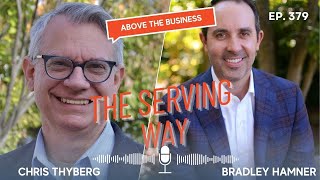
Chris Thyberg, founder of The Serving Way, argues that servant leadership isn't soft but bold and necessary in uncertain times. He outlines four concrete practices: noticing yourself and the room, confronting competing commitments, rewriting limiting beliefs, and moving from either/or to both/and thinking, like balancing accountability with empathy.
Chapters
Welcome to another episode of the Above the Business Podcast. My name is Bradley Hamner. I am your host, founder and CEO of Blueprint OS and host of the Above the Business Podcast. Through— to introduce Chris Theiberg to today's episode. He's an esteemed executive coach specializing in guiding emerging and experienced leaders through the complexities of personal and professional growth. I think We've talked about leadership in a lot of different angles on the podcast. I mean, the name of the podcast for a long time was the Club Capital Leadership Podcast. And obviously we talk about a lot of things other— outside of leadership, but for a long time we've brought different guests on to talk about this idea or this concept of servant leadership. I'm sure many of you have heard that, but I think Chris does an exceptional job of breaking the pieces down of what exactly does that mean? What are the steps to becoming an actual servant leader. And does being a servant leader mean that we're soft? Well, we talk about that in this episode. Without further ado, here's my conversation with Chris Thiberg. Welcome to the Above the Business podcast, Bradley.
Thank you so much for having me.
We are excited to have you. Well, we start all of our guests with background and origin story. I think it's fascinating how people come to kind of where they are in life at this point. So why don't you take us back wherever you you like to begin and bring us to present day?
All right, well, I'll do this by riffing off the name of my executive leadership coaching practice, which is The Serving Way. And I'll go all the way back to working with and for my dad. My parents had a camp and conference, uh, a ministry, a line of work in Connecticut, and I grew up there on the property. So that means is from the minute I was big enough to sweep a floor, there was a broom in my hands. And I love my mom and dad so much, but my dad was not an easy guy to work with. And it wasn't just with his son, it was with everybody that he was a bit challenging. So even from that early age, I think there was a seed back there that was kind of on the lookout. What? Accounts for a leader really able to inspire and motivate and bring the best out of their people. And as I grew up in my own leadership, uh, in higher education at Carnegie Mellon and Penn State, and then for a global nonprofit, I I saw that the leaders that caused me to sit up a little straighter, right? And my shoulders were a little broader and there was a sense, Bradley, yeah, I can do that. Give that task to me. Yes, it will stretch my competencies, my skills, my expertise, but I wasn't afraid that it would stretch my capacities, the inside of me. Right? So if we use a metaphor, yeah, I'd have to increase the apps, the outer game of my leadership, but I also would need to upgrade the operating system, who I am, why I lead, what my purpose is, and how I show up. So I noticed, man, there are some leaders that cause me to step up into my greatness and others, man, Absolutely not. Really felt the squash. And I realized that the, the serving leaders were exercising their power, their rightful authority with me and for me, and they weren't afraid that my own power would grow up in me. Whereas the self-serving leadership leader, the self-serving leader very much, they were in it to make sure that they could exercise power. And they were afraid that power would grow up in me. So maybe 20, 25 years ago, I discovered the work of Robert Greenleaf and his whole notion of the servant as leader. That was the title of his, his seminal work in 1970. So he phrased— he coined the phrase of a servant leader. I call it a serving leader because I like to move this into a place of action, not just an adjective, not just a noun, a verb. How the serving leader does stuff differently. And if I can encapsulate that, it's They are as— they are committed to the flourishing, the development of the people entrusted to their stewardship. And I do say that very deliberately, entrusted. People are not human capital. They are not human resources. They are humans being human at work where they spend a tremendous amount of time. And so they need from the leader the chief vision officer, the chief purpose officer, the chief culture officer. To wrap it up, the chief serving officer. Well, that just showed up in my leadership at the places where I worked over 30+ years. The more I had people reporting to me that led other people in big partnerships that spanned organizations. It was really clear to my, my number one job. I love your phrase, ab— above the organization. My number one job above was to form the leaders who would actually get stuff done.
Hmm.
I was not meant to stay around and run stuff. I was always an intrapreneur inside organizations, creating the new, rebooting stuff, right? And it became really clear to me it was all about the capacities and powers of the people entrusted to my care. So that's the origin story, from being a kid pushing a broom to now working for a number of firms since 2014 on in leadership development, and then launching my own practice, The Serving Way, in 2018. It's all about— I'll put it this way, Bradley. When I'm being polite, it's helping leaders create the conditions of thriving at work. When I'm being a bit more crass, it's helping works suck less, one evolving serving leader at a time. So that's my— and I'm sticking to it.
I love it. I have so many, so many thoughts and questions, but I want to share with you that let's go under the assumption that the people listening to the podcast, just by the nature of someone listening to a podcast, they are taking an action that they want to improve, they want to get better, they want to grow. And I think that for most people, they've heard servant leadership, and then they want to become someone who embodies servant leadership. But I think a lot of times it's, how do I do that? What, what do I do? What are actually some of the— maybe not day to day, but in some cases, day to day, week to week, month to month, quarter to quarter, what are the actual things that I need to do to not put on a show but to actually begin to transform? And I want to try to give an analogy here. At the time we're recording this, I don't know if you're a golfer, you may not keep up with golf at all. I love the game of golf. I know you're, um, a soccer, uh, fan yourself, as you called it, the real football before we hit record. Uh, but recently the US Open just finished and Bryson DeChambeau won the US Open. And it was just a handful of years ago that he was compared to some other players and was really polarizing. People did not like him. They thought he was arrogant and he probably actually was. And he has done a complete 180. Um, in the last few years. And there are tangible things that you can point to that he has done and continues to do that are stacks of evidence in the favor of him actually becoming a different person. And he's— he spoke to this. And so let's say— and I'm— this, um, long— I apologize for this being a little long, but I'm wanting to give some, some examples for someone who wants to be a servant leader. And maybe the culture is not exactly what they want it to be. Chris, what are some tangible things that we can begin to do?
Well, thank you so much. A brilliant setup. And let me riff a bit up off of serving first, because servant leadership gets a bad rap that it is soft. That it's all about kumbaya. Bradley, let me promise you, I will serve you. I will make sure you're taken care of. You will be bubble wrapped. Well, every person in the sound of our voices knows that we live in whitewater conditions for leadership. Or the acronym is VUCA from the military, volatile, uncertain, complex, and ambiguous. In a space like that, that's the framework of your question to me and your invitation, which I'll get to, to share some specifics. But the context is, in those whitewater conditions, we can't promise to anybody, I'll take care of you. That's a false promise. In fact, it's not serving you. It's serving me because it sets me up to be the parent and you to be the child. That's not serving. In fact, to really serve wisely and well requires leaders to be bold and courageous and visionary. And we can't say we'll spare you all pain. What we can say is we're going this way together. So there's an African proverb that the serving leader When the way is clear and it's daylight, the serving leader comes along behind carrying the bags. When the way is dangerous and at night, the leader is out front with a torch. Just that distinction for a leader to know, when is it my time to be from the back and more of a supporting role? Or when, yes, I need to step up. And if that means taking the brick in the forehead, yes, I will. So just that distinction right near there, I hope, begins to pose some of the concrete things that serving leader needs to do to really truly serve and not be self-serving by looking like I'm the savior, I'm the rescuer. I'll fix everything. So let me go with that. I love how you spoke of, of this audience where we're interacting with as already committed to growth, already committed to development of themselves as well as the business. Great. The place where I meet leaders is often what I call their growing edge, which means more of the same, just trying harder. Even with the superpowers that got them here, they look up and say, oh man, that is not working. In fact, I work with a lot of leaders who make that big move, whether it's a promotion or starting a new company, and they realize they're getting in their own way. Actually, by them doubling down on the stuff that got them there, they're actually inhibiting themselves and everybody else from going where they need to be. So that's point number 1. If, if leaders could take away anything, it's, can you notice that you're actually getting in your own way and you're doubling down, you're playing louder and faster the same old tune. And then to notice, oh my goodness, why do I do that? Bradley, most of us do that. You know why? Because we're afraid. Because we're facing that VUCA condition, and we, like everyone else, don't even know the right questions to ask, much less the right answers. So what do we do? We go back to the stuff, maybe since we were 5, that always got us to the next place, always got us to the next So that's the first thing to be a serving leader, become an attentive noticer of yourself and then read the room. Be able to pick up by listening very carefully, talking much less, receiving all that data from the people, not only what they say, but the body language and the emotional vibe in the room. Notice what's going on and notice, oh my goodness, it's like I've pushed the volume on this mixing board up to 11 with my superpower of— let's say I'm a super responsible achiever, I'm an expert achiever, and I'm not noticing I've lost the room. I'm not serving anybody. So step 1, notice, be aware. That's going to require slowing down, shutting up, and also attending to ourselves as well as what's in the room. Now, just noticing is a great first step, but then we have to have specific ways to pivot. And so let me name one, uh, one or two places where I find my clients really get stuck. One is a phenomenon called immunity to change. Immunity to change. And what it looks like, Bradley, is I make an out loud commitment. I'm gonna do this, this, and this as a leader. And I don't. In fact, keep doing the stuff that's getting in my own way. And the pivot here is to say, What else am I committed to? I say I'm committed to getting better in XYZ, but inside I'm worried, what will I lose if I actually get better at XYZ? Maybe if I speak up more in a meeting, I might rub people the wrong way. And if I rub people the wrong way, maybe I'll get pushed to the fringe of the group. And if I get pushed too far in the fringe of the group, I'm out of the group. Well, that's a very deep-seated psychological and even biological threat. So I may say I'm committed to speaking up more, having more leadership presence. And why don't I do it? Because I'm actually getting something out of staying quiet. And I'm risking something by taking those steps. So simply notice first, but then, oh, when I have a moment to pivot, just notice and now act. Is that story really true, Chris? If you speak up more, you won't always get it right, but will you really be drummed out of the tribe? Nah. If you got drummed out of the tribe, would that be the worst thing that ever happened to you? Nah, I bet talking among entrepreneurs, they've learned more from their failures than they have their successes.
Oh yeah, 100%.
So I would say that that's a pivot point. Notice this immunity to change dynamic. The next bit builds right on that. Develop the practices where we start questioning our unquestioned assumptions. I call them limiting beliefs. And just ask ourselves, is that true? Where did that come from? How has that story served me? And then ask, is it serving me now? Once we notice those limiting beliefs, we can start to rewrite that script. And again, it's very practical. It's what do we do at the start and the middle and the end of each day to check in with that story, that identity we carry? And then what do we do in the moment when that identity feels under threat? And we go back to that limiting belief? Can we notice and then choose a different bit of language? Sometimes, like I said before, just choose slow down, Get quiet. In fact, find your body in your chair, like physically find yourself and get here. And that little move all of a sudden unlocks a whole bunch of stuff that we now set aside some of those limiting beliefs and we walk into the new story we want to write.
Hmm.
The last little practicality that comes up all the time, and it's directly in line with immunity to change, which is based on competing commitments, one of which I'm not even conscious of. And then what's behind that? Limiting beliefs. Often what's underneath the limiting beliefs is getting locked into a polarity, into an either/or. Either I can speak up more in this meeting and have more presence, or I've just gotta stay quiet and take whatever comes.
Hmm.
Well, is it the case that it's either be bold and brash and obnoxious or passive and quiet? No, that's a false either/or. There's a both/and And it's not splitting the difference, Bradley. It's not, you know, 50/50. It's how do I both speak up but speak effectively? How do I convey with my listening that I have presence and influence? And so that one right there, for someone to notice, oh my goodness, I'm in either/or. And I bet there's a both/and. I bet there's a way to integrate these things into a new third way that has the very best of each. Sometimes it's good to be a little chill, right? But if we're nothing but chill, well, not so good. Mm-hmm. Big and bold in the room, good until there's too much, then not so good. What is it like to just know when to dance between those two? And bring them together in a— oh, I'm making it up right now, uh, I am chill and in command. I'm both. I'm both chill and in command. And doing that in a way that again has me there in service to the people. So there, there are a number of things right there that are very practical how-tos. And in coaching, each client unpacks what it looks like for them. How this stuff, this common human dynamic stuff, shows up for you personally. And then with clients, they just, um, they just design for themselves, well, I'm going to try this to notice more. I'm going to try this to know how to pivot. I'm going to try building this rhythm into my day and my week and my quarter so that I can stay in this place of integration where I might fall into an either-or. Yeah, so I'll end there with those, those 3 things.
You know, one of the things that you mentioned that really took me back, and I, I think I've shared some elements of this, but to, to your point earlier about oftentimes we learn the most through our failures and our mistakes, and one of the areas in leadership is I would flip-flop back and forth from being way too hard on my team to then be in a softy and accepting mediocrity and accepting less than stellar. So when you said serving gets this moniker as being soft, I would have totally in the past completely agreed with that. I was like, yeah, I want to be a— I want to be a— I do want to be a servant leader. I, I do. But at the same time, if I'm a servant leader, leave leader, and I'm just accepting of mediocrity and the team's not doing what they need to do and this person's not hitting their there. And, you know, what do I do? Just to accept that? Just roll over and take it? Basically, I was like, no, I want a culture where we perform and we actually get things done. And at the same time, I hold people accountable, and then they respect me. And I got to a place to where there was a period of time where I don't know how to do that. I don't know how to hold both of these— to your point— how to hold both of these elements of, you know, a culture to where we know we are actually moving forward, but I'm not feared. I didn't want to be feared. I want to be— I wanted to be respected. I wanted them to say like, no, he holds me accountable. This is what I need to do. And for the longest, that felt like a, I don't know, a fantasy land, really. So for someone that is maybe in that situation to where they go from, you know, one extreme to the next, what, what do you, what are some, what are some practical tips, um, that you would give them? And then, and then I know people are going to want to connect with you, so we'll give them an opportunity of kind of where, where they can do that, Chris.
Excellent. And what you've, what you've said, I've experienced that in my growth as a leader. And it's very common, you know, that as I'm sitting with leaders at their growing edge, the place where they need an operating system upgrade, not just more apps, not just more competencies. So what you've named really are a family of polarities. The people and the performance. If it's all about the people, then we will fall down a sinkhole. If it's all about performance and we just grind people, we're gonna burn people out. If it's all about relationships, cool until it doesn't work. If it's all about results, great on the bottom line until we watch a destroyed culture. So to hold both together moment by moment, to notice, ah, results follow at the speed of relationships. Results follow at the speed of relationships. So let's just use that one. Think of it like a bank account. Every time we hold people accountable, ask them to, to stretch, to perform, to meet a hard deadline, it's like we're taking out of a bank account. We're making a withdrawal. Cool. In the heat of battle, in the whitewater conditions, absolutely. But when we have the moment to make a deposit into those people, into supporting them as well as challenging them, and to be committed to their growth so that they now have the resources to step up when it's all hands on deck for results. We're putting stuff into the account. Mm-hmm. Now when we need to make a deposit, there are funds there. There are interpersonal, relational, emotional, social, relational capital that we can draw on. How it plays out for each leader is different, but it's a kind of moment by moment Did I put enough time in the bank when things were relatively calm so that we can draw it out when things get rough? And then I'll make one little other challenge, um, or refinement, I'd say. Leaders often think it's my job to hold people accountable. That's not true. It's not true. I hold my children accountable when they're children.
Hmm.
But at this level of serving leadership, at this stage of the game, it's much more, first of all, am I modeling that I'm accountable, that I hold myself accountable to me for my purpose and values, and that I'm held accountable by all the stakeholders. Yeah, the shareholders. Yes, the customers, but my team and my team's families and the communities. So if I model first accountability and have that vulnerability with strength that I can hear a hard word, sometimes I can be called out and called in. Hmm. Then I start to model that where we're aiming for is mutual accountability. I want everyone on my team already holding themselves accountable without me over their shoulder at all. What I do as the leaders, when we come together, it's like, hey, what are we all holding ourselves accountable to? The big purpose, the vision of this enterprise. But for each person, how are you holding yourself accountable to your own commitments, your own promises? Your values. When you say you're gonna produce something and you don't produce it, you just burned a whole lot of trust.
Yeah.
Oh my goodness. What are you doing for your own sake to be accountable and model it so that there's now more a mutual accountability? I'll just summarize that the, the leader, especially the owner or the founder of a business, creates the container, creates the conditions under which all that good stuff happens. Responsibility, results, relationships, people, performance, all of it. The leader actually creates the environment and like cultivates the conditions. Mm-hmm. That's why a leader has to get up and out of themselves and get that bigger above the organization view. I'd say when we're down in the, I'm gonna hold you accountable, we are working on the business. We might even be stuck in the business when we're down, hey, be accountable. Hey, hey. And sometimes it has to be done. And you know, a serving leader, I'm just gonna say this, a serving leader has the courage to make a, a hard choice to say to a high performer, You're not living up to values, and I don't really care what your numbers are. We can't have you stay here.
Mm-hmm.
And make a hard, hard call that is actually serving everyone and even serves that person who's the obnoxious high performer, that maybe they get a wake-up call and they just can't coast by on bad behavior. Because they're so smart, right? So there you go. That's kind of a little bit of a, of a nutshell on riffing on, uh, responsibility, results, relationships, people, performance, holding together the balance and having that courage to create the conditions of mutual accountability. Reciprocal responsibility. But the leader's got to model it, always has to go out front.
Yeah, I think one of the things that really stands out to me in this conversation is that it's really not either/or. It's really kind of and both. It really is. It's got to be both. And it's a really good, refreshing reminder for me about that is you got to be able to hold both at the same time. Chris, people want to connect with you, learn more about your work. Where would you point them to?
Well, the website's going to be a good place to start. So it's theservingway.com. And you can find me on LinkedIn under my name, Chris Thiberg. And what I hope people see when they come to the website is they see themselves first. They don't see me. They don't even see a big pitch about coaching. They see themselves and somehow this sense of, oh my goodness, somebody gets my struggle. Whether I'm an emerging leader at that first big bump or an experienced leader starting a new business or looking at succession and legacy, a, a person says, ah, yep, I am at a growing edge. And I don't know how it is, but I think this thing called The Serving Way and this guy, Chris, might be a partner. And that's who I am. And that's what great coaches are. We are not consultants. We do not come in and prescribe solutions or give answers. We help people unpack what they are, the greatness that's already in them. I put it this way. You are already pregnant with the next great leader you're about to give birth to. It's not my baby, and I can't have it for you, but I'm a really good midwife. And that's what I hope people will notice when they look at the website. And then I never sell coaching. It's, it's actually, it's really dumb. Coaching is not something one can sell because it's so relational. It's such a matter of trust and partnership and connection. So I simply say, you will have a non-sales conversation with me and explore what really matters to you, what coaching is and isn't. And above all, do we vibe together?
Sure.
It's as much about, do I feel with you that there's a good connection and chemistry that we can do great work together as it is you making a sales decision. So I hope people will follow that up and, and book a free 30-minute coaching exploration with me.
Awesome, Chris. It's been awesome, uh, having you on. Thank you so much for your time, your, um, expertise, and your experience, and, uh, and giving back to our audience today. Hope to have you back on in the future.
Good. Well, I wish everyone listening to this, viewing this, um, Blessings, courage, vision, and, uh, good whitewater rafting.
Love it. All right, great, Chris. That was fantastic. Thank you so much.
You're welcome. It's great fun. Boy, you set that up beautifully. And I've been on a number of these, but what you did put in to frame it was just right. It wasn't too much. It didn't put the spotlight on you. It just made it really real. And I appreciate your skills in doing this.
Oh, thank you so much. You are scheduled to drop on July 29th, which is about normal for us, uh, 4 to 6 weeks, um, out, which is really nice. So our team will be sending over to you and your team the assets. So feel free as you see fit to share that with your audience, and, uh, um, I hope that it, uh, brings, brings you some, uh, leads and some people to be able to chat with.
Good. And, uh, in due time, I'd like to have another conversation where I can be aware of how, with clients who need your services, I can point them to you.
Oh, fantastic. Well, I appreciate that very much. I would love to, love to be able to, to, uh, to chat with you about that. I use Moniker of the language of operating system as well. Mine is different from yours. Mine is definitely on the actual business operating system itself. And so there's definitely some, there's definitely some parallels there. Good.
Well, that's perfect because I won't want to go with a client down into the weeds of how they actually need to. Yeah, the business.
Sure.
I sit with them at those other places where they're they're wrestling with the harder stuff. But I love having a rich Rolodex of people who do different kinds of things, more consultative, more business building type things, to, to refer my clients over for that different kind of service than mine. And I hope you'll feel the same way about me and coaching, that when you have clients in your space and you sense, yeah, they need some inside out change, they need some they're ready for some upgrading of who they are, that you'll think of me and point people my way.
Uh, absolutely. Well, no question about that. Thank you very much.
Okay, I appreciate you and your time.
Thank you very much. Have a great rest of your day. Okay, everyone. Well, you know, when we first had the name of the podcast to be the Club Capital Leadership Podcast, we brought people on and talked about leadership from a lot of different places. But the reality was, is we were talking about business from the different angles. And so hence that led to one of the reasons why we decided to pivot the name to be Above the Business and not just about leadership. That said, at its core, I'm such a huge believer in the owner, the leader, the founder, the entrepreneur leading themselves first, upgrading themselves to be better for the people that they lead. And I think Chris did an exceptional job. I shared obviously around my takes around serving is not soft. I think that's one of my biggest takeaways. I think VUCA was a great acronym. I love that. And then the third one that I really took away is the growing edge, right? And so The other part that I didn't mention whenever he was on the podcast, I, for a long time, the context of this is a little different, but it will make sense. Hopefully it will make sense. Is for a long time, the only thing that I knew to push on or the only lever for success or growth or moving forward in the business was to work harder. And that was the thing that was working. Well, what do you do whenever that no longer works? And so I think that that to me was, you know, I got to a place to where, you know, culture was terrible, um, and I admitted to myself, I don't know what I'm doing. And, and I actually ended up having to, having to have that conversation with myself several different times in several different incidences. And so leadership being one of them. You have infighting, everybody's, you know, not performing and they're, they're bickering back and forth, et cetera. And I had to look in the mirror and say, you know, I, I don't know what I'm doing as a leader. I thought I did. Um, but I'm telling myself a story. And so I had to kind of look inward. And I think that's kind of what Chris is, it was able to share with us as well. So connect with him, go to theservingway.com. Thank you to our podcast partners: Club Capital, Coach B Consulting, TodayApp Pro, Autopilot Recruiting. I think that if you— at the end of the day, this podcast is really about small business and entrepreneurship. And, you know, personally, I'm not a big fan of, um, solopreneurship. Nothing wrong with that as a whole, but I really think that business is a team sport. And so even playing golf, uh, in college, you— yes, it's a very solo sport, but when you're playing on a team, it's, it's hard to replicate that camaraderie whenever you're just playing with yourself. And so, but playing as you're just playing by yourself, um, uh, team, fix that. Obviously not playing with yourself, playing by yourself. Okay, let's make sure we get that, um, in there correctly. So when you're playing, you know, as a part of a team, you care about the people that you have on your team. And so if you need to upgrade your team, or maybe you've got— so you're going to be expanding, or you see that you, you're going to be making some changes with your new team, finding a partner that can help you is incredibly important. Autopilot Recruiting— go to autopilotrecruiting.com, get a dedicated recruiter that's going to be able to help you to to recruit and find great people to be on your team. You know, a lot of times, even in my own programs that I have, I love to work with the business owner, the entrepreneur. Very rarely you can find a program that both serves you as the business owner but also your team. But that's actually what you get with Coach P. Go to coachpconsulting.com, coachpconsulting.com. Let him know that you heard about him on the Above the Business podcast. He'll give you entire free month to just give it a test drive and see what you think about it. And you'll see why so many people are sticking with him, have grown with him, um, but also their team is picking a lot up as well. That's something that is really rare to find. CoachB Consulting.com. Speaking of your team, it's important that we give our team the tool. I like to think about mindset, skill set, tool set. But also think about that for the team. What are the tools that the team is using, especially tools that they use on a day-to-day basis? If you're an insurance agency owner, you've not checked out Today@PRO, go and just book a demo. Let them have a conversation with you compared to what you're currently doing. I know the feeling of switching software is, is often like when you're switching bank accounts. It's, it can feel like or seem like it's going to be a pain. That's not the case. It's going to be with TodayApp. TodayAppPro.com. You know, kind of back to mindset, skill set, tool set. One of the mindsets, but also some skills to learn and some tools to have at your disposal, Club Capital can help you to be able to get control of your financials. I was just working with a new program member, and one of the things that we're going to be focused on over the next you know, 3, 3 to 12 months or so, is actually increasing his profitability, not even trying to grow. His biggest lever— he needs more margin, he needs more profitability in the business. He was operating 3 to 5% margins. It's just simply not enough. And so if we actually successfully grew the business and they kept those margins, he would just add stress at levels. And he said, you know what, just having insight, optics into that has been so transformative for me. Just even having an idea. And so if you don't really have some of those benchmarks of, well, how profitable should I be, how much should I be investing in these numbers, book an obligation demo with Club Capital. Go to club.capital. If you like what I do, and here are some of the things, and you'd like to learn more about what we do at Blueprint OS, we help people to design, build, and install a business operating system. We call that Blueprint OS to help you go from being the rainmaker of your business where everything is dependent upon you to becoming the architect of your business. And what do architects use? They use blueprints. So if you'd like to learn a little more about us, go to blueprintos.com. If you go to blueprintos.com/assets, you can get some of our free downloads and opt into our starter kit as well. blueprintos.com/assets. All right everyone, till next episode, lead well.










