Episode 391: Peak Mental Performance with Evan Marks
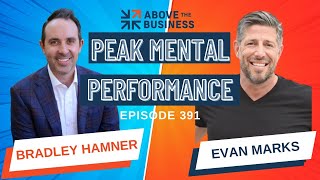
In this Above the Business podcast episode, host Bradley Hamner interviews mental performance coach and former Wall Street trader Evan Marks. Marks explains mental performance as the set of conscious and unconscious processes—thoughts, emotions, behaviors, and neuro‑plasticity—that shape decision‑making. Drawing on his hedge‑fund background, he describes how limiting beliefs and resistance, often rooted in past experiences, create mental barriers for entrepreneurs, using a golf analogy to illustrate comfort zones versus high‑performance zones. The conversation explores the interplay between skill gaps and mindset, emphasizing that behavior change precedes emotional change. Marks shares a practical mental‑performance model (acknowledge, verbalize, pause, choose behavior, act) and stresses the importance of consistency with evidence to build confidence. He discusses early warning signs of mental overload (e.g., panic attacks), holistic wealth, and daily/weekly routines such as breathwork, journaling, and exploratory questioning. The episode also covers how to set and expand a 3‑year business vision, the role of procrastination as fear of future feelings, and the value of surrounding oneself with high‑performing peers. Finally, Marks provides contact information for his coaching practice and reflects on what “working above the business” means—having a larger vision and serving others.
Chapters
Welcome to another episode of the Above the Business podcast. My name is Bradley Hammond, your host. On today's episode, we have Evan Marks. He's a mental performance coach and founder of M1 Performance Group. You know, on the podcast, especially since we rebranded to Above the Business, we bring people in from every different aspect of entrepreneurship and small business. And so one of the areas— excuse me— So one of the areas I think that we've not discussed nearly enough is the mental aspect of being a small business owner. And what does it actually look like to expand our own mental capabilities? And in this episode, we're going to explore that deeper with Evan Marks. Evan, welcome to the Above the Business podcast.
Bradley, thank you very much for having me.
Excited to have you. Well, we'd love to start with background and origin story. I'd love hearing how people got to they are. Why don't you take our listeners back?
Well, my name is Evan Marks. I am a mental performance coach and an investor. I started M1 Performance Group actually in, in January, but prior to that I was with another trading group for about 6 years. But prior to that, I spent most of my career on Wall Street as a hedge fund trader manager for about, about 25 years, right outta, you know, right outta University of Pennsylvania. I got shipped right into Wall Street and I spent most of my career there, which I didn't enjoy all the time, but I learned a lot of lessons along the way. And I really was very fortunate enough to understand the importance of mental performance in that arena and how it carries over to my coaching practice, how I invest in companies. So I'd like to say I regretted some of those years, but now when I look back, It was extremely formative time in my life where I really dug in to building my mindset, understanding resilience and emotions and behavior and the unconscious. So it was really a very valuable time for me.
Can you define— when you think about mental performance, I don't want to have an assumption of what that is. I have an idea of what that is, but how would you— how do you define that and how do you begin to work with some of your clients? And so in other words, as a business owner, entrepreneur, how would I know that, you know, I'm in need of an upgrade in my mental performance, the way that I think, etc.?
You know, it's interesting. I mean, it's a great question and I always give it thought. Whatever is, you know, in between the ears, that's your mental performance, right? We're not talking about biceps, triceps, traps and doing lunges. What we do is we— it's a mental gym. Right? We know there's an unconscious. We know there's a conscious. We know there's feelings and behavior. And we know, you know, my practice takes modern psychoanalysis, which is Freud, right? How the early years, the, the learned behavior, the experiences, the lessons we've learned, coupled with actually how the brain works. You know, we know the brain is a predicting mechanism. But what's interesting is it predicts from past experiences. So now that we couple emotions, behavior, we're, we're able to now, through which we all know about neuroplasticity, right, in the latest of neuroscience, how the brain can actually rewire itself. So growing up, certain feelings were tied to certain behaviors that served you. But as we grow up, as we become adults, as we become whatever you do for a career, and even life in general, oftentimes we need new behaviors. But what's interesting, Bradley, is that behaviors change before feelings. So I can't control how you feel, right? You're nervous, you're frustrated, embarrassed, whatever it may be. However, through mental training, I— we can get the intensity down where we can make better decisions based on better behavior which actually in turn creates what? A new experience. So now when the brain thinks into the future, we're actually creating a bigger pond now. So where fear may be, we retreated, but now it's like, wait a second, I've done this before. So now our first reaction isn't to run away. It's like, wait a second, I know I'm capable of doing this. Why? Like I like to say, consistency with evidence builds confidence. I've done this before. I've changed my behavior even with all the emotions that I have. So that's mental performance, right? So now there's techniques, you know, breathwork, visualization, journaling, talking, verbalizing, getting words out so they're not stuck in your head anymore. And that's what, that's what mental performance training is. It's fascinating stuff because, like I always tell people, when we're able to build a strong mental foundation, which is conscious behavior, which is not void of feelings, we could really, really leverage that. Hmm. And that's the exciting part. You know, I often say you have to slow down to speed up, but slowing down is intentionality. Is really figuring out what is going on in your mind, making the unconscious conscious, and really having the freedom of choice. It's pretty amazing, isn't it?
Right?
Were you ready for that?
Are you a golfer? Have you ever played golf much?
I do play golf. Am I a golfer? No.
Okay. All right. Uh, so, so I played in college, and the reason I'm sharing that is I was a, I was, I was a decent golfer. I mean, I played Division II golf, uh, you know, so I'm a scratch golfer now. And, and I say that only for what I'm about to say. I say that because when I was in college, if I would get a couple under par playing in one of our collegiate tournaments— and you're playing for the rest of the team, obviously— I would want to get it in the house, meaning I would just, okay, I'm good, I'm good, this is a good score, don't screw it up. Right? And inevitably I'd make a few bogeys coming in or make a double bogey. And, and what in my head was, I was always comfortable playing around par. Yet there were a few people on our team, a couple people in particular. Justin was one of them. He was an All-American. He'd get to 1, he'd want to get to 2. He'd get to 2, he'd want to get to 3 under. He'd want to get to 4 under. He didn't seemingly get uncomfortable the better his round was going. Doing. If he was at 500, 600, I'd be thinking, man, I got to get this in the house, you know, to solidify this. Well, here's where I want to apply this back to business. I think that through my own journey, journey of working with other business owners, they're comfortable getting the business to a half a million dollars in revenue. Maybe they're comfortable getting it to a million, but getting it to two getting it to $3 million or even thinking about scaling the business to $5 million or beyond that is— there's a mental barrier there. And so I use my golf analogy of, you know, roughly even par, right? For me, it's like, okay, I can do that. But if I'm 6 under par, I'm way out of my comfort zone. Well, same thing is true maybe in business of what we actually think we are possible of doing. In our business. What are your thoughts on that?
Well, let me ask you a question. What does it mean to you to be 6-under? What's the fear of that?
Oh, yeah. Well, the fear is that I'm going to screw it up. I'm going to screw it up and I'm in uncomfortable territory and that I just— I want to get it in the house. Of course, this is a long time ago whenever I did this, but—
No, but it's interesting. So, you know, so I'm not in a positive psychology camp. Bradley, you can do this. Think positive, think positive. There's something that happened in your past that is— there's a resistance of why you were nervous or uncomfortable being under as opposed to taking it to the house. I do coach golfers actually, and, and for business owners, well, intellectually, wouldn't you want to go from $1 million to $2 million, $2 to $5? But there is something, there's a barrier, there's something called in Mano Psych called resistance. There's a learned behavior somewhere where you were taught a certain thing, whether it was you don't deserve it, let's say in business, right? Money's evil, whatever it may be. These learned behaviors, these, these, these systems, these, this programming is unconscious. Now we know intellectually it doesn't make any sense. Of course you want to be successful. Of course you want to be the best. But there is something being played out in your unconscious that is prohibiting you from reaching what you want to do. And ironically, you may tell yourself, I don't want to do that, but there is something holding you back. So it's our job to explore the unconscious, to ask questions, to bring down the resistance to understand where we're starting from. You know, exploratory questions as a coach is very important. And what's more important, you know, I always say my job is to listen to what you're not saying.
Right?
Because there is something holding us back. Now, we could rationalize certain things, right? But there's something there. So it's our job as coaches for business owners. You know, my, my, my clients are NASCAR athletes, C-suite executive, business owners, obviously Wall Street professionals. I gotta know where we're starting from. Where is that anchor from the past holding us back? We all have feelings. We all have fear, frustration, rage, embarrassment, shame, all these gorgeous feelings, but they don't have to be quote unquote negative. Because we have to know that if we're able to understand the why behind these, bring it to light, verbalize it, we have a better chance. So now we couple that with new behavior, right? We know what mindset is, right? Having a positive mindset, an opportunistic mindset, that's great, but we gotta figure out what the hell happened in the past. That we're wired this way. Once we do that, as Nick Saban used to say, everybody's got a capability gap, right? Now our vision starts to open up. So these limiting beliefs, this, this, this old narrative starts to diminish. And what comes in? Beliefs of I can, Beliefs of, I don't need to be cautious, I need to be conscious. Beliefs of, wait a second, I've done this. Beliefs of, you know what, I do deserve this. So what served us in the past may not serve us now, Bradley.
Mm-hmm.
But we also have the opportunity to thrive. Now that doesn't mean that like if somebody just wants to have a million dollar business because they, they, they do spend a lot of time and they want to be with their family. But if that's what they consciously choose, barring these limiting beliefs, this old programming, God bless you. However, if you truthfully want more, then we have work to do. Does that make sense?
It does. And what I'm in my head, I'm reconciling is skills and mindset. So one of the things that has been really helpful to me was early on I would basically fake it that I knew what I was, was doing in, in, in business. And then I finally got to a place— I actually just shared this on a, on a podcast, um, yesterday as a matter of fact. That I got to a place of not of guilt, not of shame, but I told myself, I don't know what I'm doing. I actually don't know what I'm doing in a specific area. And what I then began to see was I had a skill deficiency. So what I really am curious about, and this is one of the biggest reasons why I wanted to have you on, is that thought process of I'm lacking certain skills. So what are the skills I can go in? I could listen to a podcast, I can read a book, I can buy a course, I can get a coach, whatever that may be to help me with some of those skills. Marketing may be one of them. I did not understand how to read business financials was another one. I could keep going. I don't— you know, you don't know how to build a sales team, etc., etc., etc. How do Does that thought process of a skill deficiency match up with, together with mindset and mental performance?
It's a great question. And if I could, if I could answer that with a quick example of that, and then I'll go into it, I think it'll be a good way to do it. So when I started M1 Performance Group in January, I had zero, zero presence in social media. Zero. I was scared beyond belief. Remember, I thought of myself as a math guy. I'm a Wall Street guy. I know how to communicate, but I don't know how to write. So I'm like, oh, I don't know how to do this. Remember, procrastination isn't the lack of effort. It's actually the fear of a future feeling. So I was nervous. I'm like, I don't know how to do this. I can't go start my own company because I don't know social media. I don't know how to do this. I don't know how to do that. I know how to talk to people. But I don't know how to write content. And I said, slow down. All right, so I'm possibly afraid of this. I'm possibly afraid of being judged, that what I'm writing won't resonate. There's a possibility that this may happen and this may happen and this may happen, right? I'm not even on the field yet. So you know what I'm gonna do? I'm going to reach out to somebody to help me because And, and this, and so I reached out for one person. I didn't like what they were doing. So I finally found somebody who helped me. And then, you know what was interesting? I wasn't that bad at this. It was just a fear of a future feeling that was holding me back. And to make and take a step forward, and this, this will answer your question. When we're able to say to Verbalize how we're feeling, right? Listen, I don't know anything about social media. I can't lie. I don't. Let me go find somebody who could help me. But what's interesting about growth is that when people say play your strengths, I agree. However, true leverage happens in your perceived, perceived weaknesses, right? So now I'm not saying I'm the greatest content writer of all time, I'm the greatest social media guy of all time, but I'll tell you one thing, Bradley, I'm a lot better than I was in January. And that was just a fear of rejection. All these things, this is what we talk about, mental performance. All right, I understand that now. I've trained myself for a long time. All right, so am I gonna get killed in the planning stages? And do nothing, or am I gonna do something to get this ball rolling? Right? Because you're a very smart guy. Right? You have this incredible podcast. You're obviously a motivated individual. Give yourself mental space. So you know what? I may be freaking out here. Fake it till you make it. I don't know. I think that's bullshit half the time. It's just a fear. Alright. I may not know a lot right now. Not yet, but I will. But how do I get started? If I need a coach, if I need to outsource it, if I need to, I'm doing that because I know once the wheels start going, we'll be good. It's just that moment of fear. It's that moment of whatever feeling is holding you back.
Do you think that there was a, there was a period of time that I needed to make some changes in the way that I was, just the way I was showing up to work. And, but it, it had to— I'm so dang hard-headed that it took what I thought was a health scare. It wasn't a health scare at all. It was panic attacks. To start making some changes. And unfortunately, that's been the case with several other things. I'm so hard-headed, it takes, you know, something actually happening to, to trigger you into it. Before someone has, you know, something serious happen in their life, what are those lights on the car that show, that say, hey, you need to get your oil changed? What are some of those things that we can start to sense the— that gives us an awareness that we've got some work to do on our mental performance before we have a mental breakdown, something happening with our health, etc., etc.?
You know, it's such a— it's a very difficult question, right? But I know where, you know, I had the same thing happen to me, by the way. I had a panic. I put— I had thought I had a heart attack at 46, and that's why I became a coach. Literally took that long that I didn't see the lights happening. And but, you know, I wasn't so involved in mental training, even though I thought I knew certain things. So it's, you know, when you say what are the lights, I, I, I believe that we're so fortunate right now that there is, you know, we know what material wealth is— cars, houses— people think that way. But I think there is such, and I do believe this, such a movement called— there's something called the holistic wealth What holistic wealth is, well-being is, is gratitude, is making sure we're number one priority and other— everybody else will benefit from it. Like, it's more about being outside, getting sunlight. It's this whole movement now. Maybe it happened right before COVID or whatever, but there's been a shift, and especially for men. So, you know, the more people talk about mental health, the more that it's in the spotlight, I believe the more it's easier to answer that question because people are starting to look at themselves and they are more concerned with their health and their mental health, and they are— they understand the impact that it has on their life, on their family, on fulfillment. So how do you pick up on it? Well, one of the easiest things to do is go to a doctor. Like, I have clients who don't even get physicals. But once we start aware about our health, right? This simple. Oh, okay. How am I feeling? You go to a doctor. Some people don't even do that. Little things. Taking a walk, right? Say, you know what? I'm gonna take a walk every day. 20 minutes, 30 minutes with no, no iPod. No, excuse me. No phone. And start paying attention to yourself. But you have to be curious. You have to be intentional and you have to want to do it. Because if you don't believe that mental health is real and then you don't believe that mental performance is real, then you're never gonna see these supposed lights in the car. What we're talking about is real. Our mental health is real. You know, I think it should be taught in schools. I mean, I think it should be taught all over the place because it is such an important thing to learn at an early age, to obviously respect, and to really not take for granted. Because if we do the necessary things, we sure as hell can take advantage of it. So I don't know if I answered that question directly, but it's very important that we start opening up our eyes because it's real. Like, it took you out, it took me out at 46. I thought it was over. It was done. I was in the hospital. I had no signs of this panic attack coming. I've never had one. And I literally, at 46 years old, I thought it was over. And, and the doctor says to me, the neurosurgeon says, you're done. You, you have a decision to make. Either you want to keep managing money then you do that, but you won't be around that long. And then he says to me, what about being a coach or a teacher? I go, coach or a teacher? I'm 46 years old. That ship has sailed. Now look at me. Mental health is real. You better take it serious because it will bite you.
I agree with that. I agree with that. 5 years ago, Bradley, I don't, wouldn't have listened to that, but, but I definitely hear it, hear it today. Question. What are some of the structure, process, routine that you recommend that someone put into their daily routine, their weekly routine? What are some things that we can do? So I think we've been high level. I'm going to squeeze it out of you to give us some of the juice here of what is one thing that I can integrate into my daily or weekly, however that, that may be, or quarterly, whatever, uh, that you feel like that can really help me to begin to build some mental resiliency, expand my thinking, think bigger, etc.?
It's a great question, and I have a great answer. This is a very simple mental model, and I'll break it down for you. First, acknowledge how you feel. Knowledge. Second, verbalize it. We need to get it out of the unconscious, out of, out of the back of your brain and into the light. When we verbalize things, we can hear it, we could see it. It's very different. And what happens in these emotions, let's say they're rage and anger, whatever they may be, The intensity comes down by literally verbalizing, getting it out and seeing it. Step 2, after verbalizing, we pause. Now we put mental space between that feeling. We give ourselves pause. Now, why is pause important? Because one, we're not reacting anymore, right? We're not on autopilot. So that pause creates Space to be proactive. Proactive in what? Next step, constantly choose a behavior that will serve you today. So now we choose a behavior, right? So now we've acknowledged, verbalized, paused, mental space. Boom, we cut off that fight or flight, that reaction. So now we're in the driver's seat. Now we choose a behavior. So we know the internal data we're feeling. There's external data coming at us. We're trying to make the best decision we can. Remember, we don't know if it's the right decision. Only time tells, but it gives us a better opportunity to make a better decision. Now we make a decision, and now we take action. What that whole package looks like is an experience. Right? Well, oh, I used to— when I— when somebody triggered me, because we don't know who the person is, if you got from the past, and you bite, you're like, ah, fuck, I did it again. We're slowing this process down, right? But now if I— if somebody upset you, somebody triggered something, whether in business, per— but, you know, personally, imagine you have that space not to react, because you know when you react, you're like, I wish I didn't do that. But how about we tie a new behavior to that trigger? And what happens now? We have a new experience that I can feel, but I can control my behavior too. Mm-hmm. And now neurologically, we start to rewire the brain. Hmm. So this is a simple model right now. Can this be used in everything you do? Everything you do. Right, so now when we choose a behavior, you can— right before that behavior, you can ask a question, self-exploratory question, right? Acknowledge, verbalize, pause, question. Pick a behavior experience. Why are exploratory questions important? How am I feeling? Why? What am I trying to accomplish here? Who am I? What do I want to do here? The people, the person who asks questions, right? I'm on this podcast. You're in the seat of influence. This is, you're the host. But when we ask ourselves exploratory questions, we put ourselves in the seat of influence because we're conscious of what we're asking. So let's put this all together. Acknowledge, verbalize. Pause, which is mental space. Ask yourself, explore, what am I trying to prove here? What am I trying to accomplish? What am I looking to do? Choose a behavior, right? Then obviously the byproduct is the outcome, is the experience. But what you've just done is created something different. Now we do this time and time again, like repetition, and all of a sudden You're rewiring your brain, right? You know, we can't control how we feel. We can't. You know, I wish I could say, when, when I'm happy, I'm gonna do this. Doesn't work that way because behavior changes before feelings. I can't tell you when you never— I've never met anybody who's never been angry. Right? But I know guys and girls and children who can act in a certain way in the face, not void of feelings. Hmm. How incredible is that? I can't control how you feel, but you sure as hell can control how you behave.
Yeah.
I mean, that's— I mean, you talk about your physiology, how you stand, how proud you are of yourself. How you're able to sit in the pocket, how you're able to find ground fast to make a decision. Athlete, business owner, C-suite, Wall Street. You're telling me if you worked on that, you're not getting better? I mean, you probably could feel it as I say it.
Yeah, for sure.
Right? You just sat up. I just felt like, yeah, of course.
Do you think, how would that apply if, so, so in one of my models that I believe in is that you have your business blueprint and one of the elements to your business blueprint is your 3-year vision for the business. And so for a lot of people that we work with, they've gotten accustomed to setting 1-year, we'll just use the word goals, 1-year goals in the business. This is what we're trying to do in 2024. This is what we're going to try to do in 2025. And so you end up with 20 years of the same year repeated over and over and over again. And so setting out and leaning out 3 years begins to help break that pattern a little bit. I myself struggled with this, but I know a lot of people we've worked with struggle with what level to put some of those— that vision. They write some things down, you see it, and you can see they're playing— they're playing it safe, they're playing conservative. It's, you know, you, you do the math on the growth over 3 years and you say— you realize that's only like 8% compounded growth year over year. And they go, oh, you know, I didn't— I didn't realize that. Okay. And then they come back and they say, Is that not enough? They say, is that not enough? I'm like, what? It's not my vision, you know? So it's your vision. And then actually, I've never had somebody do this. I've never had someone put down something that I thought, okay, that's delusional, right? That you're not, you're not going to do that. You're not going to go from half a million to a $100 million company in 3 years, right? That's never happened. It's almost always. Super conservative. And what you— this kind of a little bit goes back to my skill set question, but what you really start to sense is, number one, they've never really set a vision like that. They've actually never really done that. And so, but they're, they're struggling with the internal battle of, I don't know if I can do that. I don't know what that even looks like. I don't even know how to begin to structure that. So from a mental, uh, perspective and thinking bigger, how— what would you recommend to someone to begin to allow themselves— and maybe it goes back to the model that you just shared with us— but allow themselves to think bigger of what they're actually capable of accomplishing?
You know, and, and, you know, it's interesting, not everybody's the same, right? So if I said to you, what's your 3-year goal, and that's what we're going to do, you— there's anxiety There's all— and we haven't even worked yet together, so I'll never even go down that path. But all these things trigger that, that's what they want, but they don't unconsciously believe they can do it. So we really have to rework, work through certain things so we can actually believe that. So when you say a 3-year goal, all right, to have a mission, to have a vision for 3 years, right? I usually don't play that way first. What I play is 6 months because I know if I can build consistency with evidence and they have this confidence and we start moving their mindset around, that 3-year goal is going to look very different. But if I start off with a 3-year goal for these, you know, for certain people, the water gets a little murky in the beginning. So I want to set up patterns in the beginning. Like, so if I— somebody comes to work with me, I'll never set a goal. Ever, because they've all— they've obviously come to me because they've set goals and they haven't achieved them. So obviously me setting a goal is counterproductive. So I'll start with doing certain activities. Why don't we try this out and see if we get consistent? Once I buy in, once they buy into the behavioral shift, then I got them, and then we can leverage, because now that 2-year, 3-year goal is real. Because you believe it. Consistency with evidence builds confidence. All right, I can do that. So now we know what fear and anxiety feel like. We know what rejection feels like, but we're better equipped to use them to our advantage.
I love the consistency with evidence. I don't know how he says it, but you're probably familiar with, uh, Hormozi, Alex Hormozi, and he says Yeah, does things like, I have a stack of evidence that I don't need to prove it to someone else. I prove it to myself that I have done the thing. And to me, I, I just love that. So consistency with evidence builds confidence, equals and builds confidence. That's really, really great. I loved also, procrastination is the fear of a future feeling, correct?
Fascination is not the lack of effort. It's the fear of a future feeling. That comes from a guy named Adam Grant in a book called Hidden Potential. He's a professor, University of Pennsylvania. The guy's absolutely brilliant. So they give— I'm gonna give him the credit for that one because it's true. Because we buy in and believe like, I'm just lazy, I'm just lazy. It's not true.
Yeah, yeah.
No, I always say like, and, and what we were just discussing, be curious of what your poss— of your possibilities.
Right?
Because you may not believe it just yet, but give us some time. Because if we can— the ripple effect is real. The compound effect is real. You know, 2 and 2 is 4, doesn't seem like a lot. And 4 and 4 and 8 doesn't seem like a lot either. But as it starts to compound and all of a sudden that door opens up and that megaphone gets bigger, a million and 2 million is a lot more money or whatever it may be. But you have to be patient in that progress. Because when that door opens, whatever threshold that may be— can I curse for one second?
Sure.
Watch the fuck out. But don't think what we're doing right now is inconsequential. It's not. It's really amazing. I mean, it takes a lot of dedication, a lot of commitment.
Yeah, it does.
But when you have— when you have the right client, and I think when you have the right coach, it's really a magical relationship because we have such— we have such incredible potential.
Yeah, we do.
Right. And if you want to go seek it, I'm not saying, you know, some people, if you like being in the middle lane, stay in the middle lane. If you're cool with that.
Right?
If that's what you want, and people do, fine, so be it. That's your life, not my life. I'd like to pick my lane and have the freedom and choice that I know I can.
Love that. Evan, people want to connect with you, find out how you can— they can work with you and you can help them. Where would you point them to?
Well, my team set up a page for this podcast. It's m1performancegroup.com/above/. I'm also on Instagram, LinkedIn, Twitter, letter X, and now I'm going to be on TikTok once I figure out my daughter's password that she set up for me. So my social media team, we can't— we currently can't get on.
That's fantastic.
And I have— so, and on this page, just real quick, I have an example, if you enjoyed that whole mental model, I really spell it out there for you. Then we have these questions that you can think of. And also there's a discovery call option if you want to, you know, it's a free discovery call if you want to have a chat. I would love to hear from you. I love what I do. Hopefully, hopefully you can feel that. Yeah. And I think we all have, we all have the ability to get better.
Evan, that's great. Last question for you. What do you feel like working above the business means to you?
I think working above the business is having a bigger vision of what you want for yourself and others. I think working above the business means actually serving others.
Evan, thank you so much for coming on the podcast.
It was a pleasure. Thank you so much for having me.
Thank you. Shout out to our podcast partners. Club Capital, Coach B Consulting, Autopilot Recruiting, and Today App Pro. If you want to be able to level up your skills and even the mindset with your financials, go to club.capital, book a no-obligation demo with someone on the team, and they can see how they can help you to acquire the skills, understand the mindset of being able to make good decisions with your financials. club.capital. You know, when I think about with Evan, with the mental model, one of the things that's really helpful is also putting yourself around other people that have done— and somebody else has done exactly what it is that you're trying to do. And Coach P can help you to do just that. Go to coachpconsulting.com. coachpconsulting.com. There is, just like with mindset, there's skill set, and then there are also tools. If you've not checked out Today app, if you're an insurance agency owner still using some other software or an Excel spreadsheet, Google Sheet that you have to kind of keep track of your sales, commissions, bonus for your team, and then you have your word tracks and your scripts other places, and you want to put that all in one that works with your corporate-approved CRM, go to todayapppro.com. todayapppro.com. If you like what we do, go to blueprintos.com/assets and get a hold of the Rainmaker to Architect Starter Kit. blueprintos.com/assets.










