Episode 397: Unlock Your Potential Empathy & EQ with Jevon Wooden
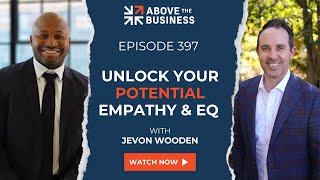
Jevon Wooden, founder of Bright Mind Consulting Group, grew up poor in Rochester and spent time in prison before military service. He now teaches small-business leaders that emotional intelligence and empathy reduce turnover, which he calls the hidden cost of "smashing Rolexes" through bad hires. EQ training builds psychological safety and creativity.
Chapters
Welcome to another episode of the Above the Business Podcast. My name is Bradley Hamner, your host. On today's episode, we have Javon Wooden. You know, you'll see this very quickly, but I always ask background and origin story. Javon has one of the best background and origin stories there is. He is on a mission to help unlock the potential in small business teams and leaders through empathy and EQ or emotional intelligence. It's really awesome to talk to someone who really has a really big, deep, wide breadth of knowledge in a particular area. I think you're going to really get a lot out of this conversation, which I really enjoyed. Here's my conversation with Javon Wooden. Javon, welcome to the Above the Business podcast.
Hey Bradley, thanks so much for having me, man. Excited to be here.
I'm excited to have you as well. Well, we always start with background and origin story. I love hearing people's journeys about kind of what where, how they got to where they are and what they do today. So why don't you take us back, whatever makes the most sense, and bring us to present day?
Yeah, man. Um, I like to say my journey started when I was 17 years old. I grew up in Rochester, New York, grew up very poor, uh, middle child of 5. And you know what, I got tired of being poor. Uh, so at the age of 17, got into some trouble trying to make some things happen. I faced 7 years in prison, and I sat in a jail cell for months waiting for someone to decide my fate. And in that time, I had time to really think about what I was doing, um, and what my purpose was on this planet. Initially, I thought money was equated to value, and while I was sitting there, I realized that it didn't. My mom had put up our house just so she can get me a lawyer, so I didn't have a public defender, because she didn't want to see her baby boy go to prison. And that showed me that my value was way more, um, and unequivocally more valuable than any monetary value that could be placed on me by anyone else. So by the grace of God, I didn't have to do those 7 years. I got out, graduated high school at 17 that same year, and just found that, um, I knew I wanted to help others. I knew that I wanted to, um, just make an indelible mark on the planet. Didn't know what that looked like still, but as I grew up, as I became a man, um, so to speak, I joined the military at 22, and that taught me so many lessons that I apply today about leadership, about patience, about empathy, emotional intelligence, and everything you hear me talk about today. Um, you know, having soldiers under me and really in life and death situations, life or death situations, there's no better teacher than that. So that's really how I got here today. I knew the importance of mindset, and that's what I initially started my business speaking about, but there was something deeper. And I realized that emotional intelligence and that intrinsic factor was that X factor that I was looking for. So that's what we do here at Bright Mind Consulting Group with leaders and workplace cultures.
Man, what a story. You know, I ask everybody that question, background and origin story. And, uh, I'd say you've got the top 3 background and origin stories from where you, you know, I've heard, uh, I can't remember who I've heard it from, but I've heard it before. It's Your mess becomes your message. And it's so awesome to see that what you've been able to accomplish up to this point. When did you first hear emotional intelligence?
You know, I didn't hear emotional intelligence until, um, it was actually probably maybe 2017 when I got home from Afghanistan. Um, I was really struggling, man. And you know, that struggle, like you just said, your mess is your message. I was struggling so bad that 6 months after I returned home, I hit a deep, deep depression. To the PTSD really set in, and I just didn't have any joy in my life. And I had to go to therapy for the first time in my life. And that therapist introduced me to the whole concept of, you know, empathy, emotional intelligence. And she, she used that in her cognitive behavioral therapy with me. And that's really was my first introduction to it.
Hmm. What did the military teach you about leadership that you share with leaders, business owners, entrepreneurs today?
Yeah, man, so much, so much. But really, you know, tying to my message of today, it taught me the importance of, you know, listening to understand. It taught me the importance of being a leader who gets feedback, being a leader who actually pays attention to what your people are saying and really taking account what they're saying because it tells you so much about the next steps that you should be taking. It also showed me about preparation. Preparing not just for yourself and walking through and table exercises and all that stuff for the strategy aspect, but making sure your people are ready for what it— what may come, you know, the uncertain things, the uncontrollables, making sure we have contingencies in place for that because we want them to be successful. So oftentimes, you know, in the corporate space, that is not the case. We just hand somebody a role and say, hey, here, Here you go, do your thing. And we don't give them any training. We don't give them any mentorship, any guidance, right? So, um, I know the importance of that. So that's really one of the first places I start when it comes to workplace culture.
You know, I think that, um, I think for sure that business owners, you don't need to be in business more than a minute to know that when you hire someone, it's probably a pretty good idea to train them. But there's both the hard skills and the soft skills of learning how to, in just the context of this question, train somebody. And so I think a lot of times that, and, and, and maybe you see different things, but I've yet to really encounter a business owner who just says, you know what, I'm just not gonna do that training thing. I just don't think I'm gonna do it. But what I think it seems it manifests itself is an avoidance, and I'll get to that down the road. And so we kind of sabotage ourselves because maybe we don't really know how to train, and we look at someone else and think, see, they're, they're so good, they're so good at training and teaching and, and coaching other people. I, I'm, I'm good at doing the thing, but I really struggle with like how to do that and you know, the structure of it, but also the soft skills of it, right? And so how do you help a business owner to kind of reconcile that aspect of it, specifically in the context of, we'll just say, developing their team?
Yeah, absolutely. And that's a great question, Bradley. Uh, first and foremost, as leaders, I see it all too often, leaders believe that they have to have the answer to everything, that they just need to be the expert, the SME, on every single component. And that's just not the case, right? That's why you bring in you know, other people. That's why you hire consultants or coaches, you know, because you don't need to be the expert on every single thing. Um, actually, it's beneficial for you to get any, um, feedback anyway, even on things you are an expert on. So what I tell, uh, leaders is, yes, you mentioned those soft skills. I like to call them foundational skills. So one of the first trainings I, I ask, um, an organization if they give training on is emotional intelligence, and effective communication, because those two will be the, the catalyst for whether you success or fail. Because without those two, right, you don't have psychological safety. And if you don't have psychological safety, you will lack creativity, and creativity leads to innovation, right? So if you have none, no, low emotional intelligence, or no emotional intelligence among your leaders, um, that's going to trickle down into your staff. And those people who were once shining stars will fizzle like fizzle out really quickly. They will just be assimilated into that, that culture of that drains them of their desire, of their passion, of their intrinsic motivation to do great things. So that's where I start when it comes to training. And then I also come in and we do like a gap analysis. We see what's working well for them. We see where they can have room for improvement. We see if, you know, speaking of psychological safety, do their people feel comfortable giving true feedback. Because a lot of companies do these surveys, and, you know, the surveys are meaningless because they're having to put their name in, having to put their employee ID in, all these things that are preventing them from feeling safe enough to say, you know what, we need to work on these things, right? So that's really the essence of where everything starts, looking at what went well, what's not going well, where we have room for improvement, and then also who is going to help us improve. Do we have everything that's needed to make this thing happen? That the resource component of everything.
Well, I love what you said about true authentic feedback because, well, I can look back in my own journey around dancing around what I want to say. And, you know, I don't really know if I should say this, and so I'll say everything around instead of just saying what it actually is, right? Because there's this, you know, element of like, I want the team to— I want the person to like me, I want them to like me. So if I say this, I don't know if they're gonna like me very much if I just say it, right? Um, what— how define— I love to go back to definition of terms, coming to an agreed upon what this actually means. And one of them I'm curious about is what is EQ and what is effective communication? Like, how do you actually define what that actually looks like?
Uh, so EQ, really, emotional intelligence quotient, that is Really, in essence, the simplest way to define it is how you understand and process emotions of yourself and others, right? That's really what it is. The scientific thing says that there's 4 quadrants that you look at. Social recognition, right? Are you true to yourself? Do you know how to process your emotions? Do you have self-efficacy? And then you have self-management. Are your feelings relating to whatever is going on? Are you able to, you know, respond versus react? Do you have an interrupt before you go blow up, or is Is that just your natural reaction? And then you have the relational aspect, the social recognition. Are you seeing the social cues that people give you when they have a conversation? Are you empathetic? And then you have social management. You know, can you cultivate meaningful relationships? Are you putting into those relationships to make sure they grow and flourish? But really, in essence, it's all about emotions and understanding and taking time to process Admit when you're wrong, being your authentic self. Um, and a lot of people think that it ties into being soft, being weak. It does not. It's actually the opposite. It's being able to have those tough conversations, is being able to call someone out and call yourself out, um, when you do make a mistake and owning up to that. Um, so it's, it's all those things and more, really, Bradley. And then you asked one more thing. What was the second?
Yeah, that, that, that's great. Uh, effective communication. How do you define what is effective communication?
Yeah, effective communication really is one, when you're effectively communicating, it means coming from a place of curiosity and openness. It's coming in as if you're blank, you do not have the answer to that. So when someone suggests an idea, for example, you're not going to just bash it and say, hey, that doesn't work. You're going to get more information. Hey, how did you come up with that? Right? What was your thought process behind that? How does that tie into our greater goal? If you're an organization, what does it do for our bottom line? Or whatever the issue you are trying to address. And you may see how that ties into maybe your idea, right? So you can say, hey, do you think this will work with this piece? Or you can say, you know what, let's work through that a little bit if you don't think that it's gonna work and then see how, you know, let's try something else. Let's go elsewhere if it doesn't work. You're not gonna sit there and say, hey, you know what, be quiet, right? Oh, that's trash or any of that. You learn how to tactfully speak with people and respectfully disagree. And it's not about arguing, it's not about denigrating anyone or belittling them. It's really about taking in the feedback, listening to understand, not to respond. And that's really what makes effective communication effective.
I love that. You know, I, I really do love the definition too of EQ, the, the ability of processing emotions of yourself and others. And to me, that's a really simple definition, but it's like, okay, that, that sense, because it was always kind of one of those things. It was actually one of the questions I want to ask you, which was, I don't— I mean, I kind of get it, but I'm not really sure I get it. I mean, I kind of understand it, but nobody's ever really defined what it is, uh, for me. So I, I'm going to ask a question, and I'm not going to share who said this, but someone that I follow that I really respect a lot and has been incredibly successful, she was sharing that for years, whenever she would meet with her team specifically, she had a lot of, um, facial expressions, right? And so people could read her body language and whether she liked something or not. And then she said, you know, I started to put a sticky note on my computer that said 'be neutral.' And she was sharing with me— sharing, sharing, not with me, but sharing on a podcast that, that, that worked. And I thought about that and I thought, but is that being authentic? Like, it goes back to, you know, it's one of those things. And so I wanted to ask you that question because there's this balance of clearly we, we don't want to have a bad, you know, look on our face when our team member's trying to do a presentation and we're looking at them like, are you kidding me? This is garbage. I mean, clearly we don't want to do that, but then to be devoid of emotion as well. I don't know. I don't know if that, if that's authentic. And so I recognize that there's depth and nuance on a lot of this, but what are your thoughts?
Yeah, um, and I understand what whoever that was is saying. Um, it's saying that let them finish their point, right? It's in, and then you can go ahead and say your piece. But it's really 70, 70 to 80%, there's really is differing things, uh, of our communication is non-verbal. Right? So if you're giving a presentation and your boss is in a room going, ah, you know, making all these faces, it's going to make you— it's going to throw you off in some way because you're like, oh shoot, the boss doesn't like this, maybe I should stop, right? So her— she realized the impact of her facial expressions. She realized that it could change the whole dynamic of whatever is being presented on, and she realized that she can take the attention away from that person that's presenting. So when she says be neutral, it's not that she's not going to say her piece afterwards, but it's giving that person the grace and space to finish their point and finish their thoughts. And then she can take notes because maybe they'll get around to how they got to this point. And then you can kind of talk. We talked about effective communication, work through their thought processes, let them know if it's going to work or not going to work, um, and all those other things. Because if you do that in the middle of a presentation, and you don't let someone finish their point, then you may not even see— they might be like, as soon as you do that, they may say, hey, what's your— what are you thinking? And then you say, and they say, actually, I was going to get to that in a later slide. Here's, here's where the answers, right? So that's what she means by be neutral from my perspective. Of course, I'm not in her head, but that's what I would, what I would assume that being neutral means.
What do businesses' leaders typically come to you with? Are they are they, do they have a good culture? They want to be great, or do they typically come to you whenever they've got issues? We've got team member turnover happening. Our workplace culture is not what it needs to be. Dare I say, maybe even toxic. What are some of the typical things that finally people reach out, send you an email and say, okay, Jevon, we need some help. We need some help. Like, what does that typically look like?
That's exactly what it looks like. It's like, you know, I, I have a conversation typically, you know, they, you know, we've had a conversation, just cross paths somehow, or they've seen my content, but they always wait a phase too late, right? It's a phase too late is when they come in for me, right? So they're already experiencing high employee turnover. They have very low engagement. Leaders are, you know, either dropping out and leaving because they still want to be, be good leaders, or they just They're just contributing to that, that terrible culture that is being manifested. And a lot of them don't even really know what the issue is. They just know that something's wrong. When I come in, we, we do that gap analysis that I was talking about, and I ask them very intentional questions to see, you know, it's kind of like a 360 assessment, what they feel is going on and how they feel their leadership ranks. And then look at the people that are on these teams or, you know, who they're saying is the catalyst for whatever is going on. Um, and then take that organizationally and apply it. Uh, and oftentimes, man, it's, it's just a phase or two too late. They've already lost a lot of money on retention and, and we could have saved them so much heartache and pain if they would have just brought us in and been proactive on it.
How often is what they think is the problem is actually the problem?
Very rarely. Very rarely. Very rarely. Well, I mean, if you think about it though, I mean, it's a common thing, right? Even for individuals. Commonly, when you're in the fight, it's really hard for you to see where those punches are coming from. So you may think that the problem is that we're not giving enough training, right, to people to develop them into leaders, when really it could be the hiring process. Maybe you're just not hiring well. So, you know, when we, when we do these things, I don't— there's no blame. It's just what can we do to fix it? Um, and, and we do that process to, to really look at what can be the root cause. And that's just the way things go. Even when I work with an individual, individuals often feel that the problem is one thing, but it's really stemming from something completely different. Yeah.
You know, I think I really love the idea of working off the theory of constraints, which is Where are we today? Where do we want to be? I call that point A, point B. And then it's really, I mean, for the, for the most part, you can get a business owner to articulate somewhat where they are today, where they think things are, at least where they want it to be. And so then you can identify the gap, but the hard part then becomes on what is really blocking forward progress. And to your point, you think it's one thing, but the reality is it's probably some, it's probably something else. And so then you go and build, build a solution. For a problem that isn't right, for the problem that's not even there. It's like, why are we working so hard and yet we're not solving this problem? I'm curious. So I love that you talk about turnover. Not that turnover is a great thing to talk about, but I love that you address it because we have this little analogy. And honestly, I was working with a business owner a couple of years ago and it just came out. I just said it and, uh, he, he liked it. So it kind of stuck and we call it smashing Rolexes. And so we say like, if you have a smashing Rolexes, smashing Rolexes. Yeah. Yeah. If you take this on stage, Javon, you just give credit. Okay. So I like the idea though. Here's the math behind it. You take a $50,000 employee, 90 days. 90 days. Do the math on it. $50,000 employee, 90 days later, by the time you've paid some onboarding cost, you've paid their taxes, certainly paid their salary. So maybe some, you know, recruiting expense along with that. You are somewhere between $12,000 and $15,000 that you've spent on that person in 90 days. And so what happens, to your point, in a mishire is that if you just turn that person over, 90 days later didn't work out, you basically went down the jewelry store, bought a Rolex and smashed it. And yet nobody would ever do that, right? Yet we do it all the time in our businesses because it's in payroll expense, right? And so that imagery has become— I honest to goodness got a text message from a business owner yesterday that said, I just saved myself from smashing a Rolex. And I was like, awesome, you know, that's really good. So From, from your angle, what are the things that you see that you help business owners do to lower— let's be real, you cannot eliminate turnover across the board. Like, you cannot do it, but you can do certain things to have a better success rate, keep good people longer, etc. What are some of the things that you work with people on?
Yeah, initially, like I mentioned earlier, that training, right? Emotional intelligence, effective communication, and from their, their level. Right? So if I'm speaking with an HR team, for instance, we have to do some strength assessments first. We have to understand like, what do you feel like you do well? And then what do you actually do well? And also, you know, because a lot of us think we hire well and we just don't. I myself, I know I don't hire well. So I had to bring someone in who was an expert in that because I know that I'm just someone— I love people. And oftentimes when we hire or when we do anything, we tend to like people who are like us. Um, so that's one of the things that I, I say initially, like, hey, who's doing the hiring? Who's making these decisions? Why have you hired your past, let's just say, 10 to 15 people, right? What was the rationale behind it? How are they doing now? And we just keep doing this. And then we do this until we, we can look out. If we have a company that's been around for a while, We try to do 10 years because in 10 years we want to see what that, that retention and attrition rate is. Where have those hires been? Right? Are they still with the organization? Have they contributed? Or are they— is half of them going out the door because they just were underperforming? And that's going to tell us a story because that's going to tell us, do we need to revisit our hiring practices? Do we need to revisit the corporate values? Are we hiring? In alignment with those values in the mission that we set out to. Because oftentimes, you know, the, the, the mission statements of organizations, the values of them are very surface-level stuff. So if we revisit that, and then we have a guiding guideline to what we're doing, now we can start making the policies right. Now we can start educating our people on what we're looking for across the board. From every level, which again ties to emotional intelligence. Now we can start making sure that our training is proper. And we're not just doing computer-based training because that is not transformational at all. We're, we're doing one-on-ones, we're doing small group training, we're doing these types of things so we can get feedback and we can have these conversations and we can do scenarios real time to see what people are doing in their daily roles, especially when it comes to hiring and training their people. And then we're going to look at You know, are we receiving the feedback from the people and are we implementing that feedback? What would they like to see, you know, to keep them there? Especially, you know, we talk about A-players and all this other stuff. Well, maybe we might have some A-players that just haven't come out because we're not giving them what they need. So we really need to start with the people, you know, listen on the people who are doing the work and say, what do you need? How can I make sure that you are happy here? How can I make sure that you're giving us your best work? And you're giving us your all, and you're not using your time here to look for another role, right? Uh, because that's really what it boils down to. Um, if, if you ensure that you are recognizing, um, people, that you're rewarding them, and then that you're, uh, rectifying when there is an issue, you will be okay.
That brings up something that I'm going to ask you about in, in just a minute, but I want to ask this question first. I'm going to ask you about feedback in a second, but before I get there, I want to ask you about low engagement. How is that measured? And I feel like that there's a terminology, I'm sure you know it, that's been going around where basically people are on the job, but they're kind of checked out. I don't know what that—
Quiet quitting.
Quiet quitting. Yes. Thank you.
Yeah.
So it seems, you know, Look, we're well past COVID and all those sort of things, but what, what is really at the root cause of that? And I want, I want, if you, if you can maybe answer it generally, but then specifically around small business, because in, in a corporate world with 10,000 employees, that's not our audience. Um, and so sure, you can kind of hide when you're in those kinds of organizations. but in a small business, you've got 2 to 20 team members as an example, and you're doing, you know, half a million to $5 million top line, something like that. You know, like, you, you know, you're not, you're not just gonna go hide. I mean, you, you had, you have, uh, a place in the organization where you're making a significant contribution. So what, what does that look like in a small business?
Yeah, I looked at, uh, two things that you can measure. Effectiveness, right? Are they getting the job done well? And then efficiency. Are they doing— or effectiveness, doing the, the thing right? Um, and then efficiency, are they doing the right thing? So it's, it's those two things are what we measure, bottom line. So if I give someone a task, how long is it taking them to do that task, right? How long should it take them? Do I even know how long it's supposed to take them? Are they spending most of their day gainfully employed, right? Are they willing to go the extra mile to get things done? And if not, then you have your answer. They're not engaged. And that's just the simplest way to look at it. You know, a lot of times we want to do these measurements and surveys and all that stuff. But in a smaller organization, you can see whether someone is engaged. And another way you can do it is ask them from time to time. If you have a smaller team, then it's beneficial for you to have one-on-ones. It's beneficial for you to ask those questions. Hey, are you, are you, do you feel like your work is meaningful? How can we best support you? Do you have the resources you need? What do you see as your next phase from this role? What would you like to be doing? All these different questions. Because a lot of times if we're, they're not doing what they would like to be doing and it's out of alignment, they may be engaged then, but it may not be in a couple of months. So you can kind of foresee. What's going to happen, um, in most cases. So we just got to ask those questions and then measure whether they're efficient and effective.
You know, I mean, there's so much— the last several years, for a lot of different reasons, there's been a lot of wage pressures for employers. And look, I'm not here to argue whether that that's necessarily good or not, but there's definitely been a shift that, look, you got to pay people well. I mean, they can go and they can go and work at Chick-fil-A and make pretty good money now. Um, there's a gas station you may be familiar with in Houston, Buc-ee's. I mean, I mean, good gracious, everything, man. Buc-ee's is life, right? For my kids, it is.
Huh, it's like an institution, man. Here's like, that's a staple. And you know, to be transparent, I haven't even been in one yet.
Oh man, okay, all right, well, you can go and check it out. I mean, there's a, there's a one of those sandwich board things out front that talks about, you know, apply Buc-ee's, and you're an entry-level teller, entry level at $17 an hour, and you can get up to $22, $23, $24, $25 an hour. And my point is, is like, look, it's a gas station and yes, it's unique and it's different. But at the end of the day, I know of other small business owners around the one that's about 45 minutes from here that have said, hey, it has really hurt us because even if our employees don't leave, they know what their friend is getting and they are coming to us and saying, Hey, I love working here, but I'm going to leave if I can go and, and, and, and do something else. What I'm saying is, what are your thoughts about how that has affected engagement, turnover, et cetera? Number one. And then number two, what are also, in addition to compensation, what are the other things in addition to what you've already mentioned that help us keep our very best employees?
Yeah, and I love this question. Um, first and foremost, you know, when you look at the wage pressures, yes, that's a very real thing. Uh, but you know, I like to go to the example of Costco versus, uh, Sam's Club and BJ's and those other, you know, huge warehouse department stores. Uh, Costco, the reason why they've done so well over the years, yes, they pay their employees well, but they had other types of compensation. Right? So it wasn't just that they paid them well, but those employees knew that they were supported no matter if there was an economic downturn, no matter what was going on. Costco said, hey, let's figure out what we can do instead of cutting their roles, instead of cutting their jobs. What else can we stop doing? You know, in an economic downturn, they knew that they had that support and that safety. So for smaller businesses, you can look at how else can you compensate? We may not be able to pay $25 an hour, but how else can we make sure that we, that employee loves our culture and knows that we represent them and we're going to stand behind them, right? One of the ways you can compensate, maybe you give them extra time off. Maybe you give them a flex day. Maybe you have other ways that you give them, you know, an employee bonus or something like that. Ask them what they really care about, because I love the idea of having a menu of benefits that equal a total compensation. So that being your benefits really can tie into what they value most. I mentioned time off. That's something that a lot of people really, really enjoy. The freedom to have their own business on the side where you're not monitoring them and hating what they're doing and telling them that they can't do what they want to do and live out. You know, there's so many different ways that a small business owner, we can assure that they thrive, because I guarantee you there's only a certain amount of money that really matters to people. After a while, the studies show it, after a while, the money doesn't matter. Initially, you may be great. You may be like, yes, I'm getting paid $200,000 for doing this. But after a while, if that culture is horrible, you're going to be trying to find your exit very quickly. Um, and a lot of people have really said that they'd rather take less money to be able to work from home, to be able to have flexible work arrangements, to be able to have their side business and not be judged for it or fired because they're posting on LinkedIn about it. right? So that really, that freedom to be human is worth more than dollars. Um, and there's a principle called hedonic adaptation that humans, um, have. So hedonic adaptation says no matter what's going on initially, there may be a shock there, but humans are known to adapt to whatever is going on, right? That's why people can have a traumatic event, um, that could seem like it's catastrophic in that moment, But then after a while, they just adapt to whatever that— whatever is going on, whatever their new norm is, right? So we have to take that into account. Um, and culture is not something that we just stop on, especially as small business owners. If we want to keep those people, we just got to keep iterating and keep saying, hey, what else can we add for you, um, to make sure that you stay here? Because we really value you. That's the key.
Good stuff, Javon. I know people are going to want to reach out to you and connect with you on social and find out about the work that you do. How can they do that?
Yeah, so first and foremost, you can go to my website, javonwooden.com, or you can connect with me on LinkedIn. Just search Javon Wooden and you'll see a light bulb next to my name.
Javon, what does working above the business mean for you? That is the name of our podcast, after all.
Yeah, for me, again, I'm an emotional intelligence and empathetic guy, right? So for me, it's about having a cause and a reason why that you're doing this that's greater than just monetary gain. Uh, for me, it's giving back to my community. It's making sure that underrepresented and marginalized business owners and people are able to have a livable wage and able to provide for their families without struggling.
Man, that's so good. You know what, I'd be remiss if I, I did not— I said I was going to come back to one question. I usually don't do this, but I did say I was going to do it. I want to come back to it. Feedback. Feedback. I was about to do my recap, but I want to know feedback. How do we give feedback well, where we can be honest and transparent, yet at the same time, and, and the team member receive it, even if it is maybe not so good news.
Absolutely. So feedback is one of those things that, um, it's really how you say it. We hear it all the time. So if I'm giving someone, um, negative feedback, for instance, and telling them that they're not— in essence, not doing their job very well— then you have to take— there's a principle called extreme ownership, right? And as a leader, we have to take extreme ownership. My guy Jocko Willink, I always talk about it. That's my guy. He pretty much says, what can we do as a leader? What's our part to play? So if I give negative feedback to one of my employees, I'm going to give it to them. I'm gonna say, hey, you know, I noticed that your job performance has been going down lately. And I wanted to know, what's— is there something— is there some way I can support you? Is there something going on that we need to know? And they're going to tell you. Really, the part of effective feedback is saying it in a way that you're not making people defensive. But you're still getting your point across, and then you're pausing to make space for them to actually respond to that feedback. And that is the key. You got to make it a conversational, not just you just talking at them.
I love that. Yeah, I love, uh, feedback is really about how you say it. I love what you shared earlier about the definition of EQ, the processing of emotions yourself and others. I also love a comment you just made, is that we feel like we all, we have to know everything. And I would even add, a lot of times we feel like that we need to do everything and we have to be able to wear all of the hats. And as a small business owner, there's just too many hats to be able to wear, and there's too many hats for one person to be great at all of those things. And then I would say one of my other biggest takeaways from our conversation, you said EQ doesn't mean it's you're being soft. It's quite the opposite. And I love that. That was a great takeaway for me. Javon, we'll post the links in our show notes. Thanks so much for coming on podcast.
Thank you so much, Bradley. It's been an honor, man.
Shout out to our podcast sponsors Club Capital, Coach P Consulting, and Today App Pro. Look, if you want to be able to develop your team in the insurance space and work with someone who is obviously doing an excellent job of growing and scaling their business, go to coachpconsulting.com. Coach P Consulting.com. Let him know that you heard about him On the Above the Business podcast, I said it in the episode, but one of the many different hats that you need to be able to wear at times is to be able to put on the different hats of understanding your financials in business. For a lot of people, it can be really intimidating. You don't know exactly how to read these fancy, fancy language, these terms, what do they mean, et cetera. And sometimes admittedly, we can kind of try to fake it until we make it. I understand that because I was the exact same way myself. But if you work with Club Capital, they're going to give you the tools, they'll give you the skills, they'll give you the mindset and a perspective with other people in your industry that they can look into and give you insights into your financials. And over time, you'll really begin to develop the skills to make better decisions in your business so you can grow top line, increase your bottom line, and make more money. Go to clubcapital.com. Bookanoobligationdemo. I was just kind of updating with our team our tech stack that we use, going over the different, you know, software tools that we have to run the podcast and run BlueprintOS, etc. And that really brings to mind, what is your tech stack that you have? You may work for a corporate entity, you may work for a captive agency, and you know, you have different things kind of cobbled together that kind of working through, and it can be overwhelming to say, uh, do we need to add something else to it. But what if there was a tool that would help combine multiple different tools all in one, obviously with a corporate-approved CRM? That is TodayApp. Go to todayapppro.com. todayapppro.com. Hey, if you like what I do, what I talk about— we help people go from being the rainmaker of their business to becoming the architect of their business— if you'd like to learn more, go to blueprintos.com assets, and you can get access to the Rainmaker to Architect Starter Kit. Blueprintos.com/assets. Art of One, till next episode, lead well.










