Episode 399: The Five Talents That Really Matter with Barry Conchie and Sarah Dalton
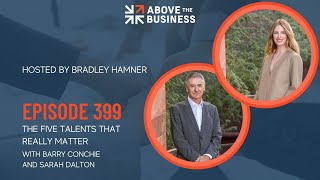
In this episode of the Above the Business podcast, host Bradley Hamner interviews Barry Conchie and Sarah Dalton, co‑authors of The Five Talents That Really Matter: How Great Leaders Drive Extraordinary Performance. The conversation begins with personal origin stories that illustrate how Sarah was recruited by Barry and how their partnership formed. The duo then critiques popular leadership assessment tools, calling out the MBTI as pseudoscientific and arguing that emotional‑intelligence metrics are overly vague and often meaningless. They argue that leadership is fundamentally a selection problem rather than a training problem, citing the Peter Principle and the need for future‑focused assessments that predict talent fit for new roles. The core of the episode is a detailed walk‑through of the five leadership talents they identified from a database of 58,000 C‑suite executives: (1) Setting Direction, (2) Harnessing Energy, (3) Exerting Pressure, (4) Connectivity, and (5) Controlling Traffic. They discuss how leaders can self‑assess these talents, promote the online Conchie leadership assessment, and warn against generic LinkedIn infographics. When a talent is weak (e.g., connectivity), they advise authenticity, accountability, and leveraging complementary partners rather than pretending to be someone else. They also share practical coaching tips for difficult conversations and highlight the limits of competency‑based training. The episode closes with the concept of “living above the business” – maintaining a 30,000‑foot, curiosity‑driven perspective – and provides listeners with URLs (conchie.com) and LinkedIn as points of contact. Throughout, the hosts blend anecdotal storytelling with research‑backed insights, offering actionable guidance for CEOs, small‑business owners, and aspiring leaders.
Chapters
Welcome to another episode of the Above the Business Podcast. I do have a recording. Welcome to another episode of the Above the Business Podcast. My name is Bradley Hammond, your host. On today's episode, we have Barry Conchie and Sari Dalton. They are the co-authors of the book The Five Talents That Really Matter: How Great Leaders Drive Extraordinary Performance. I get a ton out of this episode, and I know you will. As well. Here's my conversation with Barry and Sarah. Barry and Sarah, welcome to the Above the Business podcast.
Good to be here.
Thank you.
Well, we love to start with background and origin stories, so Sarah, I'll let you, uh, start us off. Why don't you kind of take us back wherever you feel like is appropriate, bring us to present day, and share your, uh, origin story of how you got to where you are?
I definitely can, because it was completely by accident. People ask me all the time, how'd you get connected to Barry? Why are you two working together? And it really was by accident. So I've worked with a lot of small companies where I think my expertise was in understanding what that company was trying to achieve and how we kind of, how we build the processes and hire the people to, to make that happen. And Barry was a client of mine in the last company that I worked for. And there was a point where I knew that startup was going to fail. And so I had reached out to Barry because he was my favorite client. No one could touch his project without my permission. And I think we got to a point where I was the only one he really wanted to speak to. And I, I had reached out to him and said, Barry, can you help me find a job? Here's what's going on. And his response was simply, if, if you're really going to leave, then I've got a job for you. Over my dead body would I let you go to another company. So he made me an offer to bring me into the business at a time where I'm not really sure I understood the full scope of what it is that we actually do. But he saw something in me that could be developed way beyond what I was doing in the previous work and the jobs that I, that I had held. So I'm probably a good example of a talented person who doesn't know how good they are. And could benefit from someone like Barry seeing things in them that, that just haven't had a chance to exercise yet.
I love that. You know, before we get Barry to kind of your background, I would love to double tap on something she just said. You know, there are times when people say that, you know, I just needed somebody to believe in me. Sometimes I, I can think of one particular instance in my own career where someone believed for me. They didn't believe in me, they believed for me. And then that gave me the confidence that I needed to move forward. Barry, I'd love to hear your background and origin story. How'd you get to where you are?
Background in education in the UK. So most people will quickly, quickly recognize I don't have an American accent. And I came to— out of education, I joined Gallup. First in the UK, then came over to DC in probably around 2000, 2001, sometime like that. Worked leading Gallup's leadership and research development group. Very successful, thoroughly enjoyed myself there. Recognized that I really wanted to set up my own company, which I did in 2013. And we specialize in psychometric assessments, leadership advising, coaching, selection. Development, a whole range of human-focused enterprises, all oriented around trying to figure out what makes people tick and how to make people use their capabilities to be really excellent in what they do. So to round out Sarah's observation earlier, you know, it was, it was impressive for me to work with Sarah. What she didn't realize was that it wasn't her help for the project that I was evaluating, but her. And it became clear that, you know, that she would need to join, and she's gone from strength to strength. And if you'd have asked her 8 years ago, could she imagine being on a stage in front of 500 people or 1,000 people, she would have cowered in a corner and said, not in any circumstances at all. And yet I knew that was nonsense. I knew she just needed the confidence around subject matter, and then she'd be brilliant. And that's exactly how it's turned out. So now she is my right-hand person in terms of expertise on selection and development.
Fantastic. There's a lot of myths, Barry, out there. There's a lot of misinformation, and I'm just gonna say a lot of BS in the leadership space. There's a lot of things that are just floating out there. That when I have a read on, I'm like, I don't know what to do with that. I don't know what to do with that. It's a nice quip. It's a nice thing to put on an Instagram story. I don't know how helpful it is. What are some of those myths that are actually, you believe, that are out there that are even potentially hurtful for leaders?
Well, um, one myth is that all kinds of assessments add some additive value to how a person thinks about themselves. That's a myth, particularly with respect to something as obnoxious as MBTI. So the Myers-Briggs Type Indicator, that's probably the one that most people know about and that they recognize. What they don't realize is it's not based on very soft strong scientific credentials. So those who sit there and pronounce that I'm an ENTJ, as though it was some definitive statement on themselves, don't really realize that they're delving into the depths of pseudoscience. And what they're talking about is closer to astrology than it is a really effective personality statement. The second thing is that, you know, personality assessments in and of themselves are strong predictors of leadership efficacy. The effect sizes on those kinds of claims are so tiny as to make the claim a little ludicrous. Another issue around another myth that we hear quite a lot about, and, you know, I'm going to upset a lot of people when I say this, emotional intelligence. Ever since Daniel Goleman brought out his book, I think in 1996, it's almost become a truism that emotional intelligence is associated with all good things and no bad things. So whenever you read a report about emotional intelligence, it, it, it's all encompassing in terms of its positive effect. It's not that we criticize the, the, the issue in detail. I mean, when you get into the details of emotional intelligence and really measure the elements that comprise emotional intelligence, that's where the benefit is. The term itself is relatively meaningless. I've never seen anybody give a definition that anybody would disagree with. It's so broad and so amorphous and so lacking in specificity. It's a little like motherhood and apple pie. We all really like it. It sounds great. It tastes great. But as a concept and a term, it's relatively meaningless. So that's another myth that we that we tend to meet quite a lot. We didn't tackle emotional intelligence in the book. And part of the reason for that was there were too many other targets that were equally rich pickings for us to go at. So we kind of left it alone. But, you know, watch this space. I'm sure we're gonna be publishing things in the future which tackle that issue without a doubt.
But here is my kind of guy, right to the point, right to the point. No fluff. Let's just look, that is hogwash, as my dad would say, basically. Is there anything that you want to add to that, basically, that you've seen in your own research and studies that you would add to what Barry shared?
You know, one of the issues that we're really hitting on hard right now is the idea that just anyone can be a leader. And we keep making this point that companies need to stop lying to their employees when, when that's the idea, that if you just try hard enough, or they— if you just stick around long enough, that you're going to keep progressing up the ladder and that that your potential is limitless, right? We treat leadership like it's a training issue, that anyone can be it. And as long as we put you through the right training programs, you can be a brilliant leader. And it's just not, it's not the case. When you look at company performance, when you look at employee engagement metrics, we know that there is an issue. So good leadership is not just a training issue. It's a selection problem.
There's a— it would have been really fantastic if you would have been on, on the call that I had with a, a client, incredibly successful entrepreneur, one of the more successful entrepreneurs that I've personally worked with. And he has a team member that's been with him for a long time, um, 7-plus years, invaluable to his organization, really struggling in the leadership component. And I shared with him in maybe, um, Sarah, you can add some context to this. I said, I think we might be facing the Peter Principle here. I think she got promoted to the place of incompetence. And so now he's in a position of like, okay, now what do I do now, right? Because she's really struggling in that, not doing— as an example, not doing all the, all, all the leadership things, not conducting one-to-ones, not conducting performance assessments, um, not holding people accountable. In her role, incredible asset to the company and all of the metrics around leadership, really struggling. I don't know if you have any— obviously I'm being a little, um, um, bland in the, in the comments because I want to protect obviously the person themselves, but any thoughts around that idea that people get promoted because they do really well in a position and then oftentimes they get promoted to a place of where they're just not as competent as they were in the previous position?
And that's why— I mean, that's why we keep making a case for more future-focused assessments that really look at whether people have the right talents for the role that they're being considered for. Because how well you've done in the past doesn't always translate to how you might do in future jobs where the context and the demands are completely different, right? So we see that issue all the time. I think particularly in startups. Where you've got these brilliant technical experts, but as the company grows and scales, there is a need to manage people. And not everyone can make that stretch. Not everyone's cut out for it. And it's sad when you make those decisions and you put people in positions where they can't be successful. They know they're failing because it's really difficult to wind that back and say, okay, well, now we need to demote you. If we just put you in this box, you'll be really good again. It doesn't work that way.
That's so true. I really like that. I circled that. If I circle something that, that, that stands out on my papers, so future-focused assessments. I love that, Barry. It brings up now, since we've did some, uh, Charlie Munger inversion thinking here, it now brings up the thoughts which are, okay, well, what are the things that really matter? And you all obviously wrote the book The Five Talents That Really Matter. What are the talents that actually matter in terms of leadership that you found?
Yeah, let me give you a brief description of each. So the 5 talents that matter for high-performing leadership. The first is setting direction. You know, where are you headed? Do you have clear goals? Do those goals present themselves in a way that others would look at as being valuable and worth achieving? And as you think about the goals and then work back to the present, do you envision a wonderful journey getting towards those goals. So all those are critical leadership requirements. The second is around harnessing energy. And we use the example of a city power plant. And if you imagine a power plant and going inside and seeing all those dials and numbers, you can almost smell the pressure and the energy inside that building. Not only are you managing unpredictable demand, but you've got unpredictable supply. And so, you know, we need to know that we, we have leaders who can drag themselves out of a bed on a cold Thursday morning in winter and go to work with just a spring in their step, excitement in their voice, determination as the example that they set. So harnessing energy is harnessing energy of self and of others. So it's a mobilizing capability as well as a an inspiring capability for the individuals. Exerting pressure is the third dimension, the third talent. We're not talking about cheerleading, Bradley. Anybody can cheerlead somebody else's idea. We're talking about changing people's minds. Believe it or not, as leaders, you're going to put forward ideas and people in your organization aren't going to agree with you. Now, I know this is a shock to some leaders who believe they should be all things to all people. But you've got to change people's minds, you've got to convince them that this is worth doing. You can't just show up to work and expect it. You've got to operate in a way that not only demands it, but sets out that vision in a way that leads to you being able to persuade people that they should join you in that journey. So we talk about exerting pressure, and the word exerting was chosen very carefully. So we're not sitting around holding hands and praying together or wishing things together. Leaders are sitting in front of groups of people and saying, this is the direction, you might not like it, but let me give you 6 reasons why it's the only direction worth going for. And having the fortitude to do that. The 4th talent is connectivity. It's building connectivity. And this is— I often refer to this as the hidden talent. And we've all met leaders, Bradley, I'm sure you have too, who were a little isolated from their own organizations. They're what I would call office-based leaders where, you know, they'd be pretty well protected and insulated from their organizations. I mean, just think of all those companies that have sealed-off top floors where only the executives can go. You know, the cherry wood-lined boardrooms and all that nonsense, the preferred parking places, you know, the— I mean, even we've even seen things like executive dining rooms, right, where, you know, executives pull themselves together, essentially isolated from their organization. Top-performing leaders don't operate that way. Top performing leaders build connectivity. They're as likely to be sat in a cafeteria with people wearing blue overalls who make things as they are to be rubbing shoulder to shoulder with investors on Wall Street. And you've got to be able to flex between the two. And the concept of building connectivity is that your, you know, the bounds of your relationship should have no limit. You should be reaching out the whole time. I've had people say, well, we got 300 people in our organization. I can't possibly know everybody. Well, okay, I get it. Can you get to know two-thirds of them? If you've got 35,000 people in your organization, you know, can you get to know 1,000 of them so that you know more than just a name on a spreadsheet? So building connectivity enables rapid transmission of strategic priorities. It breaks down silos. It breaks down artificial divisions. When you talked about many of the folks who listen to this podcast being, you know, business owners of relatively small businesses, maybe between $5 million, $20 million or whatever, you know, my advice to them is the more you know about the people, the quicker you get things done. It's just that simple. The fifth talent is controlling traffic. When we use the analogy of an air traffic controller, and say the very best leaders operate analogous to air traffic controllers. So if you think about air traffic control, it's a strict rule-based occupation. I mean, airplanes are not allowed to get within so many feet or so many miles of each other. They've got to fly at different altitudes. They've got to be separation on the ground, blah, blah. So those are all the rules-based. But then you got to be able to turn on a dime because circumstances change, pop-up weather storm, whether, you know, thunderstorm outside down, collapsing. Now there's a shock in summer. You're going to be able to deal with aircraft malfunction. It's stuck on the tarmac for 3 days. You got to be able to deal with it. Unruly passengers, missed bags. I mean, think of all the things that go on that impact our ability to get from city to city around the US. Air traffic controllers are operating within a rules-based environment, very strict rules. And yet have to show that fantastic flexibility. That's what high-performing leaders do in their organizations. They've got to understand where the parameters are that govern how they do work and how they get things done. But as you and I know, stuff hits the fan. Things happen that we don't expect. The Monday morning crisis, the biggest client saying they're not going to renew their contract with you. All these things kind of hit these leaders out of the blue. And if you can't enable the organization to keep pace in real times with those issues, the organization is going to struggle. So we studied the most successful leaders we've ever seen on the planet out of our database of over 58,000 C-suite executives and discerned these 5 talents. Now, I should quickly say, we don't expect every leader to be brilliant in all 5. But you better make sure you're brilliant in enough of them. And then for the ones where you aren't brilliant, you'd better make sure that the people that you rub shoulders with in that company are brilliant in those areas. Otherwise, you're gonna miss things.
I think at this point I've probably interviewed, we've done 390 or so episodes. I'd say maybe 250 of them or more have been interview-based. The rest of them have been solo, solo interviews that I— or solo podcasts that I drop on, uh, on a Friday. And I look at that when I bring people on, that my job is to just allow them to be in the spotlight. And so what that happens— what happens with that is oftentimes people will share things where in my head, as they're sharing them, I'm thinking to myself, I personally disagree with this. I actually don't agree with this, this approach. I have to be honest with you. Every— all of these, I agree with every single thing you just said. Not that you need my 58,001 sign-off on this, but I've never actually said that on a podcast where you were going through this and I was like, yeah, they've nailed— he's nailed it. He's nailed it. That makes so much sense to me. And I think it's because when I look at the 5, I can look back in my own journey and think, I don't think I did very well with that. I did not set direction very well. I didn't have a vision of where I wanted to take the company. Sure as heck, the team didn't know. I did not have the energy, so therefore I was not harnessing energy myself, let alone from other people. I probably exhibited very poor pressure on the team, like I was demanding it, but in very unhealthy ways from the team. My culture was anything but connective. As a matter of fact, it was toxic is probably a good way to, to put it, the way things were. And, uh, my air traffic control, well, we were crashing planes. Okay, so through my own journey, I can say that at least I've been able to evolve in some of those. So, Sarah, you teed me up for the part that I wanted to ask you, and that is leadership and, and business in general is really, really difficult. And there's a lot of different moving parts to it. How do we begin to honestly self-assess ourselves in each one of these 5 of the areas that we feel like that we're doing well in? And then also some of the areas that maybe we're struggling.
Uh, couple pieces of advice. One is probably disregard 99% of all the infographics that you see on your LinkedIn feed. That describe what leaders do and try and give you advice about how to improve. That might be one piece of advice around what not to do. But I'll advocate really strongly that you've got to get a good self-assessment of how you think and where you should be spending your time. As part of this book launch, we are opening up an online version of our leadership assessment. And I think it's the only one of its kind where people can get a really good read of how they think and what characteristics might help them be a more effective or a less effective leader in specific situations. Because as I listen to all the things that you just described yourself, there might be different quirks in terms of how you're wired and who you are that are driving some of those issues. And it's not always easy to understand why. Right? So, you know, when you talk about— we were, um, you know, we were talking about that dimension around harnessing drive and energy. When you say, I wasn't so motivated to keep pushing, pushing, pushing, um, you got to understand what's driving that, because there might be things that motivate you that were completely untapped in the kind of role that you were in. So it's, um, It's really interesting. I gave feedback to a leader not too long ago who had been through one of our assessments. And he talked about this frustration and aggressiveness and how he would communicate to people where he thought we would make these commitments. We're all under, you know, we're all in alignment around what we're doing. And then people would cut corners. They didn't do what they said they would. And he'd get really aggressive with people, was developing a bad reputation in the company. And I looked at the level of accountability on his profile. So accountability is I'm absolutely driven to do what I said I'm going to do. It becomes a moral obligation to meet my commitments. And so when you see other people behaving counter to that, that frustration is going to come out. It's going to bubble, right? And just being able to put a very clear language and, and a description around why he was behaving in the way he was kind of illuminated a lot of things for him. So I think if people are struggling with self-awareness and really understanding how they think, where they should be spending their time, uh, I want to point them to that assessment, and they can read more about it in the book and get a sense of whether it's the right tool for them. But it's the easiest way I can think of right now for people who, who don't know themselves as well as they should as a leader, who might be struggling to develop a concept of what leaders do, we can certainly help.
Barry, if this is the one question that I was really excited— I mean, I'm gonna say it for the interview, but I was really excited to ask you this question. Let's say hypothetically your comment earlier was you don't have to be brilliant in all of them, but you need to be brilliant in enough of them. So hypothetically, we have a leader. Let's say they're a small business owner, entrepreneur, doing a couple million dollars in, uh, in revenue. They're, they're, they're ambitious, they're driven themselves. But when they look at across these 5, these 5 talents, there's one that hypothetically they really pour out. I'll just, I'll just pick one, uh, for discussion purposes. Connectivity. Let's just say it's connectivity. They struggle with that. I, I, uh, my dad's a farmer, so I, I loved your analogy of Wall Street investors to, to overalls because my dad literally wears overalls every day, so I can relate to that. Um, but as an example, but they, but they struggle with that. within their team and even within, uh, customers, et cetera. Since you literally wrote the book Strengths Based Leadership, what is your advice to someone of improving in an area versus doubling, tripling down in the areas that they're naturally good at?
Well, I thought you, I thought you chose building connectivity because you were describing me, Bradley, because, you know, that's, that's pretty deficient in my case. Um, on a good day, my wife can put a, put forward an argument to include me in the human race, but most times she can't. And, you know, there are There are a few bits of advice I would give. One of them is don't try to wing it, don't try to pretend, because people see through it in a heartbeat. You know, if I was to show up in full-blown party mood as Mr. Sociability, well, first I'd lose patience with myself very quickly, but most people would see through it. It's just not genuine for who I am. Sarah's brilliant on relationship building, and when she and I are either in meetings or in rooms together, I just let her lead the way. And then, you know, she introduces me as the, as the cranky old fool who can talk more technically about some of these things. So I don't try to pretend to do the relationship stuff. But here's the thing, you need to take accountability for it. It's completely unacceptable for me to behave in a way that might intimidate people. But left to my own devices, I might do that. In fact, I might have fun doing that. But it's no way to lead a business. So I need to be aware of it. I need to understand it's a deficiency. I need to understand its effect on me in certain environments, and I need to take accountability for it. But that doesn't need— I mean, I need to reinvent my personality. I'm always going to be who I am. So I often say to people, look, I'm not the most sensitive person on earth. If you think I'm getting a little bit off track here, and you know, you need to bring me back closer to where you are, then please do that. It won't hurt my feelings at all. I have great relationships with clients who fully understand that about me. And in fact, they kind of like that about me, because they know it makes me more effective to operate that way. But if I was to pretend to do that every day, if I was to think that I had to predicate my days on growing my connectivity, I'd be an utter failure, an utter failure. And unfortunately, too many organizations pretend that in order to be an effective leader, you gotta be good at all things. I mean, they come up, for example, with competency procedures. And then I often say to companies, well, what do you mean by competency? Well, these are the things that you need to be competent in. Well, it sounds great. But, but some of them might be beyond a person's reach and beyond a person's capacity to develop. So let me give you an idea. Think about the capacity to have, as a leader, to have difficult conversations with an employee, even to the point of termination. And let's assume that I'm no good at that. Let's assume that I'm such a nice person, I find it hard to have tough conversations. Is that a training deficiency? Do we think that by sending somebody for a particular module on an MBA program called Toughening Up Your Leadership Messaging, that it's actually going to make one iota of difference? The answer is no. I've worked with these CEOs, and I've said to CEOs, okay, here's one thing you could try. Write down what you want to say to this person before you go into the meeting with them. And so they write down all these tough messages, and then they go in there, and they sugarcoat it. They look at all their messages, they don't deliver it in the way they wrote it. They, they start by saying, oh, you're a wonderful person, I really believe in you, you're absolutely fantastic. And By the way, there are a couple of things I'm thinking you might be able to improve. And of course, the person comes out of it completely confused. It's like, what was that conversation all about?
Yeah.
And then ask yourself also, look, think about those leaders who are socially dysfunctional. They exist. Let me just say that there are too many people in leadership positions who are socially dysfunctional, just can't relate to people. They're awkward. They say the wrong thing at the wrong time. So let's send them on empathy training. We did this with bus drivers, coach drivers, and they were trying to deal with rude and aggressive coach drivers. And their answer was send them on customer service training programs where those rude and aggressive bus drivers learned to say nice things to customers in rude and aggressive ways. It changed nothing. So we've got to be honest about what we can develop and to what standard. Now, if you don't care about the outcomes, anybody can do anything. Yeah, if the outcomes are irrelevant. So we don't really care that I abuse people in the way that I talk to them. If we don't care about the outcomes, I can be a genius in anything. But in our research, we really care about the outcomes. We really care about performance. And that's why these 5 talents really do matter.
Sarah, I'd love to double tap on something he said to help me kind of square it up a little bit. Is when I look back, uh, if I go back 3 years, but if— but let's just say 5 years, um, I, I feel like I'm still the same person today, but I'm— but I do feel like I'm a better version of me. And so there's the part of that where I heard everything he said, I agree with it, and then there's one part where it's like But I think I've gotten better. I think I've gotten better as a leader. As an example, let me give one specific one example instead of kind of talking theoretically. One of the best things that has come for me personally from the podcast, outside of getting to meet some incredible people, uh, on the episodes, has been this podcast has forced me into learning how to ask better questions. I don't think I did that very, very well. And so now with my team, I will ask, what's behind that? What's driving that? How did that make you feel? Where 5 years ago Bradley was like, I didn't care what you said. I was just going to like say what I needed to say and that was it. So I guess what I'm trying to think is how do I square up though, that I'm always wanting to get better and improve and yet I do feel like I'm a different person, yet I'm also the same person I was in a lot of ways from years ago. And I just use kind of my example, not because people care about my example, but they may see that some in themselves in their own journey.
I think it's absolutely the case that you can become a better person over time because you learn things, right? You build a set of experiences, your perspective expands about the world, either through the things that you've been through or who you meet along the way. So I mean, it's, it's absolutely the case that we can be better people that we can improve our effectiveness in certain situations because of the lessons that we've learned. But you are absolutely right to say, I'm still kind of the same person. And Barry made that comment that, you know, you can't— there are characteristics in us that are, that are essentially at this point about hardwired into, into who we are. They are so resistant to change. And sometimes those things are the best and most brilliant parts of ourselves. But sometimes the things that are so resistant to change are just talents that we don't have. And we've got to be realistic about who we are. You know, when I take people through feedback, I always tell them, I don't need you to be anybody else but who you are. Let's focus on the talents that you have, how you think, and how we maximize those things. And then there are going to be— there are going to be areas where they will always be blind spots of yours. And we can improve your effectiveness by shining a light on how you might approach certain situations. But it doesn't change who you are. And if you think about, you know, if you have a spouse, if you have a partner, if you have kids, ask yourself how successful you've been at changing them. All the annoying little kinks that drive us crazy about people, it's just a product of who we are. And what we're trying to do is help people stop focusing on the negative so much because there will be things about you that you could be absolutely brilliant that you take for granted, that you might assume are, are common and not special. And we need to flip that kind of mentality and get people focusing on the areas that, that are much more meaningful rather than what they don't do well. Right. You know, in the example that you gave, oh, Barry, I won't, Oh, I'll cut this off quickly, but in the example you gave, you might have recognized over time that unless you ask questions to get a sense of what people are thinking, you're not that good at figuring it out. You might not read people as well as you thought you did early in your career. And over time, some of those hard lessons have taught you that if you don't ask those questions, you're going to miss things, right? It hasn't improved your ability to to just read the psychology of a person in a room cold without any information. You've just learned that you got to slow down and ask people what they think, right? So it just is an interesting example that, that you gave. We talk about this stuff all the time.
Yeah, I was gonna, I was gonna add on that same issue, Bradley, because, um, you know, you mentioned that you've improved in your ability to ask questions. Think of all those people who tried and didn't improve. And that gets to the heart of the issue. You had an innate capability and you've only discovered it recently. Now, in our, in our leadership assessment, we've got a, we measure the breadth of a person's perspective in there. You know, as I think about how they think, How broadly do they think, right? And what we found is that there is a close association between breadth of thought and questioning. And what happens is that people who've got really, really broad perspectives are always questioning. Now, they might only be questioning initially in their mind, but they can develop it into an ability to question other people. And that might be what happened with you. And one of the ways to test this, and it's not, it's not a completely infallible way of doing it. But you know, were you one of those annoying kids in school who used to keep asking the teacher questions because you weren't prepared to accept things on face value? Now, if that nodding of your head and that smile on your face is affirming that characteristic, then all you've, all you're proving to us is a latent ability. To externalize that, but it was always there.
Interesting.
There are countless other people who would have loved to have developed better questioning techniques but are still where they were. As you, as you think about that, yeah, you've changed, but it's not that your psychology has changed. You've developed an awareness and a capability that was probably there decades ago. But it's really only started to matter now you've done a podcast and all, and all of a sudden you think you've discovered something about yourself. It was always there. There was a very famous study done about coal miners in the United Kingdom where I come from. And one of the features of coal miners is it's remarkable how many of them on retirement turned out to be brilliant musicians, brilliant carpenters, brilliant singers, musical instrumentalists. I mean, it really is quite amazing. And it was the product of a lot of psychological studies in the UK, certainly in the '70s, '80s, '90s, as people were really intrigued by this. I mean, not so much now because there aren't that many coal miners, right? And the theory was, maybe there's something about being cooped up in the dark for all of your life, And then as soon as you discover the light of day and the sunshine, all these capabilities suddenly appear miraculously. Great theory. There was a much simpler answer. They were brilliant musicians to begin with. There just wasn't much chance to play a violin in a coma. They were brilliant artists. There aren't that many easels and oil paints down in a coma. So it wasn't that they were discovering new talents. They were always there. It's just a different environment and different circumstances brought them out. And that's, I think, the story you're telling.
Well, that's one of the best answers I've ever heard. Yeah. I've never, I've never considered it from, never considered it from that perspective. And now that makes me to go through the path of like, you know what, mate, there is, and my smile on my face. Is because I'm thinking about my son. I'm thinking about Cooper. Cooper asks so many questions.
Oh, keep him doing it. Keep him doing it. Make him as annoying as possible.
Yes. Yes.
For sure. For sure. That's the best possible advice to give him.
Love that. This has been one of my favorite podcasts this year. Honestly, I say that, I say that genuinely. I've learned so much. Uh, Sarah, where can people learn about the book and then, uh, about the assessment? Where can people connect with the two of you?
So our website's simple. It's just conchie.com. So C-O-N-C-H-I-E.com. And we've got pages there dedicated to the book and the assessment. But I think one of the best places is just to find us on LinkedIn, which is maybe not the most common social media platform, but it's where we're most active. So we stay off, we stay off Twitter. We're not really on Facebook, but LinkedIn is where we do all of our writing and we love when people write us, ask questions, comment on things. We, we're on there all the time.
We particularly like it when people disagree with us, Bradley. That's very enjoyable to us because we like interacting with people.
I love it. I love it. All right. Well, let's end with our final question. Barry, the name of the podcast is Above the Business. What does working above the business mean to you?
Means connecting all the dots around what's going on in your organization. If you're a CEO, you can't know everything that's going on, but you'd better know most things that are going on. And that means you've got to be curious enough to ask questions, to talk to people, to learn and to understand because I've yet to meet a CEO who enjoys unpleasant surprises. And unpleasant surprises occur when you don't live above your business. And I'm gonna specify 30,000 feet altitude because if 10,000 feet is where strategy meets execution and ground zero is where all the work gets done. You need to be that person at 30,000 feet. You need to know what's going on over here, what's going on over there. Why is there a problem in the transmission of information in this part of our organization to that part of our organization? So living above the business means carrying that 30,000-foot perspective. You need to be really, really curious about that.
Great answer. Sarah?
Yeah, when we first started this, or before we started recording, I said there's a reason that I moved to Colorado. And it was to be closer to Barry because this is where we have all of our conversations about what it is we're ultimately trying to do and the difference that we're trying to make. So what are we really trying to build in the organization? How do we want to influence people? So it's getting above all the kind of tasks and goals and the things that you just got to get done. And being very clear around the difference that you're trying to make. And I think it's a good piece of advice for managers when you think about the communication you have with your team and the conversations that you have. Are you just talking about what needs to get done that week? Or are you talking about why it matters? And I think influencing how people feel and getting that right in your mind around what the future looks like, I think that's a good way of thinking about what above the business means.
I love that. Well, I've really enjoyed, uh, I've really enjoyed this, this conversation today. I love the comment of future-focused assessments, the need for that. I even love the comment you made, Sarah, that made— that I wrote down was what was driving that. I wrote that down, circled it, because then that's made me kind of go back and think, Barry, whenever you said You know, we may have an area that is not a strength or weakness, but we have to be able to take accountability for it. So many other takeaways. And obviously for me personally, I never considered that, that my whole journey around for me was something that was always there. And it just took the podcast being a catalyst for it. Thank you both so much for coming on the, on the podcast. Wish you the best. To our listeners, go and pick up the book, The Five Talents That Really Matter. Connect with both of them on LinkedIn. And go to conchie.com. Thank you both for coming on.
Thanks, Bradley.
You shout out to our podcast sponsors, Coach P Consulting, Today App Pro, and Club Capital. If you want to work with someone who's going to help develop your team and share with them exactly what they're doing to grow their insurance agency, go to coachpconsulting.com. Coach P Consulting.
.com.
When you think about the tools you want to give your team, there's a great tool. If you're an insurance agency owner, go to todayapppro.com. todayapppro.com. It works with your corporate-approved CRM, a fantastic UI experience for you and your team, and it's incredibly affordable for you to bring on as part of your tech stack. In your business. TodayAppPro.com. As you were listening to that, you may think, you know, I just don't necessarily have the certain skills around numbers or my financials, but Club Capital can help you. They can take on some of those things so that you don't have to. Go to Club.Capital, book a no-obligation demo with someone on the team. If you love what I do and what we do, to go to BlueprintOS.com /Assets. You can get access to the Rainmaker to Architect Starter Kit. We help people go from being the rainmaker, where everything is dependent upon them, to help them to become the architect of their business. And I'd love to give you our free mini course, which is in our starter kit. So go to blueprintos.com/assets. You can get access to our starter kit. All right everyone, what a great episode. Till next time, lead well.










