Episode 401: Growth Systems with Mark Osborn
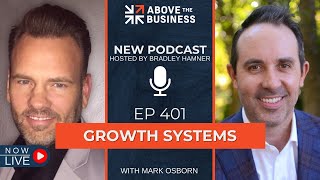
Mark Osborn explains how to build sustainable revenue growth through layered systems instead of growth hacks. He shares concrete metrics: CAC should be one-third of LTV, no single channel should supply more than 80% of leads, and referrals should account for at least 30% of inbound leads. He also introduces a free diagnostic tool and revenue scorecard to align sales, marketing, and customer success.
Chapters
Welcome to another episode of the Above the Business podcast. My name is Bradley Hamner, your host. On today's episode, we have Mark Osburn. Mark is the owner of Modern Revenue Strategies. We're going to talk about all things B2B and even a little bit of B2C marketing and sales. He has a tremendous amount of experience in helping create revenue growth systems for SaaS, tech, and boutique professional service firms. I actually had an opportunity to go on Mark's podcast, and it's amazing how aligned we are in different concepts and frameworks, you're going to get a ton out of this conversation with Mark Osburn. Mark, welcome to the Above the Business podcast.
Thanks so much for having me. I'm excited to be here.
Excited to have you. Well, we always start with background and origin story. I love hearing people's journeys of how they got to where they are. So why don't you take us back and bring us to present day?
Sure. So kind of a funny origin story, um, uh, in the early days of the internet. So I'm talking like you know, mid to late '90s, people didn't actually have access to the internet every day. They treated it, they actually called them Usenet billboard groups. And it was almost like a billboard at the local grocery store where someone would put up a flyer and like you'd peel off the phone number if you wanted guitar lessons or whatever. And so at the time I was playing in bands and managing bands. This microphone is actually a bit of a leftover from my days as a musician, but I was managing bands, and so I would notice that people would go on these Usenet groups and they would trade. I've got Dave Matthews recorded in Birmingham, so I know you like Dave Matthews Band, and I know you live somewhere near Birmingham. And they were trading these bootleg concert tapes. So I started building databases of folks that lived in certain areas and had certain music interests because there was no such thing as spam at the time. Their username was their email address. They wanted you to know how to email them. So I started building these databases, and when one of my bands that sounded like Dave Matthews went to Birmingham, I'd email all these folks. So I was selling out concerts for these little unknown artists, which led to a job at a record label, which led to a job at a radio station, which, you know, led to a more sort of traditional, you know, marketing and sales advertising career. And I got my MBA and actually helped build some digital agencies. And so for, you know, really decades almost, these finding these little hacks and these little ways to sort of game the system or game the algorithm, whether it was in SEO or paid search or a lot of digital marketing, that was really the name of the game. And in the early days of, you know, ad tech and martech, the martech conference started publishing a landscape. Of all the different, you know, technology and data solutions to help marketers do their job. When they first started doing it, I think it was around 2010, 2014, there were 150 companies on that, on that list. Today, this year, there's over 10,000. Wow. And so you really just can't keep up with the pace of innovation. And so I started to realize that trying to game the algorithm or find a growth hack wasn't the way to create success. And as I looked around at companies that were much more successful, it was those that were building systems. And this was actually accelerated a lot during the pandemic lockdowns. In the B2B marketing and sales space, McKinsey says that it accelerated some trends there by more than 10 years in less than 10 months. So a decade of change in less than a year. So I actually wrote a book about that last year that went to number 1 in 10+ categories on Amazon. But it's all about how modern B2B marketing and sales is not using growth hacks or, you know, looking for that silver bullet, but instead building systems wherein they layer in data and technology to help them do a better job of attracting more of the right prospects so they're not drowning in unqualified leads or wasting money on ads that don't work. And then accelerate those best opportunities through the sales pipeline, uh, so that they're, you know, putting the necessary resources to win those best opportunities in the market and then activating their existing clients for fast renewals, larger upsells, more referrals.
Goals.
So that, that's essentially, you know, that transition from, you know, using very tactical, uh, you know, kind of data-driven, uh, things to, to make connections in marketing, to really this transition to really seeing that today it's all about these systems, uh, and how— and then layering in the data and technology that makes those systems run better.
Well, you and I are very much aligned in our systems thinking. What— when you talk, I remember the first time I ever heard RevOps before, um, that, that terminology. I was like, what does RevOps actually mean? But you actually call it Revenue Growth, uh, Systems. Can you give an example of, let's say, a business has been grassroots, boots on the ground, gotten the business to about a million, and they really are trying to modernize of like what it takes to get it to 3, as an example? Okay, so triple the business. And for that company, for that owner or founders, it was life-changing, right? To be able to get it to from 1 to 3. What are some of the challenges, and yet also at the same time opportunities, of that business that you see whenever you're working with someone that, that has that and says, you know what, we feel like we're positioned with our product design, our product suite, our product ecosystem, whatever you want to call that, but then they just really have not gotten the, the marketing and sales, the revenue growth system in place to be able to do it.
So we actually have a free diagnostic tool that we built, modernrevenuestrategies.com/diagnostic. And in 15 questions, we can diagnose really quickly, is it around attracting more of the right prospects, or is it around accelerating your best opportunities to the sales pipeline? Or is it on activating your existing clients for fast renewals, larger upsells, more referrals? And we built this using, you know, third-party research company and, you know, my 20 years of experience on what are the most important metrics for each of those areas. And just having that diagnostic to sort of shine a light on, hey, you're about average on these two areas, but this area you're, you're way below average. Just having that focus creates a big opportunity for businesses. Now, I'll warn your audience, they're not the easiest questions because I'm gonna ask you things like, what was your churn rate over the last 12 months? And so a lot of businesses don't know those things. And so one of the things that we see to be most transformative right off the bat is building a revenue scorecard that incorporates these metrics around attraction systems, around acceleration systems, around activation systems. So that you can look very quickly and update on a regular cadence. How am I doing against these things? And so that scorecard then serves as a touchstone for a cross-functional team that includes somebody with sales responsibility. Maybe that's you as that, you know, sort of founder operator, somebody with marketing responsibility. Again, maybe you're sort of wearing both hats, but you want to sort of you know, acknowledge when you're shifting from one hat to another, and someone with sort of a customer success and sort of organic growth responsibility. By bringing those three functions together on a regular cadence to say, well, here's where we are, here's where we'd like to be, hypothesizing how do we get there, and then let's, let's put a plan in place for the next 90 days and see how well we did. On, you know, sort of improving that metric. That creates a lot more collaboration within the organization, which removes a lot of the stress that comes from finger-pointing about, well, you let us down, you didn't bring us enough leads. Instead, it's a collaboratively, well, the system let us down. Our system didn't bring us the number of leads that we wanted. So how do we together work on improving the system? And so just by creating that scorecard, creating that collaborative framework for people to come together, hypothesize ways, because oftentimes customer success knows what customers really love in a way that marketing doesn't. And so they can tell marketing, hey, talk more about X. Likewise, the person in the marketing role might be better skilled with tools and things that can communicate at scale so that they can then even help customer success. Hey, are, you know, all 20 customers that are gonna, you know, come up for renewal in the next 90 days, let's have a campaign against them so that we're reminding them why they enjoy working with us and have a marketing campaign that, you know, sort of does that. That's something the customer success, they just don't have those toolkits to know how to do. They know it would be great if it happened. And, but marketing can bring that in to impact those renewal and upsell metrics. Customer success can bring that insight in about what customers really love to marketing. And so bringing everyone together is really the start of building those systems.
One of the challenges is knowing when you have too many channels and when also you don't have enough channels. Talk me through whether it's through the diagnostic or just in your conversations where you do work with someone and say, we do need to diversify the channels here. And then at the same time, I, I think, I hypothesize here, but correct me if I'm wrong, is that most of the time the business owner has optimistically thought that they could have all of these different channels and they're, they're not really good at any of them, right? And so they're, they're trying to do all of the things because there's a lot, there's too many good ideas out there in the marketplace for them to actually execute on. Specifically when talking less than $5 million, right? So, you know, $300,000, $500,000, million, $2 million, etc. You only have so much resources— team, time, money, energy, effort— all of those kind of things that you can apply to some of this. So how do you work with business owners to be able to know when we need to turn on or off channels?
Yeah, that's a great question, and, and thanks for that. So to To be very transparent, most of the folks that I work with are operating in a specific dynamic, which is they're looking for, you know, sort of long-term contracts that, you know, sort of a significant investment size. So kind of $30,000 or more for an annual or longer contract, which then that means on the decision maker side, there's lots of folks evaluating that decision. And then if there's lots of people, that means it's sort of a long decision cycle. So it might, you know, might be 6 weeks or so. That's the dynamic that I have sort of the most experience in. So speaking to that kind of market landscape, but you know, that, that could be professional services or it could be technology. Today, most technology has services on top of it. Most services have technology underneath it. So they're very similar. But so to get back to the original question within that context, what we do is we look at, you know, what's your cost to acquire a customer by individual channels? And there's some handy rules that your lifetime value for a customer should be 3 times the cost to acquire them. And so any channel that is not performing at that ratio should be seriously considered and maybe eliminated. Now, some companies, well, I don't have a lifetime value because I expect them to stay with me for 5 years. I've only been operating for 2. Most of my folks are sticking around. Well, then we say that it should be a 1-to-1 ratio of your first year revenues from an account. So if you don't have that, a good lifetime value, you can say, well, your cost to acquire should be equal to or less than your first year of revenues from, from that account. So that's, that's one metric that we use just to, you know, how expensive is it to, you know, sort of acquire customers. And that's a customer, not a lead, because so you want to incorporate your fallout of what percentage of your leads actually convert. The next thing that we look at is what percentage of your leads come from any one channel. And if 80% or more of your leads are coming from any one channel, that is high, high risk. And so you definitely need to be thinking about diversifying if more than 80% of your leads come from any one channel, because something could happen. To that channel, and then your lifeblood is gone. And then the other thing that we see, especially in this, in this sort of business context that we operate in, around what percentage of your leads come from referrals. And we say that it should be at least 30%. And so if you're not seeing at least 30% of your inbound lead volume each month come from referrals, then there's a big opportunity to improve those activation systems. So doing a better job of asking customers for referrals, doing a better job of asking for renewals early, doing a better job of identifying opportunities for upsells and cross-sells within your organization for that sort of organic growth. So those are some of the key metrics that we use on identifying, you know, do you have the right mix of channels? Do you have the, you know, right sort of organic growth that's happening as the same time as you're, you know, sort of acquiring new customers.
I love that. Um, that's super tangible, and I appreciate the specificity there because I, I think sometimes we can kind of go, um, like conceptual in nature, but then to be able to say like, what, what does it actually need to look like?
Yeah.
And I, I agree with that. I mean, and that's kind of where I asked the question, and you know, I don't think my role here on here is too much to, um, I mean, there's times that I have people on here that they'll say something like I kind of disagree with that, you know, but that's not my role with— as the interviewer. Um, I'm not on here to— I'm not—
it's not gotcha journalism. Yeah, it's not, uh, Ricky Lake.
Yeah, right. Yeah, yeah. Maybe that actually would help downloads, possibly, if I just started to go like, you know what, I think that's— I think it's bullcrap. Like, I don't agree with that, Mark. Actually, I think you're wrong. No, it's like People wouldn't come back on the podcast. No, I, I, I don't want to do that. But I, I, I do, I do actually agree. I think that the idea that you can also, with that, you can have too many channels as well. And so I think that there is, depending on where you are, there's the right number of, of channels for lead, but also, um, where are you acquiring customers?
Yeah.
And I think what is really valuable here is it's making an underlying assumption, which goes back to one of the first things you mentioned, and that is you have to have the data. Yeah, you have to have the data of what that is. But if you don't have the data, you can't make these decisions off of that. And so really, it's one of the chicken or the egg. It's like, well, this has to happen first, otherwise we're guessing And guessing usually does not play well in business.
That's right. That's right. Yeah. And that, that's why the, that first step is, is getting that revenue scorecard together and defining what are your, you know, core key performance indicators or KPIs metrics for each of those 3 stages. And that's why we have that, you know, sort of diagnostic because those 15 questions are kind of the best practice, you know, across the industry built over, you know, decades of doing this and hundreds of millions of dollars in for clients. And then we also work with an external third party to go out and conduct research in the marketplace and ask companies that are, you know, of similar size and in similar industries, you know, what are you doing to impact these metrics? What are your results against these metrics? And so that always sort of informs that.
In your mind, what's the, what's the handshake between marketing and sales?
Yeah. So the, the first is, and, and this comes back to that idea of a revenue team, when they're getting together on a regular cadence, it gets a lot harder for marketing to give bad leads to sales and say, I did my job, just because you're building camaraderie and collaborate and collaboration by getting together on a regular cadence and coordinating. But, you know, We're big believers in not having marketing qualified leads versus sales qualified leads. There is a qualified lead for the organization and it's built through a collaborative definition of, you know, are they actually in market? And, you know, 95% of your customers are not in market at any given time. And so just because somebody dropped by your website or your booth at a trade show or downloaded a whitepaper doesn't mean that they're a qualified lead. It means that maybe they're just researching because they know one day in the next 2 years they're going to think about this topic and tackle it for their business. But that day may not be today. So we need to, you know, really sort of qualify it. And so there needs to be an agreed upon definition between marketing and sales on, you know, what makes someone qualified to pull into the sales pipeline today. And if they're not qualified to pull in the sales pipeline today, then marketing has mechanisms, some of them are automated, that nurture that person until they are qualified to pull into the sales pipeline today. So just having that, you know, sort of joint definition. And then, you know, we also like to you know, there's, there's a very common metric that people use, which is sort of pipeline velocity, which is essentially, you know, how many leads do you have? How much is each worth? How long does it take you to close? But one of the things that is missing from that is pipeline quality. And so as part of those attraction systems, we really focus on defining an ideal customer profile. As well as the buyer personas of what do our best tier 1 customers look like? Those customers that make up 80% of our revenues, what do they look like? And so if a lead comes in, let's hold it up against that standard of excellence. And if it doesn't match it on some key criteria, then it's a low quality lead. It might be qualified, but it's a low quality. And so we want to have that quality measure in place there so that Marketing isn't just saying, well, our goal was to generate 100 leads this month and we generated 110. We all get bonuses. And sales is saying, but they're all terrible. And we'll never get the company to the revenue numbers that we're looking for, the profitability that we need. And so just creating that coordination on a shared definition of, you know, what does pipeline velocity really look like when you incorporate a quality filter, and then what does a really qualified look like, lead look like that both teams can agree upon?
Well, that's good. A couple of things stand out. I want to go back to— I really like for some of our listening audience, if you haven't heard this, these terms, marketing qualified leads, sometimes people say MQLs, sales qualified leads, SQLs. I do like that because then there's gets people get into the question of like, well, what's a marketing MQL and SQL? What's the difference? Right? And I agree with you. I really do like truly like it's just a qualified lead.
That's right. I have—
I do have a question because I don't think I've actually heard this. So ICA, some people call them DCAs, Dream Customer Avatars, Ideal Customer Avatars, whatever we use that term. What do you mean buying persona? Like, what went through that a little bit deeper? I'm curious around that. And then, then I've got a question to comment on the pipeline velocity and quality component?
Sure. So within the B2B space and again, large contracts, you know, long sales cycle, complex buying committee, we really try to define the ideal client profile, ideal customer profile that describes the account. But we want to move beyond firmographics. So it's not just, well, we work with companies of a certain size in a certain geography. With a certain number of revenues that have this problem. And so that's a pretty simplistic way to define it. And that has its place. But what we find to be all the more important is sort of a company context that they're operating within and oftentimes even sort of like a company sort of set of values. And I'll give you a couple examples there. So you know, I've worked with an ad tech solution that was really good at helping companies expand their investment at a similar sort of cost to acquire a customer. And that's what the software did really well. And so as they were looking for companies to sell it to, companies that were looking to contract and spend less for the same number of customers were really bad fits. And you can look at, you know, a lot of things about a company or ask just a few very pointed questions and find out, are you looking for this type of software because you need to save money or because you're looking to grow? And if it's because you're looking to grow, we're a good fit for you. If it's because you're looking to save money, let's just go ahead and part as friends now. We're not going to be a good fit. So just understanding that company context is really important. And, you know, I've also worked with, you know, companies that their process for delivering their solution is very collaborative and they're consultants, but they co-create with their customers. So there are some companies that when they go to look to hire a consultant, they want that consultant to tell them the answer. And if that's what they're looking for, they're not going to be happy working with this company that wants to co-create it with you. This company has a lot of reasons why they believe co-creation is better than us telling you the answer. But if that's not what they're looking for, it's not going to be a good fit. So understanding those things up front is a good measure of that quality. And we use that as the ideal, you know, customer profile to define the companies that we go after. And then the buyer personas really sort of describe the different roles within the buying committee. So on complex, you know, business decisions today, usually there's a decision maker who ultimately sort of like says yes, no, signs the check. There's almost always a champion that, that decision maker might say, hey, we need new software to do X for our company. Go out and evaluate 10 folks, bring me 5 recommendations. We're gonna talk about that champion goes out and talks to a bunch of folks, starts to come with criteria, guides the decision-making, maybe makes a recommendation to the decision maker. But they're not ultimately the decision maker. And then oftentimes there's technical influencers like Well, we need software that's going to work with the other software that we have. And so this technical person can come in and say, you know, yes, it works or no, it doesn't. And so that, that's an important role to understand as well within this buying committee. Understanding who those 3 different people are within a decision process and not only what's their role on informing the business decision, but what's their personal win out of this? Are they doing this because they want to have more time to go home and spend with their family? Or are they doing this because they want this to be a successful project that they can hang their hat on, put on their resume, and get a promotion? Those are two very different motivations. You'll sell the same product two very different ways based on what those motivations are. Most times, understanding that really gives you a much better job of accelerating those deals to the sales pipeline.
I love that. Yeah, it's a much deeper understanding of the ACA and not just the, you know, the easy stuff at the very top. I think that's great. Okay, I'm going to ask you a question that I recognize is not your expertise, but I'm curious around this because you're a smart business guy, you've been in this for a while. What are principles that you utilize that you also think apply in a B2C realm, like business to consumer, right? So we— a lot of our listening audience may not be B2B, they may be a combination of B2B and B2C. So I'm curious, I know you have a deep expertise in B2B, but I'm curious, I love hearing like business principles like, hey, this applies over here and this applies over here. We can distill that down to be able to take away. I'm curious about your thoughts on that.
So this is actually something that, and I've worked with a lot of B2C companies in my career, but most of my expertise is in B2B. One of the places that I see B2B fall down a lot is using brand and sort of brand building to create demand. And a lot of B2C companies miss this too, because oftentimes if you're, you know, sort of a challenger brand or, you know, a mid-tier competitor, you're letting the market leader create demand for the category and then you're just harvesting the demand that the market leader is creating. That's always going to keep you at a disadvantaged position where you're competing on price instead of if you take the time to really define maybe a more narrow niche, but a large enough one to support your business, maybe a more specific use case for your product or solution, or maybe just a philosophical alignment between your product. Like if you can take the time to define that and then create messaging that creates demand while creating awareness, that really builds that brand, that, you know, sort of unique positioning, that is, that's the real path to having security in your market and having success. And very often in B2C, someone will be like, I'm never going to be Microsoft. And so I, I'm not going to create the demand for you know, software or whatever it might be. Well, and let's, you know, stick with a B2C example of, you know, I'm never going to be Neutrogena. So maybe you make a skincare line. So Neutrogena is out there buying all these commercials in Times Square, convincing people that, you know, they need to, you know, take care of the fine lines and wrinkles around their, around their eyes. I'm just going to ride their coattails and help people have another option for improving the fine lines and wrinkles. That's never going to be as strong of a position as coming up with a unique position that you can own, that you can be the, the leader in, which is maybe it's the ingredients that go into it, maybe it's the methodology that you use to apply it, maybe it's the speed of results that you expect, or, or whatever it might be. Coming up with some, uh, real differentiated positioning, uh, is key. For both B2B and B2C.
I love that. Some things that really stood out to me, I think diagnostic and having data is such a great reminder. I love that the comment around, look, LTV, look, CAC needs to be no more than a third of what LTV is. I think that's a great reminder. Lead volume, if it's greater than 80% in one channel, you need to diversify, referrals being at least 30%. Those are great takeaways. Love the, the marketing QLs, sales QLs, and just thinking about it as just what's a qualified lead for the company. I think that was, that was really fantastic. Mark, people want to connect with you. You're clearly a wealth of knowledge in business. They want to connect with you. What's the best way for them to do that?
Yeah, absolutely. So honestly, the thing that I recommend most is, you know, get started. And so go take that diagnostic. If you don't know the answers to some of the questions and you don't want to take the time to look it up, you can just say, I don't know. But I'll generate a report that sort of says, hey, here's your fastest path to growth. And oftentimes we've seen results from that diagnostic, you know, double revenues in as little as 90 days for folks just by having the focus on knowing where to, where to focus. And then And, you know, you know, from there, happy to, you know, schedule time with folks to really help them unpack, you know, where are they, where are they falling down? What assets do they need to, you know, sort of create that growth? Or reach out to me directly, mark@modernrevenuestrategies.com, and Mark is with a K. And I'm on LinkedIn all the time too. You'll, you'll see me there, you know, having conversations with folks and sharing out information. So would love to connect there as well.
Awesome. Mark, what do you believe working above the business means to you?
Yeah. So I love that phrase and you and I have chatted about that a little bit. And, you know, we have a phrase around here that, you know, B2B growth systems set you free. And that's one of the things that, you know, we, you talk about working on the business, in the business, and you talk about working above the business, taking the time to think about how systems can set you free. To me is that idea of working above the business. You're working, you know, on the business when you're creating those systems that those 3 Ds that you talk about that, you know, doing, documenting, and delegating. And you're working in the business when you're in the doing phase. But just taking that time to think, you know, about what are the most critical systems for my business? What are the ways that I can leverage data and technology to make those systems run better? That to me is when you really get Above the Business. I love it.
Mark, appreciate you coming on the podcast.
Thank you, Bradley. Had a great time.
Hey, big shout out to our podcast sponsors: Club Capital, Autopilot Recruiting, Today App Pro, and Coach P Consulting. If you want to help in your insurance agency, none better than Coach P. Go to coachpconsulting.com. Let him know that you heard about him on the Above the Business podcast. You know, when I was talking to Mark around, you could just see the skill level that Mark has. But if you don't feel like you have the skill level with your financials, there's a great way that you can acquire the skills and the mindset and even get access to the tools. Go to Club Capital, go to club.capital, book a demo and work with someone on the team that they can give you insights so that you can make those investments in your growth systems as we talked about. With Mark today. One of the areas you probably do also want to make the investment in is with your team. If you want to be able to grow, typically growth is going to come from the making the investments in your team, marketing and sales team people, but also in just flat out marketing. And so if you want to do that, work with someone that can take that first part off of you and your team and also qualify some of the best candidates for your business. Autopilotrecruiting.com. On the episode with Mark, obviously we talked a ton about tech and software. It's really hard to make really good software, but TodayApp Pro has done that. If you're an insurance agency owner and you want to be able to get away from the spreadsheets and have a unified system that works with your corporate-approved CRM, todayapppro.com. TodayAppPro.com. Love that conversation with Mark. Till next episode, lead well.










