Episode 402: The Power of Purpose with Jackie B. Grice
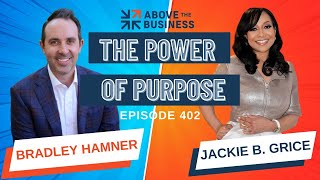
In this episode of the Above the Business podcast, host Bradley Hamner interviews Jackie B. Grice, a Certified Purpose Coach and Business Strategist. Jackie shares her entrepreneurial upbringing, the pivotal moment during COVID‑19 when she spent two days in silent meditation under a tree, and how that experience led her to discover her own purpose and become a coach. She explains what a Certified Purpose Coach does—helping people uncover their core purpose and translate it into a purpose‑driven, income‑generating business. The conversation explores why business owners often lose sight of purpose when they are either struggling or overly successful, and how purpose‑centered leadership can fill the “empty” feeling that accompanies financial success. Jackie offers concrete practices: weekly quiet/thinking time, sacred rituals, a day‑off for reflection, and the 5‑Second Rule (a countdown technique from Mel Robbins) to create a forcing function for action. Bradley and Jackie discuss how to maintain commitment to these practices, the importance of “above the business” leadership—elevating oneself as a healthy, measured leader—and provide Jackie’s contact channels (Instagram, Facebook, launchingdeeper.com). The episode ends with sponsor shout‑outs and a reminder that purpose work is essential for sustainable growth.
Chapters
Welcome to another episode of the Above the Business podcast. My name is Bradley Hamner, your host. On today's episode, we have Jackie Grice. I have a question. Have you ever had a moment where maybe you struggle in your business or just maybe even in your personal life about what is my purpose? We always talk about, or I always think about on this podcast, looking at business and entrepreneurship from every potential possible lens there is. and I don't recall that we've actually had one where we've talked about the importance of purpose. Well, we do that in this episode. Without further ado, here's my conversation with Jackie Grice. Jackie, welcome to the Above the Business podcast.
Hi, thank you. I am so excited to be here with you guys.
Excited to have you with us. Well, we'd love to start with background and origin story. I love hearing how people kind of got to where they are today. So why don't you take us back wherever you feel like is appropriate and bring us to present day?
Yeah, well, I am a product of entrepreneurs. My parents owned an upholstery business, so I, you know, my father had the shop in the, like, in the back of our house, literally. So I grew up around people doing business since I was, you know, born. And that's what I saw. He also worked a full-time job. My mother worked with him. Full-time in the business, but I really just grew to love it. I, I love the fact that, you know, they, they were able to take— you know, my father had a limited salary, but he was able to have his own business, and that gave him a lot of freedom, and it allowed for a lot of freedom for our family. And it was just good to see how they did taxes. And, you know, we're talking you know, 50 years ago, you know, how I saw how they would do their books and their taxes and they would take all of these receipts and they would take them to the, to the person that did the taxes. And I just remember just being so excited about that, that whole life, you know, that, that just really made my heart sing. So got started, ended up fast forward went to school for engineering and just loved the idea of working with my hands, just making things because I really grew up around that as an upholstery. You know, my father was an upholsterer, so I really saw how he could take, you know, things that were broken and torn and just turn it into something beautiful. So that love of creating something, that innovative part of me, just, it sparked. So went there, finished that, you know, ended up getting married. And, you know, my husband wanted to start a business in transportation, and that's sort of how we got started. I worked a 9 to 5 for Hewlett-Packard for many years as a contractor and was helping my husband on the side. But that love of business just, you know, it was very difficult to stay in that 9-to-5 space. And, you know, I told him, I was like, look, if I'm going to do this thing with you, then I have to just go all in. So that's pretty much how it all started.
Yeah, that's great. That's fantastic. So tell me, what is your title of a Certified Purpose Coach and Business Strategist? Now, business strategist, I certainly get that. But we've had, I mean, at this, we're getting, we're pushing close to 400 episodes, which is hard to believe, actually. Maybe 250 of those or so are interviews. But what, what does it mean to be a Certified Purpose Coach?
So 2020, so we're in transportation, right? And COVID hits. We were probably up there with restaurants. It was like the worst business to have. And I, you know, it literally— like they say, the wheels of the bus, they didn't go round and round. They came to a screeching halt. And so I literally sat under a tree. I really believe in silence. I believe in meditation. And I sat under a tree in my front yard for 2 days. Saying, OK, what am I supposed to do? You know, this can't be the end of it. And out of those 2 days in silence came this part and this version of me that I didn't even know existed. So I ended up going into coaching. But the biggest part was what I realized is that, you know, a lot of times people didn't understand their purpose. They were doing things that were really good things, but they weren't doing things that they were purposed to do. And a lot of times, even if they found out what their purpose was, they didn't know how to take that purpose, you know, to, to cause that impact, influence, and to build an income. So I started the journey of becoming a certified coach, and I just help people. I sit down with people and I I really help people discover what their purpose is, what they feel that they were actually put on this earth to do. And I show them how to take that and strategize those things to build a business. So that's the Certified Purpose Coach. So I became certified as a coach and really my niche is dealing with people just really discovering and understanding their purpose.
How— what is the— what are some of the first things that someone listening to this, that if they're struggling, maybe that they've had a lot of success in business? So it's interesting, I think, that if we— if, if we're struggling in business, um, or with our businesses, which is obviously our listening audience I mean, I think it's pretty obvious we're gonna— we're— we like the challenge. We don't think about it as far as embracing the challenge in the moment. We're just like, oh my gosh, I gotta— I gotta get this business turned around. So what I'm saying is, is that a lot of times, I certainly— when the business is struggling, I don't think about my purpose. I'm just like, I gotta— I gotta turn this thing around. But interestingly, when Oftentimes the business is doing well and we're achieving goals or qualifications for certain things. It can feel a little empty, right? It can feel a little empty. And I was like, hmm, I thought it would feel a little different. And those are the moments that I do reflect a little bit more on purpose and my mission that I'm on. And is this really what I wanted to be able to do? Have you found that other people have expressed that in the context of, well, specifically business owners? And then kind of a part 2 question to that is, what are some of the strategies you would have someone to do just listening to this podcast?
Yeah. So you're absolutely right. It, you know, a lot of times when you are, you know, you're making the money, you you're busy, like they say, booked and busy, and you're doing all the things, you— sometimes you find yourself saying, is there more? Is there more? And that's sort of where I was under the tree. It was, okay, we've built this multimillion-dollar business, right? And I'm sitting under the tree and I'm like, okay, I feel like I'm on the brink of losing this thing that I've just been consumed with. And it's been like, you know, I've done this every day. This is what I do. This is who I am. And it really took me to be on that verge of what if that part did not exist? Who am I? What is it that I'm really here to do? And I think the good news is that while you're doing well and while things are, you know, you're successful, is to really take that time to say, what else is there for me to do? Because at the end of the day, that is the thing that will fill your soul. It, you know, I think we all go through that where as as high achievers, as business owners, uh, we get to a place where we're like, okay, it's got to be a little bit more. It's— something's missing. And I think that that is exactly, you know, the person that I'm speaking to that has done really good things and great things and that have made great achievements. But at the end of the day, and that's what I realized, is that Wow, if I— if this business was taken away from me, what, you know, because I hadn't worked on purpose, I hadn't worked on what is it that I'm really passionate about. And I had to really dig deep and find out that the one thing that I love above transportation was I love business and I love helping other people grow their dreams and I, and I love to be a part of helping my community and employing people in the community. Those were the things that really, you know, drove me. And I think that absolutely a lot of people get to that point where, and especially, and I call these people, you know, there are 3 types, you know, you can be on the shore as a business owner, you can be in shallow water, and then you have those that are in the deep. and that's when you're running, you have more of 20, 30, 40, and up 100 employees and you're making multi-millions of dollars— is that you find yourself out here in the deep end and sort of not really— or you focus so much on building the business that you didn't look at what really mattered. And I think that to go to the part B of that question, some of the things to do is to really get quiet, you know, to really just get quiet. I, you know, I take a day a week and a lot before this I wouldn't dare do it because I felt like I had to work and I had to grind all the time. But what I found out is just by taking a day out of my work week and just getting quiet, meditating, writing down those things that really mattered, where I really wanted to take my business, how I wanted to build more of a soul-centered business, not just, you know, and when I say soul-centered, I mean a business with purpose. Those were some of the things that I think are so valuable to do. as a person that's sitting at that point where, you know, they, they're, they're doing great things, they're making lots of money, but they still feel like there's something missing.
I, we have, there's a concept that we share with our members called the Perfect Repeatable Week. And so it's designing their week. In a way based on their energy rhythms, not just on time management. And so there's several different elements that go into a PRW, but let's just say one of them is the value of thinking time. And ironically, we just went over this with our members this week. We were talking about this, and for so many of them, two things came up. We advocate 60 minutes once a week, and they were sharing with us, man, it's hard for me to find the 60 minutes, so let alone a day. Like, forget that, okay? There's no way I'm finding it a day. It was hard for them to find— for them to find 60 minutes. Now, that being said, that's actually not my question, although I think a lot of people can relate to that. I think one of the things that they struggled with more than anything was the fact that it was an appointment with themselves. It was easy to break.
Mm.
And so it's sure if, like, for instance, we have this podcast. Well, if I said I was going to do a solo podcast today at 11 o'clock, well, I would hope that I would commit to it. But the reality is I'm, ah, you know, I'll get around to it in just a little bit as long as I get it done today. And I think that that becomes where I can hear one thing. Of like the discipline of getting quiet. But until I have a forcing function on me— that's how I think about it. You, if you're in engineering, I'm sure that's maybe terminology that you all use. But if I have a forcing function on me, then I'll do it. If I put myself in the right environment, I'm around other people and we get— and, and, and we're quiet and we go to think and we go to sit around a tree because then everybody else went and, and, and, and did that, then I'll do it, right? I mean, uh, we, we'll do that sort of thing. I mean, we, we've got a retreat coming up with some of our members coming up, and, you know, we're going to be in Missouri, and we're going to do some exercises, and I'm going to encourage people or invite people— I'm not going to make them— I'm going to invite people to go and do that, these type, some of these things, right? Maybe not on finding their purpose, but on stuff around their business. And, and so my point is, is like They're going to do it. But like, how do we then— this is a really long lead up to this question, but I think it's important to give context— is that how do we keep the commitment of like getting quiet, even if it's an hour a week? I can't do it like I could do a day a week, but even getting quiet for an hour a week and doing some reflection and thinking and maybe not even thinking about the business, but just even just reflection on you know, what is it I'm here to do and the impact I want to make and my purpose? How do we keep that commitment?
That's such a good question because when I really started, you know, in my business, really telling people about getting silent and how that can really help you make quantum leaps in your business, no one wanted to hear. No one wants to hear to get silent. Come on, give me something else. Give me the 5 keys to success and all that. You know, and it is very difficult. Even myself, it's difficult, you know, and I always talk about, you know, okay, we have 168 hours in a week. We can find, you know, even that hour. And I will tell you, that is a stretch, an hour, than to try to push people to a day. But I sort of say you can't afford not to. Because I know how it literally changed my business, how it changed my life by taking 2 days. I'd never done it before. And literally when I did it, it was like, you can't undo what you did. And it's like you want to tell everybody, hey guys, there is something to this thing. And, um, and That's sort of how I do it. And sometimes I really have to force myself to take that time to be silent, to be quiet, to listen, to meditate, you know, even strategizing on my business and to be, you know, but I'm at the point where I feel like I can't afford not to do it. And I think it is one of those things, you know, I talk about these things called sacred rituals. And they're just things that you just have to do, like in order for, for my business to be successful and to be successful not only at business but in life. These are just some things I have to do. And, you know, just like you may say, I'm never going to miss one of my kids' baseball games or something like that. You just make it up in your mind. I have to do this because this is part of what I feel a good parent should do. And so that's sort of the thing with myself is saying, if I am going to be a healthy leader for my organization, if I am going to be the visionary for my organization, that I literally, I have to incorporate some time to just, you know, get out of my head, get out of the, the dings of the phone and the emails and all the things, and really to, um, to be introspective.
So you have a, a strategy called the 5-second rule. Tell us what that is and why that's something we should consider implementing.
Yeah, so that's something that I learned from Mel Robbins We all know her, she's great, you know. And she did this thing she called the 5-second rule, and it's literally counting back backwards, you know, 5, 4, 3, 2, 1, and making a commitment to just do something, whether that is to get up, whether before you say something, before you react, you sort of, just, and it causes your mind, your brain to just slow down. It just, it causes you to think a little bit more logically. And, and, and it's, it's very simple. It's basically, you know, before you make a major decision, before you say something that could be controversial, before you— a lot of times I'll do it when there's something that Say silence. I don't want to, you know, I'm like, I don't really feel like doing it. And it's just saying 5, 4, 3, 2, 1. And I just do it. It's weird, but it does work. It does, you know, it's, you know, and she used this when she was going through a really depressed state and wasn't able to get out of bed. And she, she literally used that to, to get herself up. And yeah, so awesome.
That's great.
Yeah.
Well, Jackie, if people want to reach out to you and connect with you and for you to help them in finding their purpose in life and in their business, where's the best place people can connect with you?
Yeah, so I'm on Instagram, I'm on Facebook. But it is under Jackie B. My last name is Grice, and I always say it's like rice with the G in front. So Jackie B. Grice on Instagram and on— and Jacqueline Slade Grice on Facebook. I also have a platform called Launching Deeper, and it's just motivational things on that. On that page. But launchingdeeper.com is my web address. And people that want to connect can just go in that little part that says, hey, I want to connect, I want to learn more. And those are great ways to find me.
So awesome.
Where—
if, if people wanted to be able to dive deeper, the web address is probably the best place to be able to go.
Absolutely. The, the launchingdeeper.com, and then that way they can set up an appointment, um, do a discovery call, all of those things.
Awesome. Well, last question is, we, the name of our podcast is Above the Business. What is working above the business? How does that relate? What does that mean to you?
Yeah, that means to really set your business and strategize your business. So like we talked about the E-myth, that you're not working in the business, but you're working on, but above is even that step above. And it is about, when I say, when I'm thinking, you know, above the business, it is really elevating yourself as a leader so that you can, as a leader, show up as healthy, and as centered as possible, because in order to grow and scale a business, so much of that depends on the leader. And we didn't get to really talk about hypersensitivity a whole lot, but hopefully if I'm invited to come back again, we can dive a little deeper into that. But just to be a measured leader, and a healthy leader, to me, that is how you start to be above and just make great decisions for your organization and the people that are in the organization as well.
Love that. A few things that stood out to me from what you mentioned. I think just, again, a reminder for me personally, I think for our listening audience, the value of getting quiet. And making that commitment to yourself on a regular routine, even in 60 minutes once a week. And the follow-up to that, when you said, you know, you just simply can't afford not to. And I think that that's a reframing of like, instead of I need to, it's something I want to do because you begin to see the value that comes from it. So if you can just take that step initially to do it, maybe for the first time, you can begin to see the trickle-down effects of how that affects, you know, you and your business. And I think also kind of the reminder— I've not read Mel's book, The 5 Second Rule, but it did make me think about something I believe Alex Hormozi has talked about, which is the basically the time difference between when I think I should do something and when I actually get to work and doing it. There's a— there's something that I've had on my list for a couple of weeks, and it's amazing the, the excuses and the other things I've kind of had that if I just focused in and got it done, it would have taken me maybe 30 sec— uh, maybe not 30 seconds, 30 minutes to an hour or so. And I procrastinated on it. So it was such a good reminder for me. Um, and, um, ironically, even before this, I made tangible progress early this morning. Uh, I spent about 15 minutes and then I kicked myself for about 5 thinking, why did I wait so long to just do this? Because I could have just got it done. So those are some of my big takeaways. Jackie, thank you so much for coming on the podcast.
Thank you. Thank you for inviting me. Appreciate it.
Hey, I want to give a shout out to our podcast sponsors, Coach P Consulting, Autopilot Recruiting, Today App Pro, and Club Capital. If you're an insurance agency owner and you really want to continue to grow and develop yourself and even your team, there's none better than Coach P. Go to coachpconsulting.com. They're going to let you behind the curtain, almost like the Wizard of Oz. You know, you actually kind of get to peek behind the curtain. Plus, you'll be in a community of other business owners, and your team will be around a community of other team members looking to learn and develop themselves, as well as being in a community of people who are going to be supportive in their journey. Go to coachpconsulting.com. I'm just kind of looking at my screen here, and there's so many different software, you know, tech stack. You may not have thought about that before, but what is your tech stack? If it's just Google Sheets or Excel sheets. There are some things that you can use to be a lot better, to help you to be more efficient. If you're more efficient, you can get more out of the things that you put in, get more out of your inputs, and that includes being able to sell more, grow your business, and be more profitable. One of the tech stacks that I encourage you to take a look at is TodayApp. Go to todayapppro.com. TodayApp clubcapitalpro.com. I mentioned earlier about profitability. We're getting towards the end of the year in 2024, if you can believe it. How's your year going? Has it been a great year revenue-wise, but maybe profit's not where you want it to be? Maybe profit's good, revenue is good, but maybe you haven't felt as the business owner that your personal income has gone up. If you work with Club Capital, they can help you to put together a game plan to finish out the year, but also to be able to look at 2025 so you can be more— have more revenue be more profitable and take home more money. Go to club.capital. You know, one of the biggest assets that we all have in our business is our team. If you want to work with a company that's going to help you to be able to build a bench, there's absolutely not a better recruiting company out there— is Autopilot Recruiting. Go to autopilotrecruiting.com. Autopilotrecruiting.com. That part You know, whenever you gotta go through, screen resumes, review all the resumes, call them initially, set up the initial phone screen, all that stuff. Man, they are fantastic. The number of incredible reviews that I personally have heard from business owners in our community that work with Autopilot Recruiting is absolutely stunning. Go to autopilotrecruiting.com. Autopilot Recruiting. Artevolun.com. All right, everyone, till next episode, lead well.










