Episode 412: Small Business Acquisitions with Conner Young
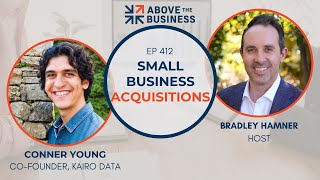
In this Above the Business podcast episode, host Bradley Hamner interviews Connor Young, co‑founder of Kairo Data, a platform that sources, finances, and closes small‑business acquisition deals, especially off‑market opportunities. The conversation covers the origins of Kairo Data, the distinction between private equity (PE) and venture capital (VC), and why PE focuses on profitable, cash‑generating businesses while VC targets high‑growth, pre‑revenue startups. They explain key financial metrics—Seller’s Discretionary Earnings (SDE) versus EBITDA—and the revenue/EBITDA thresholds that trigger deeper evaluation. Connor outlines the typical financial profile of micro‑PE targets (EBITDA $500k‑$1.5M, sometimes up to $10M) and the valuation multiples they see, ranging from as low as 1.1× to higher 4‑5× depending on industry. Financing structures are dissected, including SBA 7(a) loans, seller financing, private‑credit funds, and the common 81/19 equity split where operators retain 81% and investors hold 19%. They discuss seller considerations such as earn‑outs, operator involvement, and creative terms in off‑market deals. Connor shares three guiding principles for identifying well‑run, acquisition‑ready businesses: cash‑flow is king, effective reinvestment of earnings, and robust operations/systems. The episode closes with a discussion of the “working above the business” mindset—maintaining a strategic, future‑oriented view while staying grounded in day‑to‑day operations. Contact information and sponsor plugs are provided.
Chapters
Welcome to another episode of the Above the Business podcast. My name is Bradley Hamner and I'm your host. In today's episode, we have Connor Young. He's the co-founder of Cairo Data. They're a pioneering acquisition platform dedicated to assisting searchers, family offices, and investors in finding, financing, and closing their next deal in a small business acquisition. We had Walker Dybel on the podcast last year of Buy Then Build, and this episode I think is a fantastic— you'll see my own enthusiasm in this episode about some of these things. Now I want to give you a little bit of warning, there will be some highly technical terminologies. Hang with us through the episode as we walk through that. If some of this stuff is new, it was new to me just a handful of years ago too, and so the more you start to hear it, the more you start to kind of understand some of this terminology, and it begins to kind of pull the curtain back a little bit and demystify business. I also think it will really help you in running your business. So whether you're looking to acquire a business or sell a business, I think this will help you in running your business better. Without further ado, here's my conversation with Connor Young. Connor, welcome to the Above the Business podcast.
Thanks, Bradley. Excited to be here. I love the show, love everything that you guys put out, so this is awesome.
Awesome. Well, we'd love to start with background and origin story and kind of get an idea of how people got to where they are today. So why don't you take our listeners back a little bit on your journey?
Absolutely. Yeah, um, so lucky enough to be, uh, from the finance or investing background into getting the private equity world, which we operate now, but A lot of our background just stems from working in Austin, Texas. We started in 2016 and then working with tons of different investors for 4 years up until the 2020 era, doing normal, just traditional wealth management, financial planning, portfolio management. And then that 2020 was kind of the big change-up year, or things where we just added in where a lot of our clients and investors You know, COVID, the pandemic changed everything. So they asked us questions on commercial real estate investments, private equity, these small businesses. And that's where we dove in, did a lot of underwriting, investment analysis, research, due diligence, you name it. And we started looking at these different deals, these investments. And when we would look at a— for a small business or some type of private equity deal, landscaping company doing $4.5 million in revenue, maybe $2.7 million in EBITDA, and then they would be listed for a certain price. Hey, Connor, team, does this look good? We would go out and tackle it. But what really kind of just launched the whole Kairo Data was the question where they would bring up, hey, this is a really good deal, but it's a bidding war nightmare. Can you find me the same type of business or deal off market? And that question right there just changed everything. We immediately said, we don't know how to do that in 2020, but we are happy to figure it out and kind of roll out the red carpet, give you all the tools, resources so we can set you up with these businesses or deals that you're exactly trying to go after. So 4 years later, we have our whole platform. We've got hundreds of different off-market deals, and then we list tons of different on-market deals too that our clients or users can go in, access, and see everything that they want if they're trying to target a certain small business acquisition or you name it.
There's a lot of things that I have believed fundamentally is that the same things that make a business attractive in the eyes of an acquirer also make for a good business to own.
Yes.
Even if you're not necessarily wanting at the present time to have an exit. So we're going to, I'm going to kind of pull the thread of that at some times. And obviously we'll get into some of the things around actual acquisition and what does it look like from kind of both sides of it. That was really a world that I did not know. And I would hear things thrown around, PE, VC, and admittedly I would be like acting like I knew what people were talking about and I did not. Okay, so for our listeners, can you talk about what does private equity actually mean? Okay, what, what, what, what is that? What is it not? And then maybe even if you want to touch on just the specifically the VC, just so people having a kind of a, an idea, because I think people use those interchangeably and they're obviously not exactly the, the same. Thoughts on that?
Absolutely. Uh, there's probably dozens of different ways to define PE, private equity, and venture capital, but what I try to just line it up in a simple sentence is private equity is the idea of buying or investing in existing profitable businesses. So taking an ownership stake or just buying the business outright. So you have PE or private equity firms that can look at, you know, lots of different companies, medical device or landscaping or a pest control business and either say, hey, I want, you know, 70% of this and would love to give you this money for that. And that adds into their portfolio of investments. And that's where the PE world kind of sits versus VC or venture capital is more in the world of startups. So businesses that you can call quote unquote not yet profitable or just started, and they're trying to take a pretty sizable piece of that. With kind of just a really big guessing game on, hey, if I give you a big chunk of money and I get a, you know, sizable piece of equity, but you turn out to be worth hundreds of millions or billions, like find the next Uber, find the next Airbnb, whatever. That's where the VC world kind of sits.
It's interesting. I've got a friend named Blake, lives in Atlanta. He works for— I won't name the bank, but he works for one of the was at the time one of the biggest competitors to SVB, Silicon Valley Bank, before they, before they went out. And he sits in the VC route, and it is fascinating to me, fascinating to me, the things that they do. He's on the debt instrument side, and so he works with a lot of the VC companies that go in and make these investments in these startups. They'll do the line of credit, as an example, to that VC. And these will be pre-revenue startups, right? And it's amazing that the cash burn, etc., And one of the things that you mentioned that is, to me, typically opposite of what his world is, is the word profitability. They really don't even care about profit because they're like, we just want growth at all cost. But yet, obviously, you all are looking for established profitable businesses to make the investments in. I don't— I know that's not a great question, but any thoughts just about that world and kind of the things that you're looking for specifically around around profitable businesses?
Absolutely. Yeah, I— it's your buddy Blake. You said in the VC world, it's, it's crazy to me. We don't deal too much with finding the startups and trying to make the quote-unquote bet on, oh, that company is going to be worth hundreds of millions and let's invest $500,000 or a million or something into it. Rather, we like to find, uh, or our clients in, in particular like to find businesses that they're very familiar with i.e., we've got a couple of clients that just love pool services and they like buying companies that either do the pool cleaning, the building, or things in that kind of vein or nature. And when we do research, figure out these off-market companies, try to ask them, you know, what the revenue or their EBITDA might be, their top line, bottom line type of income, then our clients get very intrigued to add certain companies to the portfolio and say, great, I already know how to operate this. I've got these types of systems and stack in place. It's a copy and paste and kind of add everything together.
Yeah. Okay. So for the listeners, hang with us for here for about 3 to 5 minutes. This might be a little technical, but it was again helpful for me. So I'm asking these questions because I was curious. I was the one that was curious around some of these things years ago, and I was a little too afraid to ask. I've always I shouldn't say always. I've gotten to the place now to where I think about anytime a business is throwing off profit less than a million, that typically ends up looking at a thing called SDE or seller's discretionary earnings. And then anything above a million becomes EBITDA. Can you talk about— I've actually seen some people recently having shirts that have EBITDA on them. You know, I think it's kind of cool. That's probably an Austin— it probably originated from Austin.
Who knows?
But what are Where do you all kind of draw the line between those two, SDE and EBITDA? Question one. And then part two of that, what really is the place that you'll engage in a conversation about an off-market deal to where it even makes sense for you all to even continue the conversation?
Yeah, part one of the question, so just SDE versus EBITDA and those seller discretionary earnings, I Once again, you can get very technical or into the weeds of like it can kind of differ. I mean, you can get based off just a balance sheet what their EBITDA is. So it's earnings before income, depreciation, taxes, amortization, all of that. And SDE, I like to just call it as simple as just take-home pay. So if you say your SDE is this, That means from salary or distributions or dividends or all sorts of other pieces you're basically taking from business bank account and putting into your bank account. EBITDA is just focusing on the business's financials and it's just showing like what is the bottom line that the business is making. So hopefully that clarification makes a little bit more sense. S.E. is like, hey, that's what's going into my personal checking account for the family. And then EBITDA exists more into the world of just, hey, what's bottom line for the business?
Yeah, it makes sense. I think what people listening to this, which you kind of get into, is, is personal. Yeah. Yeah. So you're a small business owner and you start running things through the business that normally an acquirer probably wouldn't be running through the business. I mean, every time you go to a nice dinner, it's run through the business. Every time you, you've got, you've got your Range Rover, you're running through the business. I mean, so on and so on and so forth. You're running up country club dues or expenses through the business, etc. So anyway, all right. So that leads me to kind of the next part, which is what are you really looking for whenever you want to— you have a— forget industry for a second. Just what are the financials need to be for you all to be looking at, hey, this is, this is a potentially a good business for us to continue the conversation with.
So our focus actually varies just pretty widely based off client. So we have a lot of clients. That really like us because we are good at finding what we like to call hard-to-find businesses, which are in the micro, micro PE space, meaning they're probably doing $500,000 to maybe $1.5 million in EBITDA. Private equity firms themselves rarely maybe look at anything less than like $8, $9, $10 million in EBITDA. And so we're even going smaller than that for a handful of clients that are just, hey, this I love finding these little small gems and I add it to the portfolio and it's great. But the majority of clients that we have probably stick between 2 and 10. And then we do have some clients and great people that the private equity firms or family offices and they like finding really big businesses. So in the tens of millions, just in EBITDA that they're trying to pick up and acquire. So based off the client's preference and where we can go, we try to target and go after. And then everything that we have online in our platform. So if people can go sign up for a free account, Chirodata.com, and they can just start looking through different deals, we really, really target or try to focus on businesses that are under a 5.5 multiple. So in our world, or what that means is just whatever the EBITDA is, let's call it, let's say it's $1 million. And if it's at a 5 multiple, So that means the business is actually listed at $5 million in terms of a purchase price.
Makes sense. I love that you serve that niche because I think that is very much underserved. The typical PE firms are looking for— look, we're not even going to mess around with it if it's not doing $10 million in EBITDA. And then you end up with, you know, 6x multiples where you're looking at a $60 million exit for that person, but also the people that are buying it. I mean, that price is a lot of people out of the marketplace, to say the least. What is the average in that $500,000 to $1.5 million? What do you typically see as the average of the multiples that are sold if the company's doing $500,000 to $1.5 million in EBITDA?
It, it varies by industry, um, too, because some may be more attractive. Like landscaping themselves can be a really popular one, but they could have one of the lower multiples. Um, one of the things that we— or I guess one of the better stories for a client is we did acquire a business at like the lowest multiple I've ever seen, which is a 1.1 multiple, which is crazy. Business was doing $800,000 in EBITDA. So bottom line, totally fine or finalized by CPAs. And then the client was able to buy the business for $880,000, which is just unheard of. Yeah, so crazy. He raised a couple of prices, did some other things, and it's essentially almost going to make all of his money back in year one. On just that acquisition. And then everything on top of that, as you can imagine, is gravy, right? But for other types of resources or, I'm sorry, industries that people can look at, like your SaaS or e-commerce businesses are going to be very high multiples. Yeah, you're looking at something that probably does 1, 1.5. You're in a kind of lucky spot if you can get that around $4 to $5 million. Uh, which is on the very top end of some of these traditional mom-and-pop or brick-and-mortar businesses. Uh, but you're setting yourself up there.
You know, I think that this kind of relates to— I think it was Walker Deibel who we had on the podcast, and he has the concept of, um, buy then build, right? Uh, versus like building from scratch, a complete startup from the business. And so you just end up reducing a lot of that startup risk because you have a business that has likely an established customer base. They've been able to get the business to a certain amount of revenue, et cetera. Let's go at it from a couple of different angles. Let's go at it from the seller side. Are you typically seeing a seller exiting completely from the business? Do you see typically they stay on in an operator type role? Uh, do you see typical earnouts and maybe even for our listening audience can even refer kind of talk about what you mean by earnouts if they're not familiar with that term. What are you typically seeing, again, from the person that is selling?
So if it's a business not listed on market, i.e., meaning not with a broker who's going to be the agent responsible for representing seller and kind of getting everything put together, the documents, etc., then the off-market deals will have more creative Financing or terms on buying the business. Speaking mainly to interest rate environments, you know, it's been crazy over the last couple of years. Super high interest rates make it maybe more difficult for the 74-year-old business owner of a pest control business, and he's really trying to sell it. And there's not a lot of people kind of jumping up and down to do that because if they want to take a loan to buy the business, it's extremely difficult and kind of hard. But if it's off-market and the owner's way more open to this creative financing, they can do seller financing. So we're seeing that a lot with these off-market deals where if you find it off-market, it's very relationship-driven. The seller really starts to know the buyer and then they can tell if it's going to be a good enough deal. And then they say, "I'm the buyer. I drop down let's call it 10% down payment for $3 million business. So I scraped together $300K of either my own money or raising from some friends and family or whatever it might be. Put that down, try to get this really good business. And then that means the owner of the business or the seller, if there's no other debt or other pieces added to the deal, basically has to finance $200— or I'm sorry, $2.7 million. Where they could spread it out over the course of 5, 7, 10 years in these payments and then have whatever type of interest rate associated with that. So that gets really technical. It takes a lot longer than maybe what some of the usual processes are, but it's pushing more deals through the finish line.
Yeah, I, and I was actually going to go there, which was, you know, seller financing and kind of what you're seeing with SBA. I know that they've loosened up some restrictions recently, so yeah, I was kind of curious I guess again, I recognize that it's going to be a case-by-case basis, but it's helpful to get kind of in a picture of landscape of maybe percentage-wise how much of this is people coming with like their own personal cash sitting in the bank, one, two, how much are they going and getting a loan from the SBA, or three, maybe from just a local bank, and then four, how much are they doing from seller financing? Any, uh, just general blend of what you're typically seeing?
I always recommend people to get as much SBA assistance as possible. So the SBA 7(a) loan is very tried and true. Steady Eddie. Let me get this $3 million business. And if I need to get a loan of $2.7 million, if you're an American citizen, it's one of the greatest things that our country offers. No one— I mean, very few countries in the world even have something even close to it. So if you can take advantage of however much lending the bank will give you for that loan, depending on the underwriting of the business. Do that first. Then you definitely have to have a down payment of something. 10% normally kind of like, ah, it's, you know, average. 20% is definitely super helpful. And then you'll extremely help out or make it look really nice, appealing to the bank for the rest of whatever debt or that loan actually is. But let's just talk about trends really fast. If you do it in that standard way, that's great. 10% down payment, 90% loan, that kind of comes in. The SBA can cover what's really starting to pick up lately is the seller financing, like I mentioned. But in addition to like certain private credit funds, so private credit fund being something that's not an SBA bank or lender, they're basically giving you the same loan. It might have a slightly higher interest rate, but these have really picked up because SBA loans have gotten looser in some areas, but very strict in others in terms of what's called a PG or personal guarantee. So if you're the buyer, you have to put down a personal guarantee or, and even the seller in some instances on like, hey, this loan won't default. Like we're good for it because of this. And you put up like real estate or you put up something else and that can be really stressful on just pushing a deal through. Some of these private credit funds don't require that, which makes that very enticing and attractive to like, okay, same amount of money, maybe I pay a slightly higher interest rate, deals going through though.
Let's flip it now and go to the acquirer side. So I would be, I would be one that, so I have a setup, a holding company, and the businesses that are all in there are businesses that I have started up. Okay. So didn't acquire, but when I lean out over 2030, I have a very specific target, whether I get there or not, I don't know. We'll see. But I have a specific target of like the collective revenue of all the businesses. And one of the things that I've. Really have been looking at is then, okay, I think now it's time for an acquisition. I'm a big believer of an operating system, right? And so if you have an operating system that you can go deploy into a business, that way you can have multiple businesses that's not dependent upon, on you specifically. And so I would take my OS, so to speak, and let's, let's go deploy that into that, into that company. And so on the acquirer side, are you typically seeing real just passive— and I say passive, I hate that word actually— um, uh, investment from the perspective of I'm just going to put the money in, or are you seeing some active CEO role in, in the business, right? Um, I mean, more than likely you probably have maybe a couple of people are stepping into an operator role, uh, versus just really the investor side. What are you typically seeing on the acquisition front?
I like to call it the 81/19 rule. It's not the— if you've heard of Pareto, the 80/20, like, oh, this is kind of how like things shake out. But there's an 81/19 rule, meaning when buyers are super interested in a business, but let's say they don't have $300K, that's a ton of money, right, for a lot of people, um, to just put down as a down payment. If they love this landscaping deal and they need $300,000 as a down payment, they can technically exchange that or basically put it in as like 19% equity to an investor or somebody who really wants to add in a ton of different landscaping companies. But then this business owner or buyer still retains 81% of the company. They are the full-on hands-on operator, GM, doing all the work. And that's kind of the thing that's blown up too recently, where a lot of operators are just loving the idea of running their own show, and they're okay with giving up 19% equity. They can come in, buy the business with pretty much $0 out of their own pocket, but they definitely have to be qualified or vetted to run a landscaping company, either some experience in the field or industry or whatever. But that's been really cool to see because a bunch of entrepreneurs are just coming out of the woodwork because now it's a ton easier to connect, you know, virtually with investors and everything else and put together money and go out and capture something. And then on the flip side, investors are constantly looking to do the same type of deal with GMs and operators too. So they're saying like, hey, we can just throw in some of this money you come in and just run all of this. We're happy with this split because legally you'll just have full control and ownership. And at that 81/19 rule, we can just be the passive investors. Our money grows and grows and grows, and we're just collecting, you know, almost 20% type of dividend checks. Yeah, which is nice.
I recognize this last question I'm going to ask you is not what you do day in and day out. That said though, you have a lot of experience with it. And I mentioned at the very beginning that I think the same thing that makes a business attractive to an acquirer makes the business really good to own for someone. And so for somebody listening to this and they're a, they're a business owner, which is really our audience, what are some of, maybe give us 3 bullet points, maybe 3 lessons learned over the years. When you have been evaluating these businesses that you can look at as principles of like, these are well-run businesses, these businesses make it not only attractive for these acquirers, but also that, that person could continue to run that business because it's doing really, really well. They don't have to, they don't have to sell. What are maybe 3 principles that you've come up with?
I love this question. This is really good. And it's, it's how we evaluate stocks and every type of investment too. So it doesn't just go into like, oh, what small businesses there. But number one, first and foremost, I always hit on this one. Cash flow is king. If you're looking at a business and it is profitable and it is just making not necessarily like screaming money over fists, but it is just growing in either A, operating cash flow or B, free cash flow based off their balance sheet. That's extremely attractive. Number two would be how that business is reallocating it, or if they're reinvesting that bus— or I'm sorry, that money back into the business. Are they getting a higher return on that investment other than just taking it as quote unquote a dividend? So more private companies don't necessarily put this out as like a public company on a stock market, but you can still look at financials for a pest control business. And if they're reinvesting in new equipment or new systems or employees or whatever that is, there's definitely a money or dollar trail or calculation to determine are they making the right moves. So if I take this over, am I taking over a system or basically an organic list of sequence of steps that has been kind of going crazy or haywire, maybe going down, or are they reinvesting? And for the most part, a lot of those reinvestments are turning positive and growing revenue and then net profit. Um, and then number 3, tried and true, it's definitely the operations and systems for the employees. So if you're taking over a business, hopefully it's not a one-man show because if it's one-man show, guess who's going to run it? You. But if you're taking over a business and there's already great systems, there's traction, there's a list of different operational types of sequences, you get to be the person who can add in some type of scalability or improvement of function or technology, etc. That's great. But if there's not, you're basically taking over a car going 70 miles an hour. And if you jump into that seat, let's say the driver's gone and it's you. Can you jump into that seat and it's already on cruise control, or are you having to like pedal yourself Fred Flintstone style for a while and then get it back up to 70 and then it can take off. That's a huge thing to look at.
I mean, that's what I love. I didn't even— we didn't even talk about that, but that, that third one, that's, that's, that's the whole thing. I totally agree with that. That's great, Connor. It's been great. I've loved, uh, chatting with you about it. I love chatting about this kind of, uh, kind of nerdy stuff, so to speak, or nerdy to me anyway. Um, people want to— okay, somebody listen to this, um, like myself, wants to connect with you, um, and find more about how you can help them, um, either side of, of the aisle, so to speak. Uh, sure. Where would you point them to?
Definitely check out the website, kairodata.com. So that's k-a-i-r-o-d-a-t-a.com. And if it's just a shoot me an email, would love to just connect, uh, you can contact me at the team email, so it's just team@kairodata.com. K-A-I-R-O-D-A-T-A.com.
Awesome, Connor. Appreciate you coming on. Um, so the last question is, what does working above the business mean to you?
Man, I love this. Um, and I think it's why I like your show so much, because, you know, like E-Myth, and you mentioned it's not in the business or on the business, it's that third realm above. If it's above, you are basically seeing the entire picture of not only what the business is doing, how it's operating today, but you're seeing what that world around the business is. And if you're above it, to me personally, that means you're seeing into the future too. You're seeing everything done in the past, working on and in and above the business, and then If you're still above the business, you're saying, hey, these moves, decisions, operations, payments, et cetera, that I'm doing right now for the business is going to do X, Y, and Z in 6 months, 12 months, 5 years, whatever. So for me, it's having that long-term giant scope, call it crystal ball point of view.
I love that. I, you know, I kind of agree with that because when you're above, like, if you're, you're in a plane, you can kind of see what's coming, right? You see around the corners. When you're in, it's, it's real hard to do that, right? I mean, it's, it's, it's about like, how do I be able to look ahead? But if we can't always live up there, right? We have to be able to come back down. We have to be on the business sometimes. We have to be in it at times too. So I really love that. You know, there's a lot of stuff stood out to me. I think your way of approaching SDE and EBITDA, I think, was fantastic. I really love the 81/19. Um, I don't know, I like different frameworks that are a little unique. I think it was a good reminder around seller financing. I thought your 3 principles— cash flow is king, reallocation, and then operations for the team— was really, really great. And I think for people wanting to be able to look at some of these deals and for their company, or even for acquisitions, to go check you guys out. Connor, appreciate you coming on the podcast.
Yeah, Bradley, appreciate it too, man. This has been awesome.
Big shout out to our podcast sponsors, Club Capital Autopilot Recruiting, Coach P Consulting, and Today App Pro. Look, and Connor was talking about the value of financials, like it was a big part of this. And I think that's why as a small business owner, it's so important that you get control and handle of your financials. So some of those terminologies were a little intimidating, you don't know what they mean. Club Capital can help you. Go to club.capital. As you're thinking through systems that you have, part of the systems that you have is also some technology that you use. Get away from the Excel spreadsheets all the time, unify everything into one for your sales and your service team, go to todayapppro.com. Todayapppro.com. One of the biggest investments that you make, not only in your own personal development but in your team— who you have on your team and who you don't have in your team— is going to be a big part of your success or failure in business. You want to build a bench There's none better than Autopilot Recruiting. Go to autopilotrecruiting.com. They can help take that first part, which is honestly the biggest part that business owners don't love to do, off of your plate so that you can get back to making better decisions and running and growing your business with A-players on your team. Go to autopilotrecruiting.com. Once they come on board, how do we develop ourselves and also how do we develop our team and put them in an environment where they can learn from others? Coach P can help you. If you're an insurance agency owner, you want to learn from some of the best, go to coachpconsulting.com. Coach P consulting dot com. All right, everyone, that was a great episode. Till next time, lead well.










