Episode 420: Dare To Author! With Lior Arussy
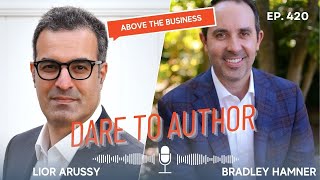
In this Above the Business podcast episode, host Bradley Hamner interviews Lior Arussy, author of Dare to Author and veteran transformation consultant. The conversation begins with Arussy’s career trajectory—from early tech startups, through senior roles at HP and NICE, to founding the consulting firm Strativity, which grew to 150 consultants and worked with brands like Mercedes‑Benz, MasterCard, and Johnson & Johnson. Arussy defines business transformation as any purposeful shift in practices, focus, or customers that interrupts the status quo. He warns entrepreneurs against the addiction to constant change, emphasizing the need to “processize” methodologies so they can be handed off and scaled beyond the founder. The discussion moves to applying a Theory‑of‑Constraints mindset: identify the single bottleneck (whether capacity, marketing, or product) and focus resources there, while also setting clear boundaries on which customers and products to serve. A major theme is the gap between documented strategy (roadmaps, plans) and actual execution. Arussy stresses the importance of anticipating employee fears, building confidence through simulated practice, and providing the right tools and authority. He challenges the traditional notion of “training,” calling it repeatable and dog‑like, and instead advocates for purpose‑driven learning experiences that start with the “why” and use storytelling to create emotional engagement. He shares concrete examples, such as converting Mercedes‑Benz dealerships from a compliance‑driven approach to an inspiration‑driven one, which tripled profitability and boosted customer satisfaction, and a simple technician‑retention hack that increased retention by giving technicians one hour a week to greet customers. Arussy explains that the two primary drivers of employee engagement are (1) understanding the impact of their work on customers and (2) having the tools and authority to get the job done – being “equipped.” He also discusses his new book Dare to Author, which reframes personal and organizational change as writing the next chapter of a story, converting past experiences into future resilience. The episode concludes with reflections on storytelling as a leadership tool, the concept of working “above the business” by inspiring personal choice and heroism, and practical ways listeners can connect with Arussy. Key takeaways include: the power of storytelling, the importance of focusing on a single constraint, the need for purpose‑driven learning over rote training, and the two engagement drivers of impact and empowerment.
Chapters
Welcome to another episode of the Above the Business podcast. My name is Bradley Hammond, your host. Today's episode, we have Lior Arusi. He's the author of Dare to Author and many other books. You're going to want to check him out. Go to liorarusi.com. You can see he is a very gifted speaker. We talk about a number of different things from strategy, coaching, and training within your team members. And you're going to see the wealth of experience he has in working not only himself in business, but also in working with businesses from all kinds of different levels over the last 20 years. I think you're going to get a lot out of this episode. There's a couple things that I specifically picked up that I think you're going to get a lot out of is what is the two main drivers of team member success, fulfillment, and engagement. We talk about that. And then number two, why he believes training is a word that we should not use in our vernacular. I'm going to get a lot more out of this episode. Actually, I don't like that last sentence. All right, without further ado, here's my conversation with Lior Arussi. Lior, welcome to the Above the Business podcast.
Thank you very much for having me on the podcast.
Excited to have you. Well, love to start with background and origin story. So why don't you take people back and tell us how you got to where you are today?
All right, so, um, started my career after MBA at Case Western Reserve in Cleveland, Ohio with two startups, technology startups, one that did very well. We went Republic, one that didn't do well at all. From there, I moved to HP, where I was the head of the internet security division, global responsibility, another technology company, NICE, which is in the call center space. And then in 2003, I started my own consulting business called Strativity, which focused on two areas, helping organizations to become customer-centric and maximize relationship with the customers. And ultimately, we quickly realized we were not really in the customer business. We were really in transformation business because a lot employees and a lot of organizations needed help not with the core strategy, but how to transform the business. And grew that business to about 150 consultants with offices in Australia, Canada, London, and New York. We did work, we had the privilege of doing work with some of the most amazing brands anywhere from MasterCard to Mercedes-Benz to Delta Airlines, some healthcare work with Johnson Johnson and Novo Nordisk and others. And over 400 transformations that we were invited to be part of for a variety of reasons, change of strategy, mergers and acquisitions, recalls. We've done some work around those areas. But basically, if I make it short, it's helping organizations write their next chapter of success. Whatever their starting point at that moment, how do we move up to the next level of performance? I wrote about 10 books. My latest book, Dare to Author, was just recently released. I'm a father of 5 and grandfather I'm a father of 5.
Great.
Thank you.
What is it? Define a transformation for me.
Transformation is a change from the way you run the business today to the place where you want it to be. It can be a change in practices. It can be a change in focus. It can be a change in customers. Anytime you are interrupting the routine of the business and trying to move the business to a different place, that's a form of transformation.
How do we balance— as I mean, everybody listens to this podcast, small business owners, entrepreneurs. You don't have to tell an entrepreneur to make a change. We chase shiny objects and squirrels all day long. That's what we love to do.
Yes.
The problem is, is we do that. I think that's one of our greatest strengths, and it becomes yet our greatest weakness because we constantly change. We constantly change. We read books. We read your book, we read Patrick Lencioni's books, we read Jim Collins' books, and we're like, oh, new idea, hedgehog concept. We're going to put in the hedgehog concept. I'm just coming up with ideas right at this point, and I just keep on and on and on and on and on. So how do we balance the need for transformation, yet at the same time, on the other side, making sure that we're not just constantly being addicted to change?
So I have to tell you, as an entrepreneur myself, okay, I, you know, I live through that all the time because we get bored very quickly. We're idea people and we get bored. The hardest thing for me, and I got that as advice from a friend, was to actually processize my methodology and actually hand it to other people to execute. We don't necessarily know how to do it well. We don't like to do it well. There's always a better way. And I have to tell you, this was my defining moment. Where a friend told me, if you're not going to teach other people to do that and you're going to trust them to do that. And when I had 150 consultants out there on the road doing this work, you freak out. Like, what if they make a mistake? Well, I can do that better. And all these type of fears that entrepreneurs and small business owners have. Guys, if you don't learn how to process it, you'll never grow. You'll never be able to build a business that way. And you'll never get to the margins that you want because you're the most expensive resource in your organization. And I had to learn to build it. And I, I tell you what I had to accept is that the 95% that my employees give are good enough for 95% of my clients. And I don't always have to be at 150% for every client all the time. And it's, it's a tough one. It's not the natural gut place of a lot of entrepreneurs, but heck, you're not gonna grow. And, you know, when I had offices in Australia, do you think I've been in Australia every, every other week? No, I can go there. I trusted a person. I handed them the methodology. I spent time doing methodology and describing it and scripting it and so on and so forth. And, you know, they did an amazing job and I would visit there once a year and it was great. So guys, not everybody has to have change all the time. And I'll tell you more than that. Your employees are gonna get tired of that. Because, you know, your employees need some kind of stability also, not just your customers. And second, you're not getting to a place of realizing where do you actually make money because you are really constantly experimenting and you're never really in monetizing.
Yeah, I totally agree. I mean, I'll put it blank like this and I've shared this, but then other people have shared with me the exact same sentiment. My, my clients have shared this with me is that their team dreads when they're going to a business conference or going to something because they're going to come back with a flood of ideas and things that they should do. They just come back and start shooting all over their team.
And I had a case when I worked with a client and they said, you know, our CEO never saw an idea he didn't like. And that's exactly, that's exactly. So I'll tell you, I actually helped a client recently with that. And we built a 10 steps or 10 dimension criteria to evaluate new ideas. And we ran all the initiatives that they're doing at that company at the time. And we found out that many of them do not qualify. They are good idea at one dimension or two dimensions. But when you look at the 10 dimension, there are better ideas out there. So the pursuit of what's next, I think part of it comes from the anxiety of the entrepreneur that they don't have the formula for success. And I'm saying the formula of success is not a new idea. The formula of success is how you process that idea. So you can, you can, you can multiply to a lot of locations.
Yeah. What are your thoughts on, um, I'm curious, I'm sure you're an avid reader. I'm sure what I'm about to share, you've read this book, um, uh, Theory of Constraints, the goal, right? And so, uh, really that takes this idea of like, you're not even, you're, you're not necessarily, you're open to new ideas, but only in the sense that you're working on, is, is that the new idea that helps us to uncouple the business from that is the constraint of the business. That right now is the thing we have to work on in the business. It's a, it's a, it's a team-related issue, it's a capacity issue, it's a marketing issue, it's a sales process issue, it's a branding issue, whatever that thing is. And then we just put all of our resources to that one thing. What are your thoughts on just that general concept?
So in general, in general, I agree with that because, and, and we, we as entrepreneurs are blind to those constraints because we we can just do everything. And we don't understand that there are strengths and weaknesses to every organization. You're not going to be everything to everyone. So, and so I would say that on the spectrum, there's the constraint that I want you to understand how to uncouple, but I also want you to define also where the boundaries are of the customers you will not work with and also put the boundaries around what products you're not going to do, at least for now. And I think that is where companies are falling into a worse situation than just not uncoupling their constraint and opening some more capacity. I think that especially entrepreneurs are pursuing every possibility and saying, I can do this and I can do this and I can do that and I can do that. Maybe you can, but what do you do best?
Yeah.
What do you do best? So for me, maybe you look at it as a new version of the theory of constraints, but I think the way we flow customers into the business is actually contaminating our ability to be profitable and to enjoy it because we just pursue sometimes business for the sake of business without really looking at, is that a good match? And I'll give I'll give you an example. When we did projects with clients, one of my first questions to clients were, what happened to the last consultant here? And if you'll see them mumbling and everything, you know that they are not a consulting-friendly organization. And therefore, I should not be another victim to their inability to accept experience and expertise from outside. And if they're saying, hey, we implemented this and we didn't implement that, okay, that's going to be a productive environment. And let me be in the productive environment and let me say no to the customers that are not good. So I'm challenging all entrepreneurs out there. It's not just the theory of constraints within your business. It's also how you flow customers into your business. And I'm afraid that sometimes we flow customers out of, you know, fear or anxiety that are not a good match for the business.
Yeah. I'm curious, in your work as a consultant, it is my fundamental belief that a lot of entrepreneurs small entrepreneurs. I personally work with business owners doing $300,000 to $3 million. I just know that space pretty well. But I think what I'm about to ask you applies for a business that size to $10 million, $25 million, and etc., is that when you are devising a strategy, ultimately I like to devise a strategy for the business and it gets documented into a roadmap, to be clear. Okay, so people call it different things— a plan, a game plan, a roadmap, whatever you want to call it. Here's, here's, here's my question. How do you help your clients to bridge the gulf between the what is documented strategy, whether you call that a roadmap or a plan, to actual executable results.
Okay. So I come with a totally different perspective on how new ideas and new strategies come in. Okay? Let me give you a real example. I have a client who's right now moving their sales methodology from relationship-based to data-driven. They wanna go to where the possibilities and opportunities are, and they want their salespeople to pursue that. And they are very excited because they did the analysis, they got all the data, and they are ready to execute that. And I said, stop, guys. I want you to think, and this is a question we can do on every strategy. Imagine that they hate your strategy and they are afraid of your strategy. Now that they're excited, you're excited. Now ask yourself why. And you're challenging experience, sometimes decades of experience of people. Salespeople are divided to data-driven, to the science of sales versus the relationship, the art. So if you're gonna take salespeople who believe in the art of sales and force them to start working with science of sales, that's an attack on their identity, on their toolkit. So I always challenge them to say, let's map right now all the obstacles we are going to face with the audience that you want to mobilize to do things differently. Let's put ourselves in the shoes of those people and ask ourselves, Why are they afraid? How are they going to fight us? What are the reasons for them not to collaborate? And then we start asking the question, how do we build a toolkit for them? And how do we simulate? This is a critical piece here. How do we simulate the situation for them before they have to go live out there with customers so they can gain the confidence? Just to give them a training doesn't mean that they gain the confidence. So we need to ultimately bridge based on understanding their fears, Building the communication accordingly, building the toolkit, and then building the confidence.
Why do you think confidence is so important?
Because we always train people and then we send them to try it alone. But you know what? Even the best actors have dry runs before they go on stage. And yet we send our employees all the time with new ideas and expect them to fail spectacularly in front of people, and they're afraid to do that. We don't give them the space to practice before we send them into the real show. Even the best Broadway show, first you do it off-Broadway before you go on Broadway. First you do it in small areas and you practice. We don't do practice in businesses. We just throw them out there and we tell them to go do it. And that's where the gulf that you're talking about is happening because we don't ask the questions, what are they afraid of? What tools do they need? How do I build confidence so they can go and perform well?
I don't think I've ever asked this question, but I'm going to ask you. How do you see the difference between training, coaching, and accountability?
I'm going to upset a lot of people right now. I think the training is for dogs. I'm sorry. Training is about repeatability. I would like first to create the desire for the why. And we do that through different, we do that through different experiences that actually put them in the place and asking them first to buy into it. Because what I found out is when people are buying into something, they'll find a way to get it done. And if they're not buying into it, no training in the world is going to help because they can listen to the training, but they're not going to do it. They're listening to the coach, but they're not going to do it because you're not starting with what is the why and how is it good for me. So that's, that's why I don't like the definition of training unless you're training me to use PowerPoint. Okay. If you want to train me to use a tool, training will do just fine because it's about repeatability. Training is about repeatability. In today's workforce, they're not looking for repeatability. They're looking for individuality. They're looking for purpose. Start with how do you create a sense of purpose? How do you make them want to buy into into it? How is it part of their life chapter? And then believe me, they'll find a way. They'll find a way. So rethink a little bit this whole notion of coaching and training in its traditional format, because we are not going to the heart of the issue, which is how do I make a person want to do it? Okay? And I'm gonna give you an example. Okay? So one of our challenges, which is publicly available in a book that was written by Joseph Micheli called Driven to Delight, we were challenged to help 350 dealerships of Mercedes-Benz around the US, 27,000 employees, okay? And every dealership runs independently. There are small businesses for that matter, entrepreneurs, sometimes second generation, and so on and so forth. And we went to it not from, these are the new rules, this is what you need to follow, this is what business, this is accountability, and we're going to start holding you accountable to those things. We came to it from, the love for the brand. Why is it— why you want to be part of it? Why do you want to be an ambassador? How do you connect to the vision of the brand? And the moment we've done that, people start outperforming what we have expected. And we had goals of becoming number 1 in customer satisfaction. We achieved that. We had goals in improving profitability. We tripled profitability within 2 years by activating people, not by training them. We inspire them. We connected them to a mission. We connected them to something bigger than that. And then they'll blow up your numbers. I remember sitting down with one of the dealer's owners and he said to me, you know, I didn't know my employees can perform that way. I said, yeah, and you probably were the obstacle for them to reach that high because you didn't give them the runway. You didn't give them the space. You didn't inspire them. So especially with Gen Z as employees, when a lot of entrepreneurs are struggling how to motivate them, inspire them first. Give them a cause. Give them a sense of purpose. Show them there is an impact. I have to tell you, an employee engagement study studies that we've done multiple times, that two drivers to mobilize employees, two drivers, not the benefits you're giving, not having a friend in the, in, in, at work, at the workplace, not number of vacation days, two drivers. I understand the impact I make on customers and I have the tools and authority to get it done. These are the two drivers that drive performance at organizations.
I understand the impact. So basically, they're able to tie the work that they do to then how it benefits the end user, the customer, the human being.
Yes. Yes. And then the second is I have the tools and authority to get the job done.
I'm basically equipped.
Yes. I'm going to give you a practical example in the automotive space. I convinced certain dealer owners to pay technicians. You know, technician works in the bay. They don't see customers, right? They see cars all day long. I convinced dealer owners to pay the technicians a 1 hour extra a week to stand outside when people come to pick up their cars and shake their hands and say thank you for the business. And you know what? That increased retention of technicians significantly. Why? Because they saw a human being. They could make that connection. It was not just a car. You understand what I'm saying?
I do.
1 hour and they increased retention of the people.
So if we don't call it training, I mean, I'm getting kind of practical here.
Sure.
But you hire a new salesperson and you have a product ecosystem of 3 products, 5 products. Yeah. Or if you work for Mercedes and Mercedes rolls out the new electric, you know, E-Class, whatever that they have, I mean, ultimately they need to learn about the new product. I mean, what do you literally call it? Teaching?
Correct. So I, you know, some people call it indoctrination. I don't know that I like that term, but I'm calling it an experience. I'm creating a learning experience for them. I want them to feel it. I think that in every learning experience, if you want it to stick, it has to be emotional. If it's not emotional, it's not gonna stick. Because as I wrote in my new book in Dare to Author, we don't live in data. We live in stories. We live in stories. So make the story inspire them. Make it emotional for them. Explain to them why is it good for them, not just what it's good for you. They'll pick up the rest. Did anybody train you on Facebook, on Instagram, on— no. We picked up the training because we understood that it was good for us. So when they understand why it's good for them, when they understand the story, they'll embrace it faster than you want it to be.
Yeah, I think this is, I think this is fascinating because I do believe I didn't know that we would go here, but I actually think that this is incredibly important what we're talking about, because truthfully, you know, my belief is business is a team sport. And so if you're going to do business, I respectfully know people who are solopreneurs. I just don't buy into that, into that idea. I think if you're wanting to do something big, you've got to do it with a, with a team, right? And, and, and, and I think team is really important because your team is made up of, now especially, and going to be increasingly, uh, this way, employees. So in the States, W-2 employees, but then also fractional contractors that are, you know, paid as independent contractors around the world. I mean, I think of all of those people as the team. My team that produces helps produce the— and edit the podcast, puts it— they're part of our team. They're, you know, contractors with that. And so whenever you are pulling people into what, you know, what you do, right, it is something that all of us as owners and entrepreneurs is that we struggle with, I think, is that we have this unique ability as the entrepreneur to have this amalgamation of different skills, and we struggle at times now Some people are easier or can do this better than others. I can think of a couple, you know, of my clients and people that I know, peers that seem to have a gift of a teacher, um, have the gift and to be able to break complex ideas down and pass that on to the team. And then I see other entrepreneurs who are so incredibly ambitious and motivated and driven, but they struggle to pass on, as you're saying, the experience and the story to the team, and the team becomes very inspired and excited to go about on the vision of where the company's going. But when it comes down to their role, they feel ill-equipped. Does this make sense? Right? It does. They feel like, yes, this is, this is what I'm joining. Now what do I do? And it's like, oh, but that's not what I wanna do. So help us, you know, the small business.
I'll share with you a small, interesting story that I captured also in Dare to Author. So I believe that storytelling is a leadership tool, and I believe that people will only follow you based on your story, not based on your facts, not based on the money you pay me, and so on and so forth. So listen to this. If you know Vegas, I was at the Aria Hotel doing a conference, and the CEO of that company, we were behind the scenes ready to go on stage and talk, and the CEO caught me, and he's a banker. Said to me, I want you to coach me on how to present because, you know, people listen to you and people don't listen to me. And, you know, I'm dry and I'm not interesting and so on and so forth. And I said, really? You want coaching from me? He said, absolutely. I said, I'm gonna coach you right now if you're willing to test something with me. And he said, what is it? I said, why do you love this company? Tell me, why do you love this company? Why do you wake up in the morning and be willing to subject yourself to all the difficulties? And he told me the story. And I said, here's what we're gonna do. I want you to abandon right now your slides. I want you to go out there on stage and I want you to tell them that story. And he said, what? Why would they care? I said, just, just watch, just watch. And you could hear a pin drop when he told the story. It was emotional. His pitch went up. It was connecting. He, and then after that, whatever he asked them to do, they'll do it. They'll do it. They loved it. He came back. He was energized. And I think we are underestimating the power of our emotional journey, our emotional story. Be a bit vulnerable. Share with them some of your failures. Entrepreneurs have some failures. Heck, my first year, I failed so miserably, you could not even scrap me from the floor. And I share that with my employees. And you know what? People don't want invincible leaders. They want vulnerable leaders. They will follow vulnerable leaders because they look like them, because they are connecting with them. If you're gonna portray the invincible, I know it all guy, then you don't need me. When you're vulnerable, you need me. People want to be needed. They don't want to be just told what to do, and they don't want a know-it-all guy. And we sometimes, as entrepreneurs, mirroring our first manager from 20 years who was a know-it-all guy who did not know how to engage employees, and we're just mirroring that style. But that style doesn't work anymore. We don't work with Windows 95, and we should not be working with our managers from '95.
That's good. That's a good, that's a good line. Tell me about your book, Dare to Author. How did that come out of you? Obviously, You've authored many other books, which maybe you can certainly share with our listening audience. But how did this book come about?
So it was an interesting confluence of a couple of things, but I'll bring one example. I was stopping the milk Manhattan by a guy who hugged me and said, Lior Orusi, you inspired me so much. I heard your speech. And I said, thank you. And he said, you inspired me to get divorced. And I'm like, what? I'm not speaking about relationship. I speak about customer strategies. How did you pick up divorce from what I said? And he, I, he actually told me which presentation he listened to, which was definitely about customer retention and not about divorce. And then it hit me, people hear what they wanna hear. People hear with their own lenses. And I started to look at this whole notion. I say one thing and they hear different thing. There's a gap because they live in their story and I need to connect my story to their story if I wanna mobilize people to, and I wanna activate people. And then when I started to unpack that and saw how my clients are struggling with change, what is the real struggle with change? The real struggle with change is not that I'm afraid of the future. What we found out is that the real struggle with change is that people are afraid to close the previous chapter of their life in order to open a new one. And when people came to me during COVID and said, this is unprecedented, I don't know what to do. And I said, you've dealt with unprecedented issues before. Let's go to 2009. Remember that? Horrible financial crisis. How did you survive it? And we went through a process of writing the success. And what I, what I'm arguing in the book is your ability to face the future is dependent on your ability to convert past life experiences into future resilience and toolkit. This is what the book is all about. It's not about journaling your life or writing a new book. It's about learning the discipline of converting life experiences into future energy, future tools, and future resilience. So when up opportunities will come in, when change will come in, you look at them as opportunities, not as threats, and you're not gonna fight them, but you're gonna embrace them in order to progress your business.
Yeah, that's so true. Lou, when I look back at the times that I've learned the most business and in my personal life, reflectively, they've all come from probably some of my biggest failures. Disappointments, struggles, frustrations. I certainly share some of those. I was on a podcast myself the other day and somebody asked me a question about kind of where did my methodology originate from, and I said pain. Hey, it originated originally from pain. I was frustrated and, and wanted to make a change. I love that. Lior, you are a wealth of knowledge. Obviously you've been able to write so many different books. You're an incredibly gifted Speaker, how do you help people and where can people connect with you?
So people can connect with me on leorussi.com. This is my website, wealth of articles and so on and so forth. LinkedIn is where I'm most active, although you'll see me on Instagram and other channels, but LinkedIn is where I publish my latest and greatest thinking, both on customer strategies, employee engagement, and all these type of things. And how do I help people? It can be speeches, it can be workshops, it can be some small consulting engagements. We can, uh, we can look at what chapter you want to write and what gets you stuck there and, uh, help you, uh, rethink that.
Okay. What is working above the business mean to you? Our name of our podcast is Above the Business. We love the book from Gerber of E-Myth, work on it, not in it. I agree. I just think that there's a third dimension, which is to be able to get above the business.
Just when you hear that, what do you feel like working above the business means So every organization and every employee has two forms of performance, the one that they have to do and the one that they inspire to do. This is a perfect— this is a personal choice. You cannot force someone to care. You cannot force someone to smile. You cannot force someone to be creative. That is a personal choice. When people make the choice not to be a victim, but to be the hero of their life story, That is where exceptional performance comes in. That's for me above the line.
I love that. Lior, thanks so much for coming on the podcast.
Thank you very much for having me on the podcast.
All right, everyone, so a couple really key takeaways that I picked up. First of all, story is a leadership tool. Circle that one. I loved the part— I think probably one of the biggest things that I take away from this one is the part where he said that two of the biggest drivers And I think it was around— he, I think he specifically said team engagement or team success had to do with, do they understand and can they connect the impact, or I would maybe say the difference that they make on a day-to-day basis? And also, do they have the tools and the authority? I summarize that using the word equipped. Are they equipped in their business or are they equipped in their job, I should say, to be able to go about making that difference? Really made me think a lot more about the aspect of teaching. Now, he said, I don't love the word training. I don't think I'm going to remove the word training specifically from my vernacular because I think most people understand that. I personally look at training as the initial teaching to get someone— he did use this word— indoctrinated into the idea. And where I think that becomes valuable is when you were doing some initial teaching of how to do the product, how to run your sales process, how to handle a customer complaint or an issue, and then it moves into coaching, which is a different thing, and then you're able to hold them accountable So I look at training as, you know, getting someone up to speed, so to speak. And so I, I can understand how he sees it more as a learning experience, and I actually think I do agree with that. So those are some of my key takeaways. So check him out, connect with him on LinkedIn, go to his website, leorarussi.com. All right, team, I'm going to do our podcast sponsors one by one with us. Shout out to our podcast sponsors, Autopilot Recruiting. If you want help in building a team, so many of my clients use Autopilot Recruiting. And even just yesterday, whenever I was recording this podcast, I was on the phone with one of our clients in our boardroom and talking to him. He was struggling. He's been going through a process of bringing someone else on as an account manager for his team, and he doesn't use Autopilot Recruiting. As we were having a conversation about how other recruiters typically charge 20% of their first year salary to recruit somebody, if you compare that to what you pay with Autopilot Recruiting, not even close. Go to autopilotrecruiting.com and they can help you. In addition to my own personal and professional development, the development of your team, as we were just talking with Lior about creating a learning experience, well, one of those things is helping to put your team around other their, their other peers, not just within your organization, but whenever they see that you are investing in them, they are going to be so much more indebted to you. So when you work with Coach P, he can do that, plus helps put you in an environment of other small business owners, specifically insurance agency owners trying to do the exact same thing. Go to coachpconsulting.com and let him know you heard about him on the Above the Business podcast. I love Tech, and I love tech that helps us to be able to get more done in the business, either get more customers or keep the ones that we got. TodayApp Pro can help you do just that. If you want a tool that's going to help your sales team be able to have customized scripts, put your bonus and compensation plans in all in one place, go to todayapppro.com. The experience is second to none, both for you and for your team. Go to todayapppro.com. Look in my core program blueprint. We just recently, at the time of this recording, we're in the middle of going over the Cash Playbook. And, you know, people come at financials from— and just like with any other thing as part of the business— from different levels. We have some people in my program that, you know, they, they, they don't— they've gotten to a pretty good place, that their level and the depth of knowledge of how to understand financials in the business is like where mine was 10 years ago, which was not very good. And that's okay. And then on the other end, we actually have someone who used to be literally an accountant who has obviously an extreme level, but far more than I do. Regardless of where you are in that spectrum, if you're an insurance agency owner, go to club.capital. They can help you to get control and on top of your financials and use that information to not make emotional decisions but make data-driven decisions that can accelerate the growth and the profitability in your personal income into the business even greater. Go to club.capital.










