Episode 436: Unlocking Leadership -The Hidden Psychology Behind Great Leaders w Dr. Elias Aboujaoude
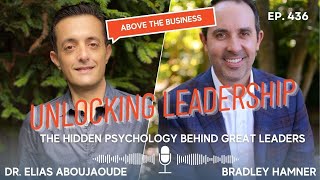
In this Above the Business podcast episode, host Bradley Hamner interviews Dr. Elias Aboujaoude, a psychiatrist, researcher, and author of A Leader's Destiny: Why Psychology, Personality, and Character Make All the Difference. The conversation explores why traditional leadership development—coaching, MBA programs, and “leadership boot camps”—often misses the core of effective leadership. Dr. Aboujaoude argues that emotional intelligence (EQ) accounts for roughly 90% of a leader’s impact, far outweighing technical skills or IQ. He defines a leader as someone who helps others rise, and warns that current leadership culture tends to select for antisocial or narcissistic traits. The dialogue delves into the importance of aligning leadership with one’s psychology, values, and character, emphasizing that there is no single “right” leadership style. Practical advice is offered for small‑business owners: self‑reflection, checking alignment with personal values, seeking honest feedback from followers, and recognizing blind spots. Dr. Aboujaoude critiques the limits of executive coaching, suggesting psychotherapy—despite its stigma—as a more effective route to deep self‑knowledge. The episode also touches on misconceptions about Stanford University, and concludes with a discussion of what it means to “work above the business,” i.e., maintaining strategic distance to assess fulfillment and purpose. Throughout, the hosts promote resources such as Dr. Aboujaoude’s website and book, as well as sponsor tools for recruiting and financial management.
Chapters
Welcome to another episode of the Above the Business podcast. My name is Bradley Hamner, your host. On today's episode, we have Dr. Elias Adeboyeje. He is the author of a fantastic book called The Leader's Destiny. And in this podcast, we're going to cover a number of different topics. I mean, the genesis of this podcast was really around leadership, so anytime I can bring someone else on for us to be able to take a look at business and leadership from a different lens. That's what I hope to do. He's the author of the book A Leader's Destiny: Why Psychology, Personality, and Character Make All the Difference. Look, I'm one that loves to think about leadership and business from the perspective of strategy and tactics and the hard skills of business, but the reality is you'll hear him say 90% oftentimes comes from the EQ side of business. 90% of success as a leader is around the emotional intelligence, not necessarily the hard skills. That was a big— one of my big takeaways from this episode. Without further ado, here's my conversation about A Leader's Destiny with Elias Adeboyeje. Well, I enjoyed having, uh, Dr. Elias Adeboyeje on the podcast. One of my biggest takeaways was Just a reminder that there's not really a single way to be a good leader. I mean, there's more of a reminder, but it is so true. I think we can look to other people, even figures in history, for inspiration and motivation, but ultimately it's really about becoming uniquely yourself, being true to yourself, and helping yourself to become a better leader. There are some people that are so disciplined and structured and organized And then there are other people that have the gifts of being able to think on their feet, etc. And while we can admire some of these traits, ultimately I think developing your own values, your own personality, and developing what is really the— your character of what matters to you is important. I also thought the comment around 90% of success— I shared this in the intro is really founded around emotional intelligence. I don't know if I had ever— I should have asked him where that statistic came from, what study that was from, because I find that to be fascinating. Because I love to think about strategy. I mean, right after this call, I'm getting on a call with somebody with my team, and we're going to be talking about specifically in the context of a marketing strategy. And I like to move the pieces on the chessboard or think about the moves that we're going to make in a marketing and sales fashion, yet it's the emotional intelligence that makes up 90% of the success. Wow, that is, that is something. Go check out his book, find it on Amazon. Go check out his, um, his website. We'll link that down in the show notes. As always, want to give a big shout out to our podcast sponsors. If you want to be a better leader, it means you're leading other people. You want to be able to have a team of A-players on your squad, you got to go through the recruiting. You got to build a recruiting system And one of the more difficult parts of building a recruiting system really has to come with the, the whole top of the funnel part for your prospects that are, that are going to work with you. But if you work with Autopilot Recruiting, they can help you with that. Go to autopilotrecruiting.com. Autopilotrecruiting.com. Obviously we talked about development, and one of the best leaders that I know is David Peterson. Go to coachpconsulting.com. You can work with David, work with his team, get an idea of an understanding of exactly how they do things at David's office. If you're an insurance agency owner, he can be able to help you to be able to understand exactly what they're doing on a day-to-day basis. CoachPConsulting.com. Just earlier this year, we made some decisions to cut out some of the tech that we were using in our businesses. We had kind of gotten a little bloated in some of the tech. But if you are an insurance agency, under one of the pieces of tech I promise you they're not going to let go of is TodayApp. Go to todayapppro.com, can work with them to be able to have something that's going to work seamlessly with your corporate approved CRM. It's going to be able to have all your word tracks, your bonus compensation plans, all in one easy-to-use place. TodayApp Pro. Elias, welcome to the Above the Business podcast.
Thank you very much for having me. Pleasure to be here.
Excited to have you. Well, we'd love to start with background and origin story, gives people a little bit of a taste of your journey, how you got to where you are. And obviously, we'll dive into your book in just a little bit. So give us the background of you.
Yeah, I'm a psychiatrist, researcher, and writer. As part of my clinical work as a psychiatrist, I work with patients for whom I recommend therapy. And often when I do that, the answer increasingly is, well, but I'm seeing a coach. So that got me interested in coaching. And at the same time, I noticed an increase in emails asking me to partake in leadership training. So that got me interested in the concept of executive coaching and, and, and the limits of how much coaching can, can do. So both from a therapy standpoint but also from a leadership standpoint, questions were kind of popping up for me in, in, in, in my work about what it takes to become a leader and, and, and to what extent coaching can or cannot accomplish that.
Awesome. Well, we talk about leadership and coaching and personal development a lot. This podcast. In your definition, what is a leader?
In my definition, a leader is someone who is there to help others rise, help others fulfill their greatest potential. Unfortunately, as we, uh, look around us, whether in, uh, corporate life, politics, even academia, increasingly a leader is someone who seems to be be defined by characteristics and traits that in our profession and the mental health field seem more aligned with what we call antisocial personality or even narcissistic personality. And I think we've set up leadership culture in a way that almost selects for these unhealthy traits. And that's another reason why I wrote my book, to try to help people identify these, these, these, these traits and select against them, if that makes sense.
Yeah, it does for me personally. But also, I know for our listening audience, as I shared with you before we hit— we're hit— started recording, that, you know, the people that listen to this podcast, listen to business podcasts in general, I mean, you could say that they want growth, they want growth in their business, and they want to be a better leader. And I had someone ask me sometime last year, uh, it was actually at the end of the year now that I think about it, and they were beginning to put together their objectives for 2025. And we started out, the first 3 were pretty standard around some marketing, some sales numbers, some revenue growth numbers, some profitability improvements. Standard things that, by the way, probably need to be objectives. And then he said, I'm gonna be honest with you, man, I don't know how to say this last one, but I just want to be a better leader. And I don't know what that looks like. I don't know where to start with that. I just know I need to and I want to be a better leader. If you were talking to that person, what would you say?
Yeah, I would, I would take a step back and start even earlier in their sort of rise to becoming leaders. And I would make sure that leadership is aligned with their psychology and leadership is something they are truly interested in and motivated to do for the right reasons. Increasingly in leadership training culture, the leadership industrial complex, as, as I call it today, we're getting the message that, that everyone and anyone can become a leader. You just need to sign on the right executive coach or pay for the right leadership training boot camp. And this ends up sending the message to people that you too are very reasonable raw material for leadership. And that's just not true. But what we end up seeing is that folks with the wrong sort of psychological makeup and, and, and, and, and, and who are missing essential personality traits end up rising to these leadership positions only to be sorely disappointed themselves because leadership doesn't align with their psychology and only for their followers to have to pay the price for, for this misalignment. So I would start earlier on and I would encourage folks who really have what it takes, have the emotional intelligence, have the right desire in terms of wanting to lift others and encouraging those to pursue leadership positions rather than what's going on today.
I'm just going to continue to use this example because I think it's representative of an avatar personality that may be listening to the podcast. Okay, this is a small business owner. Was very successful personally when they worked for someone else, they have then gotten plopped into a position of being a business owner, having a team under them, and they recognized nobody's ever taught me this. I don't know how to lead well. I want to. I signed off on this podcast, by the way, and I say lead well. That's actually my sign-off for the podcast. But, but he said, I don't know exactly what that looks like to do well. And I, and I can relate to the sense that That was kind of my story. I didn't— nobody taught me how to be a good leader. I mean, maybe I saw some examples of what not to do potentially, right, from my own experiences in work before I jumped in. And the reality is, is I got it really wrong a lot of times before I was like, okay, I got to, I got to make a change here. And so for somebody listening to this that is a small business owner, entrepreneur, and recognizes that business is a team sport. See, that's another thing, uh, pretty much everybody listens to this podcast, they're not a solopreneur, okay? Nothing wrong with that, but we believe business is a team sport. So you're going to have— you've got to elicit the support of a team, whether they're contractors or W-2s. So for that person, what are the things that, you know, they can do, tangible things that they can do? Certainly pick up your book for sure, but what are some of the things that they have a recognition, they look in the mirror, they want to improve? Where they start?
Yeah, I think one, one thing to be aware of is that there isn't a single way to be a good leader. If you look at the leadership styles that have been described in the literature and that have been researched, you'll, you'll, you'll read about the North leader, the South leader, the East leader, the West leader, any number of, of, of leadership styles that, that, that, that seem to work. So there isn't a single profile that necessarily fits and matches everyone's personality. I would say ask yourself if leadership, the way you're practicing it, the way it's playing out in your small business, is it aligning with your values? Do you feel fulfilled? Do you feel like your standards are being upheld, or are you having to compromise those values and standards to be successful. I would also say check in with your followers. How are they doing? Are they satisfied with your style? Do they feel lifted by it? So I think going back to almost this sort of introverted kind of reflection about what leadership means to you and how it aligns or not with who you are and, and with your values. This is the first step toward figuring out, you know, whether you're doing it right or not. And, and keeping in mind again that there isn't a single way for doing it right and for being successful either at practicing it or at emerging in the first place as a leader.
I think you bring up an excellent point. That's actually going to be one of my key takeaways, is that part of the mistakes that I made in being a leader in the past— now I'm not saying I get it right now, I'm not, I'm not, uh, trying to project that, but certainly I think I have improved and grown over the years through the mistakes I made. But one of the biggest mistakes is I kept trying to be somebody else.
Yeah, yeah.
I'd look at somebody else and I would say, ah, Elias, man, what a great leader. Yeah, I want to be like that person. And so I would, instead of using it as inspiration, I would almost try to emulate, but it's like, that's not my personality, that's not who I am. And, and instead, I want to become a better version of myself. I want to be a better leader of myself, but yet uniquely Bradley. Walt.
And thank you for bringing— for sharing this, Bradley. Absolutely. I think, you know, the subtitle of my book is Why Psychology, Personality, and Character Make All the Difference. And psychology, personality, and character are very unique properties of the individual. They're not things that we can easily manipulate or change, even though a lot of leadership workshops seem to be sending this message. But they're highly stubborn, if you will, you know. And psychoanalysis used to take years or decades to, to, to, to, to, to cause somebody's personality to be meaningfully transformed. So these are traits and properties and characteristics that are highly individualized, and we have to be true to them. And we have to practice leadership in a way that is aligned with them, not try to transform them so that we resemble Leader X or Leader Y that we happen to have been impressed by or that happens to have been taught to us in a leadership boot camp.
Hmm. That's so true. When you think about psychology and leadership, what do you— what do you— what do you talk to me about a little bit more about what you mean with that and the importance of it?
Yeah, absolutely. So if you look at something like EQ, emotional intelligence, so these are, these are traits such as self-awareness, social awareness, Being able to, to have empathy, being able to take the psychological temperature of yourself, but also of the room you're in. All these have been grouped under this concept of emotional intelligence, and emotional intelligence accounts for about 90% of what distinguishes a leader from someone else with otherwise identical skills and an identical IQ. So hugely important in how leaders emerge and in whether or not they succeed. Our approach, though, to emotional intelligence, if you look at a lot of what the leadership industrial complex has to offer, our approach is to almost convince people that we can teach you these things, you know, at the right price and in the right course and the right MBA program, you can be taught how to be empathic, how to have this awareness. And as a psychiatrist, these claims really ring false to me because, again, psychology, including this all-important concept of emotional intelligence, is not something that can be be easily manipulated or, or easily transformed, certainly by executive coaches who typically don't have any serious background in psychology or mental health. So psychology is hugely important in leadership culture, but the way we are approaching leadership culture and the way this industry is, is, is, is marketing itself really ignores psychology and ignores facts from the field of psychology that we cannot afford to ignore. And the end result of dismissing psychology and saying that anyone can become a leader and anyone should try to become a leader, the end result of this is what we're seeing today, which is so much product, so to speak, so many leaders being kind taking these courses and being told that you, you too can become a leader. And this kind of fierce competition which ends up selecting for those who are meaner, those who have this antisocial or narcissistic tendency, thereby enriching leadership culture, if that's the right word, with these unsavory uh, characteristics and unsavory, uh, types.
I mean, I think we all know where character— like, when you say character, personal character foundations— but I also don't want to assume. So when you're talking about personal character foundations in the context of leadership, what do you mean by that?
So character to me is about values, about a moral compass, about standards for what is right, what is wrong, absolutely fundamental to a leader and fundamental to that leader's followers. And we don't really pause to reflect on how fundamental character is to leadership. And just like we pretend to be able to teach psychology, we are also pretending to be able to teach character.
Hmm.
Hmm.
You know, I think it sounds good to say everybody can be a business owner. Not everybody can. Yeah, not everybody's cut out to be a leader too, right? I mean, to, to your point, um, I think about, to my— in my— for myself, but more so for everybody else listening to this, that if you are in a leadership position and you would consider yourself to be a good leader Maybe people around you have shared that you're a good leader, that they're grateful for the opportunity to work with you, that you've been shared these positive things. If you come from a place of humility, you want to do more. You do really want to, want to get better. And part of that is blind spots. But that's the problem with blind spots— they're blind spots. You don't recognize that you're coming across a certain way. I can remember when someone shared with me that, you know, wow, you're really upset. And in my mind, I was like, I was like a 3 on a scale of 1 to 10. And I thought to myself, Wow, if, if that was— I really coming across that way? Because in my mind I was at a 3, they received it as an 8 or a 9. And so I had to take some reflection. My point is, how do we begin to kind of look at ourselves from a place of humility but recognize sometimes it's hard to read the label from inside the jar? It's hard to see your swing if you're a golfer. You can't see your own swing. There's, there's difficulties with that. Yet I can tell you I want to level up in my leadership. So how do we, how do we work through some of those difficulties?
Yeah, yeah, absolutely. Uh, you know, it's, it's, um, it's crucial for a leader to, uh, be aware of, of, of, of blind spots. And to me, as a psychiatrist, my best recommendation in terms of how to take this sort of journey of self-knowledge is psychotherapy, right? Like therapy to better understand yourself, better understand what motivates you, better understand, uh, your, your, your, your triggers, your areas of strength, but also your areas of vulnerability, uh, our culture, we often— and in business culture especially— we often associate therapy with mental health needs, mental health disorders. It tends to be very stigmatized, but it really is, I think, a wonderful opportunity for many people to identify and address these blind spots as part of a kind of a longer journey of self- self-knowledge and self-exploration. The way leadership culture approaches self-knowledge and approaches this journey today is through, you know, coaching. But coaching is performed by individuals who by and large don't have this background in psychology and can't necessarily help you along this way. They can help with things like, you know, performance metrics or, you know, sales skills, or maybe even you know, body posture and, and, and nonverbal cues, things like that can be very amenable to coaching, but not the kind of bigger self-awareness question that, that, that, that you're asking. For that, I think therapy can be a wonderful, uh, um, uh, uh, tool. And there's no need for us as a culture and for the business culture specifically to stigmatize this, uh, this, this, this, this journey and this really helpful tool.
Well, I have to tell you, I would have been that person, um, 10 years ago, right? I mean, if you'd have told me, you know, to go to, to any form of therapy, I've been like, what are you talking about? I ain't doing that. I don't need that. I don't need that crap, you know? And now I feel so totally different about it. I really do. Like, it is— it has been— it, it actually has helped me in so many ways, navigating relationships personally, professionally. But I never would have expected that the journey inside of self would have been so impactful in, uh, so many other different ways. To, to your point of being able to like really truly understand what, what, what, what are the things that shape me, my responses to others, etc. And I guess overall it's given me a lot more empathy for people. Um, you're in San Francisco, obviously fires, um, you know, that happened in, in Palisades in California and I heard someone say their house burned and their business partner house burned. Not somebody I know personally, okay? Um, and they were leaving after, you know, being— I mean, they were able to kind of see where their house had burned, took some pictures, and they were going home to see a friend and— or, or stay at a friend's house. Who was outside the city. And as they were driving by, they said they were 15, 20 minutes away, they looked inside and it was a gym. It was lit up on the inside and people were in there working out. And he just said he didn't respond in a way of like, you know, must be nice or nothing like that, but he just thought, wow, I'm driving away from my house that just is completely burned and other people's lives are moving on. How many times has that been the case for me, where somebody else— you don't know what they're going through. And in the context of just because of this podcast is so much around business and leadership, etc., that I think often that we don't necessarily even pay attention and know all the things that are going on in the lives of our team, let alone the person you're standing next to at Starbucks. I mean, sure, it's nice to have that connection, and I think that sounds idealistic, but I think it's more those type of things have helped me to have more empathy for what people on the team are going through. Thoughts?
I love this example, and I love how you brought it back to, uh, small business dynamics. You're absolutely right. And I think whether it's therapy or another exercise that, that, that, that forces forces you to experience how you're coming across to other people, what may be going on in other people's lives, including followers or teammates or whatever. I think that's, that, that, that's absolutely essential. And, you know, therapy is a great tool for that, but, but there could be other, other ways to do it, but, but absolutely essential to being successful as, as, as, as a leader and being liked and appreciated as one too.
All right, I have a question that's not— I gotta ask this, uh, because I think I've only had one other person that either has worked, uh, or had, had an associate association with Stanford before, and I can't recall who it was on the podcast. What is probably the biggest misunderstood thing about Stanford University and as a whole? What are— what, what is one thing? Because obviously it's so well-renowned, uh, in so many academia studies, but what is one thing that, um, you being there for so long and working there is, uh, the biggest misnomer?
Can you think about that? I'll pause the podcast for a second.
Sure, sure.
That's, that's, that's, that's very interesting. The one thing about Stanford that's misunderstood. Yeah. Good question, Bradley. I would say Stanford is often seen as this idyllic place where, you know, we're amazing at finding solutions for problems and creating and inventing new things and being in Silicon Valley and all. And I would say many of these things are true, but day to day, I'm more struck by how in many ways Stanford is very similar to other places as well. And the problems that we encountered, we encounter working at Stanford or living around Stanford are very relatable, I would say, to my friends who are academics, you know, everywhere else. So this notion that, you know, Stanford is this, you know, miraculous, you know, university that stand out for not having any challenges at all, I is not entirely supported by my experience working here and living here. Having said that, I consider myself fortunate to be a member of the Stanford family, and if I weren't happy working here and living here, I would have left a long time ago.
Yeah, I love that. Yeah, I was, uh, people listen to podcast know I'm from the South, from Alabama, grew up here. Obviously I've been able to, fortunate to, to travel across the United States, across the world. I was in New York, uh, New York City, Long Island, and back in October, uh, twice as a matter of fact. And I came back and this is a month, month before the election, right? So I mean, this was— there's a lot going on. And my point is, as I got there and I thought, God, you know what, every time I go somewhere that is different from what you would maybe experience from the South, uh, conservative, liberal— and I don't talk about politics really on the podcast at all— I was like, we're— there's so many more similarities than there are differences. There really is. I mean, I went to Auburn University.
My guess is nearly enough on that, brother. We don't focus nearly enough on that. And You know, in my other life and other research I've done, other books I've written, I talked about how the internet has really— and social media have really added to the divisiveness and siloed us so much. When you kind of take a break from online life and experience being in New York or visiting New York from, from Alabama, you're often struck by similarities, not, not, not differences. And that's, I would say, experience visiting and speaking at other universities and colleges very, very far from, from, from Stanford.
Awesome. Well, it's been great having you to come on the podcast. Thank you so much for helping us to improve as leaders through our psychology, our personality, and our and our character. People want to connect with you personally, they want to find out about the book. Where can, uh, where can they do that?
Uh, thank you for inviting me, Bradley. Enjoyed this very much. Uh, they can find me at my website, uh, which is www.myfirstnameelias.com, uh, or they can find my book anywhere, A Leader's Destiny: Why Psychology personality and character make all the difference. Thank you very much.
Yeah, you're very welcome. Thank you for coming on. We'll be sure to put that, uh, put the link on for your website and for the book in our show notes. Last question for you before you go: what do you believe working above the business means to you? What do you think being above the business means?
To me, above means the— in this context means the ability to distance yourself a little bit from the day-to-day, you know, stressors and details that occupy so much of our lives. And ask ourselves about the meaning of it all and how fulfilled or not we are working in a particular business or running a particular business. To me, when I hear above the business, that's the first thing it conjures up, doing the work that needs to be done, but at the same time being able to remove yourself from it enough to ask yourself these bigger questions. Am I fulfilled? Am I doing the right thing? How satisfied am I with, uh, the direction that my work and my life are, are taking? That's, that's what it brings up for me.
Awesome. Thank you so much for coming on the podcast. It was great having you on. Appreciate you. Hopefully have you back on in the future whenever you produce another Enjoyed it.
Thank you so much.
I think business is the ultimate personal development and even professional development. And so if you can find yourself to not be good at numbers, specifically around the financials, Club Capital can help you. Go to club.capital. They can help you get a, get a handle, get control of your numbers from a financial perspective. Once you start to understand that get those on a regular basis, you make better decisions, make better decisions in your business. Go to club.capital. And lastly, if you love some of the work that we do, check out my website. Go to blueprintos.com/assets. I've got a number of different resources. You can come to one of my web classes, pick up my Scale Starter Kit completely for free. It's loaded with a lot of different tools that you're going to be able to use in your business, go to blueprintos.com/assets. Subscribe to my weekly newsletter called Thinking Tom. Those come out every single Friday. That's all in one place, blueprintos.com/assets. Art of One, thanks so much for your time and your attention. Go out, go be great, and lead well.










