Episode 446: 3 Simple Strategies to Engage Employees with Wes Adams & Tamara Myles
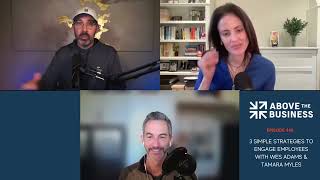
In this Above the Business podcast episode, host Bradley Hamner interviews Wes Adams and Tamara Myles, co‑authors of the forthcoming book Meaningful Work: How to Ignite Passion and Performance in Every Employee. The conversation explores why meaningful work matters for small‑business owners, introduces the authors’ “3 C’s” framework (Community, Contribution, Challenge) as the upstream driver of employee engagement, and explains how onboarding practices—cultural mastery and authentic relationship building—shape that meaning. They share research‑backed, low‑cost actions leaders can implement immediately: (1) ask employees about their lives outside work to build community, (2) give specific, sincere weekly thank‑yous to boost contribution, and (3) hold development conversations that pair high expectations with high support to provide challenge. The hosts discuss the business case—meaningful work reduces turnover, burnout, and disengagement while increasing productivity, innovation, and profitability—while also addressing cultural fit (family vs. team) and the need to tailor values to each organization. The episode closes with promotion of the book, a website (makeworkmeaningful.com) offering free tools and an upcoming assessment, and ways to connect on LinkedIn and Instagram.
Chapters
Welcome to another episode of the Above the Business podcast. My name is Bradley Hamner, your host. On today's episode, we have Wes Adams and Tamara Miles. They just are about to release a brand new book called Meaningful Work. Look, as a small business owner, you want your team to be productive. You want them to be a high performance culture, and you also want them to have the passion of the work that they do. You want them to feel engaged. You, I mean, as a small business owner, every single person that you bring on the team, it matters. It matters a tremendous amount. Look, it matters in big business, but it definitely matters for your small business. And I think you're going to get a ton out of this conversation. I picked up a couple of things. In fact, there's one simple thing you can do once a week that takes less than 30 seconds that can cut disengagement by half. And we talk about that on this podcast and so much more. Without further ado, here's my conversation about meaningful work with Wes and Tamara. Welcome to the Above the Business podcast.
Thank you so much for having us. I'm excited to be here.
Excited to have you. Well, we love to start with background and origin story. Wes, I'll throw it to you. Why don't you give a little bit of kind of your background origin story, how this came to be, how you got to where you are, and then we'll kind of go from there.
Yeah, so, um, you know, I've spent most of my career launching and growing businesses and projects, and originally that was in hospitality, restaurants, nightclubs, event space in different parts of the country. And then I moved more into social enterprise and mission-driven organizations in the second half of my career. And the part of that that always really got me energized was working with people, helping put together great teams, figuring out how to help people reach their full potential. And I also found that, you know, especially when I got to the mission-driven sector, having a purpose wasn't enough to make work meaningful or to make work a great place to show up and that I was excited about. And so I was really interested in understanding, well, what does it really take to make a great workplace? How can we deconstruct this? What are the elements that we need to make that happen. And that sort of took me to grad school where I studied positive psychology and met Tamara. And we have ended up doing, you know, research for a number of years now on this idea of meaningful work, which is the upstream factor. It's the thing that drives not only our own individual satisfaction, you know, with work and our own well-being, but also performance, innovation, and revenue and profitability at the organizational level.
Mm-hmm. Right. Tamara, your background.
So I have spent— before graduate school, I spent the previous 15 years consulting with organizations on, um, how to create systems that, that foster peak performance and productivity, right? I had written my first book, um, on a productivity model that I had developed based on Maslow's hierarchy of needs, and I was working with hundreds of leaders and organizations and helping them spend time, spend their time on what truly mattered. And what I started noticing is that people who had systems in place and, you know, priorities, all the time management techniques and all of that, had more time to spend on meaningful work. But what was really interesting is that when people were spending their time on meaningful work, they were much more energized and productive. And so their performance also increased. And so I was noticing that virtuous cycle in place. And I was really curious about how can we unlock this at scale and what is the science behind this cycle. And so I decided to go back to school to study the science and figure out how we can unlock this at scale, what systems and frameworks can we create to help leaders. And Wes and I met on the very first day of graduate school. We ended up walking back from, from class together. We fell in lockstep with each other, walk, walking back to the same hotel. And we discovered that we were both there to study meaningful work. And so we partnered up and we've been doing this now for many years.
How do you feel like, give me your definition of what you believe meaningful work is in the context of a small business. Give me, how would you define meaningful work?
We think about work, meaningful work, as a combination of what we call the 3 Cs, or the 3 sources of meaning: community, contribution, and challenge. Community is this idea of, or this belief that you belong in your organization, that you can show up authentically, you can bring your full self and all of your ideas to the table. Contribution is understanding how your work has a positive impact. Are you making a difference in, you know, for customers, for clients. But it can also be, are you positively impacting your team? Are you contributing to, you know, someone else's work or the larger goals of the organization? And finally, challenge is really about that individual opportunity to learn and grow. So am I expanding my capabilities? Am I, you know, learning something new in this job? And so meaning comes from the combination of all three of those things. We need all of them to some degree for work to be meaningful.
Do you believe that from an employer perspective that is deciding to grow and expand, let's say that, well, there's one person that's in my community that's actually going to be hiring four new sales reps over the next 90 to 120 days or so. He's really expanding his, his sales team. Is this, are the 3 C's something that he should be considering either explicitly saying, uh, about the new opportunity or maybe not explicitly saying, but making sure that he's thinking about it from that perspective of how will the community, this person contribute to the overall vision and direction of what we're doing, and then how will we make sure that they are challenged in the role.
Absolutely. One of the most surprising findings from our study was that how you begin a relationship with a new employee really shapes how meaningful their work becomes. And, you know, that shapes their ability to contribute significantly over time. And so when you are looking for people to join your team, it really matters that those people care about the same things you care about, that they're aligned with your values, with your vision for the organization. So, it's really important to discuss that, um, in an interview process as, as much as you discuss their skills and their past achievements and their capabilities. The companies that we studied and the ones we work with also, um, emphasize just as strongly, uh, a person's values and what they care about and how did those values show up in, in the past, right? But But also then when they decide that that person is the right candidate and then they hire them, the way they begin that relationship, the way they onboard them really, really shapes again that meaning. And there are two main practices that can make the onboarding really meaningful. And the first one is what we call cultural mastery. So it's about socializing people to the culture of your organization. How do we do things around here? Do people show up to work meetings on time, a little late? Do we spend the first few minutes chit-chatting? Do we all turn our cameras on or not? You know, these things that people worry about that they don't know, like letting them know how we do things around here. How do these values show up? You know, Zappos, one of their values is to deliver wow. That can be kind of abstract. So tell me a story about a time when somebody delivered wow and what that meant. Um, and then the second practice is off authentic relationship building. So really finding out who people are, what they care about, and then connecting them to others in the organizations that can help them kind of get their job done, can help them have a friend to go to lunch with. And so cultural mastery, authentic relationship building, really important in the onboarding process.
Now, I've heard the— I believe it's the Netflix CEO. I could be wrong, but we're going to go with that. We'll go with that. A big company. He said, stop referring to your team as— or you stop referring to your employees as your family. They're not a family. They're a team. And I thought to myself, that's his interpretation of how a culture should be. And I have some clients They're small businesses. They're certainly not a big business like Netflix, that one of their values is one family. And they openly talk about how they do certain things that they operate more as a family. And I thought to myself, they're both true. They're both true. He just has, has built a culture that it's a high-performance team. And then this other business owner has built one that is much more on, on, on family dynamics as an example. And they want a family you know, environment, family-style environment. Wes, what are your thoughts on, on that as an example of two different just approaches and both of them could be, uh, uh, correct?
I think you're right. I think they're both true. And I think that's a, it's really important to understand that what works at one company isn't going to work at another company. They don't have the same values or the same goals or the same mission. And so it's really about understanding where you land on that spectrum and then getting the right people in who are aligned with those values, who are aligned with those same goals and way of doing things, right? Trying to copy-paste Netflix's culture in your small business probably isn't gonna work very well because you live in a different reality. And so I, I think one of the things that we focused on in our research and in the book is really giving folks tools to do that. To understand, you know, what's important in your organization, how to connect with your employees, and use some of these universal practices without being prescriptive about what your values need to be or what your culture needs to be like. There are things we know are best practice, and we include those along with, you know, the opportunity to have an open discussion around what is important here, you know, like what are the values and what does that actually mean in practice, right? It's one thing to, you know, say we believe in integrity or whatever. It's another to tell a story of what that actually looks like.
Yeah. Yeah, for sure. So if you can't tell by my hoodie and my hat, I'm a golfer. I love to play golf and I'm glad that it's finally warming up to be able to do more of this. And I say that because last night I was actually— went to a weekly men's golf simulator league that happened over the winter with a friend of mine. And there's a, there's a business in town now built on simulators and it's pretty big. And this, this one place locally almost went out of business. And one of the people I knew, I mean, I'm a business geek, so I started asking a lot of questions, fairly intrusive questions of like, what was revenue, what was profit, etc. And they said, wait, we almost went out of business because we, it was not profitable, period. Right. And so. I'm getting to a point that, listen, at the end of the day, especially small businesses, if you aren't profitable, you can't fulfill on meaningful work. Like you're going to run out of money. You have to be profitable at some point. So, you know, certainly that is a huge part of it. And so part of it, then there's the business owner that probably is listening to this saying, I get this. Like, I really want to engage the heart and the head of my, of my team. I do. Mm-hmm. But damn it, we got some, we got some sales targets we got to hit. Okay. Yeah, we got to stay in business. All right. So help me help that business owner that's listening to this who is at a place where I'm, I'm not saying that they're struggling, but they're trying. They need to hit the targets, but they also at the same time want the passion and the connection in the performance of their employees so that they can grow, they can be profitable, they can stay in business, and find the balance of community and contribution and challenge within their employees. Does that make sense?
It makes a lot of sense. And I'll start, and I'm sure Wes is going to want to jump in. We have a lot of, um, you know, a lot of data that supports like the business case for meaningful work. But before I jump into that, I kind of want to talk at a higher level because I think this either/or, like either I can do this or I can do that, is a little bit of a misguided notion because what we really want for our organizations and our small businesses— I come from a family of entrepreneurs. My parents are both entrepreneurs. My siblings are both entrepreneurs. I run my own business. And so I think what we really want from our people that work with us is for them to be able to show up as the best versions of themselves, to be energized and lit up to do their best work, whether that's in sales or in HR and administration, whatever it is, right? We hired people for their skills, for their values, because they care. And so we want them to be able to put those into action and be energized and lit up. And what we find and what the research finds is that the best way to do that is to make work meaningful, to create community and contribution and challenge. Because it is the upstream factors— factor that unlocks all these outcomes that we care about. And I'll let Wes kind of talk a little bit about what those outcomes are.
I think you covered it really nicely. And I mean, I would just say also, you know, as, as someone who's also been a part of a lot of small businesses, when you hire somebody in a small business, you need them to outperform. You know, you don't have room for anyone who's doing you know, half work or just kind of coasting by. You need people who are gonna show up committed every day, go above and beyond. And why would anyone do that if they didn't believe that their work was meaningful, right? Like it is, as Tamara said, it's the upstream factor. When your work is meaningful, then you outperform, right? It's not the other way around. It's not, oh, I'm gonna outperform and then later worry about whether my job is worthwhile or not. So it, it really is an upstream strategy. And I, you know, I think what Tamara said about the either or is also true. Like it's, it's both, you know, and you want to be focusing on these things, but to, you know, to get to the outcomes, to get to that more creativity, loyalty, you know, putting more hard work in, getting more productivity and performance from the people that work for you. You have to give them the meaning to inspire them to do that, to ignite that passion and performance.
Do you think also, Wes, there's this incremental effort that our teams and employees have and it's tapping into that incremental effort? And I'm going to tell you a story since you're in Atlanta. I'm just going to call out the bank that I'm going to refer to, okay? It's Truist Bank, okay? I'm in Truist Bank. I've told this story, I think, briefly on the podcast before. This is 6 months ago, something like that. And I'm not going to say what branch it was, but I walk in and this— I'm standing in line, there's like 3 people in line, and there's, you know, there's 2 tellers and one is training the other. You can tell. And she's saying, okay, now that you do this and you do this. And then the, the, the trainee says, well, okay, so shouldn't I do that? They had mentioned that in training. And the veteran says, oh no, no, no, no, we don't want to go above and beyond. They don't pay us to go above and beyond.
You saw, you saw this happen?
She literally looks at me and says, she said, they don't pay me to do that.
Do that.
And I was like, boy, you'd have no idea who you're talking to. Like, I will never hire you. Okay, for sure. But, but, but, you know, listen, what I think I'm trying to express though is that there's this sentiment, right, that, that can be out there. And that's a huge bank, right? That's a massive national bank. That, you know, has however many employees and they're probably trying to do a good job to tap into that. But for her, she was like, no, no, no, I'm paid to do this. This is all I'm going to do. But to your point, with a small business, you know, you've got your 5th, your 10th, your 50th employee, that matters a lot. That can you tap into that incremental effort? Not meaning that they got to work at 9:00 at night on a Friday or they need to be working Sunday mornings. That's not what we're referring to. I'm talking about just in the day-to-day, in what the hours that they're actually working, will they say, no, no, no, I'm going to do this because the work is meaningful. And so if I have to go and be above and beyond, past what my job description is, I'm going to do that.
Absolutely. It's what a great example. I mean, that's somebody who sounds like she really feels like her job is very transactional, right? It's just the paycheck and that's what I'm paid to do. And one of the ways we define meaningful work is we're that's more, that gives you more than a paycheck, right? And so it doesn't sound like she's getting a lot more than the paycheck. And so she's not giving a lot more than the paycheck.
[Speaker:MICHAEL] Right. Yeah.
[Speaker:MAIKA] Now think about that same employee who has maybe been given autonomy and a little bit of voice and choice and freedom on how to train this new trainee. And maybe she was given a little bit of a challenge because she's never trained before. And maybe she has been told why training this person really well matters. And also that by giving good customer service to somebody like Bradley who walks into the branch, they impact Bradley, but also Bradley goes and tells their friends and their friends are going to come. And because of that, we're going to build— And so really, if these leaders take a little bit of time to provide challenge, give a little bit of autonomy, tell them why this matters, and and then make sure they feel like they matter, right? The sense of community, maybe that person would have shown up a little bit differently. And so it doesn't take a lot of time. It doesn't take a lot of money. It just takes some intention.
Yeah, intentionality. I agree with that, with that for sure. Wes, for someone listening to this, what are— let's go from high level to eye level. Now down on some things. What are some practical, practical, actionable things that a business owner can begin to do today after listening to this podcast? They may be working out right now. They may take some notes on their, on their phone. But what are some things that they could do, go back to the office tomorrow, next week, and actually begin to implement into their business?
I'll give you 3, one for each of the 3 C's that are very easy, actionable, and will cost nothing and could be implemented right away. The first one for community is ask what's going on in people's lives outside of work, right? One of the biggest indicators of meaningful work that we found in our research was if we asked someone the question, does my leader, does my manager know what's happening or care what's happening in my life outside of work? And if people answered yes to that, you know, that was a strong indication that work is going to be meaningful. So, you know, we're all very busy, especially in small business. We're running around trying to do more than we can potentially handle in a given day. And it's very easy to just make it transactional all day and to forget that we're people and we have other interests and things that we care about. So making that time to get to know each other, to understand where someone's coming from and what they care about, is really powerful.
Yeah, let me just— before you go into the next ones, I just want to double tap on that one. And, and specifically from a place of honestly a little bit of embarrassment and shame, to go back there. There was years ago, I mean, I, I was— I had a small team of, you know, 5 to 6 people, and there was a, there was a specific interaction where I I did not know— I mean, this person worked for me for about a year, and I did not know their kids' names. That's embarrassing, um, to know that. And I played it off of like, oh, you know, I kind of forget or whatever. It's like, no, actually, I really did not know. And, um, no surprise, culture sucked. Yeah. I mean, is it— you know, was it enough just to say that I knew the kids' names from a memorization perspective? No, no, no. I think it was more as it was just a manifestation or an example. Okay. Of the things that I wasn't actually creating, the type of culture that I really wanted. And that was just going to be one example of it because I wasn't creating any type of community because I saw them, saw the team as more mercenaries, just like, come in, do what I ask you to do and move on versus actually just here to get a job done. You're just here to get a job done. I'm paying you. You do this right. Yeah. And that's embarrassing to say.
And in that case, you're going to get exactly what you paid for, just like the woman— exactly the teller.
It's just like the truest teller. I'm not getting paid to know people's kids' names.
Yeah, right, right. For sure. For sure. Absolutely. And I think it only comes from whenever— oftentimes it only comes that when that blows up, so to speak. Right. And you have a bunch of turnover. That you finally say, you know what, maybe I need to stop saying that the people are bad and realize maybe they don't want to work for me. Maybe they're actually leaving me and not necessarily that. And that was hard. That took a lot of introspection to say I need to, I need to make some changes. Okay, continue on.
Tamara, you take contribution. All right.
So for contribution, The easiest and one of the most effective things a leader can do today or tomorrow is to say thank you to someone on their team, a genuine, sincere, and specific thank you. There is such power in positive recognition, right? And it's such an underutilized tool. And research shows that one thank you once a week week from a manager, just one thank you once a week, is enough to cut disengagement and burnout in half. And so it's really powerful. And the most powerful expressions of gratitude are specific. And so, hey Wes, thanks so much for helping me prepare for this interview. That, you know, that summary you did with the highlighted points were really helpful to get me on track. I really appreciate it. Doesn't take— it took me less than 30 seconds, but it's really, really meaningful.
Yeah, I think it goes back to the word I feel seen. Mentioned the other day is— or the other day, you mentioned a minute ago— is intentionality. Yes, there's intentionality and purpose. All right, last one, challenge.
For challenge, so, um, you know, challenge is this opportunity to learn and grow. And, and what we found was It's not just throwing big challenges at people and turning them loose, right? It's not just this idea of pushing people out of the nest, but it's also a leader showing support. So it's this combination of high expectations and high support. And so having a development conversation with someone, asking them, you know, what is it that you are interested in doing and how can I help you get there? What's the path forward? You know, you're doing an important role here and of course it's important that that, you know, you continue to perform at a high level, but where is it that you want to go? How can I help you move forward in your career and your aspirations? And listening to that and starting to sketch out a development plan for folks is something that's really going to get them excited to continue to show up and deliver because they have someone that believes in them, that believes that they're capable of more than what they're doing. And also is going to keep people around longer because they're going to want to stay and achieve those things.
Yeah, yeah, for sure. I have to tell you, I really love your book cover. You guys did a great job with the book cover. I don't know who designed that, but I'm going to have to find out who your designer was if I ever decide to write a book. That was pretty good. So the book is Meaningful Work: How to Ignite Passion and Performance in Every Employee. It's really awesome. Tamara, why don't you tell people how they can connect, how they can find the book, or maybe where they would want to be able to preorder. I think it's coming out April 1st. And how, if they want to connect with both of you, how they can do that.
Great. So the book is available for sale on Amazon, Barnes Noble, all the big booksellers. To find out more about us, you can go to our website, which is www.makeworkmeaningful.com. Our website is full of free tools and resources that leaders can download and use with their teams to start making work more meaningful. We are also about to launch a free assessment that people can go and take to find out how they're doing on each of the C's and making work meaningful. And so that's going to be up in the next couple of days. And then we are active on LinkedIn and Instagram and we would love to connect with you.
Awesome. Well, I tell you, there's some of my biggest key takeaways from today. I love the 3 C's framework. I actually use the 3 C's in a different context, but I really do love this one— community, contribution, and challenge. And I even think I did not know that saying a simple thank you, but although very specific thank you, can cut disengagement by half. That is unbelievable because I mean, I was thinking about this concept of quiet quitting that's out there for sure. I also think too, just the overall conversation that you can have both, right? You can have the performance aspect of hitting the numbers, but at the same time have people that are really passionate, engaged, really feel like that they're making a difference in the work that they're doing. And actually that the work that they do on a day-to-day basis is meaningful. So it's been a pleasure having both of you to come on the podcast and wish you the best with the launch of the book.
Thank you so much.
All right, everyone, well, that was a great episode. We were talking after we stopped recording on the podcast. I was telling them that it kind of reminds me of the smashing Rolexes, which I've talked about. You know, you take a $50,000 employee, and after 90 days, by the time you pay their salary, taxes, and just a little bit of recruiting cost, you're easily up to $12,000 to $15,000 And so often turnover is so costly. And so if you hire someone, they're $50,000 employee, then they churn out after 90 days or so, you just smashed a Rolex. And these type of things, I believe, are items that we can do to help really to reduce turnover and create more engagement. We didn't get too much into that, this podcast in particular, about about just turnover issues. But I think you can see how this would absolutely help you. It doesn't— it's not going to guarantee success. Look, you're gonna have some level of turnover, and quite frankly, it may even be healthy turnover. Maybe it's— you need to be able to, to replace people that are underperforming. For sure, no business is going to be 100% all the time, so don't be afraid of having some turnover. But I think we all get that there's some common sense to where You know, are we having turnover that's healthy and occasional versus bringing somebody in, they're, they're, they're leaving because I continue to hire the wrong people. I don't onboard them well, I don't train them well, and then they're out the door within 3 to 6 months. So go and check out their book. Go to Make Meaningful— Make Work— excuse me, makeworkmeaningful.com. makeworkmeaningful.com. Really enjoyed having them to come on the podcast. I want to give thanks to our podcast sponsors, Club Capital. It's coming up on tax season. Was tax season a surprise for you? Were your numbers, your tax bill, your personal— do you not know going into it what that is going to be? If that's the case, Club Capital can help you. Go to club.capital, book a no-obligation demo, make 2025 when you do your 2025 taxes much better than what 2024 is going to be. That can help you. Go do club.capital. We were just talking a lot about recruiting, and certainly one of the best that's out there. I think we've got so many of our members that work with Autopilot Recruiting and have raved about their experience. I just referred two small business owners that are wanting to scale— even the one that I was referring to earlier, the wanting to scale their team this year— and they keep talking about how hard it is to find good people. And I said, well, tell me about your recruiting system. They showed it to me and You're involved in the parts that you should be involved with. Work with Autopilot. So I referred them over to Autopilot. They got signed up right away, and the message that came back was, why did I not do this sooner? They even said, why have you not told me sooner? I said, we talk about it every week on the podcast. So if you're that person, make sure you go to autopilotrecruiting.com. I believe success leaves clues, and that's what David Peterson can help you to be able to see. If you're an insurance agency owner and you want to know exactly what does it look like to scale multiple locations to a massive team and continue to have time off. Look, David has done it and he can show you how to do it the same way. Go to coachpconsulting.com, coachpconsulting.com, and not only you but also your team is going to be able to get weekly consulting from David. We use a lot of technology across the different companies that we have and it's important. It's important, the tech that you use that makes work easier for your team. We want work to be meaningful, but we also want it to be easy for our team. We want them to have the scripts that they need, be able to put their compensation, their bonus, their sales into one place so you can track it. They have insight into it, and it's easy to use. It's going to work with your corporate-approved CRM. TodayApp Pro can help you. Go to todayapppro.com. TodayApp all right everyone, if you like this podcast, like some of the stuff that I put out, if you like to be able to get above the business and really step into getting out of the day-to-day of being the operator of your business and become a true CEO owner of your business, come to my upcoming web class. If you go to blueprintos.com, blueprintos.com, you can register for my next live web class. I look forward to seeing you there. We'll give you access to some of the tools that we use to help you go from operator to owner of your business. BlueprintOS.com. All right, everyone, that was a great episode. Till next time, lead well and go be great.










