Episode 448: Core Problem #3 - Tired
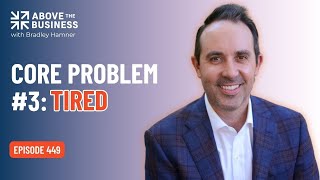
Bradley Hamner tackles chronic fatigue in small business owners through a Personal Operating System built on three weekly habits: Sunday Night Planning to protect confidence, a Perfect Repeatable Week aligned with your energy, and 45-60 minutes weekly for strategic thinking above the business.
Chapters
Hey everyone, well, if you've been following along the last 2 weeks, we've been talking about what are the most common problems that small business owners, specifically $300,000 to $3 million a year small business owners, face. Now look, there's a lot of different issues, problems, challenges that we're going to face, but I think that it can be summarized really down into 3. The first one that we talked about in week 1 was around lack of clarity, that they— their ideas about where the business is, where it's going, their plan to be able to make that happen is fuzzy at best, and it certainly is never— usually not externalized and actually documented. The second one that we spent time talking about last week was this idea that we've heard many times that we need to have systems and processes, but we really don't have true systems and processes in place, and very few of those are documented, and they're not really organized in a way that the team can find them, they have access to them, to where it really starts to operate like an operating system. And then the third one is, honestly, business owners are just tired. They're just tired. And they're tired— I heard this before— that it's, it's a type of tired that is more than what a good night's rest can solve. You know what I'm talking about if you're a small business owner. You just burn out. You need more than a weekend. You need time and you need space. You need some things to be taken off of your plate. You just have too many things on your plate. You're stretched too thin and you're frustrated. I think that we've all had the fantasy of quitting our business, leaving it and going back to do something. If you read the E-Myth, he talks about this specifically where he talks about you know, reducing it back down, letting people go, and pulling it back to a level to where you feel more in control of the business versus the business kind of throwing you around. And then you can kind of try to begin to build back up. I think that the solution when you're tired is actually to begin to work to lead yourself first. And so if our first obstacle, problem, challenge that we run into is that we lack clarity. What's the anecdote, antidote to that, so to speak? I think it's a roadmap. And a roadmap was 3 things: where are we today, point A; where are we going, point B; and what is our plan to get there. If we lack clarity, we need a roadmap. If we lack systems, we need to begin to actually learn how to document some of those systems. Putting those systems and processes inside a handful of core playbooks. And then the collection of those core playbooks begins to form the operating system. I think if it's around tired, I think you have to begin to consider leading yourself first. I was actually— the time of this recording, I was on a podcast yesterday and I was talking about a number of these things, and she came back and asked a I thought it was a thoughtful question that I'd not been asked before. And that was, how do you get it to where, yeah, I do understand that I need to do some of these things, that I probably do need to take care of myself. And I'm going to get into 3 specific things you can do, some tactical things that you can take away, not just this idea of, or the concept of leading myself first, but What does that actually mean? What would that actually look like? But she said, I get that, but if I'm doing these things that I'm going to share, how do I— how do you get someone to take it from just another, yet another good idea? And I believe personally that this is why a compelling vision, one that you actually believe in, not one of those visions where you think it's just one that sounds good, it's actually one that you truly believe in, comes into play. I think if you have a vision that's big enough and it's compelling enough and it's one that you actually want, then some of these ideas, best practices so to speak, become one of those where, you know, maybe what I'm doing isn't working anymore, and maybe I might need to consider a different path. So I'm going to give you 3 specific things that you can do in order to lead yourself first. Now we have, we call this or consider this to be part of your Personal Operating System. If you happen to be watching this on YouTube, you'll be able to see it, but we look at the entire thing as an operating system, and this First part at the top is really the principle of leading yourself first. And there's 3 playbooks underneath that. We call it MITU, your team, and the business. What's the most important thing? That's what MIT stands for. What's the most important thing you can do for yourself? What's the most important thing you can do for your team? What's the most important thing you can do for the business? What's the most important thing to do for yourself, your team, and the business? I think the most important thing you do for yourself is actually to be able to protect your confidence. I think the most important thing you can do for your team is to give them your energy. And I think the most important thing you can do for the business is to actually spend time thinking about the business. So I'm going to give you 3— with those, I'm going to give you 3 specific ways to be able to take those ideas and actually be able to put them into practice. 3 very, very simple things to do. All right, number 1. To take this from just a good idea to actually something that we do? Well, if we said the most important thing you do for yourself is to protect your confidence, then I think one of the first things that you can do is what we call Sunday Night Planning. And in Sunday Night Planning, you've heard the importance of planning for your week before. But when you start planning for the week, the very first thing that you do is you think back on What were some wins that I had? In some weeks, this is incredibly challenging. As a business owner, it's so much easier for us to find the things that are not working or the things that we're frustrated at with than it is to find the things that we think that are working. But indeed, if we can have the discipline, the routine of spending 45 minutes to 60 minutes once per week, and we found Sunday night is the best time to do that, then you can actually truly begin to see that you did have some wins the previous week, and it can help build your confidence even in some of the more challenging weeks that you may have. So, uh, tactical thing number 1 is begin to structure your week. You start to plan your week and have the discipline of 60 to 90 minutes— well, excuse me, 45 to 60 minutes once per week to plan out your week. And the very first thing that you do is you look to grab what were your wins. Number 2, I said the most important thing you can do for your team is to give them your energy. Whether we like it or not, our team is feeding off of our energy. As much as I wish that was not the case, they are feeding off of energy and they can pick up on if you're having a good day or if you're not. And so to do that, we have what we talk about or call the PRW, the Perfect Repeatable Week. What does a perfect repeatable week look like for you? Look, there's probably never going to be a week that is perfect, but if we don't know what one would look like, or at least if we do know what one would look like, then we have an opportunity to try to move closer to that. So we have a tool called the PRW template, and you begin to structure your week not by time management. It's not just about, you know, the things that you've read before with managing your time. It's actually— with a business owner, it's the opposite. It's actually about managing your energy. And so you'd start to do things and put things in place at the times that are best for you, not the other way around. And then finally, number 3. So number 1, we're going to protect our confidence. The way that we're going to do that is we're going to plan our week every week for 45 minutes to 60 minutes once per week. We call that Sunday Night Planning. And the first thing that we're going to do is we're going to grab some wins. The second thing is, if the most important thing we do for our team is to give them our energy, then we're going to make sure that we structure our week based on our natural energy rhythms, not just based on when they can meet or when's best for them, but when's best for us. Now, on the outside, that could look selfish, but it's actually one of the most selfless things that you can do because you're actually showing up as your best self. And then number 3, if the most important thing you can do for the business is to spend time thinking about the business, well, let's do that. Let's actually take 45 minutes, 60 minutes to spend time thinking about the business. Sometimes we just— things are happening so fast that we don't actually take the discipline to go to a coffee shop to be there and to actually think about and plan ahead, to cast that vision, to think about strategically what is it that we're actually trying to do, where do I think the problems are in the business, how can I actually lead and coach this person, versus we're just doing all of the time. Sometimes we need to have some above the business time. This podcast is literally called Above the Business, and this gets into kind of one of the core You know, parts of that is if we want to get above the business, you want to have time to where you're working on it, not in it, and even be able to work above it, then that's the discipline that you need to have. So what is all this about? This idea of planning for the week, structuring week by our energy rhythms, and spending 1 hour once a week just getting away, thinking on or above the business. This is all what it means to lead ourselves first. And if we can start to implement some of these disciplines and routines, and we have a number of other ones, but I wanted to give you 3 today, then it can help us to overcome one of the biggest obstacles and challenges. Let's see, is that business owners are just tired. Does this solve all of that, all of the challenges you may have in place? Does it, does it solve the season that you may be in where you just, yeah, but Bradley, it sounds all well and good, but I just lost 2 or 3 you know, staff members, and I've had a lot of turnover, and I'm having to really step in. I, I get that. I get that. But really, this is 1 hour, 45 minutes to 1 hour on a Sunday evening, right? And then this is 1 hour during the week. If you can't find an hour to be able to get away from the office just to be able to go think for just a little bit and get away from the noise, man, I don't, I don't know if you have the kind of business that you really ultimately want. We really want a business that is able to to run and grow without us. I hope this has been helpful today. So plan for your week, structure your week based on your energy rhythms, and spend 1 hour at least per week thinking about the business. If your vision is compelling enough for what it is that you're wanting to do, you'll start to put some of these disciplines in place so you can lead yourself first. Art of One. Hope this has helped you. Hey, love to be able to invite you to one of my web classes. If you like some of these ideas and concepts, want to get access to one of my toolkits, come to my— one of my live web classes. Just go to blueprintos.com, blueprintos.com. You can register for one of my upcoming live web classes and we'll send you over our operator to owner toolkit. All right, thanks so much everyone. Till next time, lead well and go be great.










