Episode 453: From Corporate Giants to Small Startups - Michel Buffet & Andres Tapia
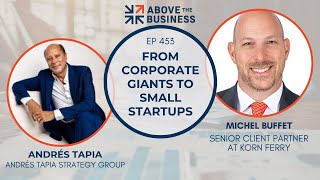
In this Above the Business podcast episode, host Bradley Hamner interviews Korn Ferry consultants Andres Tapia and Michel Bouffet, co‑authors of The Five Disciplines of Inclusive Teams: Unlocking Collective Power to Achieve Breakthrough. The conversation begins with the guests’ bicultural backgrounds (Tapia grew up in Peru, Bouffet in France) and how those experiences shape their perspective on inclusion. They identify a common leadership dilemma: organizations often have high‑performing individuals but struggle to translate that into high‑performing teams. The discussion moves to the current climate of constant disruption (tariffs, COVID, technology shifts) and the need for leaders to act without a clear playbook, emphasizing intentionality and resilience. The core of the episode is an explanation of their five‑discipline framework – Connecting, Caring, Synchronizing, Cultural Dexterity, and Power Sharing – with concrete metaphors (e.g., a Tour de France peloton) and research‑backed claims that inclusive, diverse teams deliver better financial results, innovation, and talent outcomes. They describe how the framework emerged from a desire to move beyond correlation to causality, and how they codified it into a practical Korn Ferry solution (assessment and learning experiences). The hosts also touch on hiring for diversity of thought, the paradox of homophily in startups, and the importance of intentional, pause‑driven leadership. The episode ends with information on where to find the book and an invitation for listeners to engage with their consulting services.
Chapters
And I've had multiple guests on, 2 to 3 guests at a time, so I'll do my very best, uh, to, to try to ping back and forth to each one of you on some of the questions. All right, you guys ready to rock and roll? Michelle and Andres, welcome to the Above the Business podcast. It's great to have both of you with us. We always start with background and origin story. I think it's important to kind of see people's journeys about kind of where they've been and how they got to where they are today and then share with you a little bit, our listening audience, about what all you both do today. So Andres, I'll throw it over to you. Why don't you share kind of your background and origin story, how you got to where you are?
Got it. And I love the question. You'll see how it's related to our conversation about inclusive teams, asking that question as a starter. But my origin story is I grew up in Lima, Peru. My dad Peruvian, my mom American, and I was born in the US, but I was 9 months old. My dad took his new family to Peru and that's where I grew up. Went to parochial school, but then went to the American High School of Lima, knowing that I was going to prepare for coming to college here. So I came for college, and my intent was 4 years here and go back. But still, I'm still working on that plan. So I'm still here in the Chicago area, but I'm bilingual, bicultural, you know, English-Spanish. Spanglish is probably my dominant language right now. And I'm a corporate person, as you'll see as we talk, but I'm a journalist by background, studied history, political science at Northwestern University.
Fantastic. Awesome. Michel.
Michel Bouffet. I grew up in France, sort of similar to sort of Andres, a bicultural family. Mom Spanish, my dad French. And I studied psychology in Paris, moved to the US in the early '90s to pursue a PhD in organizational psychology. And I've sort of basically settled here. And I've been working in consulting for about 25 years. Always in the space of leadership and organizational development. Trilingual, doing a lot of work with sort of expats and managers kind of moving from countries to countries. So that's kind of probably my point of entry to some of the topics that we're going to talk about today is my own experience as a transnational. I'm a US citizen now, you know, but sort of the experience, both my own experience and then working with leaders that have to straddle sort of cultural boundaries and different ways of conducting business. And I'm based out of Princeton, New Jersey now.
I'm curious, what are— Michelle, this would be for you— what are some of the challenges that you see that you work with leaders on, on a day-in and day-out basis? And what are some of the commonalities that you believe are some of the challenges, but also some of the solutions that you all employ?
Yeah, and I think I'll be happy to answer, and it'll be great to get Andrew's perspective on this as well. But, you know, in my role at Korn Ferry, I lead our top team performance practice. So that tends to filter a bit the kinds of things that come my way, right, in terms of the kinds of asks and the needs from clients. And I would say the commonality is around, you know, how do you get the most out of a team? That's a big question that a lot of these leaders are asking, right? So A lot of leaders are really good at surrounding themselves with the right kind of leaders, highly capable, great experiences, great performers, can deliver in their own areas. But then it doesn't always translate into a high-performing team. There's a pivot that needs to happen for a lot of leaders. And particularly, I see that at the C-suite level. But, you know, I know you have a broad audience, people, you know, small, medium-sized organizations. I'm sure can relate to this. If you're the head of an organization, no matter what the size, you're going to need a team to run your organization. And a question of how do you go beyond having great individual performers to have a high-performing team, I would say that's probably one of the top challenges that organizations are faced and that they come for help. They approach Confery for some support.
Yeah, yeah, for sure. Andres, I'd love to get your insight into that, and then I'll ask a follow-up question.
Yeah, and I'm going to go from the broad, which Michelle did beautifully, to the concurrent context. Right now, leaders are really struggling with disruption. No matter what industry, whether what size, everything is up for grabs at every possible level from technology to supply chain to finance to politics. And so leaders who are really good at what they do, there's a reason why they're leaders and why they're entrepreneurs and they're visionaries. The playbook that had gotten them to here is not really the playbook that helps them answer the questions to the disruptions. So what is the new playbook? And we don't have a new playbook. So right now, a lot of our work with leaders is how do we help them navigate the disruption? And almost we talk about how to lead and how to know what to do when you don't know what to do. And that's what leaders are having to rise up to the moment to lead despite the lack of a playbook and to kind of create, you know, let's just say in Spanish, se hace camino al andar, you make your path as you walk it. And leaders who are used to knowing the roadmap now are like, we got to make our own road and we're going to make it as we make it, right? And I think that's the biggest challenge is how do you go the right way and the best way?
Yeah, for sure. I mean, at the time of this recording, we're right in the middle of— obviously tariffs is a huge, uh, point of, you know, disruption. And whether it's tariffs or COVID or anything else, the reality is, is that in business there's always going to be a lot of disruption. I'm really curious around communication, and then I'm going to get to a couple other things, and then we'll get into some of the things I have around the book that you both produced. But Here's my question, uh, Andreas, first for you. In so many of the companies that you work with, uh, the C-suite executives, maybe even the higher-level leaders, they can be, depending on the size of the business, many, many different levels away from the, we'll say, the frontline workers, the people who are actually doing some of the work. And that presents a very difficult challenge to make sure that the vision, the direction, the plan that they are putting together gets communicated directly to the employees. And sometimes that can get lost in translation. For small businesses, while they may have, you know, they could have a lot of direct reports, quite frankly, the entire team could report possibly to them, or maybe at best they may have one level of management. They may have sales leaders and service leaders, et cetera. So while it's easier they still are challenged with making sure what it is that they— the vision, the plan that they're wanting to be able to execute is actually conveyed in a way that the team is able to then take that and be able to perform in a high way, uh, in, in a, in the level that they want to. So Andreas, for you, what are the things that you all do to help some of these, um, uh, leaders to be able to communicate clearly even in spite of not knowing exactly What is the roadmap ahead?
Yeah. And actually, Bradley, I think it takes us right to the work that we did because we went to answer that very question, right? What does it take for leaders to optimize the contributions of their team members, right? So you'll, as we go deeper, we'll talk about connecting, caring, synchronizing, cultural dexterity, and power sharing. And that's our answer in that, you You know, it's these entrepreneurs that listen to your show and, and small business leaders, you know, they have a strong vision. I mean, they're in it for a reason, right? And, and they're, they're making things happen. So often vision is not the problem. The problem is, to your point, how do you convey not only what the vision is, but how to execute it? And here's where, you know, team leaders or executives or, or the first line leaders fail at getting to really understand that asset that they have in not only their people, but in the teams within their organizations. So teams are really— the sum is, you know, the total is greater than the sum of the parts. And how do you get the team to come together and leverage the differences across that team functionally, geographically, origin story to really, you know, optimize and augment what every individual person does. And this is where leaders have to really think about converting their persona and their vision and the strength of what they've done and really trusting that the people that they've hired sort of buy into the vision and who also wanna succeed and make the company succeed. And that means letting go a little bit of the fullness of their vision and inviting others to really bring in their best work to it. And I think when we go through our 5 disciplines, we'll be able to unpack that further because every one of those disciplines is about unleashing greater optimization from each team member.
Yeah, great. Michel, I'd love to get your thoughts on that.
Yeah, I'd love to add something around— I think the paradox, like going back to your question around, you know, as a leader or as a top team, how do you ensure that the vision and the objectives, the strategy gets executed, right? That it's understood and executed. And I think there's a bit of a paradox in that one would think that you really want to have people that are sort of from the same— that are cut from the same cloth. Because if you're the same, if you have the same background, the same experience, the same education, you're more likely to be in harmony because you see things the same way, and therefore communication happens faster. You don't have to say things before someone understands it. What we find is that in the environment that Andreas was describing, that does not work. Because what that does is that it actually makes your organization more fragile. Because how are you going to really pick up on the signs of a need for change if everybody kind of like is more or less the same or think in the same way? And we see this as one of the biggest kind of cardinal sins of organization is groupthink, you know, too much similarity. We think that the key to that is to, is to balance. It's not like you have to let go of it, but you have to cultivate diversity of perspectives and experiences so that the people will pick up the right signals in the environment and know how to adapt that common core purpose and mission. So yes, commonality is really important. And we always tell teams like you have to define common norms, common ways of working, right? Those is really helpful. But by having a diversity of perspectives and mindsets, you make your organization more resilient because you're more likely to pick up the signals for, you know, that driving— that are driving change. So I kind of wanted to add that because that's also core to the messages that we want to convey in our book on the 5 Disciplines of Inclusive Teams.
That's great. In fact, I'm going to ask in just a second, what was the things that you both were seeing in your work that then drove the idea to say, I think we need to do some research on this, and then ultimately we can put this in a book. But before I ask that question, I just want to comment on that. I believe especially startups and small entrepreneurs can have a tendency— I'll raise my hand as being the one that would be guilty of this— is you end up recruiting people that you like to be around. And so you end up around people that don't have a diversity of thought because, well, you know, I'm the one making the hire and so I really like this person. They have maybe similar interests to me. I know Corn Fairy, I'm a golfer if you can't tell by my, by my attire. And so obviously You know, if somebody is in an interview and they, they talk about playing golf, I'm like, hey, that's great, we have a— you know. And so it's— it, it gets hard to say, you know what, I think I'm gonna— I'm thinking I'm gonna hire somebody that's different than me because I want that diversity, uh, of thought. And so I think it's prevalent in small businesses and even larger corporations. Andreas, you have something you want to share there?
Yeah, and it is— you know, there is a paradox here because we know that someone very different from us can be very disruptive in a not helpful, constructive way. So what Michelle said about common purpose, common vision, norms, how we're gonna organize ourselves to get things done, those are fundamental. And it requires some adjustment on everybody's part to sort of, okay, you know, we each have our style, but we wanna agree that this is how we're gonna do it. But the differences that we're talking about is differences in experiences, in perspective, in education, and also in life that these individuals will constructively want to bring to solve the very difficult problems and challenges and seize the opportunities that small businesses and entrepreneurs have. Right. That's what you want. You— because in the end, business is about differentiation, right? You're not going to win unless you differentiate. But if you're all the same, then how are you gonna differentiate? Even because if you can't differentiate among yourselves, how are you gonna differentiate in the marketplace? And that's where the magic comes in. Yeah.
And, and can I ask something about that? It's happening. I know I was gonna ask this question anyway. I don't think I was gonna take it from this angle, but I'm curious. More small businesses, technology has allowed for more of this. And, and some of the people that I'm working with are now hiring people from across the country. Okay, and so I, I think that that actually adds to the opportunity that they're hiring people and bringing people under their team that are coming from literal different parts of the country that are bringing in diversity of thought. I'll give you a specific example. Somebody that, um, is a client of mine lives in Seattle. Uh, just because of where he is, it's very difficult for him to be able to find team members that kind of fit his cost structure. I mean, he's literally competing against Kirkland and Costco and, and Microsoft for employees, and So he's going and hiring people remote from around the country, from the Midwest, et cetera. And he said, you know, it's really interesting how different some of the team members approach certain things. And he said, it's actually very refreshing. So I don't know, Michel, if you've seen that even some of the larger corporations that you've worked with.
Oh yeah. Oh yeah. And I'll tell you, I mean, this is something that many organizations have understood for a while, but I think what's different is that is how it's, it's expanding beyond maybe the traditional areas where we've seen this happen. So I've worked with a lot of global organizations, you know, global positions. I've understood this for a long time. When you look at the makeup of a global, you know, a top, you know, Fortune 500 global organization, you're going to see, particularly in, I would say, in the consumer business, you're going to see a lot of diversity usually at the top, in the top 2 layers, because they know that they have to really understand their market, they have to understand their users, their customers. And how are you going to do it, you know, without having actually some of the diversity represented at the decision-making level? But I think what's different now is that it's expanding way beyond, I think, where traditionally we've seen it. And, um, and so as a result, you know, I think that a lot of organizations and teams are really hungry for guidance about How do you actually do it? And that's kind of also why our book is meant to be very a practical tool with very specific practices and examples so that organizations can look at this and recognize themselves in it and some of the issues they're facing and then apply some very concrete practices that can really help them move the needle in terms of their ability to be more inclusive.
Yeah, for sure. So Michelle, your book that you both co-authored The Five Disciplines of Inclusive Teams: Unlocking Collective Power to Achieve Breakthrough. What were you both seeing that you felt that, hey, we need to do some research here and then ultimately, you know, be able to put that together in the book? What were some of the things, the early signs?
I'd love for Andres actually to tell about a bit of the journey because this, this book is, is part of a series. Andres, you want to say a little bit about the work that we've been doing for some years around inclusion.
Yeah, this is the third in a trilogy of the Five Inclusive Disciplines. So we had— I co-authored with somebody else the Five Disciplines of Inclusive Leaders, then with somebody else the Five Disciplines of Inclusive Organizations, and now with Michelle, the Five Disciplines of Inclusive Teams. And by the way, the reason for different co-authors is specifically because of the diversity of these different individuals to collaborate and come up with a better product and thinking than if it had just been solo. So we're kind of living out the practice now.
It wasn't because you didn't like the first two and then you were like, you know, never mind.
Yeah, write them off, right?
Yeah. I didn't enjoy that work with them. So, hey, Michelle, you're the one.
Third man standing, right? No. And actually, if we had the profiles of the others, you would see how different they are from each other, how different they are from me. And that was a very deliberate strategy on my part. And I'm very pleased, by the way, by the products all 3 products and what came out of the thinking of that diversity of thought and experience and origin story. Now, to answer the question about why we embarked on this, you know, for the longest time in a different era and even in the new era, however way we define the new era, when we at Korn Ferry ask leaders, what are their top priorities? Just period. Just what are the top priorities? There's 5. That come up no matter what and no matter the size organization. Marketplace growth, profitability, innovation, talent attraction, talent optimization. And so those answers have not shifted very much regardless of the disruptions all around us. And in fact, they've gotten more, more concentrated as, as urgencies. And the research has told us consistently from Korn Ferry, McKinsey, BCG, Harvard, that more diverse teams working inclusively have better financial results, generate more innovation, are more attractive employers, and are able to optimize the talent composition. So, and, and optimization of the work. So we went out to say, okay, the correlation is there, but what's the— can we get closer to proving causality? Like, what is the secret sauce? What is the formula for a diversity of perspectives, backgrounds, origin stories that actually generate these business outcomes. And if we can crack the code, then can we then systematize and codify those practices so teams can achieve those outcomes in a more consistent, predictable way and can accelerate those kinds of outcomes? Because a lot of the correlations were organic. Well, wow, you happen to have a diverse team. Great. You happen to find a way to like each other and work with each other and figure it out. And eventually, organically, you end up with these business results. But we think that you— we could systematize it, codify it, and accelerate it. And that's what we went after. And then as we talk about the 5 disciplines of inclusive teams, those are— you will share our findings.
Mm-hmm. Yeah, that's great. Well, talk about, Michelle, the— those— what those 5 disciplines are. Give us a high level, and then we'll pick maybe 1 or 2 of those to go deep on.
Actually, what I was going to do is pair up because we're defining— we're seeing sort of those 5 into a group of 2, right? Into 2 groups. The first pair is the connecting and caring. And if you look at our design, we put this around the other 3 because we feel like these are the essentials. You need to have that in place to actually truly demonstrate the other 3. So if that's OK, why don't I talk about connecting and caring and then Andreas can walk us through the other 3 disciplines. But connecting and caring really talks to the relationship, right? It's when you're looking at a team, what you really want to ensure before you apply any kind of teamwork skills and competencies, it's the ability for the team to come together truly as a team. And so what we mean by connecting, connecting is really about understanding each other, right? So it's really more the cognitive element of I know like what you're providing, what you're offering on the team, who you are, where you come from, what your perspective is, the different formative experiences you've had, and then what is it you care about and want to drive in your organization. So I would say that a lot of teams today operate suboptimally when it comes to connecting. You know, there's a lot of sort of movement happening in the C-suite. So people don't really have time. They don't really build the relationship. And oftentimes they don't really actually know what their neighbor at the table really cares about or is focusing on. So first one, caring is, it's not only that you have to understand, but you have to care about it and you have to care about the other person's well-being, welfare, success. You know, that's where we get into things like psychological safety. Are you creating a climate as a team leader and as a team member for intimacy, for caring, for I'm going to go the extra mile to help you above and beyond what I have to focus on for my own leadership role? In the work we do on trust, which is all our work on trust and helping build trust, an important element of trust is that, of course, you have credibility and reliability. Authenticity, all things is great. But in the end, what's going to make the most difference is whether I perceive you as working on behalf of the team versus on your own behalf. That's the biggest one. And so, if you know the way, the best way to undo that, the negative impact of self-serving behavior is the caring piece. Is that, is to say that, you know, the whole servant leadership is very much in that mindset to say, I care about more than my own. outcomes and my own, you know, my own performance. So I'll pause here and I would say we actually just piloted this with a Fortune 20 company with a top team, the CEO, and they really, I mean, they, it was kind of definitely a big aha moment for them that they needed to really spend time on those two things.
Yeah, in fact, I want to give a comment on that. Before I started my entrepreneurial, uh, journey myself, I, I was in the corporate world Um, and there was a feeling that certain people that I was around, um, seemed to be doing certain things, taking on certain projects, leading in a certain way, simply for them to be able to move up the corporate ladder. And it was just the team— their team was just the cogs in the wheel to be able to get them to where they wanted to go. And so there was no actual relational connection to the team. It was just about You know, they're just doing this to be able to move up themselves, to take the next job and then to take the next job. And so I completely agree with that part of round. Is it true, authentic relationships?
Yeah. And I would say that connecting, caring, many times leaders balk at that a little bit because they go, man, we have so much to do, you know, we got to get things out the door.
Yeah.
But our argument here, it's actually you get a great return on that investment because the more you find out that unique skills, formations, and experiences that people have had that you usually don't ask about. You just look at their title, maybe their previous job. But you know, Bradley, that anyone on your team, if you think about yourself, how much more there is to you that people don't know about that actually influences how you either work and they don't understand it, or you could bring if people knew that that was there in you, right? So, so that's the connecting part. And the caring part is the, the very human thing, right? If you feel that people care about you not only as a great professional, but as a, as a person who has a life outside of work and has family or friends or, or things that are causes that are important to them. The more people feel seen, that it releases from a new neuro, uh, neuroscience perspective, you know, neurotransmitters that make people actually feel good and therefore psychological safe. And we know scientifically that more comfortable and psychologically safe you feel in the workplace and your team, the more you're gonna give of yourself and the smarter you're gonna be and the more you're gonna be committed to it. So it's a great return on that investment on the connecting care. And that then surrounds the other 3 disciplines of synchronizing to harness collective intelligence, cultural dexterity to integrate perspectives, and power sharing to ensure equitable contributions. And, and so just a little bit of, on each one synchronizing. If you think about, you know, cyclists on a peloton, you know, in a Tour de France, you know, they're, they're doing two things at once. They're competing against each other because there's gonna be a winner at the end, but they're also collaborating with each other because each one has to get in front of the peloton to sort of draft. And then within that race, there's teams. That are also trying to win as a team, even as there's gonna be an individual winner at the end. And I think that's a good example of what happens in corporation. Yeah, there's competition and people wanna advance, okay? And as long as they're not self-serving and they're sort of in this paradox of saying, hey, the way I get ahead and have a better chance of getting as far as I can and even be a winner, I have to collaborate, I have to synchronize. And the beauty of a, of a peloton is you can just see when they're all pedaling, and moving and dealing with the elements, you know, the wind, the rain, the, you know, the cobblestones, the climbing the mountains, you gotta shift your gears and shift your pacing and shift your breathing in a way that gets in coordination with everybody else. That's a great metaphor for a team in synchronization where in all their diversity, they're finding a way to sort of find the right pacing to move and navigate through the disruptions that are coming, especially with the disruptions that there's, you know, another metaphor, right? Storms and winds and earthquakes. Well, how do we adjust in the moment as a team and not just every man and woman for themselves, but we collectively find a way to navigate in a synchronized way through that? So that's synchronization. Cultural dexterity, uh, it's not a new concept. It's been around for a couple generations in the workplace, the understanding that people from different cultures are going to operate differently. France, Spain, Peru, United States, right? And, and sometimes those can clash. And that can be seen as detriments and things that are just too painful. But our point of view is those are assets, right? That our cultural diversity, not only nationally, but regionally, the South, the Midwest, the West Coast, right? And the cultural diversity of people from different socioeconomic backgrounds, how they grew up, or racial ethnic or genders, that there's something innate about those unique experiences that shape a way of thinking, set of values, that actually when you're trying to innovate, those are gold, those are treasures, right? That we need to be skilled at extracting and integrating those differences. And rather than letting them clash, let them integrate into a new solution. And finally, power sharing. We have found this to be the most difficult one in the work environment, but we're— we've tripled down on it. And that is, yes, you need a team leader. Yes, you need a CEO. Yes, you need first-line manager, of course. For all the reasons that you need that coordinated action and a leader to sort of help lead the way. But leadership often gets too confused with power only, like the power only sits in the leader. And a great inclusive leader understands that power resides in every one of my team members. It resides in different ways. I might be the positional leader. And in the end, I'm accountable for the overall results of my team and to coach and engage them and hire them. But, you know, Bradley has a set of skills that I don't have and nobody else in the team has. He has power when it comes to that, when the team needs that skill, right? Or that other person, you know, may have a gift of articulation or eloquence, and that other person may have the mathematical analytical skills, and they have— and that should be seen as power. And so rather than just trying to dominate and control everything, to cede to the person with greater power in that skill, in that moment, in that experience. And the power sharing then can flow in a synchronized way across the team for optimal results. Imagine if everybody on the team feels that they can move with power in the things that really they're very good at and really care about, and they're in an inclusive environment that allows them to do that and welcomes them.
Well, that's— what a great explanation. I love the frame— well, first of all, I love models and frameworks in and of themselves. Helps me to be able to make sense of the world, make sense of business. Michelle, there was one thing that is really standing out to me as I was listening to all of these, and it seems like it's intentionality, that the leaders have to be very intentional about some of these things, because if we just allow things to happen, default is not going to be some of the— some of these disciplines. Your thoughts on that?
Yeah, I mean, it's a core concept for us, right? This notion of intentionality. And we have, you know, our colleague at Korn Ferry, Kevin Cashman, who's kind of a, you know, really has this concept of the pause principle, right? So you sort of have to go, you have to go slow to go fast. You have to pause and be reflective and really absorb what's happening around you in order to make better decisions. I think to me that speaks to that is And I would say, as an executive coach, I think it's a recurrence in the work that we do to talk about intentionality. We find that the most impactful leaders are the leaders that can be intentional. Because to me, it also speaks to a concept of— that's also dear to my heart is resilience. We think about top teams and we think about any kind of team applying the inclusive team principles. It really is about enabling the team to be more resilient, to be able— and we're back to the theme that we started with around this really unpredictable environment, this highly volatile, uncertain environment. What, what really teams need is, is how do they increase their resilience, their ability to adapt, to innovate and to grow in a context that is challenging. And it's really the those 5 disciplines are really about building resilience. It's about helping the team to be truly operating as a team. There's something that I love Andreas says oftentimes is, teams is the smallest unit of culture in organizations. Maybe that's something that's a little soundbite for your listeners is, think about this, bring this into your work to say, remind yourself that change happens where it happens more meaningfully in an organization is at the team level. It's not the individual and it's not the organization, but it's really the team level. And so what amazing power you can have as a team leader or as a team member, you know, to shape that experience, to drive the kinds of outcomes that you, you know, you care most about.
That's great. Well, the book is The Five Disciplines of Inclusive Teams: Unlocking Collective Power to Achieve Breakthrough. Andres, people want to learn more about the book. Where would you point them to and then be able to connect with you personally? And then I have one final question before we wrap up.
Yeah, you know, your favorite bookstore online is probably the best way, you know, B&B, you know, Barnes Noble, Amazon, or wherever else you like. And it's available in hard copy, audio, and digital.
Fantastic. I don't mean for this next question to be almost an advertisement for Korn Ferry, but I guess there's no, not another way for me to, to ask it, but I think you'll understand the angle. Uh, earlier you mentioned that you were working with a, uh, top, uh, Fortune 20 company. And so often, I mean, you're working with leaders that are incredibly educated, well-educated. They are an unbelievably smart people. They're surrounded on leadership teams with incredibly smart people that have diverse backgrounds, have worked for some of the biggest corporations, yet they still, they still will bring in consultants to be able to help them. I think that that is such a great thing for us, even as small business owners and entrepreneurs, to be able to say that, you know, regardless of your own experience, being able to bring in other coaches and consultants and putting yourself in the right environment is so incredibly important. Can you just comment on, you know, the fact that you've been able to— that these leaders bring you all in to be able to work with them?
I think it speaks to what we found, you know, when we did a version with the first book on Inclusive Leader. Some of the key dimensions are openness to differences, curiosity, humility, right? Like, these are all the qualities that I think top leaders are demonstrating is they can have confidence and credibility, right? That's not incompatible. You can have high confidence, highest assertiveness, high need for achievement. But, you know, how do you combine that with humility, with openness to differences, to valuing differences, you know, to have that flexibility? I think that's really— that speaks to that. And if I could just add one thing, is because you were talking about, you know, kind of the maybe some of the practical aspect. But, you know, Anders and I, you know, we wrote the book, but we moved on to kind of the next step, which is, all right, the solution. And so what I would say is that if people are interested in getting some guidance around how do you apply it. We have a solution at Comferry that actually is based on the book, on the model, that includes some assessment and some learning and development experiences. So we'd be happy to talk to some of your listeners if they're interested in learning more about the specifics of how you actually activate something like this.
That's fantastic. Michel, Andreas, it's been a pleasure having you on the podcast. Thank you so much. Wish you the best. With the book and love to have you, uh, both come on again in the future.
We'd love to. Thanks, Bradley, for the work you do.
Well, I started off by sharing in the introduction that I believe I come at small business from all of the different angles, and one of the angles is actually to look at what bigger corporations are doing. Now, it's not always a direct, you know, line from what big companies do to what our, you know, small business owners and entrepreneurs and startups need to be able to do. But there are times that there are business principles at play. And I think if you look at the Five Disciplines that Michelle and Andrés went over in that podcast, I believe you'll be able to see that there's a lot of similarities that can apply to our businesses. Number one, I think obviously being able to, uh, I think number one, to be able to just be intentional with the diversity of thought and, and, um, you know, people from around the country, different ethnic backgrounds, genders, etc., racial differences. I think all of that can really make for an incredible kaleidoscope within our teams. And I think that you're seeing more of the small businesses that are hiring people. I gave the example in the podcast where they're, you know, hiring people from across the country, um, and, and you're getting different thoughts and different way of approaching businesses, etc. That I think is, has been really awesome and additive to the cultures. And ultimately, I think the other thing was outside of their 5 disciplines, but I think at the, you know, one of the things that they talked about is like these companies, they want to grow market share, they want to increase their profitability, they want to drive innovation, they want to attract the best talent, and they want to optimize the performance of every team member. I mean, what small business owner doesn't want to really want to do that? Maybe you don't think about, you know, innovation as much as bigger corporations do But look, you want to grow in bigger corporations, that's increasing market share. You want to become and, and remain, uh, profitable in your small business, for sure. You definitely want to attract the best talent. We refer to that as attracting A-players. And then you want to optimize the performance. I refer to that as you want to develop and retain, uh, your A-players. And so just in that, there's a lot of similarities. And if you think it through You know, the, the Five Disciplines that they went over, I mean, you know, uh, one of them, like, just caring, connecting and caring. And certainly even in a small business, you know, I, I can look back honestly, regrettably, in some of the ways that, you know, I was not connecting even with my own individual small teams and what they were going through, etc., let alone if it was a if it was a big business. I really enjoyed that conversation with them. You can certainly go and pick up their book and see some of the work that they do on Korn Ferry. I want to give a shout out to our podcast sponsors, Coach P Consulting. Look, Coach P has been able to do it himself at the highest level, but not only has he been able to do it at the highest level, more importantly It's what he's been able to help other small businesses and small insurance agencies to be able to do for them as well. And I think that is so critical and so key. If you go to coachpconsulting.com, register to check out his, uh, work that he does. Let him know that you heard about him on the Above the Business podcast. He will give you one entire month free for you to be able to check it out and also for your team to be able to jump on some of the team call Coach Pete Consulting. Dot com. When you think about innovation, part of it, sometimes innovation can come from different places, and it can look like maybe being able to improve your technology stack. Today@Pro can help you to be able to do that. They can put everything with your tracking, your dashboards that you need to be able to have, your individual team members' scorecards that you want to be able to know what their numbers are so you can coach to those numbers, be able to put in your custom word tracks. Course is going to work with your corporate-approved CRM. Today@Pro.com. As I was just talking about attracting the best talent, optimizing the talent first before you develop and retain the talent, you got to get the talent. And one of the hardest parts for small business owners is they're wearing so many different hats and they know that they need to be recruiting all the time, and they typically think that that falls on their plate to be doing it. Well, if you work with someone like Autopilot Recruiting, they can take that off of your plate. Go to autopilotrecruiting.com. Now they're gonna— not gonna take the entire thing off your plate because at the end of the day you're the one that may— that's making the decision. But for an incredibly low rate per month, they're going to make sure that they're recruiting on a month-in and month-out basis for you. They're going to be able to do some of the initial screening. They're going to have some of those initial phone calls before then they put them in your hands. So then you can do, whether it's a Zoom interview or an in-person interview, do some of your additional assessments, check out references, etc. They're going to be able to take care of the first part of it. Go to autopilotrecruiting.com. Obviously, we were also talking about improving margins. Do you know what your margins were in 2024? Do you know what your profitability percentage is? Do you have a forecast of what you want your profitability number to be? In 2025? If those are questions where you go, I have no idea where I stand with that, Club Capital can help you. Go to club.capital, book a no-obligation demo with somebody on the team, and they can get an idea of kind of where you are and how they're going to be able to help and put a plan together to be— for you to be able to get more control of your financials. All right, if you like some of the things that I do, some of the things that I share, love to invite you to come to one of my live web classes. Go to blueprintos.com, the very top, you can register for one of my live web classes, help helping you to transition from being in the day-to-day to becoming a true owner of your business. BlueprintOS.com. All right everyone, until next episode, lead well and go be great. All right team, this is the intro to that podcast. Welcome to another episode of the Above the Business podcast. My name is Bradley Hammer, your host. On today's episode, we have Andreas Tapia Uh, let me redo that in case that showed up, that sound was on there. Welcome to another episode of the Above the Business podcast. My name is Bradley Hammond, your host. On today's episode, we have Andreas Tapia and Michel Buffet. They are consultants with Korn Ferry. You may have heard of Korn Ferry if you're a golfer, the Korn Ferry Tour. Well, the business behind Korn Ferry, these are consultants that work with some of the largest corporations in the world. Well, Andreas and Michelle just came out with a new book, The Five Disciplines of Inclusive Teams: Unlocking Collective Power to Achieve Breakthrough. Now in this episode, they do a great job of navigating through some of the ideas and principles that they talk about with big corporations. But then how does that also apply to us as small business owners? I believe that there are times that you can pull principles, timeless ideas, and best practices, even from some of the largest corporations, down to some of the things that we do in our small businesses. And these 5 disciplines absolutely are things that with the right intentionality, we can apply to our business as well. Without further ado, here's my conversation with Michelle and Andrés. Thank you, team.










