Episode 493: Manage Yourself First - Leadership Lessons with Margaret Andrews
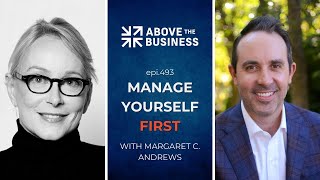
In this Above the Business podcast episode, host Bradley Hamner interviews leadership expert Margaret Andrews about her book Manage Yourself to Lead Others: Why Great Leadership Begins with Self‑Understanding. The conversation traces Margaret’s personal wake‑up call when a new boss bluntly told her she was “not self‑aware,” which sparked a deep dive into self‑knowledge that later became a Harvard class and a popular two‑day executive program. Margaret explains the core premise that leaders must first manage themselves—understand their values, influences, emotions, and behaviors—before they can effectively lead others. She highlights the common gap between a leader’s good intentions and the observable behaviors that others judge, and shares a six‑question reflective framework to surface hidden assumptions. Real‑world stories, such as a high‑performing surgeon whose toxic behavior threatened a hospital’s culture and a participant who realized he mirrored the surgeon’s flaws, illustrate the power of self‑awareness. The dialogue also covers practical tools: 360° feedback, how to give and receive it, the role of personality assessments (e.g., Enneagram), and ways to be proactive rather than reactive to cultural or turnover crises. Throughout, Margaret emphasizes that leadership challenges are universal across industries, that there is rarely a single right answer, and that a “hovering” or “above‑the‑business” perspective helps leaders see the bigger picture. The episode ends with actionable takeaways, recommended resources (margaretandrews.com), and a reminder to lead oneself first.
Chapters
Welcome to another episode of the Above the Business podcast. My name is Bradley Hemnew, your host. On today's episode, this is a fantastic episode. Fundamentally, I've always believed, like, we in our 5 principles, you hear us talk about this in the podcast with Margaret today. We believe that you need to lead yourself first. It's one of the 5 principles, and her book aligns perfectly with that. Her book, Manage Yourself to Lead Others. Why Great Leadership Begins with Self-Understanding. When I saw this title, I said, we have got to have her on here. She has so much experience. And when you hear her background and what she's been able to do at Harvard and people coming to her, she has incredible stories. You're definitely going to want to pick up her book after this episode. It aligns perfectly with one of the things that we believe in. @Blueprint. All right, everyone, without further ado, here's my conversation with Margaret Andrews. Margaret Andrews, welcome to the Above the Business podcast.
Thank you so much, it's a pleasure to be here.
Excited to have you. Well, we love to start with background and origin story. I love hearing people's journeys about kind of how they got— so bring us, take us back wherever you feel like is relevant, bring us to present day.
Yes, absolutely. So, uh, if we go back several, many years ago, I would I was working in an organization and had done very well. I had rapid promotions and succeeded at each of the new levels. Then I had a new boss come in and we didn't have as great a relationship as I'd had with my previous boss. And I found myself in a meeting with him one day and he looked across the desk at me and said, "You're not self-aware." And it was said not in a, um, let me help you kind of way. It was said in more of a you are broken and cannot be fixed kind of way. So boy, was that hard to hear, uh, and I felt very confused and defensive, uh, and these kinds of things. But later, when I calmed down, I realized that he was right, uh, that essentially I had very good strategic and operational skills, but my relationship skills were suffering a bit. They were definitely suffering with my boss and with some people, not a lot of people, but some people on my team. You know, I could, uh, I could be impatient, uh, and hard-charging. You know, I really cared about the outcomes, etc. So Anyway, what this led me to was essentially realizing that, hmm, this is a situation that I have created, and it is not one I'm proud of. It's not one that I want to have. It was never my intention, but here we are. And so I realized what I really want to do is change this. I do not want to be this person. Uh, so I started doing a lot of research. You know, I looked at famous leaders and people that I knew. I looked at books, or academic studies, management books, history, philosophy, psychology, etc. You know, I just kind of nerded out on all of this stuff. And what I came to find is the whole idea behind the book is that we have to manage ourselves before we lead others. And that means, first of all, of course, we have to understand ourselves. And this is not a surface-level understanding. It's really understanding who we are and how did we become this person, what, who and what ideas have influenced us, what are our values and these kinds of things. So that changed the way I did things. And several years later, I created a class at Harvard on this area. And the class has had a waiting list every time it's been offered for, I think it's the last 18 years or so. And then we created a 2-day professional development program out of it. And it's become the most popular executive program offered at Harvard. So I keep thinking, well, gosh, maybe I'm on to something. And therefore, that's when I decided to write the book. Book.
So that is fantastic. Well, I have a few things. I too, in, in the past, would absolutely would consider myself that organizational and strategic skills, I would over-index for those and my relationship skills sometimes, and you may not necessarily refer to these skills as this. I've heard them referred to as soft skills. I'm not sort of sure if people have debated whether or not that's hard skills versus soft skills, but I certainly began to kind of see everybody as like, hey, unless you're, you know, charging towards our outcomes and goals the way that I am, I mean, kind of get out of the way. And so therefore in a small business that related to a lot of turnover, not a very great culture, et cetera. And so that took me having to look inward, which was not easy to do, but then at the same time coming out of it and Obviously, I'm still trying to do that to this day and, and improve myself. So when you mentioned about being impatient, like, yes, I want those, that, that those yearly objectives to be, to happen in, in, in this quarter, as an example. And I would over-index for outcomes. Do you see the people that you work for that come in, that they're, they're so driven, they're so ambitious? Do you find that they, uh, because you your, your, your class, uh, the 2-day professional program has been oversold, etc. So many people want to get into it. Do you find that the majority of those people that are that way are able to self-reflect and say, no, no, this is actually an area that I want to improve? Or do you find driven, ambitious people have a hard time coming to that conclusion?
Yeah, both is what I would say. That I think that there are times I actually have people that are sent to my program, and they will oftentimes tell me that. They'll come up to me at a break or something and just say, just essentially, just want to let you know, I don't want to be here, kind of thing. And very, very often they will come up to me at the end of class and say, you know, I really didn't want to be here, but I'm so glad I came. So I do think it's one of those things that when The student is ready, the teacher appears. So that, you know, some people, you know, will ask me even, so when are we going to talk about leadership? And I tell them, we've been talking about leadership this whole time. It's not always about, you know, how do you run a meeting and, you know, how do you get other people to do what you want type of thing. I said, you know, you have to go inward before you go outward because if you understand yourself, You understand how you're different from other people.
Yes.
And therefore, when you are managing a group of people, you realize, oh, well, if I'm so different from all these other people, that means that they are individuals too. And therefore, they're going to see things a little differently than I do. And it doesn't mean that just because I'm right means that they're wrong. Right. There can be a couple of ways to look at this. And I always think of There's a cartoon out there that has two people looking at something on the floor and they're at opposite ends of it and one is shouting, "Six!" and the other is shouting, "Nine!" Right? And because from their vantage point, it's either a 6 or a 9. And I always love that because it does mean just because one person is right doesn't mean the other is wrong. So, you know, I do think that some people come and they say, very oftentimes, I will say they hit a wall that they didn't get that promotion, or they were demotivated, or as an entrepreneur or somebody running a small business, they have had a major setback. You know, their turnover is really high. You know, all the things we know can go wrong and realize at some point, oh my gosh, this is me. This is not them. This is me doing this. And that's why they come, and they're very ready for it.
You know, that actually brings up a good point. Do you find that the majority of the people do have— it has become a— there has been an event or something major that they're like, okay, finally, I need to actually go and get some help, or I need to— I want to improve in this area. And for those that maybe want to not have that situation happen, like they don't want to have to have an event like, oh my gosh, my culture is just terrible. I've had all this turnover and, you know, that I want to be proactive of kind of being able to look inward before something were to happen. How would someone go about doing that? Because I kind of think of it as like unknown unknowns. They just don't even know what they don't even know. I mean, that was like 2017. That was a moment that one of my team members at the time shared with me some information. I was like, Wait, what? What is going on right now? I had no clue what was actually happening underneath the surface. And it was so eye-opening. We'll get into intentions and behaviors in just, in just a little bit. But do you find that the majority of the people who do come from something traumatic that has happened, they didn't get the promotion, etc.? Number one. And then number two, if somebody does not have that and they feel like the things are fine, but they want to be proactive. How do they go about doing that? Yeah.
So, so, um, I, I will say, I think that the people that I'll say lap it up the most are people that have hit the wall or had something happen, right? And they, they're reeling from it and they're saying, wow, this is not what I wanted. This is not what, you know, I set out to do, but yet here I am. And actually one of my favorite stories from the book is about one time when I was running a case discussion in one of those executive programs. And the case discussion was about this very gifted surgeon who was raising the reputation of the hospital and profits and things like this. And, but at the same time was really injuring, I'll say, the culture, bullying people, etc. So, a super impassioned discussion about what we, as his, as his boss, this hospital administrator, what should we do with this guy? And, you know, so should we keep him and try to coach him so we get the benefits of his surgical skills, but, you know, try to mitigate some of these other really very bad things that are going on? Or should we cut him loose because he's creating this very toxic environment for people that stay and he's driving people out of the business? So, you know, super impassioned discussion. And just as we are narrowing down and closing up the discussion, I notice a hand in the back of the room, and it's from James, a guy that has been in the program for the whole 2 days and has said nothing. And so I call on him, and he says from the very back of the room, he said, "I'm Dr. Ventura," which is the name of the person in the case. And of course, everybody in that room, just like you would see on TV, they all turned around to look at him all at same time. Then he realizes what he says— he had said— and he said, oh, not the real Dr. Ventura. He said, I'm an engineer, not a surgeon. But he said, pretty much everything else in that case could have been written about me.
Wow.
And he said, you know, I was recently passed over for promotion. And he said, reading this case and listening to this discussion, he said, I now understand what my behaviors look like, and I'm horrified. And so it was one of those things. So He was, he absolutely, it was one of, I'll say one of the bravest things I've ever heard said in a classroom. And I will also tell you that at the break, he was the most popular guy to talk to. And it just made me realize, wow, you know, there's a lot of Ron Venturas out there because the reason they wanted to talk to him was because they realized at least part of their situation was also of their own making. So, so yes, I think that very often that is really going to— when the student is ready, the teacher appears, right? And they are ready to hear it. I do also think that, you know, some people come preventatively, if you will. But I also think that a lot of people have said, you know, oh, do you teach undergrads? And I said, no, actually, I don't. I don't usually teach undergrads. And I said, because they haven't been around the block. And I think that a lot of times you need to be around the block to realize how hard this is. Because if you read any book about leadership or strategy or any of these kinds of things, you go, well, of course, that's so obvious. And yet when you get there, you realize this is not obvious at all. It is so much harder and so much messier. And that's when people are ready to hear it.
That is so true. When I graduated undergrad from Auburn University and I immediately that last semester, spring going into summer, I started to apply for my, uh, to go get my MBA and applied to 4 or 5. I had, um, solid grades and the top schools came back and said, hey, look, thanks so much for your application, but our average— I was 22 at the time— they said our average student age is 25, 26, which in that moment I thought was just like, wait, you want me to wait 3 years? This is ridiculous. Why would I wait 3 years? It's the same thing to your point. I was like, oh, now, now I get it. Now I know and understand why there's the real world and then there's the how do you actually, what does this actually look like? And I think, do you also think that that's why, as an example, your 2-day professional development program and then just other professional development programs like that have become so popular is because people are really want to be able to bridge the gap from just theory to actual application in the business professional world?
I think that has a lot to do with it. And I think, you know, some of the very best discussions are where people are sharing, you know, what's going on in their world. Because we think, you know, and in the programs that I teach and the classes, you know, I get people from all, literally all over the world and in all kinds of industries, for-profit, not-for-profit, you know, the military, etc. Big big and small companies. And there's a sense that everybody thinks, well, in my world, everything is different than your world. And yet, when we start talking about these things, we realize, you know, there are good bosses and bad bosses in every organization, or, you know, in many different types of organizations. And there are problem employees and great employees in lots of different organizations. So in truth, they may be dealt with a little bit differently in a for-profit or not for-profit or government or military or something like that. But leadership problems are leadership problems. And we have a lot to learn from other people. And it's not just based on the industry. It's based on how we, as I say, noodle through this and understand ourselves. Because there, I oftentimes say, you know, there's really, there's rarely, I will say, a single right answer to any question in leadership. And even if you are asked the same question twice, the answer could be different because it's the situation or the people involved are different. You know, there's that old saying of, you know, no man enters the river twice because it's a different river and it's a different man, right? And I think that that is true in leadership as well, that you may try something you know, one day with one situation and it works beautifully. And then the similar situation presents itself the following month and you try the same thing and it fails. It's because it's different and we didn't recognize that.
That's so true. And, you know, we, we, if we were gonna index and for like more tactical or even strategic business things, we would realize like the same, strategies you tried 10 years ago don't necessarily have the application that they do in 2025. I mean, it's like, well, wait a bit. This is what we used to do. It doesn't work anymore. It doesn't work maybe as effective as it used to. You mentioned this earlier, and I feel like it's worth us coming back to double tap on a little bit more. Before we hit record, we were talking about, you said that often we We judge ourselves through our intentions, but others judge us through our behaviors. I've never heard that sentence before. Kind of share with us kind of what you mean by that, and then how can we begin to bridge the gap between those two?
Yeah, so, right. The thing is, is that when we want to— I'm going to say evolve as a leader, whether we've hit a wall, haven't hit a wall, or maybe we're We have a new promotion. And as we know, every time you level up in an organization, you need to level up yourself. And a lot of times what happens is most of us, I think, have very good intentions, whether we're leading other people or on a team. So, if you're a team member, you have a desire to be a great team member. If you're managing other people, you want to be a great boss. You want to be a great leader. And yet very oftentimes our behaviors don't match those intentions. And so, and I find this actually very sad because a lot of people that are considered not very good leaders have very good intentions, but those behaviors don't match those intentions. And that's this gap is where they're feeling that pain. And so, and understanding, in fact, I will often say that feeling misunderstood is often a sign that something is out of alignment. And very oftentimes it's our intentions and our behaviors. So it goes back to who are we? Some of the things that I often ask a lot of questions of people in my classes and programs, and I ask them, I start off with, what kind of leader are you now? Right? What words and phrases describe you? What type of leader would you like to become? What What words and phrases would you like to describe you? And then what's the difference? Then we sort of put that aside for a minute and then we go into a deeper dive into who really are we as a leader. And I use 6 questions that I ask people. And what I usually do is I kind of tell them the question and I give them anywhere from 5 to 10 minutes per question. And I say, great, now you've got to start. Your homework is to go revisit these because— and then look at them again next week, next month, at the end of the year, whatever it is, because every time you see them, you will see something new. And these questions relate to, you know, who and whose thinking has influenced you as an individual and therefore as a leader. I mean, of course, you think about your parents, your siblings, your community, your, you know, your college roommate, your first boss. These are people that have helped you and people that have hurt you. We are oftentimes influenced by all of them. It's about books you've read, movies you've seen, conversations you've had, right? All of these different things impact you. Second area is around what situations and events have shaped you. And these are lucky and unlucky accidents. The unlucky one is a car accident or your great boss who was going to promote you left or something like that. And the lucky accidents I hear very often is, you know, I really didn't want to go to that party, but my friend made me go to that party and that's where I met my spouse. So, right. Lucky accident. Other areas are around definition of success. You know, what are your definitions of success? Not society's, not your parents, you know, in personal life and professional life. Core values. What are they and how do they show up? Because if we understand our values, we will make decisions more in accordance with them that way. And then I also ask people about how well do you understand your emotions, the emotions that you're having in the moment and how those show up to other people. A very quick way into that is I ask them, who knows that you're mad first, you or the person you're with? That's oftentimes a quick way in. And then lastly, I ask people about what feedback have you received in your personal and your professional life over time? And because a lot of times this points to us not understanding ourselves, us not understanding our emotions or how we come across to others. So all of those sort of take— taken together, I said, now go back and say, what kind of leader am I now?
Right?
Because now we have a deeper understanding of it.
I think one thing that really stands out is number one, the, just the power of quality questions in and of themselves to make us be able to reflect. I want to ask you, uh, kind of a part A and part B may, may be similar within one another. What is your feeling on, again, our community? Quite literally this morning, there are, uh, there's engagement happening in our community around someone we had. We had a speaker at one of our events recently, and he was talking about basically sending to your team 3 particular questions to get feedback on you as a leader. And so people have been doing this taking the summary or taking the, uh, what they received back from their team anonymously, putting it in AI, being able to kind of get a summary of that, and that they've been posting that in, in our community. And so there's been a lot of really good engagement of that. So I want to ask you what your thoughts are on, you know, some people refer to it as 360 feedback, but basically getting feedback from our team, the frequency of that, what's the, what's one of the best ways to do that? So I want to get your thoughts on that. And then kind of maybe the other side of the same coin, what is your feeling on assessments or personality assessments, whether it's Enneagram? I was at dinner last night, um, uh, with another couple and we were talking about the Enneagram and, uh, certainly not in a professional setting, but in a personal setting. But what are your thoughts on the, on, on those two things, getting feedback from our teams? And then also at the same time, the use of assessments and personality trait assessments that are out there.
Yeah. Yeah. So I think feedback is helpful, right? It's, it sounds so cliché to say it, but feedback is a gift, even sometimes feedback that you don't like, because it is at a minimum, it's a gift of a perspective that you didn't have before. And what you do with it is up to you. So I'm a big believer in that. I do like 360s. I think that they can be very helpful. And I also think that when you do a 360, people have to be taught how you give feedback. We think, oh, you know, we're all adults, we know this, et cetera. And yet I've seen some really horribly done feedback. I remember one time in a class, it was very early on when I was teaching this class and we did a student project and then we had, you know, each member of the team give feedback to the other person. And we thought, you know, should we teach people really how to do this? I'm like, no, no, no, these are all adults. They know how to do it. Until, of course, somebody wrote on somebody else's feedback form, you know, so-and-so is a jerk. I thought, okay, I guess maybe we do need to tell people, you know, how to give feedback. So I think Feedback can be very helpful, but, uh, and I also think to get effective feedback, you have to be open to it, right? You have to be able to hear it, to ask questions. Um, a lot of times when I do, uh, feedback in our, uh, a class or a program, I tell people that when you are receiving feedback, you have, you can have two responses. One is, um, thank you for the feedback. And the second one is, can you tell me more? Whether it's, I don't remember what you're talking about, or et cetera. I said, don't be defensive because hear what they have to say because this may be a blind spot. So I'm a big believer in feedback. But I also think sometimes it can be— I'm going to use the word too frequent. I think we got to let people run with it for a while. I know of an organization that was big on giving feedback basically every day. And I thought, wow, that would just— I just think people would be on edge an awful lot. That time you just feel like you were under a microscope. But your question also about assessments, I think assessments are great. And in general, I think there's a lot of really good ones out there. And I think any assessment that gives you information that might help you understand yourself a little bit better or how you come across to others can be very effective. And the other thing I'll say is because it makes you think, right? It makes you think like, huh, huh, is that the way I do things? I remember, and I also am a believer too of don't take your own word for everything. I oftentimes, if I have an assessment, come back, or I'm thinking, gosh, am I this or this? I will bring it to my husband and I'll say, huh, I'm deciding, you know, do you think I'm this or this? And he will look at me and he'll go, you are absolutely this. I can't even believe you thought you could be this other one. So, uh, it's always good to have somebody that can tell you the truth.
Yeah, that's so true. That's so true. That's actually a great statement, having people around you that are willing to tell you the truth. Truth. Oh boy, it's so rare. I mean, I do think often, you know, just yesterday, uh, Taylor Swift was obviously in the news for getting engaged, and you wonder, somebody like that, how many people are around her that are willing to tell somebody like that the truth? Now that's an extreme example, but right, I mean, but she doesn't have all the answers to every single thing around her, no matter She's one of the most popular people in the world. And I think the same thing is true for us as small business owners. Like, are we really in a place that where we actively seek out feedback because we really want to be able to receive the feedback so that we can improve? And I'll tell you, I, you know, I shared this with you. I was really excited to have you on because number one, I think people that listen to podcasts, you watch YouTube videos. Read books, business owners, they, they have this— they want to get better. They want to become the best version of, of themselves. And oftentimes they realize that they, they know they have more in, in them. I— that's what I believe. I think the people that are active learners that want to improve— and if one— in one of our 5 principles, the very first one is to, to lead yourself first. And I— when I saw your book, I was like, oh, this is fantastic to be able to pull this out. And that was part of my own journey is that I realized that I needed to, I needed to take care of me first. And I, I was not being the, the leader that I knew that I needed to be. I felt like that I had some of the business skills. I still obviously needed to improve and still want to improve in that area. But there was a lot of things that I needed to improve about being a leader that I was just not My intentions were good, my behaviors did not align. So when you mentioned that earlier, I thought, wow, that's absolutely the case. And I certainly don't want that to be the, uh, be the case now, you know. I want to be able to, to have other people that can say, hey, this is how you're, you're coming across. I didn't even necessarily recognize that. I think it gets really difficult to sometimes read the label from inside, inside the jar. And so I just want to share with you, obviously, on the recording of the podcast itself, about how that I believe your book, Manage Yourself to Lead Others, aligns with fundamentally one of the principles that we've had for a really, really long time. So I'm curious, people want to— this has been fantastic. People want to learn, connect maybe with you, learn more about the book. Where would you point them to be able to pick up some other resources?
Yeah, so you can go to my website, which is margaretandrews.com. And there are some resources there. In the book, I refer to a much larger set of resources in terms of books and movies and, you know, things like that that are teaching in this area. And the book is available pretty much wherever books are sold. So, I hope they'll pick it up.
That's great. Well, for sure. All right. Last question before we go. What do you feel that being above or working above the business feel like that means to you.
Yeah, to me it is, it's a vantage point. It is, the word that comes to mind is hovering, right? It's kind of looking at the big picture of it. It's looking over the whole thing, the big puzzle and how all the puzzle pieces fit together. And we as leaders are part of that. So it's looking about how we're doing things, I totally agree with you.
I totally agree with you. I think we need to be, we float often of in the business activities and then there are on the business activities and then there is above the business activities and the floating between all of those. I had so many takeaways. One that I kind of always circle my biggest takeaways on my paper as I'm taking notes. First of all, two quotes that really stood out. One that I heard before: when the student is ready, the teacher will appear. That has been so true in my own walk, but then with so many other people too. You know, you finally have somebody that says, okay, I'm actually ready. I've listened to this for, for so long, but something happens. They wake up in the morning, they say, okay, I'm ready, I'm ready for a change. That's number one. Number two, Uh, you may actually have to re-quote it. No man enters the river twice. Is that right? Is that how you say it?
Yeah, it's a quote by, uh, I'll pronounce his name wrong, Heraclitus. Uh, and it says no man ever— I'm gonna mess this up— but no man ever enters the same river twice because it is a different river and it is a different man.
Love that. Yeah, love that. And then my biggest takeaway from today is judging ourselves by our intentions and others judge us by our behaviors and the gap between those two. That absolutely stands out to me and something I'll remember. Margaret, it's been a pleasure having you on the podcast. Thank you so much. I hope to have you back on in the future.
Great. Thank you so much. I really—
well, I want to give a special shout out to all of our podcast and brand sponsors: Club Capital, Autopilot Recruiting, DirectClicks, and Coach P Consulting. As you get into the latter part of the year, where— how's your sales? If you are an insurance agency owner and you want to take a look at your marketing to make sure that your metrics are dialed in so that you can finish out the year hitting your targets, work, work with DirectClicks. Go to directclicksinc.com. They can help you optimize your social media, your SEO, your Google pay-per-click campaigns. There are so many new things that are coming out with how Google is integrating with AI, etc. And so you want to work with a marketing agency that is on top of all of those changes while at the same time having a breadth of experience in your industry. DirectClicksinc.com. Believe it or not, now is also a great time to be on top of your financials going into the latter part of the year. Whether that's through tax planning, but also looking at even beginning to already think about 2026. How are you gonna— are you gonna expand your team? What about your marketing? Are you gonna invest more in marketing? How are you doing year to date? And having a company that has the benchmarks of the best of the best in your industry is absolutely critical. Club Capital has the data. They can also give you the mindset. They give you the tools, and they can even help you to develop the skills. Even if you don't feel like you're the CFO of your own business and even what that looks like, when you work with Club Capital, they can help you do just that. Go to club.capital. Anytime you're making an investment, one of the investments that you're making primarily is what I just mentioned a minute ago, which is around your team. All of us as small business owners understand the importance and value of always be recruiting. But the execution of that, how to actually do that, it can be difficult at times unless you work with a partner that can do just that for you. Go to autopilotrecruiting.com, autopilotrecruiting.com, and let them take that part of your business off of your plate so you can buy back your time, and then they can deliver over high-quality candidates to you and your team. Autopilotrecruiting.com. In addition to one of the biggest investments that you make in your people and in marketing, it's also in yourself. And obviously I'm a big believer in that. But if you're an insurance agency owner and you want to get a peek behind the scenes of what are people actually at the highest level doing so that I can apply it back to my business, Coach P can help you to do that. Go to coachpconsulting.com. Let him know that you heard about him on the Above the Business podcast. And he'll give you your entire first month off. You can give a test drive for you and your team. CoachB Consulting.com. All right, everyone. Well, I really love that episode with Margaret. Definitely pick up her book. Genuinely, I think leading yourself first, or as she says, manage yourself to lead others, is absolutely critical. And the subtitle of her book, Why Great Leadership Begins with Self- Understanding. Put your oxygen mask on first. Manage yourself in order that you can lead others. Love that episode. Hope you're doing well out there. Hope this 2025 has been fantastic. Thank you for always, um, thank you for your time. Thank you for your attention. Really does mean a lot. We want to try to do everything we can to provide value first, help you to become the architect of your business. And the way we do that is we help you get above the business first. All right, everyone, till next episode, lead well and go be great. Hey, if you like videos like this, click below. We'd love to have your support, like and subscribe so we can begin to grow this channel. We have big plans going into 2026 to do more things specifically for our audience on YouTube. Would love if you would like and subscribe and maybe even share this with one other person.










