Episode 495: Recast of General Stanley McChrystal - Risk: A User's Guide
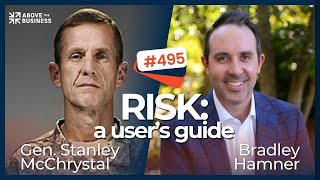
In this recast episode of the Above the Business podcast, host Bradley Hamner interviews retired General Stanley McChrystal about his new book Risk: A User’s Guide. The conversation centers on the concept of a "risk immune system" for organizations—a set of ten inter‑related factors (communication, narrative, timing, leadership, etc.) that enable an entity to detect, assess, respond to, and learn from threats. McChrystal explains why traditional, top‑down decision‑making fails in fast‑moving, high‑stakes environments and argues that leaders must shift from approving every operation to empowering subordinate experts while retaining ultimate responsibility. He illustrates his points with historical case studies such as Pearl Harbor, the Maginot Line, and the COVID‑19 pandemic, showing how neglect of internal resilience leads to catastrophic surprise. The dialogue also covers practical leadership tactics: delegating authority, creating feedback loops that encourage dissent, asking open‑ended “essay” questions, timing decisions under imperfect information, and the importance of self‑discipline and shared accountability. Throughout, McChrystal stresses that planning is valuable for the learning it generates, not for the plan itself, and that organizations must be adaptable, not brittle. The episode concludes with a brief promotion of the book and a reminder that everyone deals with risk daily.
Chapters
All of our missions were life or death, and they were strategically important to the effort. And so when I first took it, I had a view that therefore it was my responsibility to make those decisions, to approve those operations. But I quickly found out that I'm not the right person to be approving those operations. One, I can never be deeply enough involved to really be value-add to assessing whether we should do it. And what I'm really better to do is to provide an environment of information and empowerment and a sense of accountability for what we do that gets an environment in which subordinate leaders who are closer to the problem and actually more qualified to make the decision than me making it. Now, here's the hard part. I'm still responsible.
What if you could step out of the day-to-day and see your business from a whole new perspective? Welcome to Above the Business, where we empower you to rise above the daily grind and embrace a higher way way of business ownership. Get ready to build your business by design.
Welcome to another episode of the Above the Business podcast. My name is Bradley Hammond, your host. On today's episode, we have a recast of one of my favorite episodes of all time. I was honored to be able to record and interview General Stanley McChrystal. I remember this really early on. It is by far the most nervous I have ever been on a podcast, and he could not have been more kind. It was an absolute honor privilege to get to interview someone who literally reported to the President of the United States at one point in the past. And so his book Risk came out, and I really feel like that, hey, this interview was fantastic. There's so much to learn from a leader like this, but also his book Risk is a fantastic read. So if you're new to the podcast, have not heard this episode with General Stanley McChrystal, I think you're going to absolutely love it. Without further ado, here's my Recast episode with General Stanley McChrystal.
Ambition is the first step towards success. It's time to level up your agency, and Coach P Consulting will help you do just that by using the same strategies he used to sell over 700 life insurance policies in 2021 alone. Now, this is not your regular one-and-done type coaching. You'll get personalized coaching 2 days a week, every week of the month, and you'll get a live look behind the scenes of his team training and an office that's performing at the highest level. There's a reason Coach P Consulting is the fastest growing coaching company for insurance agency owners in the country. Coach P will train your team alongside his own and show you the exact steps they are taking to achieve Chairman's Circle, Exotic Travel, and Multi-Line Presidents Club and be one of the few agents to be selected to have a third office. So whether your goal is to be at the top of your local market or amongst the best in the country, this training will give you the strategies and the tactics to get there. For just $250 a month, you'll get high-level coaching each week from someone who is already getting it done at that level and his strategies work, and it's time to put them to work for you. Sign up at coachbeetconsulting.com and get your first full month for free when you mention the Club Capital Leadership Podcast. General Stanley McChrystal, welcome to the Club Capital Leadership Podcast.
Well, thanks so much for having me.
We're excited to have you. So we always start with background and origin story, but I'm going to ask you a question about your background that you may not get asked very often. You have a very rich military family from whenever you were a young boy with your siblings and your grandfather and your father. How did that time whenever you were growing up impact and just shape you as a person and also the leader that you are today?
That's a good question. On the one hand, I didn't live on Army bases in my conscious years of my youth because when I was very young we did, but then by the time I was 3, my father had moved us to Washington, DC. He worked in the Pentagon and then he would leave us there when he went to Vietnam and came back. So I didn't spend a lot of time on bases, but I was very conscious that my father was a soldier. And so my picture of what a leader looked like was my father. And my idea of how you should treat people came from my father. I never knew my grandfather. I only knew of him, but my father and then some of his friends, so I got this sense from a very early age that I wanted to be my father. Therefore, I wanted to be a soldier. And then as I extrapolated that, I started to think what that really meant and what leadership was. And that, of course, evolved throughout my lifetime like most people.
You know, as I shared before we got started, I'm coming to you in Huntsville, Alabama, a very strong military presence in this part of the country. And there's this image of discipline and accountability and structure that happens in military. And while that is certainly true, The environments that you were in were anything but that. They were constantly changing and adaptable. And when begin to think about everything that's going on in the world at the time that we're recording this, still in the COVID pandemic, there's so much change. And in your newest book, Risk, you begin to talk about a healthy risk immune system. Specifically, what do you mean by healthy risk immune system whenever it comes to because we can think about it when it comes to our personal health, right? But what does that mean for our organizations and why is that important? Sure.
First, if you think of the analogy that we draw to the human immune system, you say, well, okay, we've all got one. But what does it do? Because we don't spend a lot of time fixating on it. Well, what it does is about 10,000 times a day, it detects risks, threats that are coming to us, pathogens and other things. It assesses each of them whether it is in fact a threat. Of danger to our health. It then responds. It attacks it if it's bad or defends whatever or ignores it if it's not. And finally, it learns from it. And that's sort of the idea of vaccines. It makes the body ready to respond to that threat should it appear again and do it more efficiently. Well, organizations have the equivalent. And the risk immune system, as we call it, is really almost a number of factors or strengths or weaknesses, such as communication within the organization, how well information is shared effectively. The narrative— do people in the organization understand and believe and align on a clear narrative? And can the organization operate in a timely fashion? Can it do things as quickly as need be? Does it act, or does it admire a problem when it's— you know, sometimes we have a risk that comes in life, we all just sort of stare at it, deer in the headlights, and don't do anything. And there are 10 of these factors, and they interact. They create the equivalent of a system that if it's healthy, then the organization becomes able to detect, assess, respond, and learn, and to be resilient in the face of risk. Because our thesis is that you sort of waste time if you try to predict every risk that's going to appear. Because some of them are impossible to know, others are impossible to do anything about. And so rather than spending your time looking externally, if you make your organization stronger, more resilient, more healthy, we could say, you're going to do a lot better. And so I think we see— and as we research for the book, we see countless examples of where organizations try to predict the next great risk. And they got overwhelmed by either unexpected risks or very predictable things they should have been able to deal with.
You mentioned, and you have a great image in the book of the gears and how one thing affects another, two affects another. And then there was one where leadership, more than any other factor, can make the system function or fail. Quite frankly, we could have a 4-hour conversation around leadership. But I do want to ask you a few things. Can you just touch on why leadership and how you say how we direct and inspire the overall risk immune system, why that is so important.
Well, if we think about it, if we're in a big organization, we've ever been in an organization that is large enough to have different components. Sometimes they're siloed, sometimes they're just distinct performing their function. We need a couple of things to act. We need information to act, but we also need authority to act. And we need, in some cases, a little bit of inspiration or motivation to move and act. Almost always, leadership becomes the critical— we describe it as a wrench in the book that gets the other gears moving. But the reality is, if you've got a threat approaching an organization and everybody's wondering, what should we do? You sometimes need a calm, steady, decisive voice that says, OK, everybody. This is a threat to us. We are going to act. Start acting. Now, they don't have to micromanage everything involved in the reaction because I think there's a great room for initiative. But the reality is somebody has got to often tell the organization, pay attention, this matters. Now we've got to do this. And then set feedback loops so that that leader can give information back to the organization. Yep, we're doing well, or we're not doing well, and this is what we need to do from here on. We'd like to say that everybody can operate individually, but we don't have a wide enough field of view. We're all operating in our lane. And so we've got to get context to know when and how we can act.
You know, in preparing for the podcast, I heard you say something I think is a great segue from what you just mentioned. And that is you, by your own admission, early on, started to make the change from becoming a decision maker with everything that you did to a priority setter. And so how do you see that relating to what you just mentioned there?
Very much. And I think it's an experience many leaders have as an evolution through their career because early in our career, we're focused on being competent at what we do, technically proficient in our job. And we do our part of the overall effort. But then when you get bigger, suddenly you're leading through people. And there are experts below you that know much more than you do. And they're the appropriate people to execute certain things. But in fact, they need somebody to tie that together. In my military career, I found that as I got more senior, I had these wonderfully competent subordinates, but they needed to be empowered. And they needed to be empowered with a couple of things. One was context, information. I needed to share more information. I couldn't treat them like mushrooms and say, "Just do what I say," because they didn't understand the big picture and they couldn't shape what they did effectively. The next thing I had to do was expectation. This is, you are, you have the authority and the responsibility to act more broadly. And so leadership essentially can unstick all the other factors that can get caught up with a little bit of inertia. And leadership unsticks that.
I would be remiss if I didn't have an opportunity to ask you this. Delegation, because it just kind of one of the things I'm hearing some of the times, and you can maybe even point to this, that you were giving the responsibility and the authority to act in decisions that may have been life or death, but you were pointing the way. And so a lot of times we as business leaders, we're so slow to want to delegate because we think we're the only one that can do that. And for someone like yourself, that's been at the highest levels with the greatest things at risk possible. How do you see delegation as, as part of that, what you just mentioned there?
This is easy for us to talk about, but it's actually hard to do. And so I want to make sure listeners understand the difference there. Often when we are leaders, what we do is we think that we are responsible to make all the decisions because that's why we're in the job. When I was the commanding general of Joint Special Operations Command, our counterterrorist forces, All of our missions were life or death, and they were strategically important to the effort. And so when I first took it, I had a view that therefore it was my responsibility to make those decisions, to approve those operations. But I quickly found out that I'm not the right person to be approving those operations. One, I can never be deeply enough involved to really be value-add to assessing whether we should do it. And what I'm really better to do is to provide an environment of information and empowerment and a sense of accountability for what we do that gives an environment in which subordinate leaders who are closer to the problem and actually more qualified to make the decision than me make it. Now, here's the hard part. I'm still responsible. And a lot of leaders struggle with this. I remember getting with my subordinate leaders and saying, okay, you've got to delegate authority lower so we get quicker. But many of my subordinate leaders said, well, wait a minute, am I still responsible for the outcome? The answer is yes. And you go, well, if I'm not making the decision but I'm responsible, that's putting my fate in somebody who's junior and less experienced than my hands. Got it. That's tough. What you've got is develop them, help them, support them. But there's no other way. A very centralized system where theoretically you go to the smartest person at the top of the organization doesn't work anymore. If it ever did work, it's too slow now, and it's not involved enough at the lowest level to know the right answer. In fact, when I was in Afghanistan, I was now at that— the senior-most part of my career. We would come up with these strategies and plans, and we'd send them out all around the country. Through levels of the chain of command. And we realized— and it takes a little bit of humility to realize this— the order that I gave them may not be appropriate on the ground in some remote place. I may say this, and it makes great sense in Kabul when I say it, but when it gets down to this small valley or village, it doesn't make sense. And so what we told people was, if the order we give you is not right, execute the order we should have given you. Meaning know the big picture, know what we're trying to do, and then do what's appropriate, not the specific of what we said to do.
That's incredible insight and just a great metaphor for what we're talking about, how important it is to cast the vision for where that you want to take the organization. And then some of your other books, Leaders in particular, you talk about the importance of empowering followers. And that's kind of what you're mentioning there. Early on in the book, Let me read this one section because I think it's important for our listeners. Why was the attack on Pearl Harbor such a devastating surprise? It's a familiar pattern. Fixated on external factors, individuals, organizations fail to tend to their risk immune system and become vulnerable even to perceived risk. Time and again, we see that the greatest risk to us as individuals and to our organizations is us. Can you just speak to that?
Yeah, and I'll draw two parallels here. One is Pearl Harbor. With the passage of time, We refer to the sneak attack by the dastardly Japanese on Pearl Harbor as this day which will live in infamy. And that's true. But the reality, it was anything but a real surprise because for almost a year we had been at loggerheads with Japan because of their policies in China primarily. So we had embargoed raw materials to them and we put Japan in a position where It was not a viable state unless it either got the United States to release those embargoes or it started a war to go to grab the raw materials. So we put Japan into a corner and so we knew they were going to have to act, one of which was sort of surrender, which was unlikely, and the other was be aggressive. We even knew that they were aggressively looking around at potential targets. We had a good read into Japanese diplomatic cables and whatnots were actually reading part of their mail. And so there was this high likelihood that war was going to break out really within days. Now, Pearl Harbor was not viewed as the most likely place to be struck because of its geographic location was far enough that a carrier strike was a bold endeavor, but it wasn't impossible. Yet with all of those indicators and warnings going out from the United States and, and people being afraid or being aware What you have on Pearl Harbor is planes parked wingtip to wingtip. And the theory was you protect them from saboteurs, but you have most of the fleet in port. We were just lucky that the carriers were out on an exercise. So the reality is, despite all of this, we're so fixated on what are the Japanese going to do? We really didn't look inside and say, well, what is it should we be doing to be more resilient? If they do something. And it was almost criminally negligent to be as unprepared as we were. And the attack was not as big a surprise. And I would draw the same analogy to COVID-19. And I know this is a little bit controversial, but the reality is COVID-19 is not a new thing. That particular variant of the coronavirus is new, but we've seen similar viruses, pandemics from Spanish flu on and back in history. So we know that it is not only possible, it is inevitable that we will have the rise of additional threats like that. And we know what public health works. There's a good track record of that. So we know that we have an inevitable threat. We know the solution to it. And then when it appears, we freeze again like deer in the headlights for lots of reasons. One of the big ones was leadership, but there were other parts of the risk immune system that just didn't function effectively. And I think we still feel it to this day. We're still struggling with narrative. We're still struggling with leadership. We're struggling with a number of aspects, and it's costing lives. It's extraordinary.
Are you an agency owner looking to grow your revenue, increase your bottom line, and better manage your taxes? Club Capital is here to help. Club Capital is the largest accounting and advisory firm for insurance agents in the country, providing monthly accounting, Tax strategy and CFO services. Way more than bookkeeping and your everyday run-of-the-mill tax prep, Club Capital is focused on providing financial and tax advisory services that help you plan and forecast your agency's performance. Their financial dashboards and agency forecasting tools help you better understand your agency's historical performance, create and measure future targets, and see how your agency compares to your peers around the country. Imagine what it would be like to understand the impact to your bottom line when deciding to hire a new employee. Or forecast the impact rate changes or commission rates will have on your business. With over $200 million in tracked annual revenue and $140 million in tracked annual expenses, Club Capital has the data and the team to help you make better informed decisions for your agency. They will help you turn that back office stress into the backbone of your agency's success by giving you the tools to take your agency and your leadership to the next level. Visit club.capital today to book a solution overview with one of our business consultants. Club Capital, way more than a CPA firm. You detail also just about regarding the COVID-19, and again, a lot of people have different opinions of this, but the reality was, is that it is known that they were doing, and I think and believe in 2019, they had basically decided not to continue to fund, I cannot recall what it was called, but pandemic research basically. And they decided not to move forward with it. And less than a year later, Here we are. And we were caught totally unprepared. And I just have to pull this around to some of the things that our organizations and leaders who listen to this podcast are challenged with right now is hiring. Because of everything that's going on, people are having— organizations, managers, leaders, business owners are having a really hard time to be able to find great people right now. And the marketplace and the hiring market is just really challenging. And so when you begin to think about that, how do we begin to make ourselves less vulnerable to risk in the future? Because, okay, we are where we are now, and you're saying one thing, we need to make sure that we're taking action, right? We just can't stand idly by and say, I don't know what to do and be paralyzed, but we need to take action. But then looking forward, how can we begin to prepare our immune system so that we're less vulnerable to different attacks, whether it's COVID, a hiring, you know, challenging hiring market, etc.? Right.
It's a great question. It's almost key to how we have to think. If we think about those kinds of things that are going to potentially threaten our organization, we try to predict and we try to make a brittle wall. It's a little bit like creating the Maginot Line. If you get it exactly right, if you predict that the Germans are going to attack us and they're going to attack us right on this part of our border of France, and you build this impregnable line, then maybe you solve the problem. But as the French found out in 1940, they had built a very impressive line, but it wasn't complete. And so, it left part of their border unsecured. And so, the Germans simply went through that part that the Maginot Line did not protect. We need to think about that in our organizations. If I throw out the idea of cybersecurity now, cyberattack, because everybody's worried about it, and they should be. One of the new techniques from ransomware hackers is not to break into your system strictly technologically. What they do is they go to employees inside companies and they say, please insert this into your system. So they take a human to help them get around this Maginot Line that you may have created with very expensive cybersecurity. They get inside and then boom, there they are. And what does that tell us? That tells us that those threats will almost always find a way to get inside and to hit you. Organizations have got to be prepared for the fact that they are going to have to deal with that reality. It's always going to be a problem. So what I would argue is you need to prepare a team that operates when things fall apart. You know, in the military we used to do extensive planning, but every operation I went on never went exactly as planned, even though they were brilliantly planned. As they always say, no plan survives enemy contact. And so what we focused on doing was creating an organization that as soon as things start to be— we call it in football a broken play— you've got people with the relationships internally, with the initiative, with the basic skills that they can react adaptively. And that's the way our organizations have to be. We can't be brittle, process-driven, inflexible entities that do the following. We've got to be malleable. Adaptable would be the terms. And all of those factors are critical. And it's a mindset that bureaucracies sometimes struggle with because bureaucracies, if they're created on rules-driven processes, Have you ever been to a clerk in a government bureaucracy and you go up and have to have 3 documents and you've got 2 and, you know, and they go, it says here you got a 3, but it doesn't make sense. And that's what we've got to build in our organization.
I didn't know I was going to ask you this question, but I think it's actually important. You were just mentioning about that you went into the war with these elaborate plans and then you would make modifications along the way. But never once did you say, well, that was my plan. It's not working. So therefore, you know, you just throw caution to the wind. I guess it's out the window. I don't know what to do now. But a lot of times as business owners and leaders, we'll do the same thing. And so we'll put together a business plan. So we're kind of getting towards the end of this year, looking into 2022 to build our business plans. And no business plan I've ever created has actually worked out the exact same way that we did. So I have to ask this, this real basic question: why do we even do it? Why do we even put the plans together? What are your thoughts around that?
It's a really good question. And I would say planning is extraordinarily important. As Dwight Eisenhower once said, the value of planning is not in the plan, it's in the planning. And so when you plan, you learn the problem, you study the problem, you study your options, you develop capabilities. As we looked at in the military for years and I advocate today, war gaming, that is going through how the year will play out, never actually approximates how the year plays out. But what it does is it says, when things get ugly, what can I do? What levers can I pull? If I decide to cut costs, how long does it take me to cut costs in my company before I can actually harvest some of those costs? How quickly can I change direction in this or that or logistics or whatever? Unless you know those things, then you're far less adaptable. You know, whenever you see a movie when something starts to go bad and the great leader brings everybody together and says, what can we do? And people start putting information. If they've done that beforehand through a wargaming process, they've learned what their options are, what their capabilities are. And then it's much easier to, we would say, option off the basic plan.
No, that's really valuable. That's great insight. Okay. So I wanted to pull out a couple of the 10 risk factors. We've talked about one pretty extensively, leadership. I wanna go to the very first one you mentioned, which is communication. And the reason I wanted to ask you about this one is because with so many people, remote work has become a much bigger thing in the last couple years. And so this conversation's not so much about remote work specifically, but more about fragmented conversation, OK, fragmented communication, and how important it is to make sure at the time that we have with our teams, that communication is actually being disseminated correctly. And so, I'm sure that you can relate back to stories that you may have thought you were so clear as to what you were trying to communicate, kind of where things were going to go. And they went off and they took action on exactly what it was that they thought that you wanted. Only for them to find out that's not exactly what he wanted. So can you speak to this communication, how important that is?
Yeah, it's so hard. I'll start with just a story. When I was a regimental commander, I commanded the 75th Ranger Regiment, very elite unit in the U.S. Army and very disciplined organization. And by the time I'm the colonel, I've been in it a long time, and I think I've got a lot of great ideas and guidance to impart. So I do. But I go out and talk to young Rangers all the time, and I remember going to them I would have conversations like there'd be 3 young Rangers out in the field and I'd sit down with them and I'd start a conversation as it goes. And then I'd ask them to ask me questions. And it took a while for them to get over their caution. I remember one of them asked me, I can't remember the exact question, but it was sort of like, "Sir, why do we have to wear our underwear on our heads?" I remember going, "What are you talking about? Nobody ever said you had to wear underwear on your heads." But guidance I'd gotten out, by the time it made its way all the way through the chain of command, had gotten corrupted unintentionally. But by the time the private's sitting there going, what in God's name is this guy talking about? And they're down there usually just being disciplined, putting their underwear in their head and going, I don't know if the old man's, you know, lost it. So the first problem is just the fact that getting information to people clearly is hard and it takes repetition. We always talk the rule of threes. Unless you've said it 3 times you haven't said it. And leaders have got to be careful that they say it very clearly. And sometimes they have to use slightly different words just to make sure everybody's getting it. Then, you've got to understand that they've got to be able to understand it. They've got to be willing and able to receive it. So, you've got to ensure you've got the technical capability to get it to them, whether face-to-face or whether you've got to get it over the computer, radio, whatever, telephone. You got to be able to connect. They got to be able to reach it on the other end, but then they've got to understand enough and have a willingness to take in what you've said, to digest it and go forward. I remember when I was a younger Ranger officer, we were planning an operation and a guy gave an operations order, told the Rangers, you know, okay, here's what we're going to do. And near the end of it, he says, we're going to be very careful not to create any collateral damage. and I was evaluating this platoon attack is what it was going to be. And so when they stopped, I said, can I ask a question? And I turned to one of the young Rangers and I said, Ranger Smith, what is collateral damage? And the young Ranger looked at me, he says, so I don't know, but we're not going to have any. And so, you know, there, a guy given a good order, but you don't have the ability for that young guy didn't have enough understanding to get that. So when we talk about communication, it's really an art. And it takes huge amounts of effort. It's not just transmitting.
As we're talking, you just bring up things that I just did not know that I was going to ask you about. But earlier you mentioned about feedback loops. How did you ensure that you did not surround yourself with people who were just going to be— I don't know how else to say it. But yes men and women, like they were just going to, because of your position and authority, that they had the confidence and that you articulated how important it was for them to challenge you on your own ideas. Because a lot of us can say, well, you know, we're the business owner, so whatever we say goes. And anyway, you get the point of the question. How did you do that and articulate that and create that environment where people were willing to challenge you? On some of your ideas and thoughts?
It takes a lot of thought about it because we all say we want those people around us, but when we get busy and we're trying to push something, we really don't want that. We want to look at everybody and we want a Greek chorus behind us going, "Yes, so great one, you nailed it." So you've got to construct that first. You've got to go find people who you know have that tendency, and then you've got to keep reinforcing it. You've got to tell people I want you to tell me what I've got wrong. I want you to give me that. And that means the leader has got to be not just open to it. You can't just say, well, listen, anybody, because you may believe that, but they're not going to say it unless you ask it. So what I learned as a more senior officer is, and the higher you get, the harder it is, because the higher you get, people are more nervous about being very candid to you. And so you've got to learn to ask questions in a way that elicits a different kind of response. So, for example, I learned by the time I got very senior that if I went and asked people, okay, how's the strategy going? They know it's my strategy, or whether I came up with it, I approved it. And so they're not going to go, well, I think this sucks. They assume I don't want to hear that answer. So they'll go, going great, sir. So you can't ask that question. What you have to ask is, and the way I learned to do it was, If I told you you couldn't leave Afghanistan until we win, what would you do differently from what we're doing right now? Now, what that is, it's kind of like you go from multiple choice question to essay question. You make them answer a broader thing and you have to kind of pull it out of them, but you have to pay attention. Meaning if you are a senior leader and you go down and you ask somebody's opinion, and then when they start to answer, you look over their shoulder like you're looking for something more interesting or the next thing. That just shuts it off. So you've gotta listen, you gotta follow up and pay attention.
Two things that really stand out to me. I love the analogy you gave. Instead of giving multiple choice, ask a question where they give an essay answer. I love that. That was fantastic. I've never heard that before. And then it just illustrates again the power of great questions and just as leaders, how important that is for us to develop that skill. And don't you believe it's a skill, by the way, it's not that somebody is inherently born as being, well, they're just a great question asker, right? They're just born with that. I don't think so at all. Don't you agree that it's a skill you can actually develop?
You can. You gotta sit back and think, what am I trying to get out of this conversation? What do I really want to know? Mm-hmm. And so that skill, sometimes you just watch people who are good at it, but you can also sit, but before you have an engagement with a group of people, you've gotta decide, what do I want from them? And how senior are they? What's your experience level? What kind of questions do I need to ask them? And it takes a little bit of prep. You know, being a senior leader requires intentionality because each of your interactions with people in your organization is a little stilted because of the— often the difference in experience levels. But it's also not often enough because if it's a big organization, you just can't mathematically. You've got to make each one effective. You've gotta make it two things, very informational for you and inspirational for them.
Are you a football fan?
I am.
So football season is upon us. And if we think about whether you're an NFL or college fan, you think about you can do the right things at the wrong time. So in, for instance, if a team goes out and does the 2-minute drill to start the football game, you would be like, what in the world are they doing? That makes no sense. The reason I bring this up is just in one of the 10 factors. You talk about timing and talk about how when we act affects the effectiveness of the response. Can you just touch on timing and how we can begin to think about that within our organizations? Sure.
Timing is really hard because typically we say, well, the key thing about timing is doing something early. And sometimes that's true. Sometimes it's not true. Sometimes you should not make a decision or start to act until you have as much information as is possible appropriate to that situation. The challenge is knowing a couple of things. The first thing you need to understand is what problem am I trying to solve? What's my challenge here? The second is what action will likely produce the outcome I want? And usually, there's a cost associated with that. So, you don't want to pull the trigger on it until it's appropriate or you have to do that because you don't want to spend huge resources on things that are unlikely to occur. But the key thing that a lot of leaders don't understand is if there is an action that will be effective or is needed, it has to occur at what point? You know, to identify that. When does that have to happen to be effective? Because if I swing at the pitch too late, no good. And so when do I have to start my swing for it to be effective? Then you've got to back it up and you've got to back it up to when do I have to decide to begin that action? And one of the things I saw routinely in government, I see it in business as well, is leaders don't understand that, that time relationship because they don't want to make an early decision because they don't want to make a mistake. So they defer the decision, defer the decision. Until they've got as close to perfect information as they can and then say, okay, let's do X. Well, by that time, it takes too long for the organization to kick it into motion to start to act and have the effect you want. So you're, in fact, swinging late at the pitch. Leaders typically have got to make decisions on imperfect information, but they need to understand what that point is. So one of the first things a leader should ask is if you have a growing potential crisis, learn enough to know what actions would be needed, what decisions produce those actions, how long they take to decide, and how long they take to implement. And then when you've made those, then you start to say, well, I have to make a decision on this by this point, or it's of no value. And so routinely we see people not respecting that. Reality and then being frustrated when their decision doesn't work right.
You know, Phil, what I hear described there is almost this dichotomy between perfectionism and delaying on taking action of something. But on the other end, you hear, and I know you see often, people making decisions based on their emotions in the moment. And so that could be one of two things. So you're emotionally charged, both excited, things are going well, you've landed a big deal. So now you go think you can go hire 10 people off of that one thing. Conversely, things are happening and you decide to start slashing and cutting 10% of the workforce without actually thinking through that. Help us to reconcile how you, because at the end of the day, you're a human being too. And so whenever you were faced with having to make a decision in the moment, I'm sure your emotions were coming in. So how did you almost detach yourself slightly from the emotion of the moment to be able to make a logical, thought-through decision even in spite of, as you just mentioned, imperfect information.
Yeah, it's a really important point for leaders. First, when you have time to do due diligence, to study the problem, to get all the analysis you can, gather data, you should do that. But there are many times when there's just not time to gather as much information as you'd like. The key is very upfront up front making the decision we said that says, or making the analysis that says, when do I have to decide this to have the effect that I want? And it may be now. You've got to decide this minute, or you're going to have a declining effectiveness of your decision if you delay making it. And that's when leaders often have got to say, okay, I am going to use my intuition, my experience, all the things that got me in this position. And I'm going to make that decision. If you think about a pandemic, for example, the problem with the pandemic is the growth of the viral spread is exponential. It's not linear. So the reality is a leader has got to make a decision far before it's obvious to people that it's going to be a pandemic. And so you are saying, hey everybody, I am going to implement a number of things that may not be popular, may be difficult, may be expensive, simply because I think there's a very high probability that this thing will get out of control if we don't do that. And the hard part for leaders is if you do that and it works and it doesn't become a pandemic, you've got all the people on the sidelines going, wow, we spent all that money, we did all those things. And in reality, it wasn't a pandemic. And the leader can go, well, yeah, it wasn't because I, We did that. And yet, if you wait till the house is on fire, then everybody says, we've got to do something. The reality is, in many situations, then your measures are relatively ineffective. And so, that is a point where leaders have got to have a certain amount of courage because often the people around you will be counseling, well, let's wait till we get better information. Let's mitigate the risk of this decision being wrong or criticized. And sometimes leaders have just got to get in front of that. Nope, I think the risk of this is too great. We, in fact, we've got to act early.
I just learned something there. So did you ask, did you actually, whenever people would come to you with a decision, would you ask, is this the decision I need to make right now? Or ask for that deadline? Were you clear in that?
Yeah, I learned to be. And the first thing you ask is, okay, what decision are you asking? What is it you are asking me to approve or whatever you want me to do. It's pretty important to get that one. And if I gotta go ask somebody else, if I need higher approval, I gotta identify that right then. So you're asking me to ask for approval, which again, you gotta factor in a time factor. So the first thing, and then I'd say, when do you need this decision to execute this? And they always go, well, we'd like the decision right now. I'd say, no, explain to me when you need it and why you need it then. Because it educates you on the problem very quickly. Now, sometimes it's, yeah, we needed them. We should have made this decision yesterday, but we didn't know to ask you. All right. That's not hard. You go. But the reality is you've got to set these parameters up early or you'll tie yourself in knots.
We started the conversation talking about how all of these factors are like gears and they affect one another. And what a beautiful illustration of that than what we just talked about whenever you were mentioning We were talking about timing, but then you were saying how that affects communication because you're just saying, wait a minute, what is the question you're asking me? Let me make sure I'm clear on this, number one. And then number two, what is the timeline in which I need to actually get an answer back to that? I think that was a great analogy. Well, obviously, we would love to be able to go through all 10 of those. We touched on communication, timing, a little bit of adaptability and leadership as the overall. I wanted to ask you, what do you believe, I mean, you've this book on risk and leaders, one of my favorite, Team of Teams, fantastic book, as I mentioned to you earlier. What do you believe? I think I've heard you mention that leadership is very misunderstood. So this is a two-part question. Number one, why do we not really know what leadership is? And then in your opinion, what is the number one leadership trait that leaders need to develop?
Sure. I think we don't understand leadership because we want to simplify We want to see a great woman or man come and tell us the way and go. And then we always get disappointed when we find out they're human. They make mistakes and they've got shortcomings and whatnot. And so we go through this sort of up and down. We love this person, we hate this person because they're not everything we hoped they'd be, nor are we. So that's sort of one. And so when we put too much faith in the excellence or the omnipotence of a single person, we're going to get disappointed. That's going to happen. On the other hand, leaders are extraordinarily important. I will tell you, I bounce around on what I think the most important leadership quality is. And I've really come down to self-discipline. Most of us know what good leadership looks like. If we've been lucky enough to be exposed to it, we know what it looks like. We may know what bad leadership looks like because we've been exposed to that as well. We've had good days ourselves as leaders who've had bad bad days, and we know it. So, it's not a question of not knowing what we should do. It's not having the self-discipline to do it. How do we do all the things the way we know they should be done? How do we treat people? How do we make decisions? How do we do things as opposed to default to something that is lazier? There are all other traits of empathy and whatnot that I think are very, very important. But at the end of the day, if a leader can't make themselves behave in a way that they know they should, then they're really not gonna be very effective because it's of no value to know the right answer and do the wrong thing.
My last question for you, and then we'll share with people how they can pick up the book, is how do we as leaders develop the skill and the confidence to be able to let go and actually empower the people who we are in charge of leading?
Yeah. We all sort of philosophically can agree with it. We should do that. But then, when we get in the moment, we centralize, you know, and just, it's our company or it's our responsibility. And so, we say, "They're just not ready to do that." I think it takes making the very overt statement to your team that that's what you're doing. It becomes a shared accountability there. If you get in front of your team and say, "Okay, this is what I'm going to do. I'm going to push down. I'm going to empower you. I'm going to give you information. I want you to do X." hold me accountable if I'm not doing that. And then you say, of course, I'm going to hold you accountable to execute with the same level of responsibility and professionalism that we hope so. Otherwise, you have a tendency to be one kind of leader one day and then lapse back into centralized, et cetera. I think it has to become a cultural thing, and you have to keep pushing the idea of shared accountability.
That's so true. Yeah, I love that. Well, this has been a fantastic conversation. I think I could talk to you for for hours and ask you so many different things. Congratulations on the book. This is your fourth book. Your first book, My Share of the Task, Team of Teams, Leaders, and now Risk: A User's Guide has just recently released. General McChrystal, how would you like for people to be able to pick up a copy? I know that they're going to want to.
Yeah, it's really exciting for us. Of course, you can go on Amazon, you can get it. You can go through— it's Penguin Random House book. The key thing are the ideas. And if we all stop and think about, we deal with risk every day. There is no way to hide from it. So as I tell people, you don't need to read this book unless you deal with risk. And of course, the answer is, therefore, we all better read it.
That's right. Absolutely. Well, General McChrystal, thank you for your service to the country. It has been an absolute honor to get to speak with you for a few minutes, and I hope that we're able to have you back on in the future. Thank you so much.
My honor, Brett. Thank you so much.
Well, I hope you enjoyed that recast episode of the General Stanley McChrystal podcast from a few years ago. It was an absolute honor to obviously be able to have him to come on the podcast. Shout out to our podcast and brand sponsors, Coach P Consulting, DirectClicks, Club Capital, and Autopilot Recruiting. Look, if you want to minimize your risk with your financials and maybe even the tax man, Club Capital can help you to do just that. Go to club.capital, book a no-obligation demo today. Furthermore, one of the other riskier things in business is sometimes the team members that you hire. And so therefore, look, we always hire someone with the intent that it's going to work out, but there are times that it doesn't. Or maybe you get a recent surprise. Somebody has left. That's why recruiting consistently matters. But the execution of that can be really difficult unless you work with a partner like Autopilot. Autopilotrecruiting.com. Autopilotrecruiting.com. Look, the move with AI is obviously making it into marketing as well. Are you familiar with PMAX Are you familiar with all of the changes that are happening in with Google? Well, if you're not, that's okay. If you work with a partner like DirectClicks, they are on top of those changes and can make sure your campaigns are optimized and even optimized for AI. Go to directclicksinc.com, directclicksinc.com. And last but certainly not least, as we get into football season. It's important for you to have a coach as well as to have a coach for your team. If you're an insurance agency owner, there's none better than Coach P. Coach P Consulting dot com. Coach P Consulting dot com. Hey, by the way, if you're listening to this, coming up at the end of September, we have got the quarterly. We're going to be, believe it or not, planning for Q4. We'll reflect back on Q3, we'll plan for Q4. I'd love to invite you to the event me and my team are hosting for small business owners to plan for Q4. It's going to be on Tuesday, September the 23rd, from 10 AM to 12 PM Central Standard Time. I'd love to invite you to be able to come. If you go to my website blueprintos.com/assets, blueprintos.com assets, you can register for the event. I look forward to seeing you there and helping you to plan and have a fantastic Q4. All right, everyone, hope you enjoyed that recast with General Stanley McChrystal. Until next time, lead well and go be great. Hey, if you like videos like this, click below. We'd love to have your support. Like and subscribe so we can begin to grow this channel. We have big plans going into 2026 to do more things specifically for our audience on YouTube. Would love if you would like and subscribe and maybe even share this with one other person.










