Episode 499: The Godfather of Customer Experience on Building Culture at Scale - Bruce Temkin
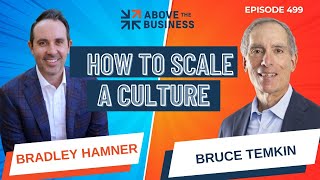
In this Above the Business podcast episode, host Bradley Hamner interviews Bruce Temkin, widely known as the "Godfather of Customer Experience" and host of the Humanity at Scale podcast. Temkin shares his unconventional career path—from engineering submarine missile systems to leading tech and research organizations, creating Forrester’s customer‑experience practice, and running a thought‑leadership institute at Qualtrics—culminating in his current mission to embed humanity into organizations at scale. He defines "humanity at scale" as intentionally infusing humane interactions into every layer of a company so they can be replicated across small and large teams. The conversation explores how intentional culture‑building, micro‑moments, and reflective leadership can shape both employee and customer experiences. Temkin revisits his Six Laws of Customer Experience, emphasizing that disengaged employees cannot create engaged customers, and argues that improving CX must start with employee experience. He discusses navigating complexity and uncertainty by adopting short‑term correction patterns, increasing an organization’s change capacity, and providing clear, simple direction amid chaos. To avoid adding further complexity, he advises leaders to practice "selective neglect"—deliberately choosing what not to focus on. A core practical framework he offers is a hierarchy of reflection rituals (daily, weekly, monthly, quarterly) to build habit, gain clarity, and align actions with purpose. Temkin also outlines his advisory approach, teaching leaders to guide with purpose, embrace values, cultivate trust, and act with empathy. Finally, he explains what “working above the business” means: focusing on the broader impact on employees, customers, and communities beyond mere financial results. The episode ends with actionable takeaways, including daily reflection, selective neglect, and the fire‑hose metaphor for strategic focus.
Chapters
Welcome to another episode of the Above the Business podcast. My name is Bradley Hamner, your host. On today's episode, we have Bruce Timken. He's often referred to as the Godfather of Customer Experience, and he's also the host of the Humanity at Scale: Redefining Leadership podcast. In this episode, we talk about a lot around culture. We talk about how do you navigate complexity and uncertainty at scale, and what are the ways that we can use reflection and the cycles of reflection to be able to help us to, number one, get clear ourselves, and then number two, be able to communicate that in a very simple message to our teams. We talk about that and much more in this episode. Without further ado, here's my conversation with Bruce Timken. Bruce Timken, welcome to the Above the Business podcast.
Thanks for having me.
Excited to have you. We love to start with background and origin story. I think it's fascinating to kind of hear people's journeys. About how they got to where they are. Why don't you take us back to wherever you feel is appropriate and, and, uh, bring us up to speed about who you are?
Yeah, I have a journey that, um, doesn't make sense going forward, but I sometimes can make logic out of it going back. I started as an engineer designing submarine missile systems, uh, and made it all the way to do now, which is helping leaders understand how Putting humanity first is actually the recipe to sustainable business and organizational success. So in the middle, um, I led lots of development organizations, um, tech organizations for Fidelity, for some internet startups. Then I spent 12 years at Forrester Research. For those who listen, don't know, it's sort of one of, if not the leading research firm that looks at future trends with technology. In that, I created the practice around customer experience. I went on my own, I got acquired, and then worked for several years at Qualtrics, where I led a thought leadership institute inside of that big tech company focused on experience management. So what were the leading practices, what were the results, and what were the opportunities in the world of customer and employee experience. And that gets me to today where I am driving a movement around humanity at scale.
Tell me, what does humanity at scale— and I know you've got the kind of the sub-bullet point of that redefining leadership— but what does humanity at scale actually look like? Scale gets thrown around quite a bit and people have a little bit different— it's almost open interpretation in some respects. But how would you define that?
So to me, when I talk about humanity at scale, there are humanness of interactions, right? You can talk about humanity in terms of how we treat each other, right? And that's certainly an important part of humanity. You can talk about humanity in terms of what the world looks like and what organism and what sort of countries look like, the big humanity. But the place that I wanted to have an impact is on how do you bring that humanity to an organization in a way that it scales across teams, right? Small teams to larger teams, larger organizations. So it's really a focus on what is it that leaders can do to infuse humanity in their organizations in a way that scales. Scale has always been important to me. It gets back to my engineering roots. Mm-hmm. Right? There's a lot of stuff you can do in a lab, you can do one-on-one, you can do once, right? But if it doesn't scale, if it's not something that can be done repeatedly or mimicked by other people or happen in a consistent way over time, then it doesn't drive change and it doesn't have sustained impact.
With so many people, and I don't know how much you see this, but I mean, this just came up yesterday, so it's relevant for me to ask this question. But business owner, we were having a conversation around culture and it came up around specifically remote and even some cases remote fractional teams. And they said, I think it's really, really hard to build culture whenever you're not with people, right? I mean, you may be across, you know, the country. And so they said, yeah, I mean, I understand that it's something I want to do. You know, it could potentially extend my hours of sales time if I have somebody on, say, the Pacific Coast. You know, you and I are talking on Central, you're Eastern time as an example. But I mean, they don't know how to be able to do some of those things. And so Do you see that often? And how do people kind of lead whenever more and more folks are working fractionally and even working remotely?
Yeah, I think that— so a lot of the stuff I do work with does center around culture. And that's a common sort of situation, which is how do I ingrain, embed culture into whatever group— fractional, distributed. To me, I come back to sort of a core foundation for any leader, which is the notion of intention and reflection. So I'll start there because I think that's a baseline you need to have, which is you have to be intentional about the things you do, and then you have to reflect afterwards. And if you don't have that, then anything I'm about to say about how you build culture ends up being meaningless, right? So on the intentional side, you have to think about what are the core tenets of the culture that you think are important, right? You can't just say, I wanna have a great culture and be vague in your thinking about it. And then try and build like this connection with everyone that fulfills it. 'Cause that to me is not intentional enough. Intentional culture looks like I want every voice to be heard, or I want a culture where we sort of revel in new ideas, whether they're good or bad. So thinking about culture, in those environments, you have to start with very intentional statements about what you want your culture to be like. And then the reflection, you have to think about your behaviors. I recently wrote an article on how culture is shaped by micro moments, right? Small moments that leaders have that signal what is appropriate for the culture or not appropriate. So for instance, if we want to have a culture where we say every idea is a great idea and we love the contribution of ideas. Well, if in a single moment you give a facial response that looks like you're souring on someone giving an idea in Zoom, you've killed that cultural sort of direction. So you have to really sort of be intentional. And then you have to reflect on in what ways are your behaviors either amplifying qualifying or negating the cultural attributes that you want to see. And so I think it really, really takes that combination. And this is true across almost anything we'll probably talk about, but I wanted to land it in certainly in culture, the notion of being intentional with clarity and reflecting on how your actions, even small ones like facial expressions in the middle of a meeting, have an impact on the people around you.
Hmm. Let's expand that out. You are often referred to as the Godfather of the customer experience. How do you feel like that then culture ends up shaping the customer experience?
Oh, it's one of the— so I wrote years and years ago, I wrote something called the Six Laws of Customer Experience. And one of the laws is that unengaged employees can't create engaged customers. At the end of the day, everything— I think of organizations as systems and the output of those systems actually interact with customers. If you think about your organization system, the predominant component that creates that output that customer sees are employees. If the employees aren't committed to the goals and the objectives of the organization, they're not connected to the purpose or vision, they're not going to try hard, they're not going to care much. If the organization itself and the leaders don't show the importance of customers, then neither will employees. So oftentimes, if I'm working with an organization and they want to improve customer experience, I'll oftentimes start with employees. Because what organizations sometimes do is say, "Okay, we have lousy customer experience," and oftentimes they probably have lousy employee experience. So we'll go and we'll try hard and we'll fix the customer experience, and it's like putting the phrase lipstick on a pig. Great, we can force the good experiences for customers. We can design things like good interactions in the contact center. Design good interactions in the store, we can redo the digital environment. But what happens over time is if those employees aren't on board and committed to the same direction and feel like they're valued, then all those things that we put in place will deteriorate over time. Um, and so even if we get a short blip in an improvement in customer experience, if our employees aren't engaged, then it won't last for very long.
Yeah. I'm curious around your ideas and thoughts about navigating complexity and change initiatives, and those necessarily don't always have to be together, but they certainly do tend to follow one another. You know, a business owner wants to make a change. Seems like on a daily basis that business owners, or weekly basis, business owners want to make a change. And look, they always, myself included, we always try to make changes in an effort to be able to do more, to be able to grow the companies, period. Um, so it's, it, the intent there is always good. That being said, with some of these change initiatives comes complexity and uncertainty. What are the ways that you have found that leaders have been able to successfully navigate both complexity, which could be inner, inner operations, but it also could be outward changes depending on the business. I think the majority of our business owners are not dealing with some of the tariff changes, but that is a good example. That is very much an external change. That could be affecting many other businesses that are out there?
Yeah, so one of the things that I've been pretty active telling organizations over the last several years is that complexity and uncertainty aren't a blip in the environment. They're actually the background by which every leader needs to think about operating going forward. So complexity, uncertainty is just the way of the world now. And I think that the way you operate in complex, uncertain environments is that you sort of make shorter— you always have to have a long-term vision, but you have to make shorter-term correction patterns. So one of the things that you want to do is not just make a decision and run with it. If you're changing something. But you need to make a decision and listen to the signals of the customers, of the market, of your employees as you're going along, which means that— it goes back to what we were talking about before— you need to engage your employees more than ever in uncertain and complex times because you need them to be part of the system that tells you what's going on in the world, what's working, what's not working, what's changed. And they also also have to be on board because they have to be the people that are willing to pivot, right? And change isn't easy for people. So we have to create an environment where our employees feel like they're involved and understand the why. Why are we making changes? Why are we preparing? What is, what, what is the uncertainty out there that we can understand and deal with? That way they become part of the change enablement, the change capacity. Change capacity is a good word because if you think about, I look at everything from the point of view of human beings in a system, so I'm very system-oriented. If you think about a bunch of people and a bunch of processes and a bunch of technology thrown together in a business, at the end of the day, those components have a fixed capacity to change or a set capacity to change. You can change really fast, you can make decisions all the time as a leader, but those systems and those people can only change to a certain degree because human beings don't change, your systems have to be redesigned. To some degree, to a lot of degree, I would say in uncertain and complex times, We need to increase the capacity of that system to be able to change faster. A large portion of that is conditioning the employees to be part of an environment. We also have to build our systems and our technology and our processes so that they change faster. If we're in a world where we have to make decisions and change what we do every 6 months, you can't compete if your processes take 9 months to change. If your technology takes 8 months to change. If the cycle of decisions, of critical decisions and critical pivots and critical changes are shorter than your ability to change the system, then you're in trouble. You have to figure out how do we change what we do to be able to more quickly respond to this uncertain complex environment. I'll add one more thing because I just talk a lot. Even in complex times, it's important that leaders provide clarity and simplicity to their employees. It's fair to share the complexity, but at the end of the day, we have to give our employees clarity on where we're heading and give them hope that we're heading in the right direction. And that oftentimes takes simplification from the leaders and sort of a sense of vision and purpose going forward.
All right. So that brings up a second follow-up question that I'll ask after I ask this first one. I think that was actually really great. One of the things I wrote down is the world is complex, but how do we avoid not making it more complex? In other words, the business environment. I've got a lot of businesses right now that they feel like, who moved my cheese? The thing that we did earlier 5 years ago that worked, 3 years ago that worked to grow the company doesn't seem to be working anymore. Now, sidebar for a second. I actually feel like that they get away from the things that do work. That's neither here nor there. But My broader question is the business, the world, the business environment is complex, it's changing, but how do we as the leader not do certain things to then overly make it more complex than it already is?
So, and I think that is a fair challenge, right? And I think that it requires leaders to, and I go back to intention and reflection, to be not just always responding in the moment. So I find that leaders tend to over-respond to the signals and the changes going on, which is, oh, this is happening, we're gonna try this, we gotta fling this around, fling this around. And if you're making a lot of small changes without a lot of thought, then that can make the world a lot more complex, as opposed to having clarity about where we're heading and saying, we're seeing these things, let's talk about it with our teams, let's understand it, and let's come to some vision of where we're heading. Because I do see that people oftentimes over-index on, and this is a recency bias that people have, a salience bias. Something happened with one customer and we overreact to that, or we lost this deal, over here, we overreacted. It may be an important signal, but it's one of many signals we need to have. And I think it comes back to also what you talked about, what you were hinting at, which is people lose their way, right? At the end of the day, organizations should compete on a set of competencies that they have. So part of what you need to do every once in a while is say, okay, the world has changed. What is it that we were strong at? What are we still strong at? What can we continue to bring to the market? And how do we actually do it in a way that demonstrates to the market that we are— we continue to be really good at these things? Yeah.
So my follow-up question to what you mentioned is, you said we must be clear, and I agree with this, we must be clear with our teams. We must provide clarity and simplicity. That is making a very large assumption that we are clear ourselves first. And right before this, I was sharing with you, I was a couple minutes running behind because I was on, on a call with a business owner that was dealing with a tremendous amount of complexity. The, the, the, the way that he verbalized that. I mean, this is real time. I mean, I haven't even debriefed that call, obviously, but very much real time. I, I'm putting out fires, you know, I'm putting out fires. Um, I've got these fires that, you know, I need to burn. But yeah, hear that, but it's, it's, it's, it's raging. And so I feel like a really, really good firefighter right now. And so he wants to provide clarity and simplicity, but he's not clear himself. He's not clear himself. And so how do you, whenever a business owner, entrepreneur, president feels like they're dealing with it, what are the things that they now need to do themselves? What are the things you help them navigate through so that they can find the clarity? They can find the simplicity to then be able to express that over to the team so that they don't feel like that they're honestly, you know, it gets really hard for a business owner to go, I don't know, I don't know, right? We tend not to do that. What are your thoughts?
Yeah, so I see that a lot. And generally the companies I deal with are very large companies, hundreds of thousands of people operating globally. So you can imagine what complexity might look like in that environment, right? Sure. To me, like, at the end of the day, you have to— as a leader, you have to recognize that there are situations that are drawing your attention, right? And you have to make a decision proactively about where you're going to use your attention. You cannot allow the world to decide where you're going to put your attention because there will always be things pulling you apart. And I remember, well, I, I, at business school, one of the first— I think it was the first time the dean, it was Lester Thurow, an economist, a Nobel laureate economist who was our dean. And he said something that stuck with me, which is that you're going to be working, you're going to be at school, and you're going to see so many things that are going to spark your interest, and you could read all night, and you'll never you will not ever be able to consume all of the material that we're gonna throw at you. So my one word of advice is learn selective neglect, which is the idea that you make decisions about what you're not gonna do and what you're not gonna focus on so that you can make sure that you're spending the time on the things that you really wanna focus on, because otherwise the world will make those decisions. You'll run out of time. When it comes to leaders like that, you have to first of all realize that as a leader, it's probably more important for you to establish clarity and direction for the organization than it is for you to put out every single fire. It might mean I need to step back and let some fires rage for a while. Because if you think about a fire, let's use the fire metaphor. Right? If, if I'm a firefighter in the middle of a forest that's ablaze, right, if I spend all my time with my single hose trying to put out that fire, it'll continue to rage and grow and we'll never get ahead of it. Whereas if I step back and think, what's my strategy to bring in more firefighters from different regions and get them on board and spend my time organizing them and maybe calling up the National Guard and getting some people to come overhead with dropping water. If I don't take the time to step back, and this goes back to my initial discussion about intention and reflection, right? If I don't step back and think about how am I going to make the organization succeed in this environment, then I'm just going to continue to be fighting those fires and falling farther and farther behind.
Yeah, I love the visual of a raging forest fire. I mean, obviously tragic, right? But I mean, think about the, uh, Palisades, Pacific Palisades fire, to your point, obviously tragic. We're using it as a metaphor to try to explain business and one person out there with their fire hose. Good luck to you. Not gonna, not gonna work. Right. And so. Yeah, I think, I think that's absolutely fantastic. How do you, how do you work with business owners? How do you work with leaders, CEOs, presidents of companies? What does that actually look like for you, Bruce?
So I'm generally an advisor to senior executives and provide like workshops and I do a lot of workshops anymore, like speeches generally to groups of leaders. And what I try to do, and this has been sort of my whole career, is to get people to shift their thinking by a combination of inspiring. So what I try to do is, at this point, is inspire them to understand how a better focus on people will help them achieve their goals and then give them some tools. So a lot of the work is around— I work on sort of 4 sets of behaviors. Like how do you guide with purpose, how do you embrace your values, how do you cultivate lasting trust, and how do you act with empathy. And so those are the skills that I try to teach, but the underlying, underlying component of that is I try to get them to have rituals of reflection. Because like I said, I— you can teach leaders just about anything, but they're not going to change and they're not going to have a consistent approach to anything unless they really, really reflect. And, and, and this is my advice for reflect is you need to have a daily, weekly, and monthly, and a quarterly reflection cycles. Like, how do you reflect every day? It might be small bits, might be in the morning, might be at the end of the day, take 5 minutes, think about it. But that's that. Then every week, at the end of the week, how do you reflect? How did we do? How did I do on that week? What do I want to do different? Monthly, when you have monthly results, how do I reflect? And then quarterly, like any time that you have the end to a period, how are you looking in the mirror and honestly asking yourself, how did I do and how do I want to show up going forward?
If I was going to, I hear this and I'm like, I get it. Daily, weekly, monthly, quarterly reflection cycles. Love that. I love the rich. I love the comment of the rituals of reflection, by the way, too. But if you had to pick one, I pinned you to the ground and I said, you got to tell me one. What is the one that you feel like, like if I was going to start somewhere, you know, because we tend to try to overestimate what we can get done. Oh, I'm going to start reflecting every day, every week, every month, every quarter. I'm going to have all these. Like, well, then we can add in our own complexity. But where should people start?
It's funny because I'm going to give you the answer that probably is counterintuitive. I would start daily, right? And it's counterintuitive because you might say, well, I can— quarterly seems like it's easier, right? But the, you know, in order to make the ritual of it, you need repetitiveness and you need to build muscle memory. So it's hard to build muscle memory on rituals that don't happen very regularly, right? It's easy to forget it and easy to let it go. So I would, I would have a daily reflection ritual, you know, after breakfast, before dinner, uh, late in the morning, whatever, but a daily one. And it doesn't have to be long, but that gives you the best opportunity for ingraining it in your ongoing rhythm of, of sort of operations.
Love that. Bruce, what does working above the business mean to you?
So, you know, I'm going to personalize it to my focus and my vision, right? To me, working above the business is understanding that whatever we do, whatever business you have, we're impacting people, we're impacting employees, we're impacting customers, and we're impacting the communities in which we serve. And, and being above the business is not only worrying about the results of the business, but worrying about what you are doing to change the lives of all those people that you're touching.
Love that. Bruce, people want to learn more about you, the work that you do. Where would you point them to?
Go to humanityatscale.com. That'll give you access to my weekly newsletter, which also in it, I highlight my, my podcast as well. But humanityatscale.com is the best place to go.
Love that. Well, I love the, the, some of my takeaways from today. Rituals of reflection and then what you called reflection cycles, daily, weekly, monthly, quarterly. Love the idea of the repetitiveness on daily. That's something that I'm going to consider implementing myself. I have the reflection ritual of Sunday night planning. I have the quarter, I have the weekly, and I have the quarterly. So I like to, I like to reflect on Sunday evenings on the previous week and plan a little bit for, uh, for the upcoming week. So I feel like I do a decent job of that one. And even quarterly, the two that I don't do is I don't reflect monthly nearly as much. I tend to get in my mindset of quarterly cycles and, uh, I certainly don't reflect daily. So that's something that stands out to me. I loved also the second part, which was. The selective neglect. I had not heard it ever put that way. I thought that was great. And then the visual, I would say, would be my third one, which was your single fire hose is not enough. And for me, I think about, you know, again, the tragic thing that happened over in the Palisades in California. But yeah, you're out there with one fire hose. That's not going to cut it no matter how hard you're working to be able to put it out. Bruce, thanks so much for coming on the podcast.
Thanks for having me.
Well, I really enjoyed that podcast episode with Bruce Tempkin. Make sure you go and check him out at humanityatscale.com. Big shout out to our podcast sponsors, DirectClicks. If you want to be able to help finish out 2025 with your marketing and your growth efforts, DirectClicks can help you to do that. Whether it's your Google pay-per-click, your SEO, your social media, they can help you. DirectClicks, I-N-C. Obviously, when we're talking about humanity at scale, we're talking about teams. Coach P can help you to train and develop your team and help you to train and develop yourself in all one monthly subscription coaching package. Go to coachpconsulting.com. Coach P consulting dot com. We all understand the value of team, whether it's a remote team or an in-person team. We also understand as business owners and entrepreneurs How smart it is to be always recruiting because you never know when you're going to have a gap in your team that you're going to need to backfill. That gets— it's easy to understand, hard to execute unless you work with a trusted vendor like Autopilot Recruiting. Autopilotrecruiting.com. Autopilotrecruiting.com. How are your financials doing for 2025? As you go into 2026, are you on pace for what you said you wanted to accomplish in '25? Or are you behind? Club Capital can help you to get on top of your financials. Go to club.capital. All right, everyone. Hope you enjoyed that episode with Bruce Timken. Thanks so much for your time and attention and considering sharing this episode with one other person. It would mean a tremendous amount to me. All right, until next episode, lead well and go be great. Hey, if you like videos like this, click below. We'd love to have your support. Like and subscribe so we can begin to grow this channel. We have big plans going into 2026 to do more things specifically for our audience on YouTube. Would love if you would like and subscribe and maybe even share this with one other person.










