Episode 503: The Blueprint to Scale Your Business from $3M to $10M+ with Chad Cannon
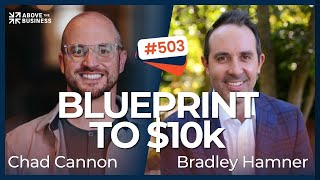
In this Above the Business podcast episode, host Bradley Hamner interviews growth strategist Chad Cannon about the specific challenges and strategies for scaling a company from the $3 million to $10 million revenue range. The conversation covers four core shifts required at this stage: (1) the owner’s mindset must evolve from hands‑on operator to strategic leader; (2) founders must step out of the rainmaker/sales role and build a repeatable sales system; (3) financial visibility must deepen, with a focus on lead‑measure KPIs, detailed cost‑per‑acquisition analysis, and disciplined budgeting (typically 10 % of revenue for marketing); and (4) organizational layers and leadership structures (integrator/COO, management teams) become essential, bringing decision‑making out of the founder’s hands. Chad also discusses practical marketing tactics—starting with a single dominant channel, then expanding to an omnichannel mix (Meta, Google, YouTube, Reddit, TikTok) once the budget exceeds $3 M—and the attribution headaches introduced by iOS 14 and privacy changes. They debate the “swamp” label for the $1‑3 M stage, emphasizing that a lifestyle business can thrive there if the owner’s vision aligns. The episode further explores CRM/dashboard overload, the importance of keeping vision communication constant to avoid “vision leaks,” and hiring strategies for integrators versus high‑salary C‑level hires. The dialogue ends with actionable takeaways for founders: evolve mindset, relinquish rainmaker duties, master lead‑measure metrics, build layered leadership, and continuously reinforce vision.
Chapters
Welcome to another episode of the Above the Business podcast. My name is Bradley Hamner, your host. On today's episode, we have my good friend and repeat guest Chad Cannon, who really is the growth guy. He worked with Donald Miller, worked with Michael Hyatt, but he has helped also so many businesses to be able to scale their companies. There really is not anybody that I personally know that understands what it looks like to be able to scale companies nearly as much as Chad. And specifically what we're going to talk about today today's episode is the blueprint from $3 to $10 million. We talk often about the different blueprints from $0 to $3, $3 to $1 million, $1 million to $3 million, but Chad is uniquely positioned to understand that $3 to $10 million space. So even if you're not in that arena, if you want to understand the differences between what those companies are doing and what you might be doing one day whenever you get there, this episode is for you. Without further ado, here's my conversation with Chad Cannon. Chad, welcome to the Above the Business podcast.
Thanks, Bradley. Excited to, to be here. This why I feel like it's the second or third time on the podcast with you, so honored to be back whether it's the second or the third.
It's great to have you. Uh, it's crazy that we're recording this after spending a weekend, uh, together, which has been— which was super awesome. So it was great to spend time with you, uh, personally.
Absolutely.
Uh, you know, Chad, you and I've gotten to know each other obviously, um, over the last several years and for our audience, right? We talk a lot around having a business blueprint. And one of the things that I thought would be great for us to start off with and kind of noodle on today is the space that we typically look at having different blueprints is in this, you know, what's it look like to have a stage-based blueprint from $300,000 to a million and then one from one to $3 million and then $3 million plus, and I typically would then say $3 million to $10 million. Certainly there's a lot of different ways for people to cut that up. And we typically on the podcast really focus in on that $300,000 to $1 million, the million to $3 million space. And there's really, honestly, uh, while you're a good friend, there's really not anybody that I know that has the depth of experience in, A, personally helping companies in that space and being a part of those companies, but then also working with other businesses to be able to scale from that space. And so what I thought would be a great part for us to discuss is the similarities, but also the differences in having a blueprint for your business from that, say, $3 to $10 million space. So with that context, what do you first think are maybe some of the biggest differences that you see with the companies that are in that space, $3 to $10 million, than what some of the smaller businesses face on a day-to-day basis when they're trying to grow their company?
Man, that's a great question. I love having this conversation. You know, I've been thinking about that since you kind of just like seeded it to me earlier today. It's like, hey, this is the angle we want to take. And actually one that just came to my mind, which I think is probably the thing we need to start with first, is it's a different mindset for the owner. You know, like, and what I mean by that is there are going to be things that you no longer are involved with in your business that at one point you did everything. And the reality is, is no one is going to be— no one is going to be able to do them as good as you. Certain things, there's going to be some things that people can do better than you. There's going to be some things you're going to have to be willing to give up as a business owner, and someone else may only be able to do it 70 or 80%, but that's actually what's going to be best for the business. And your mindset is going to have to be okay with that. And so, you know, from a sales standpoint, typically no one's going to be able to come in and do the same that you're going to be if you're the, if you're the primary salesperson, depending product or service and you're selling it. So that's the second thing is one, you're typically no longer the rainmaker. You can be the rainmaker up until probably certain types of businesses in the million to $3 million. A lot of times that's where you start to hire your first salesperson and, you know, but maybe you're still involved, maybe you're selling 70%, the other person selling 30%. But I also see a lot of times founder-led CEOs or companies, they hire a salesperson And they think that person's just going to come in and do it, doesn't do a great job of training, onboarding, person doesn't do well so that person gets back in and that person feels like, oh my gosh, I just lost 2 years in the business because everything that I was doing that I thought I'd be able to do since I wasn't doing sales, now I got to jump back into sales and then no one else takes with other things. And so you've got a good sales process and a good salesperson or team depending on the type of product that you sell and how many leads you have coming in. And then I think third, there's, you know, I know you talk about this with your clients, but know your numbers and it's different in the $3 to $10 million range. It's different. There's a lot more at stake. I literally was with a client today where we were mapping out our budget for next year and we called it really a global omnichannel brainstorming meeting where it's like, hey, this business has been built on the backs of— this year we spent $450,000 on Meta ad spend. That's how we've driven the growth. We started testing Google, YouTube with ChatGPT world. We're going into Reddit, all of this. So we're going to take 10% 10% of our marketing budget next year, which is going to be north of— because this— we scaled from $3 to— we'll do probably $7 million this year, and we want to go to beyond $1 million next year. So what I typically tell my clients is like, hey, whatever your revenue is this year, let's take 10% of it, spend that next year. So we'll come in between $7 and $8. So let's just roughly say, hey, we're going to take an ad budget of $700K. Next year and we're gonna divide that up across our channels. And so the majority of that's still gonna be Meta, but we're gonna take 10% off of that and we're gonna experiment and test. We're gonna test on Google, we're gonna test on YouTube, we're gonna test on Reddit, TikTok, all of it. And if you guys don't know, Reddit is becoming a game changer right now in advertising because ChatGPT, that is what ChatGPT is referencing first and foremost when doing search queries. So Reddit is huge. If you are not dabbling, even from an organic Reddit, you've got to be there. And the thing about Reddit is it's the wild, wild west right now. And it has been, it's always been the wild, wild west, but it's why it's being prioritized is because it's user reviewed. It can't be manipulated typically from an SEO perspective, but because of that, you have to be good with the bad. There's going to be people that don't like your company and that's been burned. Reddit has been a place where you can go and be crazy and say whatever you want. And that's just that you're gonna have to be okay with that in the, in the, in the world because ChatGPT is relying on it. Like if you have ChatGPT and you do a long form, like deep research, it'll, you know, it queries Reddit more than anything. So that's super important. Know your numbers, you know. So we first, we think we started was we looked at our cost per acquisition across all of our channels by product. And it's just a different level of detail. And if you're not spending on ads, you know, and you're a company that gets referrals, You need to know your conversion rate. Hey, when a lead comes in, how many, how many of those turn into sales calls? How many of those sales calls get converted? Because you need to know at some point you typically— most businesses grow out of referrals. There's a ceiling for a referral-based business. You then have to do some form of marketing, some form of advertising, even if it's being out in the community and building relationships and starting to network because you didn't do that. You, you have to be able to reverse engineer your numbers to be able to project growth. To say, hey, we need 100 leads, that gets us 80 sales calls, we convert 40 of those, our average deal size is this. Then we, and then each month we're looking at that. Are we on pace? Are we behind? You know what that looks like. So knowing your numbers. And I think fourth is there becomes a layer of leadership and management inside your company that whereas before, you know, you may have an all-hands meeting and you're, you know, with saying, hey, this week our focus is this, everyone go march and do it. Everyone kind of talks to everyone in Slack or email and everyone knows what everyone's doing. 3 to 10 million, you become— there's teams that become specialized. You start to have a management team that has separate meetings than the rest of the team. They're making decisions for the organization. You're trusting them to be— to then take that message and communicate down. You're not involved in all of those meetings and you know, it changes the culture because at one point, and I remember this vividly in both organizations when we crossed over that $3 million mark and we really scaled and we're dealing with this, this company I talked about today is they no longer feel like they have access to the founder and it's not purposeful. It is just the, the necessary evil of the business owner can't be involved in everything. Yeah. And people that liked that and felt like, oh, I'm part of a company that you know, I get my say in everything. It's like, it's just impossible. You start to, to math out someone's calendar. They can't do that for us to be able to grow. And so that starts to happen. Those people either decide, they either know, they either learn that that's not going to change. It's in fact, it's actually only going to become increasingly more gap and they're okay with it, or they decide, hey, I don't want that. I want to be a part of another company. And so you start to lose people that were important on the way to $3 million, but on the way to $10 million, typically this is something Michael Hyatt coached in our, in our company all the time was we are growing like a rocket ship. You know, this company just grew from $3 to $7 million that I'm working with. We'll probably grow from $7 to $12 next year. Just think about that. Like, if you're not growing as fast as the company, you're going to get left behind, which means not just you as the owner, but your expectation of people on your team. We're growing at, you know, sometimes 80%. Are you growing 80% inside this company year over year personally? And if not, you're going to be left behind, you know? And so you have to be growing as fast as the company. And that's the case in these fast-growing companies. But even companies that are growing 30%, 40% year over year, it's the same thing, you know? And so when you get that mindset of the people that want to grow just as fast or faster than the company, that's what accelerates growth in your business.
So the, the 4 things to go back over them. Number 1, the mindset of the owner has to evolve. And I'll kind of, I want to pull some, some things you were just mentioning there. Secondly, you just really can't sit in the rainmaker seat almost at all. Um, in that, in that position of the rainmaker seat, uh, from the sales perspective. Number 3, the level of detail of knowing your numbers. Clearly, if you're listening to this and you're at, you know, $40,000, half a million dollar run rate, you're sure knowing your numbers is important, but there's a handful. The level of detail changes when you're talking $700,000 in monthly ad spend. And then number 4, you start getting in layers of leadership and decisions are made, you know, big decisions even are made outside of one single person, the founder owner's decision-making that happens. I want to go back up to mindset for a second. And that is you brought up something and you were actually even tying it in at the very end. Let's think about the owner slash owners. It could be two, it could be two or three potentially. Um, but, um, I believe that especially in that first, the, the space I was talking about earlier, that $300,000 to $3 million, I think that the business owner's mindset and how they see things has to evolve first, and then the business gets pulled to that.
So true. Yep.
So like Uh, there's a business that I know that, you know, they were at $400,000 and that business owner himself, they now do $4 million. That he has evolved so much himself. Like, and so now one of the last things that we were talking about is how does he need to show up and operate as a $10 million business owner? Like, how does he need to show up first before the company actually gets to that level? Does that make sense? And what are your thoughts around how much you've seen the owner slash owners evolve and change over time to be able to stick with totally a business that's growing that fast.
Yeah, it's so true. You know, I think of, you know, the saying is always you dress for the job you want, not the job you have. Yeah. You know, think about that from a mindset, you know, it's like, hey, if you've got a vision for a company to be doing $10 million, you're doing $3 million. You're not going to be hanging out, hanging around people that are making $3 million. You want to hang around people that are making $10 million. You want to find groups. You want to find people that have done that before you. You know, don't, don't try to reinvent the wheel. Find a coaching group. Find people in your community that are doing it. Be, you know, so many free resources out there. I mean, like podcasts. I mean, Diary of a CEO, like, you know, he talks about so much, but like, I think it's one of the most amazing podcasts where He, you know, he touches on culture, he touches on business, he touches on a lot. But, you know, listening to some of his business podcasts, I think are some of the best out there. But you're always learning. That's the thing is like you're always learning. You're always trying to figure out how to take your mindset to a different level and what is it that you need to be bringing to your team? Because at that point you are just as much like a— you become a coach to a lot of your team versus a doer. You know, you start to, you know, be like, because you're, you're, you're not going to be making as many decisions. That's what's crazy is the, the, the bigger the company gets, the owner is actually making less decisions when they were making at $350,000. Yeah, but the decisions are scarier because you're high. You have to hire right people because those people are going to be making more decisions than you made at $350,000 or, you know, $750,000. So you've got to trust those people. You can't micromanage it and you've got to trust them. You obviously, what I always say is you, you know, inspect what you expect, but you don't micromanage. You know, there's an expectation you have for all your people and it's okay to inspect what you expect. But if you micromanage it, you're going to lose A-players. You won't get great people. You know, I think the other thing that this hits on is most people that scale from 3 to 10, they have an operator or an integrator, you know, EOS speak or whatever, but they've got someone that is managing and responsible for for the day-to-day operations of the business and that's reporting up to them unless that founder CEO is very operations driven. But most times, you know, they're visionaries, you know, things of that nature. So if you are a visionary, it's important to have a right-hand person, especially in the 3 to 10, because you will drive people crazy and you will not get anything done because every idea you put out there, everyone's going to go try to execute. Even if you never intended them to execute. I can remember very vividly in Slack, we had to, we had to create rules for Michael Hyatt in Slack. The moment you put an idea out in Slack, now 10 people are going to chase that idea and think that it's the gospel. And that's not what we're doing as a business. And you literally just threw it out there as an idea and didn't want anyone to take action. You wanted people to actually, hey, is this good? Is this bad? So we had to kind of create rules that, okay, there's a small group that you can throw that idea out to. Because now, like, our copywriter was in that group. Now that copywriter is not doing their job for what they were supposed to do this week. Now they're doing this, you know? And so just important to, to have that. And I think that didn't happen until we were probably, I would guess, probably in that $6 to $7 million range, you know? And then when we got to north of $10, he wasn't even in Slack, you know, if I'm honest.
So, yeah. So, you know, it brings in this idea. So I did a podcast Friday. solo podcast on this that is called, uh, I think we literally named it The Swamp. And here, the reason I named it The Swamp, and I didn't tee you up for this, so this will be interesting to get your organic thoughts on this. So I got an email several weeks ago, um, uh, from Hormozy, you know, acquisition.com, and they was, he was talking about that he believes that the $1 to $3 million space is known as the swamp and I basically, the connotation is it's not a good place to be. And I thought to myself, God, I completely disagree with that. I think the $1 to $3 million space, if that's the lifestyle business you want, can be phenomenal place to be. You give me a $2 million company throwing off 25% net profit every single year and you pay yourself a nice salary. And you mean to tell me that that's a bad place to be? That's an ideal place to be. With this one caveat, and this is important.
Mm-hmm.
He looks at everything of can you scale that company to $100 million, right? I mean, that's his book, etc. And I was like, well, if then the vision of the founder or founders is then to go to $30 million, sure, that $1 to $3 million space can be challenging, right? Mm-hmm. So, but if your ultimate goal is to have a more of a lifestyle business that $1 to $3 million space could be fantastic. So I'm curious about then— I'm not shifting the swamp then to $3 to $10 per se, but there are some legitimate challenges. And this is why you bringing up about that second in command integrator, COO level person is like, wow, okay, we're going to have to make a big decision on hiring a very expensive second in command person to, to be able to scale. How have you seen that and helped companies to kind of navigate through some of those decisions?
Yeah. Yeah. So, you know, I've never heard him refer to it as the swamp, but I tend to agree with him. But I also agree with you and the lifestyle business. If you're doing $2 million, 25% profit and like, hey, you don't want to scale and grow, man, enjoy that. Don't let anyone tell you that's the swamp or that's bad. But in my experience in working with companies that want to grow and scale the $1 to $3 million range, getting out of that is the hardest. To do. It's, it's so hard. Um, because what I would say is like talented people, if you have a really good product or a service and you're an entrepreneur, you can get to 7 figures just by sheer might and will. Like you'll work yourself to death, to the bone to get to $1 million or $2 million. You can't, you can't do that to break through $3 million. You just can't. Your sheer might will not get you there. And let you know, it's very unique. You know, I never say never because there's always an exception to the rule. But it's the majority. And when I say majority, it's probably 98%. There might be 2% of you that can get north of 3 and not follow kind of what we're talking about. But because it's super hard and, you know, when you say super expensive COO or integrator in that $1 to $3 million range, I would not hire someone super expensive because it's the fastest way to cut into your margin. If you're in that $1 to $3 million, you promote someone within that knows your company really well, that's operationally driven and that can grow with the company. Company and that wants to grow with the company. That'll be your fastest way because you've already built up trust with them because you're at that point, you're having to rely on them. Hiring someone from the outside that's got a high salary, like, because they've done it with someone else, like, you, you'll have resentment the moment they do something wrong. You're paying them all this money because they're probably going to cut into what you're making initially. Um, you know, I think of that like both with Michael and Don, um, are the two companies that I was in, but then even seeing coaching and providing to thousands of others that until we were probably beyond $5 million is where we typically invested in like a C-level operator. But someone, both of them that ended up stepping into the operations role that I would say in that $2 to $6 million, $7 million started out as VAs to the CEO, got more and more responsibility on the operations side and basically saw every piece of the business because of how closely they worked with the CEO. And then they became director. And then ultimately, and then ultimately both had to kind of step away when they hired a C-level person because they got to a point that they couldn't go beyond. And that's just the nature of most companies. It wasn't anything bad about those people. It was just the reality. One of them stepped out, did other things. One of them found a different position in the company and worked. But that's to me, you know, if you're $3 million, you need to find someone, I would say, that can do that role. You know, like sub-$80, potentially maybe make $100,000 if you have a really good year, you know, but C-level above $3 million, you're obviously going to pay someone probably $100,000 to $110,000 with bonus upside based on the delta of growth or whatever that looks like.
Yeah, that makes sense. The second thing that kind of brought up is, look, a business that I would think, and you speak to this, that's going from $3 to $10 million still needs to try to find a way to, to keep things simple. But the reality is what is simple at a $5 million, $6 million, $7 million business is a different level of complexity than a business that's at, say, a million trying to keep things simple. And one of the examples is when you were mentioning, just kind of whenever you were talking about the kind of the principle of knowing your numbers and you mentioned, you used the word omnichannel as an, as an example. And so with a $700,000 budget, they just have the— they just have more fuel in the tank to throw to enough places. Whereas if we're talking about a $100,000 total marketing budget, you can't splinter that over so many different places because you're not putting enough into it to even get any, any data. So can you talk about just like the fact that when you get into those levels, you can add in as an example, different marketing channels in different things because you've got much, many more people that are able to manage that versus whenever you're at a million, as an example.
Totally. Yeah. And honestly, I wouldn't— until you're north of $3 million, I wouldn't recommend hitting multiple marketing channels and trying to divide your ad spend. Granted, again, there's an exception to every rule. But if you have the type of business that Meta works, Meta is superior to every other platform. Why we're looking, you know, when we started, you know, on the launch, we would, we used to spend, this business would spend $10,000 on a launch. We spend that per week now on a weekly webinar. We, you know, it took us, it took us 5 years to get there. You know, so that's not something you have overnight. It's not something that, um, you know, when we started was like where we thought we would be. It just kind of evolved, you know, into that. And so, um, if you like, I would say focus, find one good channel that works and own that until you're at a point where then you can, And for us, there's a bunch of data out there in the marketplace that if you— they call it, you know, upper funnel spend, which is basically brand awareness, not the goal of customer acquisition, like lead acquisition, not customer acquisition, but lead acquisition. If you spend on the upper funnel over time, it drives your CPL and your CPA down. So your cost per lead and your cost per acquisition down because you're spending on awareness. You know, and this is for this type of business, obviously the big brands in the world have figured this out for a long time. You know, this is why, you know, people spend however money on a Super Bowl ad. You know, it's like obviously they're not generating direct-to-consumer. You know, that's where I've spent most of my life is like, hey, spend $10, I expect to make $100 because I got your email. I know what the email funnel looks like. I'm able to convert. That's the life. That's where I've lived. I mean, I've done some brand stuff, but they figured this out a long time ago. I can spend this much money, raise, get this many eyeballs, you know, and their numbers are just different. It's going to require this many eyeballs for us to hit this many billion in sales at this retail outlet, you know, or this e-commerce platform. You know, you know darn well they're not spending money and losing it. Granted, there's some brands that take a risk and they throw their whole thing at the Super Bowl and they're out of business 3 years later, you know, but that was their You know, someone talked, someone in marketing talked the owners into doing it. You know, but GoDaddy wouldn't exist without, without a Super Bowl ad. You know, GoDaddy was one that took that risk and it worked. There's just as many companies that it worked and didn't work. And that's just kind of the nature of business, right?
Yeah. So do you think that, and I recognize I'm almost trying to give a prescription that's not necessarily applicable to all businesses. I get it. But Don't you think that maybe in that, that first, those early stage, that's $300,000 to $1 million, $1 million to $3 million, that the more of a percentage, and maybe you can even say, is it 80/20, 90/10 of the, of the marketing dollars needs to go to more of the direct response, more of a, a Google pay-per-click, a Meta ads directly where you can attribute dollars in, this is how many leads we got. This is our cost per lead. And then as you get bigger, more of the percentage of the entire marketing budget goes to branding efforts, such as if depending on the business, if you're a local business, maybe billboards as an example, right?
Yeah.
Or local TV ads, things of that nature. It's like, well, we're not necessarily going to be looking at our cost per lead on the, on the TV ads. That is branding and awareness.
Totally. Yeah, you definitely. Do you, when you're smaller, you don't, you know, there's not money to be throwing around like that. You know, again, there's exceptions to every rule. I would even say, you know, I know some businesses that local businesses, this works more in the local and, you know, if you're insurance or a lawyer or whatever, you know, the classifieds or like, you know, the restaurants, you know, I remember a restaurant back where I was hometown where it's like the placemat literally had 25, you know, ads on it or locations and things like that. Like those are such small ad spans. Try it, you know, who the heck knows? But you ask somebody, how many leads have you gotten from that? No one ever knows, right? So if you've got a limited marketing budget, probably that's probably not the best place to put it. I would rather say, hey, let's put it where we know where the leads are coming from. Can we convert? And it's, you know, it, it's so complex now with Google. People are searching. If you've got a product, people are searching for it, you know, or searching for the pain, you know, the answer to the pain that your product solves. So you should be able to spend, to spend money doing it. And the algorithm is better than it's ever been before. You know, case in point, you know, I told Bradley over the weekend, you know, I like, I have a life event coming up that I want to celebrate when it's over. And I was asking about watches. Little did I know that Bradley's into watches. And so for about 25 minutes, he's like educating me on all these watches.
25 minutes is like 2 hours.
Yeah, that's true. Well, we, you know, the reason why we had 2 hours, because the US sucked at the Ryder Cup, and so we were— it was way better to talk about Rolexes and other watches. And so for 2 days now, I can't get rid of watches in my— you know, and I've never had watches in my feed, uh, but they're listening to us. And so I'm grateful. Now I'm educated, and now I have, you know, like, the algorithm thinks that I want to watch. And actually, the algorithm doesn't think, it knows, because of the conversation we had. That's right. Sounds right.
Yeah. And that actually brings up, no joke, one thing that I think, like, I would put you in the bucket. Tell me if I'm wrong on this, like, as a growth guy. And here's my definition of growth. Marketing and sales efforts combined. Okay. So, so marketing and sales is an effort to be able to grow a company. So like, I think you're one of the, like, your experience, et cetera, is like really on helping companies to grow. Like, um, and with that, which you just mentioned, it is getting more and more difficult to really understand direct sales attribution. Here's the thing. Somebody, you're doing a job. Let's say you're a local, like I'm in where I'm literally at right now is I'm at a local exterior remodeling company's office doing this podcast. And so they're doing a job and they're, they're doing the, you know, Hardie board siding as an example for a company. Somebody comes by, they see one of the door hangers sitting right here. Okay. That's there on their house. They throw it away. You know, 6 months later, they're like, oh, wait a minute. Who was that company? And they go down the street and they ask their neighbor at the pool or something at the gym. Like, hey, who did that? Oh, you know, that was Freedom. Okay. Got it. And so they could do this and then they go to Google. And then they find them on Google and then that, that the company ends up attributing the sale to Google. Google didn't have anything to do with the sale. And that's just one example. And I could just end up laying all these different things. Whereas the attribution has gotten more difficult to know where really did this person come from. So I'm curious how you've helped companies to navigate through like, yeah, these things we can track, but some things, some things we just, we can't exactly track exactly where people are coming from.
Yeah, it's 100%. I mean, it was a lot easier. I mean, iOS 14 was the game changer for that. iOS 14, the moment it started basically allowing people not to do cookies and all of that. I mean, literally it ruined Facebook ad agencies' jobs overnight because it was like, because people are like, oh, our cost per acquisition used to be this and now it's 3 times as high, but our sales are the same. You know, it's like, you know, they just weren't able to attribute it because Facebook wasn't actually giving you that because someone opted out. You know, of cookies and all that. So it's becoming harder and harder. You mentioned, you know, marketing and sales. It is kind of like, like as a growth guy, like I love marketing and sales. And depending on when you met me in my career, you're like, Chad's a marketing guy or Chad's a sales guy. And it's one of those I love. Like to me in this modern world, there's not much of a difference. I typically say, I mean, this kind of breaks down in the e-commerce world, but the moment a human has to interact with a customer, that's where sales happens. Everything up to that, is marketing. Granted, you know, like you can say there's sales copy on a sales page or, you know, on a cart where there's a product, you know, you're selling it, you know, there's some sales there. But again, I'd say that's more marketing than sales where you're like not relying on a human, but you're relying on some form of medium to clearly bring someone's pain to life that your product could solve. Through a hanger, through a website copy, through, you know, an ad, through video, through whatever, all that's marketing to me. But for us, we have to make it like a lot of times, like we, in this meeting, we had to make assumptions just to say, hey, this is like, we're trying to track where sales came from, from certain launches, different things like that. And maybe 70%, we were like dead on. We knew exactly where it's from, but 30%, we had to make educated guesses based on, and like, this would have happened before the meeting where the marketing team came to me and said, hey, we can't directly attribute this to Facebook or whatever, but this person came in in this timeframe, which we were spending money to the launch or to the webinar or to whatever. And then we just made a determination. That's where it was so that we could at least make the best guess for analysis sake. You know, and again, all this data is for is for analysis to make better strategic decisions. The whole purpose of knowing your numbers is to be able to, to see where if things are trending in the right way or if they're not, so that you can put your head together with other people on your team or yourself to solve a problem in your business. The numbers will tell you if there's a problem in the business well before. And again, this is, you know, lead measures. The numbers will tell you way before revenue. The problem is most business owners react and they think the problem is revenue and it's never a revenue problem. It's something else that's driving to revenue. But revenue, you know, I forget the— what is it? The execution. I forget what it's called, but it's a— this is where, you know, lead measures and lag measures. Revenue is a lag measure.
Oh, for disciplines of execution.
For disciplines of execution. Exactly. Yes. The lag measure is typically where most business owners make decisions, not lead measures. And this is— I think this is also, I think, a big thing for that $3 to $10 million. When I say know your numbers, they are making decisions off of lead measures, not lag measures. People sub that or making decisions off of lag measures. The only way to scale is to make decisions in your business off of lead measures. So coming up with KPIs that are lead measures is the thing that's going to help you scale faster than anything.
You know, it's really interesting you say that. And then what I'd love for you to speak into, and this is the last where we'll stop, I feel like this could have been like Chris Williamson 3-hour podcast or diary.
I would talk with you for 3 hours about business all the time, Bradley.
I know, we should probably just do that.
We hung out, we hung out all weekend. It didn't talk business.
It was great. It was great. It was so great.
Yeah, I was very throttled.
I was like, all right, when I go— we talked about it for like 10 minutes on the back deck.
That is true.
Yeah. Um, so, okay. I'm gonna, I'm gonna ask this question under the context of a CRM. This is not about what CRM is good and this, that, and the other. It's irrelevant to that. But as an example, if you have a CRM, Salesforce, HubSpot, Zoho, what, GHL, GoHighLevel, etc., is that if you hire an implementation person to set up your CRM, they can put all kinds of whiz-bangs on there. And what ends up happening is that then they can show you all these numbers and all these dashboards can be created, but it can be unbelievably overly complex.
Okay.
That's what I was getting at is that there's a $2 million company that I was talking to recently and, you know, they're trying to obviously go to $3 and then from there to go to $8 over the next handful of years. And I was looking at some of his dashboards because he was talking— he was basically talking about complexity. I got stressed out for about 10 minutes looking at all the things they were measuring. I was like, do you even know what any of this means? This is the most complex set of numbers that they're trying to overly measure things. So while we have— you and I have talked about like, you got to know your numbers and you got to measure on the lead measures. There's also— did you also see that sometimes you can see people over-engineer things? It's like, whoa, that is NATO complex.
Yeah, 100%. There's nothing, you know, there's, there's data points that different levels of the, of management, the business need to look at. And so there's a dashboard that should be C-level. There should be a dashboard that, you know, and for me, when I think of lead measures, when I say KPIs, like when I work with clients, I'm going to get you to 3. Here's the 3 things you need to be looking at. If these 3, if we know these 3 numbers, doesn't mean that that's the only thing you're tracking, but these are the things you're making decisions off of. And if you have limited time in a day to look at, these are the 3 things you're gonna look at. And they're different in every business. I can't tell you exactly what 3 are, but typically that's gonna be around something about leads, how many leads are coming into the business, the conversion of those leads. And that conversion could be to a sales call or to a sale, depending on what your business is. And, um, you know, to me, those are like, you know, if you're not doing that, like, that's a big, big mistake. Uh, I'm trying to think what else could be a, um, you know, like sales calls had that day. Because if you know your conversion rate, how many calls like were actually completed? Because not every sales call is completed because people don't show, but that's something that you could be looking at. to be able to see if, if, hey, we normally average 7 sales calls because we've got 3 reps and we did 2 today. And then you see that trend 3 days in a row, something's wrong. Like, you know, so that's the type of data you want to be looking at and to be able to know at any given point where you're at. Sure, there might be 20 things that your CRM is reporting so that when something is off, you can then go and be like, well, why is it off? And then you can go and those dashboards are helpful to just to be able to tell the story on this, you can then be strategic. But if you haven't been looking at numbers, I would say it's like— and it's hard to do— what are the 3? Because the business owner is going to tell you there's 7 things they need to be looking at at all given times. Okay. That I'm like, it's asking the hard questions. Okay. Why is that relevant? What's more important than that? That then you don't have to worry about that number. Yeah. You know? Yeah. And it's— and it takes that— sometimes that takes a full day to wrestle to the ground, like, but for sure it's not a waste of time. Because the wasted time is you're gonna be looking at 7 numbers every day that then if you're looking at 7, the reality is you're looking at 30 because you're out of those 7, you're unhappy with 3. So then you go digging and before you know it, it's the end of the day and you didn't solve anything. You just got a bigger web of problems. This is what you're talking about with like measuring too much data. Yeah.
I'm gonna close with this. I, I have the, the longer that I've been in business, the more that I've try to help business owners, there are fewer and fewer hills I'm willing to die on.
Yeah.
One of them is I believe everything is downhill from the vision that the business owner has. Like every decision you make on marketing, team, personnel, your time, everything I think is ultimately downhill from what it is we're trying to accomplish. Like where the heck are we trying to go? What are your thoughts? And this, that's a super broad question. So just, you know, short answer, like, what are your thoughts whenever you're working with a business owner on how much time do you spend on like, hey, what is it you're trying to do here first? So I can understand all these decisions we're making is at least to this end.
Yeah. I mean, I can't help solve your problem as a business owner if I don't know what you want. So it's right. Like it's the first thing. And here's the thing, vision leaks. So you think you communicated vision at the beginning of the year and you wonder why people by June and you haven't talked about vision again and everyone in your company is frustrated and you look under the hood, everyone's doing something different and they're not going after the thing that you communicated in January, which guess what happens in almost every business is— and we coach this through Business Made Simple with Donald Miller— is every freaking week when you meet with your team, you share your vision statement. Because vision leaks. You, when you highlight stories of transformation, you bring it back to vision. As a CEO, you can never communicate about vision too much because it leaks in a bad way. What if someone doesn't hear the vision for 3 weeks, they create their own vision. And so it's hugely important to come back to that. You know, I've got a a client, their job is to end— like, they want to end world divorce. Yeah. Today at 6 PM, I've got a meeting with them. And so I know, like, at the end of the day, we're making decisions on that. Last week they had a— like, they were— they're in the certification business and they have people that are kind of ripping off their content and, you know, small compared to them. And I'm like, you guys are spending so much time worried about these people that are potentially maybe make a, could build a $60,000 business. You're doing $4.5 million. Why do you care? And if they help you solve your mission and your vision, more power to you, right?
More power to you.
And it was like, it was a huge, like the breakthrough. They're like, oh my gosh, how much energy I've spent worried about that. Now they've like freed it up to be like, oh, it's not how I would want my vision to be achieved, but they're helping.
Yeah, for sure.
So, yeah.
Chad, you're such a good friend. Um, good golfer too. Can't wait to take some money off of your back pocket when the next time we play golf. But people want to, uh, uh, know about you, connect with you, follow you.
My handicap— I'm padding my handicap for that game.
You were— oh, we're not— we're— I mean, I'm not giving you any strokes whenever we play, that's for dang sure. Uh, people want to connect with you on social and, uh, and find out where, where would you point them to?
Yeah, Instagram is the best place. I'm pretty much referral based, but Instagram, I'll share what I'm doing at @ccannon21 or LinkedIn, just Chad Cannon's great place for to find me. I love working with founder-led business and executive teams, and we typically start with a strategy session where we kind of sit down and say, hey, what is it that we want to solve? Some of it is like, hey, we've got a marketing problem. Sometimes we have a sales problem. But we don't— it's funny you bring it up at the last little bit. It's like it's a matter of who your customer is and why you're doing what you're doing. I can't come in and coach you or consult with you until that's the— if that's not clear, doesn't really matter what you're doing, you know? And so again, it comes down to that mindset. And when that $3 to $10 million part of your job is literally making sure that unmistakably everyone is clear every day on what they're— what the vision of the company is.
Yeah, for sure. I totally agree with that. No doubt about it.
Thanks for having me.
Yeah, man, it's great having you on here. My biggest takeaways are the 4: the mindset of the owner, the, um, understanding you got to get out of the rainmaker seat, really understanding your numbers and the layers of leadership that, that come in, and then the very last one as a bonus, the part around vision leaks. Chad, appreciate you coming on, man.
Yeah, thanks, Bradley. Take care.
Well, I hope you enjoyed that episode with Chad. He really is a wealth of knowledge when it comes to growing a company from the marketing and sales perspective. And in addition to what I said is kind of my two key takeaways, I'll add even an additional bonus. And that is when he talked about like the, like marketing and sales are even getting harder to distinguish. And I totally agree with him. I think that's why I like to distinguish the combination of those two things as like, what are your growth efforts, period? What are we doing to grow? So definitely check him out, go and follow him on Instagram, connect with him on LinkedIn if you would love to be able to get your own, as we call it, blueprint to help you to scale from $3 to $10 million. I want to give a shout out to my podcast sponsors, Autopilot Recruiting, Coach Pete Consulting, Club Capital, and DirectClicks. Go to directclicksinc.com/podcast. Above the business, directclicksinc.com/above-the-business, and they will help have you— they will, they will help— sorry, they will set you up with your free marketing audit. We just talked to Chad today. If you're an insurance agency owner and you would like to be able to know, well, how is my marketing performing? The best place to start is with DirectClicks, directclicksinc.com/above-the-business. /above-the-business. Find out how your SEO, your social, all of your marketing efforts is doing to help you to grow your insurance agency. DirectClicksInc.com/above-the-business. From there, one of the things that you do after you make the investments in the marketing is obviously in your sales efforts, but how does all of this Affect your financials. That's where Club Capital comes in. If you want to be able to see and start to forecast some of these growth numbers, Club Capital CFO services can help you do just that. Go to club.capital. And again, I say all of these intertwined because quite frankly, I think that they are. With DirectClicks helping you with your marketing efforts, Club Capital helping you to manage your financials, and then Coach B helping you to manage your sales. Team and even you to understand what strategies are they putting in place in their agencies that you can employ into your agencies. Go to coachpconsulting.com, coachpconsulting.com. Let him know you heard about him on the Above the Business podcast. Obviously, I believe business is a team sport. You can't have a team unless you go about recruiting. Autopilot can take that part of the recruiting process. It's Oh, such a pain, but it's oh so important off of your plate. Help buy back your time. Go to autopilotrecruiting.com, autopilotrecruiting.com. All right, everyone. Hope you enjoyed that episode with Chad. Until next time, lead well and go be great.










