Episode 509: Leadership Unblocked with Muriel Wilkins
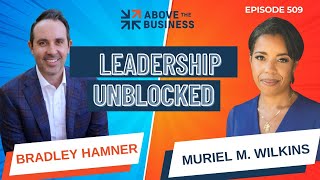
In this episode of the Above the Business podcast, host Bradley Hamner interviews Muriel Wilkins, author of Leadership Unblocked: Breakthrough the Beliefs That Limit Your Potential. The conversation explores the nuances of leadership in small businesses, emphasizing the distinction between being a leader and actually leading, much like the difference between being a parent and parenting. Muriel introduces the concept of an "internal operating system"—a set of hidden, often unconscious, limiting beliefs (which she calls "hidden blockers") that shape a leader’s actions. She explains how recognizing and reframing these beliefs can unlock more effective leadership. The dialogue moves into practical territory: aligning vision, resources, and seasonal realities; deciding whether to transfer existing skills to a growing team or to hire new talent; and the importance of making deliberate, resource‑based decisions when scaling. Muriel shares a framework for uncovering limiting assumptions before taking action, and she stresses the need for adaptive leadership as businesses plan for 2026 in a fast‑changing environment, including the impact of AI and market volatility. A personal anecdote illustrates a mindset shift from "working for the business" to "having the business work for you," highlighting the role of flexibility and intentional breaks. The episode concludes with Muriel promoting her book, directing listeners to her website and social channels, and summarizing key take‑aways about leadership, belief systems, and strategic alignment.
Chapters
Welcome to another episode of the Above the Business podcast, where we help small business owners get above the business, start thinking like an architect, and then go and design the business blueprint so they, they can grow their business. On today's episode, we have Muriel Wilkins. She is the author of just the soon-to-be-released new book, Leadership Unblocked: Breakthrough the Beliefs That Limit Your Potential. The genesis of this podcast was actually The Leadership Podcast. And so we talked about leadership, but we ended up expanding and talking about all things small business. But at its core, and I mentioned this on the episode, sure, strategy and tactics and having a vision is incredibly important, but also at its core is the culture and especially how you lead. And in this episode, she talks about the difference between being a leader and leading. That and much more. Without further ado, here's my conversation with Muriel Wilkins. Muriel, welcome to the Above the Business podcast.
Thank you, Bradley. I'm delighted to be here.
Excited to have you. Love to start with background and origin story and see how people kind of got to where they are. Why don't you take our listeners back and bring us to present day?
Sure. Absolutely. I mean, I think, um, maybe it makes sense to take me back to what I didn't think I'd be doing. Uh, so 30-something years ago when I was in business school, excuse me, if you had told me that I'd be doing anything leadership development related, I would say absolutely not. My intent had been to be a chief marketing officer somewhere someday. And as I rose through the ranks to get closer to that and actually did reach the C-suite, I started facing many of the frustrations that leaders of all sizes of businesses face and, quite frankly, couldn't find the resources to help me, including an executive coach. And so One of my mentors who actually was thinking of hiring me said, look, something that's always been true to you is you've always wanted to start your own business. So you found a problem, go start your business and see what happens. And that was a little over 20 years ago. And now I spend most of my time working one-on-one as an advisor with C-suite level leaders in all types of organizations and companies.
I love business strategy. I love coming up with the vision of where a company is going to go, strategy to be able to get there. But there there's a couple things that are always underpinning that. One is culture, and then another would certainly be leadership. What do you think leadership— how would you describe leadership in the small business environment? And why is it—
yeah, absolutely. You know, and I've lived it, right? Like, I've lived it for the past 20 years growing, uh, going from being a sole, uh, proprietor, the only person, and then growing it into having a team and scaling and all of that good stuff. So I know what it feels like. And I think leadership in a small business, you know, quite frankly, there's a distinction between being a leader and leading is the way that I think about it. Just like there's a difference between just because you're a parent doesn't mean that you're parenting. Okay. And so when I think about leading a small business, I think it is no different than leading any other type of organization in terms of being able to have a sense of the direction that you want to go into and the vision that you have, but also being— making sure that you're aligning all of the resources that you have at your disposal to reach that vision. And so that is people, systems, clients, financial capital, all of those. I think where we tend to miss the boat sometimes, particularly when we're moving from small stage to a little bit bigger, no matter what the size of your business, when it's small, smaller is we tend to, uh, at times overly rely on the tasks part, the activities part of running the business and not so much on the people side. And I think that is a miss because leading is both. It's a function of both, uh, the task and the activities and, and the result and people. You're not gonna grow your business without people. And here we're talking about people who might work for you, the people who you serve. In terms of your customers, your clients. And that's a big piece that I think we miss in the equation, particularly when it's a small business, because we're so tied into the tasks.
There's one thing that I, I read whenever I was preparing for the podcast, and so I'll just read this one sentence because I think it's so true. It's something I fundamentally believe, and we've talked about on the podcast quite a bit, but I want to get you to dive in. You said leaders spend so much time trying to control others, stressing, remediating on how to force the situation to bend to their will when instead they should be focusing on themselves. We even have a principle that's called lead yourself first. Talk from your perspective why that's so important.
Yeah, I, I, much of what I read about my experience in working with these leaders, but it's also my own experiences having, uh, been a leader and still being a leader. And I think when we are used to being the individuals who, uh, are driving results, are high achieving, right? And these are a lot of people who are entrepreneurs. That's what you don't just wake up one day and not everybody says, I'm going to be an entrepreneur. There is something in you that actually says, I can do this, right? And having the conviction and the confidence that you can do it, which is great. But a lot of times where that stems from is experiences that we've had in the past in being able to kind of make things happen for us, like literally make things happen, myself included. I think the issue is that then becomes a fundamental belief that we can make anything happen, which quite frankly, Bradley, is not true. Like, not everything is— as much as we don't like it— is not in our control. But if we stay latched on to that belief, then we go into our business and particularly with our people or with the task or the strategy, sort of trying to force fit what needs to happen in order to make our vision come true or in order to make us feel better instead of adapting, right? Instead of course correcting. And you see this a lot of times with, again, smaller businesses, right? The number one lesson I learned from business school in my accounting class was, you know, out of all the things I learned, they said the biggest reason businesses fail is not because of revenue. It's because of cash flow, right? And so what, what came out of that, and I'm going to get to my point here, is the cash flow issue is because at some point in time, there was not an adaptation. There wasn't an adaptation to say, oh, the bank account is getting low, or we're not getting our receivables in, or whatever it might be. Therefore, I need to change my approach rather rather than trying to force what I've put in place. And so this is, this is a function of being used to being able to control things. Sometimes we have to say, I cannot control the situation that's happening right now, but what I can do is change my response.
You know, I'm curious your thoughts on this. One of the things, because of the world that we live in, of— I particularly live in with small businesses even, you know, south of $5 million in revenue, is when you listen to some thought leaders, not yourself, but some thought leaders, one of the things that you end up kind of finding out is that if the business gets so big that there's enough revenue that they're hiring team members that are making you know, and even leaders in the organization that are making a quarter of a million dollars. Okay. You got a $100 million company. I mean, you have some very highly paid, incredibly skilled, very experienced people kind of around you. In small businesses, a business doing $3 million is not paying somebody that. I mean, it's just not even remotely close. And one of the things that is, is this challenge that happens in this area is that the leader, the founder, and maybe even if it's 2 or 3 founders, they have to like transfer skill sets and actually really developing and coaching people and even holding people accountable. And what I've seen become challenging is that the leader themselves are— they're really good at the thing that they're doing. I mean, we could just pull one as an example, and maybe they're really good at sales themselves, right? They can, they can sell, they can convince people, they go meet with clients, they, they, they're the primary salesperson. But then to transfer that over, those skill sets, and actually developing people, that, that becomes very difficult for them to be able to, to, to do so. I mean, Michael Jordan was great, but Michael Jordan was never a, an NBA, uh, Finals-winning coach, right? I mean, so it was just different skill sets. What are your thoughts around that, and how can leaders, really, business owners understand how to develop those skill sets themselves so that they can hire and really develop the team?
Mm-hmm. Yeah. And that's, that's a great question. And I'm just going to keep it real with you, right? Because I face this with some of my clients in terms of they want to sort of transfer their skills so that they can focus on other things or grow the business. And I think there's a decision point that you have to make here. Like, what is the goal? Is the goal truly to transfer the skills? Or is the goal to scale your business up? OK? And if the goal is to scale your business up, I don't care how you cut it. You need resources to do that. You cannot scale a business on the same level of resources that you had when you first started. And so it becomes, you know, in concrete terms, I think it becomes a decision point. Are you willing to invest in the resources, whether it's people, as you're talking about, or the systems, or whatever it might be that are gonna create the soil so that you can grow your business. Because if you're using the same soil and just think, if I just keep, you know, watering it and watering it and watering it, maybe it will grow these new flowers that I'm trying to grow. No, that doesn't work that way. It'll keep growing the same flowers. So I think something that small business owners often get stuck on, and I've seen it repeatedly, is they think that they can keep doing things the same way and get different results, which we've all heard this in a very cliché way is the definition of insanity, right? So to be honest, I think there comes a point where you have to say, is it possible for me to transfer my skills? That's decision number 1. A, do I have the right people I can transfer these skills to? Are they coachable, right? Number 2, do I have the capability of transferring those skills? And do I have the time? right? Not just the time today, but how quickly am I trying to grow? Do I have the 2 or 3 years, 4 years runway for them to actually adapt those skills? And if not, then the other decision point is, do I need to bring in different types of people? And if, look, the value associated with those folks is a higher dollar amount, then there becomes a decision. Do I need to get investment to do that? I mean, this is why you see companies then have to make a decision. Do I go get fund? You know, do I go raise funds to help grow my business. So I think at the end of the day, let's go back in to the beginning. What's your vision? If you're trying to grow your business and scale it, there are a couple of very different variables that you're gonna have to take account versus keeping it the same. You don't have to grow your business. Look, for me, I reached a point where I said, we're good, right? The resources were there, I, or I had access to the resources to scale it some more. But I looked at what that would require, and it was not aligned with what I wanted and how I wanted to lead. So we reached a point where I said, we do not need to scale any further than this, which meant I don't have to go do all these other things. I had done what I needed to do. That's the decision that I think, uh, needs to be made up front, and that then drives your actions. And that's the model for anything.
Tell me about your book. Leadership Unblocked Breakthrough: The Beliefs That Limit Your Potential. What was it inside of you that you were seeing through your experience that you felt like, you know what, I need to, I need to begin to put this, compile this into a book?
Yeah. I mean, first of all, this was the book that I never wanted to write because I said I would never write another book again because I'm not, I'm not a writer. You know, I'm a business person. That's what I do. But I'm also an ideas person. And when an idea holds on to me and I can't let it go, I've got to sort of bring it into reality. And I think at the end of the day, that's what it means to be entrepreneurial, to be honest. And so what happened, Bradley, is that I noticed that with a lot of the clients that I was advising and coaching, we were very action biased in terms of getting them to the results that they wanted. But then let's say they wanted to change the way they manage their team or their behavior or whatnot. But what would end up happening is they would take action and it would be a flash in the pan, right? Like, it wasn't sustainable. They would be right back where they were a few weeks from then, a couple of months from then. And what I recognized was, look, we can't just be working on the surface in terms of actions. There's something else at play. And what was at play is the internal operating system, right? It's the beliefs that were driving the behavior and the actions that they had. They had. And so I started becoming curious around what are the beliefs that can actually get in the way of a leader leading effectively regardless of the size of their organization or team. And I looked across 300, a little over 300 of clients that I had worked with over the past 20 years. And lo and behold, there were some beliefs that we all have, and not whether they are good or bad, but whether they are helping you in trying to drive to the outcomes that you're trying to drive to as a leader. And if they're not, then what can you do to move to other beliefs, change the inter— not even change, adapt the internal operating system, the internal operating principles to be more aligned with those results, which then increases the probability of you actually achieving those results. So that's what the book is all about.
Yeah. What are some of those beliefs that, that you see? When I think about this, I don't know where I first heard this. I'll give credit to the first person that, the person that I remember this, but I, they were talking about in the business context that business owners will often have limiting beliefs and how to transfer limiting beliefs into liberating beliefs. And so I don't know if that's language that you use, but I mean, what are some of those beliefs that you see?
Yeah, absolutely. So I do use the term limiting beliefs. That's very much in the vernacular. I call them hidden blockers in the book because they're often hidden. We don't even know we have them, right? They're so habitual. And they block us, right? Or they have gotten to a point where they block us. And they're so simple, Bradley, right? They sound like— so some of the ones that I recognize in my clients and even in myself are ones like, I need to be involved. I don't belong here, or I can't make a mistake. I need it done now. I know I'm right. If I can do it, so can you, right? I can't say no. And so all of these sound so simple. They are often whispers, but they can really wreak havoc. I've seen it wreak havoc. It wreaked havoc for me at one point. In what it is that we're trying to accomplish as a leader. And so the magic is in recognizing them, which is probably the toughest part, which is why I wanted to write this book so you don't have to do the work to recognize them, right? I'm calling them out for you. And then getting to a place where at any given moment, just like you would your business, you would sort of change the assumptions that you're making to then decide different choices that you would take with your business. The same is appropriate as a leader, right? Like, if I change my belief, which is the same as an assumption— what do I assume about myself? What do I assume about others? What do I assume about the situation? If I can reframe that assumption, then it opens up the door for different response or different actions that I can take. And that's what we need in terms of leading. We need to have more expansive choices of how we take action rather than always go to our default.
I can think of a couple beliefs that I have that I've picked up My dad is a small business owner, and so growing up, he's in agriculture.
And my dad too.
Um, so one of the things that he would say was, you know, son, if you want to get something done, you want something done right, you're gonna have to do it yourself. Well, I— that, that, that ended up being a kind of limiting belief when I, when I got into business, and it become fairly prevailing for sure. But here's the thing, that one is a, is a belief that I know, that I'm aware of. I have an awareness of it, and I have to fight through it. What are the thoughts about finding the beliefs that are the unknown unknowns, the ones that you call the hidden blockers, that I didn't even know that I was carrying a certain belief of? Where— so So that's the— to me, I'm thinking through the challenge of like, yeah, what are some of even the beliefs that I carry on a day-to-day basis before I jumped on this podcast with you that I don't even necessarily have an awareness of even?
Yeah. Yeah. I mean, look, I think the fact that even if you get to a place of even being curious around it, that's a great start, right? To even know, like, oh my gosh, I actually have some beliefs, number one. Oh, and I have some that might not be— maybe helped me at some point but are not helping me now, just as the way the one with your dad passed down to you. Here's how you do it. I've never had a client who's kind of showed up on my doorstep and said, Muriel, I need to work on my beliefs. Never happened in 20 years. But here's what they show up with. They show up with, I'm frustrated. I'm burned out. I can't get my team to do what I need them to do. They are able to articulate that something is off. All right? We all know when something is off. We feel it. We see it. We see it in the results. And if it's not us who can see it, sometimes we're told, right? Either through feedback that we get, or we see the business results and they're not adding up. We're not getting the clients. We're not getting, you know, the, the, the customers aren't coming in the door. Something is not aligned with the goals that you want or the way that you want to lead. That's the starting point. And then from there, really, the practice, Bradley, is getting in the habit of rather than going straight to, OK, what do I need to do? What's the action I need to take? It's taking a beat and saying, before I move to action, let me kick the tires on my assumption. Number 1, how am I contributing to this dissonance or this gap that I'm feeling, to this feeling off? What's my contribution? And of that contribution, what is the mindset? What are the assumptions that I have about myself or the other or about the situation that are contributing, not necessarily 100% responsible, but that are at least contributing to this offness that I'm experiencing, right? That's where it starts. And so if there's anything that I want people to take away from this book, like, from an action standpoint, is just do that, right? Like, start there. And the more you can get into the practice of doing that, the more you will start realizing, like, oh, yeah, like, if what I want is to— let me make something up. If what I want is to be able to go home by 7:00 PM every night, right? Like being really aspirational here, by 7:00 PM every night. But I really believe I can't say no to anything. The math doesn't math up. The math ain't mathing, as we say, right? Something needs to change. Either the goal needs to change or my driving assumption, the operating principle, That needs to change.
Yeah.
And so it's all about alignment.
You know what? I will— I totally agree with that, that we were— we just got back from a retreat with some of our members in Sun River, Oregon. And there were a few people that going already kind of leaning into 2026, see it as an opportunity to really go and step on the gas to grow. Grow their company. And there are a couple of people that see it as a season, both kind of the marketplace as a whole, but then also their personal family dynamic where they want to grow, but the growth targets are not nearly as much. They maybe hope to grow 10 to 15% this next year as opposed to trying to grow 20, 30%. But they see it as a season of, of, of, of, uh, pulling back and pulling, or pulling out more profit out of the business, right? They're in a season with that, with their kids. And so they're having to make the decisions. And I think that that is so beautiful, that as a business owner, they get to make that decision.
That's right.
They get to make that decision. And what you have said there a few times, and I really hope the listeners pick this up, is around the word of alignment. You're just aligning kind of where things are with also understanding kind of the season and the resources that you're at. Those things begin to match up. Whereas you've probably seen this too, business owner will throw out these just huge aspirational things that they do in the next 12 months. And then there's like, wait a minute now, that's out of alignment.
Yeah.
Your investment level, your risk tolerance, the profitability of the company, your— where you are, the age of your kids at this point. There's so many things like that's delusional. That's delusional to be able to make that happen.
That's great, Bradley. And I, you know, look, I'm a keep it real type of person. And I think, you know, if there's one skill that I have, it's sort of being able to see patterns. And so that's exactly it. It's like the pattern doesn't make sense. You know, the puzzle pieces don't shift. No judgment. I mean, I tell my clients this all the time. I'm like, really, no judgment, no shade. It doesn't really matter what the variables are. I just want them to fit for you so that you move forward where get stuck is in that misalignment, right? We get stuck in that misalignment. I mean, I remember years ago, I was probably 7— 6 or 7 years into having my business, and I was starting to feel really burned out. Um, and I had this moment when I said, oh my gosh, like, I'm not taking advantage of one of the very few benefits that I have as a business owner, which is flexibility. I'm not taking advantage of it because in my mind I had this, I can't, you know, the thinking was I can't say no. I've got to like be back against the wall at all times, put it in at all times. You know, I was, I was still in startup mode, even though I was 7 years in, I had a pretty sustainable revenue stream. I had grown the business. I had people who could do things. They, they, it wasn't overly reliant on me anymore, but I was still operating as though it was day one.
Yeah.
And I thought, oh, I am not— what if I— the mindset shift was, what if I operated this business from a place where it works for me instead of me working for it? So that's where I started. That was the mindset shift, simple mindset shift. And I said, okay, so now what would I do differently? I was like, you know what, I'm gonna take 2 weeks off this summer. And nobody thought I was going to do it, Bradley, because they knew how I operated. They were like, you're not doing it. You're not doing it. And I was like, nope. Like, what would it mean for me to operate this way? I'm going to take 2 weeks off. I'm going to get a different phone that only my assistant and my mom will have the number to, right? And I'm going to be off the grid for 2 weeks. And I did it, right? I did it. And that eventually grew to 5 weeks a year where I would be off the grid. But it, it required a mindset shift. And every time I would go on that break, I would have to recalibrate. Muriel, what's the mindset? What's the mindset? Because without that, I would continue to operate as though I was a day one, you know, startup person, which wasn't the case. So this alignment piece is so important.
Goldsmith shared with us, like, what got you here is not the thing that's going to get you there. And I think that what you're mentioning is like the season that you were in initially of getting initial launch into the company. Okay, sure. Freedom and flexibility maybe kind of go by the wayside for a period of time, but then it's got to change. I mean, it has to change. I mean, that can't be, that can't be sustainable. You're not going to operate the business at $300,000 like you are at $3 million, let alone $30 million. I mean, it's just not necessarily things, things kind of evolve and change. I don't think that's so true. Let me ask you this. When, as we go into, I mean, this comes up a lot. I mean, I've had the podcast almost 6 years now, and it feels like that maybe back in late 2019 when we first launched it, I could have said this then. I feel like I say it now, but it seems like it's even ever more present that the speed in which things are evolving and changing. AI certainly at the forefront of that. I don't, this is not an AI question. I think it's more around a question of adaptive leadership, adaptability, planning for 2026. I mean, we're a couple of months away from the end of 2025. People will start to put together their business plan they want to accomplish in 2026. The reality is, though, there's no thing that they're going to look into that's going to give them a crystal ball to understand what next year is going to look like.
Right? That's right.
And so you end up making these assumptions and these decisions, and you put together the strategy, and then here's our plan to execute on that with less than perfect knowledge. How do leaders lead through that?
I mean, I think this is sort of a huge component of ability to lead, right? And I think that, again, what you want to go back to is being clear around what it is that I'm aiming for. So What I encourage all of my clients to do and what I do myself is— and this is the hard part, the tricky part, Bradley, around the fact that our productivity level has gone up and things are moving at a faster rate. It's like when more things become available to us, it's actually harder to make a choice. And I think leading, one of the fundamental responsibilities is to make a choice. What are you focusing on for next year? Right? And so the question that I always ask myself in my own business and what I ask my clients is, OK, like, let's think 12 months from now. What do you want to have accomplished? Where do you want your business to be? How do you want to feel? Right? And we also do it on a personal level to make sure that there's alignment there. And now let's work backwards and determine what are the 4 or 5 or 6— what— but small number of levers that increase the probability of you getting there. And then let's do a reality check. Is that possible? Okay. Is that possible? Going back to the beginning of our conversation today, based on the resources you have, what would you have to do? What would need to be true to be able to actually pull these levers? And are we living in reality or is this fantastical, delusional? But I always think it needs to be grounded in outcomes with a huge caveat, a huge caveat being put a stake in the outcomes, but hold that stake loosely because of what you said. We don't know what's going to happen. And I mean, this isn't even business grounded. This is survival, right? Those who survive are those who are adaptable, period. OK? And so it's the same with a company. It's the same in terms of, I think, just living, right? If you want to thrive, not just survive, right, to say that cliché term, The key to that is not resisting the challenges and the change of everything that's happening around us, but more being very conscious around how do I respond to it? Because not doing anything is a response, but I'd rather you be consciously responding in that way rather than just, you know, not even noticing what's happening. And so that's the key to me, I think, for 2026. Or for whatever's ahead of you is think about how you want it to be and then work backwards, reverse engineer. It's, it's interesting. I literally this morning, I was, you know, I spent about 3 minutes. That's about as much as I can take journaling every morning. And that's what came up for me, what I wanted to journal about. I was like, okay, like, what am I thinking about business development for next year? Like, where do I want, what do I want business development to look like? By the end of next year? And what would need to be true? And, and, and my focus was what would I, what would need to be true around how I think about it? That's my starting point versus the actions, right? What would I need to believe in order for that business development vision that I have to be true? And that's the starting point. Then we can talk about the actions that, that, that follow that mindset.
You know what, I, I love that. And I was thinking about that with our, uh, business planning workshop coming up at the beginning of December that we do, and just kind of making sure to put that in. I'll give you a reference and give you credit for that because I think that's so true. One of the things I think that, that even becomes one of the things that we, we talked about at Sun River last week was who do we need to become But I think even before, before we think about who we need to become, I think it's even first, the first step is what do I need to believe or how do I need to think about this? And then who do I need to become in 2026, right? So let's say that I've got this long-term vision to build a $3 million, $5 million, $30 million company, whatever that may be, you know, sure, who do I need to become along the way? But I think it's even before that, kind of the step before that is Well, what do I need to believe, or what do I need to think, or how do I need to think to be able to make that happen?
Yeah. Yeah. I mean, and look, Bradley, like, I don't work with anyone who's sort of remedial in any way, right? They're all high performers. What I'm talking about here when we talk about this mental conditioning, this mindset conditioning, that's the last mile. That's the, like, you're doing great. But, like, if you really want the extra extra, that's the piece. And this isn't— here's the thing, right? Like, I notice— that there were a lot of other domains where this was being talked about. It's talked about in sports. It's talked about in the area of relationships and parenting and self-development. But I walk the corporate halls. I work, again, with business leaders all day long. We're not talking about this. We're just talking about— or if it is, it's like whispered in the back of a room, you know, with one-on-one with somebody like me. But it's not put out there in the ether, right? Like, and why is there a difference? Why does the same concept, which I did not make up, why is that not applied in the business world as well? Because I think it's just as important as skill training and all the other types of training that we do and actually is what will really, again, fulfill that last mile between where you are and where you want to be.
I love it. Muriel, people want to connect with you personally, learn more about your work, pick up obviously a copy of the book. Where would you point them to?
Yeah, so all of— thank you for asking. So all of my things are at murielwilkins.com. My book Leadership Unblocked is available wherever you get your books. It's pretty much out there. And you can always follow me on LinkedIn @murielwilkins and on Instagram @coachmurielwilkins.
Muriel, what do you believe working above the business means to you?
I think working above the business is taking it beyond what you're seeing in the here and now with your business, getting out of the tactics and being able to zoom out, as they say, get on the balcony and understand what is at play, not just for the business itself, but also for you. So it requires taking a look at yourself. So that you can be in alignment with the business that you're leading.
Hmm. You know, some of my key takeaways today, at the very beginning, whenever you mentioned difference between leader and leading, similar to being a parent and parenting, I thought that was great. I had never seen the kind of the difference between those two things. And then number two, probably the, one of the bigger takeaways is you call it the internal operating system. We actually talk about operating systems quite a bit here. So I really like that idea of having an internal operating system. And then what are those, uh, beliefs? If there are limiting beliefs or hidden blockers, then how do we actually go about, uh, searching for those? Mira, it's been great having you on the podcast.
Oh, it's been such a pleasure, Bradley. Thank you so much.
Thank you. Well, I really enjoyed that podcast with Mira. Make sure you go and connect with her on LinkedIn, Instagram, and go and pick up a copy of her book. Shout out to our podcast Partners, DirectClicks, Coach B Consulting, Autopilot Recruiting, and Club Capital. I don't know how 2025 has turned out for you, but if you're starting to already turn your attention, you want to really be able to grow. One of the ways to grow is obviously through your people, but certainly through your marketing efforts. And marketing can at times feel very complex. How do I find leads? What's the best cost per lead? How do I know what my customer acquisition cost is? And honestly, is there a partner out there that actually will know and understand my business, will work with me and want to make sure that I'm getting the leads I need, but also getting the quality of leads I need? And that's where DirectClicks comes in. Go to directclicksinc.com. DirectClicks, I-N-C dot com. Part of also your 2025, but also likely your 2026 plan is your team. Are you wanting to expand your team? There's a lot of members that we work with. That had a lot of turnover over the last 3 to 6 months or so. And some of the ones that got caught off guard, that didn't have a recruiting company that they were working for, didn't have a bench of people that they could pick up the phone and contact, they were not always recruiting— there was the ones that were not as prepared as the ones that work with Autopilot. Go to autopilotrecruiting.com, autopilotrecruiting.com. Let them know you heard about them on the Above the Business podcast. I mentioned it on the episode with Muriel, but it's not just getting the right people, it's also training and developing them. The thing that business owners often think that we have to do is we have to be the ones that does all the training and developing. I mean, even on that episode where I was talking about training and developing the team, yes, you are going to be a part of that as a small business owner, but you're not everything. And so really having someone else to be kind of bring in can give different perspective. I mean, look, you know, I, I love coaching my son and have coached whether it's in basketball or golf over the years. But guess what he does? He listens to other people, even if they're saying the exact same thing. And at times, maybe your team can feel the same way. If you go to CoachPConsulting.com, you'll not only hear from David but also his team members about the things that are working for you— working for them now to help them to be able to scale to unbelievable levels and have, have all the success that they've had. Go to CoachPConsulting.com. Coachpconsulting.com. Finished the final extension of corporate tax returns. If you were kind of late with your corporate tax returns and you would like to kind of get back out ahead, one of the best people to be able to work with is Club Capital. Go to club.capital, book a no-obligation demo that can help you get ahead of your 2025 financials, but also really get a good plan for your 2026 financials. club.capital. All right everyone, till next episode, lead well and go be great.










