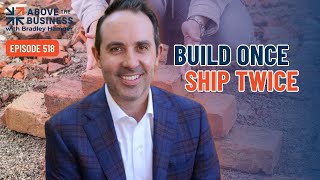
In this solo video, the host introduces the "build once, ship twice" principle as a framework for creating repeatable business systems, especially around lead follow‑up. He recounts a client conversation about marketing spend and points out that the real value lies in the follow‑up process for both new and previously purchased leads stored in the CRM. He contrasts two approaches: a chaotic, ad‑hoc outreach where the team randomly calls and texts leads, versus a deliberate, architect‑style design of a systematic follow‑up process that can be reused many times. He walks through how a business owner could step back, map out the process on paper, train the team, and then ship the same system repeatedly over months and years, turning thousands of dormant leads into revenue. The host then urges viewers to think in terms of simple, scalable systems for 2026, recommends planning early, and promotes a free 2026 Annual Planning Workshop, ending with a call to comment, subscribe, and stay tuned for future content.
Chapters
Hey everyone, have you ever heard this idea, build once, ship twice? Let me give you context. First of all, I don't know who actually shared that. I think I saw it maybe on Twitter. Somebody potentially was creating like a visual graphic of it, and I love that idea. Is, can you build something once and be able to use it multiple times? Not twice, but over and over and over. And I think it's applicable when we're talking about repeatable systems and processes in the business. Let me give you context of where this came up recently with a client. So got a message, we were talking around marketing metrics and marketing dollars specifically. And so he asked a question, uh, one of the clients asked a question regarding a specific marketing channel. It's irrelevant to what the, the channel is, but he was asking about, and I, I said, well, look, yes, that is important to be able to make a certain level of an investment in that channel. I mean, that's true for any marketing channel. You have to be able to put enough money behind it. I mean, $100 a month is probably not going to do a tremendous amount. But I said, what is really the most important is the follow-up process that you bolt on to that marketing channel. Now, That would be true for any of the marketing channels that you have, even for your referrals, but especially for paid ad marketing channels. But here's where the build once, ship twice really came into play. And I said, given that, here's what is really eye-opening. You have been in this marketing channel for a period of time. How many leads do you believe that you have purchased that are in your CRM today, just over the last 30 years? Some quick calculations, it's in the thousands. And so I said, there's your opportunity right there. Uh, not only is it important to be able to supply your team with new leads coming in on a daily, weekly, monthly basis— yes, that's important too— but what is your plan for these thousands of leads that you've already purchased? Cash flow is tight in this particular business owner situation. And so being able to work leads that he's already purchased is a noble concept. And honestly, he had not even considered it. But I said, you have two options. And this really gets into the heart of this idea of build once, ship twice. And my exact message, message to him was this. You have really two options. Option one, run around like a chicken with your head cut off and start having your team randomly call and text people just to seemingly look busy so that they're quote doing something or working the leads. Or option 2, option 2, you can step back. You can get above the, above the business for a second. You can design the system of follow-up that's repeatable and then train your team on that system and hold them accountable to it. Build once, ship twice. And so the idea there, to expand on that, was he could immediately the next day go in there to his CRM, meet with his team, and say, here's all these leads, start working the leads. And what they would do, they'd probably fall in line, they'd start working the leads. But is that a system? Has he designed a system at all? With anything that is repeatable other than just go work hard? No, he hasn't. He's just basically told his team to make up their own system. But if he takes a step back— I mean, we're towards the end of the year— he takes a step back for just a second, he slows down just enough and says, okay, maybe with a pen and paper— he thinks in ink— he goes to a coffee shop, he spends a few hours designing, well, what I want that follow-up process to be like for 12 months, for the next, for the new leads that we bring in. How do I actually want to approach this bucket of leads that I have in my CRM? Let's actually design a system. Let me give a way for my team to, instead of just diving into the ball pit of leads, let me just try to figure out if there's a way that we can actually approach this in a systematic way, in a way that not only applies this time, but applies 3 months from now, 6 months from now, and years from now. He could build that system once, and he could ship it 2, 3, and 4 times. Build once, ship twice. That is the value of not only systems systems and processes. But that's the value of stepping back for a second, getting above the business, thinking like an architect, design the thing, and then begin to put those systems and processes inside of his business blueprint. So he has two choices. Which one would you choose? You if you were him. I hope this episode helped you. My recommendation, if this is valuable to you and you hear this— it's Black Friday when this is actually dropping— here's my recommendation. If you have some time, if you're maybe, you know, don't have some work obligations, as you get to the end of the year and you start to think about doing some planning I would just try to think, think in terms of systems for 2026. How can I make this really, really simple? How can I make this a system? And then how can I go and scale it? And actually did a podcast on that concept several weeks ago. Go back and you'll see it says make it simple, make it a system, then scale. What are the systems that you need to create in your business in 2026? How can you begin to put the architect hat on and think first in terms of designing? Well, getting above it first, designing it like an architect designs it, things, because you're thinking like an architect, and then be able to create the systems and processes that need to go inside of your business blueprint for 2026. You know, speaking of 2026, I A great year starts with a plan, and that starts when you put yourself in the right environment of other business owners that are trying to do the exact same thing. We'd love to invite you to come to our 2026 Annual Planning Workshop. Go to blueprintandwest.com/assets, scroll to the middle of the page, you'll see the Annual Planning Workshop. It is totally and completely free. Yeah, this is actually the 4th year. That we've done the annual planning workshop, and I believe it's going to be our best one yet. A great year starts by planning for it. I'd love to see you there. Till next time, lead well and go be great. Hey, if you're watching this on YouTube, I would love for you to be able to leave a comment down below. What's a system that you are trying to implement in 2026? And if you like this video, I would mean— it would mean a world to me if you would hit that subscribe button. We're going to be doing some things later into 2026 in our YouTube channel. We don't want you to miss an update.