Episode 523: Business Blueprint Spotlight - Dave Curry's Journey from Struggle to Success
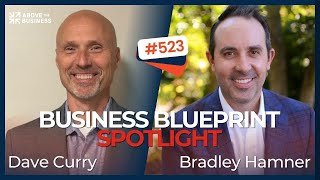
In this episode of the Above the Business podcast, host Bradley Hamner interviews insurance agency owner Dave Currie. Dave recounts his 35‑year career, beginning with a corporate accounting background, opening his first agency in the mid‑1990s, a five‑year leadership stint on the corporate side, and returning to agency ownership in 2005. He describes a decade of steady growth followed by a painful scaling attempt between 2015‑2018 that resulted in a loss of about $1 million in premium, margin pressure, and a personal crisis tied to his self‑worth. In 2020 Dave joined Bradley’s Blueprint community, which sparked a turnaround. He outlines the “blueprint” that rescued the business: (1) leading himself first – mental and leadership work; (2) building a strong team and culture with core values; (3) creating a 3‑year vision broken into 1‑year OKRs and quarterly rhythms; (4) instituting a repeatable acquisition/sales system (the “5‑0 Club” for 50‑app producers); and (5) developing an Ascension (in‑book) team to increase multi‑line revenue. Dave emphasizes the importance of peer community, autopsying wins and losses, and moving from a people‑dependent model to scalable systems. By the end of 2025 his agency has more than doubled top‑line premium, achieved a 24 % profit margin, and is on track to exceed the Rule‑of‑40 benchmark. The conversation ends with encouragement for struggling owners, stressing that they are not alone and that systematic, community‑driven growth is achievable.
Chapters
Welcome to another episode of the Above the Business podcast. My name is Bradley Hamner, your host. On today's episode, we have a business blueprint business owner spotlight series with Mr. Dave Currie. I've known Dave for the last 5 to 6 years or so. I've been lucky enough to be a small part around his journey, and in this episode, he's going to detail out— he's a— this is a real deal business owner. We've had some great speakers, authors, thought leaders that have come on the podcast. But Dave is in the trenches running a real deal business. He peels back the curtain about what are some of the things that he did in his business along his journey and some of the good times, some of the really rough times, some of the times that he almost thought about quitting and leaving his small business. And so whether you have had a great 2025 or you just need some encouragement and feel like that you're not alone in your journey, this episode is going to help you so much, I believe. He gives so many specific details in his own journey and what was the blueprint he followed to be able to grow his company into the level that it is today. Without further ado, here's my Business Blueprint conversation with Dave Currie. Dave Currie, welcome to the Above the Business podcast.
Thank you. It's good to be here, man. It's fun. What an honor. It's— I'm excited.
I'm excited to have you. Well, Dave, you know, we always start with background and origin story. And this is a, this is a business owner Business Blueprint spotlight, and this is something we're going to be doing a lot more going into, into 2026. So I'm really excited for you to be able to kind of hop on here and tell a little bit about your story. We really want to portray people's journeys and, and real actual business owners. We've been fortunate enough to have some pretty incredible guests on the podcast over the last 6 years or so. And one of the things we want to do is kind of start to peel back the curtain of real deal business owners and what are the blueprints that they're following. But before we get into any of those things, why don't you just kind of take some of our listeners back, people that don't know you, tell us a little bit about your business owner journey, how you got into, you know, when you first started your business, how you got into that, and, and a little bit maybe about where you are today.
Yeah, I, um, I am 35 years into— I'm in the insurance agency. I'm, you know, an insurance agency owner. And the— I spent 5 years kind of on the corporate side, if you will. Man, I had enough accounting in me. I took enough accounting courses. I thought I was going to major in accounting, you know, in college and go off and and be a— back in the day, right? This will date me just a little bit, but you know, the Big Eight firms, and I was going to do this whole thing. And man, I got a couple of years into that, and I was like, I like the numbers, I like the math, I like accounting, but I don't know about this. So anyway, I got a management degree, and I went to work in accounting right out of the gate, right out of college, and spent— and then I went and worked claims. And so I was on the corporate side for 5 years, but man, I just had a I just had an itch, man. You know, I just couldn't quite get it scratched and it was kind of that entrepreneurial bug. I just kind of wanted to do my own thing. And so I had an opportunity to do that. And I'm in Wichita, Kansas. Maybe you know where that is, maybe you don't. You know, I keep trying to get you to come here and do an offering, but you know, anyway, it's fine. It's good. No, I'm in Wichita, America, and I have been for, you know, basically 30 years. Got an opportunity to open an agency in late '95, early '96, 1995, '96. And you know, man, here's the— I did that for a few— I did that for 4 years and then I had an opportunity to jump into sales leadership, be a part of our leadership structure. And I did that for 5 years. And that was such a great opportunity. I got such a cool experience to be able to see inside of a lot of different agencies and what people were doing that I thought was what I didn't think was very cool. And then had an opportunity, basically, we weren't super excited about moving all over the country for our family. And so in 2005, I jumped back into an agency opportunity. And that's what I've been doing since then. And so in 2005, started back over in agency with a little bit of a book of business, you know, And it's crazy to think when I look back at some of those numbers I've tracked, I've always been pretty good at tracking numbers. Like I like a good spreadsheet, you know, I guess that's the accounting in me. And, but to look back at some of those numbers and be like, oh dang, wow. You know, like, okay. So that journey has honestly, man, it's a little bit of a blur. We've done, we did a pretty good job. All the way up until, you know, about, oh, honestly, we, here's what happened and we can get into this more, but ultimately in about 2015 had an opportunity to scale and took that opportunity to scale into an additional location. And I've, I'm not sure any other way to say it, but I feel like the wheels kind of came off. And, um, uh, it was a growth. It was a, you know, I'm sure we'll get more into that, but, um, later on in that journey, um, is obviously when I met you. And man, that's been such a big part of my, um, progression. When I look at the numbers and when I look at the growth, and, and I know some of that we just need to get into and get into the detail of it. But man, you know, we've just had the last— since about 2020, late— really, probably you should say 2021, we've really had some, some good growth. And, and not just in the numbers, but, but good growth in me, good growth in the organization and some of the things that we've done. And here we are today, and, you know, still figuring a few things out. But man, we've It's, it's been good.
You know, some of the, one of the analogies, I think business owners, we typically relate to metaphors and analogies. And one that I've, you've heard me say before, but we've, we, we say often is that one difficult part about business, and let me contrast it from sports. We're coming up on the college end of the college football season or going into the college football playoff. Those teams are going to go into, you know, a recruiting season, and then next spring they're going to be in spring ball. They are not going to be on the field playing, and then they're going to go through summer, and then they're going to get into obviously late next fall, and they're going to have all this time to prepare. But businesses are not that way, and we are— we— it's very challenging to build and repair oftentimes the plane while still trying to fly it. It's not like we have an opportunity to land the plane, put it in the hangar, fix it, repair it, do whatever we need to do, and then go take back off again. It just doesn't work that way in, in business. You had what I think is an opportunity that not many people have. And I know that later on, from 2005 to 2015, we'll, we'll talk about 2015 and kind of what you mean by the wheels came off. But I am really curious to know what were some of the things you learned in that 5 years of leadership being out of the business? Maybe, maybe you had the opportunity to kind of see it from a different perspective. And obviously, you know, we call it, you know, kind of getting above the business. What are some of the things that you learned in that 5-year period of time that you feel like helped you when you got back into owning your, owning a business again in 2005?
You know, it's interesting you ask that because I've always really appreciated that opportunity of that 5-year stint. One of the things I would say is you just get an opportunity in your language, in the language we use, to be above. You're not so dialed into the day-to-day. You're looking down on, if you will, an organization and you're observing the leader and you're observing what he or she is hoping to do, and you're being able to speak into that in a way, probably in many ways, like what you love about what you do, you know, in the coaching business and so on. And so I think one of the things that I learned honestly was like, oh, I don't like that, I wouldn't do that. Oh, I like that, that's really good. And you're almost, you know, you're collecting— I feel like maybe in some ways you're collecting intel You know, maybe back to your sports analogy, maybe I'm, maybe I'm watching game film about other teams and how they do things. I will say this, looking back on it now, if I had to do that again, if I had another 5-year stint in leadership, one of the things that I think would be important is to be more above the business. Some of what I think when I talk about the wheels coming off for us a little bit, some of that I think looking into an organization and seeing why they're succeeding, why they're not succeeding. And, you know, I listened to a podcast the other day, Craig Groeschel, you know, you and I have him in common. We like him. And he said, you have to autopsy your wins as much as your losses. And I was like, hmm, okay. You know, because when I look back on— we'll get into this, I'm sure, in a minute— but when I look back on what I consider to be the wheels coming coming off on some level is like, I can tell you, man, I don't really think I knew why we were succeeding. Well, you don't know why you're succeeding. That's probably going to be tough to scale. You know what I mean? So when I look back at the leadership stint, I think being able to see inside of people's organization what I liked, what I didn't like, what was working, what wasn't working, some of that all came naturally for for me as I just love being kind of in that. My role was actually titled like consultant for the organization. It was like, oh, okay, well, I get to kind of consult with these different levels of agency owners.
That's how I would say that. And to bring that down to— I love that idea of you need to do an autopsy also on your wins. I think we just finished up the annual planning workshop and about to go into the Q1 planning workshop. I think that that's why at the very beginning, you know how important it is that we take a few minutes to capture, well, what were the wins? And then what also were some of the losses and the lessons learned from some of those losses is because we're trying to embed this idea of looking back and trying to find them. Honestly, that rhythm is there because I struggled with that. Like, I don't want to look back on the wins too. I just want to talk about the crap that didn't go well. And so we can, we can fix that versus actually looking back and saying, okay, you know what, actually this past week, this past month, this past quarter, this past year, there were some things that actually really were positive. You know, we'll, we'll get into kind of where your turning point was, but now to fast forward and, and kind of look at, you know, first before we turn to the success that you've had and the blueprint you've been able to follow, 2015 to the time, you know, you and I first really started to work, there was a 5-year period, right? 2015, 2020 that I know you've shared with me and you talk about the wheels, you know, coming off. You get another opportunity for another location. What do you think specifically were some of the things that were not in place? What kind of went wrong? That maybe led to frustration, maybe overwhelm, burnout for you during that period of time? What do you feel like were some of the elements that were in place? Maybe what are some of the things that were not in place that you actually needed to be able to build?
You know, I've thought about this a lot and you and I have talked about it some, you know, a fair amount. You know my story. I'll tell you, if you went from 2005 to 2015, essentially a 10, 11-year run, very successful. But I would just— very successful in the mothership's eyes, right? I mean, you've said this to me. I mean, I'm obviously I'm a captive agency. And so there are things that you, as a business owner, there are just things that are outside of my control on some level. And there are things that need to be done that the mothership would want me to do, right? And 10 or 11 years, man, I would just tell you, it was year in and year out setting a target based on what was described to me as success. I don't know any other way to say it. And we did those things. We did all those. We did so many of those things. And then I come into this opportunity to scale. And if you could go back and talk to like 2008 Dave Currie, I promise you I would have told you I'm a really good business I'm a really good visionary, you know, all these things that like, and then when I look back and I'm like, man, that is rubbish. Like, okay. And I'm not saying that I'm, you know, was a total schmuck, but I'm just saying, I'll tell you one, there's no way to say anything other than when I came into 2015, 2016, and I get ready to have this opportunity to scale into a separate, another location. I had no idea what our success was built on. I had no framework. I had no, I'll use our language, blueprint. That's such a critical language for me. I was not the architect of my business. I just wasn't, man. I was, you've said this before and I can't help but say it again. It's like, well, you can either be a really good insurance agent or you can be a good business owner. And you can be a good business owner and still be a good insurance agent. But I can tell you this right now, full stop, right? Testimony. You can be a decent insurance agent and not be a very good business owner. You just can't. Now, I don't know. I don't want to hurt anybody's feelings, but I'm just telling you, that's been my experience. And I think if you look back on me, you've been like, dude's killing it. They're killing it. But I had no idea, Bradley. I had no idea why we were killing it. And then when we expanded into the separate location, a lot of the success— I know we talk a lot about Rainmaker. That's such a key concept. I didn't necessarily— I wouldn't have told you that I was the Rainmaker back in the day, but there's no question looking back on it now, it's like, dude, so much of your success Your success in one location was built around you. Yeah. And 2015, '16, January 2016 hits, and here's what happened. You know, I'm in the insurance business, so this is not a surprise to anybody. We do P&C, we do life and health, we do, you know, I mean, we have a product mix. We did okay that year, brother, in P&C. We did okay in that second location in P&C. Only because we had some momentum going into that, and then about mid-year, the wheels start coming off. Now, when I say the wheels came off, here's the biggest thing. I don't know how far you want me to go with this right now, but I can, if it's okay, I can go.
No, keep going, this is great.
Here's what I would say to that. About mid-year, the financial services piece is not going very well. This thing's not working. Uh-oh, uh-oh, You know, rut roh shaggy, what's going on? I'm in trouble. Like, this thing's not working. And I kind of go into panic mode. Now, here's the deal. Throughout all of the years that we're going to talk about, where I said the wheels have come off, we were the number one producing agency in our marketplace. Why do I tell you that? Because it's a critical piece of our story, because what ended up happening was, but we were bleeding. I've told you this before, we lost $1 million of premium over the course of 2.5 years out of our first main location. And we were not making it up in the new location. I mean, we were on a downhill, hang on for dear life. And here's what happened to me, man, because I think this is such a key piece. And I promise you there's somebody out there that needs to hear this. What happened was, is it got into my head, and what I realized pretty quickly, within just a few months, and then a few more months, man, I went to a very dark place. I had so much of my self-worth, and I'm a little bit ashamed to say it, but it's the truth, I'm a solopreneur, man. And I mean, I was big into team and I hired as many people as I could and we just threw money at it. And that was some of our— honestly, what happened when we tried to scale, just throwing money at it didn't work anymore. It's like, oh my gosh, there's only so much money to throw at it. But man, I went to a dark place and so much of my self-worth was was wrapped up in those few years of just sliding, sliding, sliding. We were still the number one producing agency in our marketplace. And if you'd have talked to me back then and not looked at the number, you'd have thought like, you're horrible.
Yeah.
The way I talked.
Yeah.
And you know that I'll never forget, man. April 2018, I was sitting with a group of my peers. And they cared about me. And one of my buddies said, "Hey Dave, you might need to think about finding something different, man. You're not the same guy I met a few years ago." Hmm. Oh, and the second thing that group told me was, "Dude, you need to get some margin. You're spending way too much of your money." And I was like, Okay. Right. I remember flying home from that meeting and I would say in many ways, man, I give a lot of credit. You know, that's one of the things that I love about our community that I'm obviously a part of, the Blueprint community, is because of, because it's a community. Like I give so much credit to my peers that cared about me enough to say, ding, ding, ding, hey brother, you're not the same guy. April 2018, kind of for me, I felt like was like a, okay, it's going to be okay. And then, you know, I met you in 2020 and, you know, that's just been a super cool piece of the story.
If somebody is listening to this and they're in, as you mentioned, a dark place. And what I have been— I have been in that very place myself. If they're in that dark place, for me, I would isolate.
Yep.
Outside looking in, everything is good. I would say all the right things, but I never really was willing to open up and to share. And that can be taken— we could talk about that in the personal sense, right? And then, but specifically just in the context, because it's obviously a business podcast, I'm talking about it from a business perspective. I held so much of my own self-worth also into how the business was was doing or how it was perceived to be doing. What was looking back, if you could kind of speak to maybe that Dave Currie back then. Okay. But specifically, I'm saying this and asking this question so that somebody else that is listening to this podcast that as at the end of 2025 has had a crap year. Yeah. Maybe turnover with team. They just, man, they can't hold on team members. Production, they've missed production targets. Revenue is not where it needs to be. Cash flow is tight. And they're even maybe having the quitting fallacy.
Yeah.
You know what? I think I could go make more money working for a corporate entity than to do this crap. Okay. What would be your recommendation to help that person just begin to kind of get out of that, that, that, that, that world, that scenario, that state? That's the word I was looking for, that state.
Yeah. You know, I would say like, if I could, I heard this the other day and I, and I loved it. It's like, if I could, I'd put my forehead on your forehead and I'd lean in close. You know what I mean? It kind of feels that way because, man, I'm not kidding you. When you say, when you ask me that question, it like, it like those emotions, I remember those emotions. You do too, right?
Yeah.
Here's what I would say, brother, sister, you are not alone. You are not alone. You are a solopreneur. You're an entrepreneur. Yes, I understand that, but you are not alone. There are a lot of us out there, and I promise you with as much as I have breath, we have experienced— a lot of us have experienced exactly it. And the circumstances don't have to be exactly the same. They can be a personal derailment, whatever, whatever. But man, you're not alone. And the second thing is this: I think it's imperative to hear somebody say like, hey, You, yourself, you are not your business. You are more than that. Like, that's such a critical thing. Bradley, I've told you this before. I think this is a good time to say it again. Like, when I met you, one of the things that I've told you, and I just, I think it's so important. I remember telling you, and I've told others this same thing, There were times early on in our relationship where you are— our business relationship, our friendship as it began back then, right? You believed not just in me, you believed for me. I think that in a community, you got to get into a community, business owner. If you're not in a community of some sort, if you don't have a peer group that you can be open and honest to and just say, I'm telling you right now, the wheels are off. And I'm ready to go wheels up, you know, or whatever. Yeah. I just, I just don't, I, I just believe that you will heal quicker in a community than you will on your own.
Yeah.
Yeah.
You're so, you're so right about that. You know, one of my, I, I had kind of many, these many defining moments I look back on, but one of the times, uh, gentleman named Keith here. I was in a, it was called a CEO roundtable. And I was just so, I was so out of my element. These were very successful businesses. I mean, HVAC company doing $30 million, Barron Services in Huntsville, Alabama, a weather Doppler radar company doing over $100 million. And I'm in a small group, like 5 or 6 of them.
Okay.
And Keith, I was trying to explain to him some things and he was like giving me this look and he said, Bradley, I don't understand. And I said, you just don't get it. He said, you're right, I don't get it. Help me understand. And it was shortly after that that I just said, Keith, I don't know. I don't, I don't know. I don't know what. And he said, now we're finally getting somewhere. Now we're finally getting somewhere. Now you're finally willing to put down that pride and ego for just a second. Yeah. And actually be willing to, to, to sit it down. And, and he goes, how hard was it for you to just say, I don't know? And I was like, golly, I don't know. It's probably the hardest thing ever because I wanted to— I felt like I needed to know all the answers and I needed to portray that out there. So yeah, I, I really do hope that that's motivating for someone. Okay, so now let's switch So 2020, so given, give people an idea. One of the things that I want to try to do in this business owner series has been incredibly helpful to me personally, is that we would have these conversations and I would meet with people, but I would always in the back of my mind be wondering like, well, what are their numbers? Like, I don't know. I can't, I can't really. And, and, you know, obviously I understand we want to be careful about what you're willing to share, but maybe give people an idea. So they can contextualize maybe your, your revenue numbers around a certain period of time. And then obviously I know what the, what the growth has been since that period. And then let's just, now that we, that'll give people some kind of context, right? It give them context and perspective. Then what we can do is to say, okay, what was the blueprint you were following? What was your blueprint that you followed to be able to get there?
Well, I told you a minute ago about the decline. I mean, we had, we had snuck over the course of 2005 to 2000. We're gonna, we're gonna use 2000, the end of 2020 is really a key turning point. Even though some of that change, like I described, you know, was happening in '18, '19. We had snuck up close. You know, you talk about $300,000 to $1 million and then $1 million to $3 million. We talk about these levels inside the Blueprint Community. We had snuck our way up close, you know, where we could almost see $1 million of top-line revenue. Now, I will tell you, looking back on those days, our profit margin— that's embarrassing. Profit wasn't Lovely. Because, because, because, again, and I think this is key, I'm just chasing these metrics. And I'm just throwing money at it. It's why in 2018, my peer group says, you might need some margin, Heller, you know, so we had snuck up close, and then we had, and then we had slid back. So we, we rolled into 2020 at at the end of 2020, we had about the 750 mark. We had rolled backwards. So, you know, like, oh, there's some good business strategies. We went backwards. But like, you know, our profit margin in 2020 was about, I mean, our growth was negative. In terms of top line revenue, we had gone backwards a couple of years in a row, as I mentioned. But our profit percentage was right at about 24% when we look back, 24%. So, I know your listeners have heard of your rule of 40. I did not quite get there. I was working on like a rule of 8, maybe total.
Yeah, right.
No, no.
Yeah, for sure. For sure.
So, since 2020, man, we've we've experienced, you know, we're going to project out at the end of '25 a little bit above where I, where I had set that to be. And I mean, we've, I mean, we're, we've more than doubled that in, in top line revenue. And we've grown, you know, obviously I'm in the insurance business, right? I've mentioned that. And so We've more than doubled our premium base. I mean, it's just, it's been for us, I think, just, it's been just great, great for her.
You know, one of the things is that we will talk about a lot on here, whether I'm referencing it on a specific podcast or whatever, and this is going to come up, I think, quite a bit, is that that million-dollar mark, number one, nobody celebrates that with you. Your accountant's not going to celebrate that with you. Nobody is going to You know, go and have it. And we want, we do that in our community. We want to celebrate people that have crossed a pretty big milestone, uh, there, uh, because it's one of those things that maybe people don't, don't talk about nearly as much as hitting 2 commas, you know, in, in revenue. Um, so we want to recognize that, but then here's the other thing. It's not a van, it's not a vanity metric. Okay. Number one, we want to recognize it. Sure. But the other thing is too, is growth really begins to accelerate. I mean, we call the $1 to $3 million— kind of, I refer to that as acceleration, because if you allow it and you stay on top of team and marketing and continue to do those things, growth will really accelerate. And you are such a good example of that. You know, it, it took you X number of years to maybe get to your first million, and then you're going to get the next million in a fraction of the period of time. Can you just kind of speak to, to that acceleration that you've experienced yourself?
Yeah, I think that's, that's exactly right. And you know, one of the things I love about what you just said, Bradley, is like, it's not a vanity thing. I think sometimes— here's what I would say to that. Looking back, I'm going to tell on myself. Part of the reason it feels like a vanity thing is the same reason that I about lost my mind when my business wasn't doing what I wanted it to do. Because it was so much about me. Sometimes I think in small business world, you know, less than a million, my name is on the sign, you know, it's, it's, it's me. It's like, well, no, it's not. You need to be the CEO of that. You need to be above the, you know, it's just so— I don't know, man. I don't know if that helps anybody or not, but it's so important because I think It's, you know, it's not about— when we get in these business conversations and the groups I'm in now with my Blueprint friends and community, like guys at, you know, $2.5 million or a guy that's at $700,000, they have different things to talk about. Most definitely they have different challenges, but it's just such a freeing place to be. I just love it. Because it's like, it's not about vanity. It's about, man, this is— I'm trying to help you. You're trying to help me. Let's go. Anyway, that's a little bit of a side note, but it's just like, I think it's important because so often we wrap it up into ourselves.
Yeah. All right. So the narrative arc here, we obviously had a kickoff, a period of time, 1995 on the business for a few years, jump into leadership, kind of was able to see it from a different perspective. You jump back in 2005, obviously had some level of success to be able to go and operate a next, another location. You do those for 10 years or so, wheels start to come off. So 2020, 2000, we're towards the end of 2025. So 5-year run here. You've done more in the last 3 to 4 years than what you would have done previously combined, right? Growth and profitability, your Rule of 40 numbers are fantastic in both of those. So now that everybody kind of has that, you know, this, you know, I don't want to call it rags to riches, so to speak. It's not necessarily what you're saying, but like, okay, great. What's the blueprint? What was the blueprint you were following? And look, I know, and everybody knows that there was some, I know there were some key personnel decisions you and I had to navigate through over time. But if you could simplify it down and say, look, This is what I did, right? This is exactly what I did. As a matter of fact, I know you actually had a scenario come up where a business owner reached out to you and kind of, they didn't ask you what was the blueprint you followed, but they were like, man, what are you doing? What are you doing? What is the simplified answer to what was the blueprint you were actually following, Dave?
First thing I would say is a principle that we talk a lot about lead yourself first. Going back to what I mentioned a minute ago, where in 2020 when you and I connected and, and we began working together, man, I had a lot of work to do on me. And I'm still working on me today. You and I talked about this just the other day in the way that I think and how big I think and, and the things that I need to be thinking about in order to get to that next level. So Lead Yourself First is certainly not done. It's an ongoing journey, but I do think that that's a really key piece to this story, is getting my head right. And it wasn't like we just stopped and said, okay, Dave Currie needs to go to counseling. I mean, I probably should have, you know what I mean? I'm sure there's some truth to that, but you know, guys jacked up. But I think that you've got to be able to— I've got to be able to point back and go, man, that was a key piece. We had to get my head right. I had to get my head right. I had to lead myself first. I had to, you know, some of these things that we just kind of gloss over, almost like we talked about earlier, protecting your confidence. Why is that a big deal? Why do we celebrate wins? Well, I wasn't. I wasn't. Everything in my organization was a complete dumpster fire, even though it wasn't. But it was. And so then I would say the next thing that we really started working on was team and culture. And here's the reality of it, brother. I didn't have a blueprint. That's the reality of it. I would have told you that, yes, of course, you know, if you'd have used this language with me back then, I'd be like, Well, yes, I'm the architect of my business. No, you weren't. You know, you're running one year to one year and setting targets based on these certain, you know, metrics. Okay. So 2020, the end of 2020 was my first 3-year vision that you and I started working on together. And I remember you saying stuff to me like, okay, man, I want you to set these targets a little further than you think. Set them a little bigger. And I was like, okay. And so, you know, we started implementing, we started implementing that 3-year vision and 1-year OKRs and then running on a quarterly basis. And some of that stuff, like some of the people that are listening, they're familiar with 12 Week Year and they're, you know, some of those things. And I was too. I had read the book. I just wasn't doing it. And so, as we began to really incorporate into that, okay, I remember this is funny to me because I remember you saying to me, and I'm so sorry if any of my previous teams are ever listening to this because you said to me, Dave, and this was early on in our journey. I don't know if you remember this or not, but you, Dave, do you even like your team?
I do remember that actually.
Huh. You know, so blueprint-wise, like, man, we started executing on 3-year vision and dropped that into 1 year. And I would say the other thing that was really pivotal for us was one of the things that I'm probably extraordinarily proud of as to what the team has done is we built I felt like I needed to get acquisition figured out. And so pretty early on in the journey, I started really spending a fair amount of my time, how do I get this acquisition thing figured out? And I'm like, this is fun to think about, but in 2021, I introduced a— it doesn't matter, but I called it the 5-0 Club. I know I've told you this, but this just speaks to the journey. I introduced this 5-0 Club. I'm like, man, if I could just have producers getting to 50 apps. Now, mind you, Bradley, I wasn't sure how they were going to get there. I just wanted them to. And this was still in 2021, so still pretty early. And I introduced this award, this trophy, super cool trophy. And one producer one time in 2021 hit the 5.0 award. And I was like, oh, okay. And fast forward now to 2025. Um, we don't have producers miss it. We've had producers this year— I've got, I've got a producer and, and he's a stud. Um, he's an absolute stud. But when you put a stud into a really good sales system and process. Yeah, it's like super stuff, you know. So hasn't missed 100 apps all year long in a month, has written over 200. I mean, it's just a different organization. And so much of that has to do with— and I do remind my team of this, I'm like, hey, you don't necessarily do this somewhere else because you're not doing this in a vacuum. You're doing this because we have built a structure around you. We have a sales system. You thumped me the other day when I gave you the answer that I had given this guy that called and said, "Hey, by the way, what are you doing, man? You're really putting up some good apps." And I gave some kind of half lame answer about, you know, "Oh, we're probably just doing what you're doing and buying leads." It's like, oh my word, that's such an undermining of what my team has done. We've got a phenomenal group of people around here now that like work in a system. We have processes, we have a blueprint. I can tell you exactly how long it's going to take me to get an acquisition person up to speed and profitable. Well, 5 years ago when you and I met, I was trying to figure out if it was my lack of training or your lack of ability as to why you didn't make it, and it was after 6 or 7 or 8 months. Yeah. You know what I mean? Like, did we train him right? Anyway, it's just so, yeah, dig in wherever you want me to, but man, we just didn't know what we didn't, what we weren't doing. And then as we started building and we have an operating system today and I'm so proud of it. Like my team has, man, I can take you to it and show it to you, and it's still somewhat of a work in progress in certain categories, but we know how we train our team. We know what our people development is. We know what our sales system is. We know what our Ascension— like this year, one of the most things I'm proud of is we've built that Ascension team, that in-book team, and that's been our focus this year because after we got the acquisition position piece, we're bringing a lot of business in, but we're not really maximizing that top line revenue, multi-line top line revenue. And so that Ascension team, we've now built that system. We know what those plays are. You ask one of my Ascension team members today and they will tell you the play they're running.
I mean, it's just, man, it's night and day, I feel I want to repeat back to you and double tap on some of the things that you mentioned. And I'm going to start with this one that I wrote down and circled. I read the book, I just wasn't doing it. There's a little list of quotes. And so that's so true for everybody is they're like, oh yeah, I got that concept. I read XYZ book. I read E-Myth. I read 12 Week Year. I read Traction, whatever the book is. Okay. And I'm actually going to do a solo podcast on this very thing kind of around that, that somebody shared with me. But it's around that specifically. As I read the book, I just wasn't doing it. Number 1. Number 2 is that environment dictates performance. It's one of our maxims. And so you created the environment and then recruited the right people into the environment. Now the expectations and the standards are where they need to be. And I wanna be very clear here. I call this a turnaround if you want to, or so. This is the hardest part about business. This is, well, this was hard. It's easy. We're getting the story right now. And Dave Curry has turned to the next 3-year vision. And then 3 years from now, we, we'll tell that story of like, man, that was a lot harder getting from where we were to where I thought we were gonna be. But at the end of the day, like, You did the work. You actually did the work. You didn't just be like, yeah, 3-year vision. That's a good idea. And slap some stuff down on a piece of paper that then was like, here, is this what you're looking for? Can I, are you gonna grade my paper and give me a passing grade on this? It was actually like, no, I really am gonna do the work on the, on the 3-year vision. I'm actually really gonna know my numbers here. And so the, what the, some of the things I specifically wrote down. Is you said lead yourself first as number 1. Number 2, you talked about culture. Number 3, actually having a 3-year vision. And then number 4, you finally figured acquisition out. Like, how do customers happen in this business actually? Right?
Right.
And how can we do that on a consistent basis? Anything else in there that you can look back on and say, I mean, yeah, this was just pivotal in our journey the last few years.
I do think that the culture piece, the one thing I would touch on there is we had some core values. They were probably aspirational and there was a bunch of them, stuff I had gathered. Like, you know, like I'm this, I am absolutely this guy, you know, I'll roll up in a business and I'll be like, oh, that is so cool. Hold on. I'm going to—
Yeah.
That's going to be one of mine. And I think when we started this journey, I have a super key team member. I hope it's okay. Mia. Mia is her name. And she's such a stud. And I remember when we started in on these core values, I mean, I think we had 12 or 14, you know?
Yeah.
And, you know, I mean, they were good. I mean, dude.
Yeah, 12, 12, 14. Why not 17?
Why not 100? I mean, holy cow. And but, but, but, but, but here's the thing. I remember when you said to me, hey, Curry, we got to— we're going to have to shrink that down a bit. Let's go core 4. Let's go. Yeah, yeah. I was like, bruh. Yeah, right. But as I start in on that journey and I look back, brother, I'm not kidding you, like those core values today, they're still in place. We talk about them literally every week. They're incorporated into our— and this is, I mean, there's so much, like I could just go on and on and on, like communication rhythms. Like I didn't have it. Did we do meetings? Yeah. Did I have communication rhythm? No. Did I have purpose? Not necessarily. But now we have a whole thing around communication rhythms. We know what our communication rhythms are. We know what our annual planning looks like, what our quarterly planning looks like. I mean, we've got so many of these systems that take me back to just like, we did not have those things. I knew they were good ideas and I knew I should probably meet with my team and I did more than maybe some of my peers did, but like, purposefully, like we're literally right now because it's December, we're in the middle of kind of our annual planning and part of our annual planning now is just looking back at what we do and evaluating, is it doing what we want it to do or not? And then it's just a slight tweak because we've got it built, which is so, so different. So I do think those core values were critical to to help catapult us forward. And I would say just to double tap on this, like, I know you believe this, but I think it could be different for every organization. But man, I think if you can get acquisition figured out, that, that's, that's the salve on a lot of wounds that buys— that bought us some time.
Yep.
Yep. You know, I didn't— so that was important to I think to us, I'm sure there's more, but man, it's been such a cool journey, you know, to look back on and just see the success and just to see honestly, man, like, like the success of my team, like individual team members. I mean, dude, I've got a guy on our team who came into our system and he's a good dude. And, you know, 3 years ago, He's homeless. I mean, he doesn't have— I mean, like, as small business owners, the ability to be able to invest in people's lives. And then here's the other thing that I would say, just one more quick thing. When you drop a good cultural fit, I mean, we need to hire for cultural fit, we need to hire for integrity and all of those things. But honestly, they don't have to be rockstar on their own good. If you drop them into a system, if you drop them into a sales system, you make really good team members. Yep. And I don't know if I'd have told you that 6, 8 years ago. It had been like, oh yeah, well, I got lucky. I hired Billy Bob and—
Yeah.
You know what I mean?
Yeah, I think what you're saying there is some of the adages of just hire, just go get A players, just go get A players. And, you know, honestly, I mean, Dan Martell kind of puts this out there a lot. And I, look, I love Dan. I love a lot of his content. So I'm not being contrarian to what he says, but the narrative comes out as just, just go hire top people and then you don't, you really don't have to do anything. And I'm like, wait a minute, we're in the real small business world. Okay. We got employees making between 50 and 100 grand. Generally speaking. Okay. Right. Like we're not hiring half a million dollars COOs here. All right. We're talking about, this is real deal business. And I think you do go get, go get good people, go get good people with good work ethic and, and, and certain level of, you know, baseline skills and knowledge and things like that. Sure. But boy, you gotta have a system too. You gotta have a system to develop them in. And as much as, you know, I hate Alabama. One of the things that I, that I definitely think I actually did some study on Saban recently. I guess, I guess enough time has passed since he's been gone that I was willing to do that. But the thing that stood out to me was not, not necessarily process and it wasn't recruiting. It was that he took— yeah, he got great talent. There's no doubt he got the Jimmys, right? Jimmys and the Joes. There's for sure. But he put them in a developmental process in a developmental system over a certain number of years that got the most out of them. It was both. And I think that that's what you've been able to do in your organization. I just want to tell you, I appreciate you as a friend, and I appreciate your willingness to come on here and share your journey and to pay it forward, honestly, to pay it forward for somebody else that's listening to this that has been where you are and wants to get kind of where you are. And I look, I know your journey's not done too. I, I, you're like, man, you keep, you're, you're, we, you're setting even future aspirations for what you want to do. And so this is just simply a, I don't know, we'll call it a mile marker, like a, a mile marker to, uh, at a rest stop along the journey, if that makes sense. Pull over and, and say like, oh yeah, look how far we've been able to come. And so I appreciate you, um, coming on and sharing a little bit about your journey. And also for being somebody that, I mean, the ideas are one thing, but it was the implementation and execution. You actually did the thing. And for you to do that and to be able to tell your story has been a pleasure for having you on.
I will say one final thing, if it's okay. Just here's the one, like, you, no matter what level of top line revenue you're at, You can do this. It doesn't happen overnight. You got to pick something and start working on it and put in the work. But man, be encouraged. You're not alone. I just think it's so important for us as business owners to come alongside and operate in community because you're just not alone. And there's so many of us that have been there and journeyed there and had someone else pull us along and believe for us. So man, it can be done. And the only other thing I was just thinking about was scalability. Like my whole idea around hiring back in the day, just, it's not scalable. If you're hoping to get lucky and hire a rock star, that is hard to scale. And so as we continue to think forward, it's like, man, these systems and processes, this blueprint that we're operating in allows us to go, oh, we can actually do that. You know what I mean? So that's pretty cool.
Yeah, it's, it's, you, you actually don't want a people-dependent business. You don't want a people-dependent business because if you don't have, if it's not systems and those systems running by great people, those people leave to go to other opportunities, move across the country, something like that. The whole thing comes crashing down because it was all built just on, just on people versus great systems and built with really good people. Dave, it's been great having you on.
Thank you, man. I appreciate it.
Well, I hope you really enjoyed that business owner Business Blueprint Spotlight with Mr. Dave Currie. I hope that encourages you that, you know, you're on your own journey and the details and the specifics are always going to look a little bit different. But I appreciate him coming on to be able to share some of his insights. You know, just one of the things, some of the things I wrote down, number one is You know, you're not alone. Number 2, he wrote down, you are not your business. Another one I circled is, you know, not just believing in someone, but believing for them. Who do you have in your corner that can believe for you? And then one of the ones I think was super important is he said, I read the book, I just wasn't doing it. And boy, do I think that that is, that is super common. So I'm sure you can connect with Dave on LinkedIn and reach out to him if you want to learn more about his experience. I want to give a shout out to our podcast brand sponsors Club Capital, Autopilot Recruiting, Coach P Consulting, and DirectClicks. As you go into 2026, marketing is a key part in your growth. If you want to grow, you got to invest in people and you got to invest in marketing. Go to directclicksinc.com/above-the-business. Directclicksinc.com/above-the-business. In that episode, Dave talked about team and how important team is, and certainly having someone on your team that can help you build your team is critically important. And that's where Autopilot comes in. Go to autopilotrecruiting.com, autopilotrecruiting.com. Let them know that you heard about them on the Above the Business podcast. I know of so many of our Blueprint members, but so many members listeners out there that have worked with Autopilot Recruiting in this past year, and it has been a key in helping them develop a pipeline of candidates to help them grow their small business. Autopilotrecruiting.com. And if you're an insurance agency owner and you want to be able to learn some of the best practices of what are the things that are actually working real time at the highest level, it's where David Peterson and Coach P Consulting come in. Go to coachpconsulting.com. Coachpconsulting.com and let them know you heard about them on the Above the Business podcast. And you know, one of the things I think the way that Dave has done it is unique is like in our Blueprint Community, we only work with business owners. We only work with small business owners. But the way Dave has created— David has created his program is that there's a component for where team members, and there's a component for business owners, which I think is super unique and very valuable. coachpconsulting.com. .com. Dave talked about himself knowing and understanding his, his financials, but also his numbers. And he has been really on top of that since I've known him for sure. But if you want to feel like you're on top of your business financials, Club Capital's the best. Go to club.capital, book a no-obligation demo, and they'll help you make sense of 2025 and get a plan for your financials going into 2023. 6. Art of One. Hope you enjoyed that episode. Till next time, lead well and go be great. Hey, if you like videos like this, click below. We'd love to have your support, like and subscribe so we can begin to grow this channel. We have big plans going into 2026 to do more things specifically for our audience on YouTube. Would love if you would like and subscribe and maybe even share this with one other person.










