How to Build a Sales Team That Doesn't Depend on You with Nikki Rausch
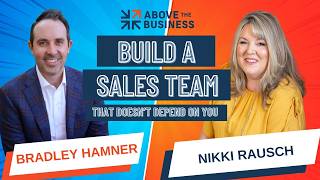
In this Above the Business Podcast episode, host Bradley Hamner interviews sales expert Nikki Rausch. Nikki shares her personal journey from a college project to becoming a top‑producing national sales manager and later founding her own sales‑training business. She explains how she leveraged Neuro‑Linguistic Programming (NLP) to develop a relationship‑focused selling style and created a proprietary framework called the "Selling Staircase," a five‑step process that gives sales teams structure while allowing individual personality. The conversation covers why generic scripts fail, the importance of understanding conversation tonality, the role of metrics (quotas, leading vs. lagging indicators), and how to balance methodology with authenticity. Nikki contrasts her approach with traditional sales methodologies like Sandler and SPIN, emphasizing flexibility, rapport, and listening. They discuss tools for capturing sales conversations (e.g., Rilla), the distinction between training (onboarding) and coaching (ongoing performance), and the need for clear accountability, recognition, and transparent reporting within sales teams. The episode ends with Nikki offering a free training, promoting her podcast, and discussing the broader concept of “working above the business” – focusing on vision and delegation rather than day‑to‑day tasks.
Chapters
Welcome to another episode of the Above the Business Podcast. My name is Bradley Hamner, your host. On today's episode, we have Nikki Rausch, the Sales Maven. You are probably a really good salesperson yourself, but getting that transferred over to your sales reps and building a sales team is challenging. In this episode, we talk about the importance of having structure, adopting a sales process or methodology. We talk about measurements of certain KPIs. We talk about training and coaching. We try to begin to kind of demystify what it actually looks like to build a sales team and become a sales maven yourself. Without further ado, here's my conversation with Nikki Rausch. Nikki Rausch, welcome to the Above the Business Podcast.
Thanks for having me.
Excited to have you. We love to start with background and origin story. I think it's really fascinating to hear people's journeys about kind of where they've been and how they got to where they are. Take us back wherever you feel is appropriate, bring us to present day.
Well, okay, so since my business is sales and teaching selling, I always like to share that I got my first professional sales job from a college project. Uh, we had to go out into a business in our community that we didn't have any contact with, uh, build relationship and go in and interview somebody from every single department from there. From their organization and then go back and give a presentation on their organization and how it worked. I had a partner, and one of the pieces that I took as part of sharing about this local business was their hiring practices. So this was back in the late 1900s, uh, so this was back when people used to actually put ads in the newspaper when they were hiring. So I had brought in this newspaper ad as part of my presentation And one of my classmates at the end of my presentation came up and said, hey, can I get that ad? I'm going to go apply to work at this company. It was a very exciting tech company, kind of doing things like they sold the third LCD panel that was ever made. And I don't even know if you'll remember LCD panels, but they used to sit on overhead projectors, and then you'd hook your computer to it, and then it would project up on the wall. Like, it was revolutionary. My co— or my classmate got hired and then they hired another one of our classmates and I thought, well, if they'll hire those two dudes, they might give me a job. And so I went and applied and that was really how I got my first professional sales job. Moved my way up there, became their national sales manager within a few years. And then I moved to the manufacturer side and had a lot of success there. And while I was selling on the manufacturer side, which means I was like a regional sales manager, I was the kind of like road warrior that was like traveling all the time. I always say my airline used to send me a Christmas gift every year because that's how much I traveled. And while I was doing that, I got really interested in how can I perform in this sales role that was in this tech space, very male-dominated industry. How could I really kind of stand out and feel authentic, like that I was really being me and I wasn't trying to sell like all the other, like, male counterparts that I was working with. Um, and that's when I found my way into Neuro Linguistic Programming, NLP for short. Anybody who might be hearing that term for the first time, it's really the study of communication. And I dove really deep into that and started studying it. I found that it helped me quite a bit with developing my own style, my own ability to build rapport with people. And so again, just, I had a lot of success in my sales career. I was the top producing rep in North America for one of the largest companies in the world. And, um, and then when I got to an age where I thought, is this it? Like, is there anything else out there? Like, is this what I'm gonna do? You know, until I retire. Um, that got me really curious and I ended up leaving the industry and going to help my NLP teacher at the time. She had moved to the state that I was living in, and I was helping to build her business for a little bit, which, you know, didn't really make sense financially, but it was a great experience because that was when I started interacting with entrepreneurs really for the first time, coming from a very corporate kind of background. And what I love about entrepreneurs is they're so filled with passion. I'm so like, like inspired by people who are really passionate about what they do. And I just wanted to spend as much time as I could around these super passionate entrepreneurs. And I found that as I got to know many of them, they struggled to make money in their business. And the reason they struggled is they did not understand the selling process. And that was something that I, I knew. So I really just kind of started helping them. Those that wanted it, really with just the idea that I got to spend time around them. I didn't ever think I was going to turn it into a business, but finally somebody pulled me aside— she was having a lot of success using the things that she was learning from me— and said, "You really should be doing this as a business," which I thought at the time was kind of dumb. I was surprised that people would pay me to learn the kind of skills that I teach, which is really this relationship-based selling. And so And that kind of brings me to where I am today. You know, I've had my business now for 12 years. It's been the most fulfilling aspect of any of my career moves. And I get to spend time with entrepreneurs teaching them how to be more strategic in their sales conversations.
Is NLP what Tony Robbins talked about that he actually initially got certified in years ago? Do you know that?
He— yes, he does have an NLP certification. There was two original founders of NLP, and they ended up at some point going their separate way. So it was, uh, Richard Bandler and, um, John Grinder. And I will say that I, I think if I, if I know this right, he really kind of studied the, the like, um, Bandler side of NLP, and I really kind of found my way through the John Grinder side. And I think I'm saying that right. It's been a while since I've talked about that. But yeah, so yes, NLP. And I will say NLP is taught around the world. It's used in a lot of different modalities and a lot of different professions. I really feel it's important that you stand in a place of integrity and that it isn't about manipulating people. It isn't about— somebody one time said that I, that I studied mind control, which is not at all what it is. It's really, I always say it references my favorite quote, which is, "Blessed are the flexible, for they shall not be bent out of shape." And I teach people how to be more flexible in their conversations so that they put the other person at ease and they're able to pick up cues and things that are going to matter to the person they're in conversation with.
Okay, so, uh, I'm going to hit you right off the top with, uh, one of the big questions that I wanted to ask. Okay, so with working with small business owners and entrepreneurs Matter of fact, I actually had a sales conversation this morning with a small business owner. It'd be interesting for you to evaluate my sales skills. Either way, I don't do a ton of that anymore myself. But here's the deal. This business owner had just crossed herself a million dollars in top line revenue. Now, I consider the $300,000 to $1 million threshold, kind of the building stage. I think you're building two things. I think it's one of the more difficult stages of business too, because you're building your team for the first time, really, and you're building systems. And one of the major systems is sales. Yeah, we refer to the whole broader thing as sales playbook. Specifically, there's different language and architecture, you know, whatever that can be used. Okay. That being said, it is incredibly difficult Oftentimes a small business owner, him or her themselves, they are naturally gifted at selling. They're passionate about it. It's their business, their baby. They kind of brought it forth and they struggle. By and large, I think this is very universal. They struggle to externalize, you know, how they're selling, what they're doing, the process they're following. The tonality in which that they're selling, etc., etc. They struggle with getting that transferred over, and so they try different scripts and other type of things, but they really just don't know how to pass it on to their team. Now, the ones that have successfully scaled sales teams have been able to do that. I think about Someone that I think is obviously very popular online and has done a great job is Alex Hormozi. He's built a ton of sales teams, so he is very good at being able to almost reverse engineer what he used to do himself and then to pass that along to other people using whatever his framework and methodology is. So very long question. I apologize. But what is the way that you help business owners to be able to not just get better at sales themselves, but actually pass that along to other— to their team and actually build sales teams?
Yeah. So, okay, well, just like I would say to anybody, like, I don't teach anybody how to sell like me because it's not going to work. And just like the business owner trying to teach somebody to sell like you is a little bit— you're just not going to be successful because nobody's you. So the idea though, and this is the piece that is the difference, is it's the structure of what, like, what is the process. And when you can teach somebody structure, then it allows for their own personality to come through because you can give somebody scripts and, and I do have scripts in my business for clients, but I always say like, this is just a getting you started because I can say something that you would look at me and be like, I would never talk like that. It would never come outta your mouth, right? Right. But you can say things that people, it would land for them and they would, they would totally be in. But if I said it, it would feel inauthentic. It wouldn't be genuine because that's not how I talk. That's not, that wouldn't feel comfortable coming out of my mouth. And so it's kind of like if you've ever been in a sales conversation where you feel like somebody's just reading a script, like that is ridiculous because the person on the other end, they don't have the other side of the script. The buyer doesn't have the other part of the script, so expecting them to respond in a certain way with this word— like, they're gonna say this, so then you say that— like, they're gonna bob and weave because they're people, they're different. So if you understand the structure of the conversation, now you, you can be more successful. So I teach, and this is my signature framework, a 5-step process to a successful sales conversation, and I teach it It's called the Selling Staircase. I wrote my third book around it. And the reason I teach it as a staircase is because most people understand that when you're ascending a staircase, you go one step at a time. And when I can teach a sales team that there are these steps and you need to understand in the conversation what step are we on, then you know what to do or say next, but you're not trying to get the other person to fit into some box and say this so you can say that. That just doesn't work. Work. So it really is about structure.
Okay. So is that then what your idea would be in terms of a replacement as of a methodology? Let me give you an example. So in one of my organizations, we follow the Sandler methodology. Okay. We, we, we particularly like that relationship building on the front and just the way the overall structure, so to speak. Or do you believe in adopting one of these other methodologies, SPIN Selling as an example, or is that your replacement? How do you kind of work between those two?
I guess I would say my process is, there is a process to it, there is a structure to it. I haven't studied Sandler, so I can't tell you exactly, you know, what their process is and how it's different than mine. Um, I think we have some similar techniques and some similar strategies. Um, the last time somebody showed me something of Sandler's, it felt like it was very script-based. So again, that's not, that's not something that I really lean into because you, like, again, you might look at a script and be like, yes, I love this. But you could give it to one of your team members and they would go like, they might say to you, Okay, I'll do my best here, but realistically it won't flow for them. It will feel like, like I'm just trying to read something versus I'm trying to be authentic in the conversation. And so do I teach rapport skills? Absolutely. Do I teach listening skills? Absolutely. Do I teach issuing invitations? 100%. So there's some of that structure that's very important. Do I teach overcoming objections? Yes. And there is structure behind that. But trying to say to somebody like, you have to say this sentence exactly like this, oftentimes it will work for some, but it won't work for others. And that doesn't mean that that person isn't going to be a successful salesperson for you. It's like there has— I truly believe salespeople, like, they have to have a little bit of breathing room, like you have to be your authentic self in the conversation. Having some strategy and some structure so that you're more strategic, I think, is the most important thing.
Yeah, that's really good. I'm going to try to recall the name of this software that I've recently come across. Apparently it is incredibly expensive, so admittedly I don't have knowledge or haven't used this. But I think I'm going to use this idea as a question for you, and then I'll try to find out what that software was specifically that I've heard that recently came out. Okay, so let's say somebody gets a structure, and I think that this is really important for our listening audience. I've asked a lot of business owners this: hey, what methodology or process do you subscribe to? And they kind of look at me like, I, what do you, what do you, what are you talking about? I don't, I don't, I don't know what that means. I think that in and of itself is something really good. So if it's the, you know, the, the 5-step process that you have, the, the selling staircase, I believe like that one or another one, I think that your point is really valid to have a structure, a methodology that you have really adopted into. And then inside of that, people can interweave it. The second thing is though, And I think that this is important, that if I was at a conference recently and people were talking about their outside sales reps. Okay, so these are sales reps that are actually going to people's homes, whether it's, say, roofing or, you know, exterior remodeling, etc. Obviously, when you have outside sales reps, but even if you have inside sales reps, you're not able to capture every single conversation unless you're recording all of those. The problem has been though that even if you capture the words, the transcript, you don't get any of the inflection, any of the tone. And so let me ask you, how do you teach and what do you believe about not only having structure— okay, somebody, somebody follow the structure— but also matching it with— I don't know what other word to be able to say— but tonality? Right, how they've actually said it. I can read the words of the transcript, but I don't know how they actually use those words.
Yeah, well, I think tonality matters. And, you know, based on my background in neurolinguistic programming, the, um, there's a, there's a presupposition that goes like this: the meaning of your communication is based on the response you get. Which, if you really lean into what I just said, there's a lot of responsibility in how you show up in a conversation. Now, what can you do to set your sales team up for success? You can teach them how to pay attention to the cues that the other person in the conversation is giving, because everybody gives cues in conversation. Like, you, you just can't be yourself and communicate. Like, we're communicating in all different kinds of ways, whether it be in the tone that we're using, our facial expressions, our body language. All these things are communication. Like cues. And so you need to take your cues from the client. So one of the things I used to pride myself on is when I was back in my corporate days on the manufacturer side, I used to go out and give a tremendous amount of presentations every week. And a lot of times I would go out with our distributors and our dealers, the reps, the outside sales team. And I was there like, you know, okay, we've got the manufacturer here, Nikki's got this business card with, you know, this high-profile company name on it. She's going to give this presentation. And my, my reps that I would go out into the field with, the thing they used to always say is, so interesting, you, you never give the same presentation twice, but you always get the stuff out. And I was like, yeah, because I'm paying attention to what's important to the person I'm in conversation with, and I'm not going to talk about things that they don't care about, and I'm not going to spend time focused on things that I can tell they're like, they're not engaged in. And I'm also gonna ask questions so that I know what are the things to focus on. Because if I go in with my agenda and I'm like, look, this is my presentation. I have to start at A in order to get to B and then C, and then, you know, we get all the place all the way down to Z, and I give the same thing over and over. You don't need me as a salesperson. You could just have a video and have 'em watch a video and it's the same every time. But the thing is, is that won't sell for you. That will not connect. Some people might like it, but other people are gonna be like, I don't like watching videos. I don't like listening to a robot. I don't like being talked at. And so teaching your sales team how to talk with people instead of at them is crucial to success. So I understand what you're saying about like being able to capture and give feedback to the sales team and you're missing tone. Yeah. You should be teaching your sales team and providing them with additional skills on how they can adjust and take their cues from the person they're in conversation with and focus on the things that matter to them. Because regardless of what your business is, like a really educated salesperson could probably talk for hours, if not days, about your products and your services. And just like I could talk for, well, now I think it's weeks, about sales, like, before you get to the end of what I could share with you. But me just talking, that's not going to be interesting to you. I need to know what part of sales is interesting to you, what part of my product is going to make a difference, what are the, what are the challenges that you're having, what are the, what is the way that you like to receive information. So you have to be able to make adjustments to the person you're in the room with. And pretending like there's a one-size-fits-all is a mistake.
You know, I found out that the software— I went and pulled it up— Rilla is actually—
oh, okay.
And it's, it's called— it says that the end of ride-alongs. And so you can see why it was, why it was specifically— but the reason I think that that is different is because it was— it's not just picking up the words. I mean, you know, you could use you could use Otter AI, you could use all kinds of different things, the PlodPen or something like that to just capture the words that they're saying.
Yeah.
And then analyze that against, analyze that against your script as an example. That's not important. What's important is the fact that they're, well, I mean, that is important, but I think it's also, I think what they're trying to solve is, yeah, but how did Nikki say that? Right? Did she have empathy? Right. Did you have curiosity in the tone of the question? So I thought that was an interesting, interesting company there. What are your thoughts about, you know, I've seen this both ways. I've seen business owners over-index for sales KPIs.
Mm-hmm.
How many dials did you make? How many quotes did you provide or estimates did you provide, you know, what's your closing ratio, which I think all of those are important. Yeah, I've seen it go too far, right?
Yeah.
Where they don't care anything about the script, the structure. It's just numbers only. They don't get into the actual coaching of the reps to help them improve some of these numbers. It's just as long as you hit your targets, that's all that matters. And then I've seen the other side where business owners, you ask them some of these questions about, all right, well, let's talk about, you know, the activities that your sales reps are doing. We'll call those leading indicators from 4DX world, leading indicators and lagging indicators. And you ask a business owner that and they're like, I have no idea. I have no idea. This is how many sales we made. I don't even know what these metrics are. Yeah, clearly in between over-indexing for KPIs and having no numbers is probably some middle ground. But what do you feel that actually makes sense?
Well, I, you know, you, you have to have quotas for your sales team, right, to, to have some benchmarks to see how they're doing. But the ultimate, like, you know, quota is did they hit the number? Like, are they making sales? Are they bringing business in the door? And if the answer is no, then there's a problem. Something's got to change. But I have found, you know, again, with my own kind of background and also with working with quite a few organizations in my, in my career, that, that sometimes there are some things that will impact the sales, like whether or not a sale is going to be made, that has nothing to do with the salesperson. And so there needs to be some adjustment for that as well. I remember years ago working for an organization where they kept changing the warranty on the product. Like when I went to work for them, it It was a lifetime warranty. And then they changed it to 5 years. Guess why they changed it? Because they had no idea how long the product was going to last. And then after, you know, I'm out here as a salesperson selling my heart out for this organization, telling people lifetime warranty, and I have to go back and go, oh, uh, actually it's a 5-year warranty. And then within less than a year, it was a 1-year warranty, and then it was no warranty. Like, what does that say as from a sales perspective? Because the thing about salespeople, depending on the type of selling that they're doing, like how important is repeat business to your, to your bottom line? And if repeat business is important, then you also better be thinking about relationships and what, what is your responsibility as the business to make sure that you're setting your salespeople up for repeat business. That means you, you can't be going back on guarantees. You, you can't be changing the message like that and expecting there not to be kind of a fallout. Um, and which there was. I mean, in my, in my case, it, it really burned some big bridge, some big bridges that I actually brought into this organization when I went to work with them because I had the relationships. And then they burned those like relationships based on the fact that they couldn't be really honest about what was going on with the product. And, um, and then when I left the organization, you know, I had to go back and try to earn back those relationships, but doing it now with a different business card and doing it for a different company. Like, these things have to be taken into consideration. So I think as a business owner, you need to think about what, what can you do to set your sales team up for success? And then of course you have to have expectations. And one of the things I find that a lot of times business owners don't think about, but I know is crucial for sales, is if you have multiple people on your sales team, they need to know where they're tracking. They need to know where their sales are tracking, probably at least weekly, if not monthly. But a lot of times people try to hide that. They're like, well, you know, we don't want Nikki to see what Bobby's doing, so We're not going to show this information, but if you really want to get salespeople that have some like oomph behind it, one of the things most salespeople are driven by— well, I would say there's two big things: money and recognition. And if they don't know where they're tracking in relation to everybody else on the sales team, that's a mistake. Because, you know, maybe there's, you know, somebody in the organization that's always going to be your number one producer. That's awesome. But if I look at that and go, well, I don't even know where I am in relation to the number 1 producer versus the number 10, and maybe I'm at number 11, I'm going to drive myself and, and strive to get past number 10 and get past number 9. And number 10 is going to drive to keep that spot. So all these things are going to help drive sales. And I think a lot of times owners don't think about that, or businesses don't really take into consideration that, like, what really drives your team? Like, like what's going to move the needle? And competition in sales moves the needle.
We've talked about structure, having a methodology and a process that you subscribe to yourself that you can share with the team. We talked about kind of the measurement, having some measurements. I love the— by the way, I actually did a solo podcast recently called Quotas. I think that that word, does not get used nearly as much as it used to. I personally think it should. I think it's a great word for sales reps. This is your quota, this is target, you're above quota, you're below quota, right? I think, I think it does not get used nearly as, as much. Okay, but let's talk about training and coaching. Now you may use— let me share with you how I I see those words.
Okay.
Um, I believe training is what happens at the beginning, right, with a new, with a new rep. Okay. So whenever you're trying to get somebody up to speed on something, and now it could be a new product that you introduce, and so therefore there obviously would be training within that.
Yeah.
But I see training at the beginning, so somebody goes through training, if that makes sense. And then there's like coaching, and then that's the— you've got a rep been with you 6 months, a year, 2 years, etc. You continue to coach them to improve. What does the right training and coaching look like in your mind? Because let's be real, there's a lot of business owners that are trying to train and coach, but they're winging it.
Yeah. Well, I do think there has to be training at the beginning, right? And I think there needs to be a plan of like, is this a 90-day kind of roll out and how things are going to roll out, or is it a 6-month plan? I always tell new sales reps when I'm working with them, like, really, you should probably keep your mouth shut for the first 6 months and just learn. Like, learn the business, learn the processes, understand why things are the way they are before you start coming in going like, well, you should change this and this doesn't work and here's why. And, you know, I think there's that. And so if you set people up for success in the beginning and say like, hey, when you come in This is going to be the training program. We're going to ask that you come in, commit to it. You're, you know, we'll, we'll ask you at times for feedback. But what we really want you to do is understand us, our culture, our products, our services. And then, you know, once you've been out in the field and had some experience, then you'll have more to contribute. And I think that is an important piece at the very beginning. And then, of course, yes, coaching is a piece that needs to happen. And I think one of the mistakes business owners people often make is that they think that the role of the sales manager is to be the coach. And that can oftentimes be a mistake because the sales manager is the one who needs to be holding you accountable to your quotas, to making sure that you're, you know, turning your reports in on, on time and that you're, you know, updating the CRM and all of that. And so sometimes I think bringing in outside coach or somebody else within the organization to help coach your sales team where they can be really like candid, because you don't really want to tell your sales manager like, this is really hard, and you know, I'm not sure that this particular relationship with this client is even salvageable, you know, whereas the sales manager's like, figure it out, go fix it. So I do think sometimes there needs to be a difference, and so really understanding And then whose role is that? As the business owner, if you think your job is to coach and mentor your sales team, then you probably need to have a sales manager who's managing them separately.
That's good. That's good feedback. Nikki, people want to learn more about you, your work, where they can find some of your books if they want to connect with you personally. Where would you point them to?
Thank you so much for that. Well, here's the— I always like to give a gift if I get to be and spend time with somebody's audience. So I have a training, it's called Seal the Deal: Questions That Close Sales. I truly believe questions are the differentiator in a successful sales conversation. So I will gift this training to any of your listeners who would like to get it. You can go to yoursalesmaven.com/above. So this really is for your audience. And then I also have a podcast, it's called Sales Maven. So check out if you're looking for another podcast to listen to an episode or two, there's 300 and some episodes there you can go and check out on sales techniques and trainings. And then you can find me, obviously we'll be connected once you download the training through Sales Maven.
Okay, awesome. That's great. Nikki, what do you feel like working above the business means to you?
I think one piece that comes to mind with that is really understanding what your role in the business is and then understanding who— whose responsibility it is to make things happen. And sometimes as the business owner, it's not your responsibility to like do the day-to-day things and having a strong team that understands what their role is and is accountable for their role. And, you know, I always think like you should, you should really be the visionary in the business and you should have a team that supports you depending on where you are, right? Like if you're early starting out, that's not always the case. But with the kind of businesses that you've shared that are your listeners here, like if you're getting into everybody's like, how are you doing this and why are you doing it this way? Like you're probably not above the business. You're, you're in the business and you're probably causing some, some backlogs and some, some confusion.
Yeah, I totally agree. Nikki, you know, some of the takeaways for me today, obviously, I think just a really great reiteration around the importance of subscribing to a process or a methodology, some structure inside of it, which is gonna— actually, I think your sales reps would love that because they get to have their own personality within it. And I think also your comment about the fact that nobody's gonna sell exactly like you because they're not you, no matter what you have. And I think also the importance of obviously measuring, uh, uh, being aware of tonality, not just the words that they say, but also tonality in that discussion. And then training and coaching. Those are some of my big takeaways from today. Nikki, thank you so much for coming on the podcast.
Thanks for having me.
Big shout out to our podcast partners, DirectClicks. Go to directclicksinc.com/above-the-business. They can help you to get control of your marketing analytics, your marketing spend, so that you can invest properly where you should to get the best return on investment. DirectClicksinc.com/above-the-business. The business. Developing our teams, whether it's our sales teams or our customer service teams, incredibly important. How do you put your insurance team with some of those business owners that are also have their teams in there so they can have peer-to-peer interaction? To go to coachpconsulting.com and let him know and the team know you heard about them on the Above the Business podcast. DirectClicksinc.com/above-the-business and coachpconsulting.com. It's also incredibly important to always have a bench, to have a recruiter. We have a recruiter with Autopilot Recruiting, and they're always sending emails on almost a daily basis with the work that you're doing. If you ever wondered, hey, what is the person doing? When we work with Autopilot, they're going to have somebody that's every day moving the needle forward for you, whether that's filling a gap, what's helping you to build a bench, etc. We know the value of always being recruiting, but the execution of that is challenging and difficult, but not if you have a recruiter on your side. Go to autopilotrecruiting.com. Autopilotrecruiting.com. You have a plan for the business, but do you have a personal leadership plan to lead yourself first in 2026? As a small business owner, you likely did everything right in January. You set the goals, you got the team aligned, and you built the plan, but yet something still feels offed. You're tired, exhausted actually. Decision fatigue is setting in. You're having to put out fires instead of working on the strategic initiatives that you put forth in this year. To small business owners, we feel like we're firefighting all of the time without realizing that sometimes we're better arsonists than we are firefighters. And that's why I'm hosting a workshop on Tuesday, February 24th. And that workshop is designed to help you to lead yourself first. You built a plan for the business, but do you have a personal leadership plan for yourself? Here's the truth: your time and energy is the most valuable and finite resource in the business. As small business owners, we're constantly having to make the decisions of finite resources—time, energy, and money—against unlimited options. What marketing plan? What team member we hire or don't hire? What strategic initiatives we move forward with? Sometimes those decisions can weigh on us. That's why we end up working long hours. We work into the weekends and we don't take care of ourselves. You have a plan for the business, but do you have a personal leadership plan to lead yourself first in 2026 so you can actually execute on the plan that you have for the business? I'd love to invite you to our workshop, Lead Yourself First, Tuesday, February 24th from 10:00 AM to 12:00 noon Central. And in 2 hours, we'll put together some systems and processes for you so you can actually put rubber on the road and execute on the plan that you have for this year. Real leadership starts when you begin to lead yourself first. So go to blueprintos.com/assets, blueprintos.com/assets, and you can register completely for free. I look forward to seeing you there. All right, everyone, hope you enjoyed this episode. Till next time, lead well and go be great.










