PPP Forgiveness & EIDL Updates
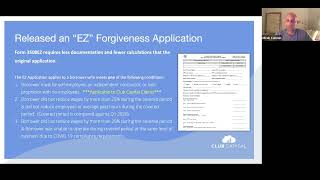
Micah Cannon covers PPP forgiveness rule changes: the covered period extended to 24 weeks, payroll threshold dropped to 60%, and non-payroll expenses raised to 40%. He walks through the 3508EZ form, eligible costs, documentation needed, and tax treatment. The second half covers EIDL terms: up to $150k at 3.75%, 30-year term, with a 12-month payment holiday.
Chapters
All right, well, we have a good number of people already on, so we will go ahead and get started. So welcome everybody again. My name is Micah Cannon. I'm one of the partners at Corb Capital, for anybody that doesn't know me. Agenda for today, obviously the title is on forgiveness for the PPP loans as well as talking about EIDL. We've been receiving a good number of questions over the last couple of weeks, especially with all the different changes that continue to come out with new legislation passed, passed by Congress. So we want to be able to talk about those, and we want to just make sure that everybody feels comfortable with kind of where they stand on forgiveness. So we're going to start today with just a couple quick announcements. Company-wise. We're going to talk about the latest legislation that was passed called the PPP Flexibility Act. There's actually a new application out there, so one of the reasons why some people are already at the forgiveness point and they're trying to, to apply with their banks, and most banks to date are not accepting applications yet. I think they might be accepting maybe this week or next week, But there's been a lot of talk about revised applications for forgiveness, and there's actually one that applies to most Corp Capital clients and the clients that we work with that's called the EZ application, which is great for everybody, right? A little bit easier to apply, kind of more for, you know, the very small businesses that are not as complex. And so we'll kind of dive into that. We'll talk about some updates on the forgiveness rules as well as some exceptions to the rules, which includes some of the reduction triggers as well. So when people are worried about some of the FTE counts, hey, how do I, how do I really calculate this? You know, am I going to be penalized if somebody, you know, just left my agency for whatever reason? We'll dive into that a little bit. For everybody that's getting ready for applying for forgiveness, What is that required documentation that you need? Club Capital is handling this for a lot of our clients, but for those that are doing this on their own, what do you need? What's that documentation that you need? And then with a caveat of this is a little bit in flux right now, we're going to talk about the 2020 tax implications from forgiveness, right? So the question coming up a lot of the time is Am I going to be taxed on this? So the loan is forgiven. What happens? Am I taxed on it? Is this revenue, right? So we want to dive into that a little bit. And then the Economic Injury Disaster Loan. This has been— so this reopened for businesses to apply in early, I believe early or mid-June, and since then I've had a lot of renewed interest from small businesses and especially a lot of our clients. If you remember and were on some of our original webinars back at the beginning of the pandemic, we were talking about the Economic Injury Disaster Loan as not being something that we felt would, would really apply for a lot of the businesses that we work with. In insurance based upon reductions in or not seeing as much of a reduction in income or revenue coming in. It appears they've changed some of the parameters to eligibility on the EIDL, and so we've seen a lot of people getting these now. So we wanted to be able to do another take and say, hey, what are these, you know, Does it apply to you? Should this be something that you look into and at least have a little bit of our take on this as well? So that's what we'll dive into, and we'll start with, of course, the disclaimer. Some of this is, you know, what we want to be able to do here is provide you all the latest information from what we know. But this is based on some of the interim rules that were officially published in mid-June. And obviously from a sense of things are continuing to change, and so we try and do some webinars pretty routinely to be able to update everybody on this. But this is the guidance as of, you know, when we have right now, but some things by the SBA may change after this too. So content is for, you know, general informational purposes. I'd really encourage people to reach out to us outside of this if it's, if it's probably a case-by-case or unique circumstance, reach out to us. And we are not lawyers too, so this is not necessarily legal advice, which that might dive into it sometimes, especially around possibly HR questions and things of that nature. Quick announcements. It is July 16th. Tax Day 2020 was yesterday. So as, as most people should know, especially our clients, The tax deadline for 2020 was changed from April 15th to July 15th. So yesterday was the deadline for tax returns or to have your extension into IRS and states. So deadline for a couple things. One, your 2019 tax liability, at least having an estimate paid in towards what your 2019 liability was, and deadline for Q1 and Q2 estimates. So those were moved You did not have to pay those because of the pandemic. So they changed the guidelines on those. And yesterday was the deadline for that. So if you're hearing this and going, wait, what? I didn't know anything about this. Either reach out to us or reach out to your CPA to make sure that you're staying on top of it. And then two just plugs here. One, the Club Capital mobile app, especially for all of our clients. Real easy access into all of our platforms, as well as staying up to date on some of the latest news through push notifications, or even reaching out directly to your account manager to be able to set up some time on the calendar with them. So just want to make sure we get that pushed out to everybody. We're at a good percentage of our client base now that is utilizing it. Just want to make sure we get that up. And then Club Capital University, we're really excited to, to launch this kind of new brand of Club Capital. We just did it this past week. It is our first jump into a supplemental learning platform, and through a lot of the feedback from our clients over the past couple of years, we've spent really the past year, especially the past 6 months, actually designing our our first digital course that, true to Club Capital, we launched as the Financial Essentials. So a lot of our clients, and we know a lot of just small business owners in general, you know, really want to be able to dive into their— not only have financials, which is, you know, what, what we do, you know, at Legacy Club Capital, but to really understand them and utilize them as a strategic measure for your agency? How do I really use the different statements that are out there? And so we've spent quite a bit of time putting this together in a really good way with, with our Director of Coaching, Bradley Hamner, who is also an agent, to really be able to say, you know, what do we need to know as insurance agency owners for our business? So you can find out more. This— we're using an amazing teaching platform called Teachable, so Our site, if you want to check out more, is clubcapital.teachable.com. All right, so let's dive into the latest passed legislation around PPP. So the PPP Flexibility Act, and I'll just kind of go through some highlights here, some that a lot of people know about, some, some that you don't. So this is, uh, the Flexibility Act extended the 8-week covered period to 24 weeks, with the total deadline, if depending on when you got your loan, it cannot surpass or go past the end of 2020, so December 31st. But you now have up to 24 weeks to have eligible expenses to reach forgiveness instead of just the initial 8 weeks. It also changed the payroll expense forgiveness requirements from a 75% threshold down to 60%. So of your total loan amount, it originally said, hey, 75% of that total loan amount needs to be spent on payroll expenses. Now that's down to 60%. And then likewise, they brought the non-payroll expenses up from 25% to it can now be upwards of 40% of the total loan value. June 30th deadline for wage and FTE reductions. Was extended to December 31st. And then there are now some what are called safe harbor exemptions. So there's a new full-time equivalent safe harbor exemption. So no FTE-based reduction for a borrower, or if a borrower is able to— excuse me, unable to rehire an employee who is terminated on or before 2/15 or can demonstrate an ability to hire qualified replacement before 12/31. So in essence saying, hey, look, if, if somebody left, or if you were able— if you got rid of somebody initially at the crisis, but then you tried to rehire them and you couldn't, we're not going to penalize you. There's a couple other things there that we'll really get into further in the presentation, um, where you'll really be able to see that they're being quite quite lenient on here from a sense of they're not trying to penalize you if you're operating your business normally. The deferral period on initial loan payments was extended from 6 months to the date the loan forgiveness is confirmed. So originally when people were getting loans in, in April, May, you had 6 months of deferred loan payments. And now what they're saying is you have deferred loan payments until you get forgiveness, right? So if you're going to qualify for forgiveness, there's no reason that you need to be able to make, that you should make a loan payment prior to that. The loan repayment. So initially these loans that you were getting, so a lot of our clients in Blue Ridge Bank, right, were 2-year loans. And then if you get it forgiven, then it's a wash, right? You don't need to worry about it. But if you did not get it forgiven or if it was only a certain portion, the remaining remained a loan at 1% interest for 2 years. So it's still 1% interest, but now they're saying if you cannot qualify for forgiveness, it's now a 5-year loan, not a 2-year loan, to help with what those payments would be. Borrowers are eligible for 2-year deferral of employer's portion of Social Security. So this is, this is pretty huge as well, and we're not going to spend too much time on this today, but it's something that we could definitely go into, but borrowers or business owners are eligible to defer your portion of Social Security that is paid during payroll for up to 2 years. The thing here is that it's a deferral, so we need to really see, is this something that we should be doing right now? I mean, this is a way to kind of save on cash currently, but if cash isn't incredibly hurting right now, it might not be something to rack up on a liability list. All right, the released EZ Forgiveness application. So there's this new form. Everybody loves all the different names and numbers of forms from government agencies, but this is called the 3508EZ form. It requires a lot less documentation and fewer calculations than the original application, which seemed quite daunting. The Easy Application applies to a borrower if they can meet one of the following conditions. So the first one being one that's applicable to most Club Capital clients or agency owners out there. So the borrower must be self-employed, an independent contractor, or sole proprietor with no employees. And then there's others where borrower did not reduce wages by more than 25% during the covered period, and did not reduce employees or average paid hours during the covered period. So there's a couple there, primarily get one of these, and the first one primarily is the one that, that most of our clients will be able to fit into. So there's a lot of talk about the covered period, but then there's also the alternative covered period. So what's the difference between the two? What do you need to know about it? The covered period is either 8 weeks, 56 days. It's not just, you know, 8 weeks from this Tuesday, right? It's a literal number of days here, or 24 weeks, which would be 168 days. There's a caveat now. The only people that can actually utilize the 8-week period at all is if they got their loan before June 5th, which I believe most people, especially most of our clients, did. So right now you have the choice of choosing when you go to forgiveness, are you looking at the rules for 8 weeks or the rules for 24 weeks? But the 8 weeks here really starts at the day that you got the loan, right? That's what the covered period is. It begins on the loan disbursement date. Alternatively, you could look at a another period where it's really based upon the pay period. So instead of it starting on the date you got the loan, which could be just a random day in the middle of a pay period, the alternative covered pay period begins on the first day of the first pay period following the PPP loan disbursement date. So it seems a little nicer, cleaner, uh, to look at that, but we'll go into a couple reasons why it might not, uh, fully make sense for a lot of our clients to look between the two. This is primarily— so in the pro tip down here, it's primarily to help businesses leverage eligible expenses based on the difference between the two dates, right? So if your agency is going to achieve 100% forgiveness far before either that 8 or 24-week deadline, it really doesn't matter which one you pick there. Because we'll go into a couple things between incurred expenses or actual paid expenses. So we'll want to just kind of look at that, but I think for those that are especially doing their own application, it's likely not going to affect your specific application and forgiveness, especially if you're achieving that FAR before the deadline. This would really be looking at a lot of people that, you know, are really butting up to the end date and are trying to figure out how are they— how's the best way that they're going to be able to achieve for this. So as we go into some of these, just a quick refresher. We've talked a lot about PPP, so quick refresher on eligible payroll cost. So compensation up to $100,000 per employee. There is a cap during this time for anybody, you know, making that amount. So 8-week covered period would be $15,385, and 24-week period would be up to $46,000. This is for an individual, right? You're allowed to include PTO, so vacation, FMLA, sick leave. There is a caveat on the tax credit. So if you are utilizing the tax credit for employees that are out on FMLA, you can't necessarily double dip because you're already going to get that back. So we can't include those wages for PPP reasons because you're going to get that back in tax credits down the line. And then all— generally most benefits actually. So benefits, group health, dental, vision, and health FSA, and HRA, and retirement contributions. And then there are some that are not eligible over here. So an HSA, is not eligible to be included, as well as group term life, short and long-term disability, as well as commuter benefits. Especially right now with commuter benefits, not a lot of people commuting anyway. So expense timing eligibility. This is what we were— what I was just alluding to. Expenses can be either incurred or paid during the covered period or alternative covered period. So what's the difference here? So incurred expenses are those that are incurred on the date that employees' pay is earned or on a— for a non-payroll expense is generated. So say like an invoice, right? So it doesn't necessarily have to be paid on that specific date, but it was incurred, right? So if you had payroll through— that runs through the 15th, but you pay it on the 20th, right, you can include through the 15th on something because it was, it was actually incurred. And then paid expenses are exactly that, those that are paid really out of the bank, right? So they're considered paid on the day the check is distributed or that the borrower originates an ACH credit transaction. So in essence, between the two, it's really encapsulating a lot of a lot of expenses for that. I think one caveat here that we've gotten questions on is, what if I prepay rent? The rent, you can't prepay rent in essence, so it has to be, the invoice would be for that future day, that future month. So we can't actually do that here, but with the extended period, you're able to include multiple months of rent if needed to achieve loan forgiveness. All right. So if you remember, there are two potential reduction triggers. So FTE reduction and wage reduction. Okay. So FTE reduction is a reduction in your loan forgiveness if your FTE equivalency during the covered or alternative covered period is reduced compared to your base period. So for FTEs, there are two different base periods to choose from. You can either choose a period in 2019, or you could choose the first two months of 2020. And in essence, they're saying, hey, look, when you got this loan, did your FTEs go down? If so, by how much? And then we can begin to look at that, or what are the exceptions, and we'll get into that on the next slide, as well as wage reduction. So the base premise here is that they're saying we— if you were going to reduce your employees' pay because of the crisis, because of COVID-19, anything that you reduce their pay— so if you were paying someone $1,000 a week, they would allow you to reduce their pay by 25%, so say to $750 a week, without being kind of penalized towards forgiveness. But anything more than 25%, you know, was not going to be included in the forgiveness amount. Okay, and so the way in which they look at this is they compare what somebody was making during the period, during your covered or alternative covered period, to Q1 of 2020. So they look at that employee's average earnings during Q1 and they compare their earnings during the covered period to that, and that's how they base it. So a couple exceptions here. The following two circumstances would not cause an FTE forgiveness reduction. So the borrower made a good faith written offer to rehire somebody. So if somebody left your office or if you fired them and you tried to hire them back and you have proof of that, then it is not going to affect your forgiveness reduction. What we saw with a lot of our clients is that there really wasn't much of this, uh, the first example here. If there was though, definitely focus on needing to notify the state unemployment offices within 30 days of that rejection to come back. But really number 2 here is where we at Cloak Capital have gotten a lot of questions from, from clients is people that were either fired for cause or they voluntarily resigned and left, whether it's due to any myriad of reasons. So any employee who during the covered period, you know, was fired for cause, voluntarily resigned, or voluntarily requested to receive a reduction in hours this is now an exception to the general rule here. So a lot of what we've seen here, if people are underperforming and you just need to, you know, kind of part ways with an employee based upon performance reasons or anything generally HR-related, if they are not a good fit for the agency, that's okay. What they're saying is you don't have to just keep people employed that should not be employed, right? If you have a salesperson that's not driving any sales for you for the last 3 months, you shouldn't feel that you have to keep them for forgiveness reasons. And then likewise, if somebody— I think a good example was somebody decided to move during this, an employee decided to move during this time and so was wanting to leave the office. And, you know, our client was worried, hey, is this going to hurt my forgiveness at all my forgiveness application? The answer is no. If somebody leaves voluntarily, this is something that, that will not affect you here. What we would recommend though for any of this, things need to be documented, right? So if you have no proof of somebody leaving voluntarily or why they were fired for cause, it's going to— it would be hard to prove that if there were questions from the SBA or the lending institution. You're going to need to show— we'll talk about this in documentation— but, you know, what was your roster, your employee roster previously? What was it during the covered period? If there's differences here, right, especially in the count, you have to be able to say why. So we need to be able to have proof. And so this is just good guidance in general to— if you're not, from an HR perspective, All of that type of conversation should be documented and should be stored in an employee's file. You can even do this within, within Gusto, the payroll platform we have. You can store those and upload those documents into their files that it always stays kind of with them, even if they're dismissed. But good to have that there. Try not to have conversations via text. You know, have things— I'd say the two biggest things is have conversations with employees via corporate email, right, so that it's always there, it's on kind of letterhead. And then even to the next step, if they— having them sign something or sign a letter of why they're leaving or that it's a letter from them saying, you know, that they are resigning or retiring or whatever it is. You just want to be able to have proof of that. Okay, wage reduction. So the second possible forgiveness reduction out there. So forgiveness can be reduced if the wage for the employee goes lower than 25% during the covered period. Borrowers must complete the Salary Hourly Wage Reduction worksheet only for employees whose wages were reduced during the covered period. So this is a worksheet that is in the application. It's one of the schedules in the EDD application. You only have to fill it out for those that were reduced. So if you had none that were reduced, don't worry about filling it out. And then of course we talked about the $100,000 cap per employee, so anything above that is not forgiven or goes into the forgiveness calculation. So the safe harbor rule here allows borrowers to be exempt from wage reduction if both of the following conditions are met. So the borrower reduced an employee's compensation between 2/15 and 4/26. So like, if you reduce their compensation during that time, the borrower has now restored the employee's average annual salary or hourly wage by no later than 12/31. So this is a big kind of new safe harbor rule here. If they're, they're them saying, you know, okay, if you did reduce it but you brought it back up, we're not going to penalize you for that. You have to be within these specific parameters, but really good to know because initially we were looking at a lot of people that did bring people down a little bit during, during the initial couple weeks of the crisis and really having to do especially a lot of calculations of how to affect the forgiveness. But now what Congress has approved is if you have brought them up to their normal salary, brought them back up, then you would be exempt from any wage reduction affecting forgiveness. So just quickly, a couple things on the documentation. There's going to be a PPP Loan Forgiveness Calculation Form with the application. There is a Schedule A that kind of goes through— it's that worksheet that I was just talking about. That helps kind of create the calculations for a lot of the cells. When it comes to payroll, the two options here are bank account statements showing what payroll was or third-party payroll provider reports, which certainly all of our clients will have from us, but any third-party payroll provider you should be able to use, especially payroll summary reports for the whole period as well as individually for each payroll run. And then tax forms, uh, so Form 941s, these are the federal 941 forms, uh, quarterly that get filed, state quarterly business and individual employee wage reports, as well as unemployment insurance tax filing. So generally anything that got filed during the period of forgiveness, uh, we're going to want to be able to have and either we or you, and submit it with your application. Payment receipts or account statements documenting employer contributions to health insurance and retirement plans. So this would be statements— this likely I would look at statements specifically from your, say, group health insurance providers. And then when it comes to FTEs, documenting— or excuse me, documentation showing the average employee account per month. Month. And so these are specifically the lookback periods here. So not only are— because your current payroll reports are going to show what your employee count is during forgiveness, but what these two do is look at what your lookback periods are. So there's a frame of reference. And so those two lookback periods are February 15th, 2019 to June 30th, 2019. Or the first 2 months of this year. Okay, so that's specifically when looking at the difference in FTEs, you're able to look at either of those 2 periods to be able to compare against. So with all this being said, I think everybody's at that point now, or a lot of people are at the point now saying, so can we go ahead and apply, right? Are we— can we apply for forgiveness if we're there, right? If we're at 100%? So short answer is yes. Generally speaking, if you're there, you're allowed to apply. A question of, do I need to wait the whole 24 weeks? If I went past the 8 weeks to achieve forgiveness, do I have to go all the way to 24 weeks? The answer there is no. You can actually apply for forgiveness as soon as you achieve forgiveness. But the— you could actually apply before you reach 100% as well. But I think our first recommendation would be to make sure that you're at 100% forgiveness before you do look to apply. And you likely have time based upon this due to the 24 weeks that have been given to you. And then the next thing is make sure that your bank is accepting forgiveness applications. So as of right now, as I mentioned at the beginning of the, of the webinar, Most banks are not there yet, uh, in terms of, uh, accepting, uh, forgiveness applications, primarily because the SBA has just recently released some of the new guidelines for forgiveness applications. And so what banks are doing now is translating that actual document into, uh, kind of their tech platforms to be able to accept forgiveness applications. And do it in a way to where you can easily online find your original application and apply based upon that. So it's taking a little bit. This isn't the initial huge rush from the origination of the loans, gosh, 10, 12 weeks ago now. They have a little bit more time, so banks are taking their time to make sure that they roll this out. I think a little smoother than the first time. And then just some specifics for our clients. If you're loaned through Blue Ridge Bank, we're expecting to have their online portal ready within the next week, is what we've heard, to be able to start accepting applications. So if you are managing the forgiveness application, Blue Ridge Bank as well as Club Capital will send out some instructions on how to do so and be there for kind of help and guidance along the way and make sure that we provide reports that you need on the, on the GUSO side. And then for those of you that have asked Club Capital to manage the Forgiveness application process, we'll just handle everything kind of on our side here. As soon as we see that you're at Forgiveness, and we'll just reach out for signature when it's needed. So this is a big one here, and I know— I believe I see that there's a number of questions kind of coming in, and we're going to get to them in just probably about 5 minutes. We'll do some Q&A. Two more slides here, I believe. So what are the tax implications for this? A lot of the questions we're starting to see now that people are seeing, okay, wow, I'm at 100% forgiveness. I'm able to get this forgiven. This is fantastic. What's the ramification of that, or is there one? So really, this is very much in flux right now. This is not final by any means. But what we can say today is really just give an explanation of where things stand today from what the current laws are. There is some disagreement between the IRS and Congress right now as to how this will be treated for taxes at the end of the year for the 2020 tax year. We very much expect that there's going to be some changes to this and possibly just through legislation that will change this. But I do want to at least be able to tell people where the law is today. So Couple things here. Will your— will a forgiven loan be taxed, right? So if you get, let's just call it an $80,000 loan and it's fully forgiven, are you taxed on that? The general answer to that is no. The value of the, of the forgiven loan is fully tax-exempt. So if that's the case, how does it impact your taxes? So this is the way in which the IRS is looking at this now. The value of the forgiven loan is tax-exempt, but they're stating that the expenses that qualified you, uh, for PPP forgiveness would not be deductible expenses for you on your tax return. So for your business, because as of right now the IRS is calling this double dipping, but this is really where the IRS and Congress don't agree. I mean, our, our take on this You know, first, I'm not here to tell you exactly how it's going to be affected at the end of the year because we have this current situation right now, this current stance, but we really think that there's going to be some legislation change to this by the end of the year. We find it highly likely, and the AICPA body finds it highly likely, that the IRS will change its stance on this later in the year. So to kind of visualize this, we put the table on the right as a sort of simple taxation example with the current laws in terms of, okay, it's tax-exempt, but then the expenses aren't deductible, right? So if we look at this here, if you had— if your agency had annual revenue of $500,000, but then you got a fully forgiven $80,000 PPP loan, your taxable revenue is still $500,000. It's, it's not $580,000, right? So your taxable revenue is $500,000. Where this comes in here and where the IRS is saying the double dipping is on the expense side. So if your total expenses throughout the year were $400,000, but then obviously if you had $80,000 worth, worth, worth of expenses that got your PPP loan forgiven, those $80,000 would not be able to go— would not be deductible expenses for your business. So your eligible deductible expenses would only be a total of $320,000, right? So that changes, in this example, your profit from your business by the amount of the PPP loan, the PPP forgiveness amount. So as we can see here, then, you know, really what it's saying is, you know, the, the loan, uh, the forgiven loan is fully tax-exempt. In this example, that's not the case, right? By not having deductible expenses of the same amount, it is being taxed. So that's where the disagreement between IRS and Congress is right now and why we really feel, you know, the spirit of this loan is to help the business owners. And so if they're wanting it to not be taxed, then it really shouldn't affect the eligible deductible expenses. So this is where we stand right now. It's not a concrete, you know, yes or no on whether it's going to be taxed, but this is where we stand right now, and I hope this gives some clarity behind what the current legislation is. Okay, the Economic Injury Disaster Loan, transitioning to this for a little bit, kind of what is it, who can apply for it, what can the funds be used for, etc. So for those— I think a lot of our clients have applied for this so far. So for those that haven't though, the EIDL is provided by the SBA and provides a loan up to $150,000 in aid for businesses. The actual loan value is based upon what they call the economic injury or the loss, the economic loss that your agency or business has sustained. The specifics of this is it's a 3.75% loan with a maximum 30-year repayment schedule, with the first loan repayment not due for 12 months. So I think with those parameters, it perked the ears of a lot of business owners saying, okay, wow, you know, this seems like relatively cheap money. That being said, it's nearly a— it's a mortgage at that point at 30 years. And so, you know, who can apply for this? So small businesses of any size located within a disaster area can apply for this. So it's a very open window, and you can check all the listed disaster areas. At this point, I would imagine mostly US, but I know there's a specific list on the SBA website if you want to be very sure specific to you. And then I think something really clear to look into here is what can the funds be used for and what can the funds not be used for. Okay, so the funds stated by the SBA can be used for working capital to pay bills, for the business and to pay fixed debts. And so what we believe the mention of paying fixed debts is, is to be able to make your either make your monthly loan payments, okay? Because when they talk about what the loan cannot be used for, one of the things here is to refinance long-term debts, okay? Which I think is the initial thought of seeing a relatively large loan value with such a low interest rate is, "Oh, wow, this appears I might be able to refinance some of my loans, either one or some of my loans." So we don't know how they're necessarily going into and really determining how and what people are doing, what businesses are doing with the money. Once they receive them. But I know on our side, you know, we tend to be certainly more conservative to say, you know, we don't know what that is going to look like. It might not be now, it might not be next year, but there's certainly going to be, especially any, any, you know, kind of government initiative, an audit, a look back of how successful was something, you know, maybe down the line after we get out of this pandemic. So It's just something to at least have in there as to what you can and what you can't do. So just to run through the, the what should these not be used for: dividends and bonuses, disbursements to owners unless it's for specific payment to owners in normal schedule, kind of contract schedule, repayment of stockholder or principal loans, expansion. So those would be kind of more personal loans. Expansion of facilities, so building, you know, a larger office, paying off debt owned by the SBA, so like refinancing. If you currently have an SBA loan, the idea is not to refinance your SBA loan. Paying any direct federal debt, refinancing long-term debts, as well as relocation. So if you're needing to pay to move your office, I mean, this isn't— these are things that they are highlighting that the loan should not be used for. Okay, so with all this being said, what is our stance on this? What's the Club Capital stance? I think the first thing is to be careful with it. I mean, first, because it's a long-term loan. This is— it's a loan. It's not something that is eligible to be transitioned into a forgiveness loan or a grant by any means. So this is a loan. So debt is still debt that has to be repaid. So just keep that in mind because from our perspective when looking at financials and helping, you know, business owners look at utilizing that is that it needs to come with some sort of a strategic plan as to what it's for. Could this be an amazing opportunity? Yes. Could it be something that is, is not necessarily needed, possibly as well. And then I think the third thing is, you know, we're not sure, you know, if some of these things are being used to refinance other loans, we're not sure how they're going to necessarily come back and look at that or audit the use of the funds at some point. So it's just something to be, I think, a little bit careful of when initially looking at it. So I am going to transition now to some questions. I think we took quite a bit of time actually going through. I know I had quite an agenda for today, but Devin, if you don't mind, Devin, our Director of Business Development, is on and hopefully can help me sift through some of the questions that were there. Yeah, of course. Can you hear me? Yep, we got you. Excellent. So the first one is just a refresher. Can you again provide 3 ways to qualify for the EZ application? Yeah, I'll actually put it back on the screen here. So one, the borrower must be self-employed, an independent contractor, or a sole proprietor. With no employees. That's the first one. And keep in mind, a sole proprietor with no employees, obviously we have a lot of sole proprietor clients and they normally have employees, but you're also self-employed, right? So there's an or in that sentence. The second one is a borrower that did not reduce wages by more than 25% during the covered period. And did not reduce employees or average paid hours during the covered period. So in essence, none of the reduction require— you didn't hit the reduction requirements, so you can use the EZ application. And borrower didn't reduce wages by more than 24%, and borrower was unable to operate during covered period at the same level. I think most of our clients would not be in the third bucket, but again, it's just people that need to meet one of these three. Excellent. What is the definition of long-term debt? Can you refinance a credit line? I think— so the first question here is, or the first— my first answer here is they haven't put out specific guidance defining what each aspect of what they mean here is. So to us, that would still qualify as long-term debt. The next question would be, does that, you know, how does that impact credit cards, right? Could we pay off some credit cards and kind of refinance the credit cards, which are not long-term debt, into something that would be long-term debt? That one seems a little bit more likely in terms of what they possibly mean here or what some of the parameters are. But yeah, long-term debt. So like, I think the two words we were looking at is the ability to pay fixed debt versus refinancing long-term debt, right? So they, in essence, the spirit of what they're trying to do is to provide you capital to pay the loan payments that you are responsible for. The cash is not meant to fully refinance the entire loan. It's meant to help you make the payments that you are already obligated to pay. Excellent. For any of those that showed up late, per usual, do we intend to send out the slide presentation as well as the webinar recording? Certainly. Yep. We— this entire thing is being recorded, and we'll send out these— a link to these slides as well. Yes. Okay. Excellent. So this one should be a softball for you. Because I know that we've covered it in the past, but the 40% forgiveness for rent utilities, what utilities are included in that theme? So for what would be included in that would be, um, it's what you would expect as well as what I would say a couple more, right? So, uh, um, it's gonna be electric, sewer, water, And then cable, internet, and phone. And what I believe, what we believe is generally a lot of people have a lot of bundled phone together anyways, is our mobile phones for the business included in that. And I think the general answer there is yes. Excellent. So if you got the PPP funds on the same day as payroll came out of your bank account, does the payroll count? Was it only payroll after the day you received the funds? Our understanding is that it would count, yes. So you need to look at what the disbursement date was too, like when was the loan made available to you. And so if that day was the 5th, right, and you also ran payroll on the 5th, then we could include that in there. Okay. Also keep in mind, you know, if you're worried about one payroll being included or not, wait 2 more weeks, have the next payroll in there, right? Because we don't have— if you're already there, you also have another 10 weeks probably, at least, in terms of eligible payroll expenses based on this 24-week window that they gave. So if you're worried about it, you're either there today or you need to wait 2 weeks and then you can apply. Excellent. Would— just a clarification— would getting an EIDL affect the PPP loan forgiveness? So two things. One is there were— there was an option for the EIDL that included a grant portion. So people might remember this. It was up to $10,000 of an initial grant that came out of the EIDL. And so that grant, if you got that, which it tended to be from what I saw, it was $1,000 per employee. So if you got the grant and let's just say that the total SBA loan was $150,000, they initially gave you $10,000 as a grant. So you have $10,000 as a grant that you don't have to pay back and then your SBA loan is $140,000. The only thing that would affect your PPP loan is the grant portion of it, because in essence they're saying you can't get both forgiven, right? So if that grant, that's like a forgiven piece of the loan, let's call it, I think we're using $10,000, right? So if you got a $10,000 upfront SBA grant, it would reduce your PPP forgiveness amount by $10,000. In essence washing it out, right? You still got the same amount forgiven, but you can't get both forgiven. Excellent. So a little clarification on the change from the 75/25 rule to the 60/40. The question is, can you use 75/25 rule within the 24-week forgiveness option? Uh, I guess the answer would be yes. At minimum you have to use 60%, right? At minimum 60%. I mean, if you're at 75-25, that's, that's great. Um, primarily you just need to— now there was like a real hard cutoff of, hey, you have to spend 75% of this on payroll, and now it's, hey, you only have to spend 60% of this on payroll. To get forgiveness. So I would say if you've achieved 60%, then you really don't need to worry about the rest. Also keep in mind it doesn't need to be those specific amounts, right? So if you achieve forgiveness with 100% of the eligible expenses coming from payroll, that's fine. So you— it doesn't have to be a specific parameter of, or breakdown, you can achieve forgiveness simply by payroll alone. Okay, further clarification on the payroll when looking for forgiveness: if commissions are lower during the repayment period, does this count as lowering the pay? Possible. And so what we would do there is compare the— their average salary during— so again, I'd say average salary. I think what I mean there is annualized salary. So you look at the covered period, whether it's the 8 or 24 weeks or whatever we're looking at here, and you take a look at their pay and you say, okay, well, they made— I'll just say $10,000 during this period. If we annualize that, what is their salary, right? And you come up with that number. And then what you do is you go back to Q1 and you say, well, what's their annualized salary here, right? So especially for— because these are primarily sales employees, right? It's hard to say all the time like what their salary is, right? Because they're on salary plus they get commissions. So you'd want to look at Q1 and say, okay, they made— how much did they make in Q1? Times that by 4, and that's what their annualized salary is. And then we'd need to look at what they made during the covered period to say, well, how does this really change compared to the base period, which is Q1 of this year, right? And then the only thing that's going to— that you'd be, I guess, a little bit worried about is if it's less than 25% of that, right? So commissions might have changed a little bit. You know, did they change by 25%? I don't know, but that's what we would need to look at. We had a question about, can you apply for forgiveness before the 24-week period if you're at 100%? The answer to that is yes. You do not have to wait until the full 24 weeks is over. I'm sure the banking institution that you worked with would rather get them into their system as they come rather than everyone bullrushing them at 24 weeks. Another question, I think this has to do— So one clarification there, uh, so yeah, one thing there is just yes, you can, uh, apply, just double-check that your bank is ready, right? So we have a lot of people ready to apply, and we're helping people apply that, you know, are with banks other than, uh, Blue Ridge Bank, who we worked with, uh, but like Chase and some other, and I think US Bank, and they're all saying, you know, hey, we're not ready yet, we'll keep you posted as to when we're ready. This question is a little short, so maybe we can try to decipher what this individual was asking. It says Social Security reductions for sole proprietors. I'm not sure if, Kirk, you're still on the line here, if you want to add any additional clarity to that question. We can also always follow up, or you can write into support@club.capital, and we can try and reach out specifically there. Do you have any other questions there, Devin? Yeah, the last one that we have before we've addressed them all is, where can I find the PPP calculation form to make sure I'm at 100% forgiveness? Awesome, we will send that out as a link in our email this afternoon. So it's a direct link to the eRETA application form as well as the schedules for the worksheet. So we'll send that out this afternoon. Excellent. So that kind of wraps things up there. Awesome. Great. Well, thank you, everybody, for joining. And again, if you have any specific questions that weren't address today or you didn't have time to put them in, you can reach out to us at support@club.capital and we will get back to you stat. And if you need help applying for forgiveness, definitely let us know. If you have specific questions at all, just let our team know. Thank you everybody for joining today.










