PPP Round 1 Forgiveness and PPP2 Eligibility and Application Process
In this recorded webinar, Micah Cannon (Partner & COO, Club Capital) and Operations Manager Chris Ferretti walk insurance agency owners through the Paycheck Protection Program (PPP) updates. They review the forgiveness timeline and application process for PPP Round 1, explain the new legislation that created PPP Round 2, and detail eligibility rules (≤300 employees, ≥25% revenue decline in any 2020 quarter versus 2019, open by Feb 15 2020, and full use of Round 1 funds). They describe how the second‑draw loan amount is calculated (2.5 × average monthly payroll over the prior 12 months or 2019 payroll, capped at $2 million), the expanded list of eligible expenses, and the simplified forgiveness forms (3508‑EZ, 3508‑S, and a new $150k streamlined form). The session clarifies tax‑deductibility – forgiven amounts are no longer taxable and related expenses remain deductible. Lending options are discussed, emphasizing that community banks (e.g., Blue Ridge Bank) will receive funds first, though borrowers may use any SBA‑approved lender. Club Capital’s advisory services—including application preparation, documentation gathering, and audit representation—are outlined. The presenters also address common questions about deadlines, using different lenders, EIDL advance waivers, and the ability to apply for Round 2 before fully using Round 1 funds. The webinar concludes with contact information for further assistance.
Chapters
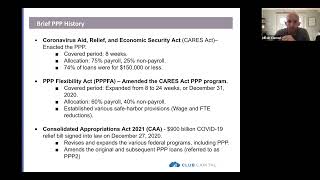
All right, well, happy Wednesday everybody and happy New Year. Again, my name is Micah Cannon from Club Capital, partner and COO. I really look forward to being able to go over really all of the updates that you need to know, very specific to PPP with some of the new legislation that's out today. So we'll go over PPP Round 1, what to know there, some updates as well as Round 2, which has just recently come out, and applications will be able to start going in possibly as soon as today, the latest I heard, but over the next couple of days for sure for Round 2. So we'll get started shortly just as people start filtering in. All right, um, just a couple, uh, kind of housekeeping items here. Uh, this webinar, um, is automatically being recorded, um, and, uh, is going to be sent out to, uh, all the emails that registered, um, as well as some of the emails that we sent this out to initially, but a link to this will be sent out later today. So in terms of taking notes and things like that, certainly do so if you want, but we'll also send out the slides. We do even have a little bit of a video in here too, especially for some of our current clients on how to pull some of the financials that might be needed for PPP Round 2, at least to be able to kind of do a quick check of eligibility before meeting with your account manager. And then also welcome your questions, obviously, as well. Our operations manager, Chris Ferretti, is joining me today and will be helping to field some, some questions maybe throughout the presentation as well as at the end. We'll do kind of a bit of a moderated session at the end. So if you do have some questions there throughout or at the end of the presentation today, just put them in there. We're going to do our best to get to as many of them as we can. Chris will kind of filter through there will likely be kind of some of the same, and so he'll filter through and ask some questions towards the end of today's session. So, um, other item here, just disclaimer, um, from our side of things, um, you know, we are an accounting firm, um, and an accounting firm that is very specific to, uh, to insurance agents. So, um, you know, this is not intended to be specific legal advice. Um, certain things, especially, I think for all business owners, agency owners, you know, likely, which is all of you on, on the webinar today, have realized there can be a lot that goes into— a lot of questions, a lot of specifics that can go into PPP and can go into a lot of the legislation surrounding COVID that might require legal advice, or sometimes very specific to HR, and so an employment attorney as well. So, you know, this doesn't constitute legal advice from us. Really, we want to be able to just put forward what we know of from the industry, looking to the AICPA for guidance as well, as well as all of our team doing the research here. So trying to provide as much as we can to all of you. So every individual circumstance and business owner circumstance may be unique, so definitely important to learn as much as you can from this and then maybe have some one-off conversations either with an employment attorney, directly with your CPA, or with us if that is just for you to discuss anything, you know, maybe specific to your unique case. And then we are going to be working and being able to help out, you know, individually with certain packages for people that would like us to, you know, help apply, either if it's for Round 1 forgiveness or getting into PPP Round 2. So, you know, use today for informational purposes only, gain the knowledge from it, and then we, you know, either we can talk outside of this individually or you can, you know, reach out to maybe your CPA if that's what you end up wanting to do. So today's agenda, very brief kind of history, kind of where are we. Right now with PPP. So a little bit of a history, talk about the forgiveness timeline for PPP Round 1, and then PPP Round 2, really get into understanding what is this, what's available to you, does it apply. You know, certainly all business owners saying, you know, hey, sign me up, right? If I had PPP Round 1, sign me up for Round 2. What do I need to do? So we want to be able to address, you know, what are the basic parameters of what we need to look at here? What does supporting documentation look like? Timeframe, etc. Forgiveness applications, um, I— outside of just the timeline, what does forgiveness applications look like? There are, in this new legislation, there's additional information about more forgiveness applications. In essence, what we've been seeing from the get-go is forgiveness applications that are getting simpler and simpler, and they're doing that for increasing loan amounts as well. So it started at $50,000, now they're going up to $150,000, and just trying to simplify some of those loan applications for, for borrowers. Tax deductibility— it is tax season, huge time of year to obviously be even thinking about this. We'll go into what the latest legislation, what the latest legislation covers in terms of PPP loan tax deductibility. This has been huge. It's something that we stressed a lot in our tax planning, uh, initially without knowing, um, of whether these were going to be taxed or not. So we have some updates there, um, and then some lending options. And what this refers to is, uh, you know, really just how are you going to be going through PPP Round 2, is it the same as before, etc. So then we'll get into Q&A. Uh, so Section 1, just kind of brief history, um, lesson here. So, uh, the CARES Act, um, is what initially enacted the PPP. Um, initial covered period, uh, was 8 weeks, 75% payroll, 25% non-payroll is what could allow you for, uh, um, for forgiveness. Um, what was amazing to see here, despite how, how quickly it went, 74% of the loans were for $150,000 or less. So that's especially why we're seeing a lot of legislation come out kind of simplifying some of those loans. And then obviously what a lot of people have seen in the news is for a lot of those kind of larger companies as to why did they get some of the PPP money where, you know, 74% of the loans were under $150,000 and then there were some that were tapping it out at $10 million initially. The PPP Flexibility Act amended the CARES Act and made the— expanded the covered period from 8 to 24 weeks. And really what the government was doing here was really trying to be able to maximize loan forgiveness for everybody. And by doing that, they also brought down the payroll threshold of you could only have 60% of the loan go towards payroll costs, 40% towards non-payroll and then established various kind of safe harbor provisions. So wage and FTE reductions, this was something that was, you know, such a big impact for small businesses. So they brought in really just a lot of legislation to help small business owners. And then Consolidation Appropriations Act, which was the large $900 billion relief bill signed on December 27th. So 3 weeks ago now. So it revises and expands the various federal programs including PPP and amends the original and subsequent PPP loans. Now, you know, in essence just being called the PPP Round 2. We won't dive into this. I thought this was just incredibly, you know, interesting to be able to see. What a lot of people have seen in the news and media coverage is kind of everything else that was tacked into this bill and what it all— excuse me— what it all goes for. All of this here is in billions of dollars. You can see that the bulk of it has to do with Paycheck Protection Program, and then some of the other items, you know, that go into this. So one of the biggest ones is going to be the direct payments as well, the $600. That's certainly been a hot ticket item politically, but obviously for today's conversation, talking about the pay— Paycheck Protection Program, but just thought this would be interesting for everybody to see kind of everything that, that is in here, a lot of which is, is for small business support. So the forgiveness timeline, um, so kind of both original and PPP2. So, um, uh, right now lenders are, uh, accepting forgiveness applications. So for a lot of those that are on the, uh, the webinar today, a lot of those are likely our clients we're helping our clients apply for forgiveness for loans. So if you have not done so already, that definitely, this is the time to do so. Normally all banks and lending institutions that you went with are notifying you kind of when it's your time to apply. Some have open portals for this and some require kind of direct unique links to the application to be sent out. That's specific to, especially specific to the bank that we have used for a lot of our clients, which is Blue Borrowers can apply for forgiveness any time up to the maturity date of the loan, which is a big thing to understand here. So the maturity date of the loan, which in essence is 5 years, right? So the thing is too, the deferral period of when you would have to pay for your loan, you have 10 months before, after the covered period before you would be required to pay, right? So the way in which we think about it for our clients is, is, you know, what's the timeline that I need to apply for forgiveness? Well, you don't want to probably— if you can apply for 100% forgiveness, you're going to want to do that before you have to make a payment on the loan. And so what that means is you have 10 months after your covered period. So for most clients, we're using the 24-week covered period, so 6 months. So 6 months from your loan origination date plus 10 months before you're required to pay. So in essence, you have 16 months to be able to get your forgiveness application in. That being said, obviously best to have it on the, um, forgiven right away. Um, and then the timeline here is that the lender, um, has 60 days to review, and then the SBA has an additional 90 days to review the application, right? So if we submitted an application, uh, a loan forgiveness application for you to your lending institution such as Blue Ridge Bank for most of our clients today, Blue Ridge Bank would have 60 days to review that forgiveness application and provide feedback, either yes, please sign this, we're sending this to the SBA, or please provide more information. Once it is sent to the SBA, the SBA then has 90 days to review that forgiveness application before giving kind of a ruling or a judgment on whether that is going to be forgiven or not. We have seen SBA certifications coming through for our clients already. So this is definitely something that is happening. I think especially the lower— especially for loan values that are under $50,000. So kind of $50,000 and then $150,000 is— are some of the two tiers I know that the lending institutions are looking at. Those that are under $50,000 tend to be, you know, pretty quick in processing from what we've seen thus far. So the lender will notify of the forgiveness result. Kind of nothing really comes through from the SBA. In essence, that's the role of the lending institution here. That intermediary is to kind of talk to the— talk to the end borrower on behalf of the SBA. An example is I just saw one through today where the promise— what will happen is that the original promissory note that was signed by the borrower when the payroll protection— when the PPP loan was given, will then be sent back in essence with a stamp of paid on it. So that promissory note is being stamped saying this has been paid off. Okay, so that is kind of what the process is going to be there. So let's talk about round 2. Um, I think what everyone wants to really hear about. So, uh, the qualifications here, um, are relatively straightforward, which is, is really good to see. So one, 300 or fewer employees, that's going to apply to, uh, every single one of our, uh, insurance clients, uh, um, or the entire insurance industry, um, across the US. Um, second item here is incredibly Huge. There is— what we're seeing is that there is a much more limited, um, role here, I think, from PPP of who's going to apply for this. Excuse me, who's going to be eligible to apply for PPP Round 2. There needs to be a 25% of gross receipt decline in any quarter in 2020 compared to the same quarter in 2019. So, uh, we can see that, you know, Q1 2020 would have a 25% reduction in revenue from Q1 2019, or Q2 '20 to Q2 2019, etc. Um, so, uh, right now it appears to be based on kind of a calendar quarter, um, which is exactly what we would expect. So the regular calendar quarter And then cash or accrual accounting. I believe what we've seen here is that just over the past, like, day or two, that you can use either cash or accrual. Generally, for all insurance agencies anyway, we're using cash-based accounting. That would be the biggest impact here anyway. And so this, this will be the biggest eligibility hit for insurance agents. There are You know, luckily, we're incredibly lucky as an industry that, uh, people are not seeing, uh, their revenue hit that hard. Certainly in some parts of the country, we all know there were rate reductions, uh, later in the year. Um, some parts of the country may have been hit harder, uh, than others, or with lab scans and things like that. So it's certainly possible, but this is going to be the biggest item that will limit how many insurance agency owners are eligible for Round 2, even if they got Round 1. So the next item here, you have to have used or will use all of your first round funds, which most certainly have. The calculation for this is going to be very similar. So the calculation of PPP Round 2 loan, is it just the exact same amount that you got in Round 1? No, we're going to do another calculation based upon 2.5 times average monthly payroll over the last 12 months. Okay, so we can either— we can actually use either 2019 payroll or the last 12 months, um, and use whichever is, is, you know, maybe higher. Um, and then of course maximum loan amount, $2 million, the same as before. Um, and so in essence, what they're really trying to do here, um, is that the second draw loans are for those that are the hardest hit. Right. Um, so there are a ton of industries out there that certainly got hit harder than the, uh, insurance market. Um, you know, I've been a lot of times, anytime I'm thinking about this, I think about the restaurant industry, right? So if, if revenue has gone down by more than 25%, you know, a lot of times that's, you know, what the type of industry that they're really trying to, to target here. Um, so, but I know especially even for our clients, there are a number of our clients where this has been the case, and so we will be looking to put through loan applications for PPP Round 2. I'll just do a quick shot here. I'll keep the volume off here, but just for our current clients, this is just a quick screen share of what it looks like in the reporting platform to quickly pull your financials. So you jump to the financials tab, you can change the time frame from monthly to quarterly, and then you'll change the comparison here from, uh, uh, budget to same quarter of last year. And so now you'll be able to look at comparison quarter over quarter, uh, every year, and then you'll be able to change that time frame up in the top right. So if you want to look at quarter 1, quarter 2, quarter 3, or quarter 4 you'll be able to then see that variance column, which is that third column over. You'll be able to see what that looks like quarter over quarter for Q4, or excuse me, the quarters of 2020 versus the quarters of 2019. So that's obvious if, if we have your data, right? If you've been working with us long enough to be able to do that. If not, you know, we'll just need to be able to get some of that information for 2019 and then move forward with that information too. So this will be quick. I'll send this out again here for any of our clients too, just reach out to your account manager too if you need some help with that, get some time on the books. Okay. In terms of first draw qualifications, so this might be the case, it is very possible, obviously, that some people did not get a PPP loan on round 1, whether it was something that wasn't applied for or, um, or if you didn't, you know, kind of make it in time or whatever have you, you're allowed to do, uh, um, have PPP Round 2 be your first draw. Okay, so definitely, um, possible to do that. Pretty much the same thing as before. So, you know, all the different entity types, um, uh, that insurance agents would be, would be able to apply for this. Um, it's going to be the same, uh, amount and same calculations, so 2.5 times average monthly payroll. And you can use 2019 or 12 months prior. Just to look at, you know, those ineligibilities, right, those exceptions. So you had to have been open by February 15th, 2020. So there are a lot of new agencies out there that are thinking about this. My understanding, too, is if you've been in business, you're trying to do, you know, some sort of a comparison year over year, We're not needing to do that. We really just need to look at your payroll costs, and you should be able to be eligible for that. So if you're not able— if you haven't been in business long enough to be able to look at, you know, quarters of 2020 versus quarters of 2019, you should be kind of immediately eligible, and we can just look at payroll, uh, average payroll costs per month and be able to come up with that loan. So we can work with you directly on that, or if you're working with somebody else, you should be able to work with them on that. Some other ones here, I think, especially for us, this should be— that's the biggest one to really look at in terms of ineligibilities. So kind of some expansions here just to look at here. Most insurance agents are really utilizing payroll costs for 100% of the forgiveness. Applications. That being said, there are some other things, uh, that can apply now. So outside of payroll costs, mortgage interest, rent, utility payments, they've also expanded some eligible expenses, right? So a lot of people are spending a lot of money on, on PPP safety equipment for the offices. Those are eligible expenses to put into the Payroll Protection Program to apply for forgiveness. Also some operations expenditure software HR, accounting expenses can go towards this. I mean, one of the biggest things that PPP has really shown a lot of the country, a lot of the small businesses, is the reliance and need, you know, for regular accounting so that you can have your, your numbers, you know, and your financials in front of you, you know, very quickly to be able to apply for things like this. So, you know, expenses like that have gone up significantly, and they want to be able to have that help apply for forgiveness for you. Property damage costs, supplier costs, you know, a number of different things that are now being able to apply for, help you be eligible for the forgiveness aspect. And then the 60/40 split is going to be the same for PPP Round 2, as well as having the choice to be able to choose between 8 and 24 weeks to do so. In essence, you can apply for forgiveness anytime, you know, that, that you are at 100% between 8 and 24 weeks. Just a quick note on the forgiveness application. So there was the main forgiveness application, um, uh, that for anyone that applied for the PPP. Then they came out with the 3508EZ form, which is any employer who has not reduced employee wages by more than 25%. And then the 3508-S, which is anyone that had loans under $50,000. And now with this new legislation, there's a simplified forgiveness application for anyone with loans under $150,000. So I know especially for a lot of the clients that went with Blue Ridge Bank through Club Capital, a lot of those loans that were between $50,000 and $150,000 A lot of the applications haven't been started yet, really because we've been waiting, the bank has been waiting on this new application to come out. And so this should come out over the next week or so, and those loans should be able to be processed hopefully over the next couple of weeks. The forgiveness applications for those loans should be able to be processed over the next couple of weeks. I think we actually just went over this. More information just on some of those forms that, that we'll send out in this presentation afterwards. Tax deductibility, though. Oops. So the COVID-19 relief bill clarifies now that no deduction shall be denied, no tax attribute should be reduced, and no basis increase shall be denied by reason of the exclusion from gross income provided. So it makes it clear that both for the original PPP as well as the second round of PPP loans, in essence, that this is not going to be a taxable event for your business, which is incredibly impactful to everyone that has received the PPP loan, especially for those that, that we've worked with. You know, what was happening previously was that they were not by default taxing the funds of the loan, but on forgiveness, what they were saying is that the IRS's stance was, you know, that that you couldn't kind of double dip almost. So, uh, whatever the expenses were that qualified you for forgiveness of the loan, those expenses would then not be deductible from your, uh, for your business when it comes to taxes. So in essence, the loan wasn't taxable, but your profit would have gone up by the amount of those, uh, the forgiveness amount of the loan. So if the profit went up that amount, it's that amount of taxable— that much more taxable income that is being reported on your taxes, um, and therefore would be taxed, right? So they've then now gotten rid of that. You are still able to deduct all of the expenses that do qualify you for PPP loan forgiveness. So that's both written into the legislation for round 1 and for round 2. Uh, some lending options here. Um, the latest we've heard, uh, is actually that today, um, uh, it— the— there are kind of 2 rounds of this. They're actually allowing some of the smaller banks, the community banks, which is actually the, uh, what Blue Ridge Bank is. They're allowing the community banks to go first this time. And that was due to a lot of feedback previously that a lot of the larger banking institutions that normally have some of the larger client relationships were able to process things much quicker. And all of the funds were able to go to the larger companies sooner than it was able to get to the rest of the country, especially since the stat of 74% of the loans went to— were $50,000 and under. So what they're doing now is having community banks be able to tap into the funds first before some of the larger institutions. And what we're hearing is that is going to start maybe as soon as today. I haven't actually heard anything today if that is— if they've started actually opening that up. Obviously a lot of planning and logistics goes into this, but we will be able to— we are working again, Club Capital is working closely again with Blue Ridge Bank to be able to help process some of these loans. So we'll be finding out more and more information from them as soon as, as soon as applications are able to be processed. And then the— so January 20th established streamlined PPP forgiveness loans for loans under $150,000. So that actually, that application that we talked about in a previous slide should be available next week for those to happen. Um, so lending options, again, uh, community banks can go first. Um, uh, in essence, anyone that was an SBA lending institution before is going to be able to process these as well if they so choose. One of the things that we have seen is that some banks are choosing not to get into this again, so you might need to just check with your bank to understand if they are doing that if you did not use Blue Ridge Bank. If you did use Blue Ridge Bank and we helped you with Club Capital, They are certainly doing this. They are on top of it, um, and they will be helping, um, this round again, and we'll be able to help you, uh, as well. Um, they will be sending links directly to this if you're eligible. I think generally the first question you're going to have is probably reaching out to us to understand, am I eligible? How do I get my supporting documents, etc.? Um, and then there are some other ones, especially some fintech banks that, um, that are handling some of these as well. Uh, Lendio, I know, is a big one specifically that we worked with, um, uh, for some of our clients, uh, in the past. So how can we help? Um, similar to last time, we are doing, uh, going to be doing more of these webinars, uh, to make sure everybody has the information that they need, um, for this, providing tools, checklists to manage, uh, the expenses and cash flow, um, and, and obviously more and more webinars. on this to make sure everyone knows what's going on. Similar to last time, uh, as well on PPP Round 1, we are going to have advisory services to be able to help, um, with this if you would like us to kind of do this on your behalf. Um, so we can manage and complete the loan application as well as the forgiveness application similar to Round 1, help compile all the supporting documentation. So for, you know, a lot of our current clients, this is all within our system. For some of our current clients and non-clients, this might be out of our system, so we might need to be looking at prior years' financials to be able to put together and understand, you know, what was your revenue quarter over quarter for 2019. Consultation during loan forgiveness, through the entire loan forgiveness period, And then representation of the business in event of an audit by the SBA or the lending institution. In essence, just kind of be there when you need us. Okay, so there are things that we can certainly help out with on that side. Please let us know if we can help. We're going to get into Q&A session now, so Chris, if you can start preparing for that. And then so you can reach out to us, go to our website club.capital. Or for non-clients or current clients, obviously reaching out to your account manager, reaching out to support@club.capital for questions, going through financials, going through our reporting platform to understand, you know, what your eligibility looks like. Work with them and then we can get you kind of on our list and query to make sure that we can help process PPP Round 2 if you're eligible for it. And then for anybody that does want to learn more too, if you're not a client, you can go to our main website, club.capital— there's no dot-com there— and just schedule a demo with us if you're just wanting to learn a little bit more. And you can talk to, uh, likely Devin, um, to talk about our services, whether it's regular monthly services or PPP. So, uh, Chris, can you kind of help and, um, walk through some of the questions that we've had thus far?
Yep, so we actually touched about this, or touched on this a little bit during the webinar, but what happens if you opened up, like, let's just say in Q4, like in the middle of Q4 of 2019, and want to qualify for PPP Round 2?
Our understanding is that you should be fully eligible for PPP Round 2. So whether it's your first round or second round, So you should be eligible. So I would definitely, you know, work with us or just plan on either going through us with Blue Ridge Bank or another lending institution. But you are certainly, from our eyes, you should be eligible for that there because you're a newer business. I believe they're not going to require the year-over-year revenue comparisons, from my understanding. Even if they did, it would in essence, be, you know, zero type of thing. So I believe you'd be eligible, and from our perspective, we would be moving forward with an application at that point. And we can get a little bit more information from Blue Ridge, but from this— from our standpoint right now, we would be moving forward with an application.
When is the deadline for PPP Round 1, like the for the forgiveness application?
Round 1, the deadline, absolute deadline, is at the end of your loan's maturity date. That maturity date should be, oof, it's either 2 or 5 years. I'm forgetting, but it's years away. And so there's no deadline for it kind of in the short term. The, the short— the deadline I would give you from the accounting side of things is that you have 10 months after your covered period. And so that covered period was likely that 24 weeks, right? So 8 or 24 weeks covered period for expenses. So you have 10 months from the end of that covered period before you would be required to make your first payment on that loan. So technically, what I would say your deadline is, is that those 10 months so that you can get your loan forgiveness approved before having to make any sort of payment. That being said, I'd go ahead and move on it, you know, kind of as quickly as you can or as quickly as the banking institution, you know, is able to move.
Can you apply for a PPP Round 2 loan if you still have not used all the funds of PPP Round 1?
So the short answer is yes, I believe. Let's go here. Yeah, so the way in which they, uh, wrote the legislation is that it's the business has used or will use the full amount of the first draw of funds. In this specific instance, I would work with— I would probably try and set some time with us to maybe talk through that specific circumstance, understand when you're going to be— likely when that projected end date is going to be. But the short answer is yes. The second answer is I would probably work with us to make sure that you feel comfortable and just in terms of planning on when that would be.
Yeah, and just to kind of chime in on that as well, what we've seen is that most clients have, you know, have used their PPP Round 1 funds when they choose the 24-week time period. So it would be a very rare instance if you still haven't used the funds. That being said, definitely speak with us and we'll be happy to chat with you. Another question is, has there been any talk of eligibility for businesses that open in 2020?
The only thing is that you had— I mean, you have to have been open by February 15th, 2020. Anything after that, I'm not entirely sure what the option is, but right now the eligibility is had to have been open by February 15th. 2020.
If you use a different lender for PPP Round 1, can you use the, you know, basically Blue Ridge Bank for Round 2?
Yes, you can. Yeah, we checked with Blue Ridge on that. There's no, there's no requirement anywhere that you have to use the same lending institution as Round 1.
I'm not seeing any other questions so far, but Please feel free to ask any questions. We'll be more than happy to answer them for you.
Fantastic. Another thing just to mention for everyone is on EIDL as well. So just as a reminder for everyone on the first round of PPP funds that the initial, the initial amount of the advance that you were provided, if you received an EIDL loan, there was likely up to $10,000 advance that was made that was going to be taken out of the PPP forgiveness. It's our understanding now that that might be, that that is going to be waived as well. So if there are specific questions or unique instances with that, that, that people have questions about, definitely reach out to us as well, support@club.capital, and we can try and help coordinate the relationship either with your bank or, or with Blue Ridge Bank, uh, just on making sure that that is fully waived as well. What they were doing in all the applications, if you did receive any EIDL loan is that, say, if you got like the $5,000 advance but you were, you know, 100% forgiven on the PPP, is that the PPP would still have a $5,000 balance on it due to that EIDL advance. And I believe that's now going to be fully waived as well. So they're not going to, I guess, ding you for getting both of those.
So actually, we have a prime example of somebody who just wrote in right now saying, my bank stopped taking forgiveness applications because of the new litigation. What major changes are being made?
I guess I'm not exactly sure on that one. They might just not be taking forgiveness applications for the time being as they're trying to figure out how to roll out PPP Round 2, but forgiveness applications are still needing to be filled out for PPP Round 1. It just— they might just be putting a pause as they're trying to roll out Round 2. That's just my first thought without knowing anything else.
Yeah, and I mean, the biggest major change is basically that you do have to show a drop in revenue from a quarter in 2019 to a quarter in it— to the same quarter in 2020. For the elaborate, and then another client just said, so just to confirm, do you have to be done with PPP Round 1 before you can apply for PPP Round 2?
The short answer is no. Perfect.
So you can apply before the funds have been used for— yes, and client says might have missed this, but if we got PPP and EIDL last time, can we get— are we able to apply for PPP Round 2 if we qualify?
If you qualify, yes.
When does PPP 2 start?
We're not exactly sure. I mean, they're trying to roll out the applications as soon as possible. So I mean, it could be, it could be later today, it could be tomorrow, it could be early next week. I mean, if you all can go back in time to April of this past year and remember how many things changed on a daily basis. We're hoping that that's going to be much different this time around, but, you know, we still do have the government rolling out a massive program. So, you know, look for some changes on it and updates on a daily basis.
A client asked, how do they schedule a meeting with us to take advantage of the PPP consultation services?
The best thing you could do is just write into support@club.capital. And ask about this. We'll get back to you. Both Chris and I, as well as your account managers, will be helping field all of these, and then you'll likely just be sent a link to schedule with us for as soon as we can over the next 7 days.
Looks like that may be it for questions. Any questions, guys, ladies and gentlemen?
All right, well, thank you for joining, everybody. Um, we will do another, uh, session next week. Um, and then we, as, as soon as we learn more, we'll be sending it out. We're also going to be sending it out on our Facebook pages as well. So stay tuned for this, and if you have any questions, again, support@club.capital. Um, uh, your account managers— for those that work with us, your account managers should be able to field as much as possible. Whatever they don't know, they'll be reaching out to myself and Chris, and we'll try and get something to you as soon as we can. Thanks everybody, have a good rest of your week, and please continue to stay safe in 2021.










